CONTRIBUTING FACTORS TOWARDS DIFFICULTIES IN
GENERATING IDEAS AMONG TECHNICAL STUDENTS
Yee Mei Heong
Universiti Tun Hussein Onn Malaysia Email: [email protected]
Jailani Bin Md Yunos Universiti Tun Hussein Onn Malaysia
Email: [email protected]
Razali Bin Hassan
Universiti Tun Hussein Onn Malaysia Email: [email protected]
Mimi Mohaffyza Binti Mohamad Universiti Tun Hussein Onn Malaysia
Email: [email protected]
Widad Bt. Othman Open University Malaysia Email: [email protected]
Tee Tze Kiong
Universiti Pendidikan Sultan Idris Email: [email protected]
ABSTRACT
Idea is a thought or collection of thoughts that are important to decision making and problem solving. The purpose of this research was to analysis the factors contributing to difficulty in generating ideas among technical students. A total of 375 technical students from four technical universities in Malaysia were randomly selected as samples. A set of questionnaires was developed and used as research instrument. The findings indicated that a total of 319 (85.1%) technical students faced difficulties in solving individual assignments. Most of the problem faced by technical students is the difficulty of generating ideas for solving individual assignments. The most difficult individual assignment is critical review or summary of articles. Deadlock of ideas is the most important factor in the difficulty to generate ideas among technical students. A total of 261 students (69.6%) also believed that the difficulty of generating ideas is a key factor affecting the achievement of the students’ assignments. As a result, difficulties in generating ideas lead to students having problems in completing their assignment. Therefore, students need to learn higher order thinking skills which are essential skills enabling students to generate ideas and consequently complete assignments.
1 INTRODUCTION
In this era of globalization, the economic growth of a country depends on knowledgeable and skilled workforce who is able to adapt to technological changes to produce maximum output (Web Based et al., 2007, Strom & Storm, 2002). Workforce need to possess positive values such as dedication, cooperation, dynamic and creative. The intention of the 9th Malaysia Plan stated that the human capital that is knowledgeable, skilled, and innovative should be developed to drive the knowledge-based economy (Economic Planning Unit, 2006).
In addition, the increase in labour productivity also depends on the quality of each individual’s talent, namely creativity (Ario, 2006). Creativity and innovation are important keys to success in any field in this era of rapid development (Wheelihan, 2011). This is because the business management activities such as processes to increase productivity, solve problems, motivate employees, make decisions and rapid technological changes are in dire need of creative ideas. Idea generation is a crucial part in resolving a problem (Sharp, 2008).
Jonson (2005) defines the idea as a basic element of thought which can be visual, concrete, or abstract. The idea is all stages of the cycle of abstract thinking (Graham & Bachmann, 2004) and it also can be visualized in our mind. Therefore, Abdul Hamid (2001) and Beyer (1992) categorized the generation of ideas as a higher order thinking skills (HOTS) activities that require high level creative thinking and action.
However, not everybody is able to generate good ideas because ideas cannot be generated easily. Idea generation occurs in our brain through cognitive, meta cognitive, chemical and biological process (Abd Hamid, 2001). Based on aspects of cognitive psychology, the generation of an idea that goes through several phases are affected by internal and external factors (Mohamad, Esa & Junoh, 2008). Internal factors include individual factors, interests, preferences, goals and motivation. With the availability of internal attributes, one would be driven to try to generate ideas more easily.
Also, an idea can generate by external factors such as environment, employers, friends, problems faced, and rewards and so on. Accordingly, Abdul Hamid (2001) defines idea as a mental process or personal opinion that is available exclusively through information and stimuli from the environment, experience, observation, informal learning and discussion with others. In conclusion, ideas in the human mind which is generated from the cognitive and meta cognitive processes due to internal and external stimuli.
2 PROBLEM BACKGROUND
Generating abstract or concrete ideas for solving problem is a Problem-Based Learning approach (PBL) where students are exposed to the actual solving process (Mohamad, Esa & Junoh, 2008). PBL involves learning the process of acquiring knowledge in technical areas; and consequently in the mastery of the knowledge itself. Acquisition and mastery of knowledge especially those related to a real situation or problem will lead to the collection of facts needed to find the solution (Whittington, 2003). Hence, the need to generate multiple ideas has become a necessity for every technical student in order to complete their course assignments.
However, many students have difficulty generating ideas whether it is to be used to produce concrete or abstract product. Difficulty in generating ideas among technical students conclsuion was supported by a survey conducted on 246 students at the Faculty of Technical Education, Universiti Tun Hussein Onn Malaysia. The findings showed that students have a high level of difficulty in producing projects (concrete idea), and a moderate level of the difficulty in completing a written assignment (abstract idea) for engineering education couses (Yee et al., 2010). Research findings also showed that among the most difficult assignment to generate ideas for concrete products is PBL assignment in Engineering Drawing II (AutoCAD). Students also perceived that the highest level of difficulty in the process of producing a concrete product is idea generation.
Students feel that it is difficult to generate creative ideas as they do not realize everyone possess the capacity to generate ideas. However, ideas do not simply materialise on their own. Ideas must be generated through the stimulation of senses and sensory. Thus, it is the purpose of this study to analyze the factors that contribute to difficulties in generating ideas among technical students from Malaysia Technical University Network (MTUN) comprising four technical universities.
The specific objectives of this study are to identify:
i) The major difficulties faced by technical students in generating ideas for completing individual assignments
ii) The difference in the types of difficulties faced by students according to gender, year of study and education background
iii) The importance attached by students to the ability to generate ideas for solving individual assignment based on students’ gender, year of study and education background.
iv) The difference in the importance attached to of generating ideas for solving individual assignment according to students’ gender, year of study and education background
3 RESEARCH METHODOLOGY
3.1 Population and Sample
Population is a group of people who have similar characteristics. Population should be identified appropriately based on the research to be conducted (Ary, Jacobs & Razaviech, 2002). In this study, the target population was the year 1, 2, 3 and 4 technical students in te Bachelor of Civil Engineering, Electrical and Electronic Engineering and Mechanical Engineering from the Malaysian Technical University Network (MTUN) institutions. MTUN comprises four universities, namely University Tun Hussein Onn Malaysia (UTHM), Universiti Teknikal Malaysia Melaka (UTEM), Universiti Malaysia Pahang (UMP) and Universiti Malaysia Perlis (UNIMAP).
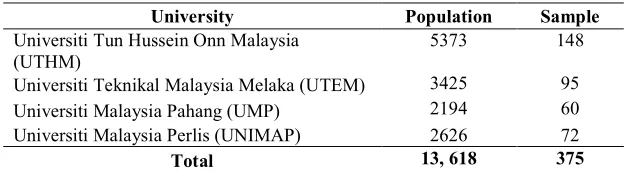
A total of 375 technical students were selected as samples. The minimum number of samples selected was based on the Krejcie & Morgan (1970) table. The sampling procedure used for this study was stratified random sampling. The stratification was based on university. The samples were randomly selected in a specified layer to reduce sampling error such as the size of a large variance of sample estimates (Idris, 2010). Table 1 shows the population and sample of technical students by university.
Table 1: The population and sample of technical students in four universities
University Population Sample
Universiti Tun Hussein Onn Malaysia (UTHM)
5373 148
Universiti Teknikal Malaysia Melaka (UTEM) 3425 95 Universiti Malaysia Pahang (UMP) 2194 60 Universiti Malaysia Perlis (UNIMAP) 2626 72
Total 13, 618 375
Source of student population data: Student Academic Management Division, MTUN
3.2 Research Instrument
The choice of instruments is important to ensure data collected will answer the research questions. A set of questionnaires was developed and used as research instrument. Questionnaires allow respondents more time to think and make responses. They will be able to decide on the response or provide a more accurate data because they do not need to hurry with their responses (Chua, 2006). In addition, more data can be obtained from the respondents in a short period of time (Wiersma, 2005). Furthermore responses are found to be more consistent when compared with data collected through observation.
The questionnaire is divided into two parts. Part A comprises six items related to demographic factors including age, gender, year of study, academic result, intake qualification and parents’ monthly salary. Meanwhile, Part B comprises 19 multiple choice items which consists of two choice answers, 'Yes' and 'No' and four rank-ordering items.
items were obtained through Kuder-Richardson 20 (KR-20), which is .91. However, rank-ordering items are of ordinal scale. The reliability of rank-rank-ordering items was tested using the test re-test method and the value of the reliability was obtained through Spearman Rho correlation test. The correlation tests showed that there was a significant positive relationship between the questionnaire scores for the first time and the questionnaire scores for the second time. This means that all items are suitable and reliable for obtaining stable scores.
4 DATA ANALYSIS AND RESULTS
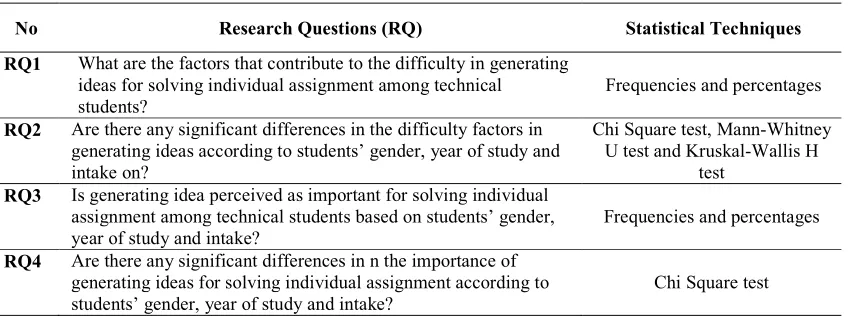
The collected data were analyzed using the statistical techniques appropriate for the research questions (Table 2). Descriptive statistics such as frequencies and percentages have been used to explain the distribution of data and also for answering the research question 1 and 3. Inferential test analysis is used to answer the research question 2 and 4. The findings are presented in the table format with calculation of mean score.
Table 2: Summary of Research Questions and Statistical Techniques Used in the Study
No Research Questions (RQ) Statistical Techniques
RQ1 What are the factors that contribute to the difficulty in generating ideas for solving individual assignment among technical students?
Frequencies and percentages
RQ2 Are there any significant differences in the difficulty factors in generating ideas according to students’ gender, year of study and intake on?
Chi Square test, Mann-Whitney U test and Kruskal-Wallis H
test RQ3 Is generating idea perceived as important for solving individual
assignment among technical students based on students’ gender, year of study and intake?
Frequencies and percentages
RQ4 Are there any significant differences in n the importance of generating ideas for solving individual assignment according to students’ gender, year of study and intake?
Chi Square test
4.1 Difficulties in Completing Individual Assignment among Technical Students
Table 3. Percentage of students facing difficulties in completing individual assignment according to gender, year of study and education background
Characteristics
Responses
Total
Yes No
f % f % f %
Gender
Male (M) 160 42.7 28 7.5 188 50.1
Female (F) 159 42.4 28 7.5 187 49.9
Total 319 85.1 56 14.9 375 100
Year of Study
Year 1 (Y1) 81 21.6 13 3.5 94 25.1
Year 2 (Y2) 80 21.3 14 3.7 94 25.1
Year 3 (Y3) 84 22.4 10 2.7 94 25.1
Year 4 (Y4) 74 19.7 19 5.1 93 24.8
Total 319 85.1 56 14.9 375 100
Back-ground
Matriculation (M) 117 31.2 17 4.5 134 35.7
STPM (S) 69 18.4 12 3.2 81 21.6
Diploma of Community College (DCC) 6 1.6 1 0.3 7 1.9 Diploma of Polytechnic (DP) 95 25.3 22 5.9 117 31.2 Diploma of University (DU) 32 8.5 4 1.1 36 9.6
Total 319 85.1 56 14.9 375 100
Table 4 shows that a large number of technical students agreed the biggest problem faced while solving individual assignments is difficulty of generating ideas. This was followed by problems in the vagueness of assignment questions; understanding the requirements of the assignment and competition among peers.
Table 4: Types of difficulties faced by technical students in completing individual assignment
Problems f %
Difficulty in generating ideas (P1) 193 51.5 Vagueness of assignment questions (P3) 85 22.7 Understanding the requirements of the assignment (P4) 75 20.0
Competition among peers (P2) 22 5.9
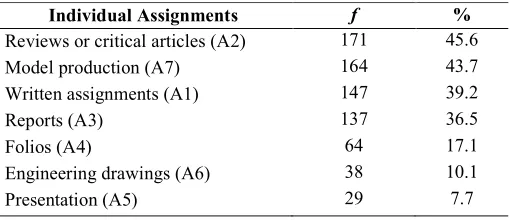
Table 5 indicates a total of 171 (45.6%) technical students felt the most difficult individual assignment for them is critical review or summary of articles. This was followed by model production, written assignments, reports, folios, engineering drawings and presentation.
Table 5: Descending order of individual assignments that students have problems in generating ideas
Individual Assignments f %
Reviews or critical articles (A2) 171 45.6
Model production (A7) 164 43.7
Written assignments (A1) 147 39.2
Reports (A3) 137 36.5
Folios (A4) 64 17.1
Engineering drawings (A6) 38 10.1
Deadlock of ideas is the major factor contributing to the difficulty in generating ideas among technical students as illustrated in Table 6. This was followed by the lack of information, specialized skills, and exercises to generate ideas, time and emotional disorders such as depression.
Table 6: Factors contributing to difficulties in generating ideas
Factors of Difficulty in Generating Ideas f %
Deadlock of ideas (F3) 121 50.0
Lack of information (F2) 99 40.9
Lack of specialized skills (F5) 96 39.7 Lack of exercises to generate ideas (F6) 81 33.5
Lack of time (F1) 45 18.6
Emotional disorders such as depression (F4) 41 16.9
4.2 Difference in Students’ Gender, Year of Study and Intake on the Factors of Difficulty in Generating Ideas
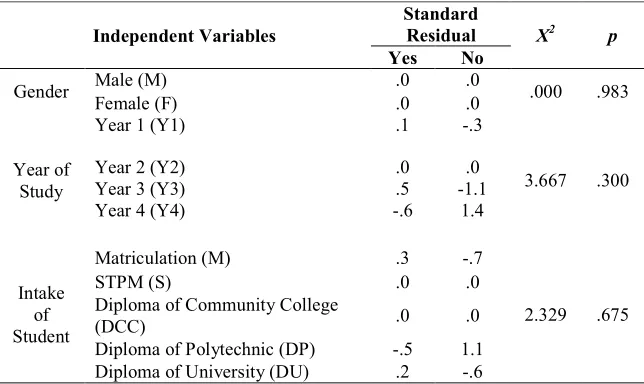
Results of Chi Square test in Table 7 shows that there was no significant difference in students’ gender, year of study and intake on the existence of problems when technical students complete individual assignment. It can be concluded that a majority of technical students regardless of gender, year of study or intake face difficulties while solving individual assignments.
Table 7: The difference in students’ gender, year of study and intake on the existence of problems
Independent Variables
Standard
Residual X2 p
Yes No
Gender Male (M) .0 .0 .000 .983
Female (F) .0 .0
Year of Study
Year 1 (Y1) .1 -.3
3.667 .300
Year 2 (Y2) .0 .0
Year 3 (Y3) .5 -1.1
Year 4 (Y4) -.6 1.4
Intake of Student
Matriculation (M) .3 -.7
2.329 .675
STPM (S) .0 .0
Diploma of Community College
(DCC) .0 .0
Diploma of Polytechnic (DP) -.5 1.1 Diploma of University (DU) .2 -.6
*Difference is significant at the .05 level.
significant difference between male and female students only report (A3) (U = 15190.0, p
<.05). The findings depict male students (mean rank = 200.7) have more problems in generating ideas while writing a report compare to female students (mean rank = 175.2).
Table 8: The difference between gender on the faced problems (P), individual assignments (A) and the factors of difficulty in generating ideas (F)
Items Mean Rank U p
M F
Problems (P)
P1 181.9 194.1 16433.0 .235
P2 183.3 192.8 16688.5 .341
P3 197.3 178.7 15830.0 .080
M4 190.5 185.5 17105.0 .640
Individual Assignments (A)
A1 197.4 178.5 15806.0 .087
A2 180.3 195.8 16122.0 .158
A3 200.7 175.2 15190.0 *.021
A4 190.4 185.6 17121.0 .658
A5 185.0 191.1 17005.0 .571
A6 189.6 186.4 17277.0 .769
A7 180.9 195.2 16233.0 .193
Factors of Difficulty in Generating Ideas
(F)
F1 183.8 192.2 16787.0 .442
F2 192.8 183.2 16677.0 .381
F3 187.1 189.0 17398.5 .859
F4 183.5 192.6 16725.5 .402
F5 192.0 184.0 16834.5 .471
F6 190.5 185.5 17108.5 .649
*Difference is significant at the .05 level.
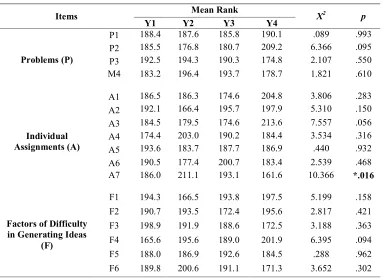
Table 9: The difference among year of study on the faced problems (P), individual assignments (A) and the factors of difficulty in generating ideas (F)
Items Mean Rank X2 p
Y1 Y2 Y3 Y4
Problems (P)
P1 188.4 187.6 185.8 190.1 .089 .993 P2 185.5 176.8 180.7 209.2 6.366 .095 P3 192.5 194.3 190.3 174.8 2.107 .550 M4 183.2 196.4 193.7 178.7 1.821 .610
Individual Assignments (A)
A1 186.5 186.3 174.6 204.8 3.806 .283 A2 192.1 166.4 195.7 197.9 5.310 .150 A3 184.5 179.5 174.6 213.6 7.557 .056 A4 174.4 203.0 190.2 184.4 3.534 .316 A5 193.6 183.7 187.7 186.9 .440 .932 A6 190.5 177.4 200.7 183.4 2.539 .468 A7 186.0 211.1 193.1 161.6 10.366 *.016
Factors of Difficulty in Generating Ideas
(F)
F1 194.3 166.5 193.8 197.5 5.199 .158 F2 190.7 193.5 172.4 195.6 2.817 .421
F3 198.9 191.9 188.6 172.5 3.188 .363 F4 165.6 195.6 189.0 201.9 6.395 .094 F5 188.0 186.9 192.6 184.5 .288 .962
F6 189.8 200.6 191.1 171.3 3.652 .302
*Difference is significant at the .05 level.
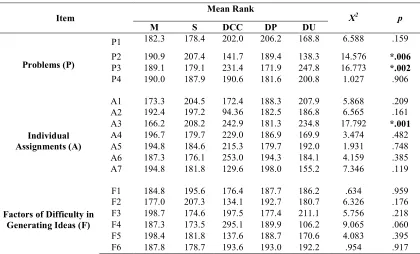
Results of Kruskal-Wallis H test in Table 9 indicate there was no significant difference among students’ intake on problems faced, individual assignments and the factors of difficulty in generating ideas. However, the problems faced in terms of competition among peers (A2) (X2 = 14,576, p <.05) and vagueness of assignment questions (A3) (X2=16.773, p<.05) had a significant difference among students’ intake. The findings also depict STPM intake students (mean rank = 207.4) have the most problem in the competition among peers while university diploma students have the most problem in the vagueness of assignment questions (mean rank = 247.8).
Table 10: The difference among intake of student on the faced problems (P), individual assignments (A) and the factors of difficulty in generating ideas (F)
Item
Mean Rank
X2 p
M S DCC DP DU
Problems (P)
P1 182.3 178.4 202.0 206.2 168.8 6.588 .159
P2 190.9 207.4 141.7 189.4 138.3 14.576 *.006 P3 189.1 179.1 231.4 171.9 247.8 16.773 *.002 P4 190.0 187.9 190.6 181.6 200.8 1.027 .906
Individual Assignments (A)
A1 173.3 204.5 172.4 188.3 207.9 5.868 .209 A2 192.4 197.2 94.36 182.5 186.8 6.565 .161 A3 166.2 208.2 242.9 181.3 234.8 17.792 *.001 A4 196.7 179.7 229.0 186.9 169.9 3.474 .482 A5 194.8 184.6 215.3 179.7 192.0 1.931 .748 A6 187.3 176.1 253.0 194.3 184.1 4.159 .385 A7 194.8 181.8 129.6 198.0 155.2 7.346 .119
Factors of Difficulty in Generating Ideas (F)
F1 184.8 195.6 176.4 187.7 186.2 .634 .959 F2 177.0 207.3 134.1 192.7 180.7 6.326 .176 F3 198.7 174.6 197.5 177.4 211.1 5.756 .218 F4 187.3 173.5 295.1 189.9 106.2 9.065 .060 F5 198.4 181.8 137.6 188.7 170.6 4.083 .395 F6 187.8 178.7 193.6 193.0 192.2 .954 .917 *Difference is significant at the .05 level.
4.3 The Importance of Generating Ideas for Solving Individual Assignment according to Gender, Year of Study and Education Background
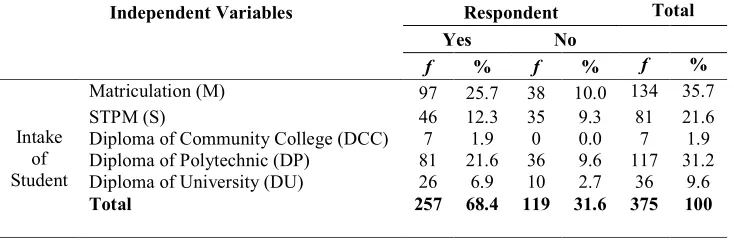
Table 11 shows that a total of 257 (68.4%) technical students regardless of gender, year of study and intake agreed that idea generation are important for the completion of individual assignment. This is because the difficulty of generating idea will lead to technical students having problems in completing their assignments. They believed the difficulty of generating idea is a key factor affecting the achievement of their assignments.
Table 11: Distribution of the importance attached to ideas generation among technical students
Independent Variables
Respondent
Total
Yes No
f % f % f %
Gender
Male (M) 126 33.5 63 16.7 188 50.1
Female (F) 131 34.9 56 14.9 187 49.9
Total 257 68.4 119 31.6 375 100
Year of Study
Year 1 (Y1) 76 20.3 18 4.8 94 25.1
Year 2 (Y2) 68 18.0 27 7.1 94 25.1
Year 3 (Y3) 57 15.2 37 9.9 94 25.1
Year 4 (Y4) 56 14.9 37 9.9 93 24.8
Independent Variables Respondent Total
Yes No
f % f % f %
Intake of Student
Matriculation (M) 97 25.7 38 10.0 134 35.7
STPM (S) 46 12.3 35 9.3 81 21.6
Diploma of Community College (DCC) 7 1.9 0 0.0 7 1.9 Diploma of Polytechnic (DP) 81 21.6 36 9.6 117 31.2 Diploma of University (DU) 26 6.9 10 2.7 36 9.6
Total 257 68.4 119 31.6 375 100
4.4 Importance attached to Ideas Generation according to Gender, Year of Study and education background
Using Chi Square test, it was found that there was no significant difference in students’ gender and intake on the importance of generating ideas for solving individual assignment among technical students (Table 12). The findings statistically proved that majority of technical students regardless of gender or intake agreed that generating ideas is essential to resolve their individual assignments.
However, there was a significant difference among years of study on the importance of generating ideas (X2=8.071, p<.05). It means that students in Year 1, Year 2, Year 3 and Year 4 have different opinions on the importance of generating ideas for completing individual assignments.
Table 12: Importance attached to ideas generation according to gender, year of study and education abckground
Independent Variables
Standard
Residual X2 p
Yes No
Gender Male (M) -.5 .6 1.024 .312
Female (F) .5 -.6
Year of Study
Year 1 (Y1) 1.4 -1.7
8.071 *.045
Year 2 (Y2) .1 -.1
Year 3 (Y3) -1.0 1.2
Year 4 (Y4) -.5 .6
Intake of Student
Matriculation (M) .6 -.8
9.012 .061
STPM (S) -1.1 1.3
Diploma of Community College
(DCC) 1.4 -1.7
Diploma of Polytechnic (DP) -.3 .3 Diploma of University (DU) .3 -.4
5 DUSCUSSION
Ideas generation has become a necessity for every student to solve all assignments. However, deadlock of ideas will cause the difficulty in generating ideas. Deadlock of idea is a reflection of the weakness of one’s thinking skills (Abd. Rashid, 1999). In fact, weakness in higher order thinking skills (HOTS) is the main factor causing deadlock of ideas. Thus, students who are weak in thinking skills cannot perform cognitive and metacognitive based tasks effectively (Pillips, 1997).
According to Abdul Hamid (2001), one must go through a process of experience, observation, informal learning and discussion with others for generating an idea. The process of ideas generation occurs through restructuring and relating knowledge and experience in new ways. Information form the basis for generating ideas and without information, idea generation will not begin. Therefore, information must be collected, restructured and assessed in the right brain to generate new ideas. This is a clear indication that ideas will be generated through a process of thinking. However, thinking is not an easy task because it requires an effective method and skills particularly to generate ideas. But with experience, knowledge and thinking skills, an idea can be generated more easily.
Furthermore, HOTS are needed when we seek to understand a piece of information that will be used for generating ideas. This is because HOTS challenges us to interpret, analyze or manipulate information (Mohamed, 2006, Ea, Chang & Tan, 2005, Newmann, 1990). HOTS ask an individual to make use of new information or existing knowledge and manipulate the information to obtain a satisfactory answer to the new situation (Rajendran, 2008 and Lewis & Smith, 1993). Therefore, a creative idea can be triggered by HOTS.
6 CONCLUSION AND RECOMMENDATIONS
In conclusion, this study illustrated that the majority of technical students regardless of gender, year of study or intake faced problems when solving individual assignments. The biggest problem that students faced while solving individual assignments is the difficulty of generating ideas. The most difficult individual assignment for technical students is critical review or summary of articles. Deadlock of ideas is the factor contributing most to the difficulty in generating ideas among technical students. However, idea generation is important for the completion of individual assignment. Therefore, overcoming the difficulty in generating ideas is crucial. As a solution, students need to learn HOTS to address the difficulty in generating ideas. HOTS become essential as it can assist them to complete their assignments and learn the subject. Consequently, students should be assisted to acquire HOTS; either through the conventional teaching and learning environment or a self- instructional, individualized manual.
7 ACKNOWLEDGMENT
authors also wish to thank the four faculties of the UTHM who have given their full cooperation to ensure the success of this study.
8 REFERENCES
Abd Hamid, M. A. (2001). Pengenalan Pemikiran Kritis &Kreatif. Skudai, Johor: UTM. Cetakan pertama.
Abd. Rashid, A. R. (1999). Kemahiran Berfikir Merentasi Kurikulum. Shah Alam: Penerbit Fajar Bakti Sdn. Bhd.
Ario, B. (2006). Managing Creativity in the Workplace: Using Creativity of Your Workers. Associated Content.
Beyer, B.K. (1992). Practical Strategies for the Teaching of Thinking. London: Allyn and Bacon, Inc.
Chua, Y. P. (2006). Kaedah dan Statistik Penyelidikan Buku 1. Kuala Lumpur: McGraw-Hill (Malaysia) Sdn. Bhd.
Ea, J.; Chang, A.. & Tan, O. S. (2005). Thinking about Thinking: What Educators Need to Know. Singapore: National Institute of Education, Nanyang Technological University, McGrawltill Education. pg 72.
Graham, D & Bachmann, T. (2004). Ideation: The Birth and Death of Ideas. John Wiley and Sons Inc.
Jailani, Md. Y., Yee, M. H., Arihasnida, A., Widad, O., Razali, H. & Tee, T. K. (2010). Penjanaan Idea Berdasarkan Kemahiran Berfikir Aras Tinggi Bagi Mata Pelajaran Pendidikan Kejuruteraan. Persidangan Kebangsaan Pendidikan Kejuruteraan Dan Keusahawanan 2010 (NCEE 2010). Universiti Malaysia Terengganu & Universiti Tun Hussein Onn Malaysia. Trade Centre, Kota Bahru, Kelantan. Sept 25-26.
Jonson, B (2005). Design Ideation: the conceptual sketch in the digital age. Design Studies, 26 (6), 613–624. Kaprawi, N., Razzaly, W., Saim, H., Spahat, G., Ikhasan, M. N., Hamid, H., Abbas@Ahmad, L. N. (2007).
Panduan Penjaminan Kualiti Dalam Latihan Dan Pendidikan Teknikal Berterusan. Universiti Tun Hussein Onn Malaysia: Pusat Pendidikan Berterusan.
Krejecie, R. V. & Morgan, D. W. (1970). Determining Sample Sixe for research Activities. Educational and Psychological Measurement, 30(3), 680. Sage Publications, Inc.
Kuh, G. D. (2001). Assessing What Really Matters To Student Learning: Inside The National Survey of Student Engagement. Change: The Magazine of Higher Learning, 33(3), 131-137.
Lewis, A. & Smith, D. (1993). Defining Higher Order Thinking. Theory Into Practice, 32, 131-137.
Mohamad, B., Esa, A. & Junoh, H. (2008). Psikologi Pendidikan Dalam PTV. Johor: Penerbit UTHM.
Mohamed, S. Z. (2006). Kesan Pendekatan Penyebatian Kemahiran Berfikir Kreatif Dalam Pengajaran Karangan Deskriptif Dan Karangan Imaginatif Dalam Kalangan Pelajar Tingkatan IV. Universiti Sains Malaysia: Disertasi PhD.
Newmann, F. M. (1990). Higher Order Thinking In Teaching Social Studies: A Rationale for The Assessment of Classroom Thoughtfulness. Journal of Curriculum Studie, 22, 41-56.
Rajendran, N. S. (2008). Teaching & Acquiring Higher-Order Thinking Skills: Theory & Practice. Tanjong Malim: Penerbit Universiti Pendidikan Sultan Idris.
Sharp, A. (2008). Teaching Fluency in Gifted Classrooms: Generating Ideas is an Important Part of Creative Problem Solving.
Strom, R. D., & Storm, P. S. (2002). Changing the Rules: Education For Creative Thinking. Journal of Creative Behavior, 36 (3), 183-199.
Unit Perancang Ekonomi JPM. (2006). Rancangan Malaysia Kesembilan. Dicapai pada 15 April, 2009, dari http://www.utusan.com.my/utusan/SpecialCoverage/RMK9/html/bahasa.htm.
Wheelihan, K. J. (2011). Creativity for Success. The Creativity Institute. http://EzineArticles.com/
Whittington, M. S. (2003). Improving The Cognitive Capacity Of Students By fully Engaging Professors In The Teaching And Learning Process. Unpublished Manuscript. The Ohio State University.
Wiersma, W. (2005). Research Methods In Education: An Introduction. 7th ed. Boston: Allyn & Bacon. ms. 86-96.