Published online October 07, 2014 (http://www.sciencepublishinggroup.com/j/ijass) doi: 10.11648/j.ijass.s.2014020601.12
Gravitational “constant” G as a function of quantum
vacuum energy density and its dependence on the distance
from mass
Luigi Maxmilian Caligiuri
1, 21
Foundation of Physics Research Center, FoPRC, via Resistenza 87053 Celico (CS), Italy
2
University of Calabria, via P. Bucci 87036 Arcavacata di Rende (CS), Italy
Email address:
To cite this article:
Luigi Maxmilian Caligiuri. Gravitational “Constant” G as a Function of Quantum Vacuum Energy Density and its Dependence on the Distance from Mass. International Journal of Astrophysics and Space Science. Special Issue: Quantum Vacuum, Fundamental Arena of the Universe: Models, Applications and Perspectives. Vol. 2, No. 6-1, 2014, pp. 10-17. doi: 10.11648/j.ijass.s.2014020601.12
Abstract:
In a previous paper the author has shown the gravitational constant ruling Newton’s law can be expressed as a function of quantum variables related to Zero Point Field as Planck’s time and quantum vacuum energy density. On the other hand the quantum vacuum energy density has been proved to be modified by the presence of a mass within the volume occupied by the mass itself and in the space surrounding it. Furthermore, according to the Einstein’s Theory of General Relativity the same mass determines a gravitational potential that alters the speed of light, the clock’s rate and the particle size as a function of the distance the distance from the center of mass. All these considerations strongly suggest that also the constant G could be expressed as a function of quantum vacuum energy density somehow depending on the distance from the mass whose presence modifies the Zero Point Field energy structure. In this paper, starting from the idea of inertial mass of a body as the seat of standing waves of Zero Point Field and from the picture of a fluid-like model of space, it has been established a model in which the gravitational constant G is expressed as a function of Quantum Vacuum energy density in turn depending on the radial distance from center of the mass originating the gravitational field, supposed as spherically symmetric. The proposed model suggests the gravitational “constant” G could be not truly unchanging but varying as a function of the distance from the mass originating gravitational potential itself, whose approximate analytic expression has been also found and discussed. Finally a possible experimental test of the model, making use of precise measurements on a satellite has been outlined. The proposed theoretical model could be able to give valuable insights into a deeper understanding of the true origin and dynamics of gravity as well as the theoretical basis for unthinkable applications related, for example, to the field of gravity control and space propulsion.Keywords:
Quantum Vacuum Energy Density, Planck Scale, General Theory of Relativity, Gravitational Constant G, Relativistic Gravitational Potential, Standing Waves, Fluid-like Model of Space, ZPF Inertia Hypothesis1. Introduction
The understanding of the true origin of fundamental physical constants is a crucial task in order to formulate a correct theory of all the natural phenomena. Among these constants a special role is played by the gravitational constant
G that gives the “strength” of gravity through the well –
known Newton’s law of gravitation
1 2
2
g r
m m
F G u
r
⋅
= (1)
where m and 1 m are the interacting masses and r is 2
their relative distance vector.
So far, within the commonly accepted picture G , like
light velocity c , has been considered as one of the most fundamental constants of the Universe, whose current value is estimated to be [1]
(
)
11 3 1 16.67384 0.00080 10
G= ± ⋅ − m ⋅kg− ⋅s− (2)
regardless of the magnitude of the mass generating gravitational field it rules and of the distance from it. Nevertheless, recent theoretical studies [2,3] suggested that
“Quantum Vacuum Zero Point Field Mass – Density Equivalent” ρQV giving a measure of the energy density of the QED quantum vacuum (also known as ZPF) and the Planck time t giving the smallest time interval required P
for the stability of space-time structure within the General Theory of Relativity (GTR). On the other hand in 1967 the Russian physicist A. D. Sakharov already suggested [4] that gravity could be the effect of a change in the quantum-fluctuation energy of ZPF quantum vacuum induced by the presence of matter.
Later, starting from Sakharov’s results, Puthoff [5] proposed the hypothesis that ordinary matter could be ultimately composed of sub-elementary constitutive charged entities he called “partons”, able to dynamically interact with the fluctuating QED quantum vacuum according to a sort of resonance mechanism. According to Puthoff’s model, the inertia of a body would be the result of the interaction between partons and ZPF quantum fluctuations whose effect would result in the modification of the electromagnetic modes of ZPF at the interface between a body and its surrounding space determining the so – called Zero-Point-Field Lorentz force [6]. In this way both the inertial and gravitational masses of a body could be substantially composed of confined e. m. modes of ZPF whose presence modifies the previous state of QED quantum vacuum.
On the other hand, it is a known fact, theoretically explained within the GTR and supported by strong experimental evidences, that the gravitational potential generated by mass, depending on the distance from it, affects the running rate of clocks as well as the velocity of light. These effects can be accounted to by introducing a suitable scale factor (gauge) affecting the length and frequency measured within the gravitational fields that, as we’ll see in the following, can also modify the quantum vacuum energy density, so suggesting further evidence of a deep relationship between the gravitational force strength G and ZPF energy
density.
Moreover, in some recent works [7,8,9] the author, basing on similar assumptions, proposed a model of Quantum Vacuum (QV), characterized by a Planckian metric, described in terms of the dynamics of energy density in which inertial and gravitational mass are interpreted as local stable variations of QV energy density with respect its “unperturbed” value. Within this model gravity is interpreted as originated by the local gradients of QV energy density
( )
r t,ρ
∆ , due to presence of mass, giving an unbalanced ZPF pressure that manifest itself as gravitational force.
In another previous work [2] the above model has been already extended by showing that, under heuristic but well - founded reasoning, the gravitational constant G could be expressed as a simple function of quantum variables represented by Planck time tP and QV energy density itself.
In this paper, starting from the idea of inertial mass of a body as the seat of standing waves of Zero Point Field and from the picture of a fluid-like model of space, it has been established a model in which the gravitational constant G is
expressed as a function of Quantum Vacuum energy density in turn depending on the radial distance from center of the mass originating the gravitational field, supposed as spherically symmetric.
The proposed model then suggests the gravitational “constant” G could be not truly unchanging but varying as a function of the distance from the mass originating gravitational potential itself and whose approximate analytic expression has been also found and discussed.
Finally a possible experimental test of the model, making use of precise measurements on a satellite has been outlined. The proposed theoretical model could be able to give valuable insights into a deeper understanding of the true origin and dynamics of gravity as well as the theoretical basis for unthinkable applications related, for example, to the field of gravity control and space propulsion
2. Gravitational Potentials and the
Gauge of Physical Quantities
As known by GTR, the motion of a free falling particle inside the gravitational field generated by a mass Mcan be studied in the
( )
r t, reference system of the Schwarzschild metric (SM) whose differential element is given by(
)
(
)
(
)
1
2 2 2 2 2 2 2
2 2 2
1 2 sin
1 2
ds GM c r dr r d d
GM c r c dt
θ θ ϕ
−
= − + + +
− − (3)
where
(
r, ,θ ϕ)
are the standard polar coordinates with rbeing the radial distance from the massM.
Now at t=const the size of a physical object at 0
dθ=dϕ= is defined, through (3), by the equation
(
)
2 1 2 2 2
ds = − − GM c r dr (4)
that can be rewritten, recalling the pseudo – Euclidean metric induced by Special Theory of Relativity, i.e.
(
)
2 2 2 2 2 2 2 2 2
ds =c dt − dx +dy +dz =c dt −dl (5)
in the form
(
)
2 2 1 2 2 2
dl = −ds = − GM c r dr (6)
or, equivalently
2 2 2
f
dl =s dr (7)
having posed
2 2
1 2
f
s ≡ − GM c r (8)
In a similar fashion, the measured time of an event at 0
dr=dθ=dϕ= , is given by
(
)
2 2 2 2
1 2
that correctly reduces, when r→ ∞, to the usual time measured by an inertial observer at rest with respect to M. By using (9) we can write, even in this case
2 2 2
s
dτ = f dt (10)
Equation 10 allows us to calculate the frequency shift of a “falling” photon due to the presence of such gravitational field as
0
' sf
ν = ν (11)
where ν'is the shifted frequency, ν0 the frequency “outside” (or, more popularly, the “proper” frequency) the gravitational field and s is just the “gauge” factor defined f
by (8), namely
2
1 2
f
s = − GM rc (12)
determining a clock runs slower in a gravitational fields as experimentally confirmed.
A similar effect influences the measure of the length in a gravitational potential, whose value is given by an analogous expression
0
' sf
l = l (13)
where l represents the measured length inside gravitational ' field, l the proper length (outside the gravitational field) 0
and s is the same gauge factor given by (8). f
The consideration of (10) and (11) allow us to write a similar expression for the velocity of light “falling” in a gravitational potential, simply noting that
( )( )
2 20 0 0 0 0
' ' ' f f f f
c = ⋅ =l ν s l sν =s lν =s c (14)
so we can write
2 0
' f
c =s c (15)
showing that the gauge factor affecting light velocity is the square of that applied to the other quantities. This effect was experimentally found in 1966 by Shapiro [10] that showed the gravitational potential of Sun influenced radar signals reflected back to Mercury and Venus, causing them to be delayed, the amount of this delay being greater when these two planets are directly opposed to the Earth within their orbits.
Furthermore the measured delay is in agreement with that calculated by (14) and with the results obtained, more recently, by means of GPS system [11].
Nevertheless, as already shown [12], the Einstein’s gravitational gauge factor given by (8) poses some problems and a modified version of it has been proposed [12], i.e.
2 GM rc f
s =e− (16)
which coincides with that in Eq. 12 at first order. This
assumption is also coherent with the picture of ZPF as a polarizable medium proposed by Puthoff [13] and with the model here proposed, then it will be adopted in all the following discussion.
3. The Gravitational “constant” G as a
Function of Quantum Vacuum
Variables and its Dependence on
Distance from Mass
As already well-known, the physical vacuum cannot be considered, due to Heisenberg uncertainty principle, as a void deprived by any physical dynamics but as physical entity manifesting a complex and fundamental background activity in which, even in absence of matter, processes like virtual particle pair creation – annihilation and e.m. fields fluctuations, known as zero point fluctuations (ZPF) continuously occur.
The maximum amount of “virtual” energy density
,
QV MAX
ρ stored in the “unperturbed” ZPF fluctuations of QV can be estimated by considering the Planck’s constants. Planck in fact showed, basing on dimensional arguments, that the values of gravitational constant G, velocity of light c and Planck’s constant ℏ, it was possible to derive some natural units for length, time and mass, i.e. the respectively so-called Planck’s length (lP), time (tP) and mass (mP). Then he (and we with him) reversed the point of view by considering these quantities as the most elementary ones, from which the “fundamental” constants (as G, c and so on) can be derived.
In order to assume GTR to remain valid up the Planck scale, we must have
2 3
,max
QV m cP lP
ρ = (17)
where mP is the Planck mass and lP the Planck length, whose currently accepted values respectively are
8
2.177 10 kg× − and 35
1.616 10× − m when
11 3 1 2
6.67384 10
G= × − m ⋅kg− ⋅s−
The value of 113 3
10
QV J m
ρ ≈ ⋅ − so obtained by (17), can
be considered as the maximum possible value ρQV,max of QV energy density, since it would represent, within the currently accepted picture, the maximum energy density can exist “without being unstable to collapsing space-time fluctuations” [14] associated to the value
11 3 1 2
6.67384 10
G= × − m ⋅kg− ⋅s− currently assumed.
As already shown [2,3] the relationship between the gravitational “constant” G and QV energy density ρQV can be expressed in a “natural” way by noting that, dimensionally
[ ] [ ] [ ] [ ]
3 1 2G = L ⋅ M − ⋅T − (18)
[ ] [ ]
3QV M L
ρ −
= ⋅
(19) where we indicate for simplicity with ρQV, from now on, the
so-called Mass – Density – Equivalent (MDE) of QV energy density (equal to ρQV c2 where ρQV is the originally
defined QV energy density function) referring to it simply as QV energy density, so we can write
(
2)
1 QV P
G= ρ ⋅t (20)
where tP is the Planck’s time whose value is
44 5.391 10
P
t = × − s when G=6.67384 10× −11m3⋅kg−1⋅s−2. We can then assume that also G is a function of QV energy density and that it defines a fundamental properties of space itself originated from QV
(
)
3 2 2
P P P
G=l m c t (21)
Equation (20) can be naturally generalized to the case of a variable QV energy density by formally assuming
( )
(
2)
1
QV QV P
G ρ = ρ t (22)
Equation (22) also means that far from any mass , where the quantum vacuum energy density reaches its “unperturbed” value given by (17), the gravitational constant
G , given by (22), takes the value given by (21) while, in the
proximity of a mass its value varies according to (22). We’ll see in the following its value in a given point of space will depend upon the radial distance of the considered point from the centre of mass of the body (or the system of bodies) generating the gravitational field.
3.1. The Model of Inertia as Superposition of Modes of Electromagnetic. Standing Waves
Following the suggestion of the model of Hairsh, Rueda and Puthoff (HRP) [5,6,14] a material body can be represented, with respect to the electromagnetic interaction, as a resonant cavity in which a suitable set of oscillating modes of ZPF or Quantum Vacuum oscillate. According to this hypothesis, the inertial and gravitational masses m and i
g
m associated to a given material body are given by
(
2)
( ) ( )
0 0
i g
m m V c η ω ρ ω ωd
∞
= =
∫
(23)in which ω is the angular frequency of ZPF mode, ρ ω
( )
is the spectral energy density of quantum vacuum ZPF fluctuations and η ω
( )
is a function that would quantify thefraction of ZPF energy density that electromagnetically interacts with the particles contained in the “useful volume”
0
V or, in other words the “efficiency” of interaction [11]. In
this way the apparent inertial mass of a given object would originate by the interaction, during the accelerated motion of
the body, between the ZPF energy density fraction enclosed in the object (given by η ω
( )
) and the partons contained in the volume V . 0It is now important to stress the physical meaning of such volume that must intended as electromagnetic resonant cavity with conducting wall, being the volume V the space 0
enclosed within the cavity walls. In this way the electromagnetic modes of ZPF are trapped inside the cavity and the resulting energy is accumulated inside it.
This energy cannot be however accumulated without limit, since the possible electromagnetic modes inside a resonant cavity are upper bounded by a limiting frequency ωup whose value is substantially determined by the plasma frequency ωPl of the electrons in the cavity walls.
The connection between the modes inside cavity with those outside it is allowed by the conductive structure of cavity walls.
Now if we consider an ideal resonant cavity (i.e. neglecting energy dissipation of modes) at the absolute temperature T =0, outside the cavity there are only the ZPF quantum fluctuations while inside it there is a discrete number of modes possible oscillating at their exact characteristic frequencies ranging from 0 up to ωPl.
So, said N the maximum number of this modes, we have
1
2
N tot k
k
E ω
=
=
∑
ℏ (24)where ω ω1≤ 2≤ ≤... ωN ≤ωPl . Now, under the above assumptions, the energy given by (24) must be equal to the quantity given by (23) multiplied by c2, namely
( ) ( )
2 0
1 0
2
N
tot k
k
E mc V η ω ρ ω ωd ω
∞
=
= =
∫
=∑
ℏ (25)On the other hand we know that the density of ZPF electromagnetic oscillation modes in the frequency interval between ω and ω+dω is given by
( )
(
2 2 3)
N ω ωd = ω ω πd c dω (26)
and, assuming an average energy per mode given by ℏω 2, we obtain the spectral energy density of ZPF fluctuation as
( )
d(
3 2 2 3c)
dρ ω ω= ℏω π ω (27)
that substituted into (25) gives
( )
(
2 3)
(
)
0 1
N
k k k
c V
η ω π δ ω ω ω
=
=
∑
− (28)Equation (28) states that the spectrum of e.m. field inside the cavity is composed by a sum of N lines placed at
k
ω ω= whose amplitude diminishes with the increase of frequency.
dissipation occurs. Nevertheless it can be shown [14] that, if the dissipation is small a more accurate expression for the line-shaped functions δ ω ω ω
(
− k)
k is given by the so-called Lorentzian –lineshape function, whose expression is( ) (
) (
) (
2)
10
2 2
l ω ω π ω ω ω
−
= ∆ − + ∆ (29)
where the quantity ∆ω is the lineshape broadening parameter and describes the various types of dissipation and broadening effects.
By discretizing (29) and using it in (28) we have
( )
(
)
(
) (
2)
12 3
1 0
2 2
N
k k k
k
c V
η ω π πω ω ω ω ω −
=
=
∑
∆ − + ∆ (30)where, as above, ωk is the proper frequency of the k-th mode and ∆ωk >0 its frequency broadening.
Finally the mass associated to a resonant cavity (not including the overall mass of the walls) is given by (23) using the result (30), namely
(
)
( ) ( )
(
)
( )
(
) (
)
2 5 2 1 2 0 0 0 1 2 2 Nk k k
k
c
m V c d
d π πω ω ω ω ω η ω ρ ω ω ρ ω ω = ∞ ∞ − ∆ − + ∆ = = = × ×
∑
∫
∫
(31)now by using (27) in (31) and recalling the definition of energy given by (25), we can write
(
)
( )
(
) (
)
(
)
(
)
(
) (
)
( )
(
)
(
) (
)
(
)
2 5 2 1 2 5 2 1 2 0 0 13 2 3
0 0 1 1 2 1 0 2 2 2 2 2 2 1 2 2 N
k k k
k
N
k k k
k k k N k k c c m d c d c d π πω ω ω ω ω π πω ω ω ω ω ω ω ω ρ ω ω ω π ω ω π ω ω = = ∞ − ∞ − ∞ − = ∆ − + ∆ ∆ − + ∆ − + ∆ = × × = = × × = = ∆ × ×
∑
∑
∫
∫
∑ ∫
ℏ ℏ (32)or, in a more compact form
( )(
)
1 0 2 N k km A ω ω dω
∞
=
=
∑∫
ℏ (33)where we have posed
( )
2(
)
(
) (
2)
10
2
2 k k
k k
A ω c ω π ω ω ω
∞ −
− − + ∆
=
∫
∆ (34)Equation (33) is very meaningful since it shows the total mass inside the resonant cavity associated to a body can be expressed, even in the presence of dissipation, as the overlapping of the zero point energies of all the electromagnetic modes of Quantum Vacuum each of them broadened by a suitable factor given by (34). Furthermore it is expected that the most part of modes are not overlapping as long as the cavity size remains small, since their frequency separation will become comparable with the broadening ∆ω only at the highest frequencies [14].
Basing on the above result we can then interpret the mass of a body as the place of occurrence of electromagnetic standing – waves of ZPF that determines a storing of e.m. energy density within the body itself.
This dynamics of ZPF together with the consideration of other theoretical elements [3] shows that, inside the portion of space associated to “electromagnetically useful” volume
0
V , the energy density of ZPF reduces giving rise to a
standing wave structure in which this energy is “stored”. Outside this structure, on the contrary, the quantum vacuum energy density is higher and determines the gravitational potential.
This also coherent with the model already developed in previous works [2] in which the inertial mass of a body or particle is interpreted as the result of the reduction of the local QV energy density determining, in its neighborhoods (where the QV energy density is higher), an energy density gradient ∆ρ
( )
r t, which originates the gravitational potential.3.2. The Gauge of ZPF Energy Density inside a
Gravitational Potential Generated by a Mass within a Fluid-Like Model of Space
In the proposed model the energy spectrum related to ZPF modes of standing waves inside the resonant cavity originating the inertia of a body is substantially a discrete one and includes a finite number of modes whose frequencies are in the interval ω ω ω1≤ ≤ N, with ωN ≤ωPl. Nevertheless, when the size of cavity increases so do the number of modes and, due to broadening of frequencies, we obtain a continuous-like frequency spectrum. Physically this must be the case since, when the maximum size of the cavity
max
L → ∞ all the modes are possible and we obtain the limit of continuum.
We can then interpret the standing waves inside the resonant cavity associated to a massive body like those generated within an elastic fluid medium [13]. For such a medium the relation between the (longitudinal) wave propagation velocity v and the medium density ρ can be written as
v=k ρ (35)
where k is a constant factor related to the medium
characteristics.
QV
c=K ρ (36)
where c is the velocity of light, ρQV is the ZPF energy density and K a constant related to the elastic medium. By inserting (36) into (15) and squaring both the members we obtain
(
)
4 0
1 ρQV '=sf 1ρQV (37)
We now must observe that in our case we can interpreted the space surrounding the cavity as the region “inside” the gravitational potential generated by the ZPF energy density so the following correspondence holds: ρQV'→ρQV and
,0 ,ext
QV QV
ρ →ρ where ρQV is the ZPF energy density in the space around the body and ρQV,ext is the ZPF energy density “outside” the gravitational field, i.e. in a point very far from it.
Equation (37) then becomes
4 ,ext
QV QV sf
ρ =ρ (38)
showing that QV energy density in the space surrounding the body is scaled by a factor 4
f
s− with respect its “unperturbed” value.
3.3. The Gravitational Constant G as a Function of Distance from Mass
We are now in position to reformulate this model in order to obtain the dependence of gravitational constant G on the
distance from the mass source of gravitational potential. By using the definition of s given by (16) in (38) we f
obtain
( )
4 2,ext
GM rc QV r e QV
ρ = ρ (39)
where we have explicitly expressed the functional dependence of ρQV on r and have assumed the value of
,ext
Qv
ρ as constant. Multiplying side by side by 2
P
t , taking
the reciprocals and using (22) gives our main result
( )
( ) 24G r M rc
ext
G r =G e− (40)
where we have put 2 0 1 QV ext P,
G ≡ ρ t . A similar expression for ZPF density can be also obtained by using the same (22) in (39), giving
( )
4 ( )2 2,ext
QV P
M r r c t
QV r e QV
ρ
ρ = ρ (41)
Equations (40) and (41) respectively describe the dependence of G and ρQV on the radial distance r from the mass M generating the gravitational potential.
They are transcendent equations and cannot be solve analytically but their qualitative behavior can be discussed in the case of weak and slowly varying gravitational fields. In
this case we can expand the scale factor obtaining, at the first order inG
2
4GM rc 1 4 2 ...
e− = − GM rc + (42)
Using this result in Eq. 40 we find
( )
( )
21 4
ext
G r =G − MG r rc (43)
Equation (43) is a first order approximate equation for
( )
G r that can be immediately solved to give the solution
( )
(
1 4 2)
ext ext
G r =G + G M rc (44)
The asymptotic behavior of this function appears to be coherent with physical assumptions since we have
( )
( )
0
lim
lim 0
ext r
r
G r G
G r
→+∞ →
=
= (45)
in fact the case r→ +∞ correspond to a point far from gravitational source (in which G assumes its “unperturbed”
value Gext), while the case r→0 corresponds to point at the centre of spherical symmetrical object in which, as known, gravitational field is zero.
4. Discussion
According to the model proposed in this paper, gravity is originated by the ZPF energy density gradients generated by the presence of a massive body. Inside a body, ZPF energy density is decreased to give rise to the standing waves structure described by (33), this consequently increases the quantum vacuum energy density outside the resonant cavity represented by the body and this generates the gravitational potential associated to it. The increment of ZPF energy density around the body decreases with the distance from the centre as shown by Eq. 41.
When two massive bodies are close each other the ZPF energy density increase between them is smaller so originating gravitational attraction.
An important remark concerns the physical meaning of the parameter Gext: it represents the value of G at a point “infinitely” far from mass M (in our nomenclature
“external” to gravitational field) in which the ZPF is unperturbed. Its value should be determined by experimental measurements (far from any masses) or extrapolated by means of the know value of gravitational field at a given distance from a mass M .
Contrary to what one could think Gext is not necessarily
equal, within the proposed model, to the quantity 3 2 2
P P P l m c t
(with the Planck’s unites given by the commonly accepted values) since the values of Planck’s units themselves is derived by previously assuming a value for G (measured at
eventually on G , coming from strong and weak interactions,
at this stage not still included in our model of the function describing G r
( )
(and not considered in the Haisch, Rueda and Puthoff model of inertia as well [6]).It is remarkable to note that (44) like the more general (40) doesn’t contain any Planck’s units, allowing the calculation of G without using these values but only that of Gext.
A possible estimation of Gextcould be obtained by using the know value of G at Earth’s surface as given by [1] in the (40) with r=REarth and M=MEarth. Following this procedure we obtain
(
)
(
)
211 3 1 1
exp 4
6.673840019 10
ext Earth
Earth Earth Earth
G G R
G R M R c
m kg s
− − −
= ×
× =
= × ⋅ ⋅
(46)
where we have assumed c=299792458m s⋅ −1 ;
24
5.9736 10
Earth
M = × kg and 6372.7955 103 Earth
R = × m .
The value of Gext represents the value of gravitational constant, associated to the field generated by Earth mass as if it should be far from all the other masses of Universe.
It must be noted the numerical value given by (46) is slightly higher, on the average, of that commonly assumed [1] in agreement with the predictions of our model.
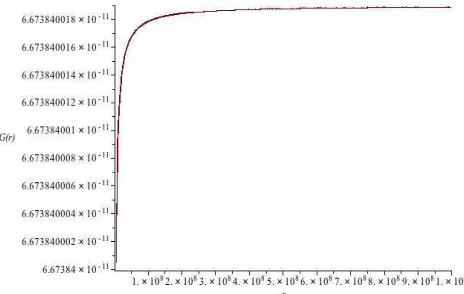
By using this value of Gext we can plot, by way of qualitative example, the function G r given by (44) as a
( )
function of distance r (Fig. 1) from the Earth center.
Figure 1. Plot of Gas a function of distance from Earth center. The plot starts from r=REarth,rand Gare expressed in standard units.
In evaluating this graphic we must remember that (44) just represents an approximation, at first order, of the value of
( )
G r that is valid when ∆ →G 0, so it doesn’t necessarily represent the actual numerical values of function G r in
( )
particular in the slope-region of the curve, since it is just here the contribution of the higher order terms of the series of (42) could be more important; nevertheless it gives correct indications about the asymptotic behavior of the function
( )
G r at r→0 and r→ +∞.
Conceptually, a possible experimental test of (40) could be performed on a satellite by measuring, with very high precision, the value of G at a certain distances from the Earth center rSAT i, and comparing these values among themselves and to that measured at the Earth’s surface at distance REarth. More specifically, if we respectively call these values G r
(
SAT i,)
and G R(
Earth)
, we can write ∀i, by (40)(
)
( ) 2, ,
4 ,
SAT i SAT i
G r M r c SAT i ext
G R =G e− (47)
and
(
)
4 ( ) 2Earth Earth
G R M R c Earth ext
G R =G e− (48)
Dividing side by side (47) by (48) gives the equation
( )
(
)
(
)
( )
(
)
{
}
,
2
, ,
4
SAT i Earth
SAT i SAT i Earth Earth
G G R
Exp M c G r r G R R
r =
= − − (49)
in which only measured quantities and known constants appear so that it can be experimentally verified.
Nevertheless, in a realistic set-up, very high measurement precisions would be required in order to reveal this very small variations between the values of G r
( )
at different distance from Earth.Furthermore, the influence of other celestial bodies (firstly the Sun and the Moon) on the ZPF energy density at the considered points and then, on the overall gravitational potential, should be taken into account. This would introduce additional terms into (40) able to modify the form and behavior of solutions and it also represents an important theoretical question to be addressed in the future developments of the model, already in progress. Among these we are considering its extension to generic shape bodies and the calculation of numerical solution of (40) able to quantify the contribution of the higher order terms to the function
( )
G r .
5. Conclusions
In this paper a novel model of gravity, based on the variability of gravitational constant G , expressed as a function of ZPF energy density, has been proposed. Starting from some previous theoretical results, the inertial and gravitational mass of a body have been interpreted as the seat of standing waves of ZPF, analogous to longitudinal waves generated inside an elastic medium.
These waves are able to alter the local QV energy density determining a decrease of ZPF energy density within the massive bodies and, consequently, a ZPF energy density increment in the surrounding space in this way generating Quantum Vacuum energy density gradients (unbalanced ZPF pressure) and ultimately the gravitational force.
radial distance from its center and that gravitational constant
G also depends on ZPF energy density and on radial
distance from the mass generating the gravitational field. The main result of this work is then a model suggesting that the gravitational “constant” G is actually variable and
its dynamics is ruled by the quantum vacuum energy density, depending on the distance from massive object.
Under some simplifying assumptions, an approximate analytical expression of the function G r
( )
, describing the radial dependence of gravitational “constant”, has obtained.Finally, a possible experimental test of the model is suggested, involving the accurate measurements of G at different distance from Earth surface.
Although the above theoretical model is still in a very preliminary phase and involves some simplifying assumptions to be addressed in its future developments, its theoretical, experimental and applicative consequences could be very deep. They will be discussed in details in future and forthcoming publications.
References
[1] CODATA, “Internationally recommended values of the Fundamental Physical Constants”, 2010.
[2] L.M. Caligiuri, T. Musha, “Quantum Vacuum Energy, Gravity Manipulation and the Force generated by the Interaction between High – Potential Electric Fields and ZPF”, Journal of Astrophysics and Space Science, Vol. 2, No. 6-1, pp. 1 – 9 (2014). DOI: 10.11648/j.ijass.s.2014020601.11.
[3] L.M. Caligiuri, “Quantum Vacuum Energy Density Dynamics and its consequences on Inertia and Gravitation”, submitted for publication.
[4] A.D. Sakharov, “Vacuum Fluctuation in Curved Space and the
Theory of Gravitation”, General Relativity and Gravitation, Vol. 32, No. 2, pp. 365 – 367 (2000).
[5] H.E. Puthoff, “Gravity as a zero-point-fluctuation force”, Phys. Rev. A, Vol.39, No.5, pp. 2333 – 2342 (1989).
[6] B.Haish, R.Rueda, H.E. Puthoff, “Inertia as a zero-point-field Lorenz force”, Physical Review. A, Vol.49, No.2, pp. 678-694 (1994).
[7] L.M. Caligiuri, “The Emergence of Space – Time and Matter: Entropic or Geometro – Hydrondynamic Process ? A Comparison and Critical Review”, Quantum Matter, Vol. 3, No. 3, pp. 249 – 255 (2014). DOI: http:/dx.doi.org/10.1166/qm.2014.1120.
[8] L.M. Caligiuri, A. Sorli, “Relativistic Energy and Mass Originate from Homogeneity of Space and Time and from Quantum Vacuum Energy Density”, American Journal of Modern Physics, Vol. 3, No. 2, pp. 51 – 59 (2014). DOI: 10.11648/j.ajmp.20140302.14.
[9] L.M. Caligiuri, A. Sorli, “Gravity Originates from Variable Energy Density of Quantum Vacuum”, American Journal of Modern Physics, Vol. 3, No. 3, pp. 118 – 128 (2014). DOI: 10.11648/j.ajmp.20140303.11.
[10] I.I. Shapiro, “Fourth Test of General Relativity: Preliminary Results”, Phys. Rev. Lett., Vol. 20, pp. 1265-1269 (1968). [11] R.R. Hatch, GPS Solutions 8(2), 67 (2004).
[12] H.E. Montanus, Phys. Essays 10, 666 (1997).
[13] H.E. Puthoff, H. E. Puthoff, "Polarizable-Vacuum (PV) Approach to General Relativity," Found. Phys. Vol. 32, pp. 927-943 (2002)
[14] A. Rueda, B. Haisch, “Gravity and the Quantum Vacuum Inertia Hypothesis”, arXiv:gr-qc/0504061v3 (2005).