ABSTRACT
This study aims to analyze the whether tax, foreign ownership, bonus plans and debt covenants effects to transfer pricing in the multinational
manufacturing companies in Indonesia. This study uses audited financial
statement of the manufacturing companies’. The research sample used in this study is the multinational manufacturing company listed on the Indonesia Stock Exchange in the 2012-2014 periods, amounting to 111. The analysis technique used in this research is a logistic regression. The results of this
study showed that the taxes and foreign ownership have a significant positive
effect on the company’s decision to transfer pricing while the bonus plan
and debt covenant do not significantly influence the company’s decision
to transfer pricing.
Keywords: transfer pricing, tax, foreign ownership, bonus plan, debt covenant
INTRODUCTION
The economic globalization has brought the increasing impact of international transactions in the various countries of the world. The existence of a global cooperation agreement to establish a free market area or an Asian Free Trade Agreement (AFTA) has resulted in the increasingly thin boundaries of the international transactions. AFTA has prompted a lot of external parties, which in this case is Multi-National Corporations MNCs)
TRANSFER PRICING PRACTICES:
EMPIRICAL EVIDENCE FROM
MANUFACTURING COMPANIES
IN INDONESIA
Batsyeba Sundari Yugi Susanti
Faculty of Economics, Gunadarma University, Indonesia
ARTICLE HISTORY
Article History :
Received : 22 April 2016
to invest in the developing countries. One of the key issues faced concerning the foreign investments is transfer pricing. Transfer pricing is a company’s policy in deciding a transfer price of a transaction of commodities, services,
intangible assets, or financial transactions conducted by a company. Transfer pricing is a classic issue in the taxation field, especially with regards to the
international transactions undertaken by multinational corporations. Several researches on the tax motivation and its connection towards the decision of transfer pricing have been conducted. Yuniasih, Rasmini and Wirakusuma (2012) argued that taxes have an effect to the transfer pricing decision. The importance of a decision to conduct transfer pricing exercises will result in a globally lower tax payment in general. Bernard, Jensen and Schott (2006) have found out that the transaction price of the related party is connected to the tax level and import tariff in the country of
destination. Beside taxes, transfer pricing exercises can also be influenced
by non-tax reasons, such as foreign ownership. A controlling shareholder according to Pernyataan Standar Akuntasi Keuangan (PSAK) no. 15 is an entity that has a 20% share or more either directly or indirectly so that it
is considered to have a significant influence in controlling the company.
Kiswanto and Purwaningsih (2014) have stated that foreign ownership
positively influences the transfer pricing. A bonus mechanism is also
considered as one of the indicators of the company’s decision to carry out the transfer pricing. Hartati, Desmiyawati and Nur Azlina (2014) stated that the bonus mechanism has an effect on the transfer pricing decision. The bonus mechanism is one of the strategies or calculation motives in the accountancy whose purpose is to give an appreciation to the directors or
management based on the overall company’s profits.
Debt covenants have been found to influence transfer. In line with
the debt covenant hypothesis a company having a high debt ratio prefers
to conduct an accounting policy that can make the company’s profit higher. The company’s tendency is to choose the accounting procedures with profit
changes reported from a future period to the present one, and one of the
LITERATURE REVIEW
Transfer pricing is a company’s policy in deciding the transfer price of a
transaction of goods, services, intangible assets, or financial transactions
conducted by the company. There are two groups of transactions in transfer pricing, that is, intra-company’s and inter-company’s transfer pricing.
The Effect of Taxes on Transfer Rates
One of the reasons the company carries out transfer pricing is taxes. Taxes are people’s contribution to the State Fund based on the Law (which can be imposed) without getting any service in return (contra-prestige) that can be directly shown and used to pay for general expenses (Mardiasmo, 2011). Gusnardi (2009), states that the multinational companies carry out the transfer pricing in order to minimize the global tax liabilities of their companies.
The companies report lower profits in their financial statements; one of the methods practiced by companies to lower the profits is by transfer pricing
(Yani, 2001). The tax motivation of transfer pricing in the multinational companies is carried out by any possible means of transferring their revenue to countries with the lowest or minimal tax burden where the countries have their groups or divisions in operation. Yuniasih, Rasmini and Wirakusuma
(2012) revealed that taxes have positive influences on a company’s decision
to carry out transfer pricing. Higher tax burden triggers the companies to carry out transfer pricing in the hope that they can press down the burden. In the business practices, the businessmen generally identify tax payment as an expense so they will always try to minimize it in order to optimize
the profits.
The Influence of Foreign Ownership on Transfer Pricing
Companies in Asia including Indonesia mostly have concentrated ownership structures (Dynaty, Utama, Rossieta & Veronica, 2011).
Concentrated ownership structures tend to create a conflict of interests
market price. Foreign controlling shareholders do it in order to gain personal
profits and to harm the non-controlling shareholders (Atmaja, 2011). When
the ownership of shares owned by foreign controlling shareholders is
getting bigger, the foreign controlling shareholders have more influences to
determine various decisions in the company, including the policy of price determination as well as the total of transfer pricing transactions (Sari, 2012).
Kiswanto (2014) states that foreign ownership has positive effects on the transfer pricing. The result is consistent with a research conducted by Dynaty, Utama, Rossieta and Veronica (2011) that when foreign parties have done their investment in the Indonesian public companies with a
percentage of more than 20%, they can give significant influences on a
decision of transfer pricing which involves foreign parties. Thus, the bigger
the foreign ownership in a company, the higher the foreign party’s influence
in determining the extent of transfer pricing to be carried out. The Influence of Bonus Plan on Transfer Pricing
A positive accounting theory suggests three hypotheses of profit
management, namely: (1) the bonus plan hypothesis, (2) the debt covenant hypothesis, and (3) the political cost hypothesis (Watts and Zimmerman, 1986). The bonus program hypothesis (the bonus plan hypothesis) explains that company’s managers with a bonus plan tend to choose accounting
procedures with changed profits that are reported from a future period to
the present one.
Managers tend to take advantage of transfer pricing transactions to maximize the bonus they receive (Lo, Raymond & Micheal, 2010). So it can be concluded that the managers will tend to perform transfer pricing in order to maximize the bonus they receive. Hartati, Desmiyawati and Azlina (2014) revealed that the bonus mechanism affects the transfer pricing; it is because, in giving the bonuses to the directors, the company’s owner will surely consider their performance in managing his company. In this case,
the company’s owner will check the generated company’s overall profits as
an assessment to the directors’ performance. For this purpose, the directors will do their best, including the Transfer Pricing practices, to increase the
29
The Influence of Debt Covenant on Transfer Pricing
In the theory of positive accountancy of Watt and Zimmerman (1986),
one of the three profit management hypotheses is the Debt Covenant
Hypothesis. In this hypothesis, all the other things remain steady; when a company is getting closer to an accounting violation which is based on a debt agreement, the tendency is more likely that a company’s manager
chooses an accounting procedure with changed profits which is reported
from a future period to the present one.
The higher of the company’s debt ratio, the greater of the likelihood for the managers to select accounting procedures that can increase the
profits. One of the methods implemented by the company to increase the profits and to avoid the credit regulations is transfer pricing. The higher of
the debt ratio, the closer of the company to the expiry of the agreement or the regulation of the credit. The higher of the credit limit, the greater of the likelihood of the violation of the credit agreement. The managers will have
accounting methods that can increase the profits so that they can loosen the
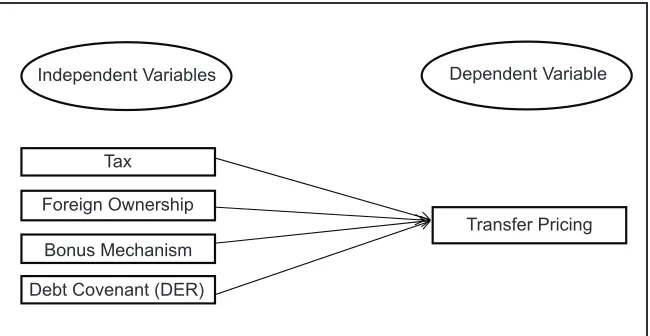
credit limit and reduce the costs of technical mistakes. Frame work of this research shows at Figure 1.
Independent Variables
The Influence of Debt Covenant on Transfer Pricing
In the theory of positive accountancy of Watt and Zimmerman (1986), one of the three profit management hypotheses is the Debt Covenant Hypothesis. In this hypothesis, all the other things remain steady; when a company is getting closer to an accounting violation which is based on a debt agreement, the tendency is more likely that a company’s manager chooses an accounting procedure with changed profits which is reported from a future period to the present one.
The higher of the company’s debt ratio, the greater of the likelihood for the managers to select accounting procedures that can increase the profits. One of the methods implemented by the company to increase the profits and to avoid the credit regulations is transfer pricing. The higher of the debt ratio, the closer of the company to the expiry of the agreement or the regulation of the credit. The higher of the credit limit, the greater of the likelihood of the violation of the credit agreement. The managers will have accounting methods that can increase the profits so that they can loosen the credit limit and reduce the costs of technical mistakes. Frame work of this research shows at Figure 1.
Figure 1: Framework of the Research
RESEARCH METHODS
The object of this research is to examine whether taxes, foreign ownership, bonus mechanism and debt covenant influence transfer pricing practices. The research units are multinational manufacturing entities in the sectors of chemical and base industries, various industries and consumer goods industries in the Indonesia Stock Exchange. The analysis units are the audited financial reports of 2012-2014 periods. The population targets in this research are the entities of multinational manufacturing in the Indonesia Stock Exchange. The entity selection is based on
Tax
Foreign Ownership
Debt Covenant (DER) Bonus Mechanism Transfer Pricing Dependent Variable Independent Variables Tax Foreign Ownership Bonus Mechanism Debt Covenant (DER)
Dependent Variable
Transfer Pricing
RESEARCH METHODS
The object of this research is to examine whether taxes, foreign ownership,
bonus mechanism and debt covenant influence transfer pricing practices.
The research units are multinational manufacturing entities in the sectors of chemical and base industries, various industries and consumer goods industries in the Indonesia Stock Exchange. The analysis units are the
audited financial reports of 2012-2014 periods. The population targets in
this research are the entities of multinational manufacturing in the Indonesia Stock Exchange. The entity selection is based on sampling purposes. This research used one dependent variable and four independent variables to
analyze the tax influence, foreign ownership, bonus mechanism and debt
covenant against the companies’ decisions to carry out the transfer pricing in the manufacturing companies listed in the Indonesia Stock Exchange. A dependent variable is a type of variable affected or explained by an independent variable. The dependent variable in this research is transfer pricing. Transfer pricing is calculate with a dichotomous approach, that is, by seeing the sales to the parties having special relationship. Using a dummy variable, the companies that sell to the parties having special relationship are rated “1”, while those who do not are rated “0” (Yuniasih, Rasmini & Wirakusuma, 2012).
Tax (X1)
The tax in this research is represented by an effective tax rate which
is the ratio of tax expense divided by a taxable profit (Yuniasih, Rasmini
& Wirakusuma, 2012).
ETR = tax expense – differed tax expensetaxable profit
Foreign Ownership (X2)
Bonus Mechanism (X3)
Bonus plan is calculated using the net income trend index (ITRENDLB) which is calculated based on the net income achievement percentage in year t against net income in year t-1. Irpan 2010 in Hartati, Desmiyawati and Azlina (2014).
ITRENDLB = Net profit year net profit year t – net profit year t-1 t-1
Debt Covenant (X4)
This research used proxy from leverage level, namely: debt to asset ratio. Qiang (2003) in Fatmariani (2013).
DAR = Total AssetTotal Debt x100%
The Logistic Regression Model used in this research is as follows:
TP= α + β1TAX + β2ASING + β3BONUS + β4DEBT + e
Description:
TP = Transfer Pricing
α = constant
TAX = Tax
FOREIGN = Foreign Ownership BONUS = Bonus Mechanism DEBT = Debt Covenant
e = Residual error (Error Coefficient)
RESULTS AND DISCUSSION
Descriptive Statistic Analysis
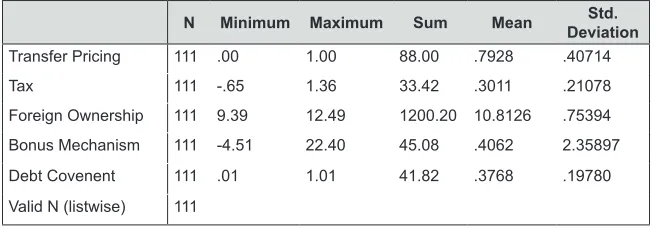
in 2012-2014 is in the average of 30.11%. However, the tax variation’ range is high enough, shown by the different amount between the maximum value of 1.36 and the minimum value of 0.65. And, this variable indicates a deviation standard of 0.211.
Table 1: Descriptive Statistics
N Minimum Maximum Sum Mean DeviationStd.
Transfer Pricing 111 .00 1.00 88.00 .7928 .40714
Tax 111 -.65 1.36 33.42 .3011 .21078
Foreign Ownership 111 9.39 12.49 1200.20 10.8126 .75394
Bonus Mechanism 111 -4.51 22.40 45.08 .4062 2.35897
Debt Covenent 111 .01 1.01 41.82 .3768 .19780
Valid N (listwise) 111
The foreign ownership variable shows that the average value is 10.81. It indicates that the companies listed in the Indonesia Stock Exchange in 2011-2014 that have a log of the total foreign share ownership used the controlling shareholder’s right to carry out transfer pricing. While the values of maximum, minimum and standard deviations of this variable are 12.49, 9.39 and 0.753.
The bonus mechanism variable has an average value of 0.406. It shows the bonus mechanism proxied by the net income trend Index (ITRENDLB),
a total of 40.6% of sample companies use the profit enlargement method for
their bonus plan. While the values of maximum, minimum and deviation standard in this variable are 22.40, -4.51 and 2.358. The Variable Debt Covenant proxied by DAR (debt to asset ratio) has the average value of 0.3768 which shows that the leverage level of the observed companies is 37.68%. It means that 37.68% of the observed companies use foreign debts
to finance their companies or to do the expansion.
Partial Hypothesis Test
Table 2 shows the test results by the logistic regression at the
significance level of 5%. The regression model that was formed based on
TP = -5.896 + 3.136 TAX + 0.812 ASING + 0.142 BONUS – 1.171 DEBT - α
The results of partial hypothesis tests show that tax and foreign ownership affect positively on a company’s decision to carry out transfer
pricing. This can be seen from the significance level of 0.012 and 0.045
each which is less than 0.05. The results are consistent with the proposed hypothesis. While the bonus mechanism and the debt covenant have no
influence on the company’s decision to carry out transfer pricing, it can be seen from the significance level of 0.590 and 0.398 which are greater than
0.005. This result is not consistent with the proposed hypothesis.
Table 2: Variables in the Equation
B S.E. Wald df Sig. Exp(B)
Step 1a TAX 3.316 1.251 6.288 1 .012 .043
ASING .812 .404 4.028 1 .045 2.251 BONUS .142 .263 .290 1 .590 1.152 DEBT -1.171 1.384 .716 1 .398 .310 Constant -5.896 4.171 1.998 1 .158 .003
Tax Influence on A Company’s Decision to Carry out Transfer
Pricing
High tax rates cause the tax burden endured by a company to grow so bigger that the company tends to choose transfer pricing as an alternative to minimize the tax burden they pay. The higher the tax rates applied to a company, the higher the business entity’s decision to carry out transfer pricing. This result is consistent with the research conducted by Yuniasih,
Rasmini and Wirakusuma (2012) that taxes have positive influence on
company’s decisions to carry out transfer pricing. Bigger tax burden triggers companies to carry out transfer pricing in the hope of pressing it down.
Because in the business practice, the businessmen generally equate the tax payment as a burden so that they always try to minimize it in order
to optimize the profits. The research has successfully proved that taxes influence company’s decisions to carry out transfer pricing. It is supported
(2012), Jacob (1996), and Hartati, Desmiyawati and Azlina (2014). The
results of the researches state that taxes have influences on company’s
decisions to carry out transfer pricing.
Influence of Foreign Ownership on Company’s Decisions to
Carry out Transfer Pricing
If foreign ownership in a company is more than 20%, the decision of a business entity in using the transfer pricing policy is also greater. It is because the ownership percentage that grows bigger can make the shareholders be in a strong position to control including controlling the decisions regarding the extent of transfer pricing carried out by the company. The controlling shareholders according to PSAK No.15 are entities that have 20% shares or more either directly or indirectly so that the entities are considered to have
significant influences on controlling the companies. The non-controlling
shareholders are the entities that have shares less than 20% either directly
or indirectly so that they are considered not to have significant influences
on controlling the companies. The non-controlling shareholders entrust the controlling shareholders to supervise the management because the controlling shareholders have a better position and have access to better information so that it is possible for them to abuse the control rights for their own welfare (Dion, 2009). One of them is by carrying out transfer pricing.
The results are in line with the research conducted by Dynaty, Utama, Rossieta and Veronica (2011) that when foreign parties have invested in the Indonesian public companies with a percentage of more than 20%, they can
give significant influences to the transfer pricing decisions involving foreign
parties. Therefore, the bigger the foreign ownership in a company, the higher
the foreign influences on determining the extent of transfer pricing to be
carried out. Yuniasih, Rasmini and Wirakusuma (2012) states that a tunneling
incentive (share ownership percentage) influences positively on a decision
The research has successfully proved that the foreign ownership
influences the company’s decisions to carry out transfer pricing. It is
supported by the results of the previous researches conducted by Dynaty, Utama, Rossieta and Veronica (2011); Yuniasih, Rasmini and Wirakusuma (2012); Jarallah and Kanazaki (2011). The research results state that the
foreign ownership influence the company’s decisions to carry out transfer
pricing.
Influence of Bonus Mechanism on Company’s Decision to
Carry out Transfer Pricing
In increasing the company’s profits the directors do not forever choose transfer pricing to increase the company’s profits to get bonuses.
The theory is that the directors want high compensations in every period. If their compensations depend on the bonuses reported in the net income, they can possibly increase their bonuses in the said periods by reporting the net income as highly as possible. However, the multinational companies, in fact, tend to focus themselves on the tax burden of the business entities. How the companies can minimize the tax burden which they must bear is by way of reducing the company’s net income from the companies located in the countries having high company’s tax rates to those having lower rates or to those as Tax Heaven Country. It can be done by way of transfer pricing. So that the bonus mechanism seen from the Net Income Trend Index
does not influence the company’s decisions to carry out transfer pricing.
The owners, therefore, give bonuses not only to the directors who have
successfully generated profits for their divisions and subunits, but also to those who are willing to cooperate for the sake of and the overall benefit
of the companies. It is supported by the opinion of Horngren, Datar and George (2008) stating that director’s compensations (bonuses) can be seen from the performances of various divisions or teams within one organization.
The bigger the overall company’s generated profits, the better the directos’
image in the view of the company’s owners. This research is in line with the research conducted by Kharisma (2014) stating that bonus mechanism
does not influence transfer pricing. However, this research is in contrast
with the research conducted by Hartati, Desmiyawati and Azlina (2014)
Influence of Debt Covenant on Company’s Decision to Carry
out Transfer Pricing
The high level of leverage ratio in the sample companies do not
influence the company’s decisions to carry out transfer pricing. The theory is
that the higher the debt ratio, the closer the companies to the agreement limits or credit regulations. The higher the credit limits, the greater the possibility of the credit agreement deviation and expenses so that the Managers will
have accounting methods that can increase profits.
Simultaneous Hypothesis Tests
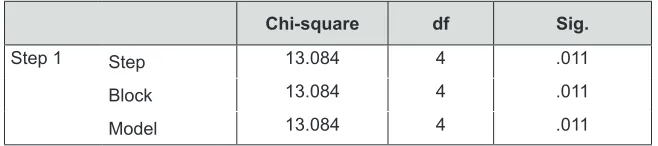
The test results on Table 3 shows that chi-square value of 13.084 with a
degree of freedom = 4, and significance level of 0.011 whose value is smaller
than 0.05 (0.011 < 0.05). It shows that taxes, foreign ownership, bonus
mechanism and debt covenant simultaneously influence the company’s
decisions to carry out transfer pricing.
Table 3: Omnibus Tests of Model Coefficients
Chi-square df Sig.
Step 1 Step 13.084 4 .011 Block 13.084 4 .011 Model 13.084 4 .011
CONCLUSION AND SUGGESTIONS
Based on the results of the researches conducted in the manufacturing companies listed in the Indonesia Stock Exchange beginning from 2012
to 2014, it can be concluded that taxes positively influence the company’s
decisions to carry out transfer pricing. It shows that high tax rates result in also higher company’s decisions to carry out transfer pricing. Foreign
ownership positively influences the company’s decision to carry out
transfer pricing. It shows that when the foreign ownership in one company is more than 20%, the controlling shareholder’s position is bigger so that the business entities’ decisions are also bigger in using the transfer pricing
carry out transfer pricing. Debt covenant does not influence the company’s
decision to carry out transfer pricing. It shows that the high leverage ratio
level in the sample companies does not influence the company’s decision to carry out transfer pricing to increase the profits.
This research is expected to provide some light to the government and policy maker to issue policies regarding transfer pricing by identifying the factors underlying the practice of transfer pricing policies. As such preventive policies can be developed in order to minimize the transfer pricing policies that harm the country and the society. This research is expected to be a motivation for the companies and management to implement the transfer pricing policies in line with the regulations issued by OECD Guidelines and The Directorate General of Taxation. It is very important considering the regulations made by OECD can already be implemented by most of the countries especially the tax regulations in Indonesia.
REFERENCES
Atmaja, L. S. (2011). Who Want To Be Rational Investor. Kepustakaan Populer Gramedia. Jakarta.
Bernard, A. B., Jensen J. B. & Schott., P. K. (2006). Transfer Pricing by US-Base Multinational Firms. NBER Working Paper.
Dion. (2009). Merger d an Akuisisi. http://dion.staff.gunadarma.ac.id
Dynaty, V., Utama, S., Rossieta, H. & Veronica, S. (2011). Pengaruh Kepemilikan Pengendali Akhir Terhadap Transaksi Pihak Berelasi.
Thesis. University of Indonesia.
Fatmariani. (2013). Pengaruh Struktur Kepemilikan, Debt Covenant dan Growth Opportunities terhadap Konservatisme Akuntansi pada Perusahaan Manufaktur yang Terdaftar di Bursa Efek Indonesia. Jurnal Universitas Negeri Padang. Padang.
Gusnardi. (2009). Penerapan Harga Transfer Dalam Kajian Perpajakan.
Hartati, W., Desmiyawati, & Azlina, N. (2014). Analisi pengaruh pajak dan mekanisme bonus terhadap keputusan transfer pricing Perusahaan Manufaktur Yang Listing Di Bursa Efek Indonesia. Jurnal Universitas Riau. 1-18.
Horngren, T, C., Datar, S. M. & George, F. (2008). Akuntansi Biaya dengan Penekanan Manajerial. Jakarta : Erlangga.
Jacob, J. (1996). Taxes and Transfer Pricing: Income Shifting and The
Volume of Intrafirm Transfer. Journal of Accounting Research, 34(2), 301-312.
Kharisma, L. (2014). Pengaruh pajak, tunneling incentive, dan kompensasi bonus terhadap keputusan transfer pricing pada perusahaan manufaktur yang terdaftar di BEI. Thesis. Mercu Buana University, Indonesia.
Kiswanto, N. & Purwaningsih., A. (2014). Pengaruh pajak, kepemilikan asing, dan ukuran perusahaan terhadap transfer pricing pada perusahaan maufaktur di BEI tahun 2010-2013. Jurnal Ekonomi Akuntansi, 1-15.
Lo, W. Y. A., Raymond, M. K. W., & Micheal, F. (2010). Tax, Financial Reporting, and Tunneling Incentive for Income Shifting: An Empirical Analysis of the Transfer Pricing behavior of Chinese-Listed Companies.
Journal of the American Taxation Association, 32(2), 1-26.
Mardiasmo. (2011). Perpajakan Edisi Revisi 2011. Yogyakarta : Penerbit Andi.
Mutamimah. (2008). Tunneling atau Value Added dalam Strategi Marger dan Akuisisi di Indonesia. Jurnal Manajemen Teori & Terapan, 2, 161-182.
Sari, R. C. (2012). Tunneling dam Model Prediksi: Bukti Empiris Pada Transaksi Pihak Berelasi. Thesis. Gadjah Mada University, Indonesia.
Watts. R. L. & Zimmerman. J. L., (1986), Positive Accounting Theory,
Yani, A. (2001). Motivasi Pajak Dalam Transfer Pricing. Bulletin Bussiness News. No. 6651.