Nursing Children and Young People
Evaluating the Effectiveness of a Clinical Holding Website for Children and Young
People: a collaborative study.
--Manuscript
Draft--Manuscript Number: NCYP801R1
Article Type: Article - if in doubt use this one
Full Title: Evaluating the Effectiveness of a Clinical Holding Website for Children and Young People: a collaborative study.
Corresponding Author: Andrea Page, PhD., MSc., PGCert., RNLD., RT., FHEA Birmingham City University
Birmingham, UNITED KINGDOM
Other Authors: Alison Warren, PG Cert (HE)., RGN., RSCN Nicola Vanes, EN(G), RGN (Adult),
Abstract: There is seldom any formal discussion around holding techniques with children and young people, their parents or healthcare staff (Page and McDonnell, 2013). The aim of this article is to discuss a clinical holding website and the author's experiences with its development, introduction to clinical areas and ongoing evaluation.
On a routine basis healthcare staff use clinical holds in order to help an infant, child or young person to stay still when administering treatments, preventing treatment interference and undertaking examinations which can sometimes be invasive (Vannorsdall et al, 2004).
It is difficult to engage children or young people in discussions about their healthcare without visual tools (Ruberg, Korsvold, Gjengedal, 2015). A transparent framework is therefore important, this notion led to the generation of a Clinical Holding website. The aim is that this website will formalise clinical holding techniques, allowing professional discussion and documentation to enhance best practice. This website allows the potential to aid true informed consent.
Keywords: Clinical Holding, procedures, techniques, discussion, website, e learning platform Additional Information:
Question Response
Please confirm that you have read and agree to our Publisher's Agreement that is available here
Yes
Have you submitted this manuscript elsewhere?
No
Has this manuscript already been published?
No
Do you have copyright for all the images, graphics and figures included with your submission?
Yes
What is the word count of your document including references but excluding the abstract?
2016
What is the word count of your document excluding both references and the abstract?
1442
Author Comments: Hello,
Thank you for the opportunity to revise our submission. We have taken on board all the reviewers comments and amended appropriately.
Best wishes
Andrea, Alison and Nicola
Dear Christine Walker
With regards to Evaluating the effectiveness of a Clinical Holding Website for Children and Young People:- a collaborative study.
Please find the following list of changes we have made to this submission :-
In response to
Reviewer #1: No: I indicated no as I wanted to make a comment.
I had to read this work several times before I could actually see the value of it. I would like to see a much stronger introduction and a tighter structure. The aims of the article needs to be included in the introduction and rationale as to why this is important - and it is important.
We have rewritten the introduction to make it stronger and included a rationale as to why the website is important.
Reviewer #2: No: This is a good article - well done. The clarity could be enhanced by reviewing the punctuation throughout - including in the title. The abstract could be much clearer and identify the essence of the study, including the fact that an educational on-line tool has been generated. You really need to include in the abstract the aim of the study. I suggest slight re-ordering - the discussion regarding clinical holding could be placed at the beginning for clarity. I am unclear what you mean when you state that 'All participants were interviewed to identify what their teaching and learning needs were' because you then state that 'this group identified twenty-eight techniques as being in use across BCH which were then transformed into three Dimensional (3D) images'. This section is unclear - because if these participants had learning needs in this skill - they may not be in a position to suggest techniques. Were the techniques based on best evidence?
We have reviewed and simplified the title. We have addressed the issue with regards the abstract being clearer and identified the essence of the study. The aim is now in within the abstract. We also agree with reviewer 2 about reordering the discussion points and have moved content around. The issue that reviewer 2 is unclear about regarding the 28 images has also been reworded in an attempt to bring clarity.
Reviewer #2: No: In places you need to justify your use of the literature, for example, you discuss the 'current view' of Allen 2000 - is there more contemporary literature available because this literature is not 'current'. You need to check that you have used the most contemporary literature or justify inclusion of older supporting literature.
Manuscript Click here to download Manuscript Letter to Christine Walker
This has been addressed through a conversation about the paucity of research on clinical holding and a reference to current articles still using references over 10 years old. (NCYP801R1)
Is the article presented in an accessible and interesting style?
Reviewer #1: No: this section overlaps with question 1 and the question below
Reviewer #2: No: Needs re-ordering to enhance the reader's understanding from the beginning. I suggest asking someone to read this article who has not been part of the research - they will be able to identify the areas that are unclear. By the end of your article there is clarity but this could be achieved from the beginning.
Again we have looked at the structure and content of the article and hopefully addressed this point.
Are references used appropriately?
Reviewer #1: Yes
Reviewer #2: No: Some review required - as outlined above.
Hopefully by responding to the issue about style we have addressed the issuer about references.
Thank you to the two reviewers who were positive in their critique of this article. This helped with the revisions we have made.
Best wishes
1
Evaluating the Effectiveness of a Clinical Holding Website for Children and Young People:
a collaborative study.
Introduction Illustration 1 Setting the scene accompanies this section
On a routine basis, healthcare staff use clinical holds in order to help children and young people to stay still when administering treatments, preventing treatment interference and undertaking examinations (Vannorsdall et al, 2004). Clinical holding is the proactive immobilisation of a part or all of the body to safely carry out a procedure, for example; holding an arm still for cannulation with the aim to prevent reflexion, withdrawal, increased pain, distress or injury to the child. Clinical holding without a child or parents’ consent is a last resort and not the first line of intervention, alternative methods to include distraction and play must be considered. Sedation, local and sometimes general anaesthesia are also used routinely.
The child or young person may become stressed during these occasions and display behaviours such as; crying, thrashing around and potentially hitting out. These behaviours can hinder healthcare staff’s ability to perform the procedure safely and is known to increase experiences of pain and anxiety (Vannorsdall et al, 2004). Parents are being asked to hold their child and believe that this is because staff do not know what to do and are not sure whether they can legally hold the child (McGrath et al, 2002). With regards to clinical holding, the literature review establishes that many holding techniques are developed over time by nurses who gain experience by observing others and that many of these techniques are not robust (Page, 2015). As with physical interventions there is no documented evidence to suggest that these techniques are safe to be used by trained or untrained professionals (Page, 2015). Best practice also means that parents and carers should be engaged in the holding process and give consent for the technique used. By planning and discussing the clinical hold this could reduce child/young person and parental anxiety. It is difficult to engage children or young people in discussions about their healthcare without visual tools (Ruberg, Korsvold, Gjengedal, 2015). This also includes how clinical holding techniques are negotiated. It is therefore essential to identify a transparent to formalise clinical holding in practice and allow professional discussion and documentation to enhance best practice. The Clinical Holding website unlocks this potential. This article documents the development process and the rational to support this collaborative work.
What is the difference between restraint (physical intervention skills) and clinical holding?
Currently in the nursing literature there is debate about what is meant by all the terms published to
define the practice to help children manage a painful or invasive procedure; therapeutic holding
(RCN 2010), holding still (Robinson and Collier 1997, RCN 2003, Graham and Hardy 2004), clinical
holding (Lambrenos and McArthur 2003), supportive holding (Jeffrey 2008 and 2010) therapeutic
restraint (Jeffrey 2002) and some authors still write about using the term restraint to define the
practice being considered in this research (Folkes 2005, Pearch 2005, Hull and Clarke 2010, Darby
and Cardwell 2011), Brenner et al, 2014 and Coyne and Scott, 2014). Although some of these
2
references are greater than ten years old, there is a dearth of publications in this subject (Page,
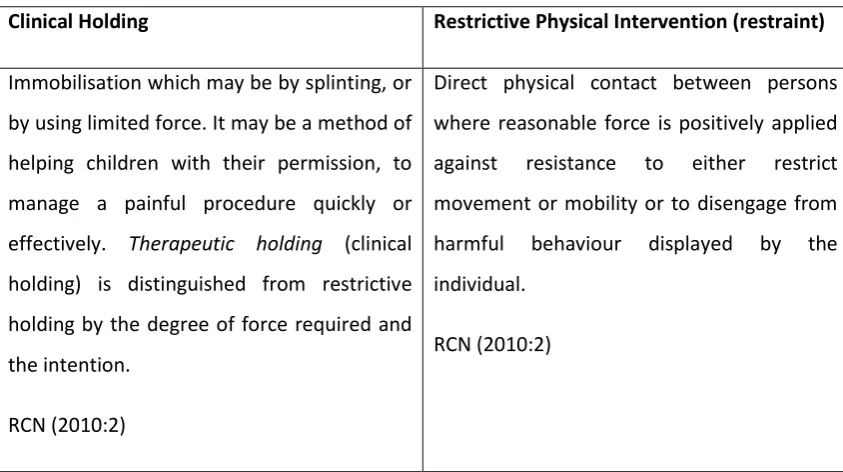
2015). The authors have elected to adopt the following definitions for clinical holding and restrictive
physical intervention .See table 1.1
Main text
Our partnership Illustration 2 BCH /BCU partnership – Timeline accompanies this section
A partnership between Birmingham City University (BCU) and Birmingham Children’s Hospital (BCH) was established as a result of the lead authors PhD research. Table 2 illustrates the timeline and collaborative workings and funding.
Research based project
The research to develop the website involved expert participants representing nursing, radiography, phlebotomy, play specialists, dental nurses, neurophysiologists and medical staff. The participants were interviewed to identify what current holding techniques were being used across the organisation. The group identified twenty-eight techniques, which were assessed for their physical safety, psychological safety, trainability, child/young person risk factors, technical robustness effectiveness and social validity (Page 2015). Discussions about the representation of these holds included how they could be disseminated. This lead to a funding application to enable the transformation of a hold into three Dimensional (3D) image.
The concept of using 3 D images enables the user to rotate the images to clearly identify the land marking for holds. The website now hosts a library of these clinical holding techniques developed for use at BCH. In addition, language barriers were recognised due to the multicultural demographics of Birmingham and the children’s hospital patient population. Therefore we identified the most common languages spoken and included this facility on the website to enable user involvement. Funding restrictions did impact the number of techniques and languages included.
Clinical Guidelines and Algorithm (see illustration 3)
In quality care provision for infants, children and young people, it is crucial that healthcare staff are
aware of and can weigh up the risks associated with holding children. Leroy and ten Hoopen (2012)
state that:- “Unless the child’s life is at stake, health care providers encountering resistance from
children against a procedure must first consider all possible alternatives and then opt for the most
appropriate care for the case”. Guidelines, algorithms and educational packages can empower staff
to make clinical decisions enabling them to safely carry out an evidence based choice and implement
the most suitable hold (Lloyd et al, 2008). Therefore to underpin the rationale for clinical holding
techniques and ensure a robust framework to guide staff, additional resources were developed to
3
About the three dimensional (3D) images Illustration 4 – Creation of 3D images accompanies this section
We used as 3D approach because this is a technique which displays visual information and which can also be interactive. The D in 3D stands for depth. We started this process by taking photographs, in other words 2D images. For twenty-eight holding techniques, three hundred and ninety-three photographs were taken. (See table 5). We worked with a freelance 3D artist who also helped us developed the website. Our priority at this stage was to create a tool that was visual, created interest and interactive. In 2008, Martin et al; produced a risk assessment tool to assess techniques used within learning disability services. One of the authors adapted this tool to assess the clinical holding techniques within this website because there were no published tools available to review holding techniques (Page, 2015)
Development of a Moodle Package and feedback facility See Illustration 5a &b
E Learning is an established resource in healthcare to disseminate and in many organisations, test user engagement and core knowledge. In BCH, Moodle is the adopted E learning platform. Role essential and mandatory training packages provide an interactive learning environment for Trust employees. This was therefore the most appropriate environment to embed the Clinical Holding website within the Moodle learning package. Following the user accessing the website, the project team developed a quiz to test the individual’s knowledge; it holds an 80% pass rate and links directly to ESR training records. Staff are required to revisit the Moodle package bi annually to ensure skills are updated or refreshed. In addition staff are also requested to leave feedback to enable website evaluation.
Conclusion Illustration 6 accompanies this section
As discussed throughout this article, there is significant evidence of clinical risk due to poor dissemination of holding techniques used. Moreover there is indication of little parity within clinical areas to support the holds being used.
As a best practice recommendation to inform national guidance, the collaborative BCH and BCU working group have developed a robust website. This learning resource is transferable to all children’s health care service providers.
The website was developed through ECQ funding and the authors acknowledge that there are a multitude of additional holds which could be added, but this requires additional funding. The authors would welcome discussions with other Trusts about developing an eLearning package to host the website. Following launch at BCH and evaluation, it is recognised that the website would be far more accessible if a phone app was developed.
4
This link offers open access to any service provider to review the resource. It is recommended that reviewers navigate to the disclaimer for user’s page. This link is an open access to any service provider. The authors would be grateful for any feedback. In addition, if the website is being used in your organisation, user evaluation would be welcome. If organisations which to develop a similar work based resource that mimic’s the BCH Moodle package please contact the authors.
Acknowledgements
Ebru Heyberi-Tenekeci for her support in developing the BCH Moodle Site
5
References
ALLEN, J. J., (2000) Seclusion and restraint of Children: A literature Review. Journal of Child & Adolescent Psychiatric Nursing, 13 (4), pp. 159-167
BRENNER, M. TREACY, M. P. DRENNAN, J and FEALY, G., (2014) Nurses’ Perceptions of the Practice of
Restricting a Child for a Clinical Procedure Qualitative Health Research 24 (8): pp. 1080-1089.
COYNE, I. and SCOTT, P., (2014) Alternatives to restraining children for clinical procedures Nursing
Children and young People, 26(2): pp.22-27.
DARBY, C. and CARDWELL, P., (2011) Restraint In the Care Of Children. Emergency Nurse, 19(7):
pp.14-17.
FOLKES, K., (2005) Is Restraint a Form of Abuse? Paediatric Nursing, 17(6): pp. 41-44.
HULL, K. and CLARKE, D., (2010) Restraining Children for clinical procedures: a review of the issues
British Journal of Nursing, 19(6): pp. 346-350
GRAHAM, P. and HARDY, M.,(2004) The immobilisation and restraint of paediatric patients during
plain film radiographic examinations. Radiography, 10 (1): pp. 23–31.
JEFFERY, K., (2002). Therapeutic restraint of children: it must always be justified. Paediatric Nursing,
14(9), pp. 20–22.
JEFFERY, K., (2008) Supportive holding of children during therapeutic interventions in Kelsey, J. and
McEwing, G. (eds.) (2008) Clinical Skills in Child Health Practice, London: Churchill Livingstone
Elsevier.
JEFFERY, K., (2010) Supportive holding or restraint: terminology and practice. Paediatric Nursing,
22(6): pp. 24–28.
LAMBRENOS, K. and McARTHUR, E., (2003). Introducing a clinical holding policy. Paediatric Nursing
15(4): pp. 30–33.
LEROY, P and TEN HOOPEN, M (2012). Forced immobilization (‘restraint’) during medical procedures
in young children. An ethical and legal investigation of common practice
https://www.each-for-sick-children.org/images/stories/pdf-files/Forced_immobilization.pdf
https://www.each-for-sick-children.org/best-practices/avoiding-restraint/forced-immobilization-
6
LLOYD, M. LAW, G. U. HEARD, A. AND KROESE, B., (2008) “When a child says ‘no’: experiences of
nurses working with children having invasive procedures”. Paediatric Nursing, 20(4): PP. 29–34.
MARTIN, A. MCDONNELL, A. LEADBETTER, D. and PATERSON, B., (2008) Evaluating the risks
associated with physical interventions In ALLEN, D. (ed.) Ethical approaches to physical interventions
Volume 2 Changing the agenda. Worcester: BILD pp.37-53.
MCGRATH, P. FORRESTER, K. FOX-YOUNG, S. and HUFF, N., (2002) ‘Holding the child down’ for
treatment in paediatric haematology: The ethical, legal and practice implications. Journal of Law and
Medicine, 10(8), pp. 85-96
PAGE, A., (2015) Holding children and young people for clinical procedures: moving towards an
evidence based practice. Unpublished PhD thesis. Birmingham City University
PAGE, A. and MCDONNELL, A. A., (2013) Holding children and young people: defining skills for good
practice. British Journal of Nursing, 22(20), pp. 1153-1158
PAGE, A and MCDONNELL, A.A., (2015) Holding children and young people: identifying a theory
practice gap. British Journal of Nursing 24(8): 378-382
ROYAL COLLEGE OF NURSING (2003). Restraining, Holding Still and Containing Children and Young
People Guidance for Nursing Staff. London: RCN.
ROYAL COLLEGE OF NURSING (2010) Restrictive physical intervention and therapeutic holding for
children and young people: Guidance for nursing staff. London.
ROBINSON, S and COLLIER, J., (1997) Holding Children Still for Procedures Paediatric Nursing 9(4);
pp.12-14.
RUBERG, E.M. KORSVOLD, T. and GJENGEDAL (2015) Characteristics of being hospitalized as a child
with a new diagnosis of type 1 diabetes: a phenomenological study of children’s past and present
experiences Available through BMC Nursing Sample http://dx.doi.org/10.1186/s12912-014-0051-9
(Accessed 27th March 2015)
SELEKMAN, J. and SNYDER, B., (1995). Uses of and alternatives to restraints in paediatric settings.
Advanced Practice in Acute Critical Care, 7(4), pp. 603–610
VANNORSDALL, T. DAHLQUIST, L. SHROFF PENDLEY, J and POWER, T., (2004) The relationship
between nonessential touch and children’s distress during lumbar punctures. Children’s Healthcare,
1
Evaluating the Effectiveness of a Clinical Holding Website for Children and Young People:
a collaborative study.
Photographs
Illustration 4
1
Evaluating the Effectiveness of a Clinical Holding Website for Children and Young People:
a collaborative study.
Diagrams
Illustration 1
Illustration 2
2010/2011 -Pilot study completed as part of PHD research question:
“What are the assumptions and practices made by Healthcare Professionals in relation to clinical holding?”
This study was a service evaluation to identify policy and procedural factors around clinical holding at Birmingham Children’s Hospital
2011/2012- Summary presented to the management board. An action plan was implemented.
2012 - Funding applied for from Birmingham City University to develop a clinical holding website
2012/2013 –Creation of 3D images and supporting literature. All clinical holds were risk assessed using adapted risk assessment tool. Creation and introduction of a Moodle learning platform for Birmingham Children’s Hospital staff which hosted the Clinical holding website. Development of Clinical Guidelines and an Algorithm to assist with clinical decision making was also included
2015- Moodle package and website was launched at Birmingham Children’s Hospital (part of essential learning for clinical staff)
Diagram Click here to download Diagram Clinical holding
2
Illustration 3
3
Illustration 5 b
1. Did you find the Evidence Based Holding of Children for Clinical Procedures website helpful? - 100% Yes
2. What Clinical Holds did you use? - Variety
3. Were they successful in helping you with the procedure? - 98% Yes
4. Did you discuss the clinical hold with a parent/carer/the child using this website? – 100% No *
5. Did you discuss the clinical hold with a parent/carer/the child without the use of the website? -100% Yes
6. Have you used any of the language facilities? – 100% No *
7. Did you look at the ‘Further information for Healthcare staff’? – 100% No *
8. If yes what did you look at?- 100% N/A
9. How would you rate this website with excellent as 10 and poor as 0– 9/10
4
Table 1.1
Clinical Holding Restrictive Physical Intervention (restraint)
Immobilisation which may be by splinting, or
by using limited force. It may be a method of
helping children with their permission, to
manage a painful procedure quickly or
effectively. Therapeutic holding (clinical
holding) is distinguished from restrictive
holding by the degree of force required and
the intention.
RCN (2010:2)
Direct physical contact between persons
where reasonable force is positively applied
against resistance to either restrict
movement or mobility or to disengage from
harmful behaviour displayed by the
individual.