N A N O E X P R E S S
A Model System for Dimensional Competition in Nanostructures:
A Quantum Wire on a Surface
Rainer Dick
Received: 16 January 2008 / Accepted: 13 March 2008 / Published online: 2 April 2008 Óto the authors 2008
Abstract The retarded Green’s function (E-H+ie)-1is given for a dimensionally hybrid Hamiltonian which interpolates between one and two dimensions. This is used as a model for dimensional competition in propagation effects in the presence of one-dimensional subsystems on a surface. The presence of a quantum wire generates addi-tional exponential terms in the Green’s function. The result shows how the location of the one-dimensional subsystem affects propagation of particles.
Keywords Fermions in reduced dimensions
NanowiresQuantum wires
Introduction
One-dimensional field theory is frequently used for quan-tum wires or nanowires [1–3] or nanotubes [4–7]. Two-dimensional field theory has become a universally accepted tool for the theoretical modeling of particles and quasi-particles on surfaces, interfaces, and thin films. The success of low-dimensional field theory in applications to the quantum hall effects [8–10], impurity scattering in low-dimensional system (see e.g. [11–16]), and the confirma-tion of low-dimensional critical exponents in experimental samples [17–22] confirm that low-dimensional field theo-ries are useful tools for the description of low-dimensional condensed matter systems.
The properties of a physical system have a strong depen-dence on the number of dimensions d. A straightforward
example is provided by the zero energy Green’s function
G(r)|E=0, which is proportional torind=1 and proportional
to lnrind=2, and decays liker2-din higher dimensions. Green’s functions determine correlation functions, two-par-ticle interaction potentials, propagation of initial conditions, scattering off perturbations, susceptibilities, and densities of states in quantum physics. It is therefore of interest to study systems of mixed dimensionality, where competition of dimensions can manifest itself in the properties of particle propagators.
To address questions of dimensional competition ana-lytically in the framework of interfaces in a bulk material, dimensionally hybrid Hamiltonians of the form
H¼ h 2
2m Z
d2x Z
dzrwþ rwþozwþozw
þh 2
2l Z
d2xrwþ rw
z¼z0
ð1Þ
were introduced in [23]. The corresponding first quantized Hamiltonian is
H¼p
2þp2 z
2m þ jz0ihz0j
p2
2l: ð2Þ
Here the convention is to use vector notation x¼ ðx;yÞ;r ¼ ðox;oyÞ for directions parallel to an interface, whilezis orthogonal to the interface. From a practical side, Hamiltonians of the form (2) may be used to investigate propagation effects of weakly coupled particles in the presence of an interface. From a theoretical side, the Hamiltonians (1,2) are of interest for the analytic study of competition between two-dimensional and three-dimen-sional motion.
The two-dimensional mass parameter l is a mass per length. In simple models it is given by
R. Dick (&)
Physics and Engineering Physics, University of Saskatchewan, 116 Science Place, Saskatoon, SK, Canada S7N 5E2
l¼ m
L? ;
where depending on the model,L? is either a bulk pene-tration depth of states bound to the interface atz=z0or a
thickness of the interface, see [24].
The zero energy Green’s function for the Hamiltonians (1,2) for perturbations in the interface (z0 =z0=0, Gðxx0;zÞ ¼ hx;zjGjx0;0i) satisfies
ðDþo2zÞGðxx0;zÞ þm
ldðzÞDGðxx
0;0Þ ¼ dðxx0ÞdðzÞ
and was found in [23] (r¼ jxx0j),
Gðxx0;zÞ ¼ 1 4p
Z 1
0
dkexpðkjzjÞ
1þk‘ J0ðkrÞ; ‘¼
m
2l: ð3Þ
The Green’s function in the interface is given in terms of a Struve function and a Bessel function,
Gðxx0;0Þ ¼ 1 8‘ H0
r
‘ Y0
r
‘
h i
ð4Þ
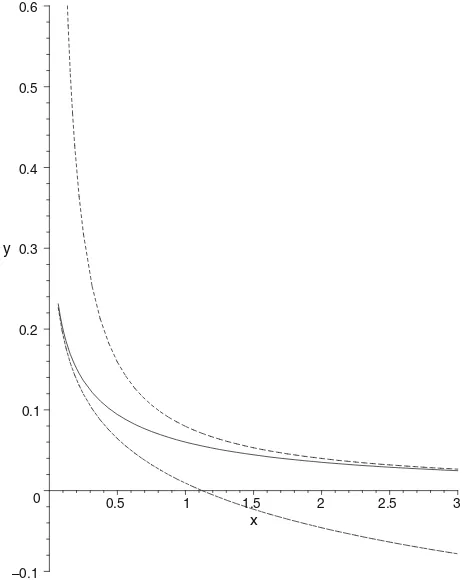
and interpolates between two-dimensional and three-dimensional distance laws (see Fig.1),
r‘: Gðxx0;0Þ ¼ 1
4p‘ cln
r
2‘ þ
r
‘þ O
r2 ‘2
;
ð5Þ
r‘: Gðxx0;0Þ ¼ 1 4pr 1
‘2
r2þ O ‘4
r4
: ð6Þ
The corresponding energy-dependent Green’s function was also recently reported [24]. However, another system of great practical and theoretical interest concerns quantum wires or nanowires on surfaces. Preparation techniques for one-dimensional nanostructures were recently reviewed in reference [25]. We will examine the corresponding dimensionally hybrid Hamiltonian and its Green’s function in this paper.
The Hamiltonian
We wish to discuss effects of dimensionality of nano-structures on the propagation of weakly coupled particles in the framework of a simple model system. We assume large de Broglie wavelengths h/p compared to lateral dimensions of nanostructures, and for our model system we also neglect electromagnetic effects or interactions, bearing in mind that these effects are highly relevant in realistic nanostructures [26,27].
The model system which we have in mind consists of non-relativistic particles or quasi-particles tied to a surface. The surface carries a one-dimensional wire. Thexdirection
is along the wire and the y direction is orthogonal to the wire. The wire is located aty=y0. The particles can move
with a mass mon the surface, but motion along the wire may be described by a different effective massm*. In case of a weak attraction to substructures, kinetic operators can be split between bulk motion and motion along substruc-tures [24]. Alternatively, for large lateral de Broglie wavelength relative to lateral extension L? of a substruc-ture, one can also argue that the lateral integral of the kinetic energy density along a substructure only yields a factor L? in the kinetic energy for motion along the sub-structure. In either case we end up with an approximation for the kinetic energy operator of the particles of the form
H¼
Z dx
Z dyh
2
2m
ow þðx;yÞ
ox
owðx;yÞ
ox þ
owþðx;yÞ
oy
owðx;yÞ
oy
þ Z
dxh
2
2l
owþðx;y0Þ
ox
owðx;y0Þ
ox ; ð7Þ
where the mass parameterl¼m=L? is a mass per lateral attenuation length of bound states, or a mass per lateral extension of the substructure. The operator (7) is the
–0.1 0 0.1 0.2 0.3 0.4 0.5 0.6
y
0.5 1 1.5 2 2.5 3
x
[image:2.595.309.541.59.353.2]second quantized kinetic Hamiltonian for the particles. The corresponding first quantized Hamiltonian is
H¼p 2 xþp
2 y
2m þ jy0ihy0j p2x
2l: ð8Þ
The wire corresponds to a channel in which propagation of a particle comes with a different cost in terms of kinetic energy. It is intuitively clear that existence of this channel will affect propagation of the particles on the surface, and we will discuss this in terms of a resulting Green’s function for the Hamiltonians (7,8).
The Green’s Function ink Space
The Hamiltonians (7,8) yield the Schro¨dinger equation
Ewðx;yÞ ¼ h 2
2mðo
2 xþo
2 yÞwðx;yÞ
h 2
2ldðyy0Þo 2
xwðx;y0Þ; ð9Þ
and the corresponding equation for the Green’s function in the energy representation,
Ep
2 xþp
2 y
2m jy0ihy0j p2
x 2l
!
GðEÞ ¼1:
The last equation reads in (x,y) representation and with the conventionGðEÞ 2mGðEÞ=h2
2m h2 Eþo
2 xþo
2
yþdðyy0Þ
m
lo 2 x
hx;yjGðEÞjx0;y0i
¼ dðxx0Þdðyy0Þ:
ð10Þ
Substitution of the Fourier transform hx;yjGðEÞjx0;y0i ¼ 1
4p2 Z
dkx Z
dk0x Z
dky
Z
dk0yhkx;kyjGðEÞjkx0;k 0 yi
exp½iðkxxþkyykx0x 0k0
yy 0Þ
yields 2m
h2 Ek
2 xk
2 y
hkx;kyjGðEÞjkx0;k 0 yi
m l
k2x
2p Z
djexp½iðjkyÞy0hkx;jjGðEÞjkx0;k0yi ¼ dðkxk0xÞdðkyk0yÞ: ð11Þ
This yields with hkx;kyjGðEÞjk0x;k
0
yi ¼ hkyjGðE;kxÞjk 0
yidðkxkx0Þ
the condition
k2xþk2y2m
h2 E
hkyjGðE;kxÞjk0yi
þm l k2 x 2p Z
djexp½iðjkyÞy0hjjGðE;kxÞjk0yi
¼dðkyky0Þ: ð12Þ
This result implies thathkyjGðE;kxÞjk0yimust have the form expðikyy0ÞhkyjGðE;kxÞjky0i
¼expðikyy0Þdðkyk 0
yÞ þfðE;kx;k0yÞ
k2
xþky2 ð2mE=h
2Þ i ;
with the yet to be determined functionfðE;kx;ky0Þsatisfying 1þm
l
k2 x 2p
Z dj
j2þk2
x ð2mE=h 2Þ i
fðE;kx;k0yÞ
¼ m l
kx2
2p
expðik0yy0Þ
k0
yþk2x ð2mE=h
2Þ i: ð13Þ
Substitution of
Z dj
j2þk2
x ð2mE=h
2Þ i¼ph Hðh2k2
x2mEÞ ffiffiffiffiffiffiffiffiffiffiffiffiffiffiffiffiffiffiffiffiffiffiffiffi
h2k2 x2mE q
þiphHð2mEh
2k2 xÞ ffiffiffiffiffiffiffiffiffiffiffiffiffiffiffiffiffiffiffiffiffiffiffiffi 2mEh2k2 x q
yields
1þmh 2lk
2 x
Hðh2kx22mEÞ ffiffiffiffiffiffiffiffiffiffiffiffiffiffiffiffiffiffiffiffiffiffiffiffi h2k2
x2mE
q þiHð2mEh
2k2 xÞ ffiffiffiffiffiffiffiffiffiffiffiffiffiffiffiffiffiffiffiffiffiffiffiffi 2mEh2k2 x q 0 B @ 1 C A 2 6 4 3 7 5
fðE;kx;ky0Þ
¼ m l
k2 x 2p
expðik0yy0Þ
k02
y þk2x ð2mE=h 2Þ i: We finally find
hkyjGðE;kxÞjk0yi
¼ 1
k2
yþk2x ð2mE=h 2Þ i
"
dðkyk0yÞ
k2 x‘ p
exp½iðk0ykyÞy0
k02
y þk2x ð2mE=h 2Þ i
ffiffiffiffiffiffiffiffiffiffiffiffiffiffiffiffiffiffiffiffiffiffiffiffi
h2k2 x2mE q
Hðh2k2
x2mEÞ ffiffiffiffiffiffiffiffiffiffiffiffiffiffiffiffiffiffiffiffiffiffiffiffi
h2k2
x2mE q
þhk2 x‘
þ
ffiffiffiffiffiffiffiffiffiffiffiffiffiffiffiffiffiffiffiffiffiffiffiffi 2mEh2k2 x q
Hð2mEh2k2 xÞ ffiffiffiffiffiffiffiffiffiffiffiffiffiffiffiffiffiffiffiffiffiffiffiffi
2mEh2k2 x q
þihk2 x‘
!#
; ð14Þ
‘¼ m 2l¼
m
2m
L?
was used. hkx;kyjGðEÞjk0x;ky0i ¼ hkyjGðE;kxÞjky0idðkxkx0) is the Green’s function which we would use in k space Feynman rules. It is also instructive to switch toy repre-sentation for the transverse direction to see the impact of the wire on particle propagation.
The Green’s Function in Mixed Representations and Impurity Scattering
It is well known in surface science that Green’s functions can also be given in closed form in mixed representations, where momentum coordinates are used along the surface and configuration space coordinates are used for the transverse directions. The same observation applies here. In particular, the Green’s function with one transverse momentum replaced by a transverse coordinate is given by
The Green’s function with both arguments for the trans-verse direction given in terms of configuration space coordinates is
The first order perturbation of a state w0(x,y) due to
scattering off an impurity potentialV(x,y) corresponds to
wðx;yÞ ¼w0ðx;yÞ 2m
h2
Z dx0
Z
dy0hyjGðE;xx0Þjy0i Vðx0;y0Þw0ðx0;y0Þ
¼w0ðx;yÞ
m ph2
Z dx0
Z dy0
Z
dkxhyjGðE;kxÞjy0i exp½ikxðxx0ÞVðx0;y0Þw0ðx
0;y0Þ: ð17Þ
The result (16) shows peculiar distance effects between the location of the wire and the perturbation or impurity on the one hand, and between the location of the wire and the
y coordinate of the wave function on the other hand. In both cases, the wavelength (for 2mE[h2k2
x) or attenuation length (for 2mE\h2k2x) are the same as in the terms from the unperturbed surface propagator. In the evanescent case,
the impact of the wire on impurity scattering is exponen-tially suppressed if either the impurity is located far from the wire or if the wave function is considered far from the hkyjGðE;kxÞjy0i ¼ 1ffiffiffiffiffiffi
2p p
Z
dky0expðik0yy0ÞhkyjGðE;kxÞjk0yi
¼ 1ffiffiffiffiffiffi 2p
p 1
k2
yþk2x ð2mE=h 2Þ i
"
expðikyy0Þ
hk2x‘Hðh2k2x2mEÞ ffiffiffiffiffiffiffiffiffiffiffiffiffiffiffiffiffiffiffiffiffiffiffiffi
h2k2 x2mE q
þhk2 x‘
exp ikyy0
ffiffiffiffiffiffiffiffiffiffiffiffiffiffiffiffiffiffiffiffiffiffiffiffi
h2k2 x2mE
q jy0y0j
h
!
i hk 2
x‘Hð2mEh 2k2
xÞ ffiffiffiffiffiffiffiffiffiffiffiffiffiffiffiffiffiffiffiffiffiffiffiffi 2mEh2k2 x q
þihk2 x‘
exp ikyy0þi
ffiffiffiffiffiffiffiffiffiffiffiffiffiffiffiffiffiffiffiffiffiffiffiffi 2mEh2k2 x
q jy0y0j
h
!#
: ð15Þ
hyjGðE;kxÞjy0i ¼hHðh 2k2
x2mEÞ 2
ffiffiffiffiffiffiffiffiffiffiffiffiffiffiffiffiffiffiffiffiffiffiffiffi
h2k2 x2mE q
" exp
ffiffiffiffiffiffiffiffiffiffiffiffiffiffiffiffiffiffiffiffiffiffiffiffi
h2k2 x2mE
q jyy0j
h
hk
2 x‘ ffiffiffiffiffiffiffiffiffiffiffiffiffiffiffiffiffiffiffiffiffiffiffiffi
h2k2 x2mE q
þhk2 x‘
exp
ffiffiffiffiffiffiffiffiffiffiffiffiffiffiffiffiffiffiffiffiffiffiffiffi
h2k2 x2mE
q jyy0j þ jy0y0j
h
#
þhHð2mEh 2k2
xÞ 2
ffiffiffiffiffiffiffiffiffiffiffiffiffiffiffiffiffiffiffiffiffiffiffiffi 2mEh2k2 x q
" iexp i
ffiffiffiffiffiffiffiffiffiffiffiffiffiffiffiffiffiffiffiffiffiffiffiffi 2mEh2k2 x
q jyyj0
h
þ hk
2 x‘ ffiffiffiffiffiffiffiffiffiffiffiffiffiffiffiffiffiffiffiffiffiffiffiffi 2mEh2k2 x q
þihk2 x‘
exp i
ffiffiffiffiffiffiffiffiffiffiffiffiffiffiffiffiffiffiffiffiffiffiffiffi 2mEh2k2 x
q jyy0j þ jy0y0j
h
#
wire. In the non-evanescent case the perturbation of the propagator due to the wire becomes a strongly oscillating function of
ffiffiffiffiffiffiffiffiffiffiffiffiffiffiffiffiffiffiffiffiffiffiffiffi 2mEh2k2 x q
=h far from the wire. Therefore the impact of the wire will also be small if we consider wave packets far from the wire.
For a simple application of (17) consider a wire at
y0=0 and an impurity potential Vðx;yÞ ¼WdðxÞdðyÞ:
The plane wave w0ðx;yÞ ¼expðiy ffiffiffiffiffiffiffiffiffi 2mE
p
=hÞ with h ffiffiffiffiffiffiffiffiffi
2mE
p
L? is a solution of the Schro¨dinger Eq. 9 which satisfies the conditions for the approximation (7). In this case we get a scattering amplitude
dwðx;yÞ ¼ mW ph
Z ffiffiffiffiffiffiffip2mE=h
0
dkx
iexpðikxxÞ ffiffiffiffiffiffiffiffiffiffiffiffiffiffiffiffiffiffiffiffiffiffiffiffi 2mEh2k2 x q
þihk2 x‘
exp
i
ffiffiffiffiffiffiffiffiffiffiffiffiffiffiffiffiffiffiffiffiffiffiffiffi 2mEh2k2 x
q jyj
h
þ Z 1
ffiffiffiffiffiffiffi 2mE p
=h dkx
expðikxxÞ ffiffiffiffiffiffiffiffiffiffiffiffiffiffiffiffiffiffiffiffiffiffiffiffi
h2k2 x2mE q
þhk2 x‘
exp
ffiffiffiffiffiffiffiffiffiffiffiffiffiffiffiffiffiffiffiffiffiffiffiffi
h2k2 x2mE
q jyj
h : ð18Þ
The equation for ‘=0 is just the standard result for scattering from a pointlike impurity in mixed representation. The presence of the wire reduces the scattering cross section of the impurity for orthogonal infall.
Equations 15 and 16 also show that the effects of the additional terms should be most noticeable if kx‘1. Since ‘¼m=2l¼mL?=2m; promising samples should have an effective massm*for motion along a quantum or
nanowire which is much smaller than the effective massm
for motion along the surface. What comes to mind is an InSb nanowire on a Si surface. Scattering of surface par-ticles off impurities in the presence of the wire should exhibit the additional propagator terms.
Conclusion
A simple model system for dimensional competition in nanostructures has been proposed. The system assumes that motion along a wire on a surface comes with a different cost in terms of kinetic energy, e.g. due to effective mass effects. The dimensionally hybrid retarded Green’s func-tion for the propagafunc-tion of free particles in the system was found in closed analytic form both inkspace and in mixed (kx,y) representations. The wire generates extra exponential terms in the propagator of the particles. The attenuation
lengths or wavelengths in the evanescent or oscillating case, respectively, are the same as for the unperturbed propagator, but the extra terms exhibit distance effects between the particles and the wire.
Acknowledgments This work was supported in part by NSERC Canada. I also gratefully acknowledge the generous hospitality of the Perimeter Institute for Theoretical Physics while this work was completed.
References
1. H. Wu, D.W.L. Sprung, J. Martorell, Phys. Rev. B45, 11960 (1992)
2. C.C. Wan, J.L. Mozos, G. Taraschi, J. Wang, H. Guo, Appl. Phys. Lett.71, 419 (1997)
3. F.J. Garcia-Vidal, F. Flores, S.G. Davison, Prog. Surf. Sci.74, 177 (2003)
4. T. Ando, H. Suzuura, Physica E18, 202 (2003) 5. T. Ando, J. Phys. Soc. Jpn.74, 777 (2005)
6. T. Umegaki, M. Ogawa, T. Miyoshi, J. Appl. Phys.99, 034307 (2006)
7. T. Ando, Y. Asada, S. Uryu, Phys. Stat. Sol. A204, 1882 (2007) 8. R.B. Laughlin, Phys. Rev. Lett.50, 1395 (1983)
9. T. Chakraborty, P. Pietila¨inen,The Quantum Hall Effects, 2nd ed. (Springer-Verlag, Berlin 1995)
10. T. Chakraborty, Adv. Phys.49, 959 (2000)
11. R. Lake, G. Klimeck, R.C. Bowen, D. Jovanovic, J. Appl. Phys.
81, 7845 (1997)
12. Y. Fu, M. Willander, Surf. Sci.391, 81 (1997)
13. K.T. Mazon, G.Q. Hai, M.T. Lee, P.M. Koenraad, A.F.W. van der Stadt, Phys. Rev. B70, 193312 (2004)
14. A.V. Shytov, E.G. Mishchenko, H.A. Engel, B.I. Halperin, Phys. Rev. B73, 075316 (2006)
15. C. Grimaldi, E. Cappelluti, F. Marsiglio, Phys. Rev. B73, 081303 (2006)
16. T. Ando, J. Phys. Soc. Jpn.75, 074716 (2006) 17. Y. Li, K. Baberschke, Phys. Rev. Lett.68, 1208 (1992) 18. C.H. Back, C. Wu¨rsch, A. Vaterlaus, U. Ramsperger, U. Maler,
D. Pescia, Nature378, 597 (1995)
19. H.-J. Elmers, J. Hauschild, U. Gradmann, Phys. Rev. B54, 15224 (1996)
20. M.J. Dunlavy, D. Venus, Phys. Rev. B69, 094411 (2004); Phys. Rev. B71, 144406 (2005)
21. A.R. Wildes, H.M. Ronnow, B. Roessli, M.J. Harris, K.W. Godfrey, Phys. Rev. B74, 094422 (2006)
22. K. Takekoshi, Y. Sasaki, K. Ema, H. Yao, Y. Takanishi, H. Takezoe, Phys. Rev. E75, 031704 (2007)
23. R. Dick, Int. J. Theor. Phys.42, 569 (2003)
24. R. Dick, Physica E 40, 524 (2008); arXiv:0707.1901v2 [cond-mat]
25. H.E. Ruda, J.C. Polyani, J. Yang, Z. Wu, U. Philipose, T. Xu, S. Yang, K.L. Kavanagh, J.Q. Liu, L. Yang, Y. Wang, K. Robbie, J. Yang, K. Kaminska, D.G. Cooke, F.A. Hegmann, A.J. Budz, H.K. Haugen, Nanoscale Res. Lett.1, 99 (2006)
26. H. Ruda, A. Shik, Physica E6, 543 (2000)