Harpenden, Herts, AL5 2JQ
Telephone: +44 (0)1582 763133 Web: http://www.rothamsted.ac.uk/
Rothamsted Repository Download
A - Papers appearing in refereed journals
Hawkesford, M. J., Buchner, P. H. and Riche, A. B. 2018. Nutrient
dynamics in wheat. Annual Plant Reviews online. 1, pp. 1-14.
The publisher's version can be accessed at:
•
https://dx.doi.org/10.1002/9781119312994.apr0663
The output can be accessed at:
https://repository.rothamsted.ac.uk/item/84v8x
.
© 1 January 2018, Rothamsted Research. Licensed under the Creative Commons CC
BY.
NUTRIENT DYNAMICS IN
WHEAT
Malcolm J. Hawkesford, Peter Buchner and
Andrew B. Riche
Rothamsted Research, Harpenden, UK
Abstract: Nutrients are taken up by plant roots in a regulated manner and are
then distributed around the plant according to demand. As the plant develops and matures, requirements will change and new sinks for nutrients will replace old. In the case of wheat, the developing grain replaces the canopy as the major sink. Hence, nutrient allocation is a dynamic phenomenon, achieved by nutrient recy-cling and linked to processes of development including senescence. The effective-ness of these processes strongly influences performance and quality, particularly grain protein and mineral nutrient content, which are important health and quality attributes of the seeds. The effective reuse of nutrients is an essential contributor to nutrient use efficiency, an important sustainability trait. Movement of nutrients is achieved by multiple large gene families encoding for transporters, each fam-ily usually specific for transporting individual substrates, but often with famfam-ily members showing varied distribution and regulatory patterns. There are observed interactions between nutrients resulting in coordinated accumulation within the plant.
Cycling of nutrients refers to the process of internal movements of nutrients between cells, compartments, and organs or their reuse in metabolic processes. It may also refer to processes occurring within the ecosystem including cycling in the soil and between soil and crop. In this article, emphasis is placed on initial uptake and use of nutrients by the wheat plant and the recycling and partitioning of these nutrients to grain tissues.
Keywords: nutrient use efficiency, nitrogen, micronutrients, transporters,
1 Introduction
Nutrient use efficiency (NUE) is usually defined as grain or total biomass produced per unit input of a nutrient. This is a particularly important con-cept for crop production, but will also influence successful competition of a species in any ecosystem. An alternative measure of NUE in crops is fertiliser recovery, and specifically a measure of capture of applied fertiliser compo-nents to the consumed product. In crop production, NUE is an economically important trait, and one gaining increasing importance for minimising nega-tive environmental impacts of excess fertiliser use. It has been estimated that for cereals worldwide, recovery of fertiliser nitrogen (N) in the harvested frac-tion is only 33% efficient, indicative of a huge waste of resource (Raun and Johnson, 1999). Partially offsetting some of these losses is the re-cycling which occurs in the soil as harvest residues break down releasing the minerals for future crops. With minerals not required for the nutritional quality of the food it is important to maximise this recycling and minimise unnecessary mineral export from the field at harvest.
Crops receive fertiliser to maximise performance and ultimately yield
or economic return. NUE (the amount of biomass or grain produced for
the amount of nutrient available; kg kg−1) is the product ofuptake efficiency
(NUpE; the amount of a nutrient taken up (in the total biomass at harvest) as
a fraction of the amount available; kg kg−1) andutilisation efficiency(NUtE; kg
of grain or biomass produced as a function of amount of nutrient taken up;
kg kg−1). For wheat, the key product is grain and therefore the grain yield
is used to calculate NUE; however, total biomass may be relevant for some
crops. Another important consideration is thenutrient harvest index(NHI),
which is the fraction of nutrient taken up finally allocated to the harvested portion of a crop compared to the total amount taken up. NUE commonly refers specifically to nitrogen, as a major economic input and as a major driver for yield, but may be also applied to other mineral nutrients.
Mineral nutrients are taken up by the roots, and the efficiency of this process is a major determinant for plant growth and development. Factors influencing uptake efficiency include genetic variability of root structure and function, and additionally soil and climatic conditions together with agronomic management. To achieve optimal nutrient efficiency, following uptake, internal processes of nutrient cycling or recycling are also required. The cycling may be at the subcellular level, between cells or between organs; it may involve physical movement of resources or cycling between metabolic pools. Finally, nutrient harvest index will reflect the recovery of a nutrient in the usable biomass. In modern wheat varieties, the harvest index for biomass and many minerals is extremely high (Barraclough et al., 2014).
environmental losses such as to leaching or volatilisation whilst optimising crop performance.
2 Developmental Processes Influence Nutrient
Requirements and Dynamics within the Plant
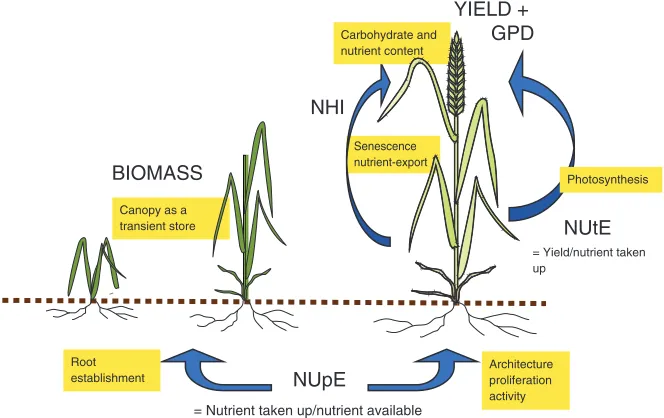
Demands for nutrients vary during development (Figure 1). As a seed ger-minates, many of the required nutrients are mobilised from seed reserves; however, the first roots soon become important for acquiring nutrients. A life cycle analysis of nitrogen demands by maize in a hydroponic experimental system confirmed varied uptake during development, mirroring demand, for example during leaf development, and accommodated by regulation of activity of nitrate transporters, and possibly involving multiple regulatory mechanisms (Garnett et al., 2013).
Adequate nutrition is required for canopy development and functionality and the canopy becomes an important sink and reserve of nutrients. This
Senescence nutrient-export
NUpE NHI
NUtE
Carbohydrate and nutrient content
Architecture proliferation activity = Nutrient taken up/nutrient available
= Yield/nutrient taken up
Canopy as a transient store
Root establishment
GPD YIELD +
BIOMASS Photosynthesis
Figure 1 Nutrient use efficiency is composed of several interacting processes, occurring at different developmental stages. Uptake of minerals occurs throughout development; the canopy acts as a sink during vegetative growth; the grain becomes an eventual sink
receivingde novotaken up nutrients and remobilised nutrients from the canopy.
Definition of major components are shown: nutrient use efficiency
(NUE)=NUpE×NUtE=yield/available N. GPD: grain protein deviation, i.e. deviation
is particularly important for micronutrients, which are acquired slowly throughout vegetative development and may subsequently be remobilised efficiently to seed tissues. Biomass will be a critical determinant of uptake and the introduction of short-statured phenotypes in modern wheat as part of the green revolution will likely have contributed to a decreased overall uptake and limited availability for remobilisation to the grain (Fan et al., 2008). After anthesis, the canopy begins to senesce and nutrients are remobilised and delivered to the newly developing sink, namely the grain (Barraclough et al., 2014). During this period, depending on conditions, nutrients will continue to be taken up by the roots and delivered to the grain and in the case of N may be a significant component of its accumulation (Bogard et al., 2010). Processes involved in these nutrient dynamics are discussed in the following sections.
3 Nutrient Translocation, the Role of Senescence, and Grain
Nutrient Accumulation
Efficient NUE, particularly of nitrogen is dependent on re-translocation from the canopy. Nutrients taken up initially and utilised for canopy synthesis and function are reused for seed formation rather than being lost from the plant with senesced canopy material. The re-translocation of minerals from vegeta-tive tissues to the grain is an important mechanism to ensure seed tissues are loaded with minerals to ensure their vigour upon germination but also has an important consequence to grain seed nutritional quality. Mineral nutri-ent contnutri-ent decline (Fan et al., 2008) was investigated in a study of 160 years of wheat samples and there was clear evidence for a recent decline in the mineral (Zn, Fe, Cu, Mg) content of grains. This could be partially attributed to higher yields and a dilution of mineral content by increased starch accu-mulation but may also be attributed to a change in plant architecture. The adoption of short stature plants would limit vegetative index, and although a high harvest index would ensure effective translocation, the total taken up may be reduced.
as protein, as well as other macronutrients and micronutrients in storage pools such as the vacuoles are efficiently remobilised and reused or go into storage pools in the newly developing grain sinks (Howarth et al., 2008). The mechanisms underpinning regulation and control of senescence have been extensively investigated (Hortensteiner and Feller, 2002), particularly in model species including Arabidopsis (Diaz et al., 2008; Have et al., 2017), and crops such as rice and maize. Similar mechanisms are assumed to exist in wheat (Zhao et al., 2015). The timing of onset and the rate of senescence will influence yield and efficiency of remobilisation. One key gene having a major impact on remobilisation efficiency is the NAM, ATAF1/2, and CUC2 domain proteins (NAC) transcription factor, no apical meristem B1 (NAM-B1), present in many ancestral wheats but largely missing from the modern gene pool (Uauy et al., 2006b). The functional NAM-B1 allele accelerates senescence and confers enhanced grain protein, Zn, and iron content; however, this may be at the expense of yield (Uauy et al., 2006a; Waters et al., 2009). Many other genes, including other NAC transcription factors (Zhao et al., 2015), appear to have contributory roles in regulating the kinetics of senescence and hence nutrient remobilisation.
1.0 1.5 2.0 2.5 3.0
2 4 6 8 10 12 14
Grain N (%)
Grain yield (t ha–1 @85% DM)
N0 N100 N200 N350
10 15 20 25 30 35 40
2 4 6 8 10 12 14
Grain Zn (ppm)
Grain yield (t ha–1 @85% DM)
N0 N100 N200 N350
(a)
(b)
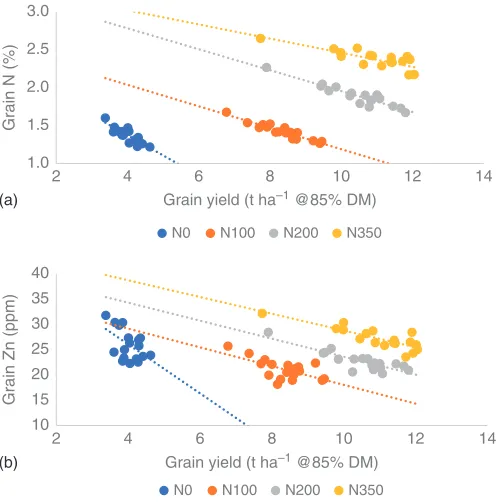
Figure 2 Grain concentrations and yield of, (a) nitrogen and (b) Zn, for a wheat germplasm panel (18 varieties) grown at 4 rates of N fertiliser inputs (0, 100, 200 and
350 kg N ha−1; with mean soil available N of 44 kg N ha−1). Data are the mean of 6 years
(2012–2017) and are samples taken from the WGIN trial at Rothamsted, UK (Barraclough et al., 2010). N determined by combustion and Zn by ICP-OES.
uptake during the vegetative phase. Nutrient accumulation and dynamics after acquisition are influenced by many factors including there being inter-dependencies with other nutrients; in this case, Zn uptake being influenced by N-fertiliser.
the gradients have substantial implications for the milling process and final product quality.
4 Transporters Are Required for Nutrient Uptake
and Cycling
Most mineral nutrients are taken up by root cells, or rarely in the case of agronomic foliar feeds, through the leaf surface, and then distributed around the plant. In addition, nutrients may be stored in intracellular organelles such as vacuoles. These movements of nutrients involve many transmembrane transport steps and many transporters responsible for this movement have been identified by gene sequence. Usually in all plant species, including wheat, large gene families encode for the transporters for specific substrates or groups of substrates. Transporters also exist for metabolites such as amino acids, and these have significance for remobilisation of N and sulfur (S) during crop maturation (senescence of leaves and grain filling). The major transporter gene families have been partially or completely identified in the hexaploid genome of wheat: members of the nitrate transporter 1/peptide transporter family (NPF) responsible for low-affinity nitrate transporter (LATS), high-affinity NRT2 nitrate transporter (HATS) as well ammonium transporter genes have been described (Bajgain et al., 2018; Buchner et al., 2010; Li et al., 2017). At least 89–94 NPF homoeologous NPF genes (Wang, Buchner and Hawkesford, unpublished), 14–17 NRT2-family genes (Buchner and Hawkesford, unpublished), and 7–8 homoeologous ammonium transporter genes (Bajgain et al., 2018; Li et al., 2017) occur in wheat. The complete Pht1 phosphate transporter gene family consists of 16 homoeologous in the three diploid subgenomes (Grun et al., 2018; Shukla et al., 2016); 14 homoeologous members are present for the sulfate transporter gene family (Buchner et al., 2010) as well as 14 ZIP zinc (Zn) transporter homoeologous (Evens et al., 2017).
100 92. 2 90 100 93.4 73.5 99.1 100 100 100 100 100 100 10 0 100 64.5
100 100
100 100
100 78.4 98.998.9
100 91.1 99.6 96.8 63 100 99.4 95.2 99.8 96.2 94.3 100 100 TaMot1-Chr7D AtSULTR4;2 AtSULTR4;1 AtMo t1 AtMot2 OsMot2 OsMot1 AtSULTR2;1 AtSULTR2;2 AtSULTR1;1 AtSULTR1;2
AtSULTR1;3 AtSULTR3;3 AtSULTR3;4
AtSULTR3;1 AtSULTR3;2 AtSULTR3;5 TaSULTR2;1-Chr4D TaSULTR3;3-Chr2D TaSULTR1;1b-Chr4D TaSULTR1;1a-Chr4D TaSULTR3;4-Chr7D TaSULTR3;2-Chr6D TaSULTR3;1-Chr4D TaSULTR3;5-Chr3D TaSULTR4;1-Chr5D TaSULTR1;3-Chr5D OsSULTR3;1 OsSULTR3;6 OsSULTR4;1 OsSULTR2;2 OsSULTR2;1 OsSULTR1;2 OsSUL TR1 ;1
Tomatsu et al., 2007) with suggested locations on either plasma membranes or tonoplast (Bittner, 2014). There is a suggestion that some members of the Group 3 clade, at least in rice, may transport phosphate (Yamaji et al., 2017; Zhao et al., 2016).
Remobilisation of nutrients, particularly N and S is often accomplished by protein degradation (Gilbert et al., 1997; Howarth et al., 2008) followed by transport of constituent amino acids and peptides directly or following inter-conversion. Members of the NPF gene family are also involved in peptide transport and recently the gene family for wheat amino acid transporters has been described (Wan et al., 2017). More than 100 distinct groups of homoeol-ogous of amino acid transporters were identified showing specific temporal and spatial patterns of expression.
5 The Transporter Systems Are Regulated by Nutrition
The transporter systems show nutritional regulation of gene expression to optimise efficient nutrient capture in relation to changing supply in the envi-ronment and demand during development (Garnett et al., 2013). For example, increased levels of expression of sulfate transporters under sulfur-limiting conditions is common although not universal for all isoforms and tissues and has been shown to occur not only under laboratory conditions (Buchner et al., 2010) but also in the field (Shinmachi et al., 2010). Similar regulation of phos-phate (Grun et al., 2018) and Zn (Evens et al., 2017) transporters has been shown in wheat.
Some low-affinity NPF as well as high-affinity NRT2 nitrate transporters are induced by nitrate (Orsel et al., 2002). Many, however, have a complex pattern of expression in relation to tissue specificity, growth stage, and sink/source demands (Buchner and Hawkesford, 2014).
Induction is a response to maximise efficiency of capture of N subject to availability as this is the major driver for protein synthesis and growth. Uptake of other nutrients needs to be balanced with N-uptake and growth and is thus demand driven. For optimum uptake of these nutrients, excess uptake, which would be energetically inefficient, is avoided by repression of expression.
6 Prospects to Improve Mineral Accumulation
modification of root architecture (Atkinson et al., 2015) and distribution at the level of internal partitioning. The roles of specific transporters responsible for nutrient dynamics and the identification of new alleles involved in NUE will be important underpinning knowledge for both target areas. Improvements will be through traditional breeding but may also encompass novel biotechnological approaches. One example is the enhancement of seed sink strength for nutrients via specific over-expression of an iron transporter located on the tonoplast, with consequent vacuole accumulation (Connorton et al., 2017). Overexpression in the endosperm, using an endosperm-specific promoter, improved overall iron accumulation but also targeted this nutritionally important micronutrient to the key tissue eaten by consumers, making this an effective strategy for biofortification. Expression of key transporters such as NRT1.1B is associated with high NUE contributing to both uptake and root-to-shoot transport in indica as compared to japonica rice (Hu et al., 2015). Overexpression of specific ion transporters to further enhance uptake would appear to be a good strategy for improving uptake; however, the complex gene families and expression patterns present a challenge. However, the overexpression of a specific pH-sensitive nitrate transporter (OsNRT2.3) in rice, with a variety of constitutive promoters, resulted in a substantial improvement in NUE in the field (Fan et al., 2016). In this case, it was suggested that the transporter is involved as a pH sensor in the phloem and high expression results in increased pH-buffering capacity enhancing N, Fe, and P-uptake, resulting in an extremely attractive strategy. Further enhancements to this strategy may use a more tissue-specific expression as well as application of this technology to a wide range of crops, including wheat.
Acknowledgements
Rothamsted Research receives strategic funding from the Biotechnological and Biological Sciences Research Council (BBSRC) as part of the 20:20 Wheat (BBS/E/C/00005202) and Designing Future Wheat projects (BB/P016855/1), and by the Defra sponsored Wheat Genetic Improvement Network project.
Related Articles
Root Architecture
Photosynthetic Carbon–Nitrogen Interactions: Modelling Inter-Pathway Control and Signalling
Effect of Nutrient Availability on Root System Development Nitrogen Assimilation and its Relevance to Crop Improvement
Transcriptional Profiling Approaches for Studying Nitrogen Use Efficiency
Transport Systems for NO3−and NH
4+
The Utilization of Nitrogen by Plants: A Whole Plant Perspective
Sensing, Signalling, and Control of Phosphate Starvation in Plants: Molecular Players and Applications
References
Atkinson, J.A., Wingen, L.U., Griffiths, M. et al. (2015). Phenotyping pipeline reveals major seedling root growth QTL in hexaploid wheat.Journal of Experimental Botany 66: 2283–2292.
Bajgain, P., Russell, B., and Mohammadi, M. (2018). Phylogenetic analyses and in-seedling expression of ammonium and nitrate transporters in wheat.Scientific
Reports8.
Barraclough, P.B., Howarth, J.R., Jones, J. et al. (2010). Nitrogen efficiency of wheat: genotypic and environmental variation and prospects for improvement.European
Journal of Agronomy33: 1–11.
Barraclough, P.B., Lopez-Bellido, R., and Hawkesford, M.J. (2014). Genotypic variation in the uptake, partitioning and remobilisation of nitrogen during grain-filling in wheat.Field Crops Research156: 242–248.
Baxter, I., Muthukumar, B., Park, H.C. et al. (2008). Variation in molybdenum content across broadly distributed populations of Arabidopsis thaliana is controlled by a mitochondrial molybdenum transporter (MOT1).Plos Genetics4: e1000004. Bittner, F. (2014). Molybdenum metabolism in plants and crosstalk to iron.Frontiers in
Plant Science5: 28.
Bogard, M., Allard, V., Brancourt-Hulmel, M. et al. (2010). Deviation from the grain protein concentration-grain yield negative relationship is highly correlated to post-anthesis N uptake in winter wheat. Journal of Experimental Botany 61: 4303–4312.
Buchner, P. and Hawkesford, M.J. (2014). Complex phylogeny and gene expression patterns of members of the NITRATE TRANSPORTER 1/PEPTIDE TRANS-PORTER family (NPF) in wheat.Journal of Experimental Botany65: 5697–5710. Buchner, P., Parmar, S., Kriegel, A. et al. (2010). The sulfate transporter family in wheat:
tissue-specific gene expression in relation to nutrition.Molecular Plant3: 374–389. Connorton, J.M., Jones, E.R., Rodriguez-Ramiro, I. et al. (2017). Wheat vacuolar iron
transporter TaVIT2 transports Fe and Mn and is effective for biofortification.Plant
Physiology174: 2434–2444.
De Brier, N., Gomand, S.V., Donner, E. et al. (2016). Element distribution and iron spe-ciation in mature wheat grains (Triticum aestivumL.) using synchrotron X-ray fluo-rescence microscopy mapping and X-ray absorption near-edge structure (XANES) imaging.Plant Cell and Environment39: 1835–1847.
Evens, N.P., Buchner, P., Williams, L.E., and Hawkesford, M.J. (2017). The role of ZIP transporters and group F bZIP transcription factors in the Zn-deficiency response of wheat (Triticum aestivum).Plant Journal92: 291–304.
Fan, M.S., Zhao, F.J., Fairweather-Tait, S.J. et al. (2008). Evidence of decreasing mineral density in wheat grain over the last 160 years.Journal of Trace Elements in Medicine
and Biology22: 315–324.
Fan, X.R., Tang, Z., Tan, Y.W. et al. (2016). Overexpression of a pH-sensitive nitrate transporter in rice increases crop yields.Proceedings of the National Academy of
Sci-ences of the United States of America113: 7118–7123.
Felsenstein, J. (1985). Confidence-limits on phylogenies – an approach using the boot-strap.Evolution39: 783–791.
Garnett, T., Conn, V., Plett, D. et al. (2013). The response of the maize nitrate transport system to nitrogen demand and supply across the lifecycle.New Phytologist198: 82–94.
Gilbert, S.M., Clarkson, D.T., Cambridge, M. et al. (1997). SO42−deprivation has an
early effect on the content of ribulose-1,5-bisphosphate carboxylase/oxygenase and photosynthesis in young leaves of wheat.Plant Physiology115: 1231–1239.
Gregersen, P.L., Holm, P.B., and Krupinska, K. (2008). Leaf senescence and nutrient remobilisation in barley and wheat.Plant Biology10: 37–49.
Grun, A., Buchner, P., Broadley, M.R., and Hawkesford, M.J. (2018). Identification and expression profiling of Pht1 phosphate transporters in wheat in controlled environ-ments and in the field.Plant Biology20: 374–389.
Guiboileau, A., Yoshimoto, K., Soulay, F. et al. (2012). Autophagy machinery controls nitrogen remobilization at the whole-plant level under both limiting and ample nitrate conditions in Arabidopsis.New Phytologist194: 732–740.
Have, M., Marmagne, A., Chardon, F., and Masclaux-Daubresse, C. (2017). Nitrogen remobilization during leaf senescence: lessons from Arabidopsis to crops.Journal of
Experimental Botany68: 2513–2529.
Hawkesford, M.J. (2003). Transporter gene families in plants: the sulphate transporter gene family – redundancy or specialization?Physiologia Plantarum117: 155–163. Hortensteiner, S. and Feller, U. (2002). Nitrogen metabolism and remobilization
dur-ing senescence.Journal of Experimental Botany53: 927–937.
Howarth, J.R., Parmar, S., Jones, J. et al. (2008). Co-ordinated expression of amino acid metabolism in response to N and S deficiency during wheat grain filling.Journal of
Experimental Botany59: 3675–3689.
Hu, B., Wang, W., Ou, S.J. et al. (2015). Variation in NRT1.1B contributes to nitrate-use divergence between rice subspecies.Nature Genetics47: 834.
Kataoka, T., Watanabe-Takahashi, A., Hayashi, N. et al. (2004). Vacuolar sulfate trans-porters are essential determinants controlling internal distribution of sulfate in Ara-bidopsis.Plant Cell16: 2693–2704.
Kearse, M., Moir, R., Wilson, A. et al. (2012). Geneious basic: an integrated and extend-able desktop software platform for the organization and analysis of sequence data.
Bioinformatics28: 1647–1649.
Larkin, M.A., Blackshields, G., Brown, N.P. et al. (2007). Clustal W and clustal X ver-sion 2.0.Bioinformatics23: 2947–2948.
Li, T., Liao, K., Xu, X. et al. (2017). Wheat ammonium transporter (AMT) gene family: diversity and possible role in host-pathogen interaction with stem rust.Frontiers in
Li, W., Chen, M., Wang, E. et al. (2016). Genome-wide analysis of autophagy-associated genes in foxtail millet (Setaria italica L.) and characterization of the function of SiATG8a in conferring tolerance to nitrogen starvation in rice.BMC Genomics17: 797.
Lim, P.O., Kim, H.J., and Nam, H.G. (2007). Leaf senescence.Annual Review of Plant
Biology58: 115–136.
Moore, K.L., Tosi, P., Palmer, R. et al. (2016). The dynamics of protein body formation in developing wheat grain.Plant Biotechnology Journal14: 1876–1882.
Mosleth, E.F., Wan, Y.F., Lysenko, A. et al. (2015). A novel approach to identify genes that determine grain protein deviation in cereals.Plant Biotechnology Journal 13: 625–635.
Nei, M. and Kumar, S. (2000).Molecular Evolution and Phylogenetics. Oxford/New York: Oxford University Press.
Orsel, M., Filleur, S., Fraisier, V., and Daniel-Vedele, F. (2002). Nitrate transport in plants: which gene and which control?Journal of Experimental Botany53: 825–833. Raun, W.R. and Johnson, G.V. (1999). Improving nitrogen use efficiency for cereal
pro-duction.Agronomy Journal91: 357–363.
Saitou, N. and Nei, M. (1987). The neighbor-joining method: a new method for recon-structing phylogenetic trees.Molecular Biology and Evolution4: 406–425.
Savill, G.P., Michalski, A., Powers, S.J. et al. (2018). Temperature and nitrogen supply interact to determine protein distribution gradients in the wheat grain endosperm.
Journal of Experimental Botany69: 3117–3126.
Shinmachi, F., Buchner, P., Stroud, J.L. et al. (2010). Influence of sulfur deficiency on the expression of specific sulfate transporters and the distribution of sulfur, selenium, and molybdenum in wheat.Plant Physiology153: 327–336.
Shukla, V., Kaur, M., Aggarwal, S. et al. (2016). Tissue specific transcript profiling of wheat phosphate transporter genes and its association with phosphate allocation in grains.Scientific Reports6.
Tomatsu, H., Takano, J., Takahashi, H. et al. (2007). AnArabidopsis thalianahigh-affinity molybdate transporter required for efficient uptake of molybdate from soil.
Pro-ceedings of the National Academy of Sciences of the United States of America 104:
18807–18812.
Uauy, C., Brevis, J.C., and Dubcovsky, J. (2006a). The high grain protein content gene Gpc-B1 accelerates senescence and has pleiotropic effects on protein content in wheat.Journal of Experimental Botany57: 2785–2794.
Uauy, C., Distelfeld, A., Fahima, T. et al. (2006b). A NAC gene regulating senescence improves grain protein, zinc, and iron content in wheat.Science314: 1298–1301. Wan, Y.F., King, R., Mitchell, R.A.C. et al. (2017). Spatiotemporal expression patterns
of wheat amino acid transporters reveal their putative roles in nitrogen transport and responses to abiotic stress.Scientific Reports7.
Waters, B.M., Uauy, C., Dubcovsky, J., and Grusak, M.A. (2009). Wheat (Triticum
aestivum) NAM proteins regulate the translocation of iron, zinc, and nitrogen
compounds from vegetative tissues to grain.Journal of Experimental Botany 60: 4263–4274.
Zhao, D., Derkx, A.P., Liu, D.C. et al. (2015). Overexpression of a NAC transcription factor delays leaf senescence and increases grain nitrogen concentration in wheat.
Plant Biology17: 904–913.
Zhao, H.J., Frank, T., Tan, Y.Y. et al. (2016). Disruption of OsSULTR3;3 reduces phytate and phosphorus concentrations and alters the metabolite profile in rice grains.New
Phytologist211: 926–939.