Professional development for teacher educators: the missing link?
Helen Lewis
University of Wales Trinity Saint David
ABSTRACT
Within Wales, teacher training has been placed under considerable scrutiny (Estyn, 2012; 2013; 2015). The focus for future development in the sector has largely emphasised systems, models and structures. Within this paper I will suggest why, in my own experience, ensuring high quality professional development opportunities for teacher educators is so important. For the purpose of this paper, I will take the view that teacher educators are ‘all those who actively facilitate the (formal) learning of student teachers and teachers’ (European Commission, 2013: 8). The paper identifies some of the challenges facing teacher educators wishing to undertake professional development, such as practical issues, teacher educators’ professional identity and the perceived value of different types of professional knowledge. It also considers the benefits of teacher educators undertaking research activity, and why these
opportunities may contribute to the ‘research-rich’ educational systems that are highlighted as best practice (eg Leat et al, 2014). It aims to indicate why professional development in teacher education must not be the ‘missing link’ in educational reform. This paper puts these challenges and benefits into context through reflection on the experiences I had during my doctoral studies. It therefore takes a retrospective narrative approach – I will provide ‘rememberings, retrospections and constructions’ (Freeman, 1984:4) of my personal experiences of professional development as evidence.
Key words: teacher educators, professional development, classroom-based research, professional identity
Background
have been well supported in my own professional development. Whilst current research suggests that the model of one-off day development courses lacks impact (Garet et al , 2001; Parsad et al, 2001; Atay, 2004), I have personally found such events useful. They have frequently ignited my interest, or provided useful insight into materials and approaches. They have allowed me to network with peers and to return immediately to my context to put ideas into practice. The information that I have gleaned on many of these courses is reflected in my day-to-day practice. Perhaps I have been fortunate in the choices that I have made, for Lord Adonis (2011:14) reported that ‘for most teachers, professional development has traditionally been haphazard, off-site, barely relevant, poorly provided, and a chore at best.’ Indeed, there are many factors that may have an impact on the quality of such development
opportunities – including choice, expertise of the trainer, and relevance to the
individual. High costs for training may limit the opportunities available to educators in all sectors, and we do not have time to merely sit and listen to expensive speakers selling their personal brand of snake oil. In my own experience, the most effective professional development opportunities are not identified by location or duration of training. Rather they have been linked to credible providers, who have challenged my thinking. The opportunities have supported me in reflecting on my own practice, within my own context, so that I can make improvements to it.
After graduating with a PGCE from the Institute of Education in London, I taught in inner-city primary schools in London. Most development opportunities involved attending day courses at a local teacher centre. These were more than a pleasant day out with lunch – most had direct impact on my classroom practice and on my curriculum leadership across the school. For example, I attended courses on cognitive acceleration materials that I then used within my class. Having identified the positive impact of the approaches on both teaching and learning, I subsequently built these into the mathematics curriculum across the school, and provided training for my team of staff. When I started working for ESIS (Education School Improvement Service) in South Wales I sustained and developed this interest in cognitive
More recently, within the context of school improvement and higher education, my professional development opportunities have been varied. Whilst I have found that there are comparatively few one-day courses aimed specifically at teacher educators, the opportunity to work on longer term, collaborative projects with teachers and teacher educators has been invaluable. I have been able to take part in the Welsh Educational Research Network (WERN) and have been supported in undertaking a PhD. I was able to undertake collaborative fellowship visits, working with experts in my field of interest. I have gained experience leading collaborative communities of enquiry, most recently working with teachers to explore children’s development of thinking skills, and the teaching of thinking in the Foundation Phase.
These opportunities have transformed my knowledge and understanding of theory and practice, and have allowed me to experience firsthand the challenges and benefits of research. This has informed my role in the university, and ultimately has raised my confidence in seeing myself as a ‘researcher’ as well as a teacher educator. However, WERN is no more – and it has not been replaced with a suitable alternative within Wales.
Discussion
Provision for teacher education in Wales has been under scrutiny in recent years. Inspection reports across the sector have raised significant concerns (Estyn, 2012; 2013; 2015). Reviews commissioned by the Welsh Government have raised questions about quality, leadership and partnership working with schools (Taberrer, 2013; Furlong, 2015). In 2015, the Education Minister, Huw Lewis ‘called time’ on current arrangements, stating that ‘We need an ITET sector that can act as a key driver in building workforce capacity, particularly as we prepare for the new curriculum for Wales’ (Evans, 2016).
the UK is variable. In Wales, research capacity and the integration of research into teacher education remains underdeveloped (Leat et al, 2014; Furlong, 2016).
There are a number of possible reasons for why this might be the case. The European Commission (2013:38) suggest that ‘teacher educators do not always get the support and challenge they need in terms of their education and professional
development’. One underlying reason may be a lack of a coherent professional identity for teacher educators. In reality we have multiple professional identities. For example: ‘[we] may think of themselves primarily as school teachers, as teachers in higher education, as researchers, or as teachers of teachers - or [we] may identify with several of these roles simultaneously’ (European Commission, 2013:8).
Teacher educators need to be supported in finding new ways to explore their professional identity – to understand and talk about their work (Doecke, 2004). Murray and Male (2005:132) give the example of Joanne, a teacher who made the move to initial teacher education and who subsequently found the expectations of research to be a source of stress: ‘I’ve been here for two years now and I still don’t see myself as an ‘academic’. That’s just not a label I like, it’s not me. I say that I’m one of the people here who don’t ‘do’ research and I’m not joking. I don’t really know what it means to be a researcher in this job’. For Joanne, the challenge of understanding herself in this new role was taking time.
I did not move from school directly into teacher education, and so the transition was possibly not as difficult for me as it was for Joanne. I was already used to working with peers as well as children, and in teaching and mentoring adults. However, I am aware that there is still an existing view of ‘theory versus practice’ within my own department – does our professional identity relate to academic endeavor or practical pedagogy? This is not a new dilemma, nor unique to my own context. Leat et al (2014) suggest that there is still a tendency to view research as a body of knowledge – which individuals may or may not choose to make use of. As Taylor (1983: 41) puts it:
I would argue that teacher educators should be encouraged to see the value of both – as ‘praxis’ - acknowledged by Darling-Hammond (2000:171), who suggests that ‘If universities are to continue to make the important contribution to the education of teachers that they can make, they need to pursue these ideals of knowledge building and truth finding by creating a genuine praxis between ideas and experiences, by honoring practice in conjunction with reflection and research’.
Therefore, teacher educators need to see the value and impact of professional development. To become research-rich, the education systems in Wales, and the individuals working within these systems, need to see research as a professional learning process. This process can transform our own practice and can support
teachers, teacher educators and learners to actively engage in enquiry. Research should be something that all, not a minority feel, empowered to undertake. In order to do this effectively there needs to be clarity over what we mean by ‘research’. In universities, practice-based research tends to be considered of inferior value, if compared with more traditional types of research, such as theoretical, subject-specific studies. For example, Hales and Clarke (2016) suggest that a there is a hierarchy of prestige assigned to research in institutions – evident through a consistent emphasis on doctoral
qualification and scholarly achievement. Yet, according to the BERA-RSA inquiry (Leat et al, 2014), research can happen at micro, macro, local and national levels. The types of activities undertaken can include literature reviews, peer-to-peer observation, work scrutiny, action research, school or college wide enquiry, and participation in national and international studies. Research can involve individuals, small groups or large networks. Outputs can be varied – through for instance social media, in-house presentations, training materials, conference presentations, papers or development courses, and can be disseminated to a wide audience such as learners, parents, colleagues, the professional community, the academic community or the wider community.
but also contribute to the wider knowledge base relating to teaching thinking skills in the Foundation Phase. Some of the thinking materials that I explored in my research have been used successfully by my students, and one of the key research tools – video stimulated reflective dialogue - is now being used to support my own trainee teachers in their own development, and new colleagues in their induction. Furthermore, I can act as a role model for my students – Lunenberg et al (2007) suggests this is crucial – we send important messages about lifelong learning and the value we place on for example, enquiry, through our actions.
I would therefore argue that an in-depth understanding of practice-based research, and involvement in such activity, is valuable to those working in teacher education. The relevance of this type of activity may be as important in the day-to-day practices of the beginner teachers as theoretical research papers. This is certainly true for David, who, as a new teacher educator says that ‘I know why I’m here, I’m valued for my up-to- date knowledge of what’s happening in schools, and the students know that I’m newly out of school and they value that, that I know what it’s like out there for them teaching on School Experience’ (Murray and Male, 2005:132). This is valuable experience. But it is not enough. As teacher educators we also need to know why we are adopting certain approaches, what evidence and theory underpins them, and how
we can evaluate their impact. For me, the opportunity to undertake doctoral research into an area that I am excited and enthusiastic about has allowed me to explore, reflect upon and deepen my understanding. It also enabled me to work with a collaborative community of like-minded teachers, and to spend sustained periods of time back in schools. My colleagues undertaking postgraduate research are also excited by the opportunity to pursue an area of interest, stretch themselves intellectually and gain a sense of personal development. They feel better equipped to engage and support students. Furthermore, becoming research active has allowed them to be more
empathetic to the student experience – saying that gaining a better understanding of the trials of referencing, meeting deadlines and navigating Moodle are added bonuses.
see that there are many ways of undertaking our professional development – and these can all have value.
Clearly, if teacher educators need to recognize the value of all types of research, and be encouraged to undertake some of these, the systems in which they operate need to allow time for these activities. Hales and Clark (2016) acknowledge that in the institutions involved in their study, whilst research was viewed as important, teaching was given the highest priority in terms of activity and work roles. Although Guilfoyle
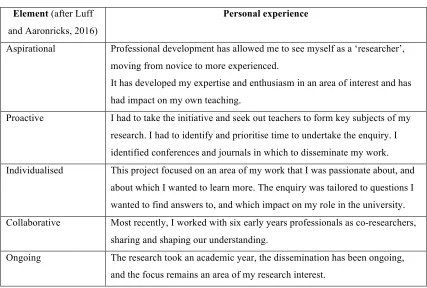
et al (1995) suggest teacher educators generally meet with little support, in my own experience, the time to undertake research is available, but not in consistent, regular blocks. My colleagues indicate that meeting their own assignment deadlines often coincides with periods of intense lecturing or school visits and so can feel very pressurized. Given the constraints of time, it is important that individual teacher educators see that the professional development that they undertake is effective, and that the outcomes are perceived to be valued within the educational community. Luff and Aaronricks (2016) suggest that effective professional development has nine elements, and Table 1 indicates how I have tried to address these elements in my own research.
Table 1. Elements of effective professional development and my own experiences
Element (after Luff and Aaronricks, 2016)
Personal experience
Aspirational Professional development has allowed me to see myself as a ‘researcher’, moving from novice to more experienced.
It has developed my expertise and enthusiasm in an area of interest and has had impact on my own teaching.
Proactive I had to take the initiative and seek out teachers to form key subjects of my research. I had to identify and prioritise time to undertake the enquiry. I identified conferences and journals in which to disseminate my work. Individualised This project focused on an area of my work that I was passionate about, and
about which I wanted to learn more. The enquiry was tailored to questions I wanted to find answers to, and which impact on my role in the university. Collaborative Most recently, I worked with six early years professionals as co-researchers,
sharing and shaping our understanding.
Well-led and managed I had to set timelines and work schedules. I had to meet deadlines and design and evaluate the project. I had to maintain communication with the teachers throughout the project.
Reflective I have learnt from reflecting on my own knowledge, beliefs and values through my research. Discussing individual understandings with others and reflecting on my own understandings has been invaluable.
Praxaelogical My project centred on classroom-based action research, and allowed me to connect theory and practice more powerfully than I would have done without the opportunity to undertake research.
Individuals need to be committed to professional development and make time when they can – it is clearly a challenge, but not one unique for teacher educators, and the majority of my colleagues are clear that this is a challenge worth overcoming.
Conclusion
Teacher educators are in a unique position. We work with learners from all backgrounds, at all stages within the broad educational system. We work with hundreds of students, who bring with them individual experiences, beliefs and
approaches. This is also the case with colleagues from across the sector. . We visit our students in a wide-range of different schools and settings, meeting many mentors on a regular and often sustained basis. We have access to research literature, expertise and professional networks. Hargreaves and Fullan (1992) suggest that we should be in a position to learn from these types of encounters and opportunities. We should be well placed to undertake all manner of research activity that can have a genuine impact on learners across the education system. Perhaps as a sector we need to argue more vociferously about how these opportunities should be valued and used more strategically to inform the profession. Rather than only focusing on reforming structures and systems of initial teacher education, policy makers need to remember that teacher educators need the opportunity to engage with high quality professional development, and so systems must include the appropriate support to put this
Of course, this article has been written from my own personal perspective. Adopting an autobiographical method ‘bets in the capacity of retrieving memory and narrating by the social actors themselves’ (Santamarina and Marinas, 1994:259). As such it is selective and I have made my own interpretations of my experiences - as suggested by Soares (2001:40) ‘I do it from the present, because this is what tells me what is
important and what is not; I do not describe; I interpret’. My personal experiences may not be representative of other teacher educators. However, based on these experiences, I do believe that as a sector we are ready and keen to engage with a research-led agenda. Let’s hope that our professional learning opportunities are not the missing link in the reforms to the Welsh education system that lie ahead.
References
Adonis, A. (2001). High challenge, high support London, Policy Network.
Atay, D. (2004). Collaborative dialogue with student teaches as a follow-up to teacher in-service education and training Language Teaching Research 8(2) 143−162.
Day C. (1999). Developing Teachers: the Challenges of Lifelong Learning. London: Falmer Press.
Darling-Hammond, L. (2000). How Teacher Education Matters Journal of Teacher Education Vol. 51 (3), 166 – 173.
Doecke, B. (2004). Professional identity and educational reform: confronting my habitual practices as a teacher educator. Teaching and Teacher Education 20 (3) 203−215.
Estyn (2012). A report on South West Wales Centre of Teacher Education and Training, Cardiff: Estyn.
Estyn (2015). A report on North and Mid Wales Centre for Teacher Education and Training, Cardiff: Estyn.
European Commission (2013). Supporting Teacher Educators for better learner outcomes Available at: http://ec.europa.eu/education/policy/school/doc/support-teacher-educators_en.pdf (accessed 5 August 2016).
Evans, G. (2016).‘We need to raise our game in the way teacher training is delivered’
Western Mail, 24 March 2016.
Freeman, M. (1984). ‘History, narrative, and life-span developmental knowledge’,
Human Development 27 1-19.
Furlong, J. (2015). Teaching Tomorrow’s Teachers; options for the future of initial teacher education in Wales. Cardiff: Welsh Government.
Furlong, J. (2016). ‘Initial Teacher Education in Wales – a Rationale for Reform’
Wales Journal of Education, 18 (1), 45−63.
Garet, M., Porter, A., Desimone,L., Birman, B., Yoon, K. (2001). ‘What makes professional development effective? Analysis of a national sample of teachers’
American Education Research Journal 38(4) 915−945.
Guilfoyle, K., Hamilton, M.L., Pinnegar,S., Placier, M. ‘Becoming teachers of teachers: The paths of four beginners’ in Russell, T., Korthagen, F. (1995) (eds.)
Teachers who teach teachers London: Falmer Press.
Hales, A. Clarke, A. (2106). ‘So you want to be a teacher educator? The job
advertisement as a construction of teacher education in Canada’, Asia-Pacific Journal of Teacher Education 44 (4) 320−332.
Hargreaves, A., Fullan, M.G. (1992) (eds.) Understanding Teacher Development
London: Cassell.
Leat, D., Lofthouse, R., Reid, A. (2014). Research and Teacher Education: The BERA-RSA Inquiry: Teachers’ Views: Perspectives on Research Engagement Oxford:
Luff, P., Aaronricks, K. (2016). The value of learning through enquiry for professional development Paper presented at the 26th Annual EECERA conference, Dublin.
Lunenberg M. , Korthagen F. and Swennen A. (2007). The Teacher Educator as a Role Model. Teaching and Teacher Education, 23, 586− 601.
Murray, J., Male, T. (2005). ‘Becoming a teacher educator: evidence from the field’,
Teaching and Teacher Education 21 125–142.
Parsad, B., Lewis, L., Farris Westat, E., Greene, B. (2001). Teacher Preparation and Professional Development: 2000 Washington: National Center for Education Statistics. Santamarina, C. & Marinas, J. M. (1994). ‘Historias de vida y historia oral’, in J. M. Delgado & J. Gutiérres (eds.), Métodos y técnicas cualitativas de investigación en
ciencias sociales (pp. 259- 283). Madrid: Síntesis, translation in Abrahão, M.H.M.B. (2012) ‘Autobiographical research: Memory, time and narratives in the first person’
European Journal for Research on the Education and Learning of Adults Vol.3, (1) 29-41.
Soares, M. (2001). Metamemória-memórias: travessia de uma educadora. São Paulo:
Cortez translation found in Abrahão, M.H.M.B. (2012) Autobiographical research: Memory, time and narratives in the first person European Journal for Research on the Education and Learning of Adults Vol.3, (1) 29-41.
Swennen A., Jones K. and Volman M. (2010). ‘Teacher Educators: their Identities, Sub-identities and Implications for Professional Development’, Professional Development in Education, 36 (1–2) 131–148.
Tabberer, R. (2013). A Review of Initial Teacher Training in Wales. Cardiff: Welsh Government.
Taylor, W. (1983). ‘Teacher education: achievements, short-