I
NTEGRATION OF
L
INKED
OPEN
DATA IN
CASE-BASED
REASONING
SYSTEMS
Christian Severin Sauer
1Kerstin Bach
2Klaus-Dieter Althoff
2University of Hildesheim, Dep. of Computer Science
Intelligent Information Systems Lab
D-31141, Hildesheim, Germany
1
[email protected],
2{
lastname
}
@iis.uni-hildesheim.de
Abstract
This paper discusses the opportunities of inte-grating Linked Open Data (LOD) resources into Case-Based Reasoning (CBR) systems. Upon the application domain travel medicine, we will exemplify how LOD can be used to fill three out of four knowledge containers a CBR system is based on. The paper also presents the applied techniques for the realization and demonstrates the performance gain of knowledge acquisition by the use of LOD.
1
Introduction
The recent developments in the field of Linked Open Data (LOD) further added value to the already existing vast amount of structured information that is available through the use of LOD [Bizer et al., 2008]. The availability of such an amount of structured information suggests apply-ing LOD to the semi-automatic generation of knowledge. In the context of our work knowledge represents the data that is organized in the knowledge containers of a Case-Based Reasoning (CBR) system. Each CBR system uses the four knowledge containersvocabulary,similarity mea-sures, transformational knowledge andcases. The work presented in this paper focuses on filling the vocabulary and similarity measure containers as well as generating cases from LOD. Therefor, we demonstrate some possibilities of filling the aforementioned knowledge containers using simplified examples. These examples are preliminary, thus cannot be used in a real-world CBR system, because they are incomplete.
The linked data is provided for free and contains com-prehensive knowledge where each term is assigned to at least one category and thus being represented in a specific context. The latest development in the field of LOD can be seen in the development of such complex knowledge repositories as for example given by the DBpedia ontol-ogy1. DBpedia contains many terms originating from the
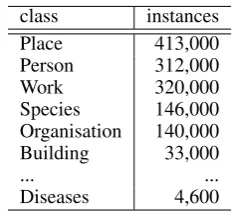
on-line encyclopedia Wikipedia. These terms are organized in an ontology and are being enriched with further infor-mation such as different labels in various languages. Cur-rently, the DBpedia ontology contains 1,478,000 instances, i.e. Table 1.
Knowledge acquisition is still the bottleneck within the development of CBR systems. Our approach aims at au-tomatization and for this purpose we propose a schema that extracts knowledge from LOD sources and provides and transforms it for CBR systems.
1
http://dbpedia.org/ontology/
class instances Place 413,000 Person 312,000
Work 320,000
Species 146,000 Organisation 140,000 Building 33,000
... ...
Diseases 4,600
Table 1: Instances of DBpedia
The remaining sections of this paper are structured as follows: In section 2 we describe the application domain travel medicine, especially the docQuery project in which the experiments are carried out, followed by section 3 that describes how knowledge can be integrated in CBR sys-tems. Section 4 presents the implementation details of our approach. The following section 5 presents experimental results of our approach before we sum up the paper and give an outlook on future work in the final section 7.
2
Application Domain: Travel Medicine
Travel medicine is an interdisciplinary specialty concerned with the prevention, management and research of health problems associated with travel, and covers all medical as-pects a traveler has to take care of before, during and after a journey. For that reason it covers many medical areas and combines them with further information about the destina-tion, the activities planned and additional conditions which also have to be considered when giving medical advice to a traveler. Travel medicine starts when a person moves from one place to another by any mode of transportation and stops after returning home without diseases or infections.
The realization of the travel medicine project docQuery is based on the SEASALT (Sharing Experience using an Agent-based System Architecture LayouT) architecture [Reichleet al., 2009] that is especially suited for the acqui-sition, handling and provision of experiential knowledge as it is provided by communities of practice and represented within Web 2.0 platforms. It is based on the Collabora-tive Multi-Expert-Systems (CoMES), approach presented by Althoff et. al. [Althoffet al., 2007], a continuation of combining established artificial intelligence techniques and the application of the product line concept (known from software engineering) creating knowledge lines.
certain topic. Further the multi-agent-system is aggregat-ing a composed result. However, within this paper we only focus on one CBR systems that contains information about diseases that might somebody can get infected with during a journey.
3
CBR System
CBR, the episodical knowledge, especially made experi-ences and successfully applied solutions for problems draw a huge potential for the development of an Experience Web [Plaza, 2008], because the experiences of many WWW users can be captured in case bases and provided in CBR systems. Because of the fact that CBR systems are based on experiences it is much easier to use them to handle ex-periences in comparison to systems that are based on tech-nologies from the areas of information retrieval or seman-tic web. Experiences in CBR systems occur in all types of knowledge: mostly in cases, but also similarity mea-sures, vocabulary and transformational knowledge can be derived. Huge amounts of raw data for the knowledge ex-traction is available on the web communities and the chal-lenge is making these experiences available.
According to Richter [Richter, 1998], the knowledge of CBR systems can be provided in all four knowledge con-tainers that include vocabulary, similarity measures, trans-formational (or adaptation) knowledge and cases. We fo-cus on how the knowledge containers can be filled using the experiences provided in web communities. Therefore we have to extract the knowledge before it can be stored.
Further on, we deal with data sources that are mostly free text what usually requires a symbolic representation of keywords. That is the reason why we currently focus on the extraction of taxonomies that can be used for both, enhancing the vocabulary and assigning the similarity.
4
Implementation
Within this paper we present how knowledge about dis-eases can be extracted from LOD and integrated in a CBR system. Our CBR system has been developed using the open source tool myCBR [Stahl and Roth-Berghofer, 2008], thus all results produced by our application are com-patible with the myCBR case representation and thus can be applied in myCBR-based applications. In case of the generation of taxonomies that contains knowledge about the similarity between objects represented in the taxonomy, we use the Knowledge Extraction Workbench (KEWo) to further refine the initially provided data from LOD. A more detailed description of KEWo can be found in [Bachet al., 2010b] and [Sauer, 2010].
As the first step we retrieved data about diseases from the DBpedia ontology. The result of such a retrieval can be seen in figure 1. In this case we queried for all available diseases in the ontology and their German labels. The fig-ure shows the shortened result containing the URI and the according label.
Furthermore, we queried the DBpedia ontology in order to extend our information retrieval by using the Resource Description Framework Schema (RDFS) to retrieve labels of diseases in different languages. Also, we retrieved the Simple Knowledge Organization System based (SKOS) in-formation about the categories a disease belongs to, e.g. that a ”bite” is a member of the category injuries. Analo-gous to the retrieval of German labels of different diseases we also retrieved the according German labels of these
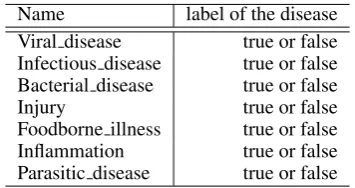
Name label of the disease Viral disease true or false Infectious disease true or false Bacterial disease true or false
Injury true or false
Foodborne illness true or false Inflammation true or false Parasitic disease true or false
Table 2: Disease categories (derived from DBPedia)
categories. The technique used for these initial retrieval steps was a set of SPARQL queries conducted via the open source Desktop-SPARQL-Query tool ”Twinkle”2. Listing
4 shows an example for a query retrieving all diseases from the DBpedia ontology together with the categories the are part of filtered in that way, that only the German labels of the diseases and the categories are returned.
Listing 1: Example Query
PREFIX r d f s : <h t t p :/ / www . w3 . o r g / 2 0 0 0 / 0 1 / r d f−schema#>
PREFIX s k o s : <h t t p :/ / www . w3 . o r g / 2 0 0 4 / 0 2 / s k o s / c o r e#>
SELECT ? d i s e a s e ? c a t e g o r i e s ? d i s l a b e l s ? c a t l a b e l s WHERE {
? d i s e a s e a<h t t p :/ / d b p e d i a . o r g / o n t o l o g y / D i s e a s e> .
? d i s e a s e r d f s :l a b e l ? d i s l a b e l s .
? d i s e a s e s k o s : s u b j e c t ? c a t e g o r i e s . FILTER ( l a n g ( ? d i s l a b e l s ) = ” de ” ) ? c a t e g o r i e s r d f s :l a b e l ? c a t l a b e l s . FILTER ( l a n g ( ? c a t l a b e l s ) = ” de ” ) }
This still simple query, compared to the many sophisti-cated possibilities SPARQL offers to retrieve complex in-formations about objects and their relations, yielded 2004 category-disease-pairs with their corresponding German la-bels. Also some of the Items in the disease ontology are of a broader nature like the item Abuse we found enough spe-cific Data to try to incorporate the retrieved Data into our CBR-system.
The simplest task was the extraction of data for the knowledge container vocabulary. For this task we simply derived the labels of the diseases from the retrieved data and thus formed a basic vocabulary of diseases for our CBR system. This vocabulary contains 2000 diseases with their German labels.
The next knowledge container we wanted to fill with Data from the LOD retrieval were the structured cases of our structured CBR system. For this purpose we chose six Categories from the English category-disease-pairs we as-sumed to be of interest for a case as attributes. The at-tributes that are describing a disease case are the follow-ing categories: Viral disease, Infectious disease, Bacte-rial disease,Injury,Foodborne illness,Inflammation, and
Parasitic disease.
Table 2 describes the structure of a disease case. The cases in our application scenario for this paper that are cre-ated based on LOD, of course, cannot serve as full case in a real-life application domain (like docQuery). However, LOD provides the potential data to create such cases.
To derive such cases from the retrieved data we imple-mented a java-based tool to extract the disease and category labels from the data and check if a disease label was part of a category-disease-pairs in which the category was, or was not one of the categories we chose to be the attributes
2
Figure 1: DBpedia retrieval result for disease (incomplete)
of our disease cases. After this extraction and comparison the resulting data was transformed into the csv-format to enable it to be imported as cases by the myCBR plugin we used in our Prot´eg´e development environment3. The cre-ated csv-file then was imported into Prot´eg´e resulting into the generation of 612 disease cases.
The third knowledge container we aimed at was the sim-ilarity measure. In our current project docQuery [Bachet al., 2010a] we use taxonomies of items e.g. diseases, lo-cations or medicaments to encode the similarity of these items into the distance of two items within the taxonomy [Bergmann, 2002]. So our goal was it to construct the according taxonomy from the retrieved LOD. This taxon-omy, representing the similarity of diseases, was built us-ing again a small java-based tool we implemented and one of our recently developed tools known as the Knowledge Extraction Workbench (KEWo). The process of taxonomy generation was thus the following: We extracted the dis-eases and the categories to which the disdis-eases belong to as described above by deriving this information via a sim-ple Java tool from the raw retrieval data. This process was again carried out on the German data set we retrieved. The resulting data was, due to the techniques used for taxon-omy generation by the KEWo, further formated in a special way. The special formating listed the category twice fol-lowed by the disease. This resulted into a line describing a category-disease-pair looking as follows: Mykose (cate-gory) –Mykose(category) –Kokzidioidomykose(disease). This special formating is owed to the numerical approach the analysis methods of the KEWo employ. More details on the analysis with a brief discussion can be found in [Bach
et al., 2010b].
Our tool KEWo was created as an knowledge extraction tool operating on an on-line forum of travel medicine ex-perts. Its goal is, in short, to derive medical knowledge from this forum employing various NLP and Information Extraction techniques on the content of the forum. For fur-ther details regarding the exact process model and principle of operation of the KEWo please see [Bachet al., 2010b].
As a workaround to employ our KEWo for taxon-omy generation from the retrieved LOD, the generated text,containing all category-disease-pairs was then inserted in the expert forum connected to the KEWo as a posting. Thus the KEWo was able to process the text containing the information from the LOD and so build a taxonomy of dis-eases.
We took the first 1000 category-disease-pairs and pro-cessed them in the described way, receiving a taxonomy describing 116 diseases. Figure 2 shows a snippet from the generated taxonomy. Such a taxonomy can be used in a
3 http://protege.stanford.edu
CBR system as both, a source for vocabulary and the as-signment of a similarity value between two concepts.
Figure 2: Snippet of the generated taxonomy
con-ducted a statistical analysis regarding the occurrences of the different diseases and categories. In a later develop-ment it is, of course, desirable to integrate ontological data available in LOD directly into a similarity measure. How-ever, our approach at this point is of a more basic nature in order to point out the possibility of simple data integration from LOD into a similarity measure.
It is obvious to ask the question why there are not more diseases in the taxonomy, given the fact that we used 1000 category-disease-pairs. The comparatively low amount of diseases showing up in the generated taxonomy is partly caused by a certain kind of ’missuse’ of our own Tool KEWo which is optimized for analyzing natural language and not such highly structured text as given to it in this ex-periment, please see Section 5 [ref Section 5] for further details on this ’conflict’. Nevertheless we were in fact able to produce a taxonomy of diseases from the retrieved LOD and in the upper ranges of its structure the linking of the disease items are of satisfying quality.
5
Experimental Results
The goal of our experiments was it to retrieve LOD about diseases and incorporate the retrieved data into 3 out of the 4 knowledge-containers of a CBR-system. These three knowledge containers were the vocabulary, the cases and the similarity measure of a CBR system used in our project docQuery which aims for on-line knowledge provision in the field of travel medicine.
Our SPARQL query to the DBpedia ontology re-turned 2004 unique English disease-labels. Further queries returned 2000 German disease-labels, 2000 En-glish pairs in which a category-disease-pair represents a disease-label and a category it is assigned to in SKOS categories, e.g. AIDS : viral diseasesand also 2004 German category-disease-pairs.
For the first knowledge container, vocabulary we were able to extract all of the either English or German dis-ease labels resulting into disdis-ease vocabularies consisting of 2004 English respectively German terms for diseases. We conclude that, the small initial amount of time invested into the development of the Java tool for the extraction of terms from the raw retrieved LOD aside, the amount of time for building a vocabulary is drastically reduced, lit-erally to minutes. Once a tool is provided it is a matter of minutes to adapt the tool, run a new query, and extract the resulting terms from the retrieved LOD for any new vocab-ulary.
For the second knowledge-container we were able to ex-tract 612 cases out of the English data retrieved. Each case consisted of a unique disease-name and six categories of diseases it either belonged to or not, please see Section 4 for the exact structure of the extracted cases. In the process of generating these cases we again used a small Java tool we developed to pre-process the raw retrieved LOD. Dur-ing the use of this tool we discovered that it is very easy to further adapt this Tool to generate any desired kind of csv-formated files representing cases and thus upon later importing these files via myCBR, easily generate any kind of structural cases from LOD, extracted according to the desired structure of the cases. Similar to the possibility to rapidly built new vocabularies this approach of building structural cases from LOD is also a very rapid approach. Given that a basic tool for the exact extraction from the retrieved LOD is already in place the generation of new cases consists of just a new query to an LOD repository, a
slight adjustment of the extraction tool and a new import of the generated csv-file via myCBR. This process can, if the cases are not overly complex, be performed in minutes and yield hundreds of cases only limited in their numbers by the amount of available LOD. Furthermore, using LOD also reduces the costs of knowledge acquisition in terms of time, logistics, effort, money, etc.
For the third knowledge container similarity measure we were able to build a taxonomy, carrying informations about its items similarity in the form of their distance within the taxonomy. The generated taxonomy contains 116 disease items an was built upon the input of 1000 category-disease-pairs. Top level structures in the generated taxonomy show a satisfying quality nevertheless in deeper levels of the tax-onomy the quality of disease item links e.g. making ’sense’ as father-child pairs of nodes deteriorates quickly. Also the amount of disease-items in the taxonomy is not satisfying. We assume this to be a result of a workaround we employed to generate the taxonomy. We used our recently developed tool KEWo which is specialized in processing natural lan-guage and information extraction out of unstructured text, generally discussion posts from an on-line forum. Feeding this tool with the highly structured text we derived from the LOD retrieval surely caused some conflicts with the origi-nal goal of the KEWo to extract information from unstruc-tured text. We took this into account as far as we were aware of this ’missuse’ and accepted the poorer results but thus getting at least a proof of concept taxonomy that shows that it is indeed possible to derive knowledge for the simi-larity measures from LOD. Also the process of generating a taxonomy from LOD is a bit more complex than the two other processes described in this paper it still is by far faster than a manual approach of building a taxonomy could not ever be. Despite the lack of quality regarding the linking of items in the deeper levels of the taxonomy, as a first proof of concept run, the generation of a similarity measure in form of a taxonomy can be seen as equally accelerated as the generation of the vocabulary and the cases are by the use of LOD.
6
Discussion
During our work with LOD we found it somewhat hard to identify relevant LOD repositories and the specific names of the attributes respectively predicates of the items in these repositories. Also we noticed there are ongoing efforts to improve the searchability of LOD this still is an issue we found somewhat hampering the use of LOD despite its ease and resource fullness if a correct repository and all of its facets are identified.
Nevertheless the rich and fast growing sources of LOD surely legitimate further research into their use as a source for knowledge to be used in the knowledge-containers of CBR. This is especially true if one takes into account their highly structured nature and the fact that LOD is available for free.
As far as we can comment on our first experimental re-sults the use of LOD, once a working development envi-ronment consisting of querying tools, tools for further in-formation refinement out of raw LOD and tools for incor-porating this refined data into CBR knowledge containers like myCBR is present, filling the knowledge containers vocabulary, structured cases and similarity measure is an easy and fast process.
and it is still questionable if there is a method to generate and/or extract knowledge for this container from LOD. We assume that there might be a chance to use the taxonomy we generated as a similarity measure to derive some adap-tation knowledge from it, like the model-based adapadap-tation approach presented in [Hanftet al., 2010]. Furthermore, one can imagine that the structuring of much of the LOD as ontologies might yield some further sources for the ex-traction of adaptation knowledge from these ontologies.
7
Summary and Outlook
In this paper we proposed the idea to use LOD as a source to fill three out of the four knowledge containers a CBR system is based on. The containers we addressed were vo-cabulary, strucutred cases and the similarity measure. We have described our experimental setup regarding the meth-ods used to acquire LOD in the field of diseases, the process of further refining the acquired data involving the develop-ment of some simple java-based tools and the use of more complex tools like our own developed KEWo and the ex-ternal tools myCBR and Prot´eg´e to transform the LOD into fitting the structural requirements of the aforementioned knowledge containers [Bergmann, 2002].
We were able to produce good quantity and quality re-sults for the knowledge containers vocabulary and struc-tural cases as well as the data extracted for assigning sim-ilarity measures in form of a taxonomy, build upon the re-trieved LOD, using our own tool KEWo is also acceptable. Further on, we were able to proof the fact that the approach of a semi-automatic acquisition of knowledge for the three mentioned knowledge containers from LOD resulted into a very rapid built up of these containers compared to man-ual or even other existing semi-automatic approaches we recently developed (see [Bachet al., 2010b] for details).
Future goals based upon the work presented in this paper consist of the further refinement and automatization of the extraction process from LOD and the development of more efficient and even more easily customizable Tools for the Refinement of retrieved raw LOD. Also the question of how to extract adaptation knowledge should also be resolved to profit on the benefits of rapid knowledge acquisition for all four of the knowledge containers.
A distant future goal is given by the idea of incorporat-ing all process-steps and tools presented in this paper into a single tool that handles the whole process from finding appropriate LOD resources, querying them, refining the re-trieved data and formating it to be further processed by our own tools, like the KEWo, or external tools like myCBR. All of these functionalities should be embedded in a con-venient GUI which allows the user to specify the knowl-edge container for which LOD should be retrieved for and the desired characteristics of this LOD, being most cus-tomizable in regard to the many facets each knowledge-containers contents can have.
References
[Althoffet al., 2007] Klaus-Dieter Althoff, Kerstin Bach, Jan-Oliver Deutsch, Alexandre Hanft, Jens M¨anz, Thomas M¨uller, Regis Newo, Meike Reichle, Martin Schaaf, and Karl-Heinz Weis. Collaborative Multi-Expert-Systems – Realizing Knowlegde-Product-Lines with Case Factories and Distributed Learning Systems. In Joachim Baumeister and Dietmar Seipel, editors,
Workshop Proceedings on the 3rd Workshop on
Knowl-edge Engineering and Software Engineering (KESE
2007), Osnabr¨uck, September 2007.
[Bachet al., 2010a] Kerstin Bach, Meike Reichle, and Klaus-Dieter Althoff. Case-Based Reasoning in a Travel Medicine Application. In Isabelle Bichindaritz and Lakhmi Jain, editors, Computational Intelligence in
Medicine, Advanced Information and Knowledge
Pro-cessing, page to appear. Springer, 2010.
[Bachet al., 2010b] Kerstin Bach, Christian Severin Sauer, and Klaus-Dieter Althoff. Deriving Case Base Vocabulary from Web Community Data. In Cindy Marling, editor, ICCBR-2010 Workshop Proceedings:
Workshop on Reasonng From Experiences On The Web,
page to appear, 2010.
[Bergmann, 2002] Ralph Bergmann. Experience Man-agement: Foundations, Development Methodology, and
Internet-Based Applications, volume 2432 of Lecture
Notes in Computer Science. Springer, 2002.
[Bizeret al., 2008] Christian Bizer, Tom Heath, Kingsley Idehen, and Tim Berners-Lee. Linked data on the web (LDOW2008). InWWW ’08: Proceeding of the 17th
in-ternational conference on World Wide Web, pages 1265–
1266, New York, NY, USA, 2008. ACM.
[Hanftet al., 2010] Alexandre Hanft, R´egis Newo, Kerstin Bach, Norman Ihle, and Klaus-Dieter Althoff. CookIIS - A successful Recipe Advisor and Menu Advisor. In Stefania Montani and Lakhmi Jain, editors, Successful
Case-based Reasoning applications. Springer, 2010.
[Plaza, 2008] Enric Plaza. Semantics and Experience in the Future Web. In Klaus-Dieter Althoff, Ralph Bergmann, Mirjam Minor, and Alexandre Hanft, edi-tors,Advances in Case-Based Reasoning, 9th European Conference, ECCBR 2008, Trier, Germany, September
1-4, 2008. Proceedings, volume 5239 ofLecture Notes
in Computer Science, pages 44–58. Springer, 2008.
[Reichleet al., 2009] Meike Reichle, Kerstin Bach, and Klaus-Dieter Althoff. The SEASALT Architecture and its Realization within the docQuery Project. In B¨arbel Mertsching, editor, Proceedings of the 32nd Annual
Conference on Artificial Intelligence (KI-2009), Lecture
Notes in Informatics, pages 556–563, September 2009. [Richter, 1998] Michael M. Richter. Introduction.
In Mario Lenz, Brigitte Bartsch-Sp¨orl, Hans-Dieter Burkhard, and Stefan Wess, editors, Case-Based
Rea-soning Technology – From Foundations to Applications,
LNAI 1400. Springer-Verlag, Berlin, 1998.
[Sauer, 2010] Christian Severin Sauer. Analyse von Web-communities und Extraktion von Wissen aus Commu-nitydaten f¨ur Case-Based Reasoning Systeme. Mas-ter’s thesis, Institute of Computer Science, University of Hildesheim, 2010.
[Stahl and Roth-Berghofer, 2008] Armin Stahl and Thomas R. Roth-Berghofer. Rapid Prototyping of CBR Applications with the Open Source Tool myCBR. In
ECCBR’08: Proceedings of the 9th European
confer-ence on Advances in Case-Based Reasoning, pages