ISSN (Online): 2320-9364, ISSN (Print): 2320-9356
www.ijres.org Volume 4 Issue 4 ǁ April. 2016 ǁ PP. 41-45
Application of potential function in molecular dynamics
simulation of natural gas hydrate
Liu Tuo
1, Chen Yu
1(College of Mechanical Engineering, Shanghai University of Engineering Science, Shanghai 201620, China)
Abstract:- In the study of natural gas hydrate, it is particularly important to determine the accuracy of the
potential function used in the study of the nature of the gas hydrate. The potential function is not only required
to reflect the true nature of the material to be studied, and it is also required to have a relatively simple
mathematical expression. Through the comparative study of different properties using a potential function that
interaction between the molecules in the reaction of natural gas hydrate in the study of natural gas hydrate
stability, simple point charge (simple point charge SPC[1] potential function and the Lennard Jones potential LJ[2]
function can very well. In addition, TIP4P[3] potential function model and OPLS[4] function model also can be
better applied to the study of natural gas hydrate stability.Among them, the interaction potential between the
water and the water molecules is the TIP4P potential model, the object and the subject, and the OPLS potential
energy model is used between the object and the guest molecule.
Key words:- natural gas hydrate, potential energy function, molecular dynamics
I. Introduction
Gas hydrate [5] is a non stoichiometric cage compound formed by water and gas molecules under low
temperature and high pressure. The study of gas hydrate was first to solve the problem of blockage in natural
gas pipeline transportation [6]. With the natural gas hydrate is a lot of proven, as the future of clean, efficient
alternative energy, gas hydrate research is paid attention to day by day, at present study of natural gas hydrate is
mainly using simulation method of molecular dynamics.
Simulation of molecular dynamics (MD) is to microscopic simulation of macroscopic properties of a
computer simulation method, has been widely used in the study of natural gas hydrate [7-12]. Molecular dynamics
is defined on a consists of N particles (atoms or molecules) system, the first step is to determine the interaction
potential between atoms (molecules) and analysis the interaction between atoms (molecules), to determine the
initial conditions and boundary conditions, and by Newton's equations of motion do numerical integration, in
order to get the trajectories of particles, and the of corresponding statistical analysis to obtain physical
information [13].
The standard LJ potential function is widely used because of its simple form. In molecular dynamics
simulation of methane hydrate stability is applied to the interaction between the guest molecules, and main
water molecules between the interaction potential is used classic SPC potential model, the PSC model
assumptions between the oxygen atoms exist LJ role [14]. In simulating the stability of methane hydrate, the
TIP4P potential energy model is also used to describe the interaction between the water molecules, and the guest
molecules, and the POLS potential energy model is used between the guest molecules and the host molecules.
of different potential functions are obtained, and the form of the potential function of methane hydrate is
obtained.
II. The potential function based on Lennard-Jones is used to describe the interaction potential
between the guest molecules
.
Dong Hai Mei, et al in the structural stability of the natural gas hydrate is studied, using molecular
dynamics simulation method, water molecules as the non spherical molecules, two non polar guest molecules
are considered for spherical molecules, which the interactions between the guest molecules potential by LJ
potential energy model. Its mathematical expression is:
U(r)=4ε[ 12
r
-6
r
](1)In the formula, R is the interatomic distance; and epsilon sigma potential parameters, varied for
different types of atoms. The minimum potential energy point, the size of the potential energy curve reflects the
depth. In the LJ potential function, the R-12 term is repulsive, and the R-6 term is attractive. When the R is large,
the LJ potential energy tends to zero, which indicates that there is no indirect effect on each other when the
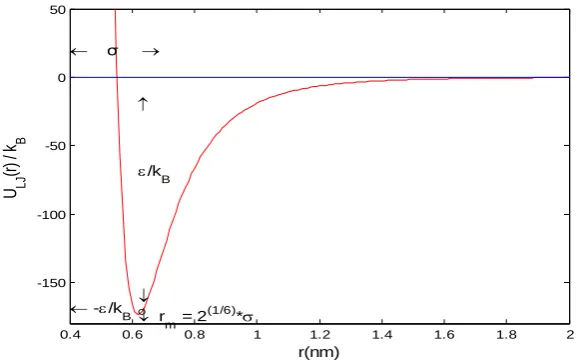
atoms are far away from each other. Figure 1 the role of LJ potential energy function describing the interaction
between methane and methane. Figure 2Thecurve of the role of theLJ potential energy function describing the
interaction between octane and octane. Figure 3. The effect of the potential energy function describing the
interaction between methane and the octane number of the LJ.From the above three groups of simulation of the
potential function of curve can be seen, the lowest point of the potential energy between methane and methane
in the =0.42nm, cyclooctane and cyclooctane between the lowest point of potential energy in the =0.90nm,
while the lowest point of the potential energy between the guest molecules of methane and cyclooctane is
located in 0.64nm. by comparing, we found that, the maximum distance between the guest molecules
cyclooctane and cyclooctane between the lowest point of potential energy, it is concluded that the molecular
value larger guest molecules between the minimum potential energy between the values of the distance is greater.
In the following three pieces of simulation, we see not hard, between methane and cyclooctane potential well
depth is greater than the other two guest molecules between the depth of the potential well, it is not difficult to
find that different kinds of guest molecules between the depth of the potential well will be even greater.
0.2 0.3 0.4 0.5 0.6 0.7 0.8 0.9 1 -160
-140 -120 -100 -80 -60 -40 -20 0 20 40
U LJ
(r
)
/ k
B
r(nm)
σ
/k B
-/k
B r
m = 2 (1/6)
Fig 2shows the curve of the role of theLJ potential energy function describing the interaction between
octane and octane.
Fig 3 shows the LJ potential function to describe the effect curve between the guest molecules of
methane and octane ring.
Table 1 potential parameters of LJ potential function
0.6 0.8 1 1.2 1.4 1.6 1.8 2 -400
-350 -300 -250 -200 -150 -100 -50 0 50 100
U LJ
(r
) /
k B
r(nm)
σ
/k
B
-/k
B r
m = 2
(1/6)
*
0.4 0.6 0.8 1 1.2 1.4 1.6 1.8 2
-150 -100 -50 0 50
U LJ
(r
) /
k B
r(nm)
σ
/k
B
-/k
B r
m = 2
(1/6)*
Type of interaction 1
k
K
10
nm
Water-water 78.2 3.1656
Methane-methane 148.6 3.7580
Cyclooctane - Cyclooctane 384.3 7.8650
Water-methane 108.8 3.4618
Water-cyclooctane 173.4 5.5153
III.
Potential model SPC is used to simulate the water molecules.
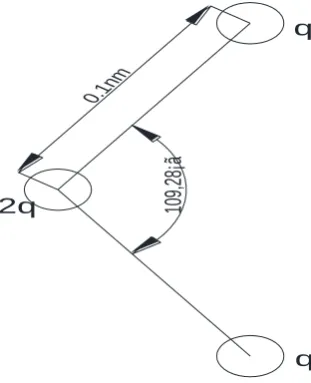
The interaction potential of water molecules is a classical simple point charge (points charge Simple) SPC
potential energy function. The point charge in the PSC model is better consistent with the position of the cluster.
The selection of the charge should be based on the minor modification of the energy E, and the final choice
depends on the minimum cut off radius. Figure 4 for the SPC potential function model chart. In the model
constructed in the graph, scientists are looking for a linear three point charge model..
0.1n m
109,
28
¡ã
q
2q
q
Fig. 4 model of SPC potential function
In e later study, the SPC potential function of the Mei East China Sea is further studied, and the O-H
bond length of the water molecule is controlled by 0.09570nm. The H-O-H bond angles for 104.52o in process
simulation, three coordinate directions using periodic boundary conditions and recent imaging method, the
initial position of the molecular [16-17] are determined according to the diffraction experiment results, the
orientation of the water molecules are randomly assigned. The SPC model divides the interaction between water
molecules into an LJ phase and a long-range electrostatic interaction:
u(
r
ij)= 3 31 1
i j
i j ij
q q
r
+ 12ij
B
r
- ij16C
r
(2)Among them, for the SPC potential model, only the oxygen atom of water molecule and the LJ
interaction between the two nonpolar guest molecules exist. For the molecular parameters of the interaction, the
classical Lorentz-Berthelot mixing rule is adopted.
IV. Conclusion
Abrief Introduction of the application of molecular dynamics simulation and theoretical knowledge of
natural gashydrate. Elaborated in recent years for the study of methane hydrate in the wider application of LJ
potential model and SPC potential model research obtained in molecular dynamics simulation, the LJ potential
function can very good application in the description of the interactions between the guest molecules, and in the
description of the interaction between the main water molecules, apparently SPC function model can be used
REFERENCE
[1]. Berendsen H C J ,Postma J P M ,van GunsterenW F ,et al .Interaction Forces ,Pullman B
ed ,Amsterdam ReidelPubliching Co 1981,331~342
[2]. The theory and practice of molecular simulation / Chen Zhenglong, Xu humanness, edited by Tang
Lida. Beijing: Chemical Industry Press, 2007.7 6~12
[3]. Jorgensen ,W.L ,et al .comparison of Potential Functions for Simulating Liquid Water [J] .J Chem.
Phys , 1983,79(2):926~935
[4]. Jorgensen ,D.S. Maxwell, J .Tirado –Rivers .Parameter for the OPLS All –Atom Force Field [J].
J .Am .Chem .Soc.1996,118~11225
[5]. Guangjin.,Ma Qinglan,Guo Tianmin)Journal of chemical industry and Engineer (china),2000,51(5):
626~631
[6]. ZHANGQI Qi Natural gas hydrate storage and transportation technology and its development status
[J].Chemical Engineering of Oil & Gas ,2013,42(3):261~264
[7]. Cheng W, Wu H C, Ye X Q,et al. Molecular Dynamics Study on the Structure I Helium
Hydrate[J].Progress in Natural Sci-ence,2004, 14(11): 1015~1018.
[8]. Cheng W, Zhou H Y, Ren S F. Molecular DynamicsStudy on the Structure I Xenon Hydrate[J].Chinese
Sci Bull, 2005, 50(8): 822~825.
[9]. KenichiorK,HidekiT,KoichiroN.On the Stability of Clathrate Hydrates Encaging PolarGuest Molecules:
Contrast in the Hy-drogen Bonds of Methylamine and Methanol Hydrates[J].Mol Simulat,1994,
12(3-6):241~252.
[10]. Wang L K,Chen G J, Pratt R M,etal.Molecule Dynamics Simulations of Thermal Conductivities of
Structure HHydrate[J].Chem Industry and Engineering, 2001, 52(4): 354~356.
[11]. Bj<rn K, Tatyana K, Kjetil A. Molecular Dynamics Simulations for Selection of Kinetic Hydrate
Inhibitors[J].J Mol GraphModel, 2005,23: 524~536.
[12]. Strobel T A,Koh C A,Sloan E D. Hydrogen Storage Properties of Clathrate Hydrate Materials[J].Fluid
Phase Equilibria,2007, 261: 382~389.
[13]. Chen Yu, Chen Shuo. Application of the molecular dynamics simulation of molecular dynamics in the
helium molecule potential function [J].Journal of Chemical Engineering (07) (2012).
[14]. Zhou Jian, Lu Xiaohua, Wang Yanru, ye Jun. Liquid water by molecular dynamics simulation [J].
Journal of Nanjing University of chemical.1998 (03)
[15]. Donghai Mei, Li Yigui, Lu Jiufang, H type gas hydrate structure and stability of molecular dynamics
simulation [J]. Journal of chemical industry and engineering, 1988,49 (6): 662-670
[16]. Udachin K .A .Ratcliffe ,C , I , Ripmmeester ,J.A.J Supramolchem 2002,2:405