Research Article
CODEN: IJPNL6
AN EVALUATION OF PACKAGE INSERTS OF ANTIMICROBIAL AGENTS
MARKETED IN INDIA
Patel Suhani V
1, Desai Chetna K
2, Patel Prakruti P
2, Dikshit Ram K
11
Department of Pharmacology, GCS Medical College, Ahmedabad- 380018
2
Department of Pharmacology, B. J. Medical College and Civil Hospital, Ahmedabad- 380016
*Corresponding author e-mail:
[email protected]
ABSTRACT
PI (n=123) of marketed AMA were collected over 6 months period. Quality of information presented was assessed and scores were given for adherence to Indian i.e. Schedule D of Drugs and Cosmetics Rules, 1945 (DCR) of India (0- 20) and US guidelines (0- 35). Adequate font size was printed in 50% PI. Only 4% PI were complete as per DCR. Adequate information on contra-indications (25%), use during pregnancy/lactation (82%), warning/precautions (92%), drug-drug (59%) and drug-food interactions (36%), adverse drug reactions (61%), effect on ability to drive/use machines (17%), overdosage (36%), uses (48%), pharmacodynamic (32%) and pharmacokinetic properties (61%), use in children (80%) and elderly (52%), preclinical study data (33%), post- marketing surveillance data (7%), references (12%), recent major changes (10%) and patient counseling information (16%) was included in few PI. A more meticulous approach in preparation of PI to include approved, essential, accurate, evidence-based and updated prescribing information is needed.
Keywords: package inserts, prescribing information, antimicrobial agents prescription
INTRODUCTION
Package insert (PI), also known as Prescription Drug Label or Prescribing Information or Package Circular, is an officially approved printed leaflet accompanying marketed drug products.[1] Apart from being a legal formality, it is a tool primarily intended to guide the prescribers for safe and effective use of the respective drug. The PI is compiled and distributed by the drug manufacturer after regulatory review and approval. Ideally, it must contain the approved, essential, accurate, evidence- based and timely updated information about the drug and should be written in a language that is not promotional, false or misleading.[1] Since it is readily available with the drug product and is mandated to strict regulations, it can be used as a reliable source of information by the prescribers [2 – 5] and can in turn minimize medication errors.[6] These are also one of the important tools in educating consumers and in improving compliance to therapy.[7] In India, regulations for manufacture, import, distribution, and sale of pharmaceutical
products are outlined in the “Drugs and Cosmetics Act (DCA) (1940) and Rules (1945)”. ‘Section 6.2’ of ‘Schedule D (II)’ of the Rules pertains to labeling and packaging information of drugs and specifies that a PI should be written in English language and the required information should be provided under suitable headings (such as posology and method of drug administration, contra- indications, special warnings and special precautions for use(if any), interaction(s) with other medicines and food, use in pregnancy and lactation, effects on ability to drive and use machines, undesirable effects or side effects, and the antidote for overdosing).[8]
Studies show that often PI provide extensive information, displayed in a complex manner, which is neither adequate nor does it conform to the WHO recommendations.[9 – 13] This makes it difficult for readers (prescribers and/or patients) to comprehend and retain the information. Additionally, the prescribing information contained may be out-of-date. In order to minimize medication errors, the US
International Journal of Pharmacy
FDA revised the rules for submission of PI in June 2006 which state that the information in PI should be divided into 3 sections i.e. highlights of prescribing information, contents of the full prescribing information (FPI), and the FPI. [1, 14] Proper references should be quoted for the source of information. The highlights section is a half-page summary of the information that is most important for prescribers. The contents section serves as a navigational tool that references all the sections in the FPI. FPI section should describe in detail the information provided in highlight section along with additional information and every PI must contain patient counseling information.
Considering the fact that AMAs are frequently prescribed medicines, we evaluated the PI of anti-microbial agents (AMA) marketed in India in this study. The development of antimicrobial resistance and the therapeutic failure of AMAs are one of the well recognized problems, which can be partly attributed to non compliance to therapy and irrational use of these drugs. Hence, the PI of this group of drugs must provide good quality information to prescribing physicians. In the present study, PI of AMA were considered a representative sample of PI of all the currently marketed drugs in India. The study aimed to evaluate whether the package inserts of AMAs currently marketed in India fulfilled the criteria laid down by Drugs and Cosmetics Rules of India in terms of parameters of completeness and quality of information. Additionally the study also evaluates whether these parameters meet the requirements specified by the U.S. FDA.
MATERIALS AND METHODS
All PI of AMAs dispensed during the study period of 6 months from five busy pharmacy stores located in a city in Western India were included in the study. A list of all the pharmacy stores located in the city was drawn from the office of pharmacy association of the city. Then, we divided the city into five different zones and made a list of five busy pharmacy stores that dispensed maximum number of prescription drugs and served 24hrs a day in each zone from the list. Then by randomization, one such store was enrolled from each zone. The investigator visited each pharmacy store once a week for one hour and collected all the available PI of AMAs dispensed during this period. Care was taken to identify and exclude duplication of a PI. All of the PI were thoroughly read and interpreted. In the first step, it was evaluated whether the required information (as per DCA and U.S. FDA) was included in the PI or not. Information contained under each of the sections
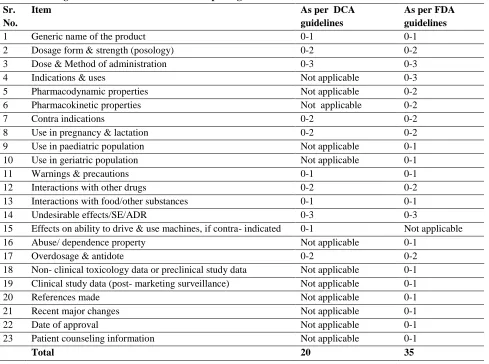
contained in the PI was judged and its accuracy assessed in comparison to that provided in standard textbooks of Pharmacology (Basic and Clinical Pharmacology, Bertram G. Katzung; 11th edition and Goodman & Gilman's the Pharmacological basis of Therapeutics; 11th edition). Following which, the information provided in each head was scrutinized and scored on a predetermined scale of 0 to 3 (Table 1). The scale was constructed in a manner that it reflects the presence of essential information in the PI. For example, the safety sections like warnings and contraindications, adverse effects, etc were given more importance over other sections in lieu of the growing safety concerns with newly marketed drugs. At the same time, requirements of regulatory authorities like DCGI and US FDA was also taken into consideration while devising the scale. US FDA requirements are more stringent and necessitates more detailing (eg- information about post marketing experience) as compared to Indian regulations. Hence, two different scores were decided with respect to requirements of both the countries.
Absence of information was scored “0” and presence of adequate and accurate information was scored 1 – 3 depending on its completeness and accuracy. The total score for each PI was calculated for adherence to DCA (maximum score of 20) and US FDA guidelines (maximum score of 35) separately. Data was analyzed using new graph pad software (INSTAT, version 3) and Microsoft Excel 2007 sheet.
RESULTS
highlighted (as a boxed warning and/or printed in capital letters). However, a few deficiencies were observed. For example certain information was found to be contradictory or incongruent at different places in the same leaflet in 7 PI (for example, use of arteether was mentioned as “contraindicated” and “use with caution” under different headings in the same leaflet). In 5 PI, the information was found to be incorrect (for example – in a PI of artesunate, the warning section was incorrect, in another PI,dose of Amoxicillin + clavulanic acid was incorrect and drug interaction information for ceftriaxone was incorrect). The information was speculative or promotional in 2 out of 123 PI. It was observed that the information provided was repeated in different headings of the same leaflet in 85 PI (for example, information on use of AMAs in pediatric patients was frequently repeated under headings of “warnings” and “method of use”). Moreover, it was not clarified whether the PI were directed only at the physicians or at the patients as well.
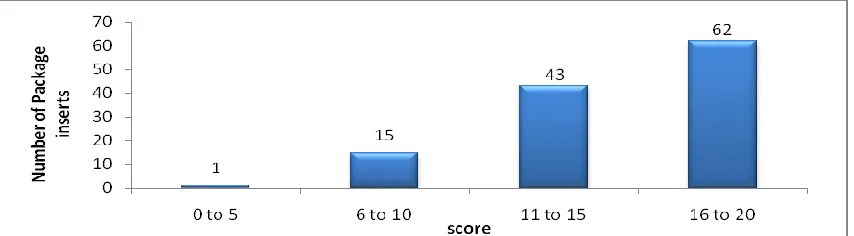
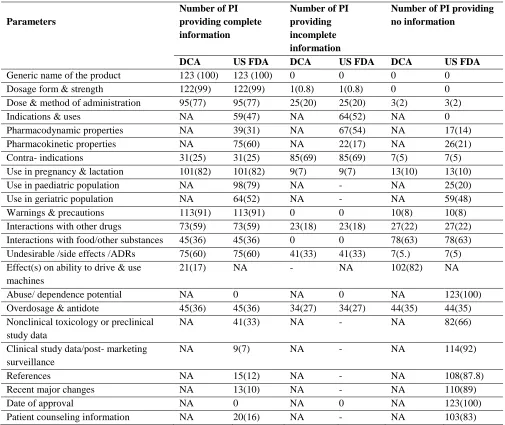
An evaluation of adherence of PI to DCA of India showed that5 (4.6%) PI provided all the necessary information (i.e. scored 20/20) (Figure 1). Half of PI (n = 62, 50%) scored more than 16/20 and 15 PI (12%) scored less than 10. As per US FDA guidelines, a PI must contain additional detailed information (i.e. besides the requirements specified by DCA of India) (Table 1). While adherence to US FDA guidelines for PI marketed in India is not compulsory, we also evaluated the PI in reference to these guidelines. Out of a total score of 35, 29 PI (23%) scored more than 26 and 2 (1.6%) PI scored more than 30 (Figure 2).The generic name of the drug was provided in all PI (Table 2). Posology of the product was correctly mentioned in 122 (99%) PI. The dose and method of administration of the product was correctly stated in 95(77.2%) PI. Information on indications and use of the product was correctly mentioned in 59(48%). Adequate information on pharmacodynamic and pharmacokinetic properties were present in 39(31.7%) and 75(61%) PI respectively. Contraindications were clearly mentioned in 31 (25.2%) PI. The suitability of use during pregnancy and lactation was specified clearly in 101 (82%) PI, while its suitability in pediatric and geriatric population was mentioned in 98(80%) and 64(52%) PI respectively. Warning and precautions were correctly provided in 113 (92%) of PI. Complete information about interactions of the product with drugs and food (or other substances) was provided in 73 (59.3%) and 45(36.5%) of PI respectively. Information on undesirable effects or side effects or Adverse Drug Reactions was adequate in 75(61%). Effects on ability to drive and use
machine was provided in only 21 (17%). All the PI lacked information about abuse or dependence liability of the product. Correct information on overdosage and antidotes for the product was present in 45(36.5%) PI. Data about preclinical study or non- clinical toxicology was present in 41(33.3%) of PI. Information about post- marketing surveillance or clinical studies of the product was provided in 9 (7.3%) of PI. Only 15(12%) PI contained references from authentic literature sources. Recent advances in research were included in 13(10.5%) PI. All the PI lacked information about date of approval of the product. Twenty (16%) PI mentioned information for counseling the patients about the use of the product.
DISCUSSION
Package insert is an officially approved, printed leaflet accompanying marketed drug products, intended to be a tool to guide the prescribers for safe and effective use of the drug.[21,22, 23, 24, 25] It is used by prescribers to gather drug related information and is governed by strict regulations. Hence it is important that they contain accurate and complete information. This study was designed to evaluate the content and quality of information provided in the package inserts of currently marketed antimicrobial agents in India and to identify the deficiencies, if any. AMA were chosen as the representative group of PI since they are a commonly prescribed group of drugs, and prone to misuse. PI, if prepared and used correctly have a potential to minimize this misuse.
the drug in pediatric (44%) and geriatric populations was largely missing (13%).[11] Likewise, a study carried out in Palestine, evaluated and compared the patient package inserts of the anti-infective agents manufactured in Palestine with the imported equivalents; package inserts from locally manufactured products had significantly lesser information with respect to warnings, dosage and administration, side effects, clinical pharmacology, date of last revision than those of imported products. Another study from Saudi Arabia evaluated the correctness and completeness of information regarding indications, dosage, cautions or contraindications, side effects and drug interactions in 37 package inserts and observed that substantial disagreement exists in information between generic package inserts versus the British National Formulary and the package insert of the brand product marketed in Saudi Arabia.[19] Similarly, an investigation of 68 patient’s PI from frequently used 20 medicines in Germany revealed that many lacked key safety information, including information on daily maximum dose and adverse effects, or had information that was difficult to comprehend.[16] The US FDA has designed new labeling guidelines in the year 2006 to help health care practitioners easily find, read, and convey information important for the safe and effective use of prescription drugs. The guideline recommends a uniform format for a PI. In the present study, such a structured layout was missing. We also observed that the completeness and quality of information provided in the PI was deficient with respect to the US FDA. All the PI lacked information regarding the abuse potential of the drug and date of approval of the product. Also, majority of PI were found to be deficient in providing non-clinical toxicological and post – marketing surveillance data and few contained references, patient counseling information and information on recent research of the product. This additional information may help make better therapeutic decisions. Hence, though not mandatory as per
current regulations, these may be included in the PI in India as well. Improvement in the accuracy and quality of information contained in the package inserts is possible by self-regulation by the industry and by updating and enforcing them periodically. The regulatory authorities in India could strengthen collaboration and information interchange with international agencies to maintain quality standards for delivering information through these package inserts. The availability of a comprehensive database for the DCGI - approved package inserts in India, would be of much help in this direction. Medication compliance can be improved by improving the awareness of patients about their medications.[20] Also, there is a need for ‘Patient-oriented Package Insert’ in India.
Thus the results of the study indicate that information on safe and appropriate use of medications was not uniformly provided in the PI of AMAs marketed in India. We recommend improvement in content and design of the PI and a strict enforcement of the regulatory guidelines. As package inserts are one of the frequently used sources of drug information by prescribers, their accuracy and completeness is important. AMAs being a commonly prescribed group of drugs and the regulatory recommendations being similar for all marketed drugs, the findings of this study could be extrapolated to other drugs as well.
ACKNOWLEDGEMENT
The authors would like to thank all the pharmacy stores who cooperated for collection of package inserts.
CONFLICT OF INTEREST
The authors have no conflict of interest to declare relevant to the contents of this study. No external source of funding has been obtained for the study.
Figure 2: Evaluation of package inserts of AMAs (n = 123) for adherence to US FDA criteria
Table 1: Scoring criteria used in the evaluation of package inserts Sr.
No.
Item As per DCA
guidelines
As per FDA guidelines
1 Generic name of the product 0-1 0-1
2 Dosage form & strength (posology) 0-2 0-2
3 Dose & Method of administration 0-3 0-3
4 Indications & uses Not applicable 0-3
5 Pharmacodynamic properties Not applicable 0-2
6 Pharmacokinetic properties Not applicable 0-2
7 Contra indications 0-2 0-2
8 Use in pregnancy & lactation 0-2 0-2
9 Use in paediatric population Not applicable 0-1
10 Use in geriatric population Not applicable 0-1
11 Warnings & precautions 0-1 0-1
12 Interactions with other drugs 0-2 0-2
13 Interactions with food/other substances 0-1 0-1
14 Undesirable effects/SE/ADR 0-3 0-3
15 Effects on ability to drive & use machines, if contra- indicated 0-1 Not applicable
16 Abuse/ dependence property Not applicable 0-1
17 Overdosage & antidote 0-2 0-2
18 Non- clinical toxicology data or preclinical study data Not applicable 0-1 19 Clinical study data (post- marketing surveillance) Not applicable 0-1
20 References made Not applicable 0-1
21 Recent major changes Not applicable 0-1
22 Date of approval Not applicable 0-1
23 Patient counseling information Not applicable 0-1
Table 2: Occurrences of essential parameters in marketed package inserts of AMA (n = 123) as per DCA and US FDA criteria
Parameters
Number of PI providing complete information
Number of PI providing incomplete information
Number of PI providing no information
DCA US FDA DCA US FDA DCA US FDA
Generic name of the product 123 (100) 123 (100) 0 0 0 0
Dosage form & strength 122(99) 122(99) 1(0.8) 1(0.8) 0 0
Dose & method of administration 95(77) 95(77) 25(20) 25(20) 3(2) 3(2)
Indications & uses NA 59(47) NA 64(52) NA 0
Pharmacodynamic properties NA 39(31) NA 67(54) NA 17(14)
Pharmacokinetic properties NA 75(60) NA 22(17) NA 26(21)
Contra- indications 31(25) 31(25) 85(69) 85(69) 7(5) 7(5)
Use in pregnancy & lactation 101(82) 101(82) 9(7) 9(7) 13(10) 13(10)
Use in paediatric population NA 98(79) NA - NA 25(20)
Use in geriatric population NA 64(52) NA - NA 59(48)
Warnings & precautions 113(91) 113(91) 0 0 10(8) 10(8)
Interactions with other drugs 73(59) 73(59) 23(18) 23(18) 27(22) 27(22) Interactions with food/other substances 45(36) 45(36) 0 0 78(63) 78(63) Undesirable /side effects /ADRs 75(60) 75(60) 41(33) 41(33) 7(5.) 7(5) Effect(s) on ability to drive & use
machines
21(17) NA - NA 102(82) NA
Abuse/ dependence potential NA 0 NA 0 NA 123(100)
Overdosage & antidote 45(36) 45(36) 34(27) 34(27) 44(35) 44(35) Nonclinical toxicology or preclinical
study data
NA 41(33) NA - NA 82(66)
Clinical study data/post- marketing surveillance
NA 9(7) NA - NA 114(92)
References NA 15(12) NA - NA 108(87.8)
Recent major changes NA 13(10) NA - NA 110(89)
Date of approval NA 0 NA 0 NA 123(100)
Patient counseling information NA 20(16) NA - NA 103(83)
Numbers in parenthesis indicates percentages
REFERENCES
1. An introduction to the Improved FDA Prescription Drug Labeling (Online). 2009 (Cited 2014 Oct 02); Available from: URL:http://www.fda.gov/Training/ForHealthProfessionals/ucm090590.htm
2. Rajan MS, Sreedhar, Khan SA, Thiyagu R, Rao PG. Information seeking behavior of clinicians in a semi urban town in southern India. J Clin Diag Res 2008;2:1069-73
3. Lal A, Sethi A. Drug package inserts in india. Ann Pharmacother 1996;30:1041
4. Joubert PH, Skene D. Attitudes of private medical practitioners toward package inserts and other drug information sources. S Afr Med J 1984; 66: 306-7.
5. Prosser H, Almond S, Walley T. Influences on Gp’s decision to prescribe new drugs- the importance of who says what. Fam Pract 2003; 20:61-68
7. L.A. Morris. Patient Package Inserts: A new tool for patient education. Public Health Reports. 1977 Sep; 92(5): 421-24.
8. Govt. of India, Ministry of Health and Family Welfare. Drug and Cosmetic Rules (Online). 1945 (Cited 2014 Oct 02); Available from: URL: http://cdsco.nic.in./html/DrugsandCosmeticAct.pdf
9. Avorn J. FDA standard: good enough for government work? N Engl J Med 2005; 353:969–72.
10.Bergk V, Haefeli WE, Gasse C, Brenner H, Martin-Facklam M. Information deficits in the summary of product characteristics preclude an optimal management of drug interactions: A comparison with evidence from the literature. Eur J Clin Pharmacol 2005; 61:327- 35.
11.Shivkar YM. Clinical information in drug package inserts in India. J Postgrad Med 2009; 55:104-7.
12.Fuch J, Werner S, Scheunpflug C, Gotze E.A, Elstermann K, Scheffel K, et al. Excessive medical information increase in package inserts. International Journal of Clinical Pharmacology and Therapeutics. 2010; 48(12):781-90.
13.Ved JK. Package Inserts in India: Need for a Revision. International Journal of Pharma Sciences and Research. 2010; 1(11), 454-6.
14.Food and Drug Administration, Health and Human Services. Requirements on content and format of labeling for human prescription drug and biological products. Fed Reg 2006;71:3921-97
15.European Commission. A guideline on the readability of the label and package leaflet of medicinal products for human use (online). 2006 Sep 29 (Cited 2014 Oct 02). Available at: URL:http://ec.europa.eu/enterprise/pharmaceuticals/pharmacos/docs/doc2006/09−2006/readability−consultation 2006−09−25.pdf, 2 October 2006
16.Fuchs J, Hippius M, Schaefer M. Analysis of German package inserts. Int J Clin Pharmacol Ther. 2006; 44:8. 17.Bernadini C, Ambrogi V, Fardella G, Perioli L, Grandolini G. How to improve the readability of the patient
package leaflet: a survey on the use of colour, print size and layout. Pharmacological Research 2001; 5:437. 18.Fuchs J, Heyer T, Langenhan D, Hippius M. Influence of Font Sizes on the Readability and Comprehensibility
of Package Inserts. Pharm. Ind. 2008: 70: 5, 584–592.
19.Gebran N, Al Haidari K. Assessment of prescribing information for generic drugs manufactured in the Middle East and marketed in Saudi Arabia. Ann Saudi Med. 2006: 26(3):192-9.
20.Fuchs J, Hippius M, Schaefer M. A survey of package inserts use by patients. Hospital Pharmacy Europe 2005; 21 - 29.
21.European Medicines Agency. Guideline on the packaging information of Medicinal Products for Human Use Authorised by the Community (Online). 2008 Feb (Cited 2014 Oct 02). Available from: URL: http://ec.europa.eu/enterprise/pharmaceuticals/eudralex/vol-2/c/bluebox_02_2008.pdf.
22.Electronic Medicines Compendium. EMEA (Online). 2010 (Cited 2014 Oct 02). Available from: URL:http://www.medicines.org.uk/emc/
23.PDR network. Health Alliance (Online). 2010 (Cited 2014 Oct 02). Available from:URL: http://www.pdr.net 24. South African Electronic Package Inserts. Malahyde Information Systems (Online). (Cited 2014 Oct 02)
Available from :URL: http://home.intekom.com/pharm