ISSN (e): 2250-3021, ISSN (p): 2278-8719
Vol. 05, Issue 04 (April. 2015), ||V1|| PP 28-41
Cell Formation in a Batch Oriented Production System using a
Local Search Heuristic with a Genetic Algorithm: An Application
of Cellular Manufacturing System
.
Rubayet Karim
1*,Sarojit Kumar Biswas
21 Department of Industrial and Production Engineering, Jessore University of Science and Technology, Jessore,
Bangladesh.
2 Department of Industrial and Production Engineering, Jessore University of Science and Technology, Jessore,
Bangladesh.
Abstract: - Cellular manufacturing is a production strategy which is capable of solving certain problems in a batch manufacturing system. A batch manufacturing system produces some intermediate varieties of products with intermediate volumes. The volume of any single product may not be sufficient to justify the use of a dedicated set of equipments for its production. Under this condition, a few or several products will have to share the production resources to balance their utilization .Production equipment in batch manufacturing must be capable of performing a variety of tasks. One of the fundamental problems in cellular manufacturing system is the formation of part families and machine cells that is the cell formation. For cell formation the part families are identified that require similar processing on a set of machines. In turn, these machines are grouped into cells. Each cell is capable of satisfying all the requirements of the part family assigned to it. In this paper an approach is used to form the part families and machine cell in a batch oriented production system. This approach combines a local search heuristic with a genetic algorithm. The genetic algorithm is used to generate the sets of machine cells. The evolutionary process, embedded in the genetic algorithm, is responsible for improving the grouping quality of the sets of machine cell generated. When the machine cells are known, it is customary to assign a product to the cell where it visits the maximum number of machines. This is optimal to minimize inter cell movement. However, it does not guarantee good utilization of the machines within a cell. To overcome this problem, a local search heuristic, which takes into consideration both inter -cell movement and machine utilization, is applied. The heuristic consists of an improvement procedure that is repeatedly applied. The objective of the heuristic is to construct a set of machine/part groups and improve it, if possible. The heuristic feeds back to the genetic algorithm the grouping efficacy of the set of machine/part groups it constructs. It is continued until the optimum result is found. After applying this approach, the result with a grouping efficacy is higher than the existing initial machine part matrix. So this approach can useful in cell formation in any batch oriented production system.
Keywords: - Cellular manufacturing; Local search heuristic; Genetic Algorithm; Grouping Efficacy
I.
INTRODUCTION
inter-cellular movement and maximize the utilization of the machines within a cell.
The rest of this paper is organized as follows: Section 2 describes a brief literature review on this topic. Section 3 reviews the problem statement. Methodology and solution procedure are described at section 4. Data collection is presented at section 5 & calculation, result & result analysis are presented at Section 6 & 7 respectively. The rest of the paper is formed of conclusions and references which are regarded in the following sections
1.1 Literature Review
The group technology (GT) concept in manufacturing was first introduced by Flanders in 1925.In 1959, Mitrofonov published a book on scientific principles of GT and Burbidge in 1960 proposed a systematic planning approach for GT called production flow analysis. From then onwards there has been a lot of methods, models and algorithms developed for finding the solution for the primary problem of design of manufacturing cells. In the last three decades of research in cell formation, researchers have mainly used zero-one machine component incidence matrix as the input data for the problem. Graphical method is first approach used by the researcher to solve the cell formation problem in GT. Rajagopalan & Batra(1975) used graph theory to solve the grouping problem. Kumar et al. (1986) solved a graph decomposition problem to determine machine cells and part families for a fixed number of groups and with bounds on cell size. Their algorithm for grouping in flexible manufacturing systems is also applicable in the context of GT. Vannelli and Kumar(1986) developed graph theoretic models to determine machines to be duplicated so that a perfect block diagonal structure can be obtained.Later Kumar and Vannelli(1987) developed a similar procedure for determining parts to be subcontracted in order to obtain a perfect block diagonal structure. Array-based clustering methods perform a series of column and row permutations to form product and machine cells simultaneously. Existing cluster analysis methods are reviewed and a new approach using a rank order clustering algorithm is described which is particularly relevant to the problem of machine-component group formation by King (1980).
A comprehensive comparison of three array-based clustering techniques is given by Chu and Tsai (1990). An efficient nonhierarchical clustering algorithm, based on initial seeds obtained from the assignment method, for finding part-families and machine cells for group technology(GT) is presented by Gupta & Seifoddini(1990) which aim was to minimize the inter-cell movements and blanks(machine idling).Another efficient non-hierarchical clustering algorithm, based on initial seeds obtained from the assignment method, for finding part-families and machine cells for group technology(GT) is presented by Srinivasan & Narendran(1991) which aim is to minimize the exceptional elements(inter cell movements) and blanks(machine idling).Later a clustering approach of the non-hierarchical type was proposed by Nair & Narendran TT(1998) which clusters machines and components on the basis of sequence data. The algorithm gives encouraging results which provide better optimum solution than the previous approaches.
grouping genetic algorithm for Bin balancing which is better suited for grouping problems than the classical representations and operators usually applied to grouping or reordering problems. After their approach, genetic algorithms become more popular to the researchers for finding the optimum solution for the cell formation problem. Cheng et al.(1998) formulated the cell formation problem as a travelling salesman problem(TSP) and a solution methodology based on genetic algorithms(GAs) is proposed to solve the TSP-cell formation problem. A genetic algorithm (GA) approach to the machine-component grouping problem with multiple objectives: minimizing costs due to inter-cell and intra-cell part movements, minimizing the total within cell load variation and minimizing exceptional elements was given by Zhao and Wu (2000).Dimopoulos and Mort(2001) used a genetic programming for the solution of a simple version of the problem.Onwubolu and Mutingi(2001) developed a genetic algorithm(GA) meta-heuristic based cell formation procedure having the objective function of minimizing the intercellular movement and cell load variation.Zolfagharia and Liang(2003) proposed a new genetic algorithm(GA) for solving a general machine/part grouping(GMPG) problem where processing times, lot sizes and machine capacities are all explicitly considered. An approach has taken by Gonclaves and Resende(2004) for solving the manufacturing cell formation problem in the term of group efficacy where they also used a local search heuristic genetic algorithm. Another genetic algorithm approach was done by Chiang & Lee(2004) for cell formation and inter- cell layout to minimize the actual inter-cell flow cost, instead of the typical measure that optimizes the number of inter-cell movements.Yasuda,Hu and Yin(2005) proposed an efficient method to solve the multi-objective cell formation problem(CFP) partially adopting Falkenauer‟s grouping genetic algorithm(GGA).The objectives are the minimization of both the cell load variation and intercellular flows considering the machines capacities, part volumes and part processing times on the machines. Brown & Keeling(2007) presented a hybrid grouping genetic algorithm for the cell formation problem that combines a local search with a standard grouping genetic algorithm to form machine-part cells. They used grouping efficacy measurement for computing results for a set of cell formation problem. Pillai et al. (2008) suggested a new approach (robust design) for forming part families and machine cells, which can handle all the change in demands and product mix without any relocation. The method suggests fixed machine cell for the dynamic nature of production environment by considering multi-period forecast of product mix and demand, which is solved by genetic algorithm. Tariq, Hussain and Ghafoor(2009) developed an approach that combines a local search heuristic(LSH) with genetic algorithm(GA).The results show that new approach not only converges to the best solution very quickly but also produces solutions that are as accurate as any results reported so far in literature.
grouping efficiency measure‟ and evaluates its relative performance with other existing measures. After that,Kim,Baek &Baek(2004) deal with the multi-objective machine cell formation problem to determine the part route families and machine cells such that the total sum of inter-cell part movements and maximum machine workload imbalance are simultaneously minimized. A new Branch-and-Bound(B&B) enhancement is then proposed by Boulif & Atif(2006) to improve the GA‟s performance which is used to solve the cell formation problem by using the binary coding system that has proved superior to the classic integer coding systems. Array-based clustering methods perform a series of column and row permutations to form product/part and machine cells simultaneously. The main problem in array- based clustering methods is that the quality of the solution given by these methods depends on the initial configuration of the zero-one matrix. But in case of our approach, the quality of solution does not depend on the initial configuration of the zero-one matrix. Hierarchical methods have the disadvantages of not forming part and machine cells simultaneously. Our approach overcomes these disadvantages. One limitation of graphical method is that the machine cells and part families are not formed simultaneously. These methods are found to depend on the initial pivot element choice. But our method overcomes these limitations. Mathematical programming methods can solve the machine part grouping problem simultaneously by considering the within-cell layout. But this technique is slightly complex & time consuming. Also none of the approaches presented above guarantees optimal solutions. So that the modern researchers have the tendency to continue their research activities in the field of group technology for machine part cell formation problem by using genetic algorithm.Zulawinski, Punch & Goodman (1995) developed a grouping genetic algorithm for Bin balancing which is better suited for grouping problems than the classical representations. After their approach, genetic algorithms become more popular to the researchers for finding the optimum solution for the cell formation problem. The objective of this paper is to present a procedure for obtaining product-machine groupings when the manufacturing system is represented by a binary product-machine incidence matrix.
1.2 Problem Statement
From the study of literature review, a grouping problem is identified. One of the key issues in batch oriented production is determining the best formation of the separate manufacturing cells. This is called the machine –part cell formation (MPCF) problem. This problem includes the identification of parts that have similar processing requirements (a part family) and the identification of the set of machines that can process each family of parts. For cells to operate efficiently, all of the machines within a cell should be fully utilized and the amount of inter cell traffic should be kept to a minimum. In order to determine the utilization of machines and the inter cell flow of parts much research has focused on the machine –part incidence matrix. The proposed approach, in this research, is based on the objective of maximizing the machines utilization within cells and minimization of inter cellular movements in a batch oriented production.
II.
METHODLOGY
There are various approaches (discussed in literature review) for solving the problem but none of these approach guarantees the optimal solution. In this paper a genetic algorithm approach is used to create the chromosome. The chromosome contains the information for the machine cell. According to the chromosome the number of machine cell has been selected and the machines have been inserted to the cells. After that the initial machine cell has been formed. The local search heuristic has been applied then to form the part families. Then the machine part matrix has been formed and the corresponding grouping efficacy has been calculated. Then with the help of part families the local search heuristic has been applied again to obtain the new machine cell. Then again the machine part matrix has been formed with the part families and the new machine cell and the corresponding grouping efficacy has been calculated. This process has been continued until the optimum solution has been found. The following figure shows the sequence of steps applied to each chromosome generated by the genetic algorithm. Then the local search heuristic is applied to the sets of machines cells generated by the genetic algorithm. The detail steps of local search heuristic are discussed in the following
The heuristic consists of an improvement procedure that is repeatedly applied. Each iteration K of the procedure starts with a given initial set of machine cells MKINITIAL and produces a set of part families PKFINAL
and a set of machine cells MKFINAL . Two block-diagonal matrices can be obtained by combining MKINITIALwith PKFINAL and MKFINAL with PKFINAL. From these two matrices, the one with the highest grouping efficacy is
chosen as the resulting block-diagonal matrix of the iteration K. The procedure stops if MK
INITIAL
= MK FINAL
or if the grouping efficacy of the block –diagonal matrix resulting from iteration K is not greater than the grouping efficacy of the block-diagonal matrix resulting from the previous iteration K – 1,(for K>2). Otherwise, the procedure sets MKINITIAL = MKFINAL and continues to iteration K+1. Each iteration K of the local search
heuristic consists of the local search heuristic consists of following two steps:
Step 1: Assignment of parts to the initial set of machine cells MKINITIAL. (Note that the initial the set of machine
cells of iteration 1, M1
INITIAL
; is supplied by the genetic algorithm).Parts are assigned to machine cells one at a time (in any order).A part is assigned to the cell that maximizes an approximation of the grouping efficacy, i.e., a part is assigned to the machine cell C*, given by
C* = argmx =
Where, argmax argument that maximizes expression, N1= total number of 1‟s in the matrix;
N1 OUT
=total number of 1‟s outside the diagonal blocks if the part is assigned to cell C; N0
IN
= total number of 0‟s or blank space inside the diagonal blocks if the part is assigned to cell C.
In this step, the heuristic generates a set of part families PKFINAL.We considered μK1 as the efficacy of the
block-diagonal matrix defined by MKINITIAL and PKFINAL.
Step2: Assignment of machines to the set of part families PKFINAL obtained in step(1).Machines are assigned to
part families, one at a time(in any order).A machine is assigned to the part family that maximizes an approximation of the grouping efficacy, that is, a machine is assigned to the part family F*,given by,
F* = argmx =
Where, argmax argument that maximizes expression, N1= total number of 1‟s in the matrix;
N1OUT =total number of 1‟s outside the diagonal blocks if the part is assigned to cell F;
In this step, the local search heuristic generates a new set of machine cells MKINITIAL. We also considered μK2 as
the efficacy of the block-diagonal matrix defined by MKFINAL and PKFINAL.The block- diagonal matrix resulting
from the iteration has a grouping efficacy given by μK =max (μK1, μK2).If MKFINAL = MKINITIAL or μK≤ μK-1(k≥2);
then the iterative process stops and the block-diagonal matrix of iteration k-1 is the result. Otherwise, the procedure sets MK+1INITIAL= MKINITIAL and continues to step (1) of iteration k+1.
III.
ANALYSIS AND DISCUSSION
3.1 Case study & Data collection
Effective & efficient data collection requires careful planning and judicious use of both the case participant‟s and the researcher‟s time (Darke et al.,1998). Data were collected from a leading furniture manufacturing company in Bangladesh. Some data are primary and some are secondary. For collecting data cutting section was selected. This section contains 22 machines and a variety of parts of various models of various products. This is actually a batch manufacturing system. It contains intermediate varieties of products with intermediate volumes. Common two model products were selected for cell formation. Through the two products, the maximum operations of parts are covered. The collected data are listed in table1& 2 respectively.
From the processing sequence of the parts of the machines, the machine part incident matrix obtained is shown in the table below.
3.2 Calculations & Result
The grouping efficacy for the exiting initial machine part matrix as shown in table 3 is given by
μinitial = = 24.56%
Now for our proposed approach suppose we start with the initial set of chromosome given by the genetic algorithm created randomly which is shown below.
Chromosome =1421123324221142545 12345
For the left string, digit length indicates total machine number, eight digit position indicates the corresponding machine number and each digit represents the machine cell it goes. For the right string, digit length indicates total number of machine cell and each digit represents the corresponding machine cell.
Here number of cells =5
Machine cell 1= {1, 4, 5, 13, 14} Machine cell 2= {3, 6, 9, 11, 12, 16} Machine cell 3= {7, 8}
Machine cell 4= {2, 10, 15, 18} Machine cell 5= {17, 19}
The initial machine cell obtained, M1INITIAL= {(1, 4, 5, 13, 14), (3, 6, 9, 11, 12, 16), (7, 8), (2, 10, 15, 18), (17,
19)}.Now the corresponding grouping efficacy has been calculated using local search heuristic which is shown below.
Iteration 1:
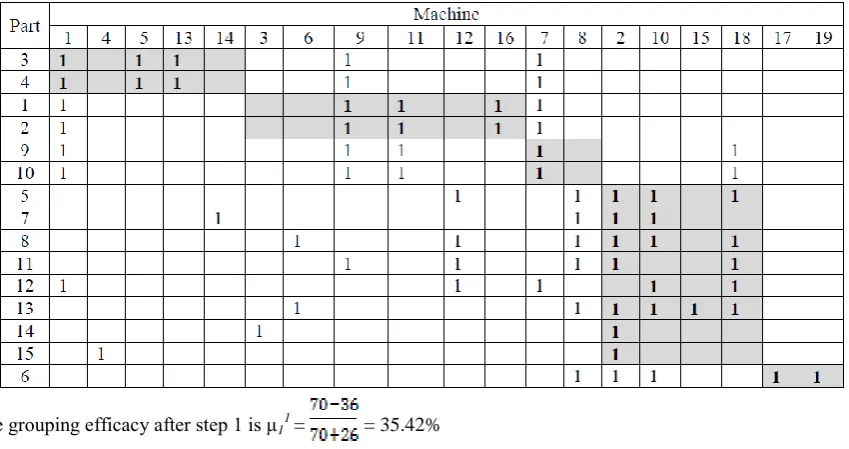
Table 4 presents the value of μc for each part and each machine cell. A part is assigned to the cell with the highest value of μc(the cells bold in table 4).From table 4 the set of part families obtained is given by P1
FINAL
= {(3,4),(1,2),(9,10),(5,7,8,11,12,13,14,15),(6)}.
The resulting machine part matrix after step1 is given in table 5.
The grouping efficacy after step 1 is μ11
= = 35.42%
Table 6 presents the value of μk for each part and each machine cell. From table 6 the set of machine families obtained is given by M2FINAL={(1,5,13),(7,16),(9,11),(2,8,10,12,18),(3,4,6,14,15,17,19)}.The resulting machine
part matrix after step 2 is given in table 7.
The grouping efficacy after step 2 is μ12= = 47.19%. Similarly at iteration 2, the set of part families
{(5,6,13,14,15),(1,7,9,11,16),(3,4,17,19),(2,8,10,12,18)} & the grouping efficacy after step 2 is μ2 2 =55.43%.
Again at iteration 3, the set of part families obtained after step 1 is P3FINAL
={(1,2,3,4,9,10),(14,15),(5,6,7,8,11,12,13)}& the grouping efficacy after step 1 is μ3 1= 58.88%.
The set of machine families obtained after step 2 isM4FINAL={(1,5,7,9,11,16),(3,4,6,14,15,17,19),(2,8,10,12,18)}
& the grouping efficacy after step 2 is μ3 2= 54.80%. At each iteration step 1 & step 2 are repeated until the final machine cell is obtained. The iteration will be stopped when the machine cell after iteration will equal to its any previous machine cell or the grouping efficacy will not increase for any further iteration. In step 1 at iteration 3, the grouping efficacy is 58.88% which seems to be maximum, but the following machines (5,6,13,14,15) are not assigned to any cell. So this machine part matrix is not selected. Similarly in step 2 at iteration 3, the grouping efficacy is 54.80% which is smaller than the value obtained at iteration 2(55.43%).So the iteration is stopped and we got the maximum efficacy at iteration 2 is 55.43%.So the final machine cell is obtained at iteration 2.From the calculations the final machine cell and the corresponding part families are
M3FINAL={(5,6,13,14,15),(1,7,9,11,16),(3,4,17,19),(2,8,10,12,18)}
P2FINAL={(3,4),(1,2,9,10),(14,15),(5,6,7,8,11,12,13)} & the grouping efficacy is μ2 2 = μFinal=55.43%.
3.1 Result analysis
IV.
CONCLUSION
The aim of this research was machine part cell formation in a batch oriented production system.The cell formation has been done for an existing problem.For this cell formation,an approach is used which is a combination of a genetic algorithm and a local search heuristic.In order to evaluate the performance of machine part cell,the grouping efficacy has been chosen. Cellular manufacturing system has greater flexibility because it uses the benefits of job shop layout,flow shop layout & batch manufacturing.If a new product enters the system, the cellular manufacturing system will easily satisfy all the requirements for processing this.That means the cellular manufacturing system has quick response to the change in product.So a change in product model or part variety the system has quick adaption. As cellular manufacturing system removes unwanted movements of parts as well as waiting time,the productivity increases.The precedence relationship of various parts has been used to form the initial machine part matrix. Using this initial machine part matrix the final machine part matrix has been achieved.So the precedence relationship has been embedded in the final matrix.As a result the final matrix follows the precedence relationship.
REFERENCES
[1] Adenso-Diaz B, Lozano S, Racero J, Guerrero F. (2001). “Machine cell formation in generalized group technology”. Computers & Industrial Engineering, 41(2):227-240.
[2] Adil G K,Rajamani D, Strong D(1997). “Assignment allocation and simulated annealing algorithms for cell formation”.IIE Transactions, 29:53-67.
[3] Askin R G, Chiu K S(1990). “A graph partitioning procedure for machine assignment and cell formation in group technology”. International Journal of Production Research, 28:1555-1572.
[4] Askin R, Subramaniam S B (1987). “A cost-based heuristic for group technology configuration”.International Journal of Production Research, 25(1):101-113.
[5] Askin R J, Standridge C R (1993).Modeling & Analysis of Manufacturing Systems. New York: Wiley and Sons.
[6] Boctor F(1991). “A linear formulation of the machine-part cell formation problem”. International Journal of Production Research, 29(2):343-356.
[7] Boulif F,Atif K(2006). “A new branch-&-bound-enhanced genetic algorithm for the manufacturing cell formation problem.” Computers & Operations Research, 33:2219-2245.
[8] Burbidge J L (1979). Group technology in Engineering Industry. London: Mechanical Engineering Publications.
[9] Chandrasekharan M P,Rajagopalan R(1989).Group ability: “Analysis of the properties of binary data matrices for group technology”. International Journal of Production Research, 27(6):1035-1052
[10] Cheng C H,GuptaY P,Lee W H, Wong K F(1998). “A TSP -based heuristic for forming machine groups and part families”. International Journal of Production Research, 36(5):1325-1337.
formation in bi-directional linear flow layout.” International Journal of Computer Integrated Manufacturing, 17:346-375.
[12] Choobineh F(1988). “A framework for the design of cellular manufacturing systems”. International Journal of Production Research, 1161-1172.
[13] Chu C H, Tsai M(1990). “A comparison of three array-based clustering techniques for manufacturing cell formation.” International Journal of Production Research, 28(8):1417-1433.
[14] Darke P,Shanks G,Broadbent M(1998). “Successfully completing case study research: combining rigor, relevance and pragmatism”.Info system, 8:273-289.
[15] Defersha F M, Chen M(2006). “A comprehensive mathematical model for the design of cellular manufacturing systems”. International Journal of Production Economics, 103:767-783.
[16] Dimopoulos C, Mort N(2001). “A hierarchical clustering methodology based on genetic programming for the solution of simple cell-formation problems”. International Journal of Production Research, 39:1-19.
[17] Goldberg D E (1989).Genetic algorithm: In search, optimization & machine learning (low price ed).Delhi,India: Pearson Education(Singapore) Pte. Ltd.
[18] Gonclaves J F, Resende M G C(2004). “An evolutionary algorithm for manufacturing cell formation.” Computers & Industrial Engineering, 47:247-273.
[19] Gunasingh K R, Lashkari R S(1989). “Machine grouping problem in cellular manufacturing systems: an integer programming approach.” International Journal of Production Research, 27(9):1465-1473
[20] Gupta T,Seifoddini H(1990). “Production data based similarity coefficient for machine-component grouping decisions in the design of a cellular manufacturing system.” International Journal of Production Research, 28(7):1247-1269.
[21] Heragu S S,Kukuturi S R(1997).Grouping and placement of machine cells. IIE Transactions, 29:561-571. [22] James T L,Brown E C, Keeling K B(2007). “A hybrid grouping genetic algorithm for the cell formation
problem.” Computers & Operations Research, 34: 2059-2079.
[23] Jeon G ,Broering M,Leep H R,Parsaei H R, Wong J P(1998). “Part family formation based on a new similarity coefficient which considers alternative routes during machine failure”. Computers & Industrial Engineering: 35,479-482.
[24] Khan M,Islam S,Sarker B(2000). “ A similarity coefficient measure and machine-parts grouping in cellular manufacturing systems.” International Journal of Production Research, 38(3): 699-720.
[25] Kim C O,Baek J G, Baek J K(2004). “A two-phase heuristic algorithm for cell formation problems considering alternative part routes and machine sequence.” International Journal of Production Research, 42: 3911-3927.
[26] King J R (1980). “Machine-component grouping in production flow analysis; an approach using rank order clustering algorithm.” International Journal of Production Research, 18(2):213-232.
[27] Kumar K R, Chandrasekharan M P (1990).Grouping efficacy: “A quantitative criterion for goodness of block diagonal forms of binary matrices in group technology”. International Journal of Production Research, 28(2): 233-243.
[28] Kumar A S ,Suresh N (2008).Production & operation management(2nd ed).New Delhi: NEW AGE INTERNATIONAL (P) LIMITED.
[29] Kusiak A (1987). “The generalized group technology concept.” International Journal of Production Research, 25:561-569.
[30] Lee H ,Garcia-Diaz A (1993). “A network flow approach to solve clustering problems in group technology.”International Journal of Production Research, 31(3):603-612.
[31] Mahdavi I ,Javadi B ,Fallah-alipour K ,Slomp J (2007). “Designing a new mathematical model for cellular manufacturing system based on cell utilization.” Applied Mathematics and Computation, 190:662-670.
[32] Nair G J , Narendran T T(1998).CASE: “a clustering algorithm for cell formation with sequence data.” International Journal of Production Research, 36:157-179.
[33] Onwubolu G C , Mutingi M(2001). “A genetic algorithm approach to cellular manufacturing systems.” Computers & Industrial Engineering, 39(1-2): 125-144.
[34] Pillai V M, Subbarao K A (2008). “Robust cellular manufacturing system design for dynamic part population using a genetic algorithm.” International Journal of Production Research, 46(1):5191-5210. [35] Rajagopalan R,Batra J L (1975). “Design of cellular production systems: a graph-theoretic approach.”
International Journal of Production Research, 13(6): 567-579.
[36] Sarker B R (2001). “Measures of grouping efficiency in cellular manufacturing systems”. European Journal of Operational Research, 130(3):588-611.
[38] Srinivasan G , Narendran T T (1991).GRAFICS: “ a nonhierarchical clustering algorithm for group technology.” International Journal of Production Research, 29: 463-478.
[39] Srinivasan G ,Narendran T , Mahadevan B (1990). “An assignment model for the part-families problem in group technology.” International Journal of Production Research, 28: 145-152
[40] Tariq A ,Hussain I ,Ghafoor A (2009). “A hybrid genetic algorithm for machine-part grouping”. Computers & Industrial Engineering, 56:347-356.
[41] Vohra T ,Chen D ,Chang J , Chen H (1990). “A network approach to cell formation in cellular manufacturing.” International Journal of Production Research, 28(11):2075-2084.
[42] Waghodekar P H,Sahu S(1984). “Machine-component cell formation in group technology.” International Journal of Production Research, 22:937-948.
[43] Wemmerlov W , Johnson D J (1997). “Cellular manufacturing at 46 user plants:Implementation experiences and performance improvements”. International Journal of Production Research, 35(1):29-49. [44] Xambre A R , Vilarinho P M (2003). “A simulated annealing approach for manufacturing cell formation
with multiple identical machines”.European Journal of Operational Research, 151: 434-446.
[45] Yasuda K ,Hu L, Yin Y (2005). “A grouping genetic algorithm for the multi objective cell formation problem”. International Journal of Production Research, 43(4): 829-853
[46] Zhao C , Wu Z (2000). “A genetic algorithm for manufacturing cell formation with multiple routes and multiple objectives”. International Journal of Production Research, 38(2): 385-395.
[47] Zolfagharia S , Liang M (2003). “A new genetic algorithm for the machine/part grouping problem involving processing times and lot sizes.” Computers & Industrial Engineering, 45:713-731.
[48] Zulawinski B W , Punch W F , Goodman E D (1995). “The grouping genetic algorithm(GGA) applied to the bin balancing problem.” Michigan State University, Technical report, Genetic Algorithm Research and Applications Group.