RESEARCH ARTICLE
STUDY ON INTELLIGENT CONTROLLERS
*Anusha Rani, V.
Assistant Professor, Department of Electronics and Instrumentation Engineering,
PSN College of Engineering and Technology
ARTICLE INFO ABSTRACT
Intelligent Control emulates the human intelligence and achieves automation in various areas of Engineering.Intelligent Controls have been used mainly in the areas of Electrical Systems; Machine Intelligence based systems like Robotics. Intelligent Control has been active in various industrial and engineering applications. There is active research in applying Intelligent Controls in distributed computing systems like web based environments. The advent of internet has changed the business models for the service providers and consumers. The Distributed Computing Systems which host various IT and business services are expected to be available with high performance and scalability to meet the desired SLAs. There is absolute necessity in predicting the future trends of the IT environments, recognize the load patterns such that the provisioning of the hardware, software resources is appropriately handled. There are research attempts to explore the applicability of intelligent control in such different areas of computing like infrastructure provisioning and Distributed Systems. In this paper we study the various Intelligent Controls and discuss the recent trends of applying intelligent controls in Distributed Systems such as Web Servers.
INTRODUCTION
Machine Intelligence is an active area of research for the last many decades. There are various technologies that have emerged such as Artificial Intelligence, Fuzzy Sets, Neural Networks. The major objective of all these technologies is to build the knowledge into a machine which emulates the behavior of human intelligence (Kevin M. Passino, 2001). Intelligent Control is successfully applied within a spectrum of industrial and engineering disciplines (Ali Zilouchian, Mo Jamshidi, 2001). There are recent research advances in investigating applicability of Intelligent Control in various areas of Computing. Mainly we observe that the target areas are Distributed Computing Systems such Web environments in improving their performance, QoS Management. The intent of intelligent control is to bring the intelligence in the control mechanisms and incorporate human expert knowledge in the computing processes. The classicalfeedback systems have bottlenecks to handle non-linear dynamics and variable load conditions such as web based distributed systems. Intelligent controllers have the ability to handle such challenges and in this paper we review the applicability of various intelligent controller techniques that are applied in distributed systems such web servers, data centers server allocation, admission control of servers. We also present a brief overview of some of the important Intelligent Controller techniques.
*Corresponding author: *Anusha Rani, V.
Assistant Professor, Department of Electronics and Instrumentation Engineering, PSN College of Engineering and Technology
Intelligent Controllers
Intelligent Control is a control technique that uses various Artificial Intelligence based approaches such as neural networks, fuzzy control. In this section we discuss the most popular intelligent controls that are explored for application in the Distributed systems. There are other techniques such as Bayesian control, Genetic algorithm based controllers but not discussed in this paper.
Neural Network Controllers
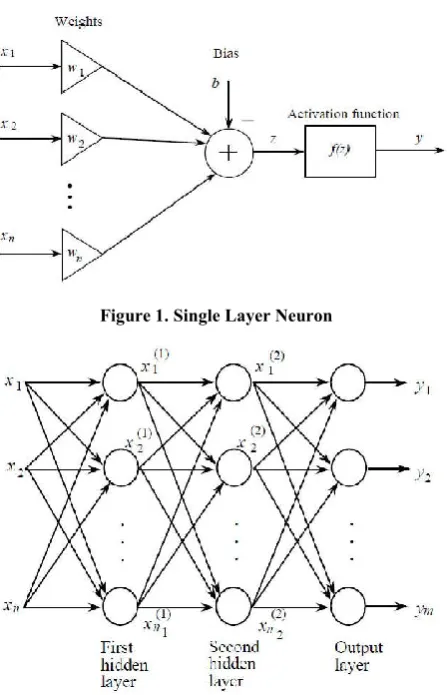
Artificial neural networks are circuits, computer algorithms, or mathematical representations loosely inspired bythe massively connected set of neurons that form biological neural networks. Artificial neural networks have proven useful in a variety of pattern recognition, signal processing, estimation, and control problems. The Figure 1 below shows a single neuron model which represents the biological neuron that fires when inputs
(xi) are significantly excited. The firing is defined by the
activation function f. The Figure 2 shows a 3 layer perceptron
as there are 3 stages of neuron processing as we can see between inputs and outputs.
Fuzzy Controllers
Fuzzy control is a methodology to represent and implement a (smart) human’s knowledge about how to control a system. A fuzzy controller is shown in Figure 3. The fuzzy controller has several components:
Article History:
Received 12th May, 2017
Received in revised form 02nd June, 2017 Accepted 29th July, 2017
Published online 30th August, 2017
International Journal of Recent Advances in Multidisciplinary Research
Vol. 04, Issue 08, pp.2727-2732, August, 2017
Keywords:
A rule base that determines on how to perform control
Fuzzification that transforms the numeric inputs so that
the inference mechanisms can understand.
The inference mechanism uses information about the
current inputs and decides the rules that are suitable in the current situation and can form conclusion about system input.
Defuzzification is opposite of Fuzzification which
converts the conclusions reached by inference mechanism into numeric input for the plant.
Figure 1. Single Layer Neuron
Figure 2. A 3-layer Multi perceptron model
Figure 3. Fuzzy Control System
Expert Systems Control
The Figure 4 below shows how feedback control can be implemented using expert systems. It has a knowledge base which is used by the inference mechanism to decide the input to the system under control. The knowledge base will be typically frames, semantic nets, causal diagrams unlike the IF
THEN statements of fuzzy controllers. The inference strategies are also more elaborate such as refraction, recency, priority.
Figure 4. Expert Control System
Planning Systems for Control
The Artificial Intelligence based planning systems are used for robotics for decisions. It can also be configured as a feedback control system as shown in Figure 5 below.
Figure 5. Closed Loop Planning control system
The planner performs plan generation, projecting into future and determines a set of candidate plans. This set of candidate plans is pruned into one plan that is the best one to apply at the current time. The plan is then executed and during execution the performance of that is monitored and evaluated.
Adaptive Control
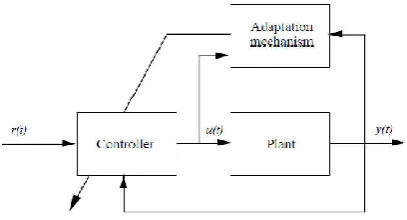
Adaptive control adapts to the controlled system with parameters which vary or are uncertain. The Figure 6 shows indirect adaptive control. If the plant parameters change the identifier will provide estimates of these and the controller designer will subsequently tune the controller.
Figure 6. Indirect Adaptive control
Figure 7. Direct Adaptive control
Intelligent Control applications
In this section we discuss how the intelligent controllers are applied in distributed systems in web server environments, Resource allocation in data centers and admission control of servers.
Web Environments
In this section we discuss the application of intelligent controllers in web based environments. QoS in web environments is an important requirement in distributed systems such as enterprises and internet. There are various investigations in improving the performance of web environments using various techniques. The feedback controllers have been investigated to improve the web server’s performance (Gandhi, 2002 and Robertsson, 2004). But the classic controllers will have the challenge of handling the uncertain and non-linear characteristics of the web environments. Intelligent control is the obvious choice to handle the non-linear behaviors. In this section we discuss the applications of intelligent controllers in web environments.
In (Yayawei, 2005), a Fuzzy control based approach is discussed for web servers as they are non-linear and independent of the system model that has to be controlled. The Figure 8 below shows the system architecture using Fuzzy control to manage performance of web server. The Connection scheduler classifies the request that come in to the server based on various parameters like IP address. The monitor measures
the absolute delays Ckexperienced by the requests of class k.
The fuzzy controller guarantees the delay of 8 seconds for the priority class of requests. The error between the measured
delay (Ck) and the desired reference delay (DDk) is the input to
the fuzzy controller as shown below. The controller then computes the number of processes that are allocated to each class. The discussed solution is applied in the modified version of Apache server and their results show that using aclassical PI Controller linearization degrades the performance of the system. The adaptive fuzzy control adapts to various web servers with speed and thus eliminates the system identification. The results of are not discussed in our review.
Figure 8. Fuzzy Control of Apache Server
In (FuquanTian, 2010), the web server QoS control is achieved using a hybrid feedback Fuzzy Adaptive PI Controller. The input requests to the web server are adjusted in a control period, and turn down the incoming requests when the server is overloaded. Considering the uncertain dynamics of web environments a fuzzy approach is chosen to tune the PI Controller parameters adaptively.
Figure 9. Architecture of ATR Feedback system Figure 10. Fuzzy adaptive control system
The notion of Accept Time Ratio (ATR) [7] is proposed in the admission control strategy. The Figure 9 shows the ATR feedback control system where the server performance is measured periodically. For every interval the controller computes the next ATR according to the error between the real output and the reference value. Then the request-accepting time
tadmis computed during which the server accepts requests, and
in the remaining of period requests are turn down. The Figure
10 shows the Fuzzy adaptive control system. The value kpwill
determine the rapid response of the system and kieliminates
steady state error. Based on the error e and variance rate ec, the
fuzzy control adjusts the values of kpand kito make the
controlled system response more rapidly and stably. The
Universe of discourse for △kpand △kiare set to {-6, -4, -2 ,0,
2, 4, 6}. The experiments are based on simulation environment where the basic PI Controller and the discussed Fuzzy Adaptive PI Control are compared on web server, while having fluctuations of load on the server the Fuzzy Adaptive PI Control behaves in a stable manner. We also notice that the adaptive Neuro Fuzzy control techniques are used in web document clustering proposing a framework to personalize e-business processes by adaptive interactive system to customer preferences in [8]. A fuzzy control query language is proposed (fCQL) for analysis and control of business. The details are not discussed here as it is beyond the scope of our review.
Resource Management
allocationwithin the eQoS framework. The Figure 11 below shows the architecture of the eQoS framework.
Figure 11. System Architecture of Apache Server STFC
The STFC is shown in Figure 12 below
Figure 12. Self tuning Fuzzy Controller
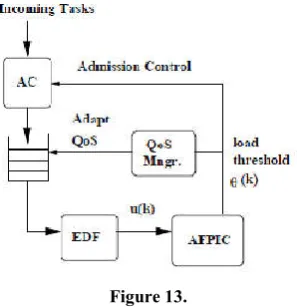
The experimental results show that STFC outperforms the PI Controller. In [10] the authors deal with the non-linear modeling challenges of computing systems and have proposed fuzzy control to minimize the utilization error of the resources in the data center that is adaptive in nature. The Figure 13 shows the closed loop real time system used to run the solution.
Figure 13.
The real time tasks are scheduled as EDF (earliest deadline
first) [11]. The desired utilization factor is Us, The AFPIC
(Adaptive Fuzzy Proportional Integral Control) computes the
acceptable load θ(k) based on error e(k) and change in the error
△e(k) for u(k) measured at kthsampling period.
The error is represented as
e(k) = Us - u(k) (2)
△e(k) = e(k) - e(k - 1) (3)
The Universe of discourse for the utilization factor is [-1, 1]
since e(k) = -1 if Us = 0 and current utilization u(k) is 1. The
Linguistic variables describe the input and outputs of the fuzzy
controller for example two inputs at the kthsampling period are
described as error. The Membership Functions for controller
input and output e(k) , θ(k), △e(k) at the kth sampling instance
are defined in the common normalized domain [-1,1]. The Fuzzy utilization control action is characterized into zones shown in Figure 14 below:
Figure 14 Fuzzy Rule Classification
The discussed Adaptive Fuzzy PI Controller is shown in Figure 15 below:
Figure 15. Adaptive Fuzzy PI Controller
adjusts the server provisioning on to bound to 95th –percentile end-to-end delay Td to a specified target Tref.
Figure 16. Self adaptive Neuro-Fuzzy Feedback Control system
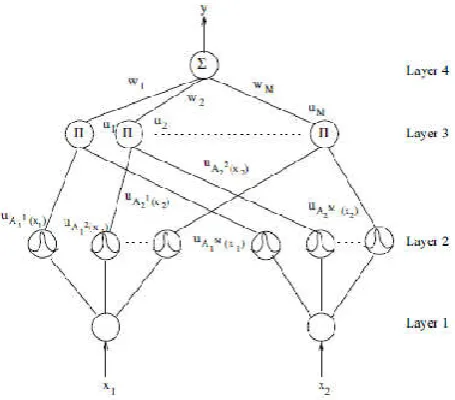
The Figure 17 below shows how the layers in the neural network used in combination with fuzzy control. The layer 1 node each corresponds to one input. The Layer 2 node acts as linguistic term assigned to one of the input variables. These nodes use the membership functions to determine the degree to which an input belongs to the fuzzy set. In Layer 3 each node represents the precondition part of the fuzzy logic rule. The layer 4 acts a defuzzifier which converts conclusions from layer 3 to numeric output in terms of resource adjustment. The magnitude of the resource adjustment depends upon various parameters and neural fuzzy controller which are determined and adapted using a two phase approach. The structure learning phase decides how to add a new node to layer 2 and parameter learning phase is used adaptively modify the consequent part of existing fuzzy rules to improve controller performance.
Figure 17. Neuro-Fuzzy Control Schematic diagram
The hybrid self-adaptive neural fuzzy control guarantees the 95th percentile end-to-end delay of requests flowing through a multi-tier cluster. Simulation based experiments are run on the controller. We infer that hybrid controls can be used to predict the server resource requirements of a data center and do resource provisioning appropriately.
Server Admission Control
We have seen so far how Intelligent Controls are applied Web server environments and IT resource provisioning. In this section we discuss how the server admission control through neural network feedback control [14] is achieved, where the
expected load and appropriate resource requirements are predicted much ahead of the time. The server is modeled as a non-linear stochastic single server queuing system. A multi-step ahead auto regressive Neural Network time response predictor is developed. The Figure 18 and Figure 19 below show the single neural network control non-linear predictor and the setup. The predictor is given an offline training where the NE (Node Element) is simulated under high load conditions.
Conclusion and Future work
The survey reveals that the Fuzzy control provides a model independent technique when compared to the classical controllers such as P, PI, PID controllers. Fuzzy control has the capability of handling the non-linear nature of the systems to be controlled. The feedback controllers will be more effective when they are hybrid controllers built using the classic P, PI and PID Controllers and Intelligent controllers such as fuzzy, neural network controllers. Building such hybrid controllers as discussed above are providing encouraging results, based on our study. It is necessary to extend the research of implementing hybrid controllers in distributed systems and other areas of computing that will result in better performance of the systems. We observe that mostof the research of applying hybrid controllers in distributed systems such as web servers is verified in simulation environments, but it will be important to study their effectiveness in real distributed systems. Additionally there are many machine intelligence based mechanisms that could be explored further in building effective controllers. Data Mining is combination of various theory and technologies has better algorithms and solutions for prediction, pattern recognition, and can be investigated to build hybrid controllers to build scalable, high performing robust distributed system applications.
REFERENCES
Ali Zilouchian, Mo Jamshidi, 2001. “Intelligent Control Systems using Soft Computing”, CRC Press
FuquanTian,WenboXu,Jun Sun, 2010. ”Web QoS Control
Using Fuzzy Adaptive PI Controller”, Ninth International Symposium on Distributed Computing and Applications to Business, Engineering and Science
Modeling and Controller Design”, IEEE American Control Conference
Harkut, D.G. 2011. K.N.Kasat, Dr.S.B.Sadar, 2011. ”Web Document Clustering Adaptive Neuro Fuzzy model”, International Journal of Advanced Computer Engineering and Architecture
JianbinWei, Cheng-ZhongXu, 2006. “eQoS: Provisioning of Client-Perceived End-to-End QoS Guarantees in Web Servers”, IEEE Trans on Computers
Jiang Ying, and Meng Dan, 2007. “Enforcing Admission Control, Using Admission-Time-Ratio and PI Controller,” Journal of Computer Research and Development.
Kevin, M. Passino, 2001. ”Intelligent Control: An Overview of
Techniques”, Perspectives in Control Engineering:
Technologies, Applications, and New Directions, pp. 104-133, IEEE Press, NY, 2001.
Mehmet H. Suzer, Kyoung-Don Kang 2008. “Adaptive Fuzzy Control for Utilization Management”, ISORC, Pages 383-390
Robertsson, A. 2004. B. Wittenmark, M. Kihl, and M. Andersson. “Design and evaluation of load control in web server systems”, IEEE American Control Conference. Yayawei, 2005. Chuang Lin, Thiemo Voigt, FengyuanRen,
Fuzzy Control for Guaranteeing Absolute Delays in Web Servers”, QoS in Wireless Networks International Conference