~ 121 ~ WWJMRD 2018; 4(6): 121-128
www.wwjmrd.com International Journal Peer Reviewed Journal Refereed Journal Indexed Journal Impact Factor MJIF: 4.25 E-ISSN: 2454-6615
Miqdam T Chaichan
Energy and Renewable Energies Technology Center, University of Technology, Baghdad, Iraq
Khaleel I Abass Mechanical Engineering Department, University of Technology, Baghdad, Iraq
Hussein A Kazem
Engineering Faculty, Sohar University, Sohar, Oman
Correspondence:
Miqdam T Chaichan
Energy and Renewable Energies Technology Center, University of Technology, Baghdad, Iraq
The Impact of Thermal Storage Materials on the
Heating and Storage Efficiencies of a Solar Air Heater
Miqdam T Chaichan,
Khaleel I Abass,
Hussein A Kazem
Abstract
In this study, two air heaters were designed and manufactured from locally available materials. Two cases of storage were studied: The first case used concrete as the main part of the air heater and depends on the sensible heat stored in the concrete. In the second case: Paraffin wax was added as PCM to concrete, which was considered the main part of the air heater. In the second case, the effect of the underlying heat storage will be studied with the calculated output heat from the heater. Practical experiments were conducted on the air heaters in the winter conditions of the city of Baghdad - Iraq for the period during the months of January and February 2018.
The results of the study showed that the temperature of the air outside the heater increased significantly for the second case (addition of the paraffin wax) compared to the first case (use of concrete only). The efficiency of the system has also improved and the maximum storage efficiency has increased to 54.13% compared to the first condition. In the second case, air temperature increased to a maximum of 54.97% when the heater was installed in February.
Keywords: Solar air heater, Paraffin wax, PCM, Heating efficiency, Storage efficiency.
1. Introduction
Increasing energy consumption, resource constraints and rising energy costs are causing great concern to decision-makers and researchers for their significant impact on the quality and standard of living of future generations [1]. The suffering experienced by the countries of the world during the last decade of fluctuation in oil prices (which is the main material for energy production) and implications of this fluctuation from the recession of large economies of the producing and importing countries of this material [2]. The need for fossil fuels is also increasing because of the doubling of cars and trucks on the roads, which operate with fossil gasoline and diesel [3, 4]. The need to provide electricity for the operation of means to improve the comfort conditions in homes, offices, and factories has caused widespread use of small generators ranging from one megawatt to hundreds of kilowatts. All this burning fossil fuel and millions of tons of pollutants from it have caused global warming and the consequences have become catastrophic [5]. The whole world today feels and suffers from a major climate changes that has started to complicate the way of life [6]. In this case, the development of alternative energy sources, which must be efficient and clean so as to reduce dependence on oil and thus reduce its side effects [7]. The switch to renewable energies has become the main challenge for many countries all over the world [8]. Solar radiation, along with other energies such as wind and waves (which can be considered as secondary solar resources), hydropower and biomass, represent the most renewable energy available on Earth
[9]. To date, a very small fraction of available solar energy is used [10]. Solar energy in
addition to light is the radiant heat of the sun, which humanity has used since time
immemorial for the benefit of man, animal and plant (plantations) using various
types of technologies
[11].
Solar energy is clean, environmentally friendly, and free. It is available in most parts of the of the earth and has a radiant density capable of processing the required energy and
according to the solar application.Electrical power can be generated from solar applications such as photovoltaic or concentrated power plants [12, 13, 14]. Such stations have become widespread around the world today and are expected to increase. One of the important problems that hinder the spread of solar applications is their fluctuation sometimes due to the shadows caused by clouds or buildings [15]. Dust also plays a key role in reducing the intensity of solar radiation and thus impedes the success of the solar application in providing the required energy [16, 17]. As the weather conditions such as humidity [18], the solar radiation intensity [19], temperature [20], and dust have different effects on different solar applications [21]. Researchers put many treatments to reduce the effects of environmental conditions on the productivity of any solar application. For example, when dust prevent is not possible, several methods of cleaning are used to reduce the stimulation of photovoltaic cells [22, 23]. High temperatures have also caused a decrease in cell productivity, so researchers have developed PVT systems that reduce cell temperature and increase their productivity while at the same time benefiting from heat dissipation in other applications [24, 25]
Solar energy technologies are either active or passive solar depending on how they capture, convert, and distribute sunlight [26]. Solar energy is used to heat water in solar collectors and hot water is used directly for domestic or industrial purposes [27]. Water can also be heated by a graduated salt pond, which in turn boils water for household or for water distillation purposes [14]. Another example of effective and inefficient solar applications, one can talk of a Trombe wall that heats up and stores heat and a cycle that warms the air inside the rooms as a passive solar application [28, 29]. Solar air heaters are considered active solar applications as the air inside the rooms is directly heated by sun [30]. Passive solar air-conditioning systems using liquids, which is effectively used for space heating, can also be used, especially in small areas such as field huts or shelters [31]. Air heating collectors have been used sometimes since World War II, mostly for low temperature heating applications. The invention of many air heaters was after the oil crisis in 1973, as part of the great interest in alternative energies [32]. Ref. [33] passed the air between several glasses before heating, showing that the compound's efficiency gained about 10 to 15%.
Modern heaters designs have focused mainly on improving convective heat transfer at the absorber. Ref. [34] used a wire mesh as a supporting material for an air heater while allowing the air to flow between the absorbent and the second glass through a mesh. The proposed heater has achieved a collector efficiency of up to 70%. Ref. [35] found that the use of a bed supported by porous media caused improved heat transfer. The pre-heating of the air through recycling it first between two glass panels, which helped improve the efficiency of the solar collector and reduce thermal losses. Results of the practical study proved that the efficiency of the proposed heater was up to 75%. Ref.
[36] used double pass heating in addition to a concrete
packing above the absorber plate and passing air through it to improve efficiency.
Thermal energy storage systems that use phase change materials (PCM) to store heat have many applications. Variable phase materials store heat in the form of latent energy and significant energy, thus increasing the amount
of stored energy compared to materials that store only perceived energy such as stone and gravel [37]. The use of PCM in solar collectors increased the heating time of the collector and enhanced its work as Ref. [38] declared. Variable phase materials have been used to efficiently store heat in solar distillates and have significantly increased the productivity of distillates [39, 40 and 41]. These materials were also used in the Trombe wall and resulted in high storage of energy potential, which increased the efficiency of the thermal wall [42]. They are used in solar heating systems in homes and glasshouses to store heat collected during periods of high insulation and thus free heat at night or at other intervals in air conditioning systems to convert peak heating and cooling loads to peak hours [43]; to fill the eclipse period when no solar energy is available [44]. Compared to other thermal energy storage systems, they are likely to have a lower weight and volume. It also absorbs and releases heat at a pre-determined temperature [45, 46]. References [47 and 48] have confirmed that storage of thermal energy using PCM is one of the most advanced and developed energy technologies that can enhance energy efficiency and sustainability of buildings. Changing phase materials have an interesting feature due to their potential to store both latent and sensible energy. It also has a large thermal storage capacity through the latent heat storage, and it is useful to use these environmentally friendly materials in renewable energy systems such as solar thermal energy. The use of phase-changing materials reduces the energy consumption of buildings in a negative and sustainable manner [49]. The equal distribution of phase change nature in systems containing PCMs can also be used to improve the heat distribution through the system [50]. Ref. [51] studied the PCM fusion in a spherical container experimentally. The process included the possibility of imaging what was inside the container. The researchers compared the change in phase using numerical modeling with Fluent 6.0. The study suggested a generalized relationship of molten fraction with time, in terms of Fourier number, Stephan number and Grashof number. Ref.
[52] conducted an experimental search on the effect of
different values of Reynolds number and entry temperatures on thermal storage capacity of paraffin wax trapped in a spherical capsule. The study concluded that the time required to change the phase of the paraffin wax in the capsule at the edge of the storage tank was shorter than the time needed at the center of the tank. This result was produced from the small porosity in the center compared to the storage tank edge.
The current study aims to design a solar air heater system that stores thermal energy inside it by using PCM. The system relies on the solar energy, which is abundant resource in the atmosphere of the Iraq. The work offers a solar heater that can be manufactured from locally available materials and is efficiently used to heat the air-conditioned spaces during the winter in the Baghdad city, Iraq.
2. Experimental Setup
Two air heaters boxes were designed and fabricated to carry out this study. The two air heaters consist of the following:
~ 123 ~ and 0.15 m height). The front and rear end converge to reduce air flow losses at these two points. Air drawing fan was fitted at the exit, its function was to draw air from the air heater and deliver it to conditioned space. The entrance was fabricated just as the exit with circular form of diameter size 10 cm. The perpendicular distances from the entrance and existence to the air heater (divergent zone for the entrance and convergent zone for the exit) were 35 cm. b. The air heater: two air heaters were built. The first one was fabricated from concrete (sand, cement and pebbles) 12 cm thicknesses. Ten copper pipes (2.58 cm dia. and 1 m long) were fixed inside the concrete block. These pipes were opened from its ends to allow air to pass through. The air gains transmitted heat from concrete to pipes while it is passing through it to the conditioned space. This crossing air was considered the base of comparison in the present study. Three essential parts form this air heating system, these parts are: a single transparent glass, isolated duct and the storage unit which is consist of a single row of cylinders. This unit works to satisfy two goals; absorb and storage the solar energy. The concrete block face was painted with absorbent black paint. The total mass of the concrete material is about 55 kg.The second air heater was fabricated in the same dimensions of the first one. It was built from concrete also but three rows of copper pipes (each one consists of 10 pipes) were fitted inside it uniformly. The middle row pipes were open ends used for air passing. The higher and lower rows were closed ends filled with paraffin wax which is the PCM used in this study. Table 1 represents the paraffin wax and concrete specifications. In this study, paraffin wax was used with a total weight of 9.72 kg. When designing the air heater, several important points were considered, such as the integration of the wax storage with the air heater, the simple construction of the heater, its dismantling, and the handling of the internal wax unit. Practical experiments are divided into two different processes: charging and discharging. The charging process was conducted by absorbing the internal parts of the heater to the solar radiation and continued this process until the change of the PCM phase from solid to full liquid. This charging process continued until the decline of the intensity of solar radiation and the sun's approach to the evening. During the discharge process, the heat stored in the PCM is released to the concrete and air, which increased the working time of the heater for extra hours.
c. Glass: 2mm thickness glass was fixed at the top of the two boxes to cover the concrete wall and the entrance
cone. It was fixed by silcon material to prefent any air leakage 3 cm above the concrete wall. Exposing the aluminun chips for sun rays was the reason for covering the entrance cone with glass.
d. Thermocouples: six copper-constantant thermocouples were fixed in six palces inside concrete block. Two were fixed at the block top, two at the middle and two at the bottom of the block. The avarage of these thermocouples was considered as the concrete temperature. Four thermocouples were fixed in each PCM layer. It was distributed in a way that its avarage can be considered as the higher and lower wax temperature. Two mercury thermometers were fixed in the air entrance and exit to measure its temperature in each case.
e. Exit air velocity measuring device: Exit air velocity was measured by (Anometer). All the measuring devised were calibrated and there accuracy was found as will be seen in uncrtinaty paragaph.
f. Aluminum reflectors: two wooden sections were covered from one side with aluminum foils and used as reflectors. They were used to insure concentrating the sun rays on the air heater at the morning and noon periods. After sunset these sections were used as covers for the air heaters to prevent any heat transfer by radiation or convection to the surrounding.
g. The Fan: A constant speed fan (10 cm dia. and 100 W powers) was used to maintain a laminar flow.
A schematic diagram of the experimental setup used in this study is given in Figure 1 & 2.
2.1 Test Proseadure
Experimintal measurments tests were conducted for the air heaters at the following cases:
1. First case: Concrete wall alone inside the air heater box.
2. Second case: Concrete wall with PCM pipes insde the air heater box.
The following equations were used to calculate storage energies and heating efficiency for each part of the usedsystems.
1. The stored energy in concrete wall:
(KJ)
2. The stored energy in paraffin wax
(KJ)
3. Air mass flow rate
4. Air volume flow rate
5. Heat transfer by air
(KW)
6. First case (Concrete) thermal storage efficiency (first case)
(%)
7. Second case (Concrete+PCM)thermal storage efficiency
(%)
8. System heating efficiency
(%)
3. Results and Discussion
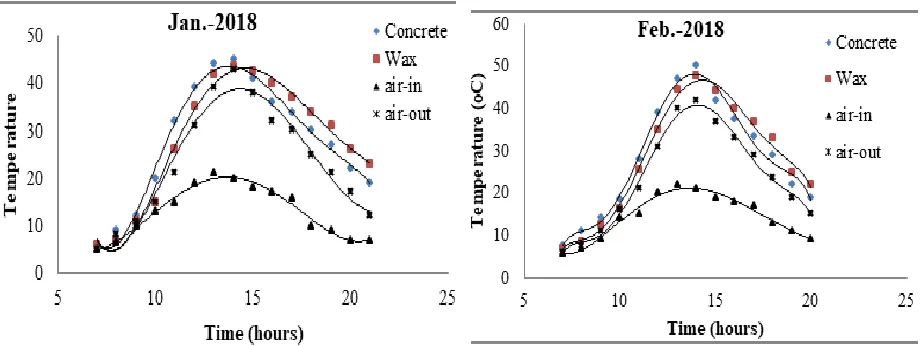
Fig. 3 shows the air heating process parts temperatures, inlet cold air, exit hot air and concrete wall temperature. Concrete wall temperature increases highly due to solar intensity starting from 8 AM until 2 PM. After 2 PM the wall temperatures reduces due to solar intensity declines accompanied with cold air entering causing exit air temperatures to be reduced and declines. The air temperature increment rate at Jan. was 61.8% while at Feb. was 57.92%. These results indicate that the air heating system can be used for Baghdad City weathers efficiently. Fig. 4 represents temperatures details for the second case tested in this study where PCM was added to the concrete wall. Temperature increase and reduction still the same as fig.1, except for in this case worming time extended for about two to three hours. Concrete temperature relatively maintained the same temperatures as case one, putting in mind, that concrete mass in this case less than case one, whereas PCM pipes take place, on the account of concrete mass. At the time of worming (from 7 AM to 2 PM) concrete temperatures exceeded all other temperature. After 2 PM concrete sensible heat gained at the last period reduced faster than PCM. Wax temperature after 2 PM exceeded all other temperature depending on its stored sensible and latent heat. The air temperature increment rates were 78.92 and 65.08% for Jan. and Feb. respectively. It can be realized from figures 1 & 2 results that the increment rates at Jan. are higher than that at Feb. This is due to the higher inlet air temperatures introduced to the air heater at Baghdad Feb. days.
Fig. 3: Temperatures of air heater parts for the first case
~ 125 ~ Fig. 5 represents air stored energy for the two studied cases versus time. It is clear from the figure that the second case stored the highest energy in air. This case contains the effect of concrete sensible heat in addition to wax sensible and latent heat. For comparison purposes, the increments in
air stored energy at Jan. were 52.59 for case 2 compared with case 1. The increments were 54.97 for case 2 compared with case 1 at Feb. It can be observed that higher heat was gained at Feb. due to higher solar intensity in Baghdad City region
Fig. 5: Air stored energy for the two studied cases
Fig. 6 demonstrates the tested systems efficiencies versus time. It is clear that higher system efficiency can be achieved using the second case (concrete + wax).
Increments in system efficiency percentages were 49.38 at Jan. and 54.13 at Feb. for cases2 compared with case 1.
Fig. 6: System heating efficiency for the two studied cases
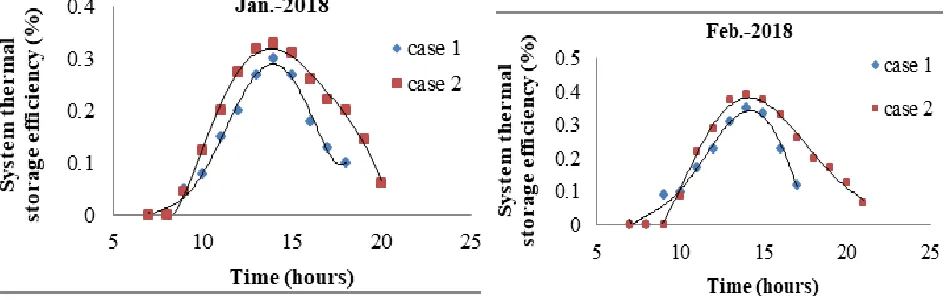
Fig. 7 illustrates the tested system thermal storage efficiency versus time. Case 2 still rank the highest thermal efficiency due to availability of concrete sensible heat storage added to wax sensible and latent heat storage. The
increments in thermal storage efficiencies were 44.39% at Jan, while at Feb. it were 49.19% for case 2 compared to case 1
Fig. 7: System heating efficiency for the two studied cases
Fig. 8 shows the charging period of PCM. This period starts from the first daytime but it appears clearly starting from 11 AM and it expands till 2 PM. In this period PCM temperature increased to reach wax melting point, at which it settles until all the wax melting is completed. The liquid
Fig. 8: PCM charging behavior for case 2
Fig. 9 represents the discharge period of PCM. This period starts around 2 PM and it expands until all the stored energy is used. PCM temperatures reduced in this period and paraffin wax started to lose its sensible stored energy until it reaches melting point. At this point it settles until all wax changes its phase to solid phase. After all the wax is solidified its temperature reduces in high rate due to two reasons. The first one is the time of this operation takes place after 2:30 PM where the solar intensity starts to drop. The second reason is the cold air passing through heater gaining stored energy.
Fig. 9: PCM discharging behavior for case 2
Conclusions
Two cases were studied in the present paper, simple case of air heater made of concrete, in the second heater PCM was added to the system. The tests were conducted at Baghdad city winter days between 1-1-2018 to 15-2-2018. The results indicate the following:
1. Adding PCM to concrete (case 2) improves the air heater system. Compared with case 1 (concrete heater) for Jan. and Feb. respectively the following is resulted: the gained temperatures increased with about 61.8. The air stored energy was improved about 54.97. The system efficiency was improved to 54.13%.
2. Adding PCM to concrete system improved the charging period. It also decelerated the system temperature lose at discharging period. This addition helps the system to worm air for longer time.
3. The results demonstrate that case 2 air heating system is adequate for air heating purposes in Iraqi winter weathers.
References
1. Chaichan M T, Abass K I, Kazem H A, Al Jibori H S & Abdul Hussain U, Novel design of solar receiver in concentrated power system, International J. of
Multidispl. Research & Advcs. in Eng. (IJMRAE), vol. 5, No. 1, pp. 211-226, 2013.
2. Al-Maamary H M S, Kazem H A, Chaichan M T, The impact of the oil price fluctuations on common renewable energies in GCC countries, Renewable and Sustainable Energy Reviews, vol. 75, pp. 989-1007, 2017.
3. Chaichan M T and Al-Asadi K A H, Environmental Impact Assessment of traffic in Oman, International Journal of Scientific & Engineering Research, vol. 6, No. 7, pp. 493-496, 2015.
4. Chaichan M T, Kazem H A, Abid T A, Traffic and outdoor air pollution levels near highways in Baghdad, Iraq, Environment, Development and Sustainability, vol. 20, No. 2, pp. 589-603, 2018. DOI: 10.1007/s10668-016-9900-x.
5. Al-Waeely A A, Salman S D, Abdol-Reza W K, Chaichan M T, Kazem H A and Al-Jibori H S S, Evaluation of the spatial distribution of shared electrical generators and their environmental effects at Al-Sader City-Baghdad-Iraq, International Journal of Engineering & Technology IJET-IJENS, vol. 14, No. 2, pp. 16-23, 2014.
6. Al-Maamary H M S, Kazem H A, Chaichan M T, Climate change: the game changer in the GCC region, Renewable and Sustainable Energy Reviews, vol. 76,
pp.555-576, 2017.
http://dx.doi.org/10.1016/j.rser.2017.03.048.
7. Ahmed S T & Chaichan M T, A study of free convection in a solar chimney sample, Engineering and Technology J, vol. 29, No. 14, pp. 2986-2997, 2011. 8. Al-Maamary H M S, Kazem H A, Chaichan M T,
Renewable energy and GCC States energy challenges in the 21st century: A review, International Journal of Computation and Applied Sciences IJOCAAS, vol.2, No. 1, pp. 11-18, 2017.
9. Kazem H A and Chaichan M T, The impact of using solar colored filters to cover the PV panel on its outcomes, Bulletin Journal, vol. 2, No. 7, pp. 464-469, 2016. DOI: 10.21276/sb.2016.2.7.5.
10. Chaichan M T & Abass K I, Productivity amelioration of solar water distillator linked with salt gradient pond, Tikrit Journal of Engineering Sciences, vol. 19, No. 4, pp. 24-34, 2012.
11. Chaichan M T & Abass K I, Practical study of basement kind effect on solar chimney air temperature in Baghdad-Iraq weather, Al-Khawarizmi Eng. Journal, vol. 7, No. 1, pp. 24-34
12. Al-Waeli A H A, Al-Mamari A S A, Al-Kabi A H K, Chaichan M T, Kazem H A, Evaluation of the economic and environmental aspects of using photovoltaic water pumping system, 9th International Conference on Robotic, Vision, Signal Processing & Power Applications, Malaysia, 2016.
13. Chaichan M T & Abass K I, Practical investigation for improving concentrating solar power stations efficiency in Iraqi weathers, Anbar J for Engineering Science, vol.5, No. 1, pp. 76-87, 2012.
~ 127 ~ 15. Hussein A Kazem, Miqdam T Chaichan, Ali H
Al-Waeli, Kavish Mani, Effect of Shadows on the Performance of Solar Photovoltaic, Mediterranean Green Buildings & Renewable Energy, pp.379-385, 2017, DOI: 10.1007/978-3-319-30746-6_27
16. Chaichan M T, Abass K I, Kazem H A, Energy yield loss caused by dust and pollutants deposition on concentrated solar power plants in Iraq weathers, International Research Journal of Advanced Engineering and Science, vol. 3, No.1, pp. 160-169, 2018.
17. Chaichan M T, Abass K I, Kazem H A, Dust and pollution deposition impact on a solar chimney performance, International Research Journal of Advanced Engineering and Science, vol. 3, No. 1, pp. 127-132, 2018.
18. Kazem H A and Chaichan M T, Effect of Humidity on Photovoltaic Performance Based on Experimental Study, International Journal of Applied Engineering Research (IJAER), vol. 10, No. 23, pp. 43572-43577, 2015.
19. Al-Waeli A H A, Sopian K, Chaichan M T and Kazem H A, Hasan H A, Al-Shamani A N, An experimental investigation on using of nano-SiC-water as base-fluid for photovoltaic thermal system, Energy Conservation and Management, vol. 142, pp. 547-558, 2017.
20. Kazem H A, Chaichan M T, Effect of Environmental Variables on Photovoltaic Performance-Based on Experimental Studies, International Journal of Civil, Mechanical and Energy Science (IJCMES), vol. 2, No. 4, pp. 1-8, 2016.
21. Al-Waeli A H, Kazem H A, Chaichan M T, Review and design of a standalone PV system performance, International Journal of Computation and Applied Sciences IJOCAAS, vol. 1, No. 1, pp. 1-6, 2016. 22. Chaichan M T, Mohammed B A and Kazem H A,
Effect of pollution and cleaning on photovoltaic performance based on experimental study, International Journal of Scientific and Engineering Research, vol. 6, No. 4, pp. 594-601, 2015.
23. Kazem A A, Chaichan M T & Kazem H A, Effect of dust on photovoltaic utilization in Iraq: review article, Renewable and Sustainable Energy Reviews, vol. 37, September, pp. 734-749, 2014.
24. Al-Waeli A H, Sopian K, Kazem H A and Chaichan M T, Photovoltaic Solar Thermal (PV/T) Collectors Past, Present and Future: A Review, International Journal of Applied Engineering Research, vol. 11, No. 22, pp. 1075-10765, 2016.
25. Al-Waeli A H A, Sopian K, Kazem H A and Chaichan M T, PV/T (photovoltaic/thermal): Status and Future Prospects, Renewable and Sustainable Energy Review, vol. 77, pp. 109-130, 2017.
26. Bendea C, Rosca M, Karitas K, High solar fraction heating and cooling systems, Analele Universităţii din Oradea Fascicula de Energetică, vol. 15, 2009.
27. Kazem H K, Aljibori H S, Hasoon F N and Chaichan M T, Design and testing of solar water heaters with its calculation of energy, Int. J. of Mechanical Computational and Manufacturing Research, vol. 1. No.2, pp. 62-66, 2012.
28. Chaichan M T, Abass K I, Hatem F F, Experimental study of water heating salt gradient solar pond performance in Iraq, Industrial Applications of Energy
Systems (IAES09), Sohar University, Oman, 2009. 29. Chaichan M T & Abaas K I, Experimental study to
improve thermal performance of simple solar energy collecting wall, Industrial Applications of Energy Systems (IAES09), Sohar University, Oman, 2009. 30. Chaichan M T, Abass K I, Al-Zubidi D S M, Kazem H
A, Practical investigation of effectiveness of direct solar-powered air heater, International Journal of Advanced Engineering, Management and Science (IJAEMS), vol. 2, No. 7, pp.1047-1053, 2016.
31. Hazami M, Kooli S, Lazâar M, Farhat A & Belghith A, Energy and exergy efficiency of a daily heat storage unit for buildings heating, Revue des Energies Renouvelables, vol. 12, No. 2, pp: 185 – 200, 2009. 32. Szymocha K, Advanced thermal solar system with heat
storage for residential house space heating, SESCI 2005 Conference, British Columbia Institute of Technology, Burnaby, British Columbia, Canada, August 20 - 24, 2005.
33. Ramadan M, Al-Sebaii A, Aboul-Enein S & Al-Bialy E, Thermal performance of a packed bed double-pass solar air heater, Energy, vol. 33, No. 8, pp: 1524-1535, 2007.
34. Stacunanathan S & Deonarine S, A tow-pass solar air heater, Solar Energy, vol. 15, No. 1, pp: 41-49, 1973. 35. Mittal M &Varshney L, Optimal thermohydrolic
performance of a wire mesh packed solar air heater, Solar Energy, vol. 80, No. 9, pp: 1112-1120, 2006. 36. Mohamad A, High efficiency solar heater, Solar
Energy, vol. 60, No. 2, pp: 71-76, 1997.
37. Chaichan M T, Kamel S H & Al-Ajeely A N M, Thermal conductivity enhancement by using nano-material in phase change nano-material for latent heat thermal energy storage Systems, SAUSSUREA, vol. 5, No. 6, pp. 48-55, 2015.
38. Chaichan M T, Abaas K I & Salih H M, Practical investigation for water solar thermal storage system enhancement using sensible and latent heats in Baghdad-Iraq weathers, Journal of Al-Rafidain University Collage for Science, Issue 33, pp. 158-182, 2014.
39. Chaichan M T, Enhancing productivity of concentrating solar distillating system accompanied with PCM at hot climate, Wulevina, vol. 23, No. 5, pp. 1-18, 2016.
40. Chaichan M T, Abass K I, Kazem H A, Design and assessment of solar concentrator distillating system using phase change materials (PCM) suitable for desertec weathers, Desalination and water treatment, vol. 57, No. 32, pp. 14897-14907, 2016. DOI: 10.1080/19443994.2015.1069221
41. Chaichan M T & Kazem H A, Water solar distiller productivity enhancement using concentrating solar water heater and phase change material (PCM), Case Studies in Thermal Engineering, Elsevier, vol. 5, pp. 151-159, 2015.
42. Chaichan M T, Abass K I, Performance amelioration of a Trombe wall by using phase change material (PCM), International Advanced Research Journal in Science, Engineering and Technology, vol. 2, No. 4, pp. 1-6, 2015.
Energy and buildings, vol. 38, No. 10, pp: 1262-1269, 2006.
44. Regin F, Solanki F S C & Saini J S, An analysis of a packed bed latent heat thermal energy storage system using PCM capsules: Numerical Investigation, Renewable energy, vol. 34, pp: 1765-1773, 2009. 45. Raj A & Velraj V R, Heat transfer and pressure drop
studies on a PCM-heat exchanger module for free cooling applications, Intl. Journal of thermal sciences, available online, 2011.
46. Chaichan M T, Al-Hamdani A H, Kasem A M, Enhancing a Trombe wall charging and discharging processes by adding nano-Al2O3 to phase change materials, International Journal of Scientific & Engineering Research, vol. 7, No. 3, pp. 736-741, 2016.
47. Regin F, Solanki A S C & Saini J S, Heat transfer characteristics of thermal energy storage system using PCM capsules: A review, Renewable & Sustainable Energy Reviews, vol. 12, pp. 2438-2458, 2008. 48. Bilir L & Ilken Z, Total solidification time of a liquid
phase change material enclosed in
cylindrical/Spherical containers, Applied Thermal Engineering, vol. 25, pp. 1488-1502, 2005.
49. Mahmud A, Sopian K, Alghoul M A & Sohif M, Using a paraffin wax-aluminum compound as a thermal storage material in a solar air heaters, ARPN Journal of Engineering and Applied Sciences, vol. 4, No. 10, 2009.
50. Chaichan M T, Abass K I, Al-Zubidi D S M, A study of a hybrid solar heat storage wall (Trombe wall) utilizing paraffin wax and water, Journal of Research in Mechanical Engineering, vol. 2, No. 11, pp. 1-7, 2016.
51. Assis E, Katsman L, Ziskind G & Letan R, Numerical and experimental study of melting in a spherical shell, Intl. Journal of Heat and Mass Transfer, vol. 50, pp:1790-1804, 2007.