Electronics Life Prediction based on Multiple
Performance Parameters ADT using
Multidimensional Time Series Model
Li Wang, Zaiwen Liu, Xuebo Jin, Yan Shi
School of Computer & Information Engineering, Beijing Technology & Business University, China Email:[email protected]
Abstract—This paper proposes a new Accelerated
Degradation Testing (ADT) life prediction method utilizing a multidimensional composite time series modeling procedure to take into account the integrated effect of system’s multiple performance parameters along with the random effect of environmental variables for equivalent damage in ADT. In this paper, system performance parameter ADT data are treated as a multidimensional composite time series model to predict system failure time. First, this paper decomposes these multiple performance parameters useful for ADT into three classes as trend, cyclical or random components, and describes them with a combined multi-dependent variable regressive model, hidden periodic model and multivariate auto-regression model. Second, according to standard practice, this paper assumes that the failure of such a system obeys a competing failure rule, that is, for an individual unit there is one primary controlling variable that will indicate failure even though others degrade they do not meet any failure criterion. Failure time at each test-stress level is predicted by using the best linear unbiased prediction of the multidimensional composite time series model. Finally, the reliability at use-stress level is estimated from a failure time distribution evaluation based on the failure time predictions at each test-stress level providing a relationship between failure time and test-stress levels.
Index Terms—Electronics, Time Series, Life prediction, Model, ADT
I. INTRODUCTION
For long lifetime and high reliability products or systems, it is difficult to obtain failure data in a short time period. Hence, Accelerated Degradation Testing (ADT) is presented to deal with the cases where no failure time data could be obtained but degradation data of parameters of the system are available. At present, the ADT life prediction method is utilized primarily with feedback from a single performance parameter system ADT dataset. However, for most systems, multiple performance parameters of these systems will degrade with time, leading to failure. It is important to note that often the systems various performance parameters will interact with each other as the performance degrades. Hence, a correct life prediction based on ADT data must take into account the integrated effect of a system’s multiple
performance parameters and the random effect of environmental variables.
In the literature, such as in the noted references [1-5], ADT life prediction is studied using time series methods due to its excellent capability of stochastic and periodic information mining. However, life predictions using the time series method in present literature are all based upon a one-dimensional time series analysis. To take into account multiple dimensions of system performance degradation, it is important to study these parameters using an ADT life prediction based on a multidimensional time series analysis method.
II. MULTIDIMENSIONAL TIME SERIES MODELING The stochastic analysis for multiple performance parameters degradation data with multidimensional time series analysis is based on the following hypotheses:
• All performance parameters of a system degrade monotonically;
• The failure mechanism for the system remains the same during the degradation process;
• The data collection for all parameters is concurrent. In ADT, performance degradation data is usually collected at defined consistent intervals producing a homogeneous variance. Typically, degradation data is not stationary per hypothesis (1) above.
Let Yt denotes the multiple performance parameters
degradation measurement at time t. Based on the Cramer Decomposition Theorem, any multidimensional time series {Yt} can be decomposed into three components: a
deterministic component, a cyclical component and a stationary random component. Hence, Yt could be
expressed as,
1 1 1 1
2 2 2 2
, 1, 2, ,
, , ,
t t t t
t t t t
t t t t
t t t t
nt nt nt nt
t N
y d c r
y d c r
y d c r
= + + =
⎛ ⎞ ⎛ ⎞ ⎛ ⎞ ⎛ ⎞
⎜ ⎟ ⎜ ⎟ ⎜ ⎟ ⎜ ⎟
⎜ ⎟ ⎜ ⎟ ⎜ ⎟ ⎜ ⎟
=⎜ ⎟ =⎜ ⎟ =⎜ ⎟ =⎜ ⎟
⎜ ⎟ ⎜ ⎟ ⎜ ⎟ ⎜ ⎟
⎜ ⎟ ⎜ ⎟ ⎜ ⎟ ⎜ ⎟
⎝ ⎠ ⎝ ⎠ ⎝ ⎠ ⎝ ⎠
Y D C R
Y D C R
"
# # # #
(1)
Here Dt is multidimensional deterministic component.
Ct is multidimensional cyclical component. Rt is the
d
it is the deterministic component of ith performance parameter,c
it is a the cyclical component of ith performance parameter,r
it is the stationary random component of ith performance parameter, i=1,2,…,n, where n is the total number of performance parameters and N is total sampling time.A. Multidimensional Deterministic Component Modeling The multidimensional deterministic component Dt is
extracted from the performance degradation data using a multi-dependent variable regression model,
( )
( )
( )
( )
1 0 1 0 1 1
2 0 2 0 2 2
0 0
1 t
n n n n
b g t y y b
b g t y y b
g t
b g t y y b
+ ⎛ ⎞ ⎛ ⎞ ⎜ + ⎟ ⎜ ⎟⎛ ⎞ ⎜ ⎟ ⎜ ⎟ = ⎜ ⎟ = ⎜ ⎟ ⎜ ⎟ ⎝ ⎠ ⎜ ⎟ ⎜ ⎟ ⎜ + ⎟ ⎝ ⎠ ⎝ ⎠ D # # # (2)
Here D(t) is a n-dependent variable regression function which effectively fits the degradation trend of the data, bi
is the degradation rate of ith performance parameter, g(t) is a monotonic regression function, y0i is the initial value
of the ith performance parameter, i=1,2,…,n. B. Multidimensional Cyclical Component Modeling
The multidimensional deterministic component Dt is
extracted from multiple performance parameters. Then the multidimensional cyclical component Ct, is modeled
using Hidden Periodic model,
1
2
1 1 1
1 1
2 2 2
2 1 1
cos(
)
cos(
)
cos(
)
n kj j j
j t k
j j j
t j t
nt k
nj nj nj j
a
t
c
a
t
c
c
a
t
ω
ϕ
ω
ϕ
ω
ϕ
= = =⎛
⎞
+
⎜
⎟
⎜
⎟
⎛
⎞ ⎜
⎟
⎜
⎟ ⎜
+
⎟
⎜
⎟
=
⎜
= ⎜
⎟
⎟ ⎜
⎟
⎜
⎟
⎜
⎟ ⎜
⎟
⎝
⎠ ⎜
⎟
+
⎜
⎟
⎜
⎟
⎝
⎠
∑
∑
∑
C
#
#
(3)Here aijis the amplitude of ith performance parameter,
k
iis the ith total number of angular frequency,
ω
ij is the jth angular frequency,
φ
ij is the jth phase, i=1,2,…,n. C. Multidimensional Random Component ModelingThe multidimensional cyclical component Ct is
extracted from multiple performance parameters. Then the multidimensional random component Rt, is modeled
using a multidimensional autoregressive model,
1
11 12 1 1 21 22 2 2
1 2
,
,
pt j t j t
j
j j nj t
j j nj t
j t
n j n j nnj nt
η
η
η
ε
η
η
η
ε
η
η
η
ε
− ==
+
⎛
⎞
⎛
⎞
⎜
⎟
⎜
⎟
⎜
⎟
⎜
⎟
=
⎜
⎟
=
⎜
⎟
⎜
⎟
⎜
⎜
⎟
⎟
⎜
⎟
⎝
⎠
⎝
⎠
∑
R
Η
R
Ε
Η
Ε
"
"
#
#
%
#
#
"
(4)Here p is the order of multidimensional autoregressive model; Hj is a n×n multidimensional autoregressive
coefficient matrix. çikj is the ith performance parameter
multidimensional autoregressive coefficient from kth performance parameter,Etis a n-dimensional white noise
vector which obeys N[0,Q], åit is the white noise of ith
performance parameter, i=1,2,…,n, k=1,2,…,n. D. Multiple Performance Parameters Degradation Modeling
The multi-dependent variable regression model for the deterministic component Dt, the hidden periodic model
for the cyclical component Ct and the AR model of the
stationary random component Rt are combined into Yt.
Hence, the performance degradation measurement Yt is
obtained as,
1
p
t t t t t t j t j t
j
− =
= + + = + +
∑
+Y D C R D C Η R Ε (5)
It can also be expressed as,
( )
1
2
1 1 1 1
01 1 1
02 2 2 2 2 2
1 0
1 11 12 1 21 22 2
1 2
cos( )
1 cos( )
cos( )
n
k
j j j
j
t k
j j j
t
j n n
nt k
nj nj nj j
j j nj
j j nj
n j n j nnj
a t
y b y
y b a t
y g t y b y a t ω ϕ ω ϕ ω ϕ η η η η η η η η η = = = ⎛ ⎞ + ⎜ ⎟ ⎜ ⎟ ⎛ ⎞ ⎛ ⎞ ⎜ ⎟ ⎜ ⎟ ⎜ ⎟⎛ ⎞ ⎜ + ⎟ ⎜ ⎟ ⎜= ⎟⎜ ⎟+⎜ ⎟+ ⎜ ⎟ ⎜ ⎟⎝ ⎠ ⎜ ⎟ ⎜ ⎟ ⎜ ⎟ ⎜ ⎟ ⎝ ⎠ ⎜ ⎟ ⎝ ⎠ ⎜ ⎟ + ⎜ ⎟ ⎜ ⎟ ⎝ ⎠ ⎛
∑
∑
∑
# # # # " " # # % # " ( ) ( ) ( ) 1 1 2 2 1t j t p
t j t j
nt n t j
r r r ε ε ε − − = − ⎛ ⎞ ⎞⎜ ⎟ ⎛ ⎞ ⎜ ⎟⎜ ⎟ ⎜ ⎟ ⎜ ⎟⎜ ⎟+⎜ ⎟ ⎜ ⎟⎜ ⎟ ⎜ ⎟ ⎜ ⎟ ⎜⎜ ⎟⎟ ⎜ ⎟⎜ ⎟ ⎝ ⎠ ⎝ ⎠⎝ ⎠
∑
# #(6) Eq.5 is called multidimensional Regression-Auto Regression (RAR) model in this paper.
III. MULTIDIMENSIONAL RARMODEL PARAMETERS ESTIMATION
A. Deterministic Component Model Parameters Estimation
Parameters for the multi-dependent variable regression model are estimated using a Least-Square estimation method. Its principle is to minimize the sum of quadratic sum of Rt, which is
2 1 1 N n R it t i r = = =
∑∑
Q Let 11 1 1 N n nN y y y y ⎛ ⎞ ⎜ ⎟ = ⎜ ⎟ ⎜ ⎟ ⎝ ⎠ Y " # % # ", g=
(
g( ) ( )
1 ,g 2 ,",g N( )
)
(
)
0 01 02 0
ˆ
=
y
ˆ
,
y
ˆ
,
,
y
ˆ
n Ty
"
, bˆ =(
b bˆ ˆ1, 2,",bˆn)
T1 0
1
ˆ ˆ
T T
gg gy T
gg gy
−
−
⎡ ⎤ ⎡ − ⎤
=
⎢ ⎥ ⎢ ⎥
⎢ ⎥
⎢ ⎥ ⎣ ⎦
⎣ ⎦
y Y gL L
L L b
Here
1 T T
gg n
⎛ ⎞
= ⎜ − ⎟
⎝ ⎠
L g I 1 1 g , 1 T T
gy n
⎛ ⎞
= ⎜ − ⎟
⎝ ⎠
L g I 1 1 Y ,
1
n =
g g, 1 T
n =
Y Y1 ,1=
(
1,1,",1)
, 1 00 1
⎡ ⎤
⎢ ⎥
= ⎢ ⎥
⎢ ⎥
⎣ ⎦
I %
B. Random Component Model Parameters Estimation Parameters of the multidimensional autoregressive model are estimated by a Yule-Walker estimation method. Point estimation of mean value of Rt, which isμ=ERt,
is
(
1 2)
1 1 ˆ ˆ ,ˆ , ,ˆ
N T
N n t
t N =
= =
∑
μ μ μ " μ R (7)
The estimate of the autocovariance function Γ
( )
h is( )
(
)(
)
( )
( )
1
1
ˆ ˆ ˆ , 0 1
ˆ ˆ , 1 1
N h
T t h N t N t
T
h h N
N
h h h N
−
+ =
⎧ = − − ≤ ≤ −
⎪ ⎨
⎪ − = ≤ ≤ −
⎩
∑
Γ R μ R μ
Γ Γ
(8)
Thus the Yule-Walker equation is
( )
( )
( )
(
)
1 1
ˆ
ˆ 0 ˆ ˆ
ˆ ˆ ˆ , 1
p j j
p j j
j
h h j h
=
=
⎧ = − +
⎪ ⎪ ⎨
⎪ − = − ≥
⎪⎩
∑
∑
Γ HΓ Q
Γ HΓ
(9)
Then ( ) ( )
( )
( ) ( ) ( )
( ) ( ) ( )
( ) ( ) ( )
ˆ 1 ˆ 0 ˆ 1 ˆ 1 ˆ 2 ˆ 1 ˆ 0 ˆ 2
ˆ ˆ 1 ˆ 2 ˆ 0
T
T
T
p
p
p p p
⎡ ⎤ ⎡ − ⎤
⎢ ⎥ ⎢
⎢ ⎥ ⎢= − −
⎢ ⎥ ⎢ ⎢ ⎥ ⎢
⎢ ⎥ ⎢ − + − + ⎣ ⎦ ⎣
Γ Γ Γ Γ
Γ Γ Γ Γ
Γ Γ Γ Γ
" "
# # # #
"
1 2
ˆ ˆ
ˆ
T
T
T p ⎡ ⎤ ⎥ ⎢ ⎥ ⎥ ⎢ ⎥ ⎥ ⎢ ⎥ ⎥ ⎢ ⎥ ⎥ ⎢⎣ ⎥⎦ ⎦
H H
H
#
(10)
The autoregressive coefficient,
(
H Hˆ1,ˆ2,",H Qˆ p,ˆ)
, is estimated by solving Yule-Walker equation.
IV. LIFE PREDICTION AND ACCELERATED MODELING In this paper, life prediction for the system at each test-stress level is obtained by modeling the failure time of each performance parameter of the system at each test-stress level. These are predicted using the best linear unbiased model of the multidimensional composite time series. The life prediction for the system at use-stress level is obtained by failure time distribution of systems, life prediction at each test-stress level and accelerated modeling.
A. Multiple Performance Parameters Degradation Prediction
The
l
th step prediction of Yt is obtained from the bestlinear unbiased prediction of Eq.4. The prediction formula is
1 N l N l N l N l
p
N l N l j N l j j
+ + + +
+ + + −
=
=
+
+
=
+
+
∑
Y
D
C
R
D
C
Η
R
(11)
B. Failure Time Prediction
In practice, the failure of systems having multiple performance parameters usually obeys the competing failure rule. That is, for most of these systems, they will degrade with time where the specific performance parameter that first passes a specified failure threshold for an individual unit will lead to the failure of that unit.
Hence, according to the competing failure rule, when total number of performance parameters is n, this paper sets failure threshold respectively, which is
(
D D
1,
2, ,
"
D
n)
, for each performance parameter of the system. The failure time of each performance parameter,which is
(
)
1
,
2,
,
nD D D
t
t
"
t
, is the time that each performance parameter passes its own failure threshold(
D D
1,
2, ,
"
D
n)
. This is predicted by Eq.10. The life prediction of the system then is the minimum failure time prediction of all performance parameters,(
1 2)
min , , , n
f D D D
t = t t " t
(12)
C. Failure Time Distribution
The life prediction is assumed to obey a certain location-scale distribution as determined by a Pearson chi-square Goodness of Fit Test. The estimate of the location and scale parameters of the failure time distribution are obtained by MLE. This paper denotes life prediction of ith system as
t
f i( ), when total number of systems is m, and then the prediction of the maximum likelihood function for the distribution of failure time is( )
(
( ))
1
,
m f i i
L
β
f tβ
=
=
∏
(13) Here,β=(
μ σ,)
T , T means transpose of matrix.C. Accelerated Modeling
To obtain the ADT life prediction for the at use-stress level, it is necessary to convert the life prediction at each test-stress level to the equivalent life prediction at the use-stress level. This paper converts the life prediction of systems from each test-stress level into a life prediction for the system at its’ use-stress level based on the stress level-median failure time relationship and accelerated model
( )
a b S
μ
= +
ϕ
(14)
Here, μ is median failure time at each test-stress level; S is test-stress level; a, b are parameters estimated from degradation data. φ(S) is a known function of S.
V.ADT DATA VERIFICATION
The personal computer records 3 different performance parameters of each test unit every 8 hours. Table I shows the temperature test parameters. The multiple performance parameters degradation path for each system is shown in Fig.1.
The ADT data of each unit is preprocessed to normalize for the initial performance value to minimize sample bias. Fig.2 shows them.
The Dt of each system is set as a linear form. The
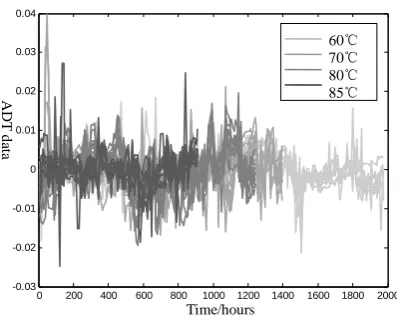
model parameters are estimated utilizing all performance parameters degradation data. Rt is shown in Fig.3.
The prediction of Yt of each system at 60℃, 70℃,
80℃and 85℃ by the multidimensional time series model is shown in Fig.4.
The prediction of the same ADT data is also processed based on the one-dimensional time series model respectively for comparison. This is shown in Fig.5.
According to Fig. 4 and Fig. 5, it is obvious that compared with the prediction curves, the multidimensional time series prediction of the amplitude
0 500 1000 1500 2000 2500 3000 3500 0.95
0.96 0.97 0.98 0.99 1 1.01 1.02 1.03 1.04
ADT d
at
a
Time/hours
60℃ 70℃ 80℃ 85℃
Prediction
Figure 5. One-dimensional prediction of Yt
0 500 1000 1500 2000 2500 3000 3500 0.95
0.96 0.97 0.98 0.99 1 1.01 1.02 1.03 1.04
AD
T
d
at
a
Time/hours
60℃ 70℃ 80℃ 85℃
Prediction
Figure 4. Multidimensional prediction of Yt 0 200 400 600 800 1000 1200 1400 1600 1800 2000 -0.03
-0.02 -0.01 0 0.01 0.02 0.03 0.04
ADT d
at
a
Time/hours
60℃ 70℃ 80℃ 85℃
Figure 3. Rt of ADT data
0 200 400 600 800 1000 1200 1400 1600 1800 2000 0.96
0.97 0.98 0.99 1 1.01 1.02 1.03 1.04 1.05
ADT
d
at
a
Time/hours
60℃ 70℃ 80℃ 85℃
Figure 2. Preprocessed ADT data
0 200 400 600 800 1000 1200 1400 1600 1800 2000 23
24 25 26 27 28 29 30
AD
T d
at
a
Time/hours
60℃ 70℃ 80℃ 85℃
Figure 2. 3-performance parameters ADT data TABLE I.
PARAMETERS OF ADT
Temperature Sample size Num. of Sys.
60℃ 247 3
70℃ 174 3
80℃ 155 3
Yt more closely models the original performance than the
one dimensional time series method.
Given the failure threshold of each performance parameter as 96% of the initial value, the failure time of each of the performance parameters are shown in Table II.
The life prediction of each unit is the minimum failure time prediction across all performance parameters for each unit. The predicted failure time distribution is determined by the Pearson chi-square Goodness of Fit Test. Table III shows the results of the Pearson chi-square test.
According to Table III, Lognormal distribution is the best fit for failure time distribution.
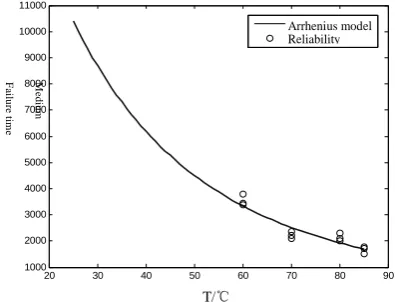
The life prediction for test-stress levels is converted into the use-stress level by establishing relationship between median failure time and test-stress levels, which is established assuming an Arrhenius accelerated model. That is
ln
μ
=
3454.04 /
S
−
2.4015
Fig.6 shows median failure time and temperature stress level relationship based on a multidimensional time series analysis.
Fig.7 shows median failure time and temperature stress level relationship based on a one-dimensional time series analysis for comparison.
The error of the prediction is defined as the mean square error for all parameters of each system degradation measurement across all prediction points between the start point and last time point before system failure. The predicted error is shown in Table IV.
Fig.8 shows the reliability prediction at the use-stress level 25℃, based on the multidimensional time series analysis and the one-dimensional time series analysis is shown for comparison.
TABLE III.
PEARSON CHI-SQUARE TEST OF FAILURE TIME DISTRIBUTION
Temp. 60℃ 70℃ 80℃ 85℃ Ave. Lognorm 0.158 1.362 1.362 0.158 0.960 Weibull 0.455 0.833 2.779 0.455 1.356
TABLE II.
FAILURE TIME (HOURS)
Temperature 60℃ 70℃ 80℃ 85℃
Sys. 1
Perf. 1 3080 >2112 1688 >1712 Perf. 2 >3416 2072 1688 1672 Perf. 3 2968 >2112 >1880 1672
Sys. 2
Perf. 1 >3416 1720 1488 1608
Perf. 2 3184 1792 1608 1328
Perf. 3 >3416 2040 1808 1632
Sys. 3
Perf. 1 3400 >2112 1736 >1712 Perf. 2 >3416 1704 1720 >1712 Perf. 3 >3416 1896 1648 1528
TABLE IV.
ERROR OF PREDICTIONS
Model Multidimensional time series
Temp. 60℃ 70℃ 80℃ 85℃
Sys. 1 0.00114 0.00094 0.00142 0.00120
Sys. 2 0.00078 0.00111 0.00141 0.00116
Sys. 3 0.00132 0.00149 0.00091 0.00105
Model One-dimensional time series
Temp. 60℃ 70℃ 80℃ 85℃
Sys. 1 0.00231 0.00158 0.00234 0.00193
Sys. 2 0.00273 0.00143 0.00156 0.00251
Sys. 3 0.00156 0.00203 0.00148 0.00253
0 0.2 0.4 0.6 0.8 1 1.2 1.4 1.6 1.8 2 x 10⁴ 0
0.1 0.2 0.3 0.4 0.5 0.6 0.7 0.8 0.9 1
R
Time/hours
One
Multiple
Figure 8. Reliability prediction by two methods
20 30 40 50 60 70 80 90
1000 2000 3000 4000 5000 6000 7000 8000 9000 10000 11000
T/℃
Me
d
iu
m
Fa
ilu
re
t
im
e
acceleration model prediction lifetime
Arrhenius model Reliability
Figure 7. Median failure time & temperature relationship based on one-dimensional time series
20 30 40 50 60 70 80 90
1000 2000 3000 4000 5000 6000 7000 8000 9000 10000
T/℃
Med
ium
failure time
acceleration model prediction lifetime
Arrhenius model Reliability
Table V. shows failure time distribution parameters at the use-stress level based on the multidimensional time series analysis with the one-dimensional time series analysis for comparison.
According to Fig.8 and Table V, it could be concluded that life predictions by a multidimensional model are more conservative than one-dimensional model. And according to Table IV, it could be concluded that life predictions by a multidimensional model are more accurate than one-dimensional model. Hence, the former is more credible than the latter.
V.CONCLUSIONS
This paper proposes a life prediction method utilizing a multiple performance parameter system ADT based on a multidimensional time series modeling procedure.
• Compared with one-dimensional time series analysis, the multidimensional time series analysis takes into account the interaction of multiple performance parameters on the performance degradation process.
• Based on the practice, the failure of systems with multiple performance parameters is assumed to obey a competing failure rule that enables a solution for the failure determination problem given multiple system performance failure measures.
• To obtain a life prediction for systems with multiple performance parameters at the use-stress level, this paper proposed a conversion method based on a life prediction across multiple system performance measures at test-stress level based upon a test acceleration model.
• According to the ADT data verification process compared to a one-dimensional time series analysis, the prediction based on a multidimensional time series analysis of the amplitude observed in ADT more closely model the original curve. Thus any failure time or reliability prediction based on multidimensional time series method was demonstrated to be more conservative, accurate and credible.
ACKNOWLEDGMENT
This research is supported by the Research Foundation for Youth Scholars of Beijing Technology and Business University under grants QNJJ2012-21, Key Program of Beijing Natural Science Foundation 8101003 and Science
and Technology Program of Jiangsu provincial water resources bureau 2011014.
REFERENCES
[1] Wang Li; Li Xiaoyang; Jiang Tongmin, “SLD
Constant-Stress ADT Data Analysis based on Time Series Method”,
8th International Conference on Reliability, Maintainability
and Safety, 2009.
[2] Victor Chan, William Q. Meeker, “Time Series Modeling
of Degradation Due to Outdoor Weathering”, Communications in Statistics - Theory and Methods, 37:3,408-424 , 2008.
[3] Wang, J., Zhang, T., “Degradation prediction method by
use of autoregressive algorithm,” IEEE Transactions n Industrial Technology, 21-24, Page(s):1-6, April 2008.
[4] Xu, L., “Study on Fault Prognostic and Health
Management for Electronic System”, Ph.D. Thesis, University of Electronic Science and Technology of China, 2009.
[5] Bachmann, S. M., “Using the Existing Spectral Clutter
Filter With the Nonuniformly Spaced Time Series Data in Weather Radar,” IEEE Geoscience and Remote Sensing Letters, Vol. 5, No. 3, July 2008.
[6] V. Serdobolskii, “Multivariate Statistical Analysis”,
Springer, 2000.
[7] Shuyuan He, “Applied Time Series Analysis”, Peking
University Press, 2003.
[8] Wang Li, Li Xiaoyang, Jiang Tongmin, “CSADT Life
prediction based on DAD using Time Series Method ”, Proceedings of Annual Reliability and Maintainability Symposium (RAMS2011), 2011.
[9] Wang Li, Li Xiaoyang, Wan Bo, “Step-Stress ADT Data
Estimation based on Time Series Method ”, Proceedings of Annual Reliability and Maintainability Symposium (RAMS2010), 2010.
Li Wang received the PhD degree in reliability and system engineering from Beihang University, Beijing, in 2011. She joined the school of computer and information engineering, Beijing Technology and Business University, as a lecturer in 2011. Her research interests include data analysis, accelerated test modeling, and life prediction.
Zaiwen Liu received the PhD degree from Beijing Institute of Technology. He joined the school of computer and information engineering, Beijing Technology and Business University. His research interests include data analysis, accelerated test modeling, and life prediction.
Xuebo Jin received the PhD degree from Zhejiang University. She joined the school of computer and information engineering, Beijing Technology and Business University. Her research interests include data analysis, accelerated test modeling, and life prediction.
Yan Shi received the PhD degree from Beijing Institute of Technology. She joined the school of computer and information engineering, Beijing Technology and Business University. Her research interests include data analysis, accelerated test modeling, and life prediction.
TABLE V.
FAILURE TIME DISTRIBUTION PARAMETERS
Model Multidimensional time series
One-dimensional time series
Lognormal mean 9.1893 9.2493
Lognormal variance 0.1525 0.1268