Distributed
𝐻
∞
coordination of multi-agent
systems with directed switching topology and
time-delay
Lixin Gao, Yanping Luo
Institute of Intelligent Systems and Decision, Wenzhou University, Zhejiang, China Email: [email protected]
Abstract—In this paper, we consider multi-agent 𝐻∞ consensus control problems with external disturbance under directed switching topologies. Both switching networks with and without time-delay are taken into consideration. By the model transformation, the multi-agent𝐻∞control problem is converted into the switching linear system 𝐻∞ control problem with special structure. Based on graph theory and common Lyapunov function method, we establish LMI suffi-cient conditions under which all agents can reach consensus with the desired𝐻∞ performance in two cases of zero and nonzero communication delays respectively. Specially, we obtain an explicit estimation expression of𝐻∞performance index in undirected non-time-delay switching topology case. Finally, two numerical examples are provided to illustrate the effectiveness of the obtained results.
Index Terms-Multi-agent systems, 𝐻∞ control, switching topology, consensus, time-delay
I. INTRODUCTION
Recently, the coordination problem of multiple au-tonomous agents has attracted a great deal of attention for its applications in many fields such as aggregation behavior of animals, collective motion of particles, coop-erative control of unmanned air vehicles, schooling for underwater vehicles, distributed sensor networks, attitude alignment for cluster of satellites, distributed optimiza-tion of multiple mobile robotic systems, scheduling of automated highway systems and congestion control of communication networks in [1]–[5].
In the literature, a critical problem in distributed coop-erative control of multi-agent systems is to design appro-priate protocols that enable all agents to asymptotically reach an agreement on certain quantities of interest. This is usually called the consensus problem, which is well accepted as one of the most important and fundamental issues in the fields of automata theory and coordination control of multi-agent systems. In the fields of system and control, the development of consensus theory is primarily impelled by Vicsek’s particle swarm model mentioned in [1]. Vicsek et al. proposed a simple discrete-time model for phase transition of a group of self-driven particles and simulation showed complex dynamics of the model. Jadbabaie et al. provided a theoretical explanation for the observed behavior of the Vicsek model using the graph theory [3]. Till now, many interesting results for solving similar or generalized consensus problems have also been obtained (see [4], [5] and the references therein).
There is no doubt that the stability of multi-agent systems is of utmost importance. In real applications, the interacting topology between agents may change dynamically. For example, in the case of interaction via communications, the communication links between vehi-cles may be unreliable due to disturbances and/or subject to communication time-delay. However, a well-known fact is that switching of the communication topology and communication time delays may lower the system performance and even cause the network system to di-verge or oscillate [6]. So it is necessary for us to solve the problem with the impact of external disturbances and time-delay on the network. In [7], Lin et al. con-sidered robust 𝐻∞ control in the multi-agent system which involved disturbances and time-delay in both fixed topology case and switching topology case respectively. A linear matrix inequality (LMI) approach was adopted to study consensus problems in [8] and it was proved that all the nodes in a network achieved average consensus asymptotically for appropriate communication delays if the network topology was connected. From a practical standpoint, LMI approaches are appealing for applications because there are effective and powerful algorithms such as interior-point method for the solution of LMI problems and there are also a number of software packages such as Matlab to be available for solving LMI problems [9]. [10] investigated the 𝐿2-𝐿∞ leader-following coor-dination problems with undirected switching topologies and external disturbance. Theoretically, the consensus in undirected switching topology with time delay is easier than that of directed switching topology. Recently, some preliminary results have been reported to deal with the directed switching topology with time delays (see, for instance, [7], [8] and [11]]).
switching topology by using common Lyapunov function method.
Motivated by the above works, we study a group of agents with the double integrator dynamics. The main purpose of this paper is to develop a decentralized control strategy to reach the global consensus of the multi-agent systems and discuss𝐻∞performance index of the closed systems under the directed switching topology. By using the model transformation, the multi-agent 𝐻∞ control problem is converted into the switching linear system 𝐻∞control problem with special structure. In our leader-following construction, the interconnection topological structure among the agents keeps changing, a sufficient condition given by constructing a parameter-dependent common Lyapunov function can still guarantee global consensus stability and achieve the desired 𝐻∞ per-formance. Especially, we obtain an explicit estimation expression in non-time-delay case to estimate 𝐻∞ per-formance index, which may make our result be applied easily.
The rest paper is organized as follows. In Section II, we give a formulation of the coordination problem with the help of graph theory and 𝐻∞ control theory. Then in Section III, the main results on the consensus stability and 𝐻∞ performance index are obtained for the multi-agent system under varying interconnection topologies. Following that, Section IV provides simulation examples, and finally, the concluding remarks are given in Section V.
The notation of this paper is standard. Throughout this paper, the following notations are used:𝑅is the real num-ber set.𝐼is an identity matrix with compatible dimension. 𝐴𝑇 is denoted as transpose of a matrix𝐴; 1=[1. . .1]𝑇 with proper dimension; For symmetric matrices𝐴and𝐵, 𝐴 >(≥)𝐵means𝐴−𝐵is positive (semi-) definite.𝜆(𝐴) represents an eigenvalue of 𝐴. For symmetric matrices 𝐴, 𝜆min(𝐴) and 𝜆max(𝐴) represent the minimum and maximum eigenvalue of𝐴respectively.∥ ∙ ∥denotes Eu-clidean norm. “∗” denotes the entries of matrices implied by symmetry. ⊗ is the denotes the Kronecker product, which satisfies (1) (𝐴⊗𝐵)(𝐶⊗𝐷) = (𝐴𝐶)⊗(𝐵𝐷); (2) If𝐴≥0 and𝐵≥0, then𝐴⊗𝐵≥0.
II. GRAPHTHEORY,𝐻∞CONTROLTHEORY AND
PROBLEMFORMULATION
A. Graph Theory
First of all, we introduce some preliminary knowl-edge of graph theory that will be used throughout this paper. More details are available referring to [17]. Let 𝒢 ={𝒱, 𝜀, 𝐴)be a weighted directed graph of order 𝑛, where𝒱 ={𝑣1, 𝑣2,⋅ ⋅ ⋅ , 𝑣𝑛} is the set of nodes,𝜀is the set of edges and a weighted adjacency matrix 𝐴= [𝑎𝑖𝑗] is of nonnegative elements. The node indexes belong to a finite index set ℐ = {1,2,⋅ ⋅ ⋅ , 𝑛} . The element 𝑎𝑖𝑗 associated with the edge of the directed graph is positive . i.e., 𝑎𝑖𝑗 > 0 ⇐⇒ (𝑣𝑖, 𝑣𝑗) ∈ 𝜀. Moreover, for all 𝑖 ∈ ℐ we assume 𝑎𝑖𝑗 = 0. Throughout the paper, we assume that all the graphs have no edges from a node
to itself. A weighted graph is said to be undirected if ∀(𝑣𝑖, 𝑣𝑗)∈𝜀=⇒(𝑣𝑗, 𝑣𝑖)∈𝜀and 𝑎𝑖𝑗 =𝑎𝑗𝑖. Otherwise, the graph is called a directed graph. If (𝑣𝑖, 𝑣𝑗)∈𝜀, then 𝑣𝑗 is said to be a neighbor of𝑣𝑖 and we denote the set of all neighbor nodes of node 𝑣𝑖 by𝒩𝑖 ={𝑗∣(𝑣𝑖, 𝑣𝑗)∈𝜀}. A path is a sequence of ordered edges of the form
(𝑣𝑖1, 𝑣𝑖2),(𝑣𝑖2, 𝑣𝑖3),⋅ ⋅ ⋅,(𝑣𝑖𝑗−1, 𝑣𝑖𝑗) where 𝑖𝑗 ∈ ℐ and 𝑣𝑖𝑗 ∈ 𝒱, which starts from𝑣𝑖 and ends with𝑣𝑗 such that consecutive pair of vertices make an edge of digraph. 𝑣𝑗 is said to be reachable from 𝑣𝑖 if there is a path from node 𝑣𝑖 to another node 𝑣𝑗 . If a node 𝑣𝑖 is reachable from every other node of the directed graph, then it is said to be globally reachable.
The degree matrix 𝐷 ={𝑑1, 𝑑2,⋅ ⋅ ⋅, 𝑑𝑛} ∈ ℛ𝑛×𝑛 of graph 𝒢 is a diagonal matrix, where diagonal elements
𝑑𝑖 = ∑
𝑗∈𝒩𝑖
𝑎𝑖𝑗 for 𝑖 = 1,2,⋅ ⋅ ⋅, 𝑛. Then the Laplacian
of 𝒢 is defined as 𝐿 =𝐷−𝐴 ∈𝑅𝑛×𝑛. Obviously, the Laplacian matrix of any undirected graph is symmetric.
In what follows, we mainly consider a graph 𝒢ˆ as-sociated with the system with 𝑛 agents (labeled by 𝑣𝑖, 𝑖 = 1,2,⋅ ⋅ ⋅, 𝑛) and one leader (labeled by 𝑣0). A simple and directed graph 𝒢 describes the topology relation of these𝑛followers, and𝒢ˆcontains graph𝒢 and 𝑣0with the directed edges from some agents to the leader
describes the topology relation among all agents. The graph 𝒢ˆis said to be undirected if the induced subgraph 𝒢 associated with 𝑛 followers is undirected. A diagonal matrix𝐵∈𝑅𝑛×𝑛 is defined as a leader adjacency matrix associated with𝒢¯whose diagonal elements are𝑏𝑖(𝑖∈ ℐ). Moreover, the information topology 𝒢¯ is time-varying. Denote {𝒮¯ = {𝒢¯1,𝒢¯2,⋅ ⋅ ⋅,𝒢¯𝑁} as a set of the graphs of all possible topologies and denote 𝒫 ={1,2,⋅ ⋅ ⋅, 𝑁} as its index set. To describe the variable interconnection topology, we define a switching signal 𝜎: [0,∞)→ 𝒫, which is piecewise constant. Let 𝑡1 = 0, 𝑡2, 𝑡3,⋅ ⋅ ⋅ be an infinite time sequence at which the interconnection graph of the considered multi-agent system switches. Therefore, 𝒩𝑖 and the connection weight 𝑎𝑖𝑗(𝑖, 𝑗 = 1,⋅ ⋅ ⋅ , 𝑛) are time-varying, and furthermore, Laplacian 𝐿𝜎(𝑡)(𝜎(𝑡) ∈ 𝒫)associated with the switching interconnection graph is also time-varying, though it is a time-invariant matrix in any interval[𝑡𝑖, 𝑡𝑖+1). Assume there is a constant𝜏0>0, often called dwell time, with 𝑡𝑖+1−𝑡𝑖≥𝜏0, ∀𝑖.
B. 𝐻∞ control theory
In this subsection, we introduce some basic concepts on 𝐻∞ control theory. Consider the following switching system
{
˙
𝑥(𝑡) =𝐴𝜎𝑥(𝑡) +𝐵𝜔(𝑡)
𝑧(𝑡) =𝐶𝑥(𝑡) (1)
𝐻∞ norm of closed-loop transfer function matrix 𝑇𝑧𝜔(𝑡) from external disturbance 𝜔(𝑡) to the controlled output 𝑧(𝑡)which is defined by
∥𝑇𝑧𝜔(𝑡)∥∞= sup
𝜔(𝑡)∕=0
∥𝑧(𝑡)∥2
∥𝜔(𝑡)∥2
Thus, the 𝐻∞ control objective is to design an output feedback protocol𝑢𝑖(𝑡)(𝑖∈ ℐ)such that∥𝑇𝑧𝜔(𝑡)∥∞< 𝜇, or equivalently, the closed-loop system meets the dissipa-tion inequality
∫ ∞
0 ∥𝑇𝑧𝜔(𝑡)∥
2𝑑𝑡 < 𝜇2∫ ∞ 0 ∥𝜔(𝑡)∥
2𝑑𝑡,∀𝜔∈ ℒ 2[0,∞)
where 𝜇 > 0 is a given 𝐻∞ performance index. The following result is about the 𝐻∞ performance index.
Lemma 1: [7] System (1) is asymptotically stable with ∥𝑇𝑧𝜔(𝑠)∥∞< 𝜇for all nonzero𝜔(𝑡)∈ ℒ2[0,∞), if there exists a positive definite matrix 𝑃 ∈ ℛ𝑛×𝑛 and a scalar 𝜇 satisfying
⎡ ⎣ 𝐴
𝑇
𝜎𝑃+𝑃 𝐴𝜎 𝑃 𝐵 (𝐶⊗𝐼𝑛)𝑇
𝐵𝑇𝑃 −𝜇𝐼
𝑛 0
(𝐶⊗𝐼𝑛) 0 −𝜇𝐼2𝑛
⎤ ⎦<0
C. Problem Formulation
In the paper, suppose that the multi-agent system under consideration consists of𝑛agents. Each agent is regarded as a node in a directed graph 𝒢. 𝒢ˆ is the graph with a leader in𝒢. Assume the𝑖𝑡ℎagent(𝑖∈ ℐ)has the second-order dynamics and disturbance is considered as follows
{
˙
𝑥𝑖(𝑡) =𝑦𝑖(𝑡)
˙
𝑦𝑖(𝑡) =𝑢𝑖(𝑡) +𝜔𝑖(𝑡) , 𝑖= 1,⋅ ⋅ ⋅, 𝑛, (2) where𝑥𝑖(𝑡)represents the position of the node 𝑣𝑖, 𝑦𝑖(𝑡) its velocity, 𝑢𝑖(𝑡)its control input and 𝜔𝑖(𝑡)∈ ℒ2[0,∞) its disturbance input. The dynamic of the leader is taken
as {
˙
𝑥0(𝑡) =𝑦0(𝑡)
˙
𝑦0(𝑡) = 0 (3)
where 𝑦0 is the leader’s velocity and keeps unchanged. The leader of this considered multi-agent system is active, and its motion only depends on the known input 𝑦0 and does not be influenced by the following agents. But follower nodes are affected by other followers and the leader. To the end, the controller𝑢𝑖 of agent𝑖, regarded as node 𝑖 in a graph, requires state information from a subset of the agent’s flockmates, called the neighbor set 𝒩𝑖as above. Take the local control law as follows in case of non-delay for agent𝑖(𝑖= 1,2,⋅ ⋅ ⋅ , 𝑛), which bases on neighbor feedback law and had been proposed by several references
𝑢𝑖=𝑘[
∑
𝑣𝑗∈𝒩𝑖
𝑎𝑖𝑗(𝑡)(𝑥𝑗(𝑡)−𝑥𝑖(𝑡))
+𝑏𝑖(𝑡)(𝑥𝑖(𝑡)−𝑥0(𝑡))]
+𝑘𝑟[ ∑
𝑣𝑗∈𝒩𝑖
𝑎𝑖𝑗(𝑡)(𝑦𝑗(𝑡)−𝑦𝑖(𝑡))
+𝑏𝑖(𝑡)(𝑦𝑖(𝑡)−𝑦0(𝑡))]
(4)
Take the local law as follows in case that there is time-varying delay,
𝑢𝑖=𝑘[
∑
𝑣𝑗∈𝒩𝑖
𝑎𝑖𝑗(𝑡)(𝑥𝑗(𝑡−𝜏(𝑡))−𝑥𝑖(𝑡−𝜏(𝑡)))
+𝑏𝑖(𝑡)(𝑥𝑖(𝑡−𝜏(𝑡))−𝑥0(𝑡−𝜏(𝑡)))]
+𝑘𝑟[ ∑
𝑣𝑗∈𝒩𝑖
𝑎𝑖𝑗(𝑡)(𝑦𝑗(𝑡−𝜏(𝑡))−𝑦𝑖(𝑡−𝜏(𝑡)))
+𝑏𝑖(𝑡)(𝑦𝑖(𝑡−𝜏(𝑡))−𝑦0(𝑡−𝜏(𝑡)))]
(5)
Here 𝑘 is ”control” parameter, which is positive con-stant and will be determined later.𝑟is positive weighted parameter, 𝜏(𝑡) is time-varying delay and it satisfies
0≤𝜏(𝑡)< 𝑑,𝜏˙(𝑡)≤𝑑1<1.
At time𝑡 , the𝑎𝑖𝑗(𝑡)and𝑏𝑖(𝑡)are chosen by
𝑎𝑖𝑗(𝑡) =
{
𝛼𝑖𝑗 if agent𝑖 is connected to agent𝑗
0 otherwise
(6)
𝑏𝑖(𝑡) =
{
𝛽𝑖 if agent𝑖is connected to the leader
0 otherwise
(7) where 𝛼𝑖𝑗 > 0(𝑖, 𝑗 = 1, ..., 𝑛) is connection weight constant between agent 𝑖 and agent 𝑗, and 𝛽𝑖 > 0(𝑖 =
1, ..., 𝑛) is connection weight constant between agent 𝑖 and leader.
The main purpose of this paper is to design 𝑘, 𝑟 in 𝑢𝑖𝑗(𝑡)to guarantee that any follower-agent can track the active leader, i.e.,
{
lim
𝑡→∞𝑥𝑖=𝑥0
lim
𝑡→∞𝑦𝑖=𝑦0
, 𝑖= 1,⋅ ⋅ ⋅, 𝑛, (8)
and the closed system has smaller𝐻∞performance index. For the convenience, define
𝑥:=
⎛ ⎜ ⎜ ⎜ ⎝
𝑥1
𝑥2
.. . 𝑥𝑛
⎞ ⎟ ⎟ ⎟
⎠, 𝑦:= ⎛ ⎜ ⎜ ⎜ ⎝
𝑦1
𝑦2
.. . 𝑦𝑛
⎞ ⎟ ⎟ ⎟
⎠, 𝜔:= ⎛ ⎜ ⎜ ⎜ ⎝
𝜔1
𝜔2
.. . 𝜔𝑛
⎞ ⎟ ⎟ ⎟ ⎠.
Then we can rewrite the closed-loop system (2-4) as
⎧ ⎨ ⎩
˙
𝑥=𝑦
˙
𝑦=−𝑘(𝐿𝜎+𝐵𝜎)𝑥+𝑘𝐵𝜎1⊗𝑥0
−𝑘𝑟(𝐿𝜎+𝐵𝜎)𝑦+𝑘𝑟𝐵𝜎1⊗𝑦0+𝜔
(9)
where 1 = (1,1, ...,1)𝑇. 𝜎 : [0,∞) → 𝒫 ={1, ..., 𝑁} is a piecewise-constant switching signal with successive switching times,𝐿𝜎is the Laplacian for the𝑛agents,𝐵𝜎 is a 𝑛×𝑛diagonal matrix whose𝑖th diagonal element is 𝑏𝑖(𝑡) at time𝑡 (𝑏𝑖(𝑡)is a positive constant if agent 𝑖 is connected to the leader ).
Denote𝑥¯(𝑡) =𝑥(𝑡)−𝑥0(𝑡)1and𝑦¯(𝑡) =𝑦(𝑡)−𝑦0(𝑡)1. For convenience, let𝐻𝜎 =𝐿𝜎+𝐵𝜎. Due to𝐿1= 0, we can obtain
{
˙¯
𝑥= ¯𝑦
˙¯
Define consensus error vector𝛿= (¯𝑥𝑇,𝑦¯𝑇)𝑇. Thus, using the control law (4), the error dynamics of closed system can be expressed as follows:
˙
𝛿(𝑡) =𝐹𝜎𝛿(𝑡) +𝐵𝜔(𝑡) (11)
where
𝐹𝜎=
[
0 𝐼𝑛
−𝑘𝐻𝜎 −𝑘𝑟𝐻𝜎
]
, 𝐵=
[
0
𝐼𝑛
]
(12)
As for the time delay case, the error dynamics can be written as the following form by using the control law (5):
˙
𝛿(𝑡) =𝐴𝛿(𝑡)−𝐸𝜎𝛿(𝑡−𝜏(𝑡)) +𝐵𝜔(𝑡) (13)
where
𝐸𝜎 =
[
0 0
𝑘𝐻𝜎 𝑘𝑟𝐻𝜎
]
, 𝐴=
[
0 𝐼𝑛
0 0
]
(14)
Obviously, the multi-agent system achieve consensus if and only if lim
𝑡→∞𝛿(𝑡) = 0. The consensus stability of the multi-agent system (2, 3) and (4) in non-time delay case is converted into the stability of error dynamics system (11), and the consensus stability of the multi-agent system (2, 3) and (5) in time delay case is converted into the stability of error dynamics system (13)
To quantize the influence of the disturbance input on the consensus, we should investigation how the disturbance affect the relative position and relative velocity errors between each follower and the leader. Therefore, we consider the following output 𝑧(𝑡) for the error dynamic systems (11) and (13):
𝑧(𝑡) = (𝐶⊗𝐼𝑛)𝛿(𝑡) (15)
where
𝐶=
[
𝑎 0
0 𝑏
]
(16)
The weighted matrix 𝐶 is erroneous scope restraint to relative position and velocity, the value of the weighted coefficients𝑎and𝑏may be different according to the con-trolled different ranges of relative position and velocity. Generally speaking, the smaller the controlled range is, the larger the weighted value is. So we can limit∥𝑧(𝑡)∥∞ within certain range. That is to say, we can limit relative position and velocity to the desired scope of the systems. Since 𝑧(𝑡) = 0 implies that the following agents can track the leader, the attenuating ability of multi-agent system on consensus against external disturbances can be quantitatively measured by the 𝐻∞ norm of closed-loop transfer function matrix𝑇𝑧𝜔(𝑡)from external disturbance 𝜔(𝑡)to the controlled output𝑧(𝑡). From the above trans-formations, we know that the 𝐻∞ consensus problem of the multi-agent systems with external disturbances are converted into the above 𝐻∞ control problem of the switching systems (11) and (15) or the switching time-delay system (13) and (15).
III. 𝐻∞CONSENSUSPROBLEM
Before giving the main results, some useful results are introduced, which will be used later.
Lemma 2: [18] (Schur Complement) Suppose that a symmetric matrix is partitioned as
[
𝐷1 𝐷2𝑇
𝐷2 𝐷3 ]
(17)
where 𝐷1 and 𝐷3 are square. This matrix is positive definite if and only if 𝐷3 is positive definite and 𝐷1− 𝐷2𝐷−31𝐷𝑇2 is positive definite.
Lemma 3: [9] For any vector𝑢, 𝑣, and symmetric pos-itive definite matrix𝑆, there is2𝑢𝑇𝑣≤𝑢𝑇𝑆−1𝑢+𝑣𝑇𝑆𝑣
Lemma 4: [12] If graph 𝒢ˆ is connected and undi-rected, then the symmetric matrix𝐻𝜎 is positive definite.
Therefore, define
¯
𝜆:= min
𝑝∈𝒫{𝜆(𝐻𝑝)∣𝒢ˆ 𝑖𝑠 𝑐𝑜𝑛𝑛𝑛𝑒𝑐𝑡𝑒𝑑 𝑎𝑛𝑑 𝑢𝑛𝑑𝑖𝑟𝑒𝑐𝑡𝑒𝑑} (18) Based on lemmas 4 and the fact that the set 𝒫 is finite, we can obtain that is fixed and greater than zero, which depends directly on the constants all constants 𝑎𝑖𝑗 and𝛽𝑖 (𝑖, 𝑗= 1,2,⋅ ⋅ ⋅ , 𝑛) given in (6) and (7).
A. Non-time-delay Case
In this subsection, we first solve the problem of 𝐻∞ performance index of the switching system (11) and (15) under directed switching communication topology based on the LMI approach. As a special case, the consensus condition for the switching and undirected interconnection topology case can be obtained directly.
Theorem 1: For the system (11) and (15), suppose that the interconnection graph is connected for any interval
[𝑡𝑖, 𝑡𝑖+1). If there exist a positive definite matrix𝑃¯ and a positive constantℎsuch that
𝐻𝑇
𝑖 𝑃¯+ ¯𝑃 𝐻𝑖≥ℎ𝐼, 𝑖∈ 𝒫 (19)
and take a constant
𝑘 > 2𝜆𝑚𝑎𝑥( ¯𝑃)
ℎ𝑟2 , (20)
then the local control law (4) can guarantee that multi-agent system in leader-following directed case can achieve the consensus for any given initial condition 𝑥(0) and 𝑦(0) in case that 𝜔(𝑡) = 0. Furthermore, the 𝐻∞ disturbance attenuation from 𝜔(𝑡) to 𝑧(𝑡) is not greater than
min
𝑚>0𝜆max(𝑄
−1Ω),
where the matrices 𝑄 and Ω are expressed respectively as follows
𝑄=
(
𝑘𝑚𝑟ℎ𝐼 𝑘𝑚𝑟2ℎ𝐼−2𝑚𝑃¯
𝑘𝑚𝑟2ℎ𝐼−2𝑚𝑃 𝑘𝑚𝑟¯ 3ℎ𝐼−2𝑚𝑟𝑃¯ )
,
Ω =
(
𝑚2𝑟2𝑃¯2+𝑎2𝐼 𝑚2𝑟3𝑃¯2
𝑚2𝑟3𝑃¯2 𝑚2𝑟4𝑃¯2+𝑏2𝐼 )
.
[𝑡𝑗, 𝑡𝑗+1)), the interconnection topology does not change.
Therefore,𝐹𝜎(𝑡)is a constant matrix for𝑡∈[𝑡𝑗, 𝑡𝑗+1)for any 𝑗≥0, and then the solution to equation (11) is well defined. Choose a positive definite matrix
𝑃=𝑚
[
2 ¯𝑃 𝑟𝑃¯ 𝑟𝑃 𝑟¯ 2𝑃¯
]
. (21)
We can verify that 𝑃 is positive definite by result of lemma 2. Consider a common Lyapunov function𝑉(𝑡) = 𝛿𝑇(𝑡)𝑃 𝛿(𝑡), where 𝑃 is defined in (21). Then, for any interval [𝑡𝑙, 𝑡𝑙+1) , we can assume that 𝜎(𝑡) = 𝑖, 𝑖 ∈ 𝒫, 𝑡∈[𝑡𝑗, 𝑡𝑗+1). To analyze stability of error system (11), we always assume that 𝜔(𝑡) = 0. For the convenience, define
Ω𝑖=𝐻𝑖𝑇𝑃¯+ ¯𝑃 𝐻𝑖 For any interval[𝑡𝑗, 𝑡𝑗+1), we can obtain
˙
𝑉(𝑡) =𝛿𝑇(𝑡)(𝐹𝑇
𝑖 𝑃+𝑃 𝐹𝑖)𝛿(𝑡) =−𝛿𝑇(𝑡)𝑄𝑖𝛿(𝑡) where𝑄𝑖 is defined as
𝑄𝑖:=−(𝐹𝑖𝑇𝑃+𝑃 𝐹𝑖)
=
(
𝑘𝑚𝑟Ω𝑖 𝑘𝑚𝑟2Ω𝑖−2𝑚𝑃¯
𝑘𝑚𝑟2Ω
𝑖−2𝑚𝑃 𝑘𝑚𝑟¯ 3Ω𝑖−2𝑚𝑟𝑃¯
)
(22)
Noticing that
(
𝑘𝑚𝑟 𝑘𝑚𝑟2
𝑘𝑚𝑟2 𝑘𝑚𝑟3 )
⊗ (Ω𝑖−ℎ𝐼)≥0,
Thus we obtain
𝑄𝑖≥𝑄:=
(
𝑘𝑚𝑟ℎ𝐼 𝑘𝑚𝑟2ℎ𝐼−2𝑚𝑃¯
𝑘𝑚𝑟2ℎ𝐼−2𝑚𝑃 𝑘𝑚𝑟¯ 3ℎ𝐼−2𝑚𝑟𝑃¯ )
. (23) By using the Schur Complement lemma 2, we know that 𝑄 is positive definite only if the inequality (20) is satisfied. So we have 𝑉˙(𝑡) <0 when 𝜔(𝑡) = 0. In this case, we have lim
𝑡→∞𝛿(𝑡) = 0, that is, the system can reach consensus for any given initial state𝑥(0)and𝑦(0) when 𝜔(𝑡) = 0.
To consider𝐻∞performance index, we always assume that all initial values are zero and nonzero 𝜔(𝑡) ∈ 𝐿2[0,∞). Moreover, by applying the result of lemma 1, the𝐻∞disturbance attenuation of the multi-agent system is also not greater than𝜇if the following inequalities are satisfied for any 𝑖∈ 𝒫
⎡
⎣ −𝑄𝑖 𝑃 𝐵 (𝐶⊗𝐼𝑛)
𝑇
𝐵𝑇𝑃 −𝜇𝐼
𝑛 0
(𝐶⊗𝐼𝑛) 0 −𝜇𝐼2𝑛
⎤ ⎦<0
which can be guaranteed by
⎡
⎣ 𝑄 −𝑃 𝐵 −(𝐶⊗𝐼𝑛)
𝑇
−𝐵𝑇𝑃 𝜇𝐼
𝑛 0
−(𝐶⊗𝐼𝑛) 0 𝜇𝐼2𝑛
⎤ ⎦>0,
where the matrices𝑄𝑖and𝑄are defined by (22) and (23) respectively.
By using lemma 2 again, the above matrix is positive definite if and only if
𝜇𝑄−Ω>0. (24)
It is easy to verify the matrixΩis positive definite. Thus, the inequality (24) is satisfied only if 𝜇 > 𝜆max(𝑄−1Ω). Therefore, due to 𝑚 >0, we can obtain that the 𝐻∞ disturbance attenuation from 𝜔(𝑡) to 𝑧(𝑡) is not greater than
min
𝑚>0𝜆max(𝑄
−1Ω).
Now, the proof is completed.
Remark 1: For two positive definite matrices 𝑄 and
Ω, we have𝜆(Ω−1𝑄) =𝜆(Ω−12𝑄Ω−12)[18]. Obviously,
Ω−1
2𝑄Ω−12 is also a positive definite matrix. Thus, all
eigenvalues of matrixΩ−1𝑄are positive real number. The natation 𝜆max(𝑄−1Ω)used in Theorem 1 is meaningful and compatible.
As a special case, the undirected switching topology is discussed in following corollary.
Corollary 1: For the system (11) and (15), suppose that the interconnection graph is connected and undirected for any interval [𝑡𝑖, 𝑡𝑖+1). Take the positive constants 𝑘 and 𝑟 satisfied
𝑘 > 1
𝑟2𝜆¯. (25)
Then the local control law (4) can guarantee that multi-agent system in leader-following directed case can achieve the consensus for any given initial condition 𝑥(0) and 𝑦(0) in case that 𝜔(𝑡) = 0. Furthermore, the 𝐻∞ disturbance attenuation from 𝜔(𝑡) to 𝑧(𝑡) is not greater than
min
𝑚>0𝜆max( ¯𝑄
−1¯Ω),
where the matrices 𝑄¯ and ¯Ω are expressed respectively as follows:
¯
𝑄=
(
𝑘𝑚𝑟ℎ 𝑘𝑚𝑟2ℎ−2𝑚
𝑘𝑚𝑟2ℎ−2𝑚 𝑘𝑚𝑟3ℎ−2𝑚𝑟 )
, (26)
¯Ω =( 𝑚2𝑚𝑟22𝑟+3𝑎2 𝑚2𝑚𝑟42𝑟+3𝑏2 )
. (27)
Proof: Based on lemma 4 and the definition of 𝜆¯ in (18), we have
𝐻𝑇
𝑙 𝐼+𝐼𝐻𝑙≥2¯𝜆𝐼.
Choose a symmetric matrix
𝑃 =𝑚
[
2𝐼 𝑟𝐼
𝑟𝐼 𝑟2𝐼 ]
(28)
By using similar method as proof of Theorem 1, we can known that if the positive constants𝑘 and𝑟satisfied
𝑘 > 1
𝑟2𝜆¯, (29)
then the local control law (4) can guarantee that multi-agent system in leader-following directed case can achieve the consensus for any given initial condition 𝑥(0) and 𝑦(0)in case that𝜔(𝑡) = 0. Moreover, the𝐻∞disturbance attenuation of the multi-agent system is also not greater than𝜇 if
where
𝑄=
(
𝑘𝑚𝑟ℎ𝐼 𝑘𝑚𝑟2ℎ𝐼−2𝑚𝐼
𝑘𝑚𝑟2ℎ𝐼−2𝑚𝐼 𝑘𝑚𝑟3ℎ𝐼−2𝑚𝑟𝐼 )
,
Ω =
(
𝑚2𝑟2𝐼+𝑎2𝐼 𝑚2𝑟3𝐼
𝑚2𝑟3𝐼 𝑚2𝑟4𝐼+𝑏2𝐼 )
Obviously, the matrix inequality (30) is equivalent to
𝜇𝑄¯−¯Ω>0, (31)
where the matrices 𝑄¯ and ¯Ω are defined in (26) and (27) respectively. Similarly, we can obtain that the 𝐻∞ disturbance attenuation from 𝜔(𝑡) to 𝑧(𝑡) is not greater than
min
𝑚>0𝜆max( ¯𝑄
−1¯Ω).
Remark 2: It is easy to verify the two matrices𝑄¯ and
¯Ω are positive definite. The two eigenvalues of matrix
¯
𝑄−1¯Ω are positive, which can be obtained by directed
calculation. Although the close-system have𝑛-dimension, the estimation of𝐻∞disturbance attenuation only based on two-dimension matrix.
B. Time-delay Case
In this section, we mainly study𝐻∞control problem in the directed network of multi-agents with switching and time-varying delay.
Theorem 2: Assume that the interaction graph 𝒢 is connected, for given positive constants 𝑘, 𝑟 >0 and the time-varying time-delay𝜏(𝑡)which satisfies0≤𝜏(𝑡)< 𝑑 and𝜏˙(𝑡)≤𝑑1<1, the system (13) and (15) is stable for 𝜔(𝑡) = 0 with the given 𝐻∞ disturbance attenuation at least 𝜇, if there exist a positive constant 𝑚 and positive definite matrices𝑃 , 𝑄¯ 1, 𝑄2, 𝑅1, 𝑅2 such that
⎡ ⎢ ⎢ ⎣
Θ11 Θ12 Θ13 Θ14
∗ Θ22 Θ23 Θ24
∗ ∗ Θ33 Θ34
∗ ∗ ∗ Θ44 ⎤ ⎥ ⎥
⎦<0 (32)
where
Θ11=−𝑘𝑚𝑟𝑃 𝐻¯ 𝑖−𝑘𝑚𝑟𝐻𝑖𝑇𝑃¯+𝑄1+𝑎2𝐼𝑛,
Θ12= 2𝑚𝑃¯−𝑘𝑚𝑟2𝑃 𝐻¯ 𝑖−𝑘𝑚𝑟2𝐻𝑖𝑇𝑃¯
Θ13=𝑘𝑚𝑟𝑃 𝐻¯ 𝑖,
Θ14=𝑘𝑚𝑟2𝑃 𝐻¯ 𝑖,
Θ22= 2𝑚𝑟𝑃¯−𝑘𝑚𝑟3𝑃 𝐻¯ 𝑖−𝑘𝑚𝑟3𝐻𝑖𝑇𝑃¯
+𝑄2+𝑑𝑅1+𝑏2𝐼𝑛
Θ23=𝑘𝑚𝑟2𝑃 𝐻¯ 𝑖
Θ24=𝑘𝑚𝑟3𝑃 𝐻𝑖,
Θ33=−1−𝑑𝑑
1𝑅1−𝜇𝐼𝑛
Θ34= 0,
Θ44=−1−𝑑𝑑
1𝑅2−𝜇𝐼𝑛
.
Proof: Choose a common Lyapunov function as
𝑉(𝑡) =𝛿𝑇(𝑡)𝑃 𝛿(𝑡) +∫ 𝑡 𝑡−𝜏(𝑡)𝛿
𝑇(𝑠)𝑄𝛿(𝑠)𝑑𝑠
+
∫ 0
−𝜏(𝑡) ∫ 𝑡
𝑡+𝜃
˙
𝛿𝑇(𝑠)𝑅𝛿˙(𝑠)𝑑𝑠𝑑𝜃
where 𝑄 =
[
𝑄1 0
0 𝑄2
]
, 𝑅 =
[
𝑅1 0
0 𝑅2
]
, 𝑃 =
[
2𝑚𝑃¯ 𝑚𝑟𝑃¯ 𝑚𝑟𝑃 𝑚𝑟¯ 2𝑃¯
]
.
For any 𝑇 >0, also define a performance function as
𝐽(𝑡) =
∫ 𝑇
0 [𝑧
𝑇𝑧−𝜇2𝜔𝑇𝜔]𝑑𝑡.
By calculating the derivation of 𝑉(𝑡) about the time 𝑡, we can get
˙
𝑉(𝑡) = 2𝛿𝑇(𝑡)𝑃𝛿˙(𝑡) +𝛿𝑇(𝑡)𝑃 𝛿(𝑡)
−(1−𝜏˙(𝑡))𝛿𝑇(𝑡−𝜏(𝑡))𝑄𝛿(𝑡−𝜏(𝑡))
+𝜏(𝑡) ˙𝛿𝑇(𝑡)𝑅𝛿˙(𝑡)
+ ( ˙𝜏(𝑡)−1)
∫ 𝑡
𝑡−𝜏(𝑡)( ˙𝛿
𝑇(𝑠)𝑅𝛿˙(𝑠))𝑑𝑠
(33)
According to the system (13) and (15), using Lemma 3 and noticing the fact that𝛿(𝑡−𝜏) =𝛿(𝑡)−∫𝑡𝑡−𝜏𝛿(𝑠)𝑑𝑠, we can obtain
˙
𝑉(𝑡)≤2𝛿𝑇(𝑡)𝑃 𝐴𝛿(𝑡)−2𝛿𝑇(𝑡)𝑃 𝐸 𝑖𝛿(𝑡)
+1−𝑑𝑑
1𝛿 𝑇(𝑡)𝑃 𝐸
𝑖𝑅−1𝐸𝑇𝑖 𝑃 𝛿(𝑡)
+ 2𝛿𝑇(𝑡)𝑃 𝐵𝜔(𝑡) +𝛿𝑇(𝑡)𝑄𝛿(𝑡)
−(1−𝑑1)𝛿𝑇(𝑡−𝜏(𝑡))𝑄𝛿(𝑡−𝜏(𝑡))
+𝑑𝛿𝑇(𝑡)𝐴𝑇𝑅𝐴𝛿(𝑡) +𝑑𝛿𝑇(𝑡)𝐴𝑇𝑅𝐵𝜔(𝑡)
+𝑑𝛿𝑇(𝑡−𝜏(𝑡))𝐸𝑇
𝑖 𝑅𝐸𝑖𝛿(𝑡−𝜏(𝑡))
+𝑑𝜔𝑇(𝑡)𝐵𝑇𝑅𝐴𝛿(𝑡) +𝑑𝜔𝑇(𝑡)𝐵𝑇𝑅𝐵𝜔(𝑡) (34)
we rewrite (34) in a compact form as follows
˙
𝑉(𝑡)≤
⎡
⎣ 𝛿(𝑠−𝛿(𝜏𝑠))
𝜔(𝑠)
⎤ ⎦
𝑇
𝑀𝑖
⎡
⎣ 𝛿(𝑠−𝛿(𝜏𝑠))
𝜔(𝑠)
⎤
⎦ (35)
where𝑀𝑖 has the following structure
𝑀𝑖:=
⎛
⎝ Φ11 0 𝑃 𝐵+𝑑𝐴
𝑇𝑅𝐵
0 Φ22 0
∗ 0 𝑑𝐵𝑇𝑅𝐵
⎞
⎠ (36)
with
Φ11=𝑃 𝐴+𝐴𝑇𝑃−𝑃 𝐸𝑖−𝐸𝑖𝑃
+1−𝑑𝑑
1𝑃 𝐸 𝑇
𝑖 𝑅−1𝐸𝑖𝑇𝑃+𝑄+𝑑𝐴𝑇𝑅𝐴
Due to zero initial conditions and using the above inequal-ity, we know
𝐽(𝑇) =
∫ 𝑇
0 [𝑧
𝑇𝑧−𝜇2𝜔𝑇𝜔]𝑑𝑡
=
∫ 𝑇
0 [𝑧
𝑇𝑧−𝜇2𝜔𝑇𝜔+ ˙𝑉(𝑡)]𝑑𝑡−𝑉(𝑇) +𝑉(0)
≤
∫ 𝑇
0 ( ⎡
⎣ 𝛿(𝑡−𝜏𝛿((𝑡))𝑡)
𝜔(𝑡)
⎤ ⎦
𝑇
(Υ +𝑀𝑖)
⎡
⎣ 𝛿(𝑡−𝜏𝛿((𝑡))𝑡)
𝜔(𝑡)
⎤ ⎦)𝑑𝑡
−𝑉(𝑇) +𝑉(0)
(37) whereΥhas the following form:
Υ :=
⎛ ⎝ 𝐶
𝑇𝐶⊗𝐼
𝑛 0 0
0 0 0
0 0 −𝜇2𝐼
𝑛
⎞
⎠ (38)
Due to𝑉(𝑇)>0and𝑉(0) = 0, if(Υ+𝑀𝑖)<0, then we have𝐽(𝑇)<0. That is to say,𝑧𝑇𝑧 < 𝜇2𝜔𝑇𝜔, which implies ∥𝑇𝑧𝜔(𝑠)∥∞ =𝑠𝑢𝑝∥∥𝜔𝑧∥∥2
2 < 𝜇. Following that, we
provide the conditions of (Υ +𝑀𝑖)<0.(Υ +𝑀𝑖)can divide into Ξ1+ Ξ2, where
Ξ1:= ⎛
⎝ Φ11+𝐶
𝑇𝐶⊗𝐼
𝑛 0 𝑃 𝐵
0 −(1−𝑑1)𝑄 0
𝐵𝑇𝑃 0 −𝜇2𝐼
𝑛
⎞ ⎠
(39) and
Ξ2:= ⎛
⎝ 0 0 𝑑𝐴
𝑇𝑅𝐵
0 −𝑑𝐸𝑇
𝑖 𝑅𝐸𝑖 0
𝑑𝐵𝑇𝑅𝐴 0 𝑑𝐵𝑇𝑅𝐵
⎞
⎠ (40)
Noticing that Ξ2≥0, so(Υ +𝑀𝑖)<0 is equivalent to
Ξ1<0.
By using the lemma 2, Ξ1 is converted into Ξ3+ Ξ4.
Ξ3 andΞ4 are expressed respectively as follows:
Ξ3:= (
Φ11+𝐶𝑇𝐶⊗𝐼𝑛 0
0 −(1−𝑑1)𝑄
)
(41)
Ξ4:= 𝜇12 (
𝑃 𝐵
0
)
∗( 𝐵𝑇𝑃 0 ) (42)
SinceΞ4≥0, we can getΞ3<0. Thus,(Φ11+𝐶𝑇𝐶⊗ 𝐼𝑛)<0, by using the lemma 2 again, the inequality can rewrite asΔ that has the following structure:
Δ :=
(
Δ11 𝑃 𝐸𝑖
∗ − 𝑑
1−𝑑1𝑅−𝜇𝐼2𝑛
)
<0 (43)
whereΔ11=𝑃 𝐴+𝐴𝑇𝑃−𝑃 𝐸𝑖−𝐸𝑖𝑇𝑃+𝑄+𝑑𝐴𝑇𝑅𝐴+ 𝐶𝑇𝐶⊗𝐼
𝑛
From above analysis, we can obtain the LMI condition given in the theorem 2 by substituting the block expres-sion of 𝐴, 𝑃, 𝑄, 𝑅, 𝐸𝑖 into Δ. The proof is completed now.
IV. SIMULATION EXAMPLES
In this section, two numerical simulations will be given to illustrate the theoretical results obtained in the previous section. Without loss of generality, in case that there is no time-delay, we take 𝑎 = 1, 𝑏 = 1, 𝑘 = 10, 𝑟 =
2, ℎ= 1. Consider a multi-agent system with one leader and six followers. The interconnection directed topology is arbitrarily switched with switching period 1 among three graphs 𝒢ˆ𝑖(𝑖 = 1,2,3). The Laplacian matrices 𝐿𝑖(𝑖 = 1,2,3) for the three subgraphs 𝒢ˆ𝑖(𝑖 = 1,2,3) are
𝐿1= ⎡ ⎢ ⎢ ⎢ ⎢ ⎢ ⎢ ⎣
3.5 −1.5 0 0 0 −2
−1 5.5 −2.5 0 −2 0
0 −1 2 −1 0 0
0 0 −2 5 −1 −2
0 −2 0 −1 5 −2
−1 0 0 −1 −2 4
⎤ ⎥ ⎥ ⎥ ⎥ ⎥ ⎥ ⎦
𝐿2= ⎡ ⎢ ⎢ ⎢ ⎢ ⎢ ⎢ ⎣
5 −1 −2 0 −2 0
−1.5 4.5 −1 0 0 −2
−2 −1 4 0 −1 0
0 0 0 2 0 −2
−1 0 −1 0 2 0
0 −2 0 −2 0 4
⎤ ⎥ ⎥ ⎥ ⎥ ⎥ ⎥ ⎦
𝐿3= ⎡ ⎢ ⎢ ⎢ ⎢ ⎢ ⎢ ⎣
3 0 0 −2 0 −1
0 2 0 −1 −1 0
0 0 2 0 0 −2
−2 −1 0 5 −2 0
0 −1 0 −2 3 0
−2 0 −2 0 0 4
⎤ ⎥ ⎥ ⎥ ⎥ ⎥ ⎥ ⎦
and the diagonal matrices for the interconnection relation-ship between the leader and the followers are
𝐵1=𝑑𝑖𝑎𝑔{1,0,0,1,0,0}
𝐵2=𝑑𝑖𝑎𝑔{0,1,0,1,0,0}
𝐵3=𝑑𝑖𝑎𝑔{1,0,0,0,1,1}.
From matrices 𝐿𝑖 and𝐵𝑖 (𝑖= 1,2,3), we know that the interconnection graph 𝒢ˆ𝑖 is connected.
The positive definite
¯
𝑃 =
⎡ ⎢ ⎢ ⎢ ⎢ ⎣
3.411 0.236 0.094 0.348 0.727 0.209 0.236 3.092 0.668 0.273 0.524 0.489 0.094 0.668 5.303 0.363 0.475 1.20 0.348 0.273 0.363 3.046 0.420 0.487 0.727 0.524 0.475 0.420 4.618 0.389 0.209 0.489 1.203 0.487 0.389 3.794
⎤ ⎥ ⎥ ⎥ ⎥ ⎦
satisfies condition (19). Its Maximum and minimum eigenvalues are 𝜆𝑚𝑎𝑥( ¯𝑃) = 6.72 and 𝜆𝑚𝑖𝑛( ¯𝑃) = 2.71 respectively.
To verify 𝐻∞ performance index, we choose distur-bance model𝜔(𝑡) =𝑠𝑖𝑛(5∗𝑡). The initial positions and velocity of the all agents are randomly produced. The position errors in Fig. 1 are defined as∣∣𝑥𝑖(𝑡)−𝑥0(𝑡)∣∣and the velocity errors in Fig. 2 are defined as∣∣𝑦𝑖(𝑡)−𝑦0(𝑡)∣∣ . This two figures show that the follower-agents can track the leader.
0 5 10 15 −40
−30 −20 −10 0 10 20 30 40 50
t/s
position error
Fig. 1. Position tracking errors of followers
0 5 10 15
−25 −20 −15 −10 −5 0 5 10 15 20 25
t/s
velocity error
Fig. 2. Velocity tracking errors of followers
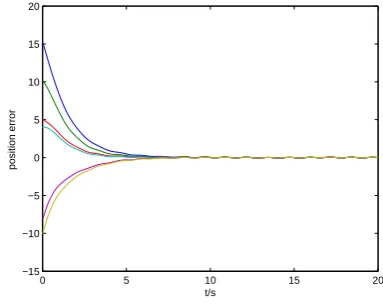
Consider a multi-agent system with six agents. The interconnection topology is also arbitrarily switched with switching period 1 among three graphs 𝒢ˆ𝑖(𝑖 = 1,2,3). The Laplacian matrices 𝐿𝑖(𝑖 = 1,2,3) for the three subgraphs 𝒢ˆ𝑖(𝑖 = 1,2,3) are also defined as above. Consider time-varying time-delay case, we take 𝑎 =
1, 𝑏 = 1, 𝑘 = 10, 𝑟 = 5, 𝑚 = 1, the disturbance model 𝜔(𝑡) =𝑠𝑖𝑛(5∗𝑡) too. The initial positions and velocity of the all agents are randomly produced. At the same time, we can take the maximum time-delay is not greater than 𝑑 = 0.7 and the maximum value of the derivation of time-delay is 𝑑1 = 0.92. so we can get that the disturbance attenuation𝜇is not greater than𝜇0= 3.6766. By using the Matlab LMI Control Toolbox, we can get
¯
𝑃 , 𝑄1, 𝑄2, 𝑅1, 𝑅2as follows, which satisfy the condition (32).
¯
𝑃= 10−4× ⎡
⎢ ⎢ ⎢ ⎢ ⎣
7.037 0.665 0.308 0.264 0.113 0.467 0.665 6.311 0.848 −0.084 0.767 0.680 0.308 0.848 9.117 0.375 0.421 1.499 0.264 −0.084 0.375 6.057 0.631 0.427 0.113 0.767 0.421 0.631 8.075 0.741 0.467 0.680 1.499 0.427 0.741 7.537
⎤ ⎥ ⎥ ⎥ ⎥ ⎦
𝑄1 = 10−4× ⎡
⎢ ⎢ ⎢ ⎢ ⎣
2.464 0.135 0.067 0.052 0.027 0.096 0.135 2.321 0.172 −0.014 0.157 0.139 0.067 0.172 2.886 0.076 0.091 0.304 0.052 −0.014 0.076 2.271 0.125 0.090 0.027 0.157 0.091 0.125 2.676 0.150 0.096 0.139 0.304 0.090 0.150 2.569
⎤ ⎥ ⎥ ⎥ ⎥ ⎦
𝑄2 = 10−3× ⎡ ⎢ ⎢ ⎢ ⎢ ⎣
2.2 0.3 0.1 0.1 0.0 0.2 0.3 1.9 0.4 −0.0 0.4 0.3 0.1 0.4 3.2 0.2 0.2 0.7 0.1 −0.0 0.2 1.8 0.3 0.2 0.0 0.4 0.2 0.3 2.7 0.3 0.2 0.3 0.7 0.2 0.3 2.5
⎤ ⎥ ⎥ ⎥ ⎥ ⎦
𝑅1 = 10−3× ⎡ ⎢ ⎢ ⎢ ⎢ ⎣
3.2 0.5 0.2 0.2 0.1 0.3 0.5 2.6 0.6 −0.1 0.5 0.5 0.2 0.6 4.7 0.2 0.2 1.1 0.2 −0.1 0.2 2.5 0.4 0.3 0.1 0.5 0.2 0.4 3.9 0.5 0.3 0.5 1.1 0.3 0.5 3.5
⎤ ⎥ ⎥ ⎥ ⎥ ⎦
𝑅2 = 10−3× ⎡
⎢ ⎢ ⎢ ⎣
1380 −139.5 323.9 −72.50 7.20 −311.9 −139.5 1215 −190.2 −51.5 −183.7 −110.2 −323.9 −190.2 1315 −239 −185.8 49.1 −72.50 −51.5 −239 1284 −145.3 −277.2 7.20 −183.7 −185.8 −45.3 1373 −201.5 −311.9 −110.2 49.1 −277.2 −201.5 1443
⎤ ⎥ ⎥ ⎥ ⎦
The position errors in Fig. 3 are defined as ∣∣𝑥𝑖(𝑡)− 𝑥0(𝑡)∣∣ and the velocity errors in Fig. 4 are defined as
∣∣𝑦𝑖(𝑡)−𝑦0(𝑡)∣∣. This two Figures show the multi-agent
system in time-delay case can achieve consensus.
0 5 10 15 20
−15 −10 −5 0 5 10 15 20
t/s
position error
Fig. 3. Position errors of followers with time-delay network
V. CONCLUSION
0 5 10 15 20 −10
−8 −6 −4 −2 0 2 4 6 8
t/s
velocity error
Fig. 4. velocity errors of followers with time-delay network
extreme value of the controlled output is confined and the confined ranges are different. The weighted coefficients are designed respectively according to the controlled output of the position and the velocity. A sufficient condition for the directed graph without time-delay is presented to ensure all agents to reach consensus and the system satisfies the 𝐻∞ performance which provides a theoretical basis to design consensus protocol. Also, a sufficient condition is given for the directed graph with time-delay to make the system achieve the desire results. By using the similar method, it may be possible to probe 𝐻∞ consensus problem of multi-agent systems under leaderless case, which will be our future work. Due to conservativeness of the common Lyapunov function method, we should probe less conservative method. In this paper, the assumption that agent’s state are 1-dimension is for notational simplicity and will not lost generality. Although the dimension of agent considered in this paper is one, all results of this paper is also true for high di-mension, and we can revise the expressions via kronecker product. Finally, the simulation examples also show the effectiveness of our theoretical results.
ACKNOWLEDGMENT
This work was supported by the National natural Science Foundation of China under grants 61074123, 60674071.
REFERENCES
[1] T. Vicsek, A. Czirok, E. B. Jacob, I. Cohen, and O. Schochet, “Novel type of phase transitions in a system of self-driven particles” ,Physical Review Letters, vol 75, pp. 1226-1229, 1995.
[2] S. Mu, T. Chu and L. Wang, “Coordinated collective motion in a motile particle group with a leader”,Physica A, vol. 351, pp. 211-216, 2005.
[3] A. Jadbabaie, J. Lin, A. S. Morse, “Coordination of group of mobile autonomous agents using nearest neighbor rules”,
IEEE Trans. Automat. Control, vol. 48(6) pp. 988-1001, 2003.
[4] R. M. Murray, “Recent Research in Cooperative Control of Multivehicle Systems” , ASME Journal of Dynamic Systems, Measurement, and Control, vol. 129, pp. 571-583, 2007.
[5] W. Ren and R. W. Beard, Distributed consensus in multi-vehicle cooperative control: theory and applications, Berlin: Springer, 2008
[6] S. Xu, J. Lam, Y. Zou, “New results on delay-dependent robust𝐻∞control for systems with time-varying delays”,
Automatica, vol. 42, pp.343-348, 2006.
[7] P. Lin and Y. Jia, “Distributed robust𝐻∞consensus control in directed networks of agents with time-delay” ,Systems
&control letters, vol. 57(8), pp. 643-653, 2008.
[8] Y. Sun, L. Wang and G. Xie, “Average consensus in networks of dynamic agents with switching topologies and multiple time-varying delays”,Systems and Control Letters, vol. 57(2), pp.175-183, 2008.
[9] S. P. Boyd, L. EI Ghaoui, E. Feron, V. Balakrishnan,Linear matrix inequalities in system and control theory, SIAM, Philadelphia, 1994.
[10] Y. Luo, L. Gao and F. Wang, “The𝐿2−𝐿∞control for leader-following coordination with switching topology and time-delay”, Journal of Networks, vol. 5(12), pp. 1513-1520, 2010.
[11] P. Lin and Y. Jia, “Average consensus in networks of multiagents with both switching topology and coupling time-delay, Physica A: Statistical Mechanics and its Ap-plications, vol. 387(1), pp. 303-313, 2008.
[12] Y. Hong, J. Hu and L. Gao, “Tracking control for multi-agent consensus with an active leader and variable topol-ogy”,Automatica, vol. 42, pp. 1177-1182, 2006.
[13] J. Hu, and Y. Hong, “Leader-following coordination of multi-agent systems with coupling time delays”, Physica A, vol. 374, pp. 853-863, 2007
[14] F. Xiao and L. Wang, “Consensus problems for high-dimensional multi-agent systems”,IET Control Theory & Applications, vol. 1(3), pp. 830-837, 2007
[15] L. Gao, H. Yuan and D. Jin, “Consensus problems in multi-agent systems with double integrator model ”, Chinese Physical B, vol. 19(5), pp.050520, 2010.
[16] L. Gao, J. Zhang and W. Chen, “Second-order consen-sus for multi-agent systems under directed and switching topologies”,Mathematical Problems in Engineering, 2012 (to appear)
[17] C. Godsil, G. Royle,Algebraic Graph Theory, New York: Springer-Verlag, 2001.
[18] R. A. Horn and C. R. Johnson, Matrix Analysis, Camb-bridge University Press,CamCamb-bridge;New York,1985.
Lixin Gaoreceived the M.S. degree in Math-ematics from East China Normal University, China, in 1994, and the Ph.D. degree in Automatic Control from Zhejiang University, China, in 2003. He is currently a professor in Wenzhou University, China. He was a Post-doctoral Research Associate in Institute of Systems Science, Chinese Academy of Sci-ences from 2004 to 2006. His research interests include robust control, multi-agent systems, intelligent computation, numerical analysis.