Multi-Channel Image Noise Filter
based on PCNN
Beiji Zou
School of Information Science and Engineering, Central South University, Changsha, China Email: [email protected]
Haoyu Zhou*, Hao Chen, Cao Shi
School of Information Science and Engineering, Central South University, Changsha, China Email: [email protected], [email protected], [email protected]
Abstract—Through analysis of PCNN’s work principle, a noval filtering approach capable of detecting and removing impulsive noise in multi-channel images. The filter detects noise pixels in the image by utilizing PCNN’s specific feature that the fire of one neuron can capture firing of its adjacent neurons due to their spatial proximity and intensity similarity. Then it estimates the noise pixels by a VMF-likely vector filtering. Experimental results show that the proposed filter has excellent performance, and is able to preserve fine details while suppressing impulsive noise.
Index Terms—Multi-channel image processing, Nonlinear vector filtering, PCNN
I. INTRODUCTION
The perception of color is important to vision system of humans and machines, since they use color information to sense the environment and recognize the objects on the scene. Because the acquisition or transmission of digital images through sensors or communication channels is often affected by impulsive noise [1-4] (e.g., bit errors [5] or mixed impulsive and Gaussian noise [2,5]), the aim of pre-processing techniques is the noise filtering [5,6,7] which enables communication in noisy environments [5] and processing of different kinds of multi-channel images (e.g., enhancement of cDNA microarray images [8,9], digitized artwork images [10,11], old movies [12-14], and images acquired by sensors [15,16]).
The purpose of the image filtering is the removal of useless information such as various signal distortions in order to obtain the image which corresponds as closely as possible to the output of an ideal imaging system [1]. In many applications, it is indispensable to remove the corrupted pixels to continue subsequent image processing operations such as edge detection, image segmentation, and pattern recognition. To convey the desired information correctly, the noisy signal should be
processed by a filtering algorithm which removes the noise, but retains the image structure.
Many of the methods used for multi-channel image noise reduction such as componentwise (marginal) median filters [17, 18] are direct extensions of the methods used for gray-scale imaging. The independent processing of color image channels is, however, inappropriate and leads to strong color artifacts (sub-optimal estimates in sense of color information), which are caused by scalar ordering of the multi-channel samples in the input of the filter. To overcome this problem and avoid the color artifacts produced by marginal approaches, the vector processing of color image data as vector fields is desirable due to the strong correlation that exists among the image channels [19-22]. Therefore, the standard techniques developed for monochrome images have to be extended in a way which exploits the correlation among the image channels and processes the input multi-channel samples as the set of image vectors.
In the case of impulsive noise, (e.g., bit errors and outliers), filtering approaches based on the order-statistics theory are often employed [5, 7, 23, 24]. These nonlinear filters: (i) operate by ordering the image samples inside a processing window, (ii) are able to match the underlying statistical model, and (iii) they are computationally simple. In gray-scale images, the ordering of the samples inside the filter window moves the atypical image samples, often corrupted by noise, to the borders of the ordered set. Therefore, the middle-positioned samples in the ordered sequence represent the robust estimates in the environments corrupted by outliers.
It has been widely recognized [19-22] that the nonlinear vector processing of color images is the most effective way to filter out outliers. For that reason, a number of filtering approaches, such as those presented in [25-27], have been developed to extend the filtering efficiency of the standard filtering approaches. Vector median filter [19] is a typical example of such an extension, when the median defined over the gray-scale samples has been replaced with the lowest ranked multi-channel sample achieved by vector ordering [1]. This filter is very often used for the removal of impulsive Manuscript received January 15, 2011; revised March 22, 2011;
accepted April 15, 2011.
noise in color images. On the other hand, the standard median filter [23] or its multi-channel extensions, i.e., the vector median filter [19] and the basic vector directional filter [21], are unable to adapt their behavior to varying noise and signal statistics related to the local image information of the samples inside a sliding filtering window. These filters performing the fixed amount of smoothing result in blurring of fine image details.
In the late 1980s, Eckhorn et al. discovered that the midbrain in an oscillating way created binary images that could extract different features from the visual impression when they had studied the cat visual cortex [36-39]. Based on these binary images the actual image is created in the cat brain. Due to this discovery they developed a neural network, called Eckhorn’s model, to simulate this behavior. In the early 1990s, Rybak et al. also found the similar neural behavior based on the study of the visual cortex of the guinea pig and developed a neural network, called Rybak’s model [39,40]. Because Eckhorn’s model and Rybak’ model provided a simple, effective way for studying synchronous pulse dynamics in networks, they was recognized as being very potential in image processing [41-43].
The above discoveries have paved the way for the generation of pulse-coupled neural network. Then Johnson et al. carried on a number of modifications and variations to improve its performance as image processing algorithms [41, 42]. This modified neural model is called pulse-coupled neural networks (PCNN).
The PCNN is a single layer, two-dimensional, laterally connected network of integrate-and-fire neurons, with a 1:1 correspondence between the image pixels and network neurons. This is a neural network that without any training needed. The output images at different iterations typically represent some segments or edges information of the input image. As a new generation of neural network, the PCNN is good at digital image processing and applied in many fields like image segmentation, image enhancement, image fusion, object and edge detection, pattern recognition, etc [48].
The rest of this paper is organized as follows. In Section 2, a brief overview of the PCNN model is presented. In Section 3, we propose a new color image filter based on PCNN. In Section 4, the proposed method is tested compare with some existing filters. Section 5 is the conclusion and this paper end with acknowledge- ments in Section 6.
II. PCNNMODEL
As mentioned above, the PCNN is two-dimensional, single layered, laterally connected neural network of pulse-coupled neurons, which connect with image pixels one to one. Because each image pixel is associated with a neuron of the PCNN, processing the pixels can be translated into processing the corresponding neurons of the PCNN.
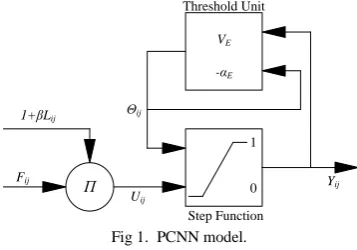
The PCNN neuron’s structure is shown in Fig. 1. The neuron consists of an input part, linking part and a pulse generator. The neuron receives the input signals from feeding and linking inputs. Feeding input is the
primary input from the neuron’s receptive area. The neuron receptive area consists of the neighboring pixels of corresponding pixel in the input image. Linking input is the secondary input of lateral connections with neighboring neurons. The difference between these inputs is that the feeding connections have a slower character- ristic response time constant than the linking connections. The standard PCNN model is described as iteration by the following equations:
[ 1] [ 1]
[ ] F
F ijkl ij kl
ij F n V w Y n ij
F n =e−α − +
∑
− +I (1)[ 1] [ 1]
[ ] L
ij L ijkl ij kl
ij L n V m Y n
L n =e−α − +
∑
− (2)[ ](1 [ ])
[ ] ij ij
ij
U n =F n +βL n (3)
[ ] ( [ ] [ 1])
ij ij ij
Y n =step U n −E n− (4)
[ 1] [ ]
[ ] E
ij E ij
ij E n V Y n
E n =e−α − + (5) In these equations, Iij is the input stimulus such as the normalized gray level of image pixels in (i,j) position, Fij[n] is the feedback input of the neuron in (i,j), and Lij[n] is the linking item. Uij[n] is the internal activity of neuron, and Eij[n] is the dynamic threshold. Yij[n] stands for the pulse output of neuron and it gets either the binary value 0 or 1. The input stimulus (the pixel intensity) is received by the feeding element and the internal activation element combines the feeding element with the linking element. The value of internal activation element is compared with a dynamic threshold that gradually decreases at iteration. The internal activation element accumulates the signals until it surpasses the dynamic threshold and then fires the output element and the dynamic threshold increases simultaneously strongly [47]. The output of the neuron is then iteratively fed back to the element with a delay of one iteration.
The inter-connections M and W are the constant synaptic weight matrices for the feeding and the linking inputs, respectively, which dependant on the distance between neurons. Generally, M and W (normally W=M) refer to the Gaussian weight functions with the distance. β is the linking coefficient. αF, αL and αE are the attenuation time constants of Fij[n], Lij[n] and Eij[n], respectively. VF, VL and VE denote the inherent voltage potential of Fij[n], Lij[n] and Eij[n], respectively.
Clearly, the standard PCNN has many parameters. A good algorithm using PCNN can make each parameter perform its own functions and further finish the task of data processing very well. Hence, we give a brief explanation about the functions of these parameters in the following.
For the feeding channel, αF determines the rate of decay of the feeding channel. Bigger αF causes faster decay of the feeding channel. VF can enlarge or reduce the influence from surrounding neurons. Matrix W refers to the mode of inter-connection among neurons in the feeding receptive field. Generally, the size of W denotes the size of the feeding receptive field. The value of matrix element wijkl determines the synaptic weight strength. In most cases, this channel is simplified via αF=0 and VF=0.
parameters (αL, VL and M) that have the same function to the parameters (αF, VF and W), respectively. It is noteworthy that the mode of inter-connection should be designed carefully according to the task of data processing (e.g. image denoising), for it has a great effect on the output of PCNN. Usually, the inter-connection employs the Gaussian weight functions with the distance.
The linking coefficient β is an important parameter, because it can vary the weighting of the linking channel in the internal activity. Hence, its value is usually depended on different demands. For example, if much influence from the linking channel is expected, β should be given larger value. All neurons often have the same value of β. It is not absolute. Each neuron can have its own value of β.
For the pulse generator, αE indicates the rate of decay of the threshold in the iterative process. Because it directly decides the firing time of neuron, αE is a significant parameter. Smaller αE can make the PCNN work in a meticulous way but it will take much time to finish the processing. On the contrary, larger αE can decrease more running time of PCNN. VE decides the threshold value of fired neuron. If expecting that neuron just fires one time, αE should be set a large value.
Θij
Π
1
0
VE
-αE
1+βLij
Fij
Uij
Yij
Threshold Unit
Step Function Fig 1. PCNN model.
III. PROPOSEDFRAMEWORK
A. Basic idea
In case of impulsive noise, color image noise pixels corrupted each channel of the image independently [19-22]. Each channel has been corrupted in different positions, but they are all corrupted in the same characteristic and pattern. Impulsive noise is a very interested noise: in each channel of the image, the value of the corrupted pixel is quite different from the pixels that have not been affected nearby, which means that the neurons corresponding to the noise pixels will not fire synchronously with the neurons that have not been affected nearby. Thus the basic idea we adopting PCNN for noise detection and removal is to fix the stimulus of noise pixels to make them fire with the normal pixels synchronously.
Color image is a multi-channel image which is not likely a gray image. For a gray image, we can build a PCNN which neurons are one by one corresponding to each pixel in the image. If we use PCNN for each channel separately and then combine the filtered channels
together, because of each channel is affected in different place, unexpected new color will be introduced to the image and hue will change in the original noise pixels. To solve this problem, we have to translate the image from original R, G, B three channels into a new space which can amplify the difference between noise pixels with normal pixels.
Thus we proposed a noise detection and removal filter based on PCNN which only modify the noise pixels in the new space. The filter only operate a neuron (i, j) when it fires, the algorithm is implemented in the following steps:
(1) When neuron (i, j) fires within its nearby neurons already fired, it means that this neuron is not able to be captured to fire because of its nearby neurons firing, so the corresponding pixel is a noise pixel, and because its fire time is later than the nearby neurons, so this pixel is darker than supposed normal value. It needs to be set brighter.
(2) When neuron (i, j) fires with its nearby neurons do not fire yet, it means that this neuron’s firing can not capture its nearby neurons firing, so the corresponding pixel is a noise pixel, and because its fire time is earlier than the nearby neuron, so this pixel is brighter than supposed normal value. It needs to be set darker.
(3) When neuron (i, j) fires with half of the nearby neurons already fired and half not fire yet, it means that this neuron is not a noise pixel, it should remains unchanged.
(4) After this action, the algorithm will get a list of suspicious noise pixels in the image. For each noise pixel, we employ a VMF-likely algorithm for filtering: build a processing window which central point is the noise pixel, then use VMF for the pixels in the processing window expects the pixels in the suspicious noise pixels list to select the median value to replace the central pixel.
B. Noise pixel detection
RGB color space is setup from primary color spectrum, it is quite suitable for hardware implementation, but not good for explanation in human vision system. In RGB color space, impulsive noise corrupts one or more channels, the probability of corruption in each channel is equal. So if we detect noise directly in RGB color space, we should consider the corruption situation in three channel equally, and the output image also can not fix the characteristic of human vision system. Human vision system use hue, saturation and intensity to describe color and observe colorful objects. In HSI color space, Impulsive noise corruption focus more on intensity than hue and saturation. The following equations can translate image from RGB space to HSI space:
2 1/ 2
, 2
, arccos
, 2 (( ) ( )( ))
2
B G R G B
H
B G R G R B G B
θ
θ π θ
≤
× − −
= − > = × − + − −
(6)
1 3 min( , , ) /( )
S= − × R G B R+ +B G (7)
( ) / 3
I= R G+ +B (8)
If the image is filtered in H, S, I channel separately, new color will be introduced to the image, and details and edges will also be destroyed. Thus we construct m:
(1 )
( cos )p q p q , 2, 0, 0, 1
By constructing m, we amplify the difference between noise pixel and its nearby pixels, and consider affection to hue, saturation and intensity by the noise pixel. Thus we avoided the problem of handling the noise in one or more channels separately. Use this equation for every pixel in the image, we will get a matrix
1 2
{
,
,...,
n}
M
=
m m
m
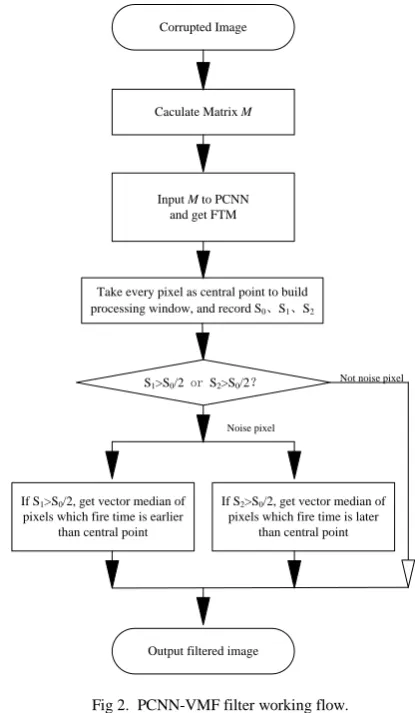
which has same size as the image.To detect the noise pixel, we use M to active a PCNN which has the same size of M. Let the neuron network runs to have all the neurons fired. And record the firing moment of each neuron to the Firing Time Map (FTM). For each pixel mi in M, check the slide window which has this pixel as central point, remark the total pixel amount in the window as S0, remark the amount of pixel firing before central point as S1, remark the amount of pixel firing after central point as S2, if S1>S0/2 or S2>S0/2 then the central point is corrupted by noise, otherwise it is not corrupted.
C. Noise pixel removal
If the pixel is not corrupted, leave it unchanged. If the pixel is corrupted, we proposed an auto parameter a VMF likely algorithm: setup a processing window which has the corrupted pixel as central point, if over half of the pixels in the window fire time are earlier than central point (S1>S0/2), choose the pixels in this processing window to build
Γ =
{ ,
x x
1 2,...,
x
L}
, ifx
l andx
k aretwo pixels in Γ , the Euclidean
distance
D l k
( , )
is:2
( , )
l kD l k
=
x
−
x
, then setcentral point as
1
arg min ( , )
k
L
x l
D l k
∈Γ =
∑
. If over half pixels in the
window fire later than central point(S2>S0/2), then choose the pixels in this processing window and are not in the noise pixel list to execute the above operations. By using this method, we can remove noise without affect image details and edges, and avoid disturbance from other noise pixel. The algorithm working flow is shown in Figure 2.
The parameters’ value should consider the following points: (1) To make neurons in PCNN fire quickly because of Eij’s value rise rapidly, VE should be rather
bigger; (2) For neuron connect with its nearby neurons, and locate noise point, the linking coefficient β should be bigger; (3) to set m’s value, η is used to smooth effect of hue. Set value of p, q should consider impulsive affection on image focus on intensity and hue. In the experiments of next section, the parameters’ values are set as
following: β=0.27,
α
E =0.2,V
E =350,0.2 1 0.2
1 0 1
0.2 1 0.2
w
=
; η=2,p=0.5, q=0.1.
Corrupted Image
Caculate Matrix M
Input M to PCNN and get FTM
Take every pixel as central point to build processing window, and record S0、S1、S2
If S1>S0/2, get vector median of
pixels which fire time is earlier than central point
If S2>S0/2, get vector median of
pixels which fire time is later than central point
Output filtered image
Not noise pixel
S1>S0/2 or S2>S0/2?
Noise pixel
Fig 2. PCNN-VMF filter working flow.
IV. EXPERIMENTALRESULTS
The primary goal of all filtering algorithms presented in this paper is to remove impulses and outliers from the image. This type of noise is often introduced through bit errors [5], especially during the scanning or transmission over the noisy information channel.
The achieved results were evaluated by the commonly used objective criteria [39, 41], such as the mean absolute error (MAE), the mean square error (MSE), and the normalized color difference (NCD).
The methods were tested using test image Lena, Airplane, Baboon, Fruits. Size of each test image is 256×256. We added impulse noise with pv=0.05 to test
image Lena, pv=0.10 to test image Airplane, pv=0.20 to
test image Baboon, pv=0.30 to test image Fruits. Then we
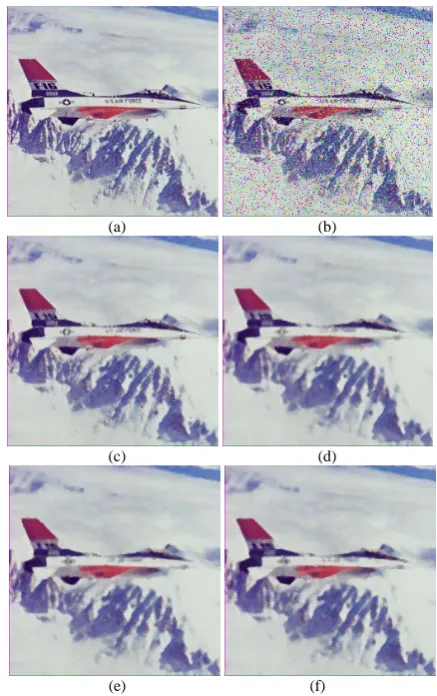
use our PCNN-VMF, VMF, BVDF, DDF (g=0.25), Rank SVMF and Mean SVMF on the image. Table I-IV and Fig. 3-6 show the experimental results.
The results show that PCNN is superior to the comparison algorithms in removal noise and image detail preservation. Especially when pv>0.2, vector filters brings
TABLE I.
Comparison of the presented algorithms using impulsive noise corruption pv=0.05
Method/criterion MSE MAE NCD ×10-4
PCNN-VMF 95.37 3.23 59.26 VMF 162.21 6.74 116.26 BVDF 171.26 6.93 122.20 DDF 153.18 5.96 109.55 Rank SVMF 95.30 3.12 62.72 Mean SVMF 116.71 4.81 83.54
TABLE II.
Comparison of the presented algorithms using impulsive noise corruption pv=0.1
Method/criterion MAE MSE NCD ×10-4 PCNN-VMF 115.23 4.01 69.02
VMF 175.50 7.11 118.62 BVDF 181.92 7.09 125.26 DDF 163.02 6.75 105.00 Rank SVMF 120.91 4.03 75.21 Mean SVMF 136.99 4.99 95.52
TABLE III.
Comparison of the presented algorithms using impulsive noise corruption pv=0.2
Method/criterion MAE MSE NCD ×10-4
PCNN-VMF 151.89 4.92 90.24 VMF 207.34 7.95 127.39 BVDF 221.35 8.23 138.96 DDF 195.41 7.31 117.25 Rank SVMF 158.22 5.52 96.77 Mean SVMF 169.50 5.79 99.28
TABLE IV.
Comparison of the presented algorithms using impulsive noise corruption pv=0.3
Method/criterion MAE MSE NCD PCNN-VMF 196.57 6.77 105.12
VMF 237.66 8.59 145.14 BVDF 274.10 8.92 161.48 DDF 236.55 7.79 161.72 Rank SVMF 209.31 7.11 115.71 Mean SVMF 219.71 7.61 136.78
(a) (b)
(c) (d)
(e) (f)
(g) (h)
Fig 3. Original Lena image, impulsive noise (pv=0.05) image and
filtered outputs.
(a) Original Lena image; (b) Noise image; (c) PCNN-VMF; (d) VMF; (e) BVDF; (f) DDF; (g) Rank SVMF; (h) Mean SVMF.
(a) (b)
(c) (d)
(g) (h)
Fig 4. Original Airplane image, impulsive noise (pv=0.10) image and
filtered outputs.
(a) Original Airplane image; (b) Noise image; (c) PCNN-VMF; (d) VMF; (e) BVDF; (f) DDF; (g) Rank SVMF; (h) Mean SVMF.
(a) (b)
(c) (d)
(e) (f)
(g) (h)
Fig 5. Original Baboon image, impulsive noise (pv=0.20) image and
filtered outputs.
(a) Original Baboon image; (b) Noise image; (c) PCNN-VMF; (d) VMF; (e) BVDF; (f) DDF; (g) Rank SVMF; (h) Mean SVMF.
(a) (b)
(c) (d)
(e) (f)
(g) (h)
Fig 6. Original Fruits image, impulsive noise (pv=0.30) image and
filtered outputs.
(a) Original Fruits image; (b) Noise image; (c) PCNN-VMF; (d) VMF; (e) BVDF; (f) DDF; (g) Rank SVMF; (h) Mean SVMF.
V. CONCLUSION
In this paper, a new color image filtering framework which based on PCNN has been proposed.
The achieved results show excellent detection and image detail preservation capabilities of the new approach, while still holding the impulsive noise attenuation characteristics of standard vector filters. The new filters clearly outperform the standard vector filtering schemes as well as their adaptive modifications. In our experiments, the best results were achieved by PCNN-VMF scheme.
VI. ACKNOWLEDGEMENTS
constructive suggestions. This paper is jointly supported by the National Natural Science Foundation of China (Grant Nos. 60970098 and 60803024), the Major Research Plan of the National Natural Science Foundation of China (Grant No 90715043).
REFERENCES
[1] R. Lukac, B. Smolka, K. Martin, K.N. Plataniotis, A.N. Venetsanopoulos, “Vector filtering for color imaging, IEEE Signal Process, ” Mag., Special Issue on Color Image Processing, vol. 22, pp. 74-86, 2005.
[2] K.N. Plataniotis, A.N. Venetsanopoulos, Color Image
Processing and Applications, Springer Verlag, Berlin,
2000.
[3] I. Pitas, P. Tsakalides, “Multivariate ordering in color image filtering,” IEEE Trans. Circuits Syst. Video Technol, vol. 1, pp. 247-259, 1991.
[4] B. Smolka, A. Chydzinski, K. Wojciechowski, K.N. Plataniotis, A.N. Venetsanopoulos, “On the reduction of impulsive noise in multi-channel image processing,” Opt. Eng. vol. 40, pp. 902-908, 2001.
[5] J. Astola, P. Kuosmanen, Fundamentals of Nonlinear Digital Filtering, CRC Press, Boca Raton, FL, 1997. [6] S. Peltonen, M. Gabbouj, J. Astola, “Nonlinear filter design:
methodologies and challenges,” in Proceedings of the IEEE Region 8-EURASIP Symposium on Image and Signal Processing and Analysis ISPA 01 in Pula, Croatia, pp. 102-106, 2001.
[7] I. Pitas, A.N. Venetsanopoulos, Nonlinear Digital Filters, Principles and Applications, Kluwer Academic Publishers, Dordrecht, 1990.
[8] R. Lukac, K.N. Plataniotis, B. Smolka, A.N. Venetsanopoulos, “A multi-channel order-statistic technique for cDNA microarray image processing,” IEEE Trans. Nanobiosci. vol. 3, pp. 272-285, 2004.
[9] R. Lukac, K.N. Plataniotis, B. Smolka, A.N. Venetsanopoulos, “cDNA microarray image processing using fuzzy vector filtering framework,” J. Fuzzy Sets Syst., Special Issue on Fuzzy Sets and Systems in Bioinformatics, vol. 152, pp. 17-35, 2005.
[10] M. Barni, F. Bartolini, V. Capellini, “Image processing for virtual restoration of artworks,” IEEE Multimedia, pp. 34-37, 2000.
[11] X. Li, D. Lu, Y. Pan, “Color restoration and image retrieval for Donhunag fresco preservation,” IEEE Multimedia, pp. 38-42, 2001.
[12] A. Kokaram, Motion Picture Restoration, Springer-Verlag, Berlin, 1998.
[13] L. Tenze, S. Carrato, G. Ramponi, “An alignment algorithm for old motion pictures,” IEEE Signal Process. Lett. 9, pp. 309-311, 2002.
[15] N.J. Garber, L.A. Hoel, “Traffic and Highway Engineering,” Brooks/Cole Publishing, Pacific Grove, CA, 1999.
[17] H. Rantanen, M. Karlsson, P. Pohjala, S. Kalli, “Color video signal processing with median filters,” IEEE Trans. Consum. Electr. vol. 38, pp. 157-161, 1992.
[18] K. He, S. Li, C. Wang, “Modified PCNN Model and Its Application to Mixed-Noise Removal,” in 201 International Conference ICC, pp. 57-62, 2010.
[19] J. Astola, P. Haavisto, Y. Neuvo, “Vector median filters,”
Proc. IEEE, vol. 78, pp. 678-689, 1990.
[20] R. Lukac, “Adaptive vector median filtering,” Pattern Recogn. Lett. 24, pp. 1889-1899, 2003.
[21] P.E. Trahanias, D. Karakos, A.N. Venetsanopoulos, “Directional processing of color images: theory and
experimental results,” IEEE Trans. Image Process. vol. 5, pp. 868-881, 1996.
[22] K.N. Plataniotis, D. Androutsos, A.N. Venetsanopoulos, “Adaptive fuzzy systems for multi-channel signal processing,” Proc. IEEE, vol. 87, pp. 1601-1622, 1999. [23] Y. Y. Cheng, H. Y. Li, Q. Xiao, Y. F. Zhang, X. L. Shi,
“Gaussian Noise Filter Using Variable Step Time Matrix of PCNN,” Applied Mechanics and Materials, vol. 48, pp. 551-554, 2011.
[24] S. Mitra, J. Sicuranza, Nonlinear Image Processing, Academic Press, New York, 2001.
[25] R. Lukac, B. Smolka, K.N. Plataniotis, A.N. Venetsanopulos, “Selection weighted vector directional filters,” Comput. Vision Image Understand., Special Issue on Colour for Image Indexing and Retrieval 94, pp. 140-167, 2004.
[26] L. Lucat, P. Siohan, D. Barba, “Adaptive and global optimization methods for weighted vector median filters,”
Signal Process.: Image Commun. vol. 17, pp. 509-524, 2002.
[27] T. Viero, K. Oistamo, Y. Neuvo, “Three-dimensional median related filters for color image sequence filtering,”
IEEE Trans. Circuits Syst. Video Technol. vol. 4, pp. 129-142, 1994.
[28] Y. Hashimoto, Y. Kajikawa, Y. Nomura, “Directional difference-based switching median filters,” Electron. Commun. Japan 85 (Part 3), pp. 22-32, 2002.
[29] Y. Hashimoto, Y. Kajikawa, Y. Nomura, “Directional difference filters: its effectiveness in the postprocessing of noise detectors,” Electron. Commun. Japan 85 (Part 3) pp. 74-82, 2002.
[30] M. Szczepanski, B. Smolka, K.N. Plataniotis, A.N. Venetsanopoulos, “On the geodesic paths approach to color image filtering,” Signal Process. vol. 83, pp. 1309-1342, 2003.
[31] S. Yang, M. Wang, L. Jiao, R. W, Z. Wang, “Image fusion based on a new contourlet packet,” Image Fusion, Vol. 11, pp. 78-84, 2010.
[32] Y. Zhang, L. Wu, S. Wang, G. Wei, “Color image enhancement based on HVS and PCNN,” Science China, vol. 53, pp. 1963-1976, 2010.
[33] T. Chen, H.R. Wu, “Adaptive impulse detection using center-weighted median filters,” IEEE Signal Process. Lett. 8, pp. 1-3, 2001.
[34] H.L. Eng, K.K. Ma, “Noise adaptive soft-switching median filter,” IEEE Trans. Image Process. vol. 10, pp. 242-251, 2001.
[35] S. Zhang, M.A. Karim, “A new impulse detector for switching median filters,” IEEE Signal Process. Lett. 9, pp. 360-363, 2002.
[36] R. Eckhorn, H.J. Reitboeck, M. Arndt, P.W. Dicke, “A neural network for feature linking via synchronous activity: results from cat visual cortex and from simulations,” in:
Models of Brain Function, Cambridge University Press,
Cambridge, UK, pp. 255–272, 1989.
[37] H.J. Reitboeck, R. Eckhorn, M. Arndt, P. Dicke, “A model of feature linking via correlated neural activity,” in: Synergistics of Cognition, Springer, New York, pp. 112– 125, 1989.
[38] R. Eckhorn, H.J. Reitboeck, M. Arndt, P.W. Dicke, “Feature linking via synchronization among distributed assemblies: simulation of results from cat cortex,” Neural Computing, vol. 2, pp. 293–307, 1990.
[40] I.A. Rybak, N.A. Shevtsova, V.M. Sandier, “The model of a neural network visual preprocessor,” Neuro Computing, vol. 4, pp. 93–102, 1992.
[41] S. He, D. Wang, Y. Nin, “Application of Pulse Coupled Neural Network in Image Recognition,” in 2010 International Conference CCIE, pp. 415-519, 2010. [42] H.S. Ranganath, G. Kuntimad, J.L. Johnson, “Pulse
coupled neural networks for image processing,” in: Proc. of the Southeast Conference on ‘Visualize the future’, pp. 37–43, 1995.
[43] L. Johnson, H. Ranganath, G. Kuntimad, H.J. Caulfield, “Pulse-coupled neural networks,” in: Neural Networks and Pattern Recognition, Academic Press, San Diego, CA, pp. 1–56, 1998.
[44] R. Lukac, “Adaptive color image filtering based on center-weighted vector directional filters,” Multidim. Syst. Signal Process. vol. 15, pp. 169–196, 2004.
[45] K.N. Plataniotis, D. Androutsos, A.N. Venetsanopoulos, “Color image processing using adaptive vector directional filters,” IEEE Trans. Circuits Syst. II, vol. 45, pp. 1414– 1419, 1998.
[46] R. Lukac, K.N. Plataniotis, B. Smolka, A.N. Venetsanopoulos, “Generalized selection weighted vector filters,” EURASIP J. Appl. Signal Process., Special Issue
on Nonlinear Signal and Image Processing—Part I 2004 pp. 1870–1885, 2004.
[47] Rastislav Lukac, Bogdan Smolka, Konstantinos N. Plataniotis, Anastasios N. Venetsanopoulos, “Vector sigma filters for noise detection and removal in color images,”
Journal of visual communication and image representation, vol. 17, pp. 1-26, 2006.
[48] Zhaobin Wang, Yide Ma, Feiyan Cheng, Lizhen Yang, “Review of pulse-coupled neural networks,” Image and Vision Computing, vol. 28, pp. 5-13, 2010.
Authors information:
Beiji Zou: First author. Male, born in 1961. Doctor, Professor of Central South University. Major field is digital image processing, computer graphics.
Haoyu Zhou: Second author, Corresponding author. Male, born in 1979. Doctor candidate. Major field is digital image processing. Email: [email protected].
Hao Chen: Third author. Male, born in 1977. Doctor candidate. Major field is digital image processing.