
Cryptanalysis of Full RIPEMD-128
Franck Landelle
1
and Thomas Peyrin
2
,?
1
DGA MI, France
2
Division of Mathematical Sciences, School of Physical and Mathematical Sciences,
Nanyang Technological University, Singapore
[email protected]
[email protected]
Abstract.
In this article we propose a new cryptanalysis method for double-branch hash functions that we
apply on the standard
RIPEMD-128
, greatly improving over know results. Namely, we were able to build a very
good differential path by placing one non-linear differential part in each computation branch of the
RIPEMD-128
compression function, but not necessarily in the early steps. In order to handle the low differential probability
induced by the non-linear part located in later steps, we propose a new method for using the freedom degrees,
by attacking each branch separately and then merging them with free message blocks. Overall, we present
the first collision attack on the full
RIPEMD-128
compression function as well as the first distinguisher on the
full
RIPEMD-128
hash function. Experiments on reduced number of rounds were conducted, confirming our
reasoning and complexity analysis. Our results show that 16 years old
RIPEMD-128
, one of the last unbroken
primitives belonging to the
MD
-
SHA
family, might not be as secure as originally thought.
Key words:
RIPEMD-128, collision, distinguisher, compression function, hash function.
1
Introduction
Hash functions are among the most important basic primitives in cryptography, used in many applications such as
digital signatures, message integrity check and message authentication codes (MAC). Informally, a hash function
H
is a function that takes an arbitrarily long message
M
as input and outputs a fixed-length hash value of size
n
bits. Classical security requirements are collision resistance and (second)-preimage resistance. Namely, it should
be impossible for an adversary to find a collision (two distinct messages that lead to the same hash value) in less
than 2
n/
2
hash computations, or a (second)-preimage (a message hashing to a given challenge) in less than 2
n
hash computations. More complex security properties can be considered up to the point where the hash function
should be indistinguishable from a random oracle, thus presenting no weakness whatsoever. Most standardized
hash functions are based upon the Merkle-Damg˚
ard paradigm [18, 6] and iterate a compression function
h
with
fixed input size to handle arbitrarily long messages. The compression function itself should ensure equivalent
security properties in order for the hash function to inherit from them.
Recent impressive progresses in cryptanalysis [29, 27, 28, 26] led to the fall of most standardized hash primitives,
such as
MD4,
MD5,
SHA-0
and
SHA-1. All these algorithms share the same design rationale for their compression
functions (i.e. they incorporate additions, rotations, xors and boolean functions in an unbalanced Feistel network),
and we usually refer to them as the
MD-SHA
family. As of today, among this family only
SHA-2,
RIPEMD-128
and
RIPEMD-160
remain unbroken, but the rapid improvement of the attacks decided the NIST to organize a 4-year
SHA-3
competition in order to design a new hash function, eventually leading to the selection of
Keccak
[1]. This
choice was justified partly by the fact that
Keccak
is built upon a completely different design rationale than the
MD-SHA
family. Yet, we can not expect the industry to move quickly to
SHA-3
unless a real issue is identified in
current hash primitives. Therefore, the
SHA-3
competition monopolizing most of the cryptanalysis power during
the last four years, it is now crucial to continue the study of the unbroken
MD-SHA
members.
The notation
RIPEMD
represents several distinct hash functions related to the
MD-SHA-family, the first
represen-tative being
RIPEMD-0
[2] that was recommended in 1992 by the European
RACE Integrity Primitives Evaluation
(RIPE) consortium. Its compression function basically consists in two
MD4-like [20] functions computed in parallel
(but with different constant additions for the two branches), with 48 steps in total. Early cryptanalysis by
Dob-bertin on a reduced version of the compression function [9] seemed to indicate that
RIPEMD-0
was a weak function
and this was fully confirmed much later by Wang
et al.
[26] who showed that one can find a collision for the full
RIPEMD-0
hash function with as few as 2
16
computations.
However, in 1996, due to the cryptanalysis advances on
MD4
and on the compression function of
RIPEMD-0,
the original
RIPEMD-0
was reinforced by Dobbertin, Bosselaers and Preneel [10] to create two stronger primitives
RIPEMD-128
and
RIPEMD-160, with 128
/
160-bit output and 64
/
80 steps respectively (two other less known 256
and 320-bit output variants
RIPEMD-256
and
RIPEMD-320
were also proposed, but with a claimed security level
equivalent to an ideal hash function with a twice smaller output size). The main novelty compared to
RIPEMD-0
is that the two computation branches were made much more distinct by using not only different constants, but
?
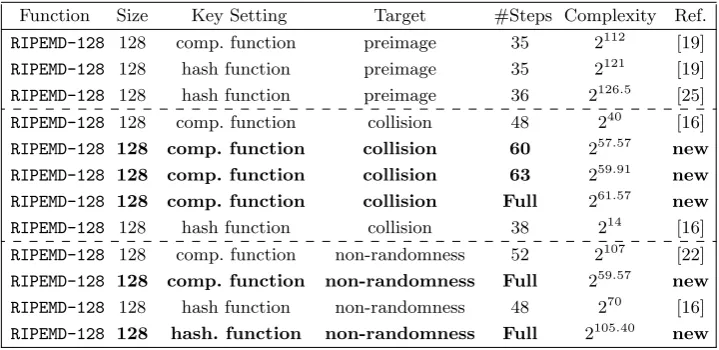
Table 1.
Summary of known and new results on
RIPEMD-128
hash function
Function
Size
Key Setting
Target
#Steps Complexity
Ref.
RIPEMD-128
128
comp. function
preimage
35
2
112[19]
RIPEMD-128
128
hash function
preimage
35
2
121[19]
RIPEMD-128
128
hash function
preimage
36
2
126.5[25]
RIPEMD-128
128
comp. function
collision
48
2
40[16]
RIPEMD-128
128
comp. function
collision
60
2
57.57new
RIPEMD-128
128
comp. function
collision
63
2
59.91new
RIPEMD-128
128
comp. function
collision
Full
2
61.57new
RIPEMD-128
128
hash function
collision
38
2
14[16]
RIPEMD-128
128
comp. function
non-randomness
52
2
107[22]
RIPEMD-128
128
comp. function
non-randomness
Full
2
59.57new
RIPEMD-128
128
hash function
non-randomness
48
2
70[16]
RIPEMD-128
128
hash. function
non-randomness
Full
2
105.40new
also different rotation values and boolean functions, which greatly hardens the attacker’s task in finding good
differential paths for both branches at a time. The security seems to have indeed increased since as of today no
attack is known on the full
RIPEMD-128
or
RIPEMD-160
compression/hash functions and the two primitives are
worldwide ISO/IEC standards [12].
Even though no result is known on the full
RIPEMD-128
and
RIPEMD-160
compression/hash functions yet,
many analysis were conducted in the recent years. In [17], a preliminary study checked up to what extent can
the known attacks [26] on
RIPEMD-0
apply to
RIPEMD-128
and
RIPEMD-160. Then, following the extensive work
on preimage attacks for
MD-SHA
family, [21, 19, 25] describe high complexity preimage attacks on up to 36 steps
of
RIPEMD-128
and 31 steps of
RIPEMD-160. Collision attacks were considered in [16] for
RIPEMD-128
and in [15]
for
RIPEMD-160, with 48 and 36 steps broken respectively. Finally, distinguishers based on non-random properties
such as second-order collisions are given in [16, 22, 15], reaching about 50 steps with a very high complexity.
Our contributions.
In this article, we introduce a new type of differential path for
RIPEMD-128
using one
non-linear differential trail for both left and right branches and, in contrary to previous work, not necessarily located
in the early steps (Section 3). The important differential complexity cost of these two parts is mostly avoided by
using the freedom degrees in a novel way: some message words are used to handle the non-linear parts in both
branches and the remaining ones are used to merge the internal states of the two branches (Section 4). Overall, we
obtain the first cryptanalysis of the full 64-round
RIPEMD-128
hash and compression functions. Namely, we provide
a distinguisher based on a differential property for both the full 64-round
RIPEMD-128
compression function and
hash function (Section 5). Previously best-known results for non-randomness properties only applied to 52 steps
of the compression function, 48 steps of the hash function. More importantly, we also derive a semi-free-start
collision attack on the full
RIPEMD-128
compression function (Section 5), significantly improving the previous
free-start collision attack on 48 steps. Any further improvement of our techniques is likely to provide a practical
semi-free-start collision attack on the
RIPEMD-128
compression function. In order to increase the confidence in our
reasoning, we implemented independently the two main parts of the attack (the merge and the probabilistic part)
and the observed complexity matched our predictions. Our results and previous works complexities are given in
Table 1 for comparison.
2
Description of
RIPEMD-128
RIPEMD-128
[10] is a 128-bit hash function that uses the Merkle-Damg˚
ard construction as domain extension
algorithm: the hash function is built by iterating a 128-bit compression function
h
that takes as input a 512-bit
message block
m
i
and a 128-bit chaining variable
cv
i:
cv
i
+1
=
h
(
cv
i
, m
i)
where the message
m
to hash is padded beforehand to a multiple of 512 bits
3
and the first chaining variable is set
to a predetermined initial value
cv
0
=
IV
(given in Table 2 of Appendix A).
We refer to [10] for a complete description of
RIPEMD-128. In the rest of this article, we denote by [
Z
]i
the
i
-th
bit of a word
Z
, starting the counting from 0.
and
represent the modular addition and subtraction on 32 bits,
and
⊕
,
∨
,
∧
, the bitwise “exclusive or”, the bitwise “or”, and the bitwise “and” function respectively.
3
The padding is the same as for
MD4
: a “
1
” is first appended to the message, then
x
“
0
” bits (with
x
= 512
−
(
|
m
|
+ 1 + 64
2.1
RIPEMD-128
compression function
The
RIPEMD-128
compression function is based on
MD4, with the particularity that it uses two parallel instances
of it. We differentiate these two computation branches by left and right branch and we denote by
X
i
(resp.
Y
i
)
the 32-bit word of left branch (resp. right branch) that will be updated during step
i
of the compression function.
The process is composed of 64 steps divided into 4 rounds of 16 steps each in both branches.
Initialization.
The 128-bit input chaining variable
cv
i
is divided into 4 words
h
i
of 32 bits each, that will be
used to initialize the left and right branch 128-bit internal state:
X
−3
=
h
0
X
−2
=
h
1
X
−1
=
h
2
X
0
=
h
3
Y
−3
=
h
0
Y
−2
=
h
1
Y
−1
=
h
2
Y
0
=
h
3
.
The message expansion.
The 512-bit input message block is divided into 16 words
M
i
of 32 bits each. Each
word
M
i
will be used once in every round in a permuted order (similarly to
MD4) and for both branches. We
denote by
W
i
l
(resp.
W
i
r
) the 32-bit expanded message word that will be used to update the left branch (resp.
right branch) during step
i
. We have for 0
≤
j
≤
3 and 0
≤
k
≤
15:
W
j
l
·16+
k
=
M
π
lj
(
k
)
and
W
r
j
·16+
k
=
M
π
r j(
k
)
where permutations
π
l
j
and
π
r
j
are given in Table 3 of Appendix A.
The step function.
At every step
i
, the registers
X
i
+1
and
Y
i
+1
are updated with functions
f
j
l
and
f
j
r
that
depends on the round
j
in which
i
belongs:
X
i
+1
= (
X
i
−3
Φ
l
j
(
X
i
, X
i
−1
, X
i
−2
)
W
i
l
K
l
j
)
<<<
s
l i,
Y
i
+1
= (
Y
i
−3
Φ
r
j
(
Y
i
, Y
i
−1
, Y
i
−2
)
W
i
r
K
r
j
)
<<<
s
ri,
where
K
l
j
, K
j
r
are 32-bit constants defined for every round
j
and every branch,
s
l
i
, s
r
i
are rotation constants defined
for every step
i
and every branch,
Φ
l
j
, Φ
r
j
are 32-bit boolean functions defined for every round
j
and every branch.
All these constants and functions are given in Appendix A.
The finalization.
A finalization and a feed-forward is applied when all 64 steps have been computed in both
branches. The four 32-bit words
h
0
i
composing the output chaining variable are finally obtained by:
h
0
0
=
X
63
Y
62
h
1
h
0
1
=
X
62
Y
61
h
2
h
0
2
=
X
61
Y
64
h
3
h
0
3
=
X
64
Y
63
h
0
.
3
A new family of differential paths for
RIPEMD-128
3.1
The general strategy
The first task for an attacker looking for collisions in some compression function is to set a good differential path.
In the case of
RIPEMD
and more generally double or multi-branches compression functions, this can be quite a
difficult task because the attacker has to find a good path for all branches at the same time. This is exactly what
multi-branches functions designers are hoping: it is unlikely that good differential paths exist in both branches
at the same time when the branches are made distinct enough (note that the weakness of
RIPEMD-0
is that both
branches are almost identical and the same differential path can be used for the two branches at the same time).
Differential paths in recent collision attacks on
MD-SHA
family are composed of two parts: a low probability
non-linear part in the first steps and a high probability linear part in the remaining ones. Only the latter will be
handled probabilistically and impact the overall complexity of the collision finding algorithm, since during the first
steps the attacker can choose message words independently. This strategy proved to be very effective because it
allows to find much better linear parts than before by relaxing many constraints on them. The previous approaches
for attacking
RIPEMD-128
[17, 16] are based on the same strategy, building good linear paths for both branches,
but without including the first round (i.e. the first 16 steps). The first round in each branch will be covered by
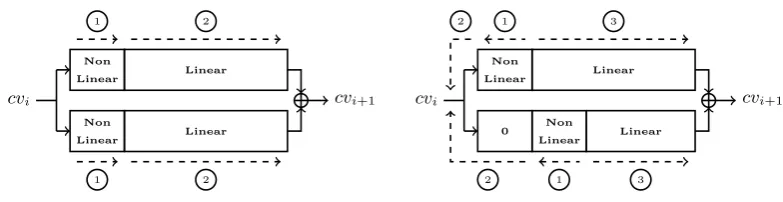
a non-linear differential path and this is depicted left in Figure 1. The collision search is then composed of two
subparts, the first handling the low-probability non-linear paths with the message blocks (step
1and then the
cv
icv
i+1Linear Non
Linear
1 2
Linear Non
Linear
1 2
cv
icv
i+10 Non Linear
Linear
1 3
2
Linear Non
Linear
1 3
2
Fig. 1.
The previous (left-hand side) and new (right-hand side) approach for collision search on double-branch compression
functions.
This differential path search strategy is natural when one will handle the non-linear parts in a classic way
(i.e. computing only forward) during the collision search, but in Section 4 we will describe a new approach for
using the available freedom degrees provided by the message words in double-branch compression functions (see
right in Figure 1): instead of handling the first rounds of both branches at the same time during the collision
search, we will satisfy them independently (step
1), then use some remaining free message words to merge the
two branches (step
2) and finally handle the remaining steps in both branches probabilistically (step
3). This
new approach broadens the search area of good linear differential parts, and provides us better candidates in the
case of
RIPEMD-128.
3.2
Finding a good linear part
Since any active bit in a linear differential path (i.e. a bit containing a difference) is likely to cause many conditions
in order to control its spread, most successful collision searches start with a low-weight linear differential path,
therefore reducing the complexity as much as possible.
RIPEMD-128
is no exception, and because every message
word is used once in every round of every branch in
RIPEMD-128, the best would be to insert only a single-bit
difference in one of them. This was considered in [16], but the authors concluded that none of all single-word
differences leads to a good choice and they eventually had to utilize one active bit in two message words instead,
therefore doubling the amount of differences inserted during the compression function computation and reducing
the overall number of steps they could attack. By relaxing the constraint that both non-linear parts must necessarily
be located in the first round, we show that a single-word difference in
M
14
is actually a very good choice.
Boolean functions.
Analyzing the various boolean functions in
RIPEMD-128
rounds is very important. Indeed,
there are three distinct functions:
XOR,
ONX
and
IF, with all very distinct behavior. The function
IF
is non-linear
and can absorb differences (one difference on one of its input can be blocked from spreading to the output by
setting some appropriate bit value conditions). In other words, one bit difference in the internal state during an
IF
round can be forced to create only a single bit difference 4 steps later, thus providing no diffusion at all. In the
contrary,
XOR
is arguably to most problematic function in our situation because it can not absorb any difference
when only a single bit difference is present on its input. Thus, one bit difference in the internal state during an
XOR
round will double the number of bit differences every step and quickly lead to an unmanageable amount of
conditions. Moreover, the linearity of the
XOR
function makes it problematic when using the non-linear part search
tool that strongly leverages non-linear behavior to obtain a solution. In between, the
ONX
function is non-linear
for two inputs and can absorb difference up to some extent. We can easily conclude that the goal for the attacker
will be to locate the biggest proportion of differences in the
IF
or if needed in the
ONX
functions, and try to avoid
the
XOR
parts as much as possible.
Choosing a message word.
We would like to find the best choice for the single-message word difference
insertion. The
XOR
function located in the 4
th
round of right branch must be avoided, so we are looking for a
message word that is incorporated either very early (so we can propagate the difference backward) or very late
(so we can propagate the difference forward) in this round. Similarly, the
XOR
function located in the 1
st
round
of left branch must be avoided, so we are looking for a message word that is incorporated either very early (for
a free-start collision attack) or very late (for a semi-free-start collision attack) in this round as well. It is easy to
check that
M
14
is a perfect candidate, being the last inserted in 4
th
round of right branch and the second-to-last
in 1
st
round of left branch.
left
round 1
XOR
0 1 2 3 4 5 6 7 8 9 10 11 12 13 14 15
round 2
IF
7 4 13 1 10 6 15 3 12 0 9 5 2 14 11 8
round 3
ONX
3 10 14 4 9 15 8 1 2 7 0 6 13 11 5 12
round 4
IF
1 9 11 10 0 8 12 4 13 3 7 15 14 5 6 2
righ
t
IF
5 14 7 0 9 2 11 4 13 6 15 8 1 10 3 12
ONX
6 11 3 7 0 13 5 10 14 15 8 12 4 9 1 2
IF
15 5 1 3 7 14 6 9 11 8 12 2 10 0 4 13
XOR
8 6 4 1 3 11 15 0 5 12 2 13 9 7 10 14
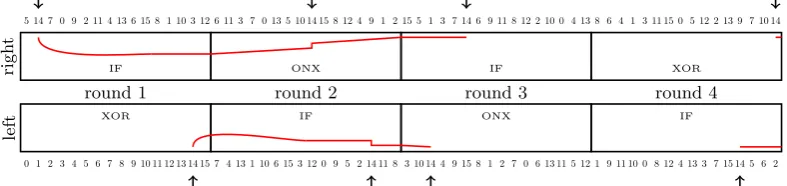
Fig. 2.
The shape of our differential path for
RIPEMD-128
. The numbers are the message words inserted at each step and
the red curves represent the rough amount differences in the internal state during each steps. The arrows show where the
bit differences are injected with
M14
.
it might be more interesting to not absorb the difference if it can erase another difference in later steps). We
give the rough skeleton of our differential path in Figure 2. Both differences inserted in the 4
th
round of left and
right branches are simply propagated forward for a few steps and we are very lucky that this linear propagation
leads to two final internal states whose difference can be mutually erased after application of the compression
function finalization and feed-forward (which is yet another argument in favor of
M
14
). All differences inserted in
the 3
rd
and 2
nd
rounds of left and right branches are propagated linearly backward and will be later connected
to the bit difference inserted in the 1
st
round by the non-linear part. Note that since a non-linear part usually
has a low differential probability, we will try to make it as thin as possible. No difference will be present in the
input chaining variable, so the trail is well suited for a semi-free-start collision attack. Following this method and
reusing notations from [4], we eventually obtain the differential path depicted in Figure 5 of Appendix F, the “?”
representing unrestricted bits that will be constrained during the non-linear parts search. We had to choose the bit
position for the message
M
14
difference insertion and among the 32 possible choices, the most significant bit was
selected because it is the one maximizing the differential probability of the linear part we just built (this finds an
explanation by the fact that at the most significant bit position many conditions due to carry control in modular
additions are avoided).
3.3
The non-linear differential part search tool
Our goal starting from Figure 5 of Appendix F is now to instantiate the unconstrained bits denoted by “?” such
that only inactive (“0”, “1” or “-”) or active bits (“n”, “u” or “x”) remain and such that the path contains no
direct inconsistency. This is in general a very complex task, but we implemented a tool similar to [4] for
SHA-1
in
order to perform this task in an automated way. Since
RIPEMD-128
also belongs to the
MD-SHA
family, the original
technique works well, in particular when used in a round with a non-linear boolean function such as
IF.
We have to find one non-linear part in each branch and note that they can be handled independently. We
included the special constraint that the non-linear parts should be as thin as possible (i.e. spreading on the
fewer possible amount of steps), so as to later reduce the overall complexity (linear parts have higher differential
probability than non-linear ones).
3.4
The final differential path skeleton
Applying our non-linear part search tool to the trail given in Figure 5 of Appendix F, we obtain the differential
path in Figure 6 of Appendix F, for which we provide at each step
i
the differential probability P
l
[
i
] and P
r
[
i
] of
left and right branch respectively. Also, we give for each step
i
the accumulated probability P[
i
] starting from last
step, i.e. P[
i
] =
Qj
j
=
=63
i
(P
r
[
j
]
·
P
l
[
j
]).
One can check that the trail has differential probability 2
−85
.
09
(i.e.
Q
63
i
=0
P
l
[
i
] = 2
−85
.
09
) in the left branch
and 2
−145
(i.e.
Q
63
i
=0
P
r
[
i
] = 2
−145
) in the right branch. Its overall differential probability is 2
−230
.
09
and since we
have 511 bits of message with unspecified value (one bit of
M
4
is already set to “1”), plus 127 unrestricted bits
of chaining variable (one bit of
X
0
=
Y
0
=
h
3
is already set to “0”), we expect many solutions to exist (about
2
407
.
91
).
In order for the path to provide a collision, the bit difference in
X
61
must erase the one in
Y
64
during the
finalization phase of the compression function:
h
0
2
=
X
61
Y
64
h
3
. Since the signs of these two bit differences
are not specified, this happens with probability 2
−1
and the overall probability to follow our differential path and
to obtain a collision for a randomly chosen input is 2
−231
.
09
.
4
Utilization of the freedom degrees
can be used to reduce the complexity of the straightforward collision search (i.e. choosing random 512-bit message
values) that requires about 2
231
.
09
RIPEMD-128
step computations. We will utilize these freedom degrees in three
phases:
•
Phase 1
: we first fix some internal state and message bits in order to prepare the attack. This will allow us
to handle in advance some conditions in the differential path as well as facilitating the merging phase. This
preparation phase is done once for all.
•
Phase 2
: we will fix iteratively the internal state words
X
21
,
X
22
,
X
23
,
X
24
from left branch, and
Y
11
,
Y
12
,
Y
13
,
Y
14
from right branch, as well as message words
M
12
,
M
3
,
M
10
,
M
1
,
M
8
,
M
15
,
M
6
,
M
13
,
M
4
,
M
11
and
M
7
(the ordering is important). This will provide us a starting point for the merging phase and due to a lack
of freedom degrees, we will need to perform this phase several times in order to get enough starting points to
eventually find a solution for the entire differential path.
•
Phase 3
: we use the remaining unrestricted message words
M
0
,
M
2
,
M
5
,
M
9
and
M
14
to efficiently merge the
internal states of the left and right branches.
4.1
Phase 1: preparation
Before starting to fix a lot of message and internal state bit values, we need to prepare the differential path from
Figure 6 of Appendix F so that the merge can later be done efficiently and so that the probabilistic part will not be
too costly. Understanding these constraints requires a deep insight of the differences propagation and conditions
fulfillment inside the
RIPEMD-128
step function. Therefore, the reader not interested in the details of the differential
path construction is advised to skip this subsection.
The first constraint that we set is
Y
3
=
Y
4
. The effect is that the
IF
function at step 4 of the right branch,
IF(
Y
2
, Y
4
, Y
3
) = (
Y
2
∧
Y
3
)
⊕
(
Y
2
∧
Y
4
) =
Y
3
=
Y
4
, will not depend on
Y
2
anymore. We will see in Section 4.3 that
this constraint is crucial in order for the merge to be performed efficiently.
The second constraint is
X
24
=
X
25
(except the two bit positions of
X
24
and
X
25
that contain differences),
and the effect is that the
IF
function at step 26 of the left branch (when computing
X
27
),
IF(
X
26
, X
25
, X
24
) =
(
X
26
∧
X
25
)
⊕
(
X
26
∧
X
24
) =
X
24
=
X
25
, will not depend on
X
26
anymore. Before the final merging phase starts,
we will not know
M
0
, and having this
X
24
=
X
25
constraint will allow us to directly fix the conditions located
on
X
27
without knowing
M
0
(since
X
26
directly depends on
M
0
). Moreover, we fix the 12 first bits of
X
23
and
X
24
to “01000100u001” and “01000011110” respectively because this choice is among the few that minimizes the
number of bits of
M
9
that needs to be set in order to verify many of the conditions located on
X
27
.
The third constraint consists in setting the bits 18 to 30 of
Y
20
to “0000000000000”. The effect is that for
these 13 bit positions, the
ONX
function at step 21 of the right branch (when computing
Y
22
),
ONX(
Y
21
, Y
20
, Y
19
) =
(
Y
21
∨
Y
20
)
⊕
Y
19
, will not depend on the 13 corresponding bits of
Y
21
anymore. Again, because we will not know
M
0
before the merging phase starts, this constraint will allow us to directly fix the conditions on
Y
22
without
knowing
M
0
(since
Y
21
directly depends on
M
0
).
Finally, the last constraint that we enforce is that the first two bits of
Y
22
are set to “10” and the first three
bits of
M
14
are set to “011”. This particular choice of bit values is among the ones that reduces the most the
spectrum of possible carries during the addition of step 24 (when computing
Y
25
) and we obtain a probability
improvement to reach “u” in
Y
25
from 2
−1
to 2
−0
.
25
.
We give in Figure 7 of Appendix F our differential path after having set these constraints (we denote a bit [
X
i]j
with the constraint [
X
i]j
= [
X
i
−1
]j
by “ˆ”). We observe that all the constraints set in this subsection consume
in total 32 + 51 + 13 + 5 = 101 bits of freedom degrees, and a huge amount of solutions (about 2
306
.
91
) are still
expected to exist.
4.2
Phase 2: generating a starting point
Once the differential path properly prepared in phase 1, we would like to utilize the huge amount of freedom degrees
available to fulfill directly as many conditions as possible. Our approach is to fix the value of the internal states
in both the left and right branches (they can be handled independently), exactly in the middle of the non-linear
parts where the number of conditions is important. Then, we will fix the message words one by one following a
particular scheduling, and propagating the bit values forward and backward from the middle of the non-linear
parts in both branches.
Fixing the message words.
Similarly to the internal state words, we randomly fix the value of message words
M
12
,
M
3
,
M
10
,
M
1
,
M
8
,
M
15
,
M
6
,
M
13
,
M
4
,
M
11
and
M
7
(following this particular ordering that facilitates the
convergence towards a solution). The difference here is that the left and right branch computations are no more
independent since the message words are used in both of them. However, this does not change anything to our
algorithm and the very same process is applied: for each new message word randomly fixed, we compute forward
and backward from the known internal state values and check for any inconsistency, using backtracking and reset
if needed.
Overall, finding one new solution for this entire phase 2 takes about 5 minutes of computation on a recent PC
with a naive implementation
4
. However, when one starting point is found, we can generate many for a very cheap
cost by randomizing message words
M
4
,
M
11
and
M
7
since the most difficult part is to fix the 8 first message
words of the schedule. For example, once a solution is found, one can directly generate 2
18
new starting points by
randomizing a certain portion of
M
7
(because
M
7
has no impact on the validity of the non-linear part in the left
branch, while in the right branch one has only to ensure that the last 14 bits of
Y
20
are set to “u0000000000000”)
and this was verified experimentally.
We give an example of such a starting point in Figure 3 and we emphasize that by “solution” or “starting point”
we mean a differential path instance with
exactly
the same probability profile as this one. The 3 constrained bit
values in
M
14
are coming from the preparation in phase 1, and the 3 constrained bit values in
M
9
are necessary
conditions in order to fulfill step 26 when computing
X
27
. It is also important to remark that whatever instance
found during this second phase, the position of these 3 constrained bit values will always be the same thanks to
our preparation in phase 1.
The probabilities displayed in Figure 3 for early steps (steps 0 to 14) are not meaningful here since they assume
an attacker only computing forward, while in our case we will compute backwards from the non-linear parts to
the early steps. However, we can see that the uncontrolled accumulated probability (i.e. step
3in right side of
Figure 1) is now improved to 2
−29
.
32
, or 2
−30
.
32
if we add the extra condition for the collision to happen at the
end of the
RIPEMD-128
compression function.
4.3
Phase 3: merging left and right branches
At the end of the second phase, we have several starting points equivalent to the one from Figure 3, with many
conditions already verified and an uncontrolled accumulated probability of 2
−30
.
32
. Our goal for this third phase is
now to use remaining free message words
M
0
,
M
2
,
M
5
,
M
9
,
M
14
and make sure that both left and right branches
start with the same chaining variable.
We recall that during the first phase we enforced that
Y
3
=
Y
4
, and for the merge we will require an extra
constraint
X
>>>5
5
M
4
=
0xffffffff. The message words
M
14
and
M
9
will be utilized to fulfill this constraint, and
message words
M
0
,
M
2
and
M
5
will be used to perform the merge of the two branches only with a few operations,
and with a success probability of 2
−34
.
Handling the extra constraint with
M
14
and
M
9
.
First, let us deal with the constraint
X
5
>>>5
M
4
=
0xffffffff, which can be rewritten as
X
5
= (0xffffffff
M
4
)
<<<5
and then
X
9
>>>11
(
X
8
⊕
X
7⊕
X
6
)
M
8
K
0
l
=
(0xffffffff
M
4
)
<<<5
by replacing
M
5
using update formula of step 8 in left branch. Finally, isolating
X
6
and
replacing it using update formula of step 9 in left branch we obtain:
M9
=
X
>>>1310
((
X
9>>>11M8
K
0l(
0xffffffff
M4
)
<<<5)
⊕
X8
⊕
X7
)
K
0l(
X9
⊕
X8
⊕
X7
)
.
(1)
All values on the right side of this equation are known if
M
14
is fixed. Therefore, so as to fulfill our extra constraint,
what we could do is to simply pick a random value for
M
14
, and then directly deduce the value of
M
9
thanks to
equation (1). However, one can see in Figure 3 that 3 bits are already fixed in
M
9
(the last one being the 10
th
bit
of
M
9
) and thus a valid solution would be found only with probability 2
−3
. In order to avoid this extra complexity
factor, we will first randomly fix the first 24 bits of
M
14
and this will allow us to directly deduce the first 10 bits
of
M
9
that fulfill our extra constraint up to the 10
th
bit (because knowing the first 24 bits of
M
14
will lead to the
first 24 bits of
X
11
,
X
10
,
X
9
,
X
8
and the first 10 bits of
X
7
, which is exactly what we need according to equation
(1)). Once a solution is found after 2
3
tries on average, we can randomize the remaining
M
14
unrestricted bits
(the 8 most significant bits) and eventually deduce the 22 most significant bits of
M
9
with equation (1). With this
method, we completely remove the extra 2
3
factor, because the cost is amortized by the final randomization of the
8 most significant bits of
M
14
.
4
Step X
iW
li
liP
l[i] Y
iW
ri
riP
r[i] P[i]
-3: --- -2: --- -1: ---
00: ---0--- | --- 0 0.00 | ---0--- | --- 5 -2.00 | -287.32 01: --- | 00000101111011100000110011000111 1 0.00 | ---01--- | x---011 14 -1.00 | -285.32 02: --- | --- 2 0.00 | ---n--- | 01000010101100100011001110010110 7 -32.00 | -284.32 03: --- | 00101100100000110100001001011110 3 0.00 | 00000000001100101010101011000000 | --- 0 -32.00 | -252.32 04: --- | 11110000101100100000101111111100 4 0.00 | 00000000001100101010101011000000 | ---0---1-1--- 9 -31.00 | -220.32 05: --- | --- 5 0.00 | 10111111101001001001010100111100 | --- 2 -32.00 | -189.32 06: --- | 00100101011001000111000001010101 6 0.00 | 00nuuuuuu11000110111011001100100 | 10111001010001001100100111001100 11 0.00 | -157.32 07: --- | 01000010101100100011001110010110 7 0.00 | 00011011111101110110010011100000 | 11110000101100100000101111111100 4 0.00 | -157.32 08: --- | 00111100101111111010001110110000 8 0.00 | 10101101110101010010000001001011 | 01100011101010100010110001110011 13 0.00 | -157.32 09: --- | ---0---1-1--- 9 0.00 | 111000110011011100101010110n0nnn | 00100101011001000111000001010101 6 0.00 | -157.32 10: --- | 10001010101010011100001100111101 10 0.00 | 1n010000110010011011010100011110 | 00000110110000101001110101001010 15 0.00 | -157.32 11: --- | 10111001010001001100100111001100 11 -32.00 | 001111111011100010nu1n1000110110 | 00111100101111111010001110110000 8 0.00 | -157.32 12: 00111010101011111111101110101000 | 01101001001010010010111011101100 12 -32.00 | nuuuuuuu011101111111101101111001 | 00000101111011100000110011000111 1 0.00 | -125.32 13: 01110011001001011011001011011110 | 01100011101010100010110001110011 13 -32.00 | 0101111110101nn10un11u1001001110 | 10001010101010011100001100111101 10 0.00 | -93.32 14: 11110100011110100101101111011100 | x---011 14 -32.00 | 010111111110010000u1001100000001 | 00101100100000110100001001011110 3 0.00 | -61.32 15: 01101010101111000101111n00110110 | 00000110110000101001110101001010 15 0.00 | 1010100u111110000001000111001100 | 01101001001010010010111011101100 12 0.00 | -29.32 16: 01010110010unnnn0010011000101111 | 01000010101100100011001110010110 7 0.00 | 1100101u1111u0011110011000010000 | 00100101011001000111000001010101 6 0.00 | -29.32 17: 0100101n011000000000000111111001 | 11110000101100100000101111111100 4 0.00 | 11101u101111u0011111001011000010 | 10111001010001001100100111001100 11 0.00 | -29.32 18: 10100010110011111110100000101000 | 01100011101010100010110001110011 13 0.00 | 11010u11000000101001100110001111 | 00101100100000110100001001011110 3 0.00 | -29.32 19: 001u10010000101n0111000101111111 | 00000101111011100000110011000111 1 0.00 | 01010000011111101010011111100100 | 01000010101100100011001110010110 7 0.00 | -29.32 20: 01100001101001101110001100100101 | 10001010101010011100001100111101 10 0.00 | u0000000000000000000000000000000 | --- 0 -2.00 | -29.32 21: 1011110100111111111001101001n110 | 00100101011001000111000001010101 6 0.00 | u---0-- | 01100011101010100010110001110011 13 0.00 | -27.32 22: 101110111000101unnnn011010000111 | 00000110110000101001110101001010 15 0.00 | 01111011111011110100000101000u10 | --- 5 -1.00 | -27.32 23: 1011111110111000000001000100u001 | 00101100100000110100001001011110 3 0.00 | ---1-- | 10001010101010011100001100111101 10 -2.00 | -26.32 24: 0100001011011n011101001000011110 | 01101001001010010010111011101100 12 0.00 | ---10---0-- | x---011 14 -0.25 | -24.32 25: 01000010110n10011101001000011110 | --- 0 -3.00 | ---u--- | 00000110110000101001110101001010 15 0.00 | -24.08 26: ---u---0-1--- | ---0---1-1--- 9 -1.00 | ---u--- | 00111100101111111010001110110000 8 -1.00 | -21.08 27: 1---0---1-u--- | --- 5 -3.00 | ---0--- | 01101001001010010010111011101100 12 0.00 | -19.08 28: 0---1---0--- | --- 2 -2.00 | --- | 11110000101100100000101111111100 4 -1.00 | -16.08 29: n---1--- | x---011 14 -1.00 | ---0--- | ---0---1-1--- 9 -1.08 | -13.08 30: u--- | 10111001010001001100100111001100 11 -1.00 | ---u--- | 00000101111011100000110011000111 1 -1.00 | -11.00 31: u--- | 00111100101111111010001110110000 8 -1.00 | ---1--- | --- 2 -1.00 | -9.00 32: 1--- | 00101100100000110100001001011110 3 0.00 | ---1--- | 00000110110000101001110101001010 15 0.00 | -7.00 33: --- | 10001010101010011100001100111101 10 0.00 | --- | --- 5 -1.00 | -7.00 34: --- | x---011 14 0.00 | u--- | 00000101111011100000110011000111 1 -2.00 | -6.00 35: --- | 11110000101100100000101111111100 4 0.00 | 0--- | 00101100100000110100001001011110 3 -1.00 | -4.00 36: --- | ---0---1-1--- 9 0.00 | 1--- | 01000010101100100011001110010110 7 0.00 | -3.00 37: --- | 00000110110000101001110101001010 15 0.00 | --- | x---011 14 0.00 | -3.00 38: --- | 00111100101111111010001110110000 8 0.00 | --- | 00100101011001000111000001010101 6 0.00 | -3.00 39: --- | 00000101111011100000110011000111 1 0.00 | --- | ---0---1-1--- 9 0.00 | -3.00 40: --- | --- 2 0.00 | --- | 10111001010001001100100111001100 11 0.00 | -3.00 41: --- | 01000010101100100011001110010110 7 0.00 | --- | 00111100101111111010001110110000 8 0.00 | -3.00 42: --- | --- 0 0.00 | --- | 01101001001010010010111011101100 12 0.00 | -3.00 43: --- | 00100101011001000111000001010101 6 0.00 | --- | --- 2 0.00 | -3.00 44: --- | 01100011101010100010110001110011 13 0.00 | --- | 10001010101010011100001100111101 10 0.00 | -3.00 45: --- | 10111001010001001100100111001100 11 0.00 | --- | --- 0 0.00 | -3.00 46: --- | --- 5 0.00 | --- | 11110000101100100000101111111100 4 0.00 | -3.00 47: --- | 01101001001010010010111011101100 12 0.00 | --- | 01100011101010100010110001110011 13 0.00 | -3.00 48: --- | 00000101111011100000110011000111 1 0.00 | --- | 00111100101111111010001110110000 8 0.00 | -3.00 49: --- | ---0---1-1--- 9 0.00 | --- | 00100101011001000111000001010101 6 0.00 | -3.00 50: --- | 10111001010001001100100111001100 11 0.00 | --- | 11110000101100100000101111111100 4 0.00 | -3.00 51: --- | 10001010101010011100001100111101 10 0.00 | --- | 00000101111011100000110011000111 1 0.00 | -3.00 52: --- | --- 0 0.00 | --- | 00101100100000110100001001011110 3 0.00 | -3.00 53: --- | 00111100101111111010001110110000 8 0.00 | --- | 10111001010001001100100111001100 11 0.00 | -3.00 54: --- | 01101001001010010010111011101100 12 0.00 | --- | 00000110110000101001110101001010 15 0.00 | -3.00 55: --- | 11110000101100100000101111111100 4 0.00 | --- | --- 0 0.00 | -3.00 56: --- | 01100011101010100010110001110011 13 0.00 | --- | --- 5 0.00 | -3.00 57: --- | 00101100100000110100001001011110 3 0.00 | --- | 01101001001010010010111011101100 12 0.00 | -3.00 58: --- | 01000010101100100011001110010110 7 -1.00 | --- | --- 2 0.00 | -3.00 59: ---0--- | 00000110110000101001110101001010 15 -1.00 | --- | 01100011101010100010110001110011 13 0.00 | -2.00 60: ---1--- | x---011 14 0.00 | --- | ---0---1-1--- 9 0.00 | -1.00 61: ---x--- | --- 5 0.00 | --- | 01000010101100100011001110010110 7 0.00 | -1.00 62: --- | 00100101011001000111000001010101 6 0.00 | --- | 10001010101010011100001100111101 10 0.00 | -1.00 63: --- | --- 2 -1.00 | --- | x---011 14 0.00 | -1.00 64: --- | | ---x---
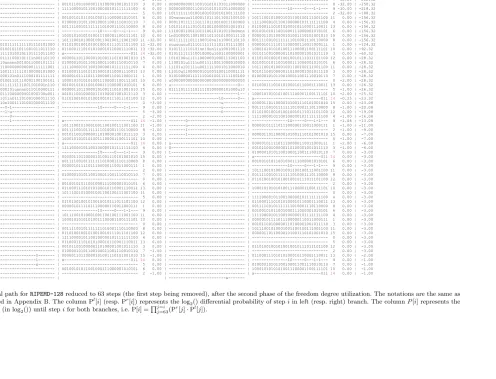
Fig. 3.
The differential path for
RIPEMD-128
, after the second phase of the freedom degree utilization. The notations are the same as in [4] and are described in Appendix B. The column
P
l[
i
] (resp. P
r[
i
]) represents the log
2
() differential probability of step
i
in left (resp. right) branch. The column
P
[
i
] represents the cumulated probability (in log
2()) until step
i
for both
branches, i.e. P[
i
] =
Q
j=ij=63
(P
r
Merging the branches with
M
0
,
M
2
and
M
5
.
Once
M
9
and
M
14
fixed, we still have message words
M
0
,
M2
and
M
5
to determine for the merging. One can see that with only these three message words undetermined,
all internal state values except
X
2
,
X
1
,
X
0
,
X
−1
,
X
−2
,
X
−3
and
Y
2
,
Y
1
,
Y
0
,
Y
−1
,
Y
−2
,
Y
−3
are fully known when
computing backwards from the non-linear parts in each branch.
This is where our first constraint
Y
3
=
Y
4
comes into play. Indeed, when writing
Y
1
from the equation from
step 4 in right branch, we have:
Y
1
=
Y
5
>>>13
(
Y
4
∧
Y
2
⊕
Y
3
∧
Y
2
)
M
9
K
0
r
=
Y
5
>>>13
Y
3
M
9
K
0
r
which means that
Y
1
is already completely determined at this point (the bit condition present in
Y
1
in Figure 3
is actually handled for free when fixing
M
14
and
M
9
, since it requires to know the 9 first bits of
M
9
). In other
words, the constraint
Y
3
=
Y
4
allowed
Y
1
to not depend on
Y
2
which is currently undetermined. Another effect of
this constraint can be seen when writing
Y
2
from the equation from step 5 in right branch:
Y
2
=
Y
6
>>>15
(
Y
5
∧
Y
3
⊕
Y
4
∧
Y
3
)
M2
K
0
r
=
Y
>>>
15
6
(
Y
5
∧
Y
3
)
M2
K
0
r
=
C
0
M2
where
C
0
=
Y
6
>>>15
(
Y
5
∧
Y
3
)
K
0
r
is a constant.
Our second constraint
X
>>>5
5
M
4
=
0xffffffff
is useful when writing
X
1
and
X
2
from the equations from
step 4 and 5 in left branch
X2
=
X
6>>>8(
X5
⊕
X4
⊕
X3
)
M
5=
C1
M
5X1
=
X
>>>55
(
X4
⊕
X3
⊕
X2
)
M4
=
0xffffffff
(
X4
⊕
X3
⊕
X2
) =
X4
⊕
X3
⊕
X2
=
X4
⊕
X3
⊕
(
C1
M
5)
where
C
1
=
X
6
>>>8
(
X
5
⊕
X
4
⊕
X
3
) is a constant.
Finally, our ultimate goal for the merge is to ensure that
X
−3
=
Y
−3
,
X
−2
=
Y
−2
,
X
−1
=
Y
−1
and
X
0
=
Y
0
,
knowing that all other internal states are determined when computing backwards from the non-linear parts in each
branch, except
Y
2
=
C
0
M2
,
X
2
=
C
1
M
5
and
X
1
=
X
4
⊕
X
3
⊕
(
C
1
M
5). We therefore write the equations
relating these eight internal state words:
X0
=
X
>>>124
(
X3
⊕
X2
⊕
X1
)
M3
=
X
>>>124
X4
M3
=
Y0
=
Y
>>>114
(
Y3
∧
Y1
⊕
Y2
∧
Y1
)
M
0K
0r=
Y
>>>114
(
Y3
∧
Y1
⊕
(
C0
M
2)
∧
Y1
)
M
0K
0rX
−1=
X
3>>>15(
X2
⊕
X1
⊕
X0
)
M
2=
X
3>>>15(
X4
⊕
X3
⊕
X0
)
M
2=
Y
−1=
Y
3>>>9(
Y2
∧
Y0
⊕
Y1
∧
Y0
)
M7
K
r
0
=
Y
>>>93
((
C0
M
2)
∧
X0
⊕
Y1
∧
X0
)
M7
K
0rX
−2=
X
2>>>14(
X1
⊕
X0
⊕
X
−1)
M1
= (
C1
M
5)
>>>14(
X4
⊕
X3
⊕
(
C1
M
5)
⊕
X0
⊕
X
−1)
M1
=
Y
−2=
Y
2>>>9(
Y1
∧
Y
−1⊕
Y0
∧
Y
−1)
M14
K
0r= (
C0
M
2)
>>>9(
Y1
∧
X
−1⊕
X0
∧
X
−1)
M14
K
r0X
−3=
X
1>>>11(
X0
⊕
X
−1⊕
X
−2)
M
0= (
X4
⊕
X3
⊕
(
C1
M
5))
>>>11(
X0
⊕
X
−1⊕
X
−2)
M
0=
Y
−3=
Y
1>>>8(
Y0
∧
Y
−2⊕
Y
−1∧
Y
−2)
M
5K
0r=
Y
>>>8
1

![Table 6. Notations used in [4] for a differential path: x represents a bit of the first message and x∗ stands for the same bitof the second message.](https://thumb-us.123doks.com/thumbv2/123dok_us/7901113.1311596/13.595.141.456.484.597/table-notations-dierential-represents-rst-message-stands-message.webp)
![Fig. 5. The differential path for RIPEMD-128, before the non-linear parts search. The notations are the same as in [4] and are described in Appendix B](https://thumb-us.123doks.com/thumbv2/123dok_us/7901113.1311596/16.595.131.634.65.485/dierential-ripemd-linear-parts-search-notations-described-appendix.webp)
![Fig. 6. The differential path for RIPEMD-128, after the non-linear parts search. The notations are the same as in [4] and are described in Appendix B](https://thumb-us.123doks.com/thumbv2/123dok_us/7901113.1311596/17.595.100.682.38.462/dierential-ripemd-linear-parts-search-notations-described-appendix.webp)
![Fig. 7. The differential path for RIPEMD-128, after the non-linear parts search. The notations are the same as in [4] and are described in Appendix B](https://thumb-us.123doks.com/thumbv2/123dok_us/7901113.1311596/18.595.133.631.41.458/dierential-ripemd-linear-parts-search-notations-described-appendix.webp)
![Fig. 8. The differential path for the full RIPEMD-128 hash function distinguisher. The notations are the same as in [4] and are described in Appendix B](https://thumb-us.123doks.com/thumbv2/123dok_us/7901113.1311596/19.595.99.687.36.463/fig-dierential-ripemd-function-distinguisher-notations-described-appendix.webp)
