ISSN (e): 2250-3021, ISSN (p): 2278-8719
Vol. 09, Issue 5 (May. 2019), ||S (III) || PP 12-18
A Novel QB Leach Based Heterogeneous Wireless Sensor
Network Using IOT
Thilagavathi.N, Swetha.V, Aishwariya.A
1
(Information Technology, Sri ManakulaVinayagar Engineering College/Pondicherry University,India)
2(Information Technology, Sri ManakulaVinayagar Engineering College/Pondicherry University,India) 3(Information Technology, Sri ManakulaVinayagar Engineering College/Pondicherry University,India)
Corresponding Author:Thilagavathi.N
Abstract
-
Heterogeneous wireless networks (HWNs) provide flexible and diversified wireless network access by integrating cellular networks, wireless LANs, and ad hoc networks with the Internet. Heterogeneous wireless sensor network is a network connecting different applications and protocols. The smart sensor nodes are used in applications like medical health care systems, industrial monitoring,environmental/earth sensing, air pollution monitoring etc. But these nodes are energy constraint devices. Efficient clustering and appropriate cluster head selection schemes are necessary to improve energy saving of sensor nodes. In this paper, dynamic cluster head selection method (DCHSM) is used where CHs are selected in two phases and network coding algorithm is implemented. Initially, QB-LEACH based Clustering is used to divide the monitoring area in polygonal shaped clusters. Then, CH election is performed in two phases. First class of CH is elected based on perceived probability and the second class is elected on the based on the residual energy estimation. Energy consumption is reduced using this algorithm. Simulation analysis show that dynamic cluster head selection methodout performs the conventional methods in terms of network lifetime.Keywords
:
Base Station (BS), Cluster Head (CH), Dynamic Cluster Head Selection Method (DCHSM), Internet of Things (IOT), Voronoi Diagram, Wireless Sensor Network (WSN).--- --- Date of Submission: 16-05-2019 Date of acceptance: 01-06-2019 ---
---I.
BACKGROUND
For applications from personal electronics to industrial electronics, IOT is the rapidly growing technology, where sensors are connected wirelessly to internet. IOT connects the world with sensing, actuation, networking and cloud computing [1– 3]. The idea of smart world is the outcome of integration of the world with internet. IOT finds application in smart home, smart city, smart automobiles, connected health, connected car, smart grids, industrial internet etc. The Cluster of IOT is WSN. WSN acts as the dominant infrastructure for sensing, networking and routing [4–6].
Low power and low cost sensor nodes are to be developed for applications in health care monitoring, industrial monitoring, intelligent buildings, military services, wildlife monitoring, wildfire monitoring, and intelligent transportation systems etc. Sizable senor nodes positioned randomly in the monitoring area are webbed together using WSNs. Irrespective of the tough environment, the sensor nodes are responsible to sense the monitoring area. The large scale information gathered by sizable number of sensor nodes are processed and finds application in the field of IOT. Hence, WSN plays as the Cluster of IOT.
The sensor nodes tracks the monitoring area heedfully and they are self-organized. For accurate measurements, the nodes should work error free throughout. Batteries are the only source to supply energy to sensor nodes. Sensor nodes spent most of the energy while transmitting and receiving sizable information. Due to the dense condition of environment in which the nodes are deployed, it is difficult to replace the batteries of sensor nodes. Inorder to improve the lifetime of WSN, it is most important to reduce energy consumption of individual sensor nodes thereby avoiding quick battery drain.
energy consumption is saved thus improvingthe network lifetime. In order to improve energy consumption of sensor nodes, efficient clustering and proper cluster head selection techniques are required.
Both distributed and centralized clustering schemes play crucial role in energy saving in WSN. BS holds the prime position in the centralized technique. Base station initially collects the energy and location details of each node and utilize these information to form clusters, elect cluster head, and form the network. Although centralized clustering improves efficiency of network in terms of energy saving, it fails to improve efficiency for large scale network. This is because the BS alone finds it difficult to manage the activities of the many number of sensor nodes deployed in the monitoring area. In distributed clustering technique, the sensor nodes self-organizedand these sensor nodes are responsible to form clusters, based on the residual energy cluster head is electedand thus network formation is done and network efficiency is improved in terms of scalability [8].
Researchers are aiming towards improved energy saving in WSNs. Distributed clustering technique is utilized to implement Low energy adaptive clustering hierarchy (LEACH) algorithm. In LEACH algorithm, CH nodes are elected based on the residual energy [9]. Non CH members monitorthe environment and communicate the information it gathered with the CH. CH then process the information and communicate it with the BS. Furthermore the algorithm uses the concept of CH rotation to stabilize the network traffic among all nodes in the network thereby improving the lifetime of the sensor Nodes. The algorithm include two phases namely, set up phase and steady state phase. During set up phase, CH is elected and clusters are formed. Steady state phase includes transmission of information. A number is chosen in range of 0 and 1 randomly for each node. If the random number obtained for each node is less than its threshold value then it can hold the position of CH. Proper CH selection schemes are required, in order to improve energy saving of sensor nodes. A deterministic component is added to LEACH algorithm, which concentrate mainly on cluster head selection criteria to develop deterministic LEACH algorithm [10]. The deterministic component added to the threshold value improves energy depletion of sensor nodes by taking into account the residual energy of individual nodes.
Dynamic clustering gained importance since it balances the traffic load among various CHs. Dynamic clustering is an applicable solution for enormous scale of data collection in IOT applications [11].Here periodic reordering of clusters attracts technical communities in improving the scalability and energy consumption in Wireless Sensor Networks.
A two phase clustering algorithm DCHSM is studied in this research work. Initially, polygonal shaped clusters are created using Voronoi diagram [12]. Then CH is elected in two stages. The first class of CH is selected based on the concept of perceived probability and the second class of CH is elected based on survival time estimation algorithm.
The work is arranged as: System architecture and model is explained in Section II. Simulation analysis is specified in Section III following the conclusion in Section IV.
II.
PROPOSED SYSTEM
Proposed System Architecture
The proposed routing protocol Quadrant based –Low Energy Adaptive Clustering Hierarchy incorporates three different techniques namely location based routing, restricted flooding and clustering concept. The network region is divided into four quadrants. Clusters are formed randomly within each of these quadrants and each cluster is assigned a cluster head based on the energy. Cluster head acts as a gateway to send the packets from source to destination. Using network coding algorithm, packets in the nodes are encoded using bitwise XOR at the source and decoded at their destination.
The proposed system is divided into three phases: level assignment mechanism, 2 connected Cluster network formation and finally routing. In first phase, the fig2 represents the base station which assigns level to each sensor node in the network. In next phase, a 2-connected Cluster network is formed using CHs. In third phase, nodes forward their packets to the lower level nodes based on the weight function as detailed subsequently.
Fig2: Proposed System Block Diagram
Level Assignment Mechanism
In this phase, we assign level (L) to every node in the network depending on its Distance from the base station. Initially, level of all the nodes is zero including the base station. The total distance between the last nodes from the base station called as the radius of the network. Then we are applying the weight to the nodes by using the distance from the base station. The nodes which are nearer to the base stations getting higher weight factor and nodes which are far from the base station getting lower weight factor. Then we are assigning the cluster head using the residual energy and based on the centroid approach, that is we are giving priority to the nodes which is nearer to the base station.
Connected Cluster Network Formation
In this phase, the Cluster network is formed with cluster heads in the network. Cluster range (CR) is used to provide Cluster connectivity. Cluster range is the range between the connected cluster heads. Here, the cluster heads in level L1 are directly connected to the BS. However, other CHs except nodes in L1 utilize their levels and cluster range for selecting next hop cluster heads.
Weight Based Routing
Received Signal Strength Scheme
In the proposed approach, there are three steps to achieve the probabilistic prediction coefficient in order to estimate the link stability for reliable data delivery in the entire network.
The three steps incorporated in the distributed approach for determining the link stability are Estimation of neighborhood stability based on Energy
Estimation of neighbor stability based on link loss Manipulation of lifetime of mobile node
Network Reconfiguration Phase
Network reconfiguration is important to achieve balanced energy consumption and also to reduce the unnecessary networking overhead due to frequent re-clustering. N this procedure, the average residual energy of CHs is compared with Maximum Threshold MAXTH as well as Minimum Threshold MINTH value. It has three possible cases. These are:
If the average residual energy of CHs is higher than MAXTH, same forwarder set is used for data forwarding and Re clustering flag is set to 0.
If the average energy of CHs is between MAXTH and MINTH , then a new set of forwarder nodes is chosen from the existing cluster heads.
If the average energy is less than MINTH, then the re-clustering process is done in order to select a new set of cluster heads and re-clustering flag is set to 1.
III.
SIMULATIONS ANALYSIS AND RESULTS
In this section, we present simulation results on the network loss probabilities of our distributed optimal movement strategy under various setting of buffer sizes and the number of mobile agents as well as different data arrival patterns to the network. In particular, we here demonstrate its considerable performance improvement over the standard random walk strategy in which a random walk at the current node moves to any one of its destination nodes.
In all these simulations, we observe that the network loss probability under our Network coding Algorithm is about 2 times smaller than that of the Distributed optimal Movement Strategy. Note that the network loss probabilities for both the standard random walk strategy and network coding strategy tend to increase with a larger number of sensor nodes (n = 200), since the number of sensor nodes to be covered by a mobile collector itself increases. The amount of reduction in the network loss probability that we achieve from Network coding strategy (in comparison with the standard random walk strategy).is much greater than the existing one. For each arrival pattern (or each simulation figure), the data points are obtained by taking the average of the results under 30 different heterogeneous and spatially-correlated data arrival patterns. We expect that our reasoning behind the Network coding strategy can be applicable for the design of Markovian random walk-based applications sample topologies of each sensor nodes. In all these simulations, we observe that the network loss probability under our Network coding Algorithm is about 2 times smaller than that of the Distributed optimal Movement Strategy model. In all cases, our coding strategy is consistently better than the standard random walk strategy, and the ratio tends to decrease, implying that our strategy is increasingly more advantageous as the buffer size.
We adopt C language to write programs and NS2 to simulation. There are 50 nodes in the Wireless Sensor Network, deployed in the range 1000m × 1000m randomly.The main parameter settings are in the below table
Parameter Value
Sensor deployment area 1000m x 1000m
Number of nodes 50
Initial energy of node 100 J
Coordinates of base station (300,720)
Packet size 512kb
Data rate 100kbps
Transceiver energy 31.32 mJ
Fig 2- Comparison of Energy efficiency
Represents the energy efficiency with respect to energy and time.The figure 2 is the comparison of energy consumption of two protocols. From the simulation, we can conclude that, the energy consumption of existing protocol is much higher than that of Network coding algorithm. At the time 9s, energy of all nodes in the network is used up in the existing work, however there is much residual energy in the improved algorithm, we consider the rest of the energy of nodes when choosing cluster heads improves the utilization of energy. From this assesment the utilization of energy is decreased in network coding process as shown in figure.
Fig 3-Comparsion of Delivery ratio
Fig3 represents the delivery ratio with respect to time and no of data packets. From this assessment no of delivery packets is increased compared to the distributed optimal movement strategy.
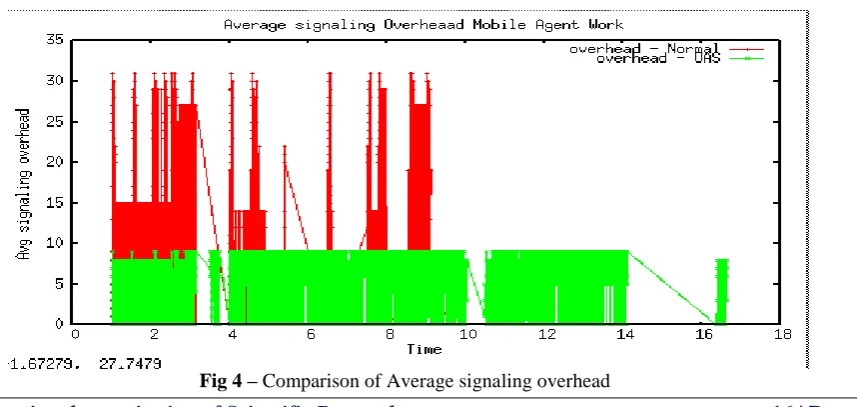
Represents the average signaling overhead with respect to time and no of nodes.From the fig4, it is clear that in the running time, there overhead of the existing work is low when compared to proposed work, but whereas in the proposed network coding algorithm; the average signaling overhead of the nodes is relatively stable and maintained till the death of the last node.. From this assessment signaling covered over the entire network is comparably high than the existing work.
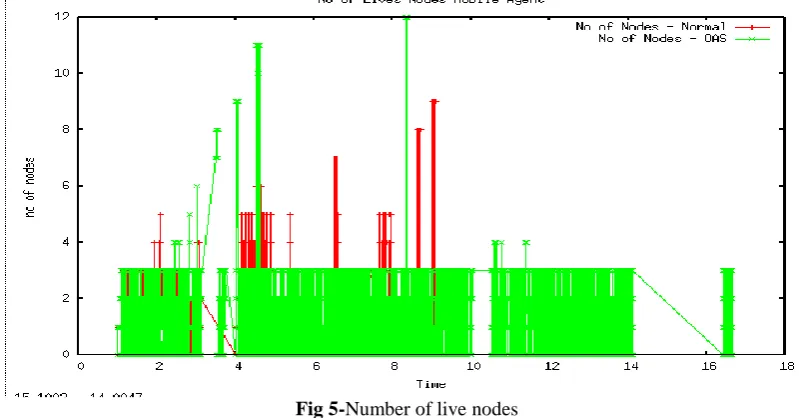
Fig 5-Number of live nodes
Represents the no of live nodes with respect to time and no of nodes. The number of alive nodes reflects the network lifetime and stability in some degree. From the fig 5, we know that in the running time, there are some nodes that begin to die in existing protocol, while in networkcoding algorithm; the nodes of alive nodes increases. This is because in this proposed work, due to the QB-LEACH based clustering and network codingthe number of alive nodes is increased which eventually increases the network lifetime and enhances the stability of the network. From this simulation assessment the maximum node covers the network.
IV.
CONCLUSION
In this effort, we have experimented the performance of DCHSM in WSN. Initially QB-LEACH based Clustering is used to obtain polygonal shaped clusters. CHs are selected in two different phases. Outcomes for 100 nodes when tested for 2000 iterations shows that DCHSM improves the residual energy in WSN by 5.70% compared to LEACH and 5.58% compared to Deterministic QB-LEACH. Hence DCHSM improves energy consumption thus increasing the network lifetime. The experiment is not tested for sizable nodes. Later, the same can be tested for sizable sensor nodes. Besides, simple energy models are used in the algorithm, which finds inappropriate for technical applications.
REFERENCES
[1]. Monica G Rathi, ”Energy Efficient And Energy Aware Techniques In Cluster Based Networks”
[2]. D.Suresh1 , K.Selvakumar,”Improving Network Lifetime and Reducing Energy Consumption in Wireless Sensor Networks” International Journal of Computer Science and Information Technologies, Vol. 5 (2) , 2014, 1035-1038
[3]. Kayhan Zrar Ghafoor ,Suleman Khan , Ali Safaa Sadiq, and Ghufran Ahmed,”EE-MRP: Energy-Efficient Multistage Routing Protocol for Wireless Sensor Networks “Wireless Communications and Mobile Computing.Volume 2018, Article ID 6839671, 13 pages,https://doi.org/10.1155/2018/6839671
[4]. Mohamed Elshrkawey Samiha, M.Elsherif ,M.Elsayed Wahed,”An Enhancement Approach for Reducing the Energy Consumption in Wireless Sensor Networks”2017Journal of King Saud University –Computer and Information Sciences
[5]. Chul-Ho Lee ,Jaewook Kwak ,Do Young Eun,”Towards Distributed Optimal Movement Strategy for Data Gathering in Wireless Sensor Network” IEEE Transactions on Parallel and Distributed Systems [6]. ( Volume:27 , 2016 )
International organization of Scientific Research
18 | Page
[8]. Bo Li and Sungkwon Park, “Maximizing the Lifetime of Wireless Sensor Networks Using Multiple Setsof Rendezvous”Mobile Information Systems Volume 2015
[9]. Ling Chen, Jianxin Wang, Xiaoqing Peng,”An Energy-Efficient and Relay Hop Bounded Mobile Data Gathering Algorithm in Wireless Sensor Networks”2015 International Journal of Distributed Sensor Networks
[10]. John. A., & Babu.K. V,” Two phase dynamic method for cluster head selection in wireless sensor network for Internet of Things applications” 2017 International Conference on Wireless Communications, Signal Processing and Networking
[11]. Salah A. Aly,Ahmed E. Kamal,”Network coding-based protection strategy against node failures”2009 IEEE international conference on Communications
[12]. Jelena Skulic , Kin K. Leung “Application of network coding in Wireless Sensor Networks for bridge monitoring” 2012 IEEE 23rd International Symposium on Personal, Indoor and Mobile Radio Communications
[13]. Zytoune, O, Aboutajdine, D, & Tazi, M. (2010)”Energy balanced clustering algorithm for routing in heterogeneous wireless sensor networks” 5th International Symposium On Communications and Mobile Network
[14]. Louai Al-Awami,”Distributed Data Storage System for Data Survivability in Wireless Sensor Networks” [15]. Wenbo Zhang, Ling Li, Guangjie Han, Lincong Zhang “An Energy-Efficient Heterogeneous Ring
Clustering Routing Protocol for Wireless Sensor Networks”
[16]. Shalli Rani , Rajneesh Talwar , Jyoteesh Malhotra , Syed Hassan Ahmed , Mahasweta Sarkar , Houbing Song “A Novel Scheme for an Energy Efficient Internet of Things Based on Wireless Sensor Networks” [17]. Josh Broch David , A. Maltz , David B. Johnson ,Yih-Chun Hu Jorjeta Jetcheva “a performance
comparison of multi-hop wireless ad hoc network routing protocols”
[18]. Tushar deepak chandra, tf.Thomas J. Warson, Hawthorne,Sam Toueg “Unreliable failure detectors for reliable distributed systems”
[19]. D. Ben Khedher, R. Glitho, and R. Dssouli. A Novel Overlay-Based Failure Detection Architecture for MANET Applications. In IEEE International Conference on Networks, pages 130–135, 2007.
[20]. C. Bettstetter. Smooth is Better than Sharp: A Random Mobility Model for Simulation of Wireless Networks. In Proc. of ACM International Workshop on Modeling, Analysis and Simulation of Wireless and Mobile Systems, pages 19–27, New York, NY, USA, 2001. ACM.
[21]. C. Bettstetter. Topology Properties of Ad Hoc Networks with Random Waypoint Mobility. ACM SIGMOBILE Mobile Computing and Communications Review, 7(3):50–52, 2003.
[22]. Intanagonwiwat.C,Govindan,R. and Estrin,D., “Directed diffusion: A scalable and robust Communication paradigm for sensor networks,”inProc.ACM/IEEE Int.Conf.Mobile Computing and Networking ,Boston,MA,Aug.2000,pp.56- 67.
[23]. Handy, M. J., Haase, M., & Timmermann, D“Low energy adaptive clustering hierarchy with deterministic cluster-head selection” 4th International Workshop on Mobile and Wireless Communications Network. doi:10.1109/mwcn.2002.1045790
[24]. Jia, D., Zhu, H., Zou, S., & Hu, P “Dynamic Cluster Head Selection Method for Wireless Sensor Network” IEEE Sensors Journal, 16(8), 2746–2754. doi:10.1109/jsen.2015.2512322