13 | P a g e
IOT BASED PREDICTION OF BUS ARRIVAL TIME USING GPS SYSTEM
Prof. Pritesh Patil1, Manasi Jain2, Pranjal Jain3, Suyog Choudhary4
1(Information Technology, AISSMS IOIT/SPPU, India)
2(Information Technology, AISSMS IOIT/SPPU, India)
3(Information Technology, AISSMS IOIT/SPPU, India)
4(Information Technology, AISSMS IOIT/SPPU, India)
ABSTRACT :
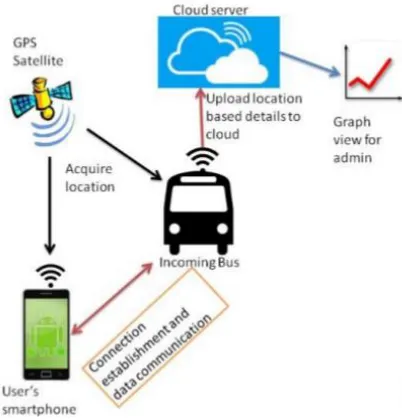
While selecting for the public-transport, time and forbearance square measure of a lot of concern . we will additionally say , human traveling on public-transport found their loss of your time attributable to waiting at the bus-stops. this method is providing a time period vehicle pursuit via Global-Positioning System technology to find the situation of bus and to use web by a general-packet-radio service (GPRS) technology to show live pictures on the Google Map or web site app for pursuit location of buses anytime. we have a tendency to square measure exploitation the GPS and GPRS modules, the GPS module can find the buses via the satellite, and also the GPRS module can collect all knowledge and send it to the web site . The buses are monitored live exploitation coordinates with this method. additionally by implementing geo-fence, user get inform once bus arrived in his/her predefined space. we have a tendency to square measure developing an Android-application which can provide the time period schedule of buses. Also, it provides fast and time period replay for inquiry, via the server. additionally just in case of any sudden activities or breakdown, the alert are sent to the system, with Bus location.
KEYWORDS - GPRS, GPS, google map, geofence, bus failure.
1. Introduction
The transportation system provide as the heart in the social and economic-growth of the country. because the population in Asian country is increasing, speedy explode in rate of vehicles which ends in an exceedingly overload on traffic-management. . Public transport is changing into a very important a part of transport system in urban areas, advance in simply obtainable technology may be enforced that facilitate the traveller who compute between a rural and concrete to-get the travel data and it helps the passengers to comfort them with the ultimate real time location. Public transport principally the bus sluice has been properly developed in several elements of the globe. For reducing the fuel-usage, snobbish usage of automobile and luxury traffic situation we are able to use the bus services. Passengers needs the precise schedule of buse. The anxiety of passengers will increase whereas watching for a long-time at the stop and alter their mind to select the buses. several passengers square measure typically on-time for workplace and plenty of students restarted to their categories as they confirm to prevent for
the buses instead-of taking associate alternative mode of transportation. Goal of system is to decrease the complexness and price of content these services by implementing Easy-Tracker, associate automotive vehicle system for the transit-tracking and advent time prediction While going out for the public transportation, time-patience are of more concern. Many passengers travelling via public-transport buses realizes time-loss due to waiting at the bus-stops. We implementing a real-time vehicle tracking-system using a GPS technology to obtain the location of the buses and to connect it to internet by a general-packet-radio service (GPRS) technology for displaying a real-time update on the web-map by Google which allows all time tracking of buses. The GPS-module will detect the buses using satellite, and the GPRS-module will collect the data and transfer it to the website. The buses will be monitored live with real time coordinates with this system. We are developing an android-application which will give real time schedule of buses. . Also in the case of any unexpected activities or breakdown, the alert will be given to the system, with Bus location. A geo-fence is a virtual-perimeter used on a real-world geographic area.[1] A geo-fence which is dynamically generated, as in a radius around a person or a point on the map, like school attendance-zones or neighborhood boundaries. This activity could trigger an notification to the device's user as-well-as alert to the passenger.
2. Literature survey
A] The work projected by Zehra Naqvi. [1] titled “Smart Public-Transport System mistreatment mobile primarily based sensing” . per her the great circle and latitude values area unit analyzed for the gap of bus from destination and for estimating schedule of bus[1]. This data is shipped to the server that informs the passengers having the good phones to access this knowledge from anyplace. The limitation of their work is that, it'll not create user’s participation mandatory within the system. this method incurs high value of installation of GSM-GPS parts within all buses. And this method is complicated additionally, because it needs
different-different hardware modules
14 | P a g e
depends on the group, that may be a major limiting issue.
B] The work projected by Qiang Zhang1 et.al. [2] titled “EasyComeEasyGo: Predicting bus point with sensible phone”. In transit system time period is most generally used variable as a result of it are often simply understood by the individuals. From the transport company’s facet time period info is beneficial in routing and programming of buses. Hence, there's would like to develop a period of time bus point prediction algorithms that may offer a lot of correct info beneath now-a-days conditions. The bus point prediction may be a terribly advanced downside, that involves several factors touch random. the essential knowledge we tend to accustomed predict bus point as well as bus numbers, real time, traveler count, longitude, latitude and next station variety. The back-end server receives the data from all sensible phones that are already put in in bus so provides the bus point prediction. once travelers use sensible phone log in ECEG system and sends its GPS references and therefore the route variety wished to the back-end server, back-end server can sends back point of the bus wished. By victimization this technique, travelers will modify their travel plans supported these info, and that they will save their time and head to their destination as quickly as potential. The GPS references of discovered stop, that significantly reduces the initial construction overhead. Querying user. Our system implementation is that there exist a backend server associate degreed a wise phone put in in bus and an robot-app for traveler The limitation of their work is that the android app put in within the smartphone can’t offer the live info of the unconditional activities or factors which can influence the bus schedule self-discipline.
C] The work planned by Rubina Choudhary et.al. [3] titled” period of time Predicting Bus regular arrival-Time A Review” Prediction of point of bus by exploitation a synthetic neural network(ANN) and kernel filter.Time index, bus delay, point, travel time is taken into account the most parameters with these models for prediction of schedule point. By finding out information assortment has done through historical-global-positioning (GPS) and to avoid missing information assortment through GPS, Automatic-fare assortment (AFC) system. It works in 2 elements that ar location and time wise elements. Location options capture the placement wise vehicle speed that thought-about the road conditions, dwell time. Timestamp feature capture the time wise vehicle speed, includeing the traffic conjointly. The works establish that HD model performs a
pair of.5 times higher than ANN regression model and a pair of times higher than SVM regression model and achieving the accuracy seventy five.65%.
D] The work projected by B. Dhivyabharathi et.al. [4] titled.” Actual Bus point in time
Prediction-System below Indian Traffic
Condition”. The recent study projected a model based mostly prediction algorithmic program that used particle filtering technique, whose inputs area unit obtained by k-NN algorithmic program, to predict bus travel times and schedule below completely different traffic conditions that exist in India. The results received were compared with the present spatially discretized model based mostly approach and actual time period obtaining from the GPS fitted buses. conjointly the developed model was capable to investigate the high variability condition of Indian traffic. Hence, it may be complete that developed model may be viable one to implement for prediction of arrival times below extremely variable heterogeneous traffic condition. The estimation accuracy is found to be higher than the present technique with MAPE values around 17 November with the accuracy of two minutes.
E] The work planned by Santa Maiti, et.al. [5] titled.” Historical information based mostly Real Time Prediction of auto Arrival Time”. during this paper we've got self-addressed business
transportation connected vehicle point
15 | P a g e
Prediction in railway system Environments".We style a theme to leverage the quality constraint of a bus, and also the travel-time consistency of buses on an equivalent road phase. we have a tendency to instantly track a bus by victimisation the scanned WiFi data accessible for bus riders WiLocator is by no means that exclusive; it will proper integrate with GPS or Cell-ID primarily based location systems. for example, once a smartphone scans no WiFi data for a short while, the GPS-module is activated so the system will adaptively work from WiFi-coverage areas to GPS viable environments.In addition to the applications for bus arrival-time prediction and traffic map generation, we have a tendency to additionally envision that the planned SVD has the potential for facilitating navigation in railway system environments
wherever associate degree inaccurate
positioning of the vehicle may result in a wrong flip instruction.
G] The work projected by Mathieu Sinn, et.al. [7] titled. " Predicting arrival times of buses exploitation period GPS measurements".This paper demonstrate the sturdy performance of Kernel Regression algorithms for the prediction of bus arrival times, that clearly shell regression or K-Nearest Neighbor approaches. this can be the first paper learning the selection of interpolation points to scale back the dimensions of historical knowledge sets, and predictions supported period updates at on an irregular basis spaced locations. In our future work, we tend to decide to investigate more methods to scale back the procedure burden, each in terms of memory and procedure time. Note that computing Kernel Regression predictions needs linear time within the size of the coaching set. Hence, we tend to decide to study however coaching knowledge will be efficiently compressed to find a decent trade-off between computation time and accuracy of the predictions. more queries square measure a way to assess the uncertainty of the time of arrival predictions (e.g., by computing confidence intervals), and the way to integrate extra regression variables.
H] The work planned by Sharad S, et.al. [8] titled. " The sensible Bus for a sensible town - A time period implementation “a model to create buses communicate to the commuters in an exceedingly sensible town system has been planned and developed. this method uses net of Things to make the system to attach the bus to the web and therefore, to the commuter and transport managers. With Artificial Neural Networks and applied mathematics Modeling techniques, algorithms and models area unit designed from historical knowledge to predict
the ETA efficiently.limitation of their system is that the buses don't seem to be connected to every alternative since they can’t show the live tarffic update.For achieving the higher results of their system they have to create Associate in Nursing androide application to produce the important time schedule of the buses
Figure 1:Working structure of system
I] The work planned by Pengfei Chou dynasty, et.al. [9] titled. " however Long to Wait? Predicting Bus point in time With transportable primarily based democratic Sensing ". during this paper, we tend to gift a crowd-participated bus arrivaltime prediction system. Primarily hoping on inexpensiveand wide out there cellular signals, the planned sys-tem provides
efficient solutions to the matter.
Wecomprehensively valuate the system through associate Androidprototype system. Over a 7-week experiment amount, theevaluation results demonstrate that our system will accu-rately predict the bus point in time. Being freelance ofany support from transit agencies and site services, theproposed theme provides a
versatile framework for par-ticipatory
contribution of the community. Limitation is that the variety of sharing passengers affects the accuracy of predicting time in our system.
16 | P a g e
the final location errors mistreatment the planned technique and also the ancient cell-ID-based technique were 163.7 m and 521.2 m, severally. The signals of neighboring cells will be analyzed at the same time to enhance mobile positioning.
3.Limitation of existing system
As per the survey meted out the data uses the latitude and meridian parameters of the GPS to get the bus location, they involve the installation of many modules within the buses[1,2] that
results in a fancy and expensive
implementation. Prediction of bus point is achieved by many algorithmic rules like kNN algorithm [4], kernel regression[7],linear
regression[8].They have used historical
knowledge that is obtained by machine learning algorithmic rule to predict the vehicle point and site accurately. however this historical knowledge based mostly model retains prediction accuracy for restricted dataset that
considers the situation and time
component[5][3].In a number of the system they need U.S.A.ed Artificial Neural Network
Modeling technique {in that|during
which|within which} buses aren't connected to every alternative attributable to which it doesn't offer us with live traffic update. Some system that involves crowd participation [9] provides U.S.A. with versatile framework to community ,but the amount of sharing passengers will increase can have an effect on the accuracy within the system.
4. Proposed system
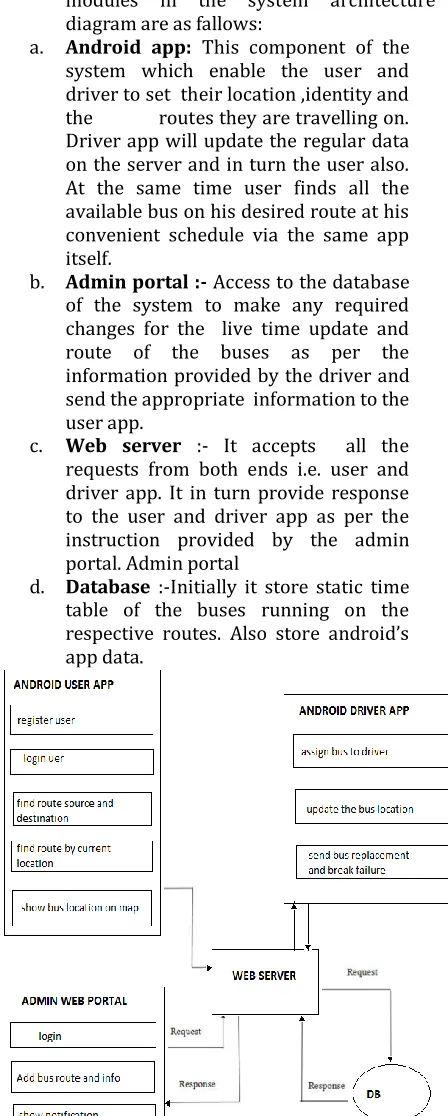
The limitations that features sudden bus point, unknown information regarding the breakdown has given United States the intuition for developing the reliable system which will inform the passengers regarding the point of their destination bus. By victimisation the Geo-fence in system that determines the nearby-location of the bus so the traveller don't have to be compelled to wait Associate in Nursing undetermined quantity of your time at probably unpleasant or unsafe stop. traveller will simply get the arrival info remotely on causing a SMS to the server or the prediction system. System can respond the estimation of bus live schedule or failure or breakdown at the side of location to traveller in SMS .In our advise system we tend to gift effective approach of predicting bus schedule supported user location victimisation GPS technology. The design diagram fig:4.1 contain 5 modules having severally vital role within the economical operating of the system The advise system eliminate overhead drawback at the side of providing platform operator to watch ,bus standing and update latest info to the user. we've got establish however lofty knowledge like route, stops, transmit schedule and blooming factors
(traffic, breakdown, unhealthy weather) is verify impromptu from straightforward GPS traces. victimisation Geofencing technology , defines a virtual boundary around a real-world geographical area. Geofencing allows automatic notification to be generated based on the defined coordinates of a geographic area. Passenger can determine exactly when to leave the home or the office and eliminating their waiting time.
The methodologies or functionalities if the modules in the system architecture diagram are as fallows:
a. Android app: This component of the system which enable the user and driver to set their location ,identity and the routes they are travelling on. Driver app will update the regular data on the server and in turn the user also. At the same time user finds all the available bus on his desired route at his convenient schedule via the same app itself.
b. Admin portal :- Access to the database of the system to make any required changes for the live time update and route of the buses as per the information provided by the driver and send the appropriate information to the user app.
c. Web server :- It accepts all the requests from both ends i.e. user and driver app. It in turn provide response to the user and driver app as per the instruction provided by the admin portal. Admin portal
d. Database :-Initially it store static time table of the buses running on the respective routes. Also store android’s app data.
17 | P a g e
5. CONCLUSION
We are developing an android application for the passengers as well as for the bus driver. The system dynamically create geofence which notifies the passengers about live location of bus. This system is self-calibrating and functions everywhere and doesn’t require any lab or manmade environment. Having a GPS is truly an advantage you can determine your location.
REFERENCES
1) Zehra Naqvi “Smart Public Transport System
Using Mobile phone based sensing” IEEE INDICON 2015 1570187213.
2) Qiang Zhang1, Yanhu Zhang2.”
EasyComeEasyGo: Predicting bus arrival time with smart phone” 2015 Ninth International Conference on Frontier of Computer Science and Technology.
3) Rubina Choudhary, Aditya Khamparia.” Real
Time Prediction of Bus Arrival Time A Review”. 2016 2nd International Conference on Next Generation Computing Technologies (NGCT-2016) Dehradun, India 14-16 October 2016.
4) B. Dhivyabharathi, B. Anil Kumar. " Real Time
Bus Arrival Time Prediction System under Indian Traffic Condition." 2016 IEEE International Conference on Intelligent Transportation Engineering.
5) Santa Maiti, Arpan Pal." Historical Data based
Real Time Prediction of Vehicle Arrival Time". 2014 IEEE 17th International Conference on Intelligent Transportation Systems (ITSC) October 8-11, 2014. Qingdao, China
6) Wenping Liu∗†‡, Jiangchuan Liu. " WiLocator:
WiFi-sensing based Real-time Bus Tracking and Arrival Time Prediction in Urban Environments" 2016 IEEE 36th International
Conference on Distributed Computing
Systems.
7) Mathieu Sinn, Ji Won Yoon. " Predicting arrival times of buses using real-time GPS measurements" 2012 15th International IEEE-Conference on Intelligent Transportation Systems Anchorage, Alaska, USA, September 16-19, 2012
8) Sharad S, Bagavathi Sivakumar P,." The Smart
Bus for a Smart City - A real-time imple'mentation" [email protected], [email protected],v
9) Pengfei Zhou, Student Member, IEEE," How
Long to Wait? Predicting Bus Arrival Time With Mobile Phone-Based Participatory-Sensing" IEEE TRANSACTIONS ON MOBILE COMPUTING, VOL. 13, NO. 6, JUNE 2014
10) Ta-Sheng Kuan , Kuen-Rong Lo," A
High-Efficiency Method of Mobile PositioningBased on Commercial Vehicle-Operation