© 2018, IRJET | Impact Factor value: 6.171 | ISO 9001:2008 Certified Journal
| Page 4216
Sensor Surveillance Solar Synchronous System
B.S.Gowthaman
1, SP.Umayal
21
PG Scholar,Department of Electrical and Electronics Engineering,Muthayammal Engineering
college,Rasipuram,Tamilnadu,India
2
Professor & Dean ,Department of Electrical and Electronics Engineering,Muthayammal Engineering
college,Rasipuram,Tamilnadu,India
---***---Abstract - This work presents a solar energy applications
increases due to their enormous advantages like a maintenance and fuel cost. Solar lightning system back bone in domestic as well as commercial industrial areas. But due to their high cost of solar equipment’s and its accessories , its only a dream about the buy and installation for many rural areas especially villages at their traditional pedestrian pathways. To overcome the problem , the proposed SSSSS (Sensor surveillance solar synchronous system) with KY boost converter system which reduces the cost of installing solar lightning system in the pedestrian pathways , also the energy is consumed in order to increase the backup of the system. The proposed system which contains the solar panel, charge controller coupled with dc to dc converter ,battery , high lumens LED lamp , process controller ,motor, PIR motion sensor , battery with mechanical structural arrangements.
Keywords : PV , SSSSS, MPPT,LED,PIR
1. INTRODUCTION
Nowadays, the power plants in Brazil are predominantly based on hydroelectric energy. This happens because of the high hydroelectric potential of the country. However, due to the country continental dimension, the energy distribution system is very huge and expensive. and, besides this huge energy distribution system, there are a lot of localities without energy supply [1]-[2]. The objective of this work is to develop an autonomous street lighting system for remote places, with high efficiency and long lifetime, using alternative energy. Besides, this solution can also be adopted as an alternative for the conventional street lighting systems in urban centers. Solar-electric-energy has grown consistently by 20%-25% per year over the past 20 years, which is mainly due to the decreasing costs and prices. This decline has been driven by
1) Efficiency increase of solar cells;
2) Manufacturing technology improvements; and
3) economies of scale
In the case of an autonomous street lighting system, the best solution is the solar energy option, because of the long lifetime, easy installation, and modularity. The main lamp types used in street lighting are the high pressure discharge lamps, e.g.: mercury vapor lamps, HPS lamps, and metal halide lamps. The discharge lamps demand a ballast that provides their starting and steady state behavior, which is commonly electromagnetic [4]. Lighting emitting diodes (LEDs) are being presented as an alternative to replace the conventional lighting systems. Besides their use as signalizing systems is much broadcasted they are not commonly used as lighting systems. However, recent technology is improving gradually the LEDs efficiency and color quality, which allows their application in lighting systems [5].
The main advantages of using LEDs in the proposed lighting system are: their long lifetime (100,000 hours) that is compatible with the solar panels lifetime (higher than 25 years); and their DC supply, exempting the use of an inverter, which improves the circuit efficiency and decreases its cost. Some examples of LEDs applied in street lighting can already be found in the literature [6].
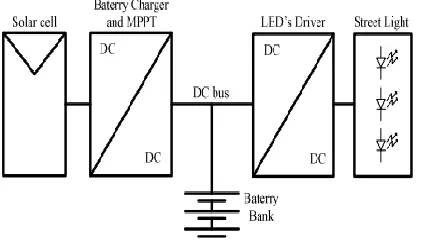
It presents the proposed system that is composed by a photovoltaic solar panel in order to charge the batteries during the day through the DC/DC converter. This converter is controlled by an MPPT algorithm. During the night, the batteries supply the LEDs lamp through the driver, providing the adequate current value and dimming the lamp when necessary. It can be observed that the whole system works in DC, avoiding the energy wasting with additional inverter power stages.
power-© 2018, IRJET | Impact Factor value: 6.171 | ISO 9001:2008 Certified Journal
| Page 4217
electronic grid interface will lead to a new generation ofquiet, efficient, and economical wind turbines. In Section III, we present power-conditioning systems used in grid-connected photovoltaic (PV) generation plants[6].
The continuously decreasing prices for the PV modules lead to the increasing importance of cost reduction of the specific PV converters. Energy storage in an electricity generation and supply system enables the decoupling of electricity generation from demand other words, the electricity that can be produced at times of either demand low-generation cost or from intermittent renewable energy sources is shifted in time for release at times of high-demand high-generation cost or when no other generation is available. Appropriate integration of renewable energy sources with storage systems allows for a greater market penetration and results in primary energy and emission savings.
The increasing number of renewable energy sources and distributed generators requires new strategies for the operation and management of the electricity grid in order to maintain or even to[7] improve the power-supply reliability and quality. In addition, liberalization of the grids leads to new management structures, in which trading of energy and power is becoming increasingly important. The power-electronic technology plays an important role in distributed generation and in integration of renewable energy sources into the electrical grid, and it is widely used and rapidly expanding as these applications become more integrated with the grid-based systems. During the last few years, power electronics has undergone a fast evolution, which is mainly due to two factors. The first one is the development of fast semiconductor switches that are capable of switching quickly and handling high powers. The second factor is the introduction of real-time computer controllers that can implement advanced and complex control..
2. PROPOSED METHODOLOGY
2.1 Introduction
The number of LEDs used in the fixture is an extremely important variable to be considered in the project of the lighting system, once both the designs of the photovoltaic solar panels and battery bank are dependent of this number. The number of LEDs needed in the fixture depends on the following factors:
• Lamp to be replaced;
• Relationship between photopic and scotopic human vision;
[image:2.612.322.533.90.212.2]• LEDs model
Fig – 1: Proposed Block Diagram
Public illumination systems are frequently based on high pressure sodium (HPS) lamps instead of LEDs. For this reason, a clear design methodology for LEDs based systems cannot be found in the literature. In this work, a design methodology is proposed, where the equivalence between a standard illumination system and the LEDs based one is performed. As a case study, a 70W HPS lamp was replaced, specifically an OSRAM lamp model Vialox Nav-E Standard, by a set of LEDs that leads to the same luminous efficiency.
An approximated spectral power distribution of the lamp is illustrated in Figure 2. Other important characteristics of the used model are:
• Luminous flux = 5600lm.
• CRI ≤ 25.
• Average life = 28000 h.
• Fixture efficiency = 80%.
The human eye has two types of photoreceptors in the retina, rods and cones, responsible for sending visual signals to the brain. In high levels of light, daylight, for example, the cones are the majority photoreceptors, qualifying this vision as photopic. At low light levels, the rods are the majority photoreceptors, qualifying this vision as scotopic. In an intermediate light level, people deal with the called mesopic vision, where both cones and rods are responsible for light perception. Figure 3 presents the human eye sensitivity as a function of the light wavelength, for the photopic and scot pic conditions.
© 2018, IRJET | Impact Factor value: 6.171 | ISO 9001:2008 Certified Journal
| Page 4218
(nominal flux) in photopic vision conditions. However,when people deal with public illumination of remote localities, as the application discussed in this work, the scotopic vision characteristics are more adequate to be considered. The perceptual equivalence of a nominal (photopic) luminous flux in a specific visual condition is called effective flux or effective lumens.
2.2 LED Model Selection
Nowadays, a large variety of high power LEDs is commercially available and, therefore, a careful study is required before a specific model could be chosen. The most common method to obtain white light is by using a blue LED coated with phosphor that, when excited by the blue light, emits a broad range spectrum, producing the white light. By this method, it can be obtained LEDs of colors known as cool white, neutral white and warm white, by varying the amount of phosphor. The cool white LEDs are considered the most efficient in scotopic conditions, since they require fewer phosphor and produce light with wavelengths close to the peak of sensitivity of the human scotopic vision. By this way, cool white LEDs were chosen.
It is also important to notice that LEDs are commercially available for 350, 700 and 1000mA (nominal mean current). From a brief market analysis, it was noticed that the 700mA LEDs certainly yield the lowest price per lumens, among the high power LEDs. By this way, the model Luxeon Rebel – Cool White Lambertian – 145 lm @ 700 mA was chosen.An approximation of its spectral power distribution isillustrated in Figure 4. Other important characteristics of this model are:
• Luminous flux = 145 lm.
• CRI ≥ 70.
• Average life = 50000 h.
• Fixture efficiency = 100%.
• Average power = 2.4 W
2.3 LEDs Arrangement Design
The efficiency of a light source can be evaluated by the power spectrum distribution of this source weighted by the human visual spectral sensitivity function As it was discussed in Section 2.2, the human visual perception depends on the lighting and viewing conditions (photopic or scotopic), and the nominal luminous flux of a source (the standard commercial characteristics) is usually determined considering the photopic human visual sensitivity. In this
[image:3.612.339.554.201.529.2]section, the number of LEDs is calculated based on the efficiency of the lamp to be replaced and on the efficiency of the previously modeled LEDs, both in scotopic conditions. The efficiency of a light source under specific lighting conditions can be evaluated by integrating the power spectrum distribution weighted by the human visual spectral sensitivity function [6]. This methodology leads to a chart of merit that is called source effective illumination
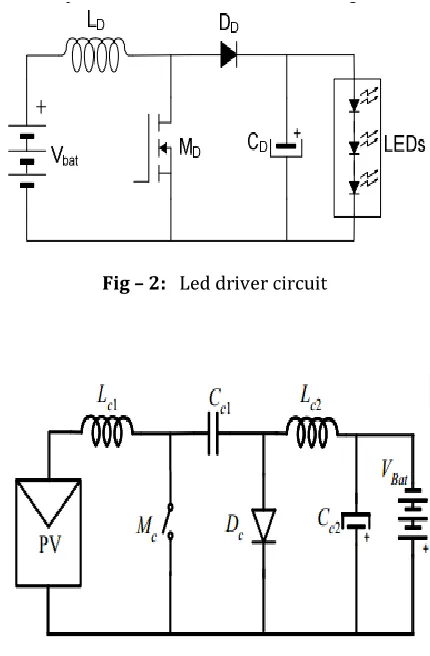
Fig – 2: Led driver circuit
Fig – 3: Battery charging circuit
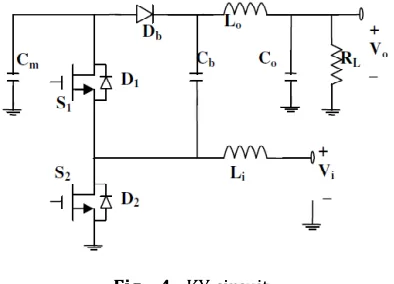
2.4 DESIGN OF KY BOOST CONVERTER
© 2018, IRJET | Impact Factor value: 6.171 | ISO 9001:2008 Certified Journal
| Page 4219
Algorithm based controller with response to the error [image:4.612.43.540.89.749.2]signal.
Fig – 4: KY circuit
3.SIMULATION RESULTS
In this paper, we use MATLAB software to simulate the tracking conditions of photovoltaic module array under four different shading statuses by means of MPPT, KY these two are illustrated in Table 1
Fig – 5: MPPT Voltage
[image:4.612.316.542.99.463.2]Fig – 6: MPPT Current
Fig – 7: Output Voltage
Fig – 8: Output Current
[image:4.612.70.267.129.271.2]© 2018, IRJET | Impact Factor value: 6.171 | ISO 9001:2008 Certified Journal
| Page 4220
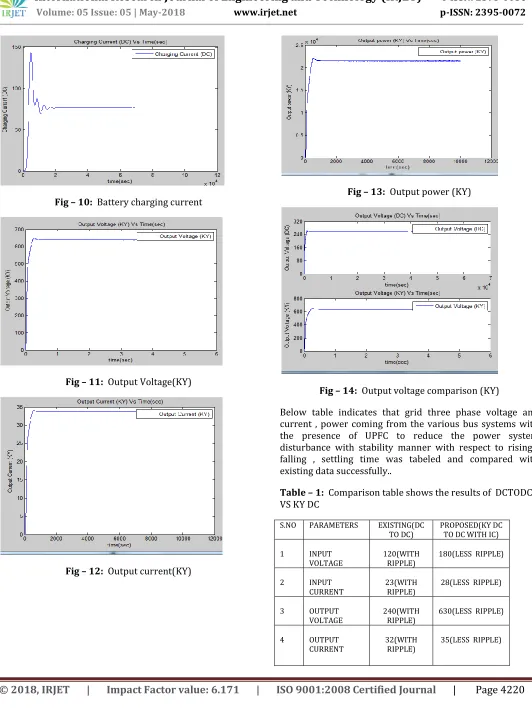
Fig – 10: Battery charging currentFig – 11: Output Voltage(KY)
Fig – 12: Output current(KY)
Fig – 13: Output power (KY)
Fig – 14: Output voltage comparison (KY)
Below table indicates that grid three phase voltage and current , power coming from the various bus systems with the presence of UPFC to reduce the power system disturbance with stability manner with respect to rising , falling , settling time was tabeled and compared with existing data successfully..
Table – 1: Comparison table shows the results of DCTODC VS KY DC
S.NO PARAMETERS EXISTING(DC
TO DC) PROPOSED(KY DC TO DC WITH IC)
1 INPUT
VOLTAGE 120(WITH RIPPLE) 180(LESS RIPPLE)
2 INPUT
CURRENT 23(WITH RIPPLE) 28(LESS RIPPLE)
3 OUTPUT
VOLTAGE 240(WITH RIPPLE) 630(LESS RIPPLE)
4 OUTPUT
[image:5.612.37.569.47.757.2]© 2018, IRJET | Impact Factor value: 6.171 | ISO 9001:2008 Certified Journal
| Page 4221
4. CONCLUSIONSThis work has proposed an autonomous street lighting system, which uses solar energy as primary source, batteries as secondary source, and LEDs as lighting source. This system is an interesting solution for remote localities, as for roads and crossroads. The system presents high efficiency, since all the power stages are DC-DC. This kind of conversion yields an easy implementation and control. The LEDs technology has been significantly improved in the last few years, and they have been considered a promising alternative to the illumination systems. The main advantages of using LEDs are: high average life; high luminousefficiency; and simple drives, when control and dimming systems are required. The results prove that output of KY boost converter is 620V when compared existing DC to DC converter capacity and also output of KY boost converter current is 32A with less ripple said that with filter the input ripple content.
REFERENCES
[1] J.M Carrasco, “Power-electronic systems for the grid integration of renewable energy sources: a survey,” IEEE Transactions on Industrial Electronics, vol. 53, no 4, June 2006, pp. 1002-1016.
[2] R.E. da Costa, J.S. da Silveira, F.L. Tomm , T.B. Marchesan, A. Campos and R.N do Prado, “Warm-up and steady-state control of high-pressure sodium lamps applied to public lighting systems,” Industry Applications Society Annual Meeting(IAS), 2008.
[3] A.Zukauskas, M.S. Shur and R. Coaska. “Introduction to solid-state lighting,” Ed. Wiley Inter-Science, 2002.
[4] Y. He, M. Rea, A, Bierman and J. Bullough, “Evaluating light source efficacy under mesopic conditions using reaction times,” in Proc of Illuminating Eng. Soc. Of North America Annual Conf., pp.236-257, 1996.
[5] Ian Lewin, "Lumen effectiveness multipliers foroutdoor lighting design," Journal of the Illuminating Engineering Society 30, 2001 , pp. 40–52.
[6] T. Goodman, A. Forbes and H. Walkey, “A practical model for mesopic photometry”, in Proc of XVIII IMECO,2006 , pp.1-6.
[7] N. Mohan, T. M. Undeland and W. P. Robbins, “Power electronics: converters, applications, and
design,” John Wiley & Sons, 2nd Edition, New York, USA, 1995.
BIOGRAPHIES
B.S.Gowthaman was born
in Salem ,India. Hereceived his BE (Electrical and Electronics Engineering) from Adhiparasakthi College of Engineering , Vellore, TamilNadu, India, in 2008 and 2012 respectively. In 2013 he joined Sofia Infology, Madurai, India, as a Embedded developer in the area of embedded systems, power electronics , image processing etc. From 2015 he joined Borg energy inc (USA) , India, as a Research Engineer in the department of Research and Development, he coordinated and supported to various products such as solar off grid , on grid and irrigation type inverters etc. His areas of interest include Led design and manufacturing , Solar design and technologies , power converters etc. Now he is pursuing Master of Engineering (Power Electronics and Drives) in Muthayammal Engineering College, Rasipuram, Namakkal, India. He has participated workshops , conferences and presented many papers on power system management , power electronics, Led design , Solar technologies etc.
SP. Umayal was born in Chennai India. She received her B.E.(EEE). and M.E.(Power system) degrees from Thiagarajar college of Engineering, Madurai, India, in 1990 and 1999, respectively. She received her Ph.D. degree in Electrical Engineering from Anna University, Chennai, India, in 2008. In 1996 she joined Sethu Institute of Technology, Virudhunagar, India, as a Lecturer in the Department of Electrical and Electronics Engineering, where she was an Assistant Professor from 2001 to 2007, and Professor & Head of the Department from 2008 to 2013. She is presently working as Professor&Dean at Muthayammal Engineering College, Namakkal, India. Her current research interests include intelligent control techniques, power quality monitoring, power electronic converters and AC drives. She has published more than 20 technical papers in national and international journals.