Effect of Interface Friction ON Active Earth
Pressure in Different Soils
U. A. Patil A. S. Pallewad
Student Student
Department of Civil Engineering Department of Civil Engineering
Sinhgad Academy of Engineering, Kondhwa (Bk.) Pune. Sinhgad Academy of Engineering, Kondhwa (Bk.) Pune.
411048. (India) 411048. (India)
J. R. Deshmukh P.B. Gunjal
Student Student
Department of Civil Engineering Department of Civil Engineering
Sinhgad Academy of Engineering, Kondhwa (Bk.) Pune. Sinhgad Academy of Engineering, Kondhwa (Bk.) Pune.
411048. (India) 411048. (India)
S. P. Banne
Assistant Professor Department of Civil Engineering
Sinhgad Academy of Engineering, Kondhwa (Bk.) Pune. 411048. (India)
Abstract
Shear strength is the principle engineering property which controls stability of soil mass under load. Its governs the bearing capacity of soil, stability of slopes in soils, the earth pressure against retaining structure and subgrade in highway. In soil structure interaction problems often becomes important to make a good estimation of friction of frictional resistance between ground and foundation. The information interface friction angle of soil against frictional surfaces is of great interest among research in soil structure interaction. Retaining wall is one of the important structure which are used mainly to retain soil mass hence need proper design. Present study includes series of DST to investigate the interface friction angle of different friction surfaces (jute, geotextile) with three soil samples (sand, murrum, clay). Using these friction values active earth pressure is evaluated by Rankine’s, coulomb’s method, and poncelet’s , culmann’s method.
Keywords: Shear strength parameter, Interface friction angle, Active earth pressure, Retaining wall
________________________________________________________________________________________________________
I. INTRODUCTION
For past two decades use of geosystemic material has grown up significantly and is still growing. Now they are well known and well accepted construction material. Reinforcement materials are used in order to improve resisting forces. Interface friction angle and adhesion are important parameters for design of soil structures. The shear strength of soil is of special relevance among geotechnical soil properties because it is one of the essential parameters of analyzing and solving stability problems. In many soil structure interaction problems including retaining wall, pile foundations and earth reinforcements involve the estimation interfacial friction between soil and such structures. The soil geosystemic interaction parameters with cohesive soils and other cohesion less soil is essential for proper designing and efficient performance of reinforcement soil structures under such special practical conditions.
(IJSTE/ Volume 2 / Issue 10 / 169)
II. EXPERIMENTAL INVESTIGATIONS
In this work, different soil samples from local supplier from yewalewadi have been chosen 1) Clay
2) Murrum 3) Sand
Laboratory Analysis:
Specific Gravity (IS 2720-IV):
The average specific gravity is tabulated as shown below. Table 1 Specific gravity for various soil samples
Sr. No. Types of soil Specific Gravity (G)
1 Sand 2.74
2 Murrum 2.35
3 Clay 2.22
Grain Size Distribution (IS 2720 : PART IV):
Fig. 1: The grain size distribution curve for sand Table – 2
Propertise of material SAND MURRUM CLAY D10 0.75 0.11 0.2 D30 1.9 0.55 0.65
D60 4 1.9 2
CU 5.33 17.27 10 CC 1.2 1.45 1.06
Standard Proctor Test(IS:2720-VIII)
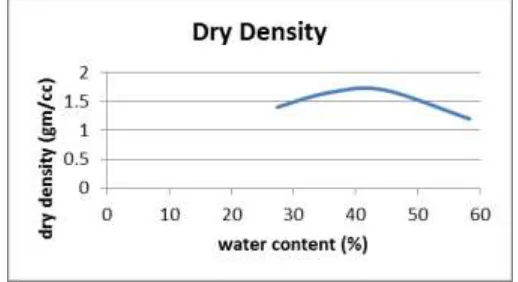
The standard proctor tests are performed for murrum and sand by using standard proctor tests apparatusas. Clay: Standard proctor test is performed on clay.
Table – 3 Properties of material
STANDARD PROCTER TEST CLAY MURRUM
OMC 40% 18%
MDD 1.7 2.1
Direct Shear Test: (IS 2720-XIII)
A small box direct shear test (IS 2720: Part XIII ) was used to investigate interface friction angles . Geosynthetic were glued to a piece of rigid block with thickness such that lower half of dimensions are occupied by wooden rigid block and upper half box was poured with geo-material. All test are carried out at constant strain rate of 1.25 mm/min.
Three soil samples (Clay, Sand, Murrum) with alternate combination with geotextile and jute were used.
Sliding block test :
The soil specimen is placed in the soil box with the lubrication layer between the soil box and the sliding plate. To investigate the effects of normal stress on the interface friction angle, different weights are placed on the soil specimen before testing. By rotating the handle, the uplift rod rises and increases the inclination of the sliding plate. The force F acting on the soil-plate interface can be resolved into a normal component N and a tangential component T. As the inclination of the plate is increased, based on the equilibrium of forces, the sliding resistance T also increases until the driving force overcomes the resistance and the soil box starts to move. At this moment, the inclination of the plate to the horizontal is the interface friction angle δ that represents the characteristics of the friction-reducing layer.
III. RESULT AND ANALYSIS
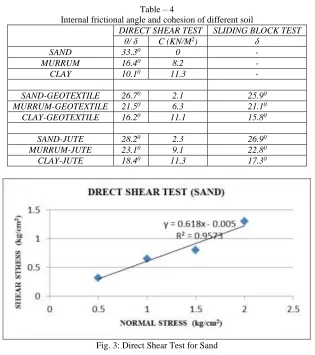
Table – 4
Internal frictional angle and cohesion of different soil
DIRECT SHEAR TEST SLIDING BLOCK TEST
θ/ δ C (KN/M2) δ
SAND 33.30 0 -
MURRUM 16.40 8.2 -
CLAY 10.10 11.3 -
SAND-GEOTEXTILE 26.70 2.1 25.90
MURRUM-GEOTEXTILE 21.50 6.3 21.10
CLAY-GEOTEXTILE 16.20 11.1 15.80
SAND-JUTE 28.20 2.3 26.90
MURRUM-JUTE 23.10 9.1 22.80
CLAY-JUTE 18.40 11.3 17.30
Fig. 3: Direct Shear Test for Sand Table – 5
Result Direct Shear Test for Plain Sample
SAND MURRUM CLAY
PLAIN Sr. No.
NORMAL STRESS (kg/cm2)
SHEAR STRESS (kg/cm2)
Sr. No.
NORMAL STRESS (kg/cm2)
SHEAR STRESS (kg/cm2)
Sr. No.
NORMAL STRESS (kg/cm2)
SHEAR STRESS (kg/cm2)
1 0.5 0.32 1 0.5 0.23 1 0.5 0.24
(IJSTE/ Volume 2 / Issue 10 / 169)
3 1.5 0.80 3 1.5 0.52 3 1.5 0.50
4 2 0.130 4 2 0.80 4 2 0.54
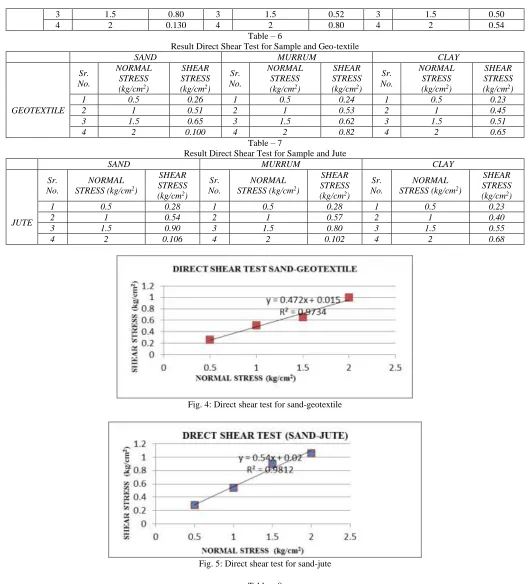
Table – 6
Result Direct Shear Test for Sample and Geo-textile
SAND MURRUM CLAY
GEOTEXTILE Sr. No.
NORMAL STRESS (kg/cm2)
SHEAR STRESS (kg/cm2)
Sr. No.
NORMAL STRESS (kg/cm2)
SHEAR STRESS (kg/cm2)
Sr. No.
NORMAL STRESS (kg/cm2)
SHEAR STRESS (kg/cm2)
1 0.5 0.26 1 0.5 0.24 1 0.5 0.23
2 1 0.51 2 1 0.53 2 1 0.45
3 1.5 0.65 3 1.5 0.62 3 1.5 0.51
4 2 0.100 4 2 0.82 4 2 0.65
Table – 7
Result Direct Shear Test for Sample and Jute
SAND MURRUM CLAY
JUTE Sr. No.
NORMAL STRESS (kg/cm2)
SHEAR STRESS (kg/cm2)
Sr. No.
NORMAL STRESS (kg/cm2)
SHEAR STRESS (kg/cm2)
Sr. No.
NORMAL STRESS (kg/cm2)
SHEAR STRESS (kg/cm2)
1 0.5 0.28 1 0.5 0.28 1 0.5 0.23
2 1 0.54 2 1 0.57 2 1 0.40
3 1.5 0.90 3 1.5 0.80 3 1.5 0.55
4 2 0.106 4 2 0.102 4 2 0.68
Fig. 4: Direct shear test for sand-geotextile
Fig. 5: Direct shear test for sand-jute Table – 8
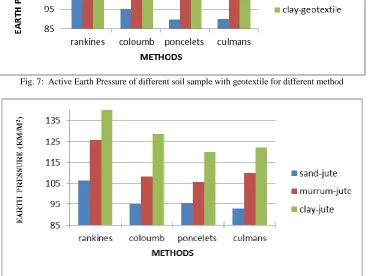
Comparison of Active Earth Pressure for different methods and different soil samples by analytical method Sr. No. Type of Sample Active Earth Pressure (KN/M2)
Rankine’s Method Coulomb’sMethod Plain Geotextile Jute
1 Sand 106.2 106.2 95.15 95.04
2 Murrum 125.69 125.69 122.09 108.34
3 Clay 154.88 154.88 130.45 128.61
Table – 9
Sr,. No. Type Of Sample
Active Earth Pressure (KN/M2) Graphical Method
Poncelet’s Method Culman’s Method Plain Geotextile Jute Plain Geotextile Jute
1 Sand 105.6 89.9 95.7 110 90 93
2 Murrum 124.8 120 105.6 122 120 110
3 Clay 145.6 128 120 140 126 122
Fig. 6: Active Earth Pressure of different soil sample for different method
Fig. 7: Active Earth Pressure of different soil sample with geotextile for different method
(IJSTE/ Volume 2 / Issue 10 / 169)
IV. CONCLUSION
1) The interface friction angle in sliding block test is less than direct shear test.
2) Jute is having higher interface friction angle than geotextile in all three type of sample.
3) In the presents work poncelet method gives lower Active earth pressure for all types of sample as compare to coulomb’s method
4) In case of retaining wall was designed using geotextile as well as jute and using sand ,murrum and clay as backfill material , it was found that active earth pressure decreases .
5) As in comparison with jute and geotextile active pressure in jute is less than direct shear test.
6) Active earth pressure is maximum for clay as backfill and minimum when sand is use as backfill material where as murrum shows intermediate value of active earth pressure in between clay and sand.
7) Active earth pressure decreases 10.40 % in case of geotextile and 10.50% in case of jute by using sand as backfill. 8) Active earth pressure decreases 2.86 % in case of geotextile and 13.8 % in case of jute by using murrum as backfill. 9) Active earth pressure decreases 15.77 % in case of geotextile and 16.96% in case of jute by using clay as backfill.
REFERENCES
[1] Gireesha N. T, K. Muthukkumaran, (October 2011) “Study on soil structure interface strength property” IJESE. , Vol.04, No 06 SPL, pp89-93.
[2] Awdhesh Kumar Choudhary1, A. Murali Krishna2, (March 2014) “Influence of Different Types of Soils on Soil- Geo-synthetics Interaction Behavior”
IJIRSET. Vol.03, pp 60-68.
[3] M. Ghazavi and J. Ghaffari (2013) “ Experimental investigation of time-dependent effect on shear strength parameters of sand–geotextile interface ”
[4] S.J.Shah and K.S.Shikha (December 2013) “Determination of interface friction characteristics of different soil-geosynthetic combinations” , prIndian geotechnical conference ,Roorkee.
[5] Yung-Show Fang, Tsang-Jiang Chen, Robert D. Holtz, and Wei F. Lee (2004) “Reduction of Boundary Friction in Model Tests ”, ASTM. eotechnical Testing
Journal, Vol.27, No.1
[6] Daehyeon Kim and Sungwoo Ha (Feb. 2014) “Effects of Particle Size on the Shear Behavior of Coarse Grained Soils Reinforced with Geo-grid ”
[7] Abdullah I. Al-Mhaidib,(2006) “Influence of shearing rate on interfacial friction between sand and steel” Engineering Journal of university of Qater Vol. 19
[8] Chia-Nan Liu Jorge G. Zornber , Tsong-Chia Chen Yu-Hsien Ho and Bo-Hung Lin “ Behavior of Geogrid-Sand Interface in Direct Shear Mode”
[9] IS 2720 (Part III/section 1): 1980, Indian Standard, Methods of Test For Soils – Determination of Specific Gravity (First Revision), Bureau of Indian Standards, New Delhi, 1980.
[10] IS 2720 (Part IV): 1985, Indian Standard, Methods of Test for Soils – Grain Size Analysis (Second Revision), Bureau of Indian Standards, New Delhi, 1986.
[11] Dr. K. R. Arora, “Soil Mechanics and Foundation Enginering.”
[12] Dr. B. C. Punmia “Soil Mechanics and Foundation Enginering.”