S T U D Y P R O T O C O L
Open Access
Effectiveness of a behavioural intervention
to prevent excessive weight gain during
infancy (The
Baby Milk
Trial): study protocol
for a randomised controlled trial
Rajalakshmi Lakshman
1*, Fiona Whittle
1, Wendy Hardeman
2, Marc Suhrcke
3, Ed Wilson
4, Simon Griffin
1and Ken K Ong
1Abstract
Background:Infancy is a period of rapid growth and habit formation and hence could be a critical period for obesity prevention. Excess weight gain during infancy is associated with later obesity and formula-fed babies are more likely to gain excess weight compared to breastfed babies. The primary trial outcome is a change in the weight standard deviation score from birth to 1 year.
Methods/Design:We will recruit 650 to 700 parents who introduce formula-milk feeds within 14 weeks of their baby's birth to a single (assessor) blind, parallel group, individually randomised controlled trial. The focus of the intervention is the caregiver (usually the mother), and the focus of the primary outcome is the infant. The intervention group will receive the behavioural intervention, which aims to reduce formula-milk intake, promote responsive feeding and healthy weaning, and prevent excessive weight gain during infancy. The intervention is based on Social Cognitive Theory and action planning (‘implementation intentions’). It consists of three components: (1) a motivational component to strengthen parents’motivation to follow theBaby Milkfeeding guidelines, (2) an action planning component to help translate motivation into action, and (3) a coping planning component to help parents deal with difficult situations. It will be delivered by trained facilitators (research nurses) over 6 months through three face-to-face contacts, two telephone contacts and written materials. The control group will have the same number of contacts with facilitators, and general issues about feeding will be discussed. Anthropometric outcomes will be measured by trained research staff, blind to group allocation, at baseline, 6 months and 12 months following standard operating procedures. Validated questionnaires will assess milk intake, temperament, appetite, sleep, maternal quality of life and maternal psychological factors. A 4-day food diary will be completed at 8 months.
Discussion:The results of the trial will help to inform infant feeding guidelines and to understand the links between infant feeding, behaviour, appetite and growth.
Trial registration:ISRTCN20814693. Registration date 13 January 2011.
Keywords:Infancy, Formula-milk, Obesity, Weight gain, Prevention, Behavioural change, RCT
* Correspondence:[email protected] 1
MRC Epidemiology Unit and UKCRC Centre of Excellence in Diet and Activity Research (CEDAR), University of Cambridge, Cambridge, UK Full list of author information is available at the end of the article
Background
Childhood obesity has important consequences for mor-bidity and mortality in childhood and in later life [1]. In 2010, 43 million children under the age of five were obese or overweight worldwide and the prevalence is predicted to rise from 6.7 % to 9.1 % in 2020 [2]. In England, data from the National Child Measurement Programme (NCMP) show that by the time children start school, more than one in five are overweight, and one in 10 are obese [3]. Hence, tackling childhood obesity through focussing on the early years has become a national pri-ority [4]. However, to date, there is little evidence on which to develop effective strategies to prevent child-hood obesity [5]. A Cochrane Review identified 22 ran-domised trials to prevent childhood obesity; although some diet and physical activity interventions were ef-fective in promoting a healthy diet and increased phys-ical activity levels, they were not on the whole effective in preventing weight gain [6]. Only one of the included studies recruited children below one year of age (average age 21 months, n= 43), and that was a home-visiting programme for high-risk Native-American children, fo-cussing on improving parenting skills to develop appropri-ate eating and exercise behaviours to prevent obesity [7].
Infancy is a period of rapid growth and could be a crit-ical time when obesity prevention may be most effective. Recent systematic reviews have described a consistent as-sociation between rapid weight gain in infancy and subse-quent obesity risk in childhood and later life [8–10]. Energy deposition as a percentage of total energy require-ments decreases from 40 % at 1 month to 1 to 2 % from 12 months until mid-adolescence. Therefore, infancy weight gain is more closely related to energy intake, than is weight gain in childhood or in later life. In 2004, based on new data on energy expenditure in infants, the World Health Organisation (WHO) reduced the recommended energy requirements for infants by 15 to 20 % [11]. Current formula-feeding instructions in UK are based on the previous 1985 WHO recommendations and this may be an important reason why formula-fed babies are at a greater risk of rapid weight gain and subsequent obesity than breastfed infants. Three meta-analyses of observa-tional studies reported that obesity risk at school age was reduced by 15–20 % in breastfed compared with formula-fed infants [12–14]. In 2006, the WHO published growth charts based on the growth of breastfed babies and rec-ommends this lower plane of growth as the optimum standard for growth of all infants [15, 16]. While the benefits of breastfeeding are well recognised, the 2010 UK Infant Feeding Survey showed that only 21 % of ba-bies were exclusively breastfed at age 6 weeks and 1 % at 6 months [17]. Hence in addition to supporting breastfeeding, it is important to optimise the growth of formula-fed babies.
In the Baby Milktrial we aim to evaluate the efficacy, cost-effectiveness and acceptability of a theory-based, multi-component intervention to reduce formula-milk in-take (based on the 2004 WHO recommendations for en-ergy requirements) and prevent excess weight gain during infancy. We also aim to understand the psychological me-diators of any effect of the intervention on formula-milk and energy intake.
Methods/Design Study design
TheBaby Milktrial is an explanatory, parallel, individually randomised controlled trial of parents (mainly mothers) and their babies who are formula-fed. The focus of the primary outcome measurement is the baby, but the focus of the intervention is the caregiver. The intervention will commence when the baby is enrolled in the study (be-tween 2 and 14 weeks) and be delivered up to 6 months. Babies will be followed up to age 1 year. In this explana-tory trial, the intervention programme will be delivered by trained and quality-assured facilitators (research nurses). Participants in the control group will be offered the same number of contacts and standard advice about formula feeding, and weaning will be discussed.
Ethical approval has been obtained from the Cambridgeshire 4 Research Ethics Committee (Ref:10/ H0305/9), and fully informed written consent will be taken from all participants.
Recruitment and retention
Maximising retention is an important issue and regular (4 to 6 weekly) contacts with participants in both groups should reduce attrition. The information sheet will em-phasise the importance of follow-up irrespective of group allocation and adherence to the intervention. Participants who drop out from the intervention will be encouraged to attend for outcome measurements. For participants who withdraw from the trial, any data collected up to the with-drawal date will be retained and safely stored, but contact details will be removed.
Inclusion and exclusion criteria
All healthy, term infants who are receiving formula-milk within 14 weeks of birth will be eligible to participate. We will exclude low birth weight (<2,500 g) and pre-term in-fants (<37 weeks gestation) and inin-fants with major malfor-mations, hormonal or metabolic diseases that might interfere with nutrition or growth. Infants who are on
special formulas (soya-based, lactose-free, hydrolysed or anti-reflux formulas) at the time of recruitment will also be excluded; however, they will not be excluded if they are put on a special formula after randomisation.
Measurements
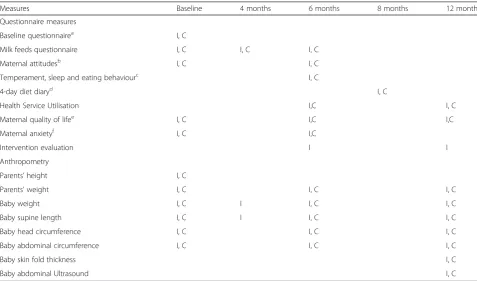
A summary of the measurements undertaken is pre-sented in Table 1.
Anthropometry
Anthropometry data will be collected by trained research assistants using standard operating procedures. In order to minimise bias, the measurement team will be blind to group allocation and will be trained to avoid discussing this with parents. Parents will also be advised not to dis-cuss allocation with the measurement team.
[image:3.595.57.535.333.614.2]Weight will be measured with the baby undressed, using Seca Infant Electronic Scales™and recorded to the
Table 1Study measures
Measures Baseline 4 months 6 months 8 months 12 months
Questionnaire measures
Baseline questionnairea I, C
Milk feeds questionnaire I, C I, C I, C
Maternal attitudesb I, C I, C
Temperament, sleep and eating behaviourc I, C
4-day diet diaryd I, C
Health Service Utilisation I,C I, C
Maternal quality of lifee I, C I,C I,C
Maternal anxietyf I, C I,C
Intervention evaluation I I
Anthropometry
Parents’height I, C
Parents’weight I, C I, C I, C
Baby weight I, C I I, C I, C
Baby supine length I, C I I, C I, C
Baby head circumference I, C I, C I, C
Baby abdominal circumference I, C I, C I, C
Baby skin fold thickness I, C
Baby abdominal Ultrasound I, C
IIntervention group;CControl group
a
Baseline Questionnaire: Parents: Demography (age; education - age at completion and highest qualification; occupation; ethnicity; marital status - cohabiting/ married/single); weight and height. Mother’s: lifestyle (smoking - during pregnancy, current alcohol consumption), pregnancy (duration, weight -before pregnancy and at time of delivery), delivery (normal, instrumental, or caesarean) and previous children (number, feeding-breast, formula, dependent on instructions/appetite/growth - Likert scale). Baby’s: sex, weight and length at birth and 6 weeks
bMaternal attitudes and feeding practices (questionnaire developed for use in this study): Mother’s attitudes; psychological measures based on Social Cognitive
Theory (self-efficacy, outcome expectancy, intentions, and motivation); perception of baby’s weight. Type of feed (breast/ expressed/ formula/ mixed), feed on demand/routine/both; feed based on instructions/appetite/growth–Likert scale
Bottle feeds (type, frequency, amounts, duration, how reconstituted, advice followed, age when started), Breastfeeds (frequency, duration, and expressed milk). Other drinks and foods. Age at weaning (only at 6 months)
c
Validated questionnaires used with permission from Prof Jane Wardle and Mary Rothbart
d
Diet diary: developed in collaboration with MRC HNR, and used in the National Diet and Nutrition Survey of Infants and Young Children
e
Quality of Life: EuroQol Visual Analogue Scale and Short Form 8
f
nearest 0.01 kg. For supine length, the baby will placed on a Kiddimeter™or Starters mat™, with only the nappy on and measured to the nearest 0.5 cm. Abdominal waist circumference will be measured using a D-loop non-stretch fibreglass tape measure and head circumference will be measured using the Child Growth Foundation reusable tape. Sub-scapular, triceps, quadriceps and flank skin fold thickness will be measured using the Holtain Tanner™/Whitehouse™skin fold calliper with an average of three measurements taken for each site. A standard ultrasound device with a 3C-RS curved trans-ducer will be used to measure intra-abdominal depth and subcutaneous fat.
Parents’ weight and percentage body fat will be mea-sured on a Tanita™ scale and height with a Seca™ wall-mounted stadiometer.
Questionnaires
A baseline questionnaire will be used to collect data from parents about demography (age, education, occupation, ethnicity, marital status), lifestyle (smoking, alcohol con-sumption, BMI), pregnancy (duration, weight gain), deliv-ery and previous children (number, feeding).
We have developed and validated a questionnaire to as-sess milk feeding practices and hypothesised psychological mediators of any intervention effect informed by Social Cognitive Theory: attitudes, self-efficacy, outcome-expectancies and intentions with regard to following feeding recommendation (feeding and growth question-naire) [18]. Baby eating behaviour, sleep and tempera-ment have recently been studied as potential risk factors for obesity [19–21]. We will use a combination of questionnaires developed by other groups (Mary Rothbart and Jane Wardle) to assess these. The tem-perament questionnaire has been validated for use in infants [22] and the eating behaviour questionnaire has been validated in older children [23, 24].
A 4-day diet diary will be used to assess energy intake at 8 months. The diary will be the same as that used by the MRC Human Nutrition Research Unit (MRC HNR) for the National Diet and Nutrition Survey of Infants and Young Children (DNSIYC). Dietary data will be ana-lysed using the Diet in Nutrients Out (DINO) computer package [25] by the dietary assessment team at the MRC HNR, who will not be aware of group allocation.
Parent’s quality of life will be assessed using the EuroQoL Visual Analogue Scale (VAS) and Standard Form (SF) 8. A questionnaire to measure health service utilisation (hos-pital, primary and community care use) using standard questions will be administered at 6 and 12 months. Par-ents’perceptions of the usefulness of the different compo-nents of the intervention (face-to-face and telephone contacts, leaflets, stickers) will be assessed among interven-tion group participants.
The questionnaires will be self-administered prior to the visit with an opportunity to clarify any doubts during the visit.
Randomisation and consent
Only participants who attend for the baseline visit will be randomised to intervention or control groups in order to minimise the bias from selective drop out. Central tele-phone randomisation will be conducted based on a random number table (generated by an independent statistician) linked to the study database. We expect that important co-variates (such as birth weight, sex, gestational age, family size, maternal BMI, smoking, ethnicity, educational level, age at entry into the study and whether predominantly formula-fed) will be balanced between groups due to the large sample size. Written informed consent will be ob-tained at baseline visit by a trained research assistant con-ducting measurements.
Intervention group
The MRC guidance for complex interventions was used to design the intervention [26]. This was an iterative process including a review of relevant theory to under-pin the intervention; systematic reviews of parents’ ex-periences of bottle feeding [27] and determinants of non-recommended feeding practices [28]; and involve-ment of mothers, psychologists, doctors, midwives and health visitors [29]. The motivational component of the intervention is based on Bandura’s Social-Cognitive The-ory (SCT), which has shown utility for understanding and changing dietary behaviours [30–32]. In order to help par-ticipants to translate their motivation into action, partici-pants are encouraged to set goals and to formulate action plans, based on the concept of ‘implementation inten-tions’[33–35]. They are also encouraged to monitor on a feeding-plan how much they are feeding their baby against Baby Milkintervention guideline amounts. Finally, partici-pants are encouraged to keep on track by formulating coping plans (that is, problem solving), which are‘if-then’ plans specifying how they will deal with difficult situa-tions, such as the baby crying. In summary, the intervention consists of three components: a motivational component, an action planning component to help translate motivation into action (including goal setting, action plans and self-monitoring), and a coping planning component helping parents to deal with difficult situations.
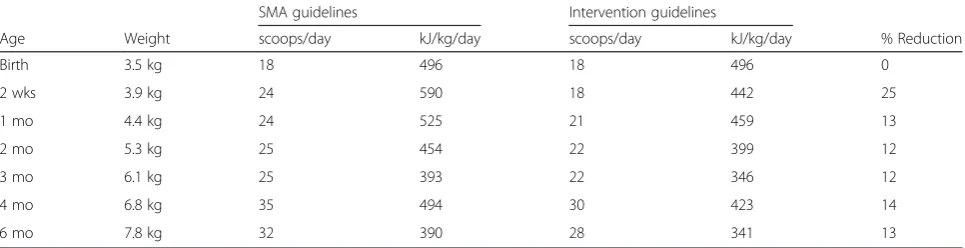
the face-to-face sessions. During the first session, the fa-cilitator will talk parents through the ‘healthy infant growth and nutrition’leaflet that explains the new feeding recommendations (Table 2) and the growth charts. The leaflet does not just impart knowledge about amounts of formula-feeds, hunger cues, growth charts and rapid weight gain, but also aims to encourage recommended feeding behaviours by strengthening self-efficacy and per-ceived benefits about following the recommendations. Demonstration of correct feed preparation (if required) and explanation of the feeding recommendations will be provided. Parents will be encouraged to make a feeding plan and provided with stickers to put on the formula milk packets. When the baby is 4-months old, parents will be invited for a second session and advice on weaning and feedback on baby’s growth will be provided. Two phonecalls when the baby is age 2 to 3 months and 5 months
-will be made to monitor progress with following recom-mendations and to support the parents with ongoing goal setting, action planning, self-monitoring and problem-solving. At the 6-month visit, the baby’s growth will be plotted on the WHO growth charts. Facilitators will feed back this information to parents, and they will be encour-aged to monitor the growth of their babies also after the end of the intervention delivery at 6 months. Growth monitoring is important because parents are not very good at identifying obesity in their children [36], so any programme to prevent obesity must include early identification.
Control group
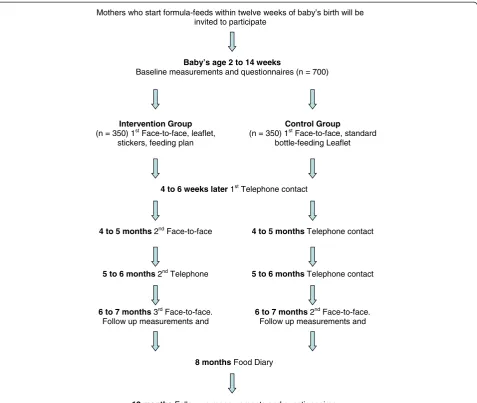
The control group will be offered the same number of con-tacts with facilitators (attention control) and general infor-mation about formula-feeding (bottles, teats, sterilisation, Mothers who start formula-feeds within twelve weeks of baby’s birth will be
invited to participate
Baby’s age 2 to 14 weeks
Baseline measurements and questionnaires (n = 700)
Intervention Group
(n = 350) 1stFace-to-face, leaflet, stickers, feeding plan
Control Group
(n = 350) 1stFace-to-face, standard bottle-feeding Leaflet
4 to 6 weeks later1stTelephone contact
4 to 5 months 2ndFace-to-face 4 to 5 months Telephone contact
8 monthsFood Diary
12 monthsFollow-up measurements and questionnaires
5 to 6 months Telephone contact
5 to 6 months 2ndTelephone
6 to 7 months 2ndFace-to-face. Follow up measurements and
6 to 7 months 3rdFace-to-face. Follow up measurements and
[image:5.595.60.538.88.491.2]making up feeds) will be discussed. The 4 to 6 weekly phone calls will be used to discuss general issues (parent-ing, sleep, etcetera), to monitor feed quantity and frequency and to encourage continued participation in the study.
Parents in both groups will be given a help-line num-ber to contact the study team about feeding issues.
Training in intervention delivery and intervention fidelity
Facilitator training includes a 2-day training programme in the evidence base underlying the intervention, theor-ies, behaviour change techniques, intervention strategies and communication skills, including demonstration and practice with individual feedback. The training is sup-ported by an extensive training manual. In order to standardise intervention delivery, facilitators will use standardised protocols for all the contacts in the inter-vention and control conditions. Four research nurses will deliver the intervention and control group protocols and all face-to-face and telephone consultations will be audio-taped. Fidelity will be promoted, and contamin-ation across the two groups minimised by assessing a random sample of audio-taped contacts using standar-dised fidelity checklists, peer appraisal, followed by feed-back and team discussion. Team meetings will be held over the whole period of intervention delivery to discuss and problem solve challenging situations.
Sample size calculation
The primary outcome is conditional infant weight gain from birth to 12 months of age (conditional on birth weight). Birth weight and weight at 6 and 12 months will be converted to standard deviation scores (SDS) adjusted for age and sex using the WHO 2006 growth standard. SDS refers to the number of standard deviations the measurement lies above (positive value) or below (nega-tive value) the 50thpercentile (median value 0). Condi-tional weight gain is calculated as the change in weight SDS between birth to age 12 months, adjusted for birth weight SDS.
In the Avon Longitudinal Study of Parents and Children (ALSPAC), among 518 formula and mixed-fed infants,
mean ± SD for conditional weight gain was 0.65 ± 0.87, and for energy intake at 4 months was 2768 ± 479 kJ/day. Based on those data, we estimated that our target 15 % (420 kJ/day) reduction in energy intake would lead to a (mean ± SE) 0.16 ± 0.04 lower gain in weight SDS between 0 to 8 months [37]. We have powered the study on a more conservative estimate of a 10 % to 11 % achieved reduc-tion in energy intake, which corresponds to a difference in weight SDS of 0.11 to 0.12. However, the estimated effect size should be corrected for regression dilution because energy intake in ALSPAC was estimated from unweighed 1-day diet diaries. Lanigan et al. reported the within-(778 kJ) and between-infant (824 kJ) SD during the 5-day diet diaries in the 6- to 24-month-old infants, and this gives a regression dilution correction factor of 1.89 [38]. With a 10 % to 11 % lower calorie intake in the interven-tion group, we can expect a 0.20 to 0.21 SDS (0.11 to 0.12*1.89) difference between the two groups.
Sample sizes of 250 to 290 infants in each group will provide 80 % power at the two sided 5 % level to detect a 0.20 to 0.21 SDS difference in weight gain between the intervention and the control group. Allowing for around 15 % loss to follow-up, we aim to recruit 300 to 350 in-fants to each group.
Data analysis
All quantitative data will be double-entered by an experi-enced, independent data entry company with whom the MRC Epidemiology Unit has an established agreement. Statistical analysis will be performed using STATA™ statis-tical software. All qualitative data will be transcribed verbatim and analysed using Microsoft Excel™ or the Framework™software.
[image:6.595.57.540.101.225.2]Important baseline characteristics of participants in the two groups will be described. The main analyses will compare the intervention and control groups by ‘intention-to-treat’. A secondary ‘per protocol’ analysis will be undertaken among those completing the inter-vention programme based on attendance at 4/5 sessions (80 % attendance). Comparisons will adjust for age, sex, birth weight, age when formula-milk was started, and
Table 2Comparison between the guidelines on a standard formula milk packet andBaby Milkintervention guidelines
SMA guidelines Intervention guidelines
Age Weight scoops/day kJ/kg/day scoops/day kJ/kg/day % Reduction
Birth 3.5 kg 18 496 18 496 0
2 wks 3.9 kg 24 590 18 442 25
1 mo 4.4 kg 24 525 21 459 13
2 mo 5.3 kg 25 454 22 399 12
3 mo 6.1 kg 25 393 22 346 12
4 mo 6.8 kg 35 494 30 423 14
6 mo 7.8 kg 32 390 28 341 13
other potential confounding variables. Since effects may differ between babies who are fully formula-fed and those who are mixed fed (breast and bottle), provided there are sufficient babies in the two groups, sub-group analysis for the primary outcome will be calculated within each of the two feeding practice subgroups. In addition to the primary outcome of change in weight SDS from birth to 12 months, there are a number of secondary outcomes.
Growth
Weight, length and BMI will be converted to SDS ad-justed for age and sex using the British 1990 growth ref-erence and the WHO 2006 growth standard at different time points (birth, baseline, six and 12 months). Babies in the intervention and control groups will be compared for change in weight, length and BMI SDS from birth and baseline to 6 and 12 months. Percentage of babies crossing the 1 percentile band (0.67 SDS) in the two groups will be compared. Their abdominal circumfer-ence, sub-cutaneous and intra-abdominal fat (skin-fold thickness and ultrasound measurements) will also be compared at 1 year.
Dietary intake
Differences in milk intake between intervention and con-trol groups at 2, 3, 4, 5 and 6 months and age at introduc-tion of solids will be compared using quesintroduc-tionnaire data. Energy intake from 4-day diet diary data will be compared at 8 months.
Temperament, sleep, and eating behaviour
Between-group differences would be useful to study me-diation or moderation of effect and to assess any adverse effects of our intervention on temperament and sleep.
Psychological mediators of infant-feeding behaviours Differences in maternal attitudes, beliefs, intentions, self-efficacy, and outcome expectancies will be assessed between intervention and control groups. Mediation analyses will be conducted to examine to what extent any effect of the intervention on infant feeding behaviours is fully or partially explained by the above beliefs.
Parents’anthropometry
A useful halo-effect of our intervention would be if due to increased awareness, parents lost weight. At 12 months, we will compare parents’ BMI between intervention and control groups, adjusted for baseline measures.
Acceptability
Parents’satisfaction with different aspects of the inter-vention will be assessed at 6 months using a question-naire. Semi-structured interviews in a sub-sample of
intervention and control group participants and all facil-itators will explore how feeding decisions were made, to explain any intervention effects, identify which compo-nents were acceptable and potentially effective, how participants responded to the intervention or control contacts, any contextual factors that influenced partici-pant responses, and barriers and facilitators of inter-vention delivery as perceived.
Costs, health service utilisation, and economic analysis We developed instruments to collect facilitator time spent in delivering the intervention and infant primary and sec-ondary health service utilisation. The total cost of the intervention from the perspective of the NHS will be de-termined by multiplying these quantities by nationally rep-resentative unit costs. The economic evaluation will comprise a cost-consequences analysis to show the cost of delivering the intervention plus infant health service costs and outcomes (proportion of infants whose weight crosses more than one centile band upwards on the growth charts (0.67 SDS), infants of normal weight at 12 months, and probability of being normal weight as an adult using data from a meta-analysis [39]), for intervention and control groups. Where appropriate, incremental cost-effectiveness ratios will also be calculated, and uncertainty presented as 95 % confidence intervals around incremental costs and outcomes, and cost-effectiveness acceptability curves.
Confidentiality
All information that is collected will be kept strictly confidential and stored anonymously, using a study identi-fication (ID) number, by the MRC Epidemiology Unit, University of Cambridge and its collaborators, which cludes the University of East Anglia. Codes connecting in-dividual identity to the stored data records will be kept separately. The database containing personal information will be stored on a password and firewall protected secure standalone server, in the MRC Epidemiology Unit, Univer-sity of Cambridge.
Assessment of safety
As the aim of the intervention is to realign the growth of formula-fed infants more closely to that of breastfed infants, we consider that the risks to the babies (and par-ents) will be negligible. However we will actively elicit and record any (seemingly related or unrelated) adverse events and report/take action as appropriate.
Eliciting adverse events
immunisations or health checks) and ask the parent/care-giver if they have any health concerns about the baby. A potential unintended consequence of the Baby Milk intervention could be increased anxiety for the par-ent(s). Changes in anxiety levels will be assessed using the EuroQoL Visual Analogue Scale (VAS), completed by the primary caregiver (usually the mother) at base-line and 6-month visits. A drop in score of >30 points at 6 months will initiate a follow-up phone call by the study team.
Reporting adverse events
All adverse events will be recorded in the case report form, and depending on the severity and likely causality, will be reported to the Sponsor/Ethics Committee ac-cording to good clinical practice (GCP) guidelines. Inci-dental findings of underweight or weight faltering (as defined above) will be reviewed by our clinically trained investigators (paediatricians) and reported to the baby’s GP together with advice on management. In the first in-stance, in the absence of other symptoms, this will usu-ally be more frequent monitoring of weight by the Health Visitor or GP. All other incidental findings will be discussed with clinically trained investigators who will decide whether further assessment and/or reporting to the baby’s GP, and continued participation in the trial are indicated.
Discussion
This will be the first trial to evaluate the effectiveness and cost-effectiveness of a theory-based intervention to reduce formula-milk intake (based on the 2004 WHO recommendations for energy requirements) and prevent excess weight gain during infancy. Since 80 % of babies in England receive some formula feeds by 6 weeks of age [17], if effective, the intervention has the potential to make a significant contribution to reducing the burden of childhood obesity.
Despite the high prevalence of obesity at school entry, most prevention efforts have focussed on school-aged children and adolescents and have met with limited success [6]. Obesity prevention trials in infancy are a recent area of research because infancy is a period of rapid growth, habit formation and developmental plas-ticity. A 2015 systematic review of interventions deliv-ered antenatally or within the first 2 years of life identified 27 RCTs. The 24 behavioural trials mainly fo-cused on breastfeeding promotion, responsive feeding and parenting/maternal health while the three non-behavioural trials altered the composition of formula-milk [40]. Although these trials were designed to prevent child-hood obesity, none of them specifically targeted formula-milk intake and the interventions differ markedly in their
hypotheses, interventions they evaluated, design and exe-cution from theBaby Milktrial.
Regardless of its efficacy in reducing energy intake and excess weight gain during infancy, theBaby Milktrial will enhance understanding of participant and contextual fac-tors that influence excess infant feeding, an area that is currently under-researched. The results of this study will also be informative to the Scientific Advisory Committee on Nutrition (SACN) and Department of Health with re-gard to the future adoption of the revised WHO guide-lines in the UK.
Trial status
The trial was recruiting at the time of submission.
Abbreviations
ALSPAC:Avon Longitudinal Study of Parents and Children; BMI: body mass index; DH: Department of Health; DINO: Diet In Nutrients Out; DNSIYC: Diet and Nutrition Survey of Infants and Young Children; GCP: good clinical practice; GP: general practice; NCMP: National Childhood Measurement Programme; NHS: National Health Service; MRC: Medical Research Council; MRC HNR: Medical Research Council Human Nutrition Research Unit; SACN: Scientific Advisory Committee on Nutrition; SCT: Social Cognitive Theory; SDS: standard deviation score (number of standard deviations above or below the 50thpercentile); VAS: visual analogue scale, measure of health
status on a scale of 1–100; WHO: World Health Organisation.
Competing interests
The authors declare that they have no competing interests.
Authors’contributions
RL (Chief Investigator) wrote the first draft and obtained funding for the study. RL, SG (PI) and KO (PI) developed the study idea and concept. RL and WH (PI) developed the intervention and promoted fidelity. EW (PI) and MS (PI) lead the health economics analysis. FW is the study coordinator. All authors contributed to the critical revision of the paper, and approved the final version.
Acknowledgments
The authors would like to thank all the study participants and research team members, notably: Ann-Marie Wardell, Karen Forbes, Karen Poloka and Elizabeth White (intervention facilitators), Charlotte Hewitson, Sarah Arnold, Richard Powell, Chrissy-May Hall, Esther Faykeye (research assistants), Gisela Baker (study support), Annie Schiff (pilot study co-ordinator) and Emanuella De Lucia Rolfe (Anthropometry Specialist). They acknowledge the support of the Clinical Research Network (Helen Macdonald, Janet Piggott, Brenda Deboys, and Cristina Page), Cambridgeshire Community Services (Emily Li, Paula Waddingham, Elissa Harwood, and Dr David Vickers), Hertfordshire Community Services (Sally Anne Doyle-Caddick and Mary Cousins), West Anglia CLRN, General Practices and Hospitals that have helped with participant identification.
Funding
The work was undertaken under the auspices of the Centre for Diet and Activity Research (CEDAR), a UKCRC Public Health Research Centre of Excellence, which is funded by the British Heart Foundation, Cancer Research UK, Economic and Social Research Council, Medical Research Council, the National Institute for Health Research, and the Wellcome Trust. The Baby Milk trial is funded by theNational Prevention Research
Initiative(http://www.npri.org.uk; http://www.mrc.ac.uk/research/initiatives/
Research Council; The Stroke Association; Wellcome Trust; Welsh Assembly Government; and World Cancer Research Fund. RL was funded by a MRC Population Health Fellowship (Grant no. G070165). EW is funded by the Cambridge NIHR Biomedical Research Centre.
Trial Steering Committee
Dr Andrew Clark (Independent Chair), Dr Gail Goldberg and Dr Gina Ambrosini (Independent Scientists), Nikki Wallis (lay member), Heather Bagley (lay member), Gavin Mattock (funder representative), James Sylvester (sponsor representative), Fiona Whittle (study-coordinator), Ken Ong (co-investigator), and R Lakshman (chief investigator).
Data Monitoring Committee
Stephen Sharp (statistician), Amanda Ogilvy Stuart (consultant neonatologist), Rachel Morris (GP), JS, FW, KO, and RL.
Terms of reference for TSC and DMC have been drawn up according to the MRC/DH tool kit (http://www.ct-toolkit.ac.uk/).
Author details 1
MRC Epidemiology Unit and UKCRC Centre of Excellence in Diet and Activity Research (CEDAR), University of Cambridge, Cambridge, UK. 2
Behavioural Science Group, Department of Public Health and Primary Care, University of Cambridge, Cambridge, UK.3Centre for Health Economics, University of York, York, UK.4Cambridge Centre for Health Services Research, Department of Public Health and Primary Care, University of Cambridge, Cambridge, UK.
Received: 21 May 2015 Accepted: 3 September 2015
References
1. Lakshman R, Elks CE, Ong KK. Childhood Obesity. Circulation. 2012;126:1770–9.
2. de Onis M, Blossner M, Borghi E. Global prevalence and trends of overweight and obesity among preschool children. Am J Clin Nutr. 2010;92:1257–64.
3. The Health and Social Care Information Centre LS. National Child Measurement Programme: England, 2011/12 school year.
https://catalogue.ic.nhs.uk/publications/public-health/obesity/nati-chil-meas-prog-eng-2011-2012/nati-chil-meas-prog-eng-2011-2012-rep.pdf. 2012. Accessed 15th September 2015.
4. Department of Health. Healthy weight, healthy lives: a cross government strategy for England. http://webarchive.nationalarchives.gov.uk/ 20100407220245/http://www.dh.gov.uk/en/Publicationsandstatistics/ Publications/PublicationsPolicyAndGuidance/DH_0823. 2009. Accessed 15 Spetember 2015
5. Kipping RR, Jago R, Lawlor DA. Obesity in children. Part 2: Prevention and management. BMJ. 2008; 337:a1848.
6. Summerbell CD, Waters E, Edmunds LD, Kelly S, Brown T, Campbell KJ. Interventions for preventing obesity in children. Cochrane Database Syst Rev. 2005;20, CD001871.
7. Harvey-Berino J, Rourke J. Obesity prevention in preschool Native-American children: a pilot study using home visiting. Obes Res. 2003;11:606–11. 8. Baird J, Fisher D, Lucas P, Kleijnen J, Roberts H, Law C. Being big or growing
fast: systematic review of size and growth in infancy and later obesity. BMJ. 2005;331:929.
9. Monteiro PO, Victora CG. Rapid growth in infancy and childhood and obesity in later life a systematic review. Obes Rev. 2005;6:143–54. 10. Ong KK, Loos RJ. Rapid infancy weight gain and subsequent obesity:
systematic reviews and hopeful suggestions. Acta Paediatr. 2006;95:904–8. 11. FAO, WHO, UNU. Human Energy Requirements. Food and Nutrition
Technical Report Series 1. 2007. Report of a Joint FAO/WHO/UNU Expert Consultation, Rome, 2001. http://www.fao.org/3/a-y5686e.pdf. Accessed 15 September 2015.
12. Owen CG, Martin RM, Whincup PH, Smith GD, Cook DG. Effect of infant feeding on the risk of obesity across the life course: a quantitative review of published evidence. Pediatrics. 2005;115:1367–77.
13. Harder T, Bergmann R, Kallischnigg G, Plagemann A. Duration of breastfeeding and risk of overweight: a meta-analysis. Am J Epidemiol. 2005;162:397–403.
14. Arenz S, Ruckerl R, Koletzko B, von Kries R. Breast-feeding and childhood obesity a systematic review. Int J Obes Relat Metab Disord. 2004;28:1247–56. 15. WHO Multicentre Reference Study Group. WHO Child Growth Standards based
on length/height, weight and age. Acta Pediatrica Supplement. 2006;450:76–85. 16. Wright C, Lakshman R, Emmett P, Ong KK. Implications of adopting the
WHO 2006 Child Growth Standard in the UK: two prospective cohort studies. Arch Dis Child. 2008;2006:566–9.
17. Health and Social Care Information Centre. UK Infant Feeding Survey 2010. http://www.hscic.gov.uk/catalogue/PUB08694/Infant-Feeding-Survey-2010-Consolidated-Report.pdf. 2012. 26-6-2014. Accessed 15 September 2015. 18. Lakshman RR, Landsbaugh JR, Schiff A, Hardeman W, Ong KK, Griffin SJ. Development of a questionnaire to assess maternal attitudes towards infant growth and milk feeding practices. Int J Behav Nutr Phys Act. 2011;8:35.
19. Niegel S, Ystrom E, Vollrath ME. Is difficult temperament related to overweight and rapid early weight gain in infants? A prospective cohort study. J Dev Behav Pediatr. 2007;28:462–6.
20. Van Cauter E, Knutson KL. Sleep and the epidemic of obesity in children and adults. Eur J Endocrinol. 2008;159:S59–66.
21. Wardle J, Carnell S, Haworth CMA, Farooqi IS, O'Rahilly S, Plomin R. Obesity associated genetic variation in FTO is associated with diminished satiety. J Clin Endocrinol Metab. 2008;93:3640–3.
22. Helbig A, Putnam S, Gartstein M, Rothbart M. Development and assessment of short and very short forms of the infant behaviour questionnaire- revised. http://www.bowdoin.edu/faculty/s/sputnam/rothbart/pdf/. 2009. Accessed 15 September 2015.
23. Carnell S, Wardle J. Measuring behavioural susceptibility to obesity: validation of the child eating behaviour questionnaire. Appetite. 2007;48:104–13. 24. Wardle J, Guthrie CA, Sanderson S, Rapoport L. Development of the
children's eating behaviour questionnaire. J Child Psychol Psychiatry Allied Disciplines. 2001;42:963–70.
25. Fitt E, Cole D, Ziauddeen N, Pell D, Stickley E, Harvey A, et al. DINO (Diet In Nutrients Out) –an integrated dietary assessment system. Public Health Nutr. 2015;18:234–41.
26. Lakshman R, Griffin S, Hardeman W, Schiff A, Kinmonth AL, Ong KK. Using the Medical Research Council framework for the development and evaluation of complex interventions in a theory-based infant feeding intervention to prevent childhood obesity: the baby milk intervention and trial. J Obes. 2014;2014:646504.
27. Lakshman R, Ogilvie D, Ong KK. Mothers' experiences of bottle-feeding: a systematic review of qualitative and quantitative studies. Arch Dis Child. 2009;94:596–601.
28. Wijndaele K, Lakshman R, Landsbaugh JR, Ong KK, Ogilvie D. Determinants of early weaning and use of unmodified cow's milk in infants: a systematic review. J Am Diet Assoc. 2009;109:2017–28.
29. Lakshman R, Landsbaugh JR, Schiff A, Cohn S, Griffin SJ, Ong KK. Developing a programme for healthy growth and nutrition during infancy: understanding user perspectives. Child: care health and development 2011, doi: 10.1111/ j.1365-2214.2011.01283.x. [Epub ahead of print].
30. Bandura A. Self-efficacy: the exercise of control. New York: Freeman; 1997. 31. Baranowski T, Perry C, Parcel G. How individuals, environments, and health
behaviour interact; Social Cognitive Theory. In: Glanz K, editor. Health behaviour and health education-theory, research and practice. 3rd ed. USA: J Wiley; 2002.
32. Luszczynska A, Gutierrez-Dona B, Schwarzer R. General self-efficacy in various domains of human functioning: Evidence from five countries. Int J Psychol. 2005;40:80–9.
33. Sheeran P, Webb TL, Gollwitzer PM. The interplay between goal intentions and implementation intentions. Personal Soc Psychol Bull. 2005;31:87–98. 34. Gollwitzer PM, Sheeran P. Implementation intentions and goal
achievement: A meta-analysis of effects and processes. Advance Exp Social Psychol Vol 38. 2006; 38:69–119.
35. Gallo IS, Gollwitzer PM. Implementation intentions: a look back at fifteen years of progress. Psicothema. 2007;19:37–42.
36. Crawford D, Timperio A, Telford A, Salmon J. Parental concerns about childhood obesity and the strategies employed to prevent unhealthy weight gain in children. Public Health Nutr. 2006;9:889–95.
38. Lanigan JA, Wells JCK, Lawson MS, Cole TJ, Lucas A. Number of days needed to assess energy and nutrient intake in infants and young children between 6 months and 2 years of age. Eur J Clin Nutr. 2004;58:745–50. 39. Druet C, Stettler N, Sharp S, Simmons RK, Cooper C, Vey Smith G, et al.
Prediction of childhood obesity by infancy weight gain: an individual-level meta-analysis. Paediatr Perinat Epidemiol. 2012;26:19–26.
40. Redsell SA, Edmonds B, Swift JA, Siriwardena AN, Weng S, Nathan D, et al. Systematic review of randomised controlled trials of interventions that aim to reduce the risk, either directly or indirectly, of overweight and obesity in infancy and early childhood. Matern Child Nutr. 2015. doi:10.1111/mcn.12184.
Submit your next manuscript to BioMed Central and take full advantage of:
• Convenient online submission
• Thorough peer review
• No space constraints or color figure charges
• Immediate publication on acceptance
• Inclusion in PubMed, CAS, Scopus and Google Scholar
• Research which is freely available for redistribution