Comparative Studies on Construction Cost of
High Raise Buildings (Designed under RC Frame
and Shear Wall Systems)
T. Anil Kumar K. Padmanabham
PG Student Associate Professor Department of Civil Engineering Department of Civil Engineering
GVPCOE(A) GVPCOE(A)
Abstract
The present construction practice of high raise buildings, mostly adopting beam column slab (BCS) moment resistance framed system. From the observations of recent happenings, geographical changes are rapidly happening in India, causing high floods, cyclones and earthquakes which seriously influencing the performance of tall structures. Shear wall flat slab system (SWFS) is recent advancement in the construction of tall structures, where the system provides an efficient structural configuration to distribute lateral loads through shear walls and flat slab. Even the performance of SWFS system is well established in the design of tall buildings, a limited scope of studies are made against economic viability. This paper discussed about the relative cost-benefits and material consumption of SWFS system compared with BCS framed system, in a reinforced concrete multi storied buildings. The proposed 18 storied residential building located at Visakhapatnam (seismic zone-II) of Andhra Pradesh India and the design followed by ETABS software. The study concludes that SWFS system is economically viable than BCS frame system and the cost of construction and material consumption are relatively 3% less in SWFS system. Hence the designers need to promote SWFS system for better performance and economic viability of tall buildings.
Keywords: Economic studies, Shear wall, Beam column, Tall buildings, ETABS
________________________________________________________________________________________________________
I. INTRODUCTION
Rapid growth of urban population in India demands vertical growth of RC multi storied buildings. Irrespective of the location and geographical conditions of buildings, the combination of gravity and lateral forces due to seismic and wind intensity, seriously influence the structural performance of high raised buildings. In this context the recent advancements in high raised constructions promotes the use of RC shear wall flat slab system and discourage the routine practice of RC beam column slab framed system. The relevant studies made in the past also emphasized the significance of shear wall system for efficient performance of multi storied buildings against lateral forces. But due to lack of economic studies, much awareness is not promoted to adopt shear wall system in multi storied buildings. Most of the builders are in wrong inception that shear wall system is more cost than beam column framed system. To verify this fact, economic studies are conducted on 18 storied residential building, which was proposed to construct at Visakhapatnam city of Andhra Pradesh-India (seismic zone II). The structure is designed by ETABS software. Two numerical models are developed under different structural configurations such as beam column slab (BCS) system of RC moment resistance frame, and shear wall flat slab (SWFS) system. It was well established fact that SWFS system shows good structural performance and less construction time than BCS system. Hence detailed studies need to verify the economic aspects and material consumption of SWFS system. The present study conducts relative comparison of structural material consumption between SWFS and BCS system so as to promote the advantage of economic system required for high raised constructions in seismic zones.
II. LITERATURE REVIEW
Akash D.shah, conducted parametric study of multi-storey tall building using composite member and conventional member. In the study, thirty storey tall building of three different models designed based on RCC structure, steel structure and composite structure. The analysis is done by ETABS software and results such as storey drift, joint displacement and base shear are verified. He concluded that composite structures are more economical and effective than RC and steel structures in multi storied buildings
III. OBJECTIVEOFTHESTUDY
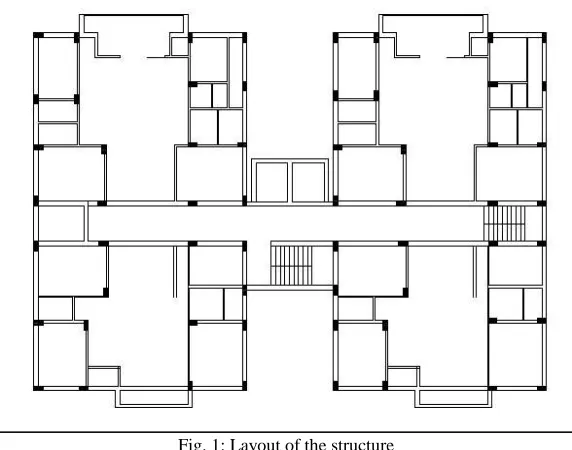
The scope and objective of this study is to evaluate the material consumption and cost of construction of 18 storied residential building designed under RC shear wall-flat slab and RC beam column framed system .Comparison of the two systems are made for economic viability. The layout of the structure is shown in Fig 1
Fig. 1: Layout of the structure
IV. BRIEF REVIEW ON DESIGN MODELS
Description:
Two types of numerical models are developed for sixteen storied buildings of plan area 27m x 38m, which is proposed to construct at seismic zone II in Visakhapatnam city-India. The proposed two models are designed for different geometric configuration based on their structural performance. Model-I consists of RC beam column slab framed system and Model-II consists of RC shear wall flat slab system. The design loads are considered as per the building code IS 875-2015 (Part-I, II & III) and the design methodology is followed by IS 456-2000 Limit state method. Influence of bot lateral and gravity loads are taken into consideration in the design. Performance studies of both models are evaluated with respect to displacement, inter storey drift and stiffness aspects .Geometry and design considerations of the building models are as mentioned below
Model I:
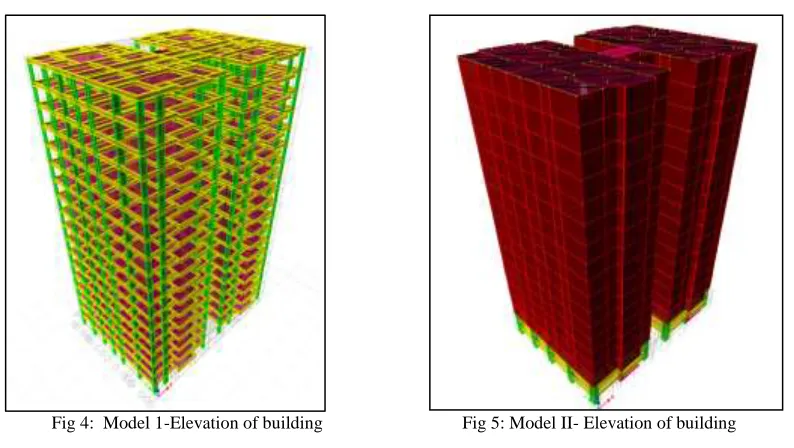
18 storied RC beam column slab framed structure with brick walls: plan area 27m x 38m, cellar floor height 3.5m and rest of the floor height 3m each (Typical).
Model II:
Fig 4: Model 1-Elevation of building Fig 5: Model II- Elevation of building
Geometry & Material Properties of models:
The modeling of the RC structure done by ETABS 2015 software. The Member dimension and applied loads are presented in Table I. Critical combination of both gravity, seismic and wind loads are taken into consideration during the analysis.
Table - 1
Structure type RC Moment resistance framed structure
Size Of Building 38mx27 m
No Of Storey 18 (Sub cellar+cellar+16 storey)
Storey Height 3m (Typical)
Cellar height 3.5m
Thickness of RC slab 0.15m
Shear Wall Thickness 0.15m
Beam Size B1 (Model I) 0.3x0.6m
Beam Size B2 0.3x0.51m
Beam Size B3 0.3x0.43m
Column Size C1 (Model I) 0.3x1.1m
Column Size C2 0.3x0.83m
Column Size C3 0.3x0.69m
Column Size C4 1.2x1.2m
Seismic Zone II
Soil Type medium coarse grained granular soils
Importance Factor (I) 1.0
Response reduction Factor 5
Zone factor 0.1
Live Load 3Kn/m
External Wall Load 16.2 KN/m
Internal Wall Load 8.1 KN/m
Grade of concrete used M25
Grade of steel used Fe415
Studies on Structural Performance of Design Models:
V. ECONOMIC STUDIES ON DESIGN MODELS
Material Consumption and Cost calculation:
Table: 2 shows the quantities of different structural materials consumed for the structural systems designed under beam column slab framed system (Model-1) and shear wall flat slab system (Model-II).
Table - 2
Material Unit Rate-
Indian Rupees
Model -1
Beam-column Model–II Shear wall flat slab
Cost of Model -1 (Rupees)
Cost of Model -II (Rupees)
Concrete M3 8,500 4696 6014 399.16x10⁵ 511.19x10⁵
Steel M.Ton 60,000 243 328 145.80x10⁵ 196.80x10⁵
Brick work
(Include5% wastage) Nos 6 21.40x10
5 - 128.4x10⁵ -
Cement Plaster M2 50 158667 - 79.33x10⁵ -
Form-work.& Shuttering M2 250 38810 49976 97.02x10⁵ 124.94x10⁵
TOTAL COST- Rs 849.71x10⁵ 832.92x10⁵
VI. RESULTS AND DISCUSSIONS ON ECONOMIC MODELS
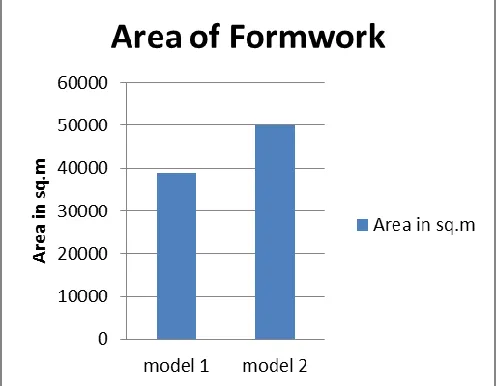
Following graphs shows the comparison of material consumption between the models Model-I: Beam column slab framed structure.
Model-II: Shear wall-flat slab structure.
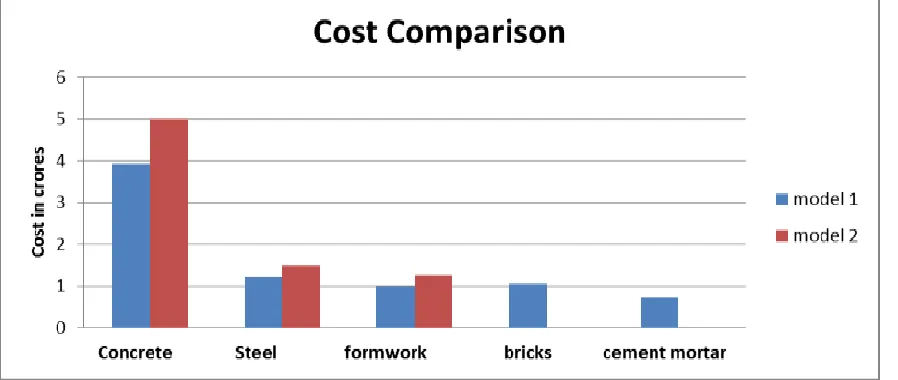
Cost comparison graph for both the models. In the graph blue indicates the framed structure (model 1) and red indicates the shear wall-flat slab structure (model 2). It shows the cost comparison of various materials such as concrete, steel, formwork, bricks and cement mortar etc.
Fig. 9: Cost comparison of materials
Observations from the graphs:
Consumption of concrete is 28.1% more in shear wall system than framed system
Consumption of steel reinforcement is 34.9% more in shear wall system than framed system Area of shuttering & formwork is 28.5% more in shear wall system than framed system
Total material cost in Shear wall system (Model-2) is Rs 4196/- per m2 floor area and in framed system (Model-1) is Rs 4326/- per m2 floor area.
The super structure costdecreased by 2% in shear wall system (Rs 17 lakhs) compared with Beam column framed system.
VII.CONCLUSIONS
Shear wall –Flat slab system is more adoptable than framed system in the construction of RC high raised structures. Optimum construction time and economy achieved in shear wall system than RC framed system
The cost of super structure isdecreased by 2% in shear wall system (Rs 17 lakhs) when compared to beam column framed system.
Both designers and builders recommended to adopt shear wall system in high raised structures for efficient performance and economic cost of the project.
REFERENCES
[1] Agarwal.P and Shirkhande. M., “Earthquake Resistant Design of Structures” Prentice hall of India private ltd. New Delhi, India. [2] Bryan Stafford Smith Alex coull., “Tall Building Structures analysis and design”, published by John Wiley and sons, New York, 2000. [3] ETAB 2009, “Technical Structural Software and Reference Manual”.
[4] K. Navyashree and Sahana T. S., “Use of Flat Slabs In Multi-Storey Commercial Building Situated In High Seismic Zone”, International Journal of Research in Engineering and Technology, Vol.03 Issue 08, 2014,pp. 439-451.
[5] N.Krishnaraju“Structural Design and Drawing: Reinforced Concrete and Steel”, published by Universities Press (India) Private Limited Hydrabad, 3rd edition,
[6] S.S. Patil, Rupali A. Sigi “Flat Slab Construction in India“, International Journal of Engineering and Innovation Technology (ISSN: 2277-3754), Vol. 3, (10), April 2014, pp. 138-141.
[7] V. L. Shah and S. R. Karve “Illustrated Design of Reinforced Concrete Buildings”, published by Structure Publications Pune, India.
[8] Y. H. Luo and A. Durrani “Equivalent Beam Model for Flat-Slab Buildings: Exterior Connections,” American Concrete Institute( Structural Journal), vol. 92(2), January 1995, pp. 250-257.
[9] IS: 875(Part 1-3)-1987, “Code of practice for design loads(other than earthquake) for buildings and structures”, published by Bureau of Indian standards, New Delhi,
[10] IS: 875(Part 1-3)-1987, “Code of practice for design loads”, published by Bureau of Indian standards, New Delhi, [11] IS: 456-2002, “Code of practice for plain and reinforced concrete”,published by Bureau of Indian standards, New Delhi,