Page 287
THE INFORMATION AND COMMUNICATION TECHNOLOGIES - CONTEMPORARY CHALLENGE FOR THE EDUCATION IN HEALTH CARE
Pavlinka Dobrilova, Galya Yankova, Ralitsa Zlatanova-Velikova
Subsidiary "Prof. Dr. Ivan Mitev" to Vratsa - Medical University of Sofia, 3000, Vratsa, Bulgaria
Abstract
The introducing of information and commutation technologies in the education puts the training of health care in new intellectual challenge. In the current conditions, health care became an area of global education where the education interacts with a scientific research in this field. The healthcare professionals must have new knowledge, skills and competences which allow them to communicate effectively, to analyze the global processes, to reflect their role globally, to take initiatives for improving the healthcare service by using the information and communication technologies. The article explores the needs of introducing information and communication technics in the healthcare training for improving the quality and the relevance of the teaching process in "Prof. Dr. Iv. Mitev", Vratsa, Medical University - Sofia.
Keywords: information and communication technology, training, healthcare
1. INTRODUCTION
The evaluation of information and communication technologies affects all spheres of our lives. They are key components not only in the contemporary society and economics but also in the training and the education in all their forms. Many people want to get educational services at any time and from anywhere and that is why the use of these technologies is so demanding. Because of the vast amount of information which the students get in the different learning disciplines it needs to use the information and communication technology (ICT). Many people prefer learning and especially e-learning at any time and from anywhere. The introduction and widespread use contemporary ICT in the learning process is about rationalizing the work of lecturers, ensuring an accessibility and improving the quality of training. It is necessary to review the training of the healthcare professionals, forms and training methods, as well the needs of introduction of ICT for improving the quality of healthcare training.
It is necessary to restruct the learning process for successful professional training of the healthcare professionals. The new needs in the health care system require the creation of new technologies in the training of the future nurses. The information progress requires trained students to solve independently very important issues, to eliminate the differences in the knowledge, to use the acquired knowledge in solving new tasks. The introduction of ICT in the healthcare training is motivated by the needs to form integrated type of professional competencies, which can help students to combine and integrate the different elements of knowledge and skills into their behavior so that they can successfully do the job. The modern requirements for professional competence of nurses with higher education requires building a new model of education at the Higher Medical School about integrating the link between general and professional knowledge. The application on a technology for a distance learning allows students to develop the capacity for professional self-improvement in the system of continuous medical education. It will improve the organization and the self-preparation of students. It is used the information resources of the global network for improving the quality of the training. The methodological materials provided via the Internet have the possibility of regular updates and additions and the students have possibilities for an interconnection and complementarity of educational material from one discipline with materials on the other.
Page 288
paper tools, as the new educational technologies increasing the share of self-learning. There is a problem with the providing e-educational resources in the teaching health care. It is necessary to develop and introduce didactic materials in electronic format to increase the efficiency of the learning material.
Purpose: To examine the need to introduce information and communication technologies in the healthcare education for improving the quality and relevance of the learning process in "Prof. Dr. Iv. Mitev"- Vratsa; Medical University - Sofia.
2. MATERIALS AND METHODS
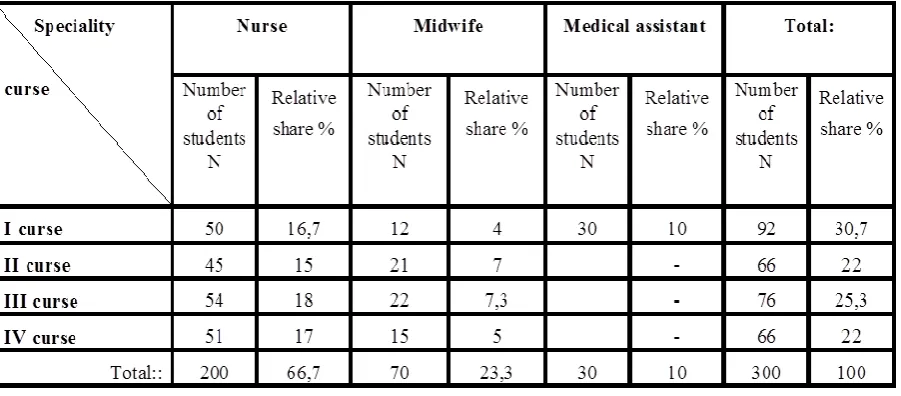
The opinion of students from the professional field "Health care", trained in "Prof. Ivan Mitev", Vratsa, Sofia University was researched with an anonymous poll. The number of students surveyed is 300, of which 200 are in the "nursing" specialty, 70 are in the "midwifery" and 30 are "medical assistants". The study period is the summer semester of the 2017/2018 academic year – February- May 2018. Statistical data processing uses SPSS v.19.0. The accepted level of significance is α = 0,05. MS Excel is used to graphically present the results.
3. RESULTS AND DISCUSSION
During the summer semester of the school year 2017/2018, 92 first-year students were surveyed, 66 second-year students, 76 third-year students and 66 students in the fourth year. The distribution of the participants by specialties and stage of training is presented in Table 1.
Table 1. Distribution of the respondents by a specialty and a course of study
Page 289
The global e-learning market continues to be active. It is way because the increased demand for an educational services and the development of the information technologies and the growing number of Internet users. The number of online e - learning courses is growing extremely fast. The results show that only 7,3% of the respondents participated in an e-learning course and 92.7% did not participate in a course (Figure 1).
Figure 1. Participation of the students in an e-learning course
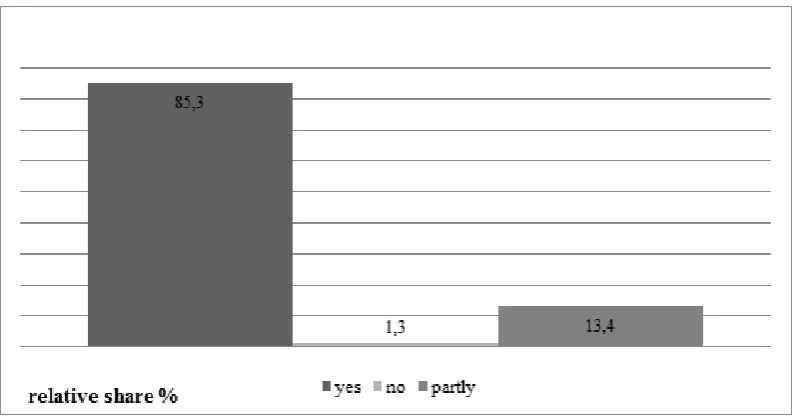
In spite of that more of the students do not have a completed e-learning course, 77,4% think that they can study in an electronic environment and this means that they would benefit from developed e-learning content. This is confirmed by the answers of the question "If there is a published content for the subject" Health Care ", will this facilitate you in learning?". 85,3% of the respondents think that the e-learning content in the subject “Health care” would make it easier for them to learn and they gave a positive answer, there is a small number of those who guess partly, only 1.3% would not use electronic content, but their share is negligible (Figure 2).
Page 290
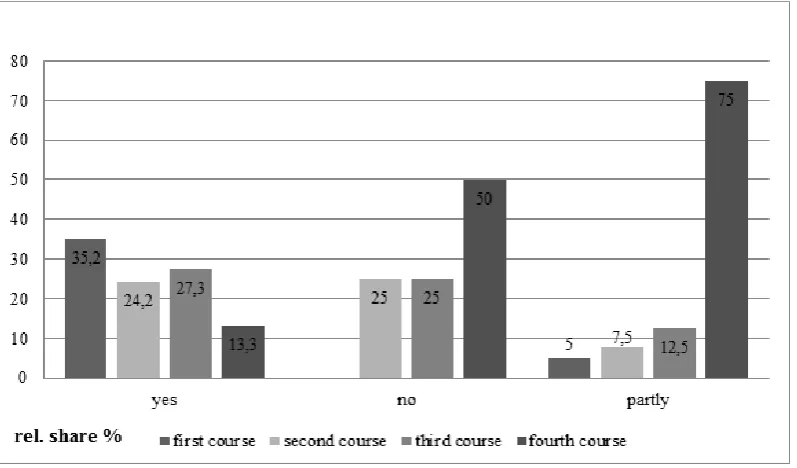
The share of the students who need to use an e-learning content in the subject “Health care” is significant. After the distribution of the courses becomes clear that the students who need an e-learning content about “Health care” are in first, second and third course, but these in fourth course almost do not need. (p< 0.05).
Figure 3. Need for e-learning
The training course for the students in the professional field "Health Care" is four years and they receive a Bachelor's degree. In the fourth year of the training it is done an internship according to the unified state requirements. Probably this is the main reason more of the students in fourth course do not need to use an e-learning content because the theoretical part is completed.
Page 291
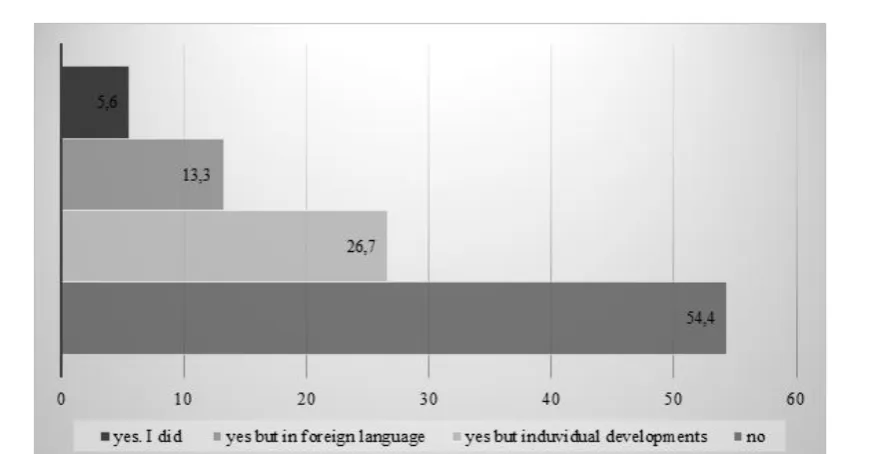
Figure 4. Distribution of the students according to the use of an electronic textbook on “Health care”
The e-learning helps to modernize university education in the spirit of the educational, the technological and the economic trends of the global information society. Its introduction do not remove the traditional form and methods of training, only to enrich by using information and communication technologies. This can contribute to the quality of the education as a complement to the traditional direction “Health care”. The training in these specialties has its specific features that influence the design of electronic forms. The learning process in VMU is an andragogical process with three participants (lecturer, students, patients), a unity between teaching and learning, as a result of which the students master knowledge, professional skills and habits, personal qualities. The training in the real hospital helps the students to build team-building skills, to apply the principles and rules of medical ethics.
The learning objectives are the first and obligatory element of the triennial structure of the learning process:
For the needs of medical education, 3 types of learning objectives are adequately covered [6]:
1. Institutional goals - they are formulated at the level of the school. They include in the content the final results of the educational process - clinical thinking, good communication skills, personal and professional qualities.
Learning objectives
Learning activity Control and
Page 292
2. Intermediate (departmental) objectives - they are derived from the institutional goals. They are more specific and give an idea of the ultimate number of knowledge, skills, habits.
3. Specific learning objectives - these are the objectives of the individual practical session or seminar. It is characterized by greater specificity and multitude. They have four elements - activity, content, condition and criteria. The activity and the content form the professional competence set as a goal in the specific study form. The condition of the specific learning objective defines the mandatory requirements. This includes equipment, pace, location, and more. The learning objective defines the specific level of knowledge, skills, habits learned at the end of a thematic unit.
A crucial condition for the optimal flow of the forming process is the connection between lectures and students, between students and patients and between students themselves.
After the review of the current situation and the perspectives for the introduction of an e-learning content on “Health care”, the following conclusions are made:
1. Development of the information and the communication technologies, a priority for health care teachers.
2. More of the students (85,3%) who have need to use an e-learning content in the subject “Health” care.
3. In the existing need of an e-learning content, only more than half of the respondents (54,4%) said that during the training they did not use an electronic textbook on “Health care”, and 13,3% of them used an electronic edition in a foreign language.
4. To satisfy the need of an e-learning content about “Health care”, it is a necessary to create a team of teachers to develop teaching materials and to entry into a self-training platform.
4. CONCLUSION
The role of the education in the developing society is undeniable. Every major achievement is expressed in the education, which ensures the further development of society. In the context of an information society, the timely updating of knowledge is crucial for the professional realization of the personality.
ACKNOWLEDGMENTS
The present research is conducted in the execution on a scientifically research project which is financed by Consul of Medical Science in Medical University-Sofia, contract №: D-102/03.04.2018, from a competition GRANT-2018 with topic: ``Exploring the possibilities for using a computing and communication technology in a healthcare training in the affiliate "Prof. Dr. Ivan Mitev "- Vratsa".
REFERENCES
1. Andonova , А.,(2011). Healthcare teaching as seen through lectors’ eyes, Academic Journal e "Management and Education”,book3, tome7, Burgas, page 341 – 344
2. Andonova, А.(2013). The training of the nurses. The rule of the motivation, St.Zagora, 2013 г. 3. Borisov, V., Zl.Glutnikova, Tz.Vodenicharov (1998). New Public Health, press „Aquagrafic”,
Sofia,
4. Vodenicharov Tz. , Zl. Glutnikova, L. Charukova (1997). Innovations in medical education, edition „Aquagrafic”, Sofia
Page 293
6. Vodenicharov Tz. , S.Popova (2000). The assessment in the medical education, press „Filvest” Sofia
7. Velikov St., S. Spiridonov, P. Petkov (2017). The interactivity in the training of healthcare professionals, Science and technologies: Volume VII, 2017, Number 1: Medical biology studies, clinical studies, social medicine and health care, pp. 88-91
8. Gurova, V. (2010). Interactive methods and motivation of students to learn – in dialogue with Phil Race, c. "Interactive Methods in Contemporary Education", Blagoevgrad
9. Polat, Е.S, М.U.Buharkina (2007). Modern pedagogical and information technologies in the education system, press „Academy”, Moscow
10. Spiridonov S., R. Zlatanova-Velikova, S. Velikov, I. Dimitrov (2017). The Role of Non-Verbal Components in the Communication among Health Workers, National Conference "Public Health - Global Priority in Science and Practice, Bulgarian Scientific Society for Public Health
11. Chi, Michelene T.H. (2009). Active – Constructive – Interactive: A conceptual framework for differentiating learning activities/topics in cognitive science 1, 73-105
12. Dobrilova P. P., Yankova G. T., Stefanova K. S. (2017). Nursing and health policy. International scientific journal «SCIENCE AND WORLD». 2017. № 11 (51)
13. Dobrilova P. P., Yankova G. T., Stefanova K. S. (2017). Modern approaches to improving the quality of life of people with disabilities. International medical scientific journal „MEDICUS“. 2017. № 5 (17).р.28-33
14. Dohmen, G, (1996) .Lifelong learning – Guidelines for a modern education policy, Bonn, 1996 15. Rosebrough, A. (1999). Russian nursing education reform project: new nurse for a new Russia,
„Image J Nurse Sch”
16. Simons,J. ,S. Dewitte, W.Lens, (2004).The role of different types of instrumentality in motivation, study strategies, and performance: Know why you learn, so you` ll know what you learn!, British Journal of Educational Psychology, 2004, vol. 74, p.343-360
17. Vodenicharova Al., T. Zlatanova, M. Alexandrova, R. Zlatanova – Velikova (2015). Role of e-learning in the faculty of public health Sofia, International Journal on New Trends in Education and Their Implications, January 2015 Volume: 6 Issue: 1 Article: 13, pp. 98-103
18. Vodenicharova A., A. Yanakieva, R. Goranova-Spasova, R. Zlatanova-Velikova (2016). Satisfaction of students from the organization and quality of education in the faculty of public health-Sofia, journal of educational and instructional studies in the world, June 2016, Volume: 6 Special Issue 1 Article: 10, pp. 61-69
19. Zlatanova T., R. Zlatanova – Velikova, Al. Vodenicharova (2015). Continuing medical education in Bulgaria - organization and attitudes, International Journal on New Trends in Education and Their Implications, January 2015 Volume: 6 Issue: 1 Article: 15, pp. 112-119
20. Zlatanova – Velikova R., St. Velikov, Al. Vodenicharova, (2015). The electronic test in continuous medical education, International Journal on New Trends in Education and Their Implications, January 2015 Volume: 6 Issue: 1 Article: 17 , pp. 131-137