EFL Student Teachers' Reflections on Their Initial Teaching Practice
Sanja Čurković Kalebić Faculty of Humanities and Social Sciences, University of Split
Abstract
This paper aims to investigate student teachers' reflections on their pre-service teaching practice. The research question is: What are student teachers' perceptions of their cognitive, behavioural and affective involvement in initial teaching practice? The participants in this study were 53 student teachers of English language and literature at a Croatian university. A questionnaire was administered to the student teachers upon the accomplishment of their school-based teaching practice. The questionnaire consisted of 18 items accompanied by a five-point Likert scale. Six items in the questionnaire referred to the student teachers' perception of their cognitive involvement when observing their mentors teach, six items referred to the student teachers' perceptions of their verbal and non-verbal behaviour when teaching their own lessons, and six items addressed student teachers' attitude towards the assignments they had during their teaching practice. Findings indicate high cognitive involvement of the student teachers during their observations of mentors’ lessons. The majority of the student teachers reported they had made an effort to understand the teaching process in terms of the principles and decisions that lay behind the procedures used by the teacher and the selection of a particular teaching strategy. The results show very high student teachers' involvement in some behavioural aspects of teaching, such as paying attention to learners' participation, and student teachers' most enjoyment in teaching their own lessons.
Keywords: pre-service teaching practice, student teachers of English language and literature, reflections
1 Introduction
Teaching practice or the practicum is an important part of initial teacher education (ITE) programmes (e. g. Farrell, 2008: 226; Gebhard, 2009: 250). Richards and Crookes (1988: 9) state that the practicum provides ”the major opportunity for the student teacher to acquire practical skills and knowledge needed to function as an effective language teacher”. The practicum usually involves ”experience with systematic observation” (Gebhard, 2009:251) and ”practical experience in classroom teaching” (Richards and Crookes; 1988:11).
To be effective observation should be guided (Day, 1990:43), systematic (Day, 1990:43; Gebhard, 2009: 250), and focused (Day, 1990: 43; Watson Todd, 1997: 122). During the observation process student teachers collect, analyze and interpret data on classroom interaction. Data on classroom interaction can be collected in a number of ways. One way of collecting classroom data is to provide a written description of what was going on in the classroom. Such a description of classroom events should be objective, nonjudgmental and nonevaluative (Day, 1990:45). This technique is considered to help student teachers raise awareness of the complexity of foreign language classrooms (Day, 1990: 44). Another technique of collecting data is through observation tasks. An observation task is ”a focussed activity to work on while observing a lesson in progress” (Wajnryb, 1992: 8). It provides a means of collecting data on one or two aspects of teaching, such as questioning, giving instructions, or attending to the learner. This technique provides student teachers with focus and clarity, with an increased skill in understanding and interpreting data, and with better understanding of the relationship between theory and practice (Wajnryb, 1992: 8).
Classroom teaching is an experiential practice in ITE (Ellis, 1990: 29). It involves student teachers in ”real” teaching. This practice, also called ”practice teaching” (Richards, 1990: 15), refers to ”participating in a variety of practice teaching experiences that are closely supervised by a skilled teacher" (Ibid.). Classroom teaching is usually considered to be the most important learning experience in ITE. It enables ”conscious understanding of the principles underlying second language teaching (Ellis, 1990: 27) and it provides student teachers with the opportunities to ”use their accumulated knowledge to make instructional decisions” (Gebhard, Gaitan and Oprandy, 1990: 17). Gebhard (2009: 252) claims that classroom teaching is the most important classroom experience because it ”not only provides direct experience of interacting with students, but it also provides the contexts and content for other activities, such as self-observation, peer observations and discussions”.
This study attempts to contribute to research on initial teaching practice (ITP) by examining foreign language student teachers' reflections on their ITP.
2 The Context of the Study
The study investigates the perceptions of pre-service English language teachers' experiences at a Croatian university during their ITP. ITP was organised as the last part of ITE programme which included courses on second language acquisition, psychology of education, pedagogy, didactics of teaching foreign languages and an English as a foreign language (EFL) methodology course. The focus of the methodology course was on lesson planning, teaching strategies and the development of observation skills. Some students also attended an elective course on classroom discourse. At the time of the study the student teachers were enrolled in the last semester of Teacher Education Programme and had accomplished their school-based teaching practice. The duration of ITP was three months and it was organised in two blocks, first in an elementary school and then in a secondary school or a school of foreign languages. Each student was allocated to a mentor, an experienced EFL teacher, in each type of school.
of his/her teaching would be the focus of observation. Peer observation was preceeded by a pre-observation session and followed by a discussion in the post-observation session.
3 Aim of the Study
The aim of this study is to investigate EFL student teachers' reflections on their ITP with respect to two main components: observation of the mentors' lessons and own teaching. It also attempts to identify student teachers' attitudes towards the different components of ITP. It addresses the following question:
What are the student teachers' perceptions of their cognitive, behavioural and affective involvement in initial teaching practice?
4 Method
4. 1 Participants
Fifty-three student teachers of English language and literature at a Croatian university participated in this study. The study was carried out in the last semester of teacher education programme, upon the student teachers' accomplishment of school-based teaching practice.
4. 2 Instrument
A questionnaire was administered to the student teachers upon the accomplishment of their school-based teaching practice. The questionnaire consisted of 18 items accompanied by a five-point Likert scale (5 - strongly agree, 4 - agree, 3 - neither agree nor disagree, 2 - disagree, 1 - strongly disagree. The items were in the form of I-statements. Six items in the questionnaire referred to the student teachers' perception of their cognitive involvement when observing their mentors teach, six items referred to the student teachers' perceptions of their verbal and non-verbal behaviour when teaching their own lessons, and six items addressed student teachers' attitude towards the practices and assignments they had during their teaching practice.
4. 3 Data analysis
A quantitative analysis was performed on the data collected by the questionnaire. The analysis was carried out using SPSS for Windows 13.0.
5 Results and Discussion
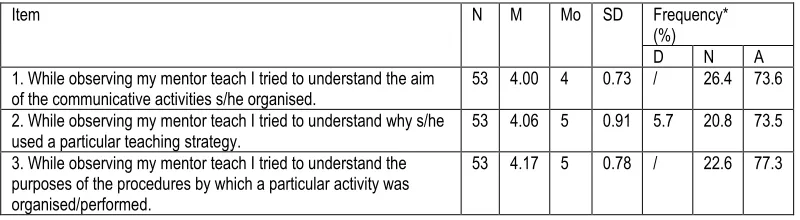
The results of the questionnaire are presented in Table 1.
Table 1 Results of descriptive statistics of the questionnaire on student teachers’ perceptions of their cognitive, behavioural and affective involvement in ITP
Item N M Mo SD Frequency*
(%)
D N A
1. While observing my mentor teach I tried to understand the aim
of the communicative activities s/he organised. 53 4.00 4 0.73 / 26.4 73.6
2. While observing my mentor teach I tried to understand why s/he
used a particular teaching strategy. 53 4.06 5 0.91 5.7 20.8 73.5
3. While observing my mentor teach I tried to understand the purposes of the procedures by which a particular activity was organised/performed.
4. While observing my mentor teach I was aware of the purposes of various teaching techniques.
53 3.72 3 0.99 11.3 32.1 56.6
5. While observing my mentor teach I considered the
communicative purpose of his/her utterances 53 3.64 3** 0.81 5.7 39.6 54.7
6. While observing my mentor's lessons I considered the learning
purpose of various types of interaction 53 3.75 4 0.90 5.7 32.1 62.3
7. When teaching my own lessons I paid attention to learners' participation.
53 4.74 5 0.49 / 1.9 98.1
8. When teaching my own lessons I paid attention to timing. 53 4.62 5 0.56 / 3.8 96.2
9. When teaching my own lessons I paid attention to my mentor's reactions.
53 2.94 3 0.60 39.6 30.2 30.2
10. When teaching my own lessons I monitored my language use. 53 4.17 4 0.75 3.8 9.4 87.6 11. When teaching my own lessons I monitored learners' verbal
behaviour.
53 4.28 4 0.60 / 7.5 92.4
12. When teaching my own lessons I monitored my position in the classroom.
53 4.09 4 0.81 3.8 17.0 79.3
13. I enjoyed filling in observation sheets. 53 2.13 1 1.19 64.1 20.8 15.1
14. I enjoyed post-observation sessions after my mentor's lessons. 53 3.15 4 1.28 32.1 22.6 45.3 15. I enjoyed post-observation sessions after my own lessons. 53 3.72 4 1.23 15.1 18.9 66.0
16. I enjoyed observing my mentors teach. 53 3.57 4 0.97 15.1 32.1 52.9
17. I enjoyed observing peer students teach. 53 3.94 4 0.91 5.7 15.1 79.2
18. I enjoyed teaching lessons. 53 4.55 5 0.64 / 7.5 92.5
* Note: Values present percentages: D=collapsed scores for Strongly disagree and Disagree, N=Neither agree nor disagree, A= collapsed scores for Strongly agree or Agree
N - number of participants
M - mean value
Mo - mode (dominant value)
SD - standard deviation
** Multiple modes exist. The smallest value is shown.
The results of the questionnaire show that student teachers' perceptions of their cognitive, behavioural and affective involvement in ITP are positive (Table 1). The result of the whole questionnaire is 3.9.
The results of the items in the questionnaire that refer to the student teachers’ perceptions of their cognitive involvement when they observed their mentors teach (items 1 to 6) is relatively high; the mean value of these items is 3.9. The mean value of items 1, 2 and 3 (4.1) and their modes (4, 5 and 5 respectively) indicate that the majority of the student teachers attempted to determine the decision making that guided the teacher in lesson planning. This finding is important because it shows the student teachers' high awareness of the importance of lesson planning in terms of the goals and objectives of the activities, the choice of teaching strategies and procedures in organising and delivering a lesson. A high awareness of the importance of these components of lesson planning may be attributed to previous course work but also to task-based observations.
complexity of factors that might influence the teacher's decisions on various aspects of classroom management, such as learner characteristics, learner language knowledge, and learner needs.
The result of the items in the questionnaire that refer to the student teachers' perceptions of their behaviour when they taught their own lessons (items 7 to 12) is very high; the mean value of these items is 4.1. Almost all student teachers in this study (98 %) claimed that when they had taught their own lessons they had paid attention to learners' participation. This finding indicates that in the initial stage of teaching practice the student teachers are highly aware of the importance of the amount of learners' participation. ”The quantity of student participation and interaction that occurs” (Richards, 2010: 113) is one of the characteristics of the learner-centered teaching approach, which is one of the ”core dimensions of skill and expertise in language teaching (Richards, 2010: 101).
The majority of the student teachers (96 %) report that they paid attention to timing when they taught their own lessons. This finding does not surprise because predicting the length of an activity in the planning phase and controlling the length of the activity while teaching are difficult for beginning teachers (Wajnryb, 1992: 116).
Monitoring learners' language use is one of the teaching skills that a student teacher needs to acquire (Richards, 2010: 107). Most participants in this study (92%) reported to have monitored learners' verbal behaviour when teaching own lessons.
Ability ”to monitor his or her own speech and writing for accuracy” is one of the language-specific competencies that a language teacher needs in order to teach effectively (Richards, 1910: 103). A great majority of the student teachers (88 %) in this study reported to have monitored their language use when teaching own lessons.
Most student teachers (79 %) reported to have monitored their own position in the classroom when teaching own lessons whereas most student teachers (70 %) either ”disagree” or ”neither agree nor disagree” that they paid attention to the reactions of the mentor who observed their lesson.
The result of the items in the questionnaire that refer to the student teachers' perceptions of their affective involvement in the ITE (items 13 to 18) is 3.5. A great variability in the student teachers' attitudes towards the different practices and assignments in ITP may be noticed. The findings show that teaching own lessons was the most pleasant experience for the student teachers in this study. Ninety-two percent of the student teachers either strongly agreed (62%) or agreed (30%) that they had enjoyed teaching their own lessons. More than three-fourths of the student teachers reported to have enjoyed observing fellow student teachers teach. This finding does not surprise because previous studies have shown that student teachers have a very positive attitude towards the use of peer observation in ITP (e. g. Čurković Kalebić, 2017). Two-thirds of the participants in this study enjoyed post-observation sessions that followed the lessons they had taught. About one-half of the student teachers (53 %) reported to have enjoyed observing their mentors teach whereas less than one-one-half of the student teachers (45%) enjoyed a post-observation session that followed an observation of the mentor's lessons. Finally, almost two-thirds of the student teachers (64 %) reported that they had not enjoyed doing written assignments (filling-in observation sheets) while observing their mentors or peers.
6 Conclusion
In this study an attempt was made to shed more light on the role of teaching practice in ITE of EFL student teachers. By answering a research question the perceptions of cognitive, behavioural and affective engagement of student teachers in ITE were investigated. Based on the findings the following conclusions have been drawn:
When teaching their own lessons student teachers seem to pay great attention to learners' learning. The findings of the study lead to the conclusion that learner participation in classroom interaction and learner verbal production were in the center of the student teachers' attention.
The findings also indicate that student teachers have a more positive attitude to the activities that include their active involvement (teaching their own lessons, peer observations, and discussion sessions that follow student teachers' lessons) than to the activities in which their active engagement is lower (observing mentors and sessions that follow mentors' lessons).
A great variability in the student teachers' attitudes towards the sessions that followed their mentors' lessons as well as their own lessons has been found. This finding indicates the need for more research in the area of mentor support, mentor feedback and student teachers' reflections on own lessons in ITP.
References:
[1] Day, R. R. (1990) Teacher observation in second language teacher education. In Richards, J. C. and Nunan, D. (eds.) Second Language Teacher Education. Cambridge: Cambridge University Press, 43 -61.
[2] Čurković Kalebić, Sanja (2017) The Use of Peer Observation in Pre-Service Foreign Language Teacher Education. INTED 2017 Proceedings, 1271-1277.
[3] Ellis, R. (1990) Activities and procedures for teacher preparation. In Richards, J. C. and Nunan, D. (eds.) Second
Language Teacher Education. Cambridge: Cambridge University Press, 26 - 36.
[4] Fanselow, J. F. (1990) " Let's see": contrasting conversations about teaching. In Richards, J. C. and Nunan, D. (eds.) Second Language Teacher Education. Cambridge: Cambridge University Press, 182 - 197.
[5] Farrell, T. S. C. (2008) ‘Here's the Book, Go Teach the Class’: ELT Practicum Support. RELC 39 (2), 226-241. [6] Gebhard, J. G. (1999) Seeing teaching differently through observation. In Gebhard, J. G. and Oprandy, R.
Language Teaching Awareness. Cambridge: Cambridge University Press, 35 - 58.
[7] Gebhard, J. G. (2009) The Practicum. In Burns, A. and Richards, J. C. (eds.) Second Language Teacher
Education. Cambridge: Cambridge University Press, 250-258.
[8] Gebhard, J. G., Gaitan, S. and Oprandy, R. (1990) Beyond prescription: the student teacher as investigator. In Richards, J. C. and Nunan, D. (eds.) Second Language Teacher Education. Cambridge: Cambridge University Press, 16 - 25.
[9] Richards, J. C. (1990) The dilemma of teacher education in second language teaching. In Richards, J. C and Nunan, D. (eds.) Second Language Teacher Education. Cambridge: Cambridge University Press, 3-15. [10] Richards, J. C. (2010) Competence and Performance in Language Teaching. RELC Journal 41 (2), 101-122. [11] Richards, J. C. and Crookes, G. (1988) The Practicum in TESOL. TESOL Quarterly 22, 9-27.
[12] Wajnryb, R. (1992) Classroom Observation Tasks: A Resource book for language teachers and trainers. Cambridge: Cambridge University Press.