
K E Y W O R D S
H I G H L I G H T S
A B S T R A C T
G R A P H I C A L A B S T R A C T
84
Research Paper
Received 2016-04-14 Revised 2016-09-15 Accepted 2016-09-17 Available online 2016-09-17
Membranes Separation Multi-membrane Permeation
• It is shown that MRCM nodes can be classified using total membrane flux • Node property threshold equation is derived for rapidly selecting membrane area ratio • An intuitive understanding of membrane residue curve map topography is developed
Journal of Membrane Science and Research 3 (2017) 84-89
Shortcut Node Classification for Membrane Residue Curve Maps
1 University of Witwatersrand, Johannesburg, South Africa 2 University of South Africa, Johannesburg, South Africa
Neil Thomas Stacey
1
,*, Mark Peters
2
, Diane Hildebrandt
2
, David Glasser
2
A R T I C L E I N F O
© 2017 MPRL. All rights reserved.
* Corresponding author at: Phone: +27 11 670 8990; fax: +27 011 917 3048 E-mail address: [email protected] (N.T. Stacey)
DOI: 10.22079/jmsr.2016.21846
1. Introduction
The vast majority of chemical processes require separation at some stage, be it in the preparation of suitable chemical feedstocks or the purifica-tion of reacpurifica-tion products. While distillapurifica-tion remains the most widely-used of separation processes alternatives have become increasingly popular, includ-ing absorption, solvent extraction and membrane permeation. Membrane permeation in particular has recently seen rapid development as a separation method.
Membrane permeators achieve separation by exposing a high-pressure fluid mixture to a membrane, through which components in the mixture per-meate at different rates, resulting in composition changes in both the residual fluid phase, called the retentate, and the stream of permeated material, called the permeate.
Peters et al.[1-3] developed Membrane Residue Curve Maps (MRCMs) as a tool for graphically tracking these composition changes, where curves are plotted by integrating the residue curve equation:
(1)
where x is the retentate composition expressed as a vector of component frac-tions and y is the composition of permeating material which is a function of x in accordance with the permeation modelling. τ is a dimensionless ratio, given by dividing the amount of material that has permeated to the amount that was initially present. In other words, at the commencement of permeation
http://dx.doi.org/10.22079/jmsr.2016.21846
Journal of Membrane Science & Research
journal homepage: www.msrjournal.com
τ=0 and when all material have completely permeated, then τ=1. M-RCMs behave similarly to RCMs and for a full account of the development and application of RCMs in a general sense, the reader is referred to Doherty [4].
M-RCMs have proven to be a useful design tool for rapid evaluation of the separation behaviour of a particular membrane. They have also proven to be a useful teaching tool, just like distillation RCMs before them, enabling the same intuitive understanding of the fundamentals of membrane separation.
Stacey et al. [5] extended the residue curve equation to include any number of material streams being removed from the initial charge with the generalised equation:
(2)
In the specific case of a two-membrane permeator, this equation takes the following form:
(3)
where the m in the superscripts indicates that the stream in question is exiting via membrane permeation and the accompanying numeral denotes which membrane it is exiting through. The split ratio, s, is the ratio of the rate of permeation through membrane 2 to the rate of permeation through membrane 1. Note that s is not constant but is dependent on composition as shown in equation 4.
(4)
where Ami is the total surface area of membrane i. The constants in equation 4
can be bundled together into a single term, E, such that E is the ratio of the rate at which a specific reference component permeates through membrane 2 to the rate at which that reference component permeates through membrane 1.
(5)
Using equation 5 makes it possible to simplify the definition of s as follows:
(6)
In this way, E bundles the area ratio together along with the other membrane characteristics that determine permeation rate, making it possible to examine multi-membrane setups solely in terms of E and the relative permeabilities.
The paper by Stacey et al. [5] demonstrated that the separation behaviour of multi-membrane permeation systems is governed by the topography of the corresponding MM-RCMs, which is in turn governed by the properties of nodes within those maps. That paper further showed that node properties and MM-RCM topography can be manipulated by modifying E and that this can result in significant improvements in membrane performance. This is done by evaluating nodes at many values of E in order to select a value that yields desirable node properties.
Evaluating nodes within M-RCMs and MM-RCMs therefore plays a significant role in their use as a design tool. At present, this is done using Lyapunov’s Theorem, which states that the stability of a node can be evaluated based on the signs of the eigenvalues of the characteristic equation. Eigenvalue inspection has the drawback of being mathematically complex, making this design method computationally laborious in some instances; the number of eigenvalues involved increases exponentially with increasing the number of components. A shortcut method for classifying nodes in M-RCMs and MM-RCMs would therefore reduce the computational complexity of this design method.
This paper undertakes demonstrating that in membrane permeation, nodes can be classified according to the total membrane flux at their respective compositions. Intuitively, one expects any non-equilibrium process to proceed from conditions of high driving force toward conditions of low driving force. In the case of membrane separation specifically, one would expect the process to proceed from conditions of high chemical potential to
conditions of low chemical potential. For a fixed pressure, chemical potential is a function of composition and we would therefore expect progression toward compositions of low chemical potential, which in turn means progression toward compositions which yield low membrane flux, which is itself a function of chemical potential.
One would therefore expect that a point of maximum flux on an M-RCM would be an Unstable Node and that a point of minimum flux on an M-RCM would be a Stable Node. This can be tested for any particular flux model by determining the total membrane flux in terms of relative permeabilities and checking to see if the flux criterion is mathematically equivalent to Lyapunov’s theorem.
The simplest and most widely-used model for permeation relies on the assumption of constant relative permeability [6]. Based on this assumption, the rate of permeation of a particular species is given by:
(7)
where
Ji is the rate of permeation of component i per unit area (mol.s-1.m-2)
p is the permeability of the reference component (mol.m.s-1.m-2.Pa-1) πn is the pressure in phase n [Pa]
xi is the mole fraction of component i in the retentate phase
yi is the mole fraction of component i in the permeate phase
δ is effective membrane thickness [m]
αi is the relative permeability of component i, which is the ratio of the
permeability of component i to that of the reference component, pi/p. By
convention, the reference component is the second component (component B) in a three-component system.
With the simplifying assumption of vacuum permeate, πn = 0 and
equation 7 reduces to:
(8)
If we define yi=Ji/J , where J is the sum of all Ji, then:
(9)
are also considered to be complex permeation models. Huang et al. [7] and Stacey [5] have previously examined complex permeation in a general way, employing a non-specific model that makes use of binary transfer coefficients. The same approach will be used in this paper, using the following modified model for complex permeation:
(10)
where γi,j is a binary interaction parameter quantifying the dependency of the
permeability of component i on the concentration of component j.γi,j can be
either a positive or negative number, since one component’s presence can inhibit or enhance the permeation of another. Note that from the above, xj.γi,j
will have the same dimensions as αi. Since αi and xj are both dimensionless, it
follows that the binary mass transfer coefficient γi,j will likewise be
dimensionless.
2. Flux criterion for systems with simple permeation
Non-equilibrium processes tend to proceed from conditions with high driving forces towards conditions with low driving forces. In the case of membrane permeation, the driving force for flux depends on the pressure difference across the membrane as well as the compositions of the material streams on either side of the membrane.
Membrane permeators operate with pumps to maintain a pressure difference, so the only avenue for driving force to diminish is through changes in composition. In the specific case of vacuum permeate, the only composition influencing flux is that of the retentate and in general, the composition of the permeate will have a far smaller influence than that of the retentate because of the higher pressure of the retentate.
N.T. Stacey et al. / Journal of Membrane Science and Research 3 (2017) 84-89
turn have higher flux than at stable nodes.
A similar observation is generally accepted about residue curve maps in the context of distillation which is that, for simple systems, unstable nodes occur at points with low boiling points while stable nodes occur at points with high boiling points. Nodes can be predicted by looking at the relative volatilities of the different chemical species within the system.
The constant relative permeability model for membrane permeation is mathematically equivalent to the constant relative volatility model for evaporation, so one would expect a similar result. It is possible to verify this mathematically.
In order to demonstrate the validity of the flux criterion for evaluating the node properties of a single-membrane ternary, we must evaluate this criterion in terms of α, the vector of relative permeabilities. We can then do the same with the conventional method of evaluating node properties using eigenvalues, and determine if the two criteria are equivalent for all values of α.
The total flux (Jtotal) through a membrane can be given by equation 11.
Note that this is a dimensionless flux which is in fact the ratio of total flux at a particular composition to the rate of flux of the reference component in pure form.
(11)
At pure component i, xi=1, and the other compositions are all zero and all
fluxes aside from that of component i are zero. Therefore, equation 11 reduces to:
(12)
We can therefore summarize the total fluxes at the node compositions as follows:
(13)
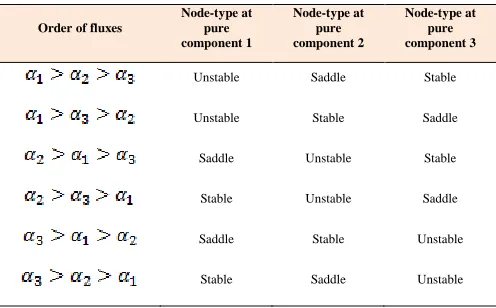
We can therefore tabulate the order of the fluxes at each node, and therefore the predicted node properties in terms of a set of inequalities of the values of α, as shown in Table 1.
Table 1
Node properties for a ternary mixture for all possible configurations of α, as predicted based on total flux.
Order of fluxes
Node-type at pure component
1
Node-type at pure component
2
Node-type at pure component
3
Unstable Saddle Stable
Unstable Stable Saddle
Saddle Unstable Stable
Stable Unstable Saddle
Saddle Stable Unstable
Stable Saddle Unstable
Now we examine the conventional approach in the same way, by determining the eigenvalues of the residue curve equation in terms of α. For a single-membrane system of three components, the residue curve equation is given by equation 1.
Since the elements of x and those of yalways sum to 1, the fraction of any one component can always be inferred from the fractions of the other two. Therefore, this residue curve equation can be considered to be a system of two equations, with two variables, those equations being:
(14)
(15)
F is a dimensionless measure of flux arrived at by dividing J by the various parameters influencing flow-rate. F is therefore given by equation 16.
(16) The Jacobian matrix of this system of differential equations is given by:
JM = (17)
The eigenvalues of this system of equations will define the nature of the nodes of the residue curve map. The eigenvalues are given by the solutions to the characteristic equation:
(18)
In practice, this amounts to subtracting λ from the diagonals in equation 18, and finding the values of λ for which the determinant of the resulting matrix is zero. This results in the following equation for λ:
(19)
Now, since nodes occur at each pure component, we wish to evaluate this equation at pure component values. Conveniently, the equation simplifies when we do this. Let us evaluate λ at x1=1, where x2=0 and F reduces to α1.
Equation 19 reduces to:
(20)
This equation has two solutions for λ:
(21)
From equation 21, the eigenvalues at this node can be evaluated purely in terms of the values of α, noting that we assume all elements of α to be positive real numbers. If α1> α2 and α1> α3, then both solutions for λ will be
positive and the node at pure component 1 will be unstable. If α1> α2 and α1<
α3, then one solution will be positive and the other negative, resulting in a
saddle node. This is true also if α1< α2 and α1> α3. If α1< α2 and α1< α3, then
both solutions will be negative and the node at the pure component will be a stable node.
The nodes at pure components 2 and 3 can be similarly evaluated, resulting in Table 2, which relates α to node properties.
Table 2
Node properties for a ternary mixture for all possible configurations of α, as given by eigenvalue inspection based on the eigenvalues in equations 20 and 21.
Order of fluxes
Node-type at pure component 1
Node-type at pure component 2
Node-type at pure component 3
Unstable Saddle Stable
Unstable Stable Saddle
Saddle Unstable Stable
Stable Unstable Saddle
Saddle Stable Unstable
Stable Saddle Unstable
with simple permeation.
In principle, the properties of a node in any number of dimensions are just an extension of its properties in each of those individual dimensions. A stable node in any number of dimensions is a node that is stable in each of those dimensions, whereas a saddle node is a node that is stable in some dimensions but unstable in others.
This logic extends beyond the explicit dimensions of components that are actually present to implicit dimensions of components that we consider to be of interest. Consider a ternary system with nodes at the pure components. At each of those nodes, only one component is present and there are in fact no explicit dimensions. There are, however, two implicit dimensions of interest, the axes for the other two components that we are considering. For binary nodes, there is one explicit dimension. For ternary nodes there are two explicit dimensions, and so on.
The topology of a Residue Curve Map in any number of dimensions is affected by the node properties in all of those dimensions, but the permeation of a real mixture is governed only by the node properties of its explicit dimensions.
For any system there are an infinite number of implicit dimensions, including any possible chemical species that could hypothetically be present. This includes chemical species that do not necessarily exist, but to which we can nevertheless assign permeation properties. Node properties are subject to change when we consider additional species to be of interest, even if those species are not in fact present. Consider the example of a mixture of Nitrogen, Argon, and Xenon exposed to a membrane of Silicone Rubber. For this system, pure Xenon is the unstable node, as it is the fastest permeating component.
If, however, we consider an additional dimension in the form of Hydrogen, then pure Xenon will become a saddle node. It will remain an unstable node in each other individual dimension; in the Xenon-Nitrogen, Xenon-Argon, and Xenon-Krypton dimensions pure Xenon is unstable but in the Xenon-Hydrogen dimension it is stable and consequently, it is a saddle node for this four-dimensional system.
This line of reasoning posits that it is possible to assess the properties of any node by examining its properties separately with respect to all of the dimensions of interest. It follows that if a criterion for node classification holds for all dimensions of interest separately, then it will hold for the system as a whole. Having proven that the flux criterion holds for ternary systems with simple permeation, we can surmise that it holds for systems with any number of chemical species provided that only simple permeation occurs.
3. Flux criterion for systems with complex permeation
In the case of systems with complex permeation, the postulate of the flux criterion can be disproved with a simple counter-example.
Consider a single-membrane system with the following permeation properties: α = [10, 1, 0.1] and γC,B = 3. This system gives rise to multiple stable nodes and an additional saddle node on the B-C axis as shown in
Figure 1.
Fig. 1. Single-membrane M-RCM with complex permeation. α = [10, 1, 0.1], γ (C,B) = 3, plotted using the residue curve equation (Equation 1).
The flux at pure A is 10, the flux at pure B is 1 and the flux at pure C is
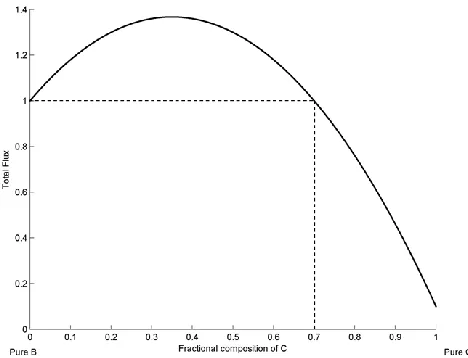
0.1. The system has an unstable node at pure A, and stable nodes at pure B and pure C. The complex permeation behaviour gives rise to a Saddle node on the B-C axis at a composition of [0,0.7,0.3]. The flux at this node is 1. In
Figure 2 we plot the total flux for a binary mixture of components B and C for this membrane. Once again, this is the dimensionless total flux J'total.
Fig. 2. Total flux for varying composition in a binary mixture with α = [10, 1, 0.1], γ (C,B) = 3, plotted using the equation for total membrane flux (Equation 16). Dashed lines to indicate the location of the additional node.
Figure 2 shows that the stable node at B is not a minimum of flux and instead, it has flux equal to that at the additional saddle node. This means that nodes cannot be classified by the flux criterion when complex permeation takes place.
It is interesting to note, however, that the flux being equal at the two nodes does indicate some relationship between total flux and node location.
We can observe the same phenomenon for a membrane with α = [10, 1, 0.1], γ (C,B) = -1.5. This system has an additional stable node at a composition of [0,0.4,0.6]. Figure 3 shows that once again, the flux at the additional node is neither a maximum nor a minimum and is instead equal to the flux at one of the other nodes.
We can conclude that for complex permeation, nodes cannot be located or classified solely on the basis of flux. The phenomenon of additional nodes occurring at points where flux is equal to that at another node cannot be considered a general result; this is just one model among many for complex permeation. Other models cannot be expected to exhibit this same property.
N.T. Stacey et al. / Journal of Membrane Science and Research 3 (2017) 84-89
4. Flux criterion for multi-membrane permeators
The solution procedure used earlier for single-membrane permeators is equally applicable to multi-membrane permeators. However, the Jacobian matrix for the corresponding system of equations is excessively cumbersome both for manipulation and for presentation in a printed format. Computation has therefore been used to simplify the process, in this case a straightforward Matlab script, shown below.
This program outputs the two eigenvalues for this system for the node at pure component 1 and those eigenvalues are as follows:
(22)
(23)
The first eigenvalue readily simplifies into the following form:
(24)
Since the top and bottom terms in equation 24 will always be positive, it follows that if the denominator is larger than the numerator then the fraction will be smaller than 1 and the eigenvalue will be positive. Since the denominator and numerator terms of the fraction are identical to the dimensionless flux at the nodes at pure 1 and 2 respectively, it follows that if the flux is greater at node 1 than at node 2, then this eigenvalue will be positive whereas if the flux at node 1 is less than at node 2 then this eigenvalue will be negative.
Thus far, the eigenvalue properties exactly match the predictions based on the flux criterion. However, the second eigenvalue is more complex to evaluate and requires further simplification. The ‘factor’ command in Matlab was used to do this, factorising the equation into the following simplified expression:
(25)
Equation 25 can be manipulated into the form shown in equation 26.
(26)
As with equation 24, the denominator and numerator terms will always be positive and, therefore, when the flux at the node at pure component 1 is greater than that at pure component 3, this eigenvalue will be positive. When the reverse is true, this eigenvalue will be negative.
It follows that if the flux at the node at pure component 1 is greater than that at both nodes 2 and 3, then both eigenvalues will be positive and that node will be an unstable node. If the flux at pure component 1 is less than at both pure components 2 and 3, then both eigenvalues will be negative and pure component 1 will be a stable node. If the flux at pure component 1 is greater than at one of the other two pure compositions but less than at the other, then the eigenvalues will have opposite signs and pure component 1 will be a saddle point.
As with the single-membrane system, the flux criterion is mathematically identical to the eigenvalue method for a two-membrane residue curve map.
This result makes it convenient to graphically track the changes in node properties with changing area ratio. Plotting E/(E+1) on the x-axis of a 2-D plot with the differences between fluxes at the nodes on the y-axis allows us to track the changes in node properties as predicted by the flux criterion. Plotting the eigenvalues of the same system on the y-axis offers an interesting comparison between the two methods. Plotting E/(E+1) as opposed to E offers the convenience of axes ranging from 0 to 1 as opposed to 0 to infinity
and also results in better spacing between points of interest.
As a first example, consider a two-membrane permeator comprising membranes with αm1=[0.25, 1, 4] and αm2=[5, 1, 0.2], where αmi is the relative
permeability vector for membranei.
If we plot the eigenvalues at pure component A along with the difference between the flux at pure component A and the fluxes at components B and C, then we can track the properties of the node at pure A, as shown in Figure 4.
Fig. 4. Eigenvalues and flux differences for pure component A in a two-membrane system with αm1=[0.25, 1, 4] and αm2=[5, 1, 0.2]. Eigenvalues drawn in thin blue lines, flux difference between node A and B in thick blue line, flux difference between node A and C drawn in black line. Figure plotted using data deriving from equations 16, 20 and 21.
At E=0, both eigenvalues are negative, as are both flux differences. Thus, both criteria predict that node A is stable for this area ratio. Moving over to higher values of E, one eigenvalue and one flux difference cross the origin at E=0.1875, indicating that node A has become a saddle node. Later, the second eigenvalue and the second flux difference cross the origin at E=0.7813, indicating that node A has become an unstable node. In this way, both criteria predict precisely the same node behaviour for all values of E, corroborating the validity of the flux criterion.
We can expand this plot by adding the eigenvalues and flux differences for pure components B and C as well, as shown in Figure 5.
Fig. 5. Eigenvalues and flux differences for pure component A in a two-membrane system with αm1=[0.25, 1, 4] and αm2=[5, 1, 0.2]. Eigenvalues at pure component A drawn in thin blue lines, eigenvalues at pure component B drawn in thin black lines, eigenvalues at pure component C drawn in thin red lines. Figure plotted using data deriving from equations 16, 20 and 21.
saddle node and the node at pure C becoming a stable node. Note that both criteria predict the same node behaviour for all nodes and for all values of E.
5. Implications of flux criterion
The teaching value of the flux criterion is certainly significant; however, there are useful practical implications. It allows for more rapid node classification, particularly in multi-membrane systems. Consider the example shown in Figure 5. Plotting 60 points for each curve, using Matlab version 7.10.0 on a PC with a 2.3GHZ Pentium Core i5-2410M processor, the computing time for plotting all of the eigenvalue curves is 58.16 seconds. By contrast, the computing time for plotting the flux difference curves was just 0.004 seconds.
In this particular instance, the computing time is a matter of mere seconds, so this saving does not necessarily appear to be of practical significance, despite the ten thousand-fold improvement. However, computing time increases enormously for systems with more membranes and/or chemical species. When faced with the task of selecting an optimal configuration from a wide range of possible membrane pairings, computing time could become a significant constraint.
The flux criterion eliminates that constraint by trivializing the computational difficulty of node classification. Furthermore, it offers a simple analytical solution for the values of E at which nodes exchange properties. Beginning with the flux of a single component through a membrane as given by equation 27:
(27)
Total flux through two membranes at pure component i, then, is given by equation 28.
(28)
Dividing through by the constants in the first term of equation 28, we arrive at equation 29, which is in terms only of the dimensionless total flux, J'total, E, x and the respective relative permeabilities of the two membranes.
(29)
Now, we can locate all values of E at which nodes switch properties by simply finding all of the zeros of the differences between the fluxes at different nodes, given by equation 30.
(30)
Equation 26 can be rearranged to make E the subject of the equation, resulting inequation 31, which shall hereafter be referred to as the node property threshold equation.
(31)
Equation 31 gives the values of E at which a change occurs in the node properties of any membrane system. The node properties of a two-membrane system can therefore be completely classified by the simple procedure of finding the real, positive solutions to this equation for all combinations of i and j and then using the flux criterion to classify the nodes within the regions delineated by those solutions. Note also that the node property threshold equation was derived to be applicable to systems with any number of chemical species.
6. Conclusions
It has been shown that, for membrane and multi-membrane systems with simple permeation, nodes can be classified according to the following criteria: Stable nodes occur at compositions where total membrane flux is minimized while unstable nodes occur at compositions which maximize total membrane flux. Saddle nodes occur at stationary points that are neither maxima nor minima in terms of total membrane flux. In general, membrane systems can be said to progress from compositions with high total flux toward
compositions with low total flux, an intuitive result.
The flux criterion results in a drastic reduction in computation time for node analysis, particularly for systems with a high number of membranes and/or chemical species. The flux criterion also gives rise to the node property threshold equation, a simple algebraic expression for determining the values of area ratio at which node properties change, further simplifying the process of node classification in systems with simple permeation. The node properties of two-membrane permeators can now be completely classified using just a handful of simple algebraic calculations as opposed to the high number of eigenvalue evaluation operations that were previously necessary.
This result also promises to aid with teaching the fundamentals of membrane separation by offering a more intuitive alternative to Lyapunov’s Theorem in the form of a common sense explanation for node behaviour.
7. References
[1] M. Peters, S. Kauchali, D. Hildebrandt, D. Glasser, Derivation and properties of membrane residue curve maps, Ind. Eng. Chem. Res. 45 (2006) 9080–9087. [2] M. Peters, D. Glasser, D. Hildebrandt, S. Kauchali, Membrane Process Design
Using Residue Curve Maps, Wiley, 2011.
[3] M. Peters, S. Kauchali, D. Hildebrandt, D. Glasser, Application of membrane residue curve maps to batch and continuous processes, Ind. Eng. Chem. Res. 47 (2008) 2361–2376.
[4] M. F. Doherty, J.D. Perkins, On the dynamics of distillation processes III, The topological structure of ternary residue curve maps, Chem. Eng. Sci, 34 (1979) 1401–1414.
[5] N.T. Stacey, M. Peters, D. Hildebrandt, D. Glasser, Synthesis of two-membrane permeation processes using residue curve maps and node classification, Ind. Eng. Chem. Res. 52 (2013) 14637–14646.
[6] J. Wijmans, R.W. Baker, The solution-diffusion model: a review, J. Membr. Sci.
107 (1995) 1–21.
[7] Y. Huang, K. Sundmacher, Z. Qi, E. Schlunder, Residue curve maps of reactive
![Fig. 5. Eigenvalues and flux differences for pure component A in a two-membrane system with αm1=[0.25, 1, 4] and αm2=[5, 1, 0.2]](https://thumb-us.123doks.com/thumbv2/123dok_us/8425417.1695725/5.595.326.541.502.674/fig-eigenvalues-flux-differences-pure-component-membrane-am.webp)
