7
Abstract
To increase the efficiency of understanding of chemistry during training of natural sciences course, the re-search methods were introduced from the beginning of learning year. The basic object for investigations was etiquette of different chemical products, mainly from household industrial products. The research activities of the pupils were stipulated to receive more information on surrounding chemical products, role of etiquette as the carrier of information. It gives more possibilities to combine the theoretical knowledge with real prac-tical life.
Another goal of the introduction of the research method is to develop investigation’s skills of the pupils. It is very important for the training of natural sciences in the modern school, which gives a possibility to develop deeper interest of pupils for investigation of the surrounding world and facilitate the growing skills for it. The defined procedures for preparation of research report were developed in the Riga French lyceum to develop all components of research activities from collection of information with verification and assessment up to presentation of own results including oral presentation for another pupils with their following valuation.
Key words: natural sciences course, training of chemistry, research training method, etiquette of household product.
Introduction
During the last several years, the pupils of 12-th form of Riga French Lyceum, which are trained in the frame of natural science course, for graduating of the course perform the small scale integrated studies, which give a possibility to demonstrate the knowledge and skills in chemistry, physics and biology. The preparations of scientific reports of the pupils usually are performed during post lessons activities, sometimes out of the school. These activities are connected with the settlement of the specific information, as well as with management of new specific methods and financial support for investigations. It was found, that exist differences in the research skills of pupils, which are determined by many factors, for example, by differ-ences in approach of natural scidiffer-ences and the humanities. Therefore, the scientific studies named as “Etiquette as the source of information” in the frame of lessons of natural science studies in Riga French Lyceum are performed for strengthening of chemistry knowledge espe-cially for better understanding the composition of each days surrounding household, food and industrial products.
The main goals of studies are following:
1. To prepare the pupils for scientific investigations;
2. To develop skills of pupils to use the etiquettes as the source of information; 3. To develop understanding of the role of household wastes management for protection of environment.
INTRODUCTION OF THE
RESEARCH METHODS
IN TEACHING OF CHEMISTRY
Gunta ABRAMENKOVA Riga French Lyceum, Latvia
8 The main tasks of the studies were following:
1. To clarify, which information contains the etiquettes of different products;
2. to determine the chemical composition of the product, as well as, formulas of sub-stances, the practical significance of the substance in the product and it’s influence on the animate nature and environment;
3. To clarify the utilization ways of product’s packages after usage of the product. These studies are connected with one of the tasks of natural sciences training programme (Grîne, 2000, p.62), to develop the skills to use the knowledge in chemistry, physics and biol-ogy for each day’s activities (Gorskis, 2004, p.52, Ïåòðîâ, 2002, p.31).
Methodology of research
Usually pupils select voluntary the item for research studies – one type industrially avail-able products with different chemical composition. Then they formulate the scientific investi-gation’s goals and tasks, taking into account the possibilities to determine the chemical com-position of products, identify the chemical formulas and structure of chemical substances, as well as, determine the functions of substances in the product and influence on environment.
Research activities usually were finished with the submission of prepared reports and presentation of obtained results. Each stage of performed activities is valued by points, which were summarized and transferred into appropriate research studies estimates. The following components are included in research studies estimates:
1. The compliance with time scale of investigations: definition of item, clarification of goal and tasks of investigations, preparation of motivation of selected item, collec-tion of etiquettes;
2. Performance of studies and preparation of the study’s report; 3. Presentation of results;
4. Discussions and formulation of final conclusions.
The schema of activities performed by pupils for scientific investigations is given in Fig-ure 1.
9
Volume 1, 2007
It was found, that the result of research activities depends on the pupil’s activities during planning and execution of the investigations and his presentation’s skills. The research studies praxis shows, that exist several cases, when the pupil’s selected product was not motivated (composition is rather complicated) correctly. After common evaluation of selected product, the decision to change the product usually was taken and pupil used another product for planned research activities.
Results of Research
The different training methods were used for pupil’s scientific investigations. To increase pupil’s knowledge’s level and understanding of the problems, the analysis of information, prepa-ration of the scientific reports and presentation of the results of investigations was widely introduced in the training process of pupils, which was one of didactic tasks for training. The co-operative training method in this case was connected with the positive mutual co-operation with all classmates during discussions on the different information’s sources and obtained results, taking into account the point of view of another pupil’s, which can differ from the opinion of the referent. The final conclusions of the investigations were formulated in such way.
Simultaneously, the referent is independent and active for explanation of the results of investigations, which increase the stability of knowledges and develop skills to use knowledges in non-standard situations. Such presentations develop the individual skills of the pupils to use scientific approach for training in natural sciences. The role of teacher during implementation of pupil’s scientific investigations is rather complicated. On the one side, the teacher must have the leading and controlling function for scientific investigations (controlling activities must be performed according to the prepared investigation’s plan, which includes the control of performed activities in different stages of investigations to avoid unnecessary stress in cases of “the last moment investigation’s” scenarios). On another side, teacher must fulfil also con-sulting activities and must be able to perform the corrective functions to provide that the pupil’s scientific activities agree with defined goals and tasks , as well as, to exclude the cases, then pupils exceed the frames of defined item or use “copy- paste” method for preparation of scientific reports. Such creative activities promote and stipulate the growth of theoretical knowledges, skills and abilities of pupils (Gorskis, 2004, p.52).
Scientific investigations should be defined as one of the pupil’s training methods, which is connected with analytical thinking as whole, since the pupil performs all critical thinking proc-ess’s steps (excitation, apprehending and reflextion (Bartuðevièa, 2004, p.71), also analysis of obtained results (Äàíèëîâà, 2002, p.22; Ïåòðîâ, 2002, p.31). After finishing of planned scien-tific investigation’s activities, pupils were involved in the evaluation processes of all research studies, taking into account the following criteria:
1. Actuality of item;
2. Presentation of the studies;
3. Description of obtained information; 4. Answers on questions;
5. Formulation of final conclusions.
Scientific studies were used for the practical training activities of pupils, based on their own knowledge and skills to utilize knowledges in previously unknown situation. Different research methods are available in scientific activities of pupils, for example, literature studies, interview method, questionnaire method, as well as, experimental method, if it is necessary depending of defined item.
10 making and define the position on reasonability of utilization of investigated product in each day’s life.
It was observed (Figure 2) using questionnaires from the involved in research activities pupils (39 respondents), that introduction of research studies method in training of natural sciences results in increasing the interest of pupils for chemistry, public health and environ-mental protection. The significant growth of knowledge and improvement of skills referred more than 90 % of respondents, confirming the suitability of used approach for training of the pupils in natural sciences. Respondents also indicated the high interest to the investigated objects (more than 90 %). It can be explained by the unaided selection of the objects for studies by the pupils and characterization of the objects, taking into account that the studies objects were from the each day’s life of pupils. Final evaluation of used research methods shown, that 69 % of all respondents recognized that used methods were interesting approach to the training of chemistry (see Figure 2). As a result, the advancement of pupils in chemistry increases, also for the pupils, who for different reasons have problems to master the chemistry in the school. The actuality of investigations positive valued 57 % of all respondents which also can be recognized as a good estimate.
Figure 2. Answers of pupils on benefits of the used research methods.
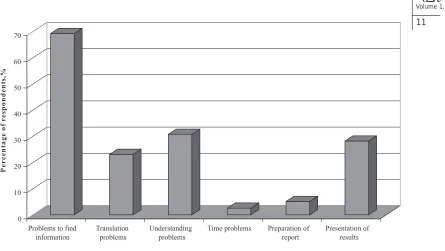
The response of pupils indicated also the difficulties to use the research methods (see Figure 3). The basic problems were connected with the collection of necessary information (67 % of all respondents). Respondents indicated mainly following problems:
1. etiquettes were designed unintelligible (more than 30 % of all respondents); 2. letters on the etiquettes were small and illegible;
3. some abbreviations of compositions can not be identified;
11
Volume 1, 2007
Figure 3. Answers of pupils on difficulties to use the research methods.
Such definitions were characteristic for the pupils with increased interest and sense of responsibility, which results in expanding of labour amount. The changes in attention to the products from their every day’s life were observed for the main amount of pupils. It was found, that some pupils have indifferent attention to the results of research studies.
The ecological questions related to the packages of used investigation’s objects were dis-cussed with the pupils during implementation of planned activities. It was found, that using the well-known objects from each day’s life of pupils, the ecological significance for sorting of household wastes can be more easy explained since pupils have very clear information on the composition of different goods and also packages of goods. Additional efforts were spent for clarification of composition of different packages and abbreviations on packages, as well as, the possibilities to sort the household wastes were explained taking into account the real situ-ation on pupil’s living place.
The research studies method was used for second school’s pupils in Riga French Lyceum, but taking into account the lessons learned from existing praxis, this method can be also intro-duced also for the training of the ninth form pupils, especially, for proper household wastes management at living place and school territory.
Conclusions
1. The scientific investigation’s method was introduced for 12-th form pupils from Riga French Lyceum in the training of natural science course.
2. Analysis of used research studies results shows that using the research methods pupils develop the skills for scientific activities, which results in essential increasing of knowledges on chemical composition of substances, as well as, the structure and functions of different substances from each day’s life objects.
12
References
Grîne M, Dreijalte S., Zvingevica A. (2000). Dabaszinîbas. Mâcîbu programma vidusskolai. Rîga, p. 62. Gorskis M., Rudzîtis G. (2004). Vispârîgâ íîmija vidusskolâ. Metodiskais lîdzeklis. Rîga: Zvaigzne ABC, p. 52.
Bartuðevièa A. (2004). Kritiskâs domâðanas mâcîbu metodes íîmijâ. Metodisks lîdzeklis skolotâjiem. Rîga: LU Akadçmiskais apgâds, p.71.
Äàíèëîâà À.Ã. (2002). Èç îïûòà ïðîâåäåíèÿ ìîíèòîðèíãà ðàçâèòèÿ îáùåó÷åáíûõ óìåíèé. Õèìèÿ â øêîëå, 10, p.22.-30.
Ïåòðîâ Þ.Í. (2002). Î òåõíîëîãèè ðàçâèòèÿ êðèòè÷åñêîãî ìûøëåíèÿ. Õèìèÿ â øêîëå, 10, p.31.-34.