OF PSYCHOLOGICAL STUDIES
HYPERION UNIVERSITY www.hyperion.ro
21
THE MODEL OF INTERACTION BETWEEN OPTIMISM,
LOCUS OF CONTROL AND HARDINESS
DAN VASILIUa
a “Ion Creangă” Pedagogical State University, Chișinău
Abstract
This research aimed to study the correlation between the locus of control and hardiness in case of optimistic individuals and of pessimistic individuals. Hardiness is a construct that anticipates the resistance to stress and the control on the resources required to go through exceptional situations. Locus of control indicates the modes of perception of the causes of success or failure as being internal or external, resulting from their own resources or under the influence of others. The biunique connection between the two constructs suggests that the adaptive modification of locus of control may have an effect on hardiness. The results of this research demonstrated that such relationship may be established only in case of optimistic individuals. In case of pessimistic individuals, there were no proofs of a correlation between locus of control and hardiness. According to the theoretical model resulted, meant to obtain results on hardiness, therapeutic assistance should be performed sequentially, first for the reinforcement of the disposition to optimism and, secondly, for the locus of control adaptive modification.
Keywords: optimism, pessimism, locus of control, hardiness.
1. INTRODUCTION
The personality factors of social-cognitive theory have an important role in the development of coping mechanisms, especially in crisis or unstable situations, and influence decision-making processes. Therefore, it is necessary to maintain a stable balance between such factors through self-regulation or therapeutic assistance from a specialist.
22
revealed significant correlations among the analyzed constructs. Research was conducted on a sample consisting of 283 students at the Massey University Albany. In 2015, Sara Keyvan Ara and Dr. Susan Imamipour, published an article that showed the correlation between locus of control and hardiness on sports performance. Kooranian, Khosravi and Esmaeli (2008) approached the phenomenon of resignation of nurses depending on the locus of control presence and on the hardiness score and the conclusion was that the two constructs correlate and are predictors of the analyzed phenomenon.
1.1. Optimism
Seligman (1992) defined the concept of “learned optimism” and thereby initiated the researches on optimism. Scheier and Carver (1992) describe the disposition to optimism as a general trend, relatively stable, in having a positive vision on the future and life experiences. Optimistic individuals assess the social and physical environment in a positive manner, invest more effort to prevent problems or to transform them, enjoy life more and have a better behaviour under stress.In contrast with the optimism is described the pessimism defined by negative expectancies on the effect of actions taken. Pessimistic individuals react to problematic situation and disappointments by renunciation, avoidance and denial. Optimism is generally associated with favourable effects. However, unwanted consequences were observed, especially in case of unrealistic or naive optimism. Optimism may correlate with negative effects under two circumstances: when it determines a passive behaviour and the positive effect is expected from luck, divinity or from a friend and under the circumstances in which, even if such circumstances cannot be changed, an optimistic person persists tenaciously to change them.
1.2. Locus of control
23 1.3. Hardiness
In 1979, Suzanne C. Kobasa introduced for the first time the concept of hardiness (Rizeanu, Vasiliu, 2016). This model refers to the resistance to stress; delimiting the individuals who remain healthy from those who develop health problems under the influence of this model. Individuals with high hardiness have better performances under stress conditions. Hardiness, as a personality trait, comprises three dispositions that operate as resources for the resistance to stress: Commitment, Control and Challenge. The hardiness construct was elaborated based on the results of a prospective study carried out over seven years. In more than 900 participants was noticed the dynamic of the relationship between the stress and disease incidence. Research data substantiate that certain participants remain healthy despite the intense stress due to those personality traits defined by the authors of the hardiness concept.
2. OBIECTIVES AND HYPOTHESES
2.1. OBIECTIVES
This research sought to emphasise the correlations between locus of control and hardiness on one hand and influence of optimism on them, on the other hand. The objective of the survey was to reveal a possible intervention model on the locus of control in an adaptive direction, depending on the optimism or pessimism manifested by an individual, in such a way as to obtain a hardiness improvement. The intervention model should be verified at a later stage in the experimental and clinical conditions.
2.2. HYPOTHESES
Work hypothesis: Correlation between locus of control and hardiness is influenced by the disposition to optimism.
A consequence of this hypothesis is that there is a theoretical model that explains the combined effect of optimism, locus of control and hardiness.
Verification of the practical validity of the model shall be the object of a further research.
3. METHOD
3.1. PARTICIPANTS
24
3.2. INSTRUMENTS
Locus of control was determined based on the Rotter’s Locus of Control Scale (1966), a 29-item questionnaire, calibrated for the population of Romania by Băban (1998). For optimism we used the LOT-R Scale (Scheier, Carver, 1994) calibrated and validated in 1998 by Băban (1998). The scale consists of 10 items with five multiple choice answers rated from 0 to 4. For scoring are considered the following items: 1, 3, 4, 7, 9 and 10. Hardiness was assessed with DRS15 Scale, the variants with 15 items, developed by Bartone (2005), validated and calibrated for the population of Romania by Vasiliu & all. (2015).
3.3. PROCEDURE
After the training of the participants in research were applied the questionnaires in order to assess the investigated constructs (optimism, locus of control and hardiness). The participants to this research were trained to tick off only one option for each scale item and were informed that all the options are correct. The administration method for each scale was paper-and-pencil. The scales administration had no time limit. In order to determine the significant correlations (the Pearson correlation coefficient) we used the p=0.05 significance threshold. .
3.4. EXPERIMENTAL DESIGN
The experimental design chosen for this research was correlational study where „O” represents training stage, „O1” represent the assessment of optimism,
„O2” the assessment of locus of control and „O3” the assessment of hardiness.
R O O1 O2 O3
The questionnaires were applied to each person or to the entire group.
4. RESULTS
25
Table 1. Descriptive statistics of data
N Minimum Maximum Mean Std. Deviation
Skewness Kurtosis
Statistic Statistic Statistic Statistic Statistic Statistic Std. Error
Statistic Std. Error Hardiness 357 14 45 31.90 5.613 -.346 .129 .070 .257 Locus of
Control 357 0 22 9.29 4.016 .068 .129 -.157 .257 Level LOC 357 1 2 1.22 .412 1.388 .129 -.073 .257 Level Opt 357 1 2 1.88 .326 -2.342 .129 3.505 .257
The connection between the locus of control and hardiness has been confirmed only for the optimistic persons. The correlations were statistically significant and negative (r=-0.432, p=0.001). This means that the optimistic persons with an internal locus of control obtained higher scores for hardiness than those with an external locus of control. The association was moderate and the noticed effect was medium (r2 = 0.192), i.e. 19.2% of the hardiness variation is explained by the locus of control variation. There was no correlation found between locus of control and hardiness for the pessimistic participants (r=-0.202, p=0.195) (Table 2).
Table 2. Correlations between locus of control and hardiness
Hardiness Locus of Control Hardiness 1
Locus of Control
-.432**
.000 1
Hardiness Locus of control Hardiness 1
Locus of Control
-.202
.195 1
Optimistic participants Pessimistic participants
26
Table 3. Effect of optimism and locus of control on hardiness
Dependent Variable: Hardiness Source Type III
Sum of Squares
df Mean Square
F Sig.
Corrected Model 2803.412a 3 934.471 39.219 .000
Intercept 110357.774 1 110357.774 4631.612 .000 Level_Opt 1312.594 1 1312.594 55.088 .000 Level_LOC 139.148 1 139.148 5.840 .016 Level_Opt *
Level_LOC 123.292 1 123.292 5.174 .024 Error 8410.957 353 23.827
Total 374482.000 357 Corrected Total 11214.370 356 a. R Squared = .250 (Adjusted R Squared = .244)
The analysis of the contrast matrices showed that
the optimistic personshave obtained significantly higher scores for hardiness (M dif=6.196, p=0.001) than the pessimistic persons. Furthermore, the persons with internal locus of control have obtained significantly higher scores for hardiness (M dif=-2.017, p=0.016) than the persons with external locus of control. In all the analyzed cases, the limits of the confidence interval of 95% did not include the zero value.
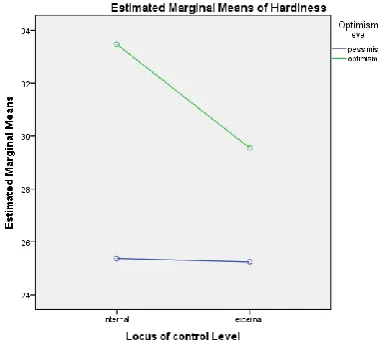
We have made the graphical representation (Fig. 1) of the theoretical model we found. According to this model, for the pessimistic participants the effect that the locus of control had on the hardiness scores was almost inexistent unlike the optimistic participants where we found that the effect was statistically significant and negative.
27
5. CONCLUSIONS
The statistical outcomes invalidated the null hypothesis and proved the existence of correlation between the locus of control and hardiness moderated by optimism. We have noticed that, for the pessimistic participants, the modification of the locus of control did not affect the level of hardiness. Pessimistic persons are characterized by negative expectations on the effect of the actions taken. Pessimistic persons react to problematic situations and disappointments by resignation, avoidance and negation. Changing their beliefs, in case of the external locus of control, i.e. the personal power is influencing just a little bit or not at all the events and such events are usually caused by the fortune, by the power of other people or by chance, will not lead to the modification of their attitude as regards their involvement in new actions or the acceptance of certain challenges generating new experiences. Pessimistic people will remain indifferent to the situation even if they feel that they can control it. These three general provisions which constitute the resources for an increased hardness will thus remain stable maladaptive.
As a consequence, the theoretical model suggests that the psychological intervention to change the locus of control has positive effects on hardiness only if we act in advance to strengthen the disposition to optimism. The more optimistic the person will be, the more significant will be the effect of the locus of control on the hardiness.
REFERENCES
Băban, A. (1998). Stres și personalitate. Cluj: Presa Universitară Clujeană. Bartone, P.T. (2007). Test-retest reliability of the Dispositional Resilience Scale-15, a brief hardiness scale. Psychological Reports, 101, 943-944.
Clarke, D. (1995). Vulnerability to stress as a function of age, sex, locus of control, hardiness and Type A personality. Social Behavior and Personality, volume 23, 1995, issue 3, pp: 285-286.
Keyvan, S.A., Imamipour, S. (2015). Comparison of Locus of Control and Hardiness in Professional and Novice Female Taekwondo Players. Journal of Applied Environmental and Biological Sciences, 5(4S)12-17.
Kobasa, S. C. (1979). Stressful life events, personality, and health – Inquiry into hardiness. Journal of Personality and Social Psychology37 (1): 1–11. doi:10.1037/0022-3514.37.1.1.PMID 458548
Kooranian, F., Khosravi, A. R., Esmaeeli, H. (2008). The relationship between hardiness/locus of control and burnout in nurses. Horizon of Medical Sciences 14(1): 58-66.
Lawler, K.A. and Schmied, L.A. (1992). A prospective study of women's health: the effects of stress, hardiness, locus of control, Type A behavior, and physiological reactivity. Women Health 1 9(1): 27-41.
Rizeanu, S., Vasiliu, D. (2016). Correlation between hardiness and the sense of coherence. Romanian Journal of Experimental Applied Psychology, vol. 7, issue 4, p 9-15.
28
Robinson, S.R. (2013). Assessing the relationship of health locus of control, hardiness, and health risks in African Americans. Central Michigan University.
(http://gradworks.umi.com/36/01/3601388.html).
Rotter, J. B. (1966).Generalized expectancies for internal versus external control of reinforcement. Psychological Monographs, 80, 609-611.
Seligman, M.E.P. (1992). Helplessness: On Depression, Development, and Death.
New York, N.Y: W.H. Freeman & Company.
Scheier, M.F. & Carver, C.S. (1992). Effects of optimism on psychological and physical well-being: Theoretical overview and empirical update. Cognitive Therapy and Research 16: 201. doi:10.1007/BF01173489.
Scheier, M.F., Carver, C.S. and Bridges, M.W. (1994). Distinguishing optimism from neuroticism (and trait anxiety, self-mastery, and self-esteem): A re-evaluation of the Life Orientation Test. Journal of Personality and Social Psychology, 67, 1063-1078.
Vasiliu, D. (2016). Correlations between Locus of Control and Hardiness.
Romanian Journal of Experimental Applied Psychology, vol. 7, Special issue 2.
Vasiliu, D. (2016). Correlations between Self-Esteem, Locus of Control, Optimism and Sense of Coherence. Romanian Journal of Experimental Applied Psychology, Vol. 7, ISSUE 4, DOI:10.15303/rjeap.2016.v7i4.a2.
Vasiliu, D., Marinescu, D.A., Marinescu, G., Sîrbu, M. (2015). Evaluarea Robusteții. Proprietăți psihometrice pentru Dispositional Resilience Scale DRS-15. Revista de studii psihologice nr. 2, București: Universitatea Hyperion.