Agnieszka Jeziorski, Alain Legardez, Doris Valente
Taking into Account Knowledge Reresentations about the Crisis, Uncertainty and
Risk in Teaching Economics: A Comparative Study of European Students in
Economics Programmes
Keywords:
social representations, knowledge representation system, relation to knowledge, economic uncertainty, crisis
Agnieszka Jeziorski is a PhD student in education
sciences at Aix-Marseille University (France) and at University Laval (Québec, Canada). Her research focuses on the study of social representations of sustainable development in the context of teacher training and in economic education.
email: [email protected]
Alain Legardez is professor of education sciences
at the “Ecole Supérieure du Professorat et de l’Education” of the University of Aix-Marseille. He coordinates a research team which is particularly interested in economic, social and environmental socially acute questions, and the thematic “school and territory”. email: [email protected]
Doris Ginevra Valente is teacher in Economics
and collaborates as teacher – trainer with the University of Milan-Bicocca and other Institutions. She is author of several textbooks and publications on educational matters and is honorary member of the Association of European Economic Education (AEEE). email: [email protected]
Drawing on work conducted on the use of the analysis of social representations in a school context and on the management of relationships with knowledge about socially acute economic issues, a medium-term survey (2000 to 2009) was conducted in several European countries of students who were at the end of the cycle in their economics programmes at lycée, or secondary school. The study examined the students’ system of knowledge representations of “economic uncertainty and risk”. The aim was to identify scientific, academic and social elements of a possible representation in this domain. The analysis will focus on a comparison between Italian and French students; it will seek to identify constants and changes, to speculate on their causes and effects, and to suggest instructional strategies that may have an impact on potential obstacles and supports for academic and civic learning.
uncertainty in the social representations of
European students who were attending the last year of secondary school (economics or management studies) and who were thus relatively specialized in economics disciplines. The survey was conducted in three different times and in several European countries (France, Italy, Sweden, Denmark, Germany, Greece, Portugal), in the years 2000, 2004 and 2009. Our presentation focuses on the results observed in France and Italy in 2009 in comparison with the results of the earlier surveys conducted in 2004 and 2000. This diachronic research was conducted from a didactic perspective, to identify elements of a possible social representation that may contain obstacles to or supports for the pro-cess of teaching and learning. The goal is therefore to verify the existence of social representation(s) and/or a system of knowledge-representation(s) on the topic of economic uncertainty that would be illuminating in instructional situations in the secondary school.
During the first phase, in 2000, research was conducted at the initiative of the AEEE2. Its aim was to study what was meant by economic uncertainty
and risk3for students in several European countries (France, Italy, Sweden and Denmark) and to derive insights for the teaching of economics (Legardez, Valente 2003). A second phase of the research aimed to reiterate the international comparisons, with the questionnaire administered in 2004 in five European countries that had been surveyed the first time (Germany, France, Italy, Greece, Portugal). In 2009, the investigation focused on the two countries at the origin of the research, France and Italy, in an effort to understand the constants and the changes more deeply. The aim was to determine the elements of continuity and change among the young students surveyed, in relation to the different times and places and taking into account the diversity of the contexts.
1 Introduction
Comparative studies have been conducted on the European system of economic studies at the secondary school level and the changes in it, in particular comparing France and Italy (Legardez, Valente 2009; Legardez, Valente, Jeziorski 2010). Research has also been conducted on the teaching of economic subjects in school education, such as money, work and unemployment, and on many other socially acute questions (Legardez & Simonneaux 2006, 2011) that are less specific to economics, such as globalization (Legardez et al. 2009) and sustain-able development1. These studies were conducted from the perspective of a partial specification of the process of didactic transposition (Chevallard 1991) and with respect to knowledge relationships (Legardez 2004b), in particular the relationship between school knowledge and social knowledge; the latter was studied using a methodology borro-wed from the structural theory of social representa-tions (Legardez 2004a).
2 Theoretical problem: how can social representations be used to develop didactic strategies?
2.1 Social representations and social learning
This study made use on the one hand of the theory of social representations (Abric 1994; Farr, Moscovici 1984; Flament 1987; Jodelet 1989; Moscovici 1961; Vergès 1994, 2001) and on the other of the analysis of “systems of knowledge representation in educational settings” (Legardez 2004a) in order to make the prior knowledge for learning at school a subject of diagnostic assess-ment. Legardez (2004a) describes this prior
knowledge as a system of knowledge
represen-tations that consists of academic knowledge acquired in lessons prior to learning a particular socially acute question, on the one hand, and social representations constructed outside of the school, on the other.
Since the book by Moscovici (1961,
Psycho-analysis, son image and son public), the study of
social representations in science has undergone great change. Today, the concept of social represen-tations is used not only in social psychology but also in other disciplines. Many researchers emphasize the relevance of the theory of social representations in research in the educational sciences, in particular in didactics (Beitone, Legardez 1997; Garnier, Rouquette 2000; Garnier, Sauvé 1998-1999; Gilly 1994; Legardez 2004a). As is pointed out by Garnier and Sauvé (1998-1999), as a process of decoding reality that guides action, an understanding of social representations can help to better identify the dynamics governing people’s behaviour and thus to propose the most appropriate instructional strate-gies.
The social representation is a form of knowledge that allows us to capture and interpret the world and our relationship to the world. More precisely, the social representation can be seen as “a form of socially elaborated and shared knowledge that has a practical aim and is concurrent with the construction of a common reality by a social group” (Jodelet 1989). It is a form of natural, naive or everyday knowledge, an organized set of cognitions (opini-ons, beliefs, attitudes, images, etc.) that does not amount to scientific knowledge.
According to the structural approach to social representations (Abric 1994; Flament 1987), every social representation is structured around a central core that gives the representation its meaning and coherence. The core is the most stable element of the representation, because it is the most resistant to change and persists amidst contexts that are moving and evolving. A social representation can be transformed only when the core is changed. According to Abric (1994), the identification of the core plays a crucial role in the comparative analysis of social representations, because for two represen-tations to be different, they must in fact be organized around two different central cores. As a result, it is not enough to simply identify the content
of the representation. The way the components are organized also has to be considered. Two different representations may contain the same elements, but can never be organized the same way. In other words, two representations defined by the same content can be radically different from each other when the organization of these elements, and hence the centrality of certain of the elements, is different.
Hence, based on the structural approach to social representations, our study relates more specifically to identifying the elements that may belong to the core of a social representation of economic uncer-tainty.
This is a didactic problematic; it fits in with the relationships of various kinds of knowledge (Chevallard 1991) in teaching and learning situations. In the context of managing relationships
to knowledge, the teacher helps the students to
construct their knowledge by working on the social knowledge imported into the classroom in order to facilitate the learning of academic knowledge (the purpose of academic learning) and by preparing the
re-exporting (conversion) of some of the learned
knowledge into social knowledge (the purpose of civic education) (Legardez 2004a, 2004b).
2.2 Economic lessons and socially acute questions
Recent years have seen the appearance in France of didactic work grouped under the heading of what is called Socially Acute Questions. These questions have now been classically defined by Legardez and Simonneaux (2011).
“A ‘(doubly) socially acute question’ is a question that takes (or is made to take) an academic form and has the following characteristics:
- It is acute within the society: an issue like this calls into question the social practices of the educational actors (inside and outside the institution) and refers to their social represen-tations; it is considered important by society (overall or in one of its components) and pro-vokes debate (from conflict to disputes); it is often the subject of media coverage so that most of those in the school setting are aware of it. Its social production in the society thus makes it ‘acute’ in an initial sense.
- It is acute in the academic knowledge: a question is all the more ‘potentially acute with respect to academic knowledge when it is doubly acute in the two other levels of knowledge’. (Legardez & Simonneaux 2011, 21-22).
Regarding the scope of subjects taught in economics, this problem is partly specific, especially as it relates to an area where most of the issues taught are socially acute (Legardez & Simonneaux 2006). When the knowledge to be taught consists of social, economic, legal and political topics, then the students are loaded up with fragments of knowledge of different origins — experiences, stereotypes, myths, ideologies — and this social knowledge often interferes with academic knowledge, to such an extent as to make learning difficult. This socially acute academic knowledge interferes with the social practices of the students and teachers, and thus demands special attention (Legardez & Simonneaux 2006).
It would be advisable that teachers take into account students' prior knowledge to build teaching strategies that are consistent and specific to the contexts, while trying to avoid the obstacles identi-fied in this prior knowledge and taking advantage of the supports therein.
The results of a survey such as the one we carried out can provide valuable information for the teaching / learning of these topics, or to help ensure that the students, who have worked on these topics at school, can then transform this into social know-ledge and civic behaviour.
3 Methodology 3.1 Tools
The survey was conducted by a written questionnaire4 (see Appendix) administered in the schools. The questionnaire consisted of an open question with spontaneous evocations and six questions with confirmations-rebuttals-explanations. Here we draw on the data from four questions. The first question (Q1), posed at the beginning of the questionnaire, focused on the students’ spontaneous evocations activated by the term economic
uncer-tainty; this is the fundamental question for this
research tradition. The terms mentioned are classi-fied by the frequency and ranking of occurrence so as to search for candidate elements for the core of a social representation (Vergès 2001). In question Q3, the students surveyed were asked to identify which domains they think concern risk, danger and uncertainty. In Q4, the students decided for which economic actors – from among those proposed in the list – uncertainty is absent or at a maximum (on a scale from 1 = absent to 5 = maximum). Q5 allowed them to reflect on the same actors, by asking them to choose how much information these actors have (1 = none to 5 = perfect)5.
In order to look for the existence of social representations of uncertainty among European youth, we used programmes for the analysis of evo-cations and of the similarity of questionnaires and
digital data from Pierre Verges (1994, 2001).
In order to enrich the results from the question-naire, in 2001 semi-structured interviews were con-ducted in Italy and France by the researchers with small groups of former students who had responded to the questionnaire in 2000. These interviews took place in a school setting (for the students who were still in secondary school) or in university (for those who were out) — a broader school context, there-fore, but not didactic and outside the presence of a teacher.
3.2 Population
Our analysis focuses on the responses of French and Italian students. The population of students who participated in the survey was composed as follows:
- In May 2000 (questionnaire): 129 students (from the economic and social sciences,
economics-management, services vocational
lycées - LPTs) in France; and of 200 students in Italy (business technical institutes - ITCs).
- In April 2001 (interviews): 3 groups of 10 students in Italy (in university or a specialist institute); 1 group of 10 students in France (last year of economics and social science).
- In May 2004 (questionnaire): 206 students aged 16 to 18 in France (“SES” [social and economic sciences], economics-management, services voca-tional lycées - LPTs); 111 students (vocavoca-tional lycée).
- In February 2009 (questionnaire): 235 students (SES, economics-management, services vocational lycées - LPTs) in France; 241 in Italy (business technical institutes - ITCs).
The diversity of the student populations assumes that precautions in usage have been taken in particular concerning the conditions (not fully under the control of the researchers) for filling in the questionnaires, translation problems and student characteristics: age groups, level of studies, etc., which are not exactly the same for the different edu-cation systems in the countries selected6.
4 Main results
4.1 Overall results for 2009 4.1.1 Spontaneous evocations
First, we seek to identify the elements that could be part of a possible social representation of
econo-mic uncertainty in the school context.
The responses of the European students to the question of evocation showed that in 2009 economic
uncertainty primarily evoked the crisis,
Figure 1: Evocations of Italian students
small, because the big have a lot of information,
unlike the “small”. It is also worth noting that uncertainty strongly affects governments — for more than 45% of the students in both countries — even though they have a lot of information. The European Union also has good information accor-ding to the students, but for 40% of the French, it still has a lot of uncertainty. A noteworthy exception is that in 2009 the results for banks and employees are similar: more than 50% of students in both countries believe that they have a lot of uncertainty (news effect), even if they also have a lot of information.
Figure 5: Perception of actors with respect to information
4.2 Comparison of results for 2009 with those for 2000 and 2004
The results for 2009 compared with those for 2000 and 2004 show that there is great stability in the students' evocations, but there are also context effects as well as cultural and political effects that characterize the two countries. We present a few qualifications on the comparative perspective in the following paragraphs.
4.2.1 Crisis
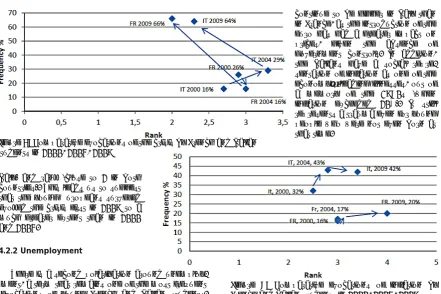
Figure 6 below shows the position occupied by the term crisis in 2000, 2004 and 2009. Note that while evocations of the crisis were already prominent in the past, its impact on the students' responses was significantly greater in 2009, both in terms of frequency (with 65% for French and 64% for Figure 2: Evocations of French students
4.1.2 Domains of uncertainty and risk
Question Q3 proposes that the students distin-guish uncertainty from risk, by linking the items proposed to these two domains. By observing the most common links, we can infer their percep-tions of the two domains. The 2009 results (Figure 3) show a fairly clear perception of two distinct domains of uncertainty and risk. They associate risk with invest-ment, business creation, business manageinvest-ment, and the financial markets, and uncertainty with economic policy, growth, GDP, income and work.
Figure 3: Perceptions of risk and of uncertainty
4.1.3 The actors in the face of uncertainty
With regard to the relationship of the actors to uncertainty and information, an analysis of the answers to Q4 and Q5 in 2009 (Figures 4 and 5) shows that the students distinguish two categories of economic actors that are clearly opposed: on the one hand, big actors that seem distant from indi-viduals: multinational corporations, insurance firms, the hypermarkets, etc.; and on the other, small actors that seem close to individuals: employees, households, SMEs and small firms. According to the students, the degree of uncertainty affecting the economic actors is low for the big and large for the
Italy) and rank (close to 2 in both countries). This leads us to suggest that the young Europeans surveyed evoked the crisis first in 2009 to a much greater extent than in 2000 and 2004.
4.2.2 Unemployment
4.2.3 Inflation
The third most frequently selected term among the evocations is inflation. Taking into account the results of our three surveys (see Figure 8 below), we note that the evocations are consistently more frequent in Italy than in France (16 points more in Italy in 2000, 26 in 2004, and 22 in 2009). We are therefore seeing the consequences of a probable
context effect.
It can be hypothesized that the context effect depends on the difference in inflation rates, which
4.3 Some comparisons with the initial results of the 2012 survey in Italy
In May 2012, the questionnaire on economic uncertainty was once again given out in a school context to 85 Italian students of the same age and same grade as the previous surveys8. Our research aims to analyze whether the elements of stability in the students’ spontaneous evocations that existed in the previous surveys are still present, thereby confirming continuity with the past, or whether new impacts related to news events and / or the socio-Figure 6: Comparative evocations of the crisis by French and Italian
students in 2000, 2004, 2009
There is a second polarization around unemploy-ment, a term that remains one of the most frequent evocations of young French and Italian students. Note, however, a clear difference between the two countries: the problem of unemployment creates uncertainty for all the students surveyed, but especially for the Italians (its frequency is 15 points higher and its rank is closer to 0.5). We can still see (Figure 7 below) divergent trends between France and Italy: in 2009, the unemployment problem is felt most strongly in Italy, while the opposite was true in 2000, which also corresponds to changes in the unemployment rates in both countries.
Figure 7: Comparative evocations of unemployment by French and Italian students in 2000, 2004, 2009
continue to be higher in Italy than in France, as the introduction of the euro has had a greater impact on prices, given the absence of government controls. In addition, the Italians have a social repre-sentation of inflation as one of the economy’s leading illnesses, out of a memory of the 1980s (when inflation exceeded 20%). It still represents a trauma even for young people who were not even born at that time.
Figure 8: Comparative evocations of inflation by French and Italian students in 2000, 2004, 2009
4.2.4 Uncertainty, risk and the economic actors We already pointed out that in 2000 and 2004 risk was limited to the management of business and the financial markets. Interviews clarified that young Europeans assimilated manager risk-takers to small entrepreneurs and thought the big had the resources to avoid more risk.
political context are calling these elements into question. The hypothesis could be made that chan-ges on the scale of the financial crisis followed by the current economic crisis could have had an im-pact on the social representations of the students.
The responses of the Italian students to the evocation question showed that in 2012 economic
uncertainty still evokes unemployment (49.4%), crisis (34.1%), inflation (22.4%) and the stock market
(10.6%). The table below shows the similarities and differences in frequencies for the terms most often mentioned in Italy compared to 2009.
At first glance, one might think that the young people are less responsive to unemployment and the crisis, and even a little less to inflation and the stock market compared to the evocations of 2009. We then sought to understand what positions the terms evoked occupy relative to the others that are less central in the students’ representations.
In addition to a relative decrease in the percen-tage of evocations with respect to the terms that political context are calling these elements into question. The hypothesis could be made that chan-ges on the scale of the financial crisis followed by the current economic crisis could have had an im-pact on the social representations of the students. The responses of the Italian students to the evocation question showed that in 2012 economic uncertainty still evokes unemployment (49.4%), crisis (34.1%), inflation (22.4%) and the stock market (10.6%). The table below shows the similarities and differences in frequencies for the terms most often mentioned in Italy compared to 2009. At first glance, one might think that the young people are less responsive to unemployment and the crisis, and even a little less to inflation and the stock market compared to the evocations of 2009. We then sought to understand what positions the terms evoked occupy relative to the others that are less central in the students’ representations. In addition to a relative decrease in the percentage of evocations with respect to the terms that have evoked stability since 2000 (the beginning of our research), it is interesting to see that the new terms reinforce the old key words and that it is perhaps necessary to view these word clouds gathered around them as elements that would render the representations of the youth around the four key terms even more stable. This could be considered a somewhat different reading of the results, but it could also lead to an understanding of other effects, such as the effect of current events or the effect of the socio-political context, which probably influ-enced the evocation of the terms mentioned.
Figure 9: Stability of effects – Italy 2012
We present some examples of these effects in the tables below.
Figure 10a and 10b: Evocations (%) of uncertainty – Italy 2012
For example, if we look at the two terms
unemployment and temporary job, together they
represent 63.5% of evocations. Lack of work then appears as the central problem for the young Italians surveyed.
In 2012, the term spread was mentioned by 22.4% of those surveyed, i.e. the same level as inflation. In this case, it is probably the effect of current events that can be identified among the young Italians, as the euro crisis has hit Italy hard. If we add the words
euro (5.9%), money (9.4%) and devaluation (2.4%) to crisis (34.1%), evocations that reflect the pressure of
current events take on great importance.
Again, the presence of key terms such as
government, national debt, taxation, national bud-get, fiscal pressure and tax evasion points to the
effects of a socio-political context that is very specific to Italy, a country in which the crisis is becoming a central event.
The last aspect we want to emphasize, while looking at the table below, is a current event effect of the financial crisis through the terms stock
exchange (element of stability), which we can relate
to banks (already weakly present in the past),
interest rate, risk, financial system, bank failure, financial and economic power, bond and central bank. This group represents 54.1% of evocations,
which tends to reinforce the relevance of the results of our survey.
The stability of the evocations over time on the one hand and the collateral effects on the other led us to hypothesize that the fundamental problem of economic uncertainty being perceived and discussed by the young Italians concerns their future — their difficulties, problems and fears, which are likely to be radicalized as the crisis deepens.
5 Discussion
In light of the results presented, we will discuss the existence of a genuine social representation of
uncertainty, and suggest certain ways to shed light on didactic strategies for teaching economics.
5.1 On the existence of a social representation of uncertainty
5.1.1 Social representation or knowledge representation system?
Based on the data for 2009, we can propose the hypothesis that there is no genuine autonomous social representation of economic uncertainty, but rather a knowledge-representation system (KRS) developed in an academic context through the stimulation of the questionnaire, which activates borrowings from elements of various types, inclu-ding elements of a genuine social represen-tation (SR) of the crisis ... along with “residues” of academic knowledge learned and then reinterpreted by the individuals. The high frequency of crisis in other surveys confirms that the representation of uncertainty is characterized structurally around the crisis, while giving it a negative connotation above all; what is observed therefore is the stability of a possible central core (Abric 1994).
Our hypothesis of the existence of elements of a social representation of the crisis in the knowledge representation system of economic uncertainty may be reinforced by the results of recent research on social representations of the economic crisis in four European countries (Galli et al. 2010) and social representations of the financial crisis of 2008 in France (Ernst-Vintila & Delouvée & Rouquette 2010).
In fact, the two research works identify
unemployment as a potential element in the core of the social representation of the crisis. In addition, it seems that this is a transnational representation (Galli et al. 2010).
One might then re-raise the question of the domination of a KRS of economic uncertainty by the SRs of unemployment and the crisis and of the exis-tence of a newly arising themata (Moscovici, Vignaux 1994; Markova 2000) — that is to say, of a system of binary oppositions (e.g. good / evil; certain / uncertain; complex / simple) located upstream of the social representation — concerning a more overall uncertainty related to the complexity of contemporary society (Beck 2001).
We also found that the most frequent evocations (crisis, unemployment, inflation, stock market) were strongly centered on the respondents themselves (that is, on their own relationships with actors and economic and social relations outside the school setting).
5.1.2 Effect of orthodox contexts?
It is also necessary to take into account the fact that the questionnaires were administered in a school setting, in the classroom with the teacher present, even though the survey was anonymous and the teachers simply played the role of an intermediary. We confirmed the presence of a school effect, which would amount to an orthodox context
effect (Moliner 1996) and would alter the effect of the social context. This configuration would tend to confirm that we are in the presence of a complex system of knowledge representations.
However, the interviews held in 2001 in the school — but without the presence of the class teacher — showed a strong contamination of a social representation of a future that is uncertain, which young people activated when they were stimulated by the questions about uncertainty and risk. As we have pointed out, the same terms emerged in the evocations in 2009, which would tend to confirm the domination of a reference SR over the general uncertainty omnipresent in society and thus not very sensitive to the orthodox context (Legardez 2004a).
5.2 Didactic questions for teaching economics in secondary school
5.2.1 Prior knowledge in economics and economic theory: concurrent knowledges?
The students seem to have highly structured social knowledge on these issues. Contrary to what might be suggested by the (relative) newness of the themes, the students in economics studies in the countries concerned have prior knowledge (in a school context) about “economic uncertainty and risk” that is quite strongly structured around
normalcy in market economics9. The theme of uncertainty concerns economic life in general and assumes a particular importance in this historical period, which is characterized both by crisis and frequent changes in a number of areas, including for
example changes in production, markets,
consumption and technological innovation, but also by the influence of exogenous factors such as the environment and the structure of the population.
From the standpoint of economic theory, the categories certainty and uncertainty occupy a significant place in the scientific development of different economic paradigms. You can read a part of the production of economic thought through these two categories: the absence of uncertainty in the theory of the early neoclassical economists (Walras, Menger, Jevons) and the presence of the category
uncertainty at different levels in the development of
economic thought (Knight, Keynes, von Neumann, Lucas, Simon, Coase, etc.). From a didactic point of view, the question is then about the choice of the knowledge to offer in the teaching of economics and how to deal with the category of “uncertainty” as an object of study.
5.2.2 How to develop a teaching strategy on the theme of “economic uncertainty and risk”?
- Identify supports and obstacles
If it is decided to devote some attention to
uncertainty as a subject of education, we can
Journal of Social Science Education Volume 12, Number 2
© JSSE 2013
ISSN 1 61 8-5293
that the teachers take into account students' prior knowledge so as to develop an appropriate didactic strategy and thereby hope to avoid the obstacles and take advantage of the supports that have been identified in this prior knowledge. Among the possi-ble obstacles, the question of managing economic risks is a priori inconsistent with the dual certainty asserted by the students that, on the one hand, the future cannot be known, and on the other, that these risks are inherent to the market economy (risk is normal in the market), so nothing can really limit them. We can then suggest that this probable obstacle could be worked on prior to any other teaching / learning activity. It is also important to take into account the general obstacle of the difficult distancing from the learner’s own experience, which is necessary in order to learn to accept autonomous, abstract economic knowledge. In the interviews, we have found a tendency among the students to understand economics starting from their own experience (or that of their relatives).
Teachers can also seek supports — for example, with regards to the belief that small businesses bear the brunt of economic risk, while the big can avoid it in part due to economic knowledge, or, as comes out in the interviews, with regards to the distinction between the realm of the certain, such as consum-ption (“even without income people consume”) and the uncertain (crisis, unemployment, income), which they could draw on for addressing the management of economic risks. It is also possible to try to modulate the degree of theorization of the lesson: either by limiting the recourse to theorization — without however doing away with a clear problema-tization of the issue — or by taking into account the specific obstacles and supports in each theory. For example, one might think that the radical uncertainty of Keynsianism is unlikely to encounter any obstacles (other than the abstraction of the theory), whereas the postulate of perfect information and of a world that is perfectly known by neoclassical economists might conflict with the prior knowledge of young Europeans.
- Organize discussion
Taking into account these supports and having identified the main obstacles that may thwart learning at school, the teacher can propose a reasoned debate that has been prepared in advance and is presented in class on the issues of economic uncertainty and risk (Legardez 2003), and thus try to collectively construct academic knowledge that is close to the scientific knowledge. One of the strategies with the greatest potential effectiveness would be to work on a particular obstacle that has been identified as resistible (in that it can be worked on) and “critical” (in that it blocks the acquisition of further knowledge), for example on ways to limit uncertainty among various economic actors.
A secondary objective for the teacher — but essential for the school (more specifically here for economics lessons) — would be assisting the students to then re-export this academic knowledge into their social knowledge so as to help develop
confirm that we are in the presence of a complex system of knowledge representations.
However, the interviews held in 2001 in the school — but without the presence of the class teacher — showed a strong contamination of a social representation of a future that is uncertain, which young people activated when they were stimulated by the questions about uncertainty and risk. As we have pointed out, the same terms emerged in the evocations in 2009, which would tend to confirm the domination of a reference SR over the general uncertainty omnipresent in society and thus not very sensitive to the orthodox context (Legardez 2004a).
5.2 Didactic questions for teaching economics in secondary school
5.2.1 Prior knowledge in economics and economic theory: concurrent knowledges?
The students seem to have highly structured social knowledge on these issues. Contrary to what might be suggested by the (relative) newness of the themes, the students in economics studies in the countries concerned have prior knowledge (in a school context) about “economic uncertainty and risk” that is quite strongly structured around
normalcy in market economics9. The theme of uncertainty concerns economic life in general and assumes a particular importance in this historical period, which is characterized both by crisis and frequent changes in a number of areas, including for
example changes in production, markets,
consumption and technological innovation, but also by the influence of exogenous factors such as the environment and the structure of the population.
From the standpoint of economic theory, the categories certainty and uncertainty occupy a significant place in the scientific development of different economic paradigms. You can read a part of the production of economic thought through these two categories: the absence of uncertainty in the theory of the early neoclassical economists (Walras, Menger, Jevons) and the presence of the category
uncertainty at different levels in the development of
economic thought (Knight, Keynes, von Neumann, Lucas, Simon, Coase, etc.). From a didactic point of view, the question is then about the choice of the knowledge to offer in the teaching of economics and how to deal with the category of “uncertainty” as an object of study.
5.2.2 How to develop a teaching strategy on the theme of “economic uncertainty and risk”?
- Identify supports and obstacles
If it is decided to devote some attention to
uncertainty as a subject of education, we can
sug-gest some ideas for a possible teaching strategy that is derived from our hypotheses and which attempts to take into account theoretical elements and economic developments. It would be advisable first
their civic personalities and therefore their choices (Legardez, Simonneaux 2006).
6 Conclusion
This survey, which was conducted from the perspective of a diachronic international comparison, should further take particular account of the specific curricular, pedagogic and didactic characteristics of education in economics (here French and Italian lycées; Legardez, Valente 2009) to study the influence of these context effects on the structuring and then the evolution of the students’ knowledge representation systems, prior to and then after the process of teaching and learning. Work conducted on other socially acute issues and on reference knowledge — globalization (Legardez et al. 2009),
sustainable development (Jeziorski 2012; Legardez,
Simonneaux 2011) — has also been shown to be
potentially acute in education (academic and
non-academic) and requires somewhat specific didactic analysis. These comparative analyses (over time, in relation to their territorial and socio-cultural contexts and situated in their hierarchical school system) could allow a more detailed knowledge of the didactic variables involved, and would therefore better inform instructional strategies10. Experimen-tation and a variety of convergent and / or complementary strategic studies would probably contribute to equipping the teachers in the concerned disciplines. Thus recent studies advocate the instruction process involved in research (Chevallard & Ladage 2010), while others argue for classroom debate on socially acute questions (Giral, Legardez 2011; Legardez 2003; Simonneaux 2006) – these are new strategies that are alien to traditional forms of schooling (Vincent 1994) and could contribute to developing new forms of schooling.
References:
Abric, Jean-Claude. 1994. Pratiques sociales et représentations. Paris.
Beck, Ulrich. 2001. La société du risque; sur la voie d’une autre modernité, Paris : Flammarion. Beitone, Alain; Legardez, Alain. 1997. La monnaie et
ses représentations: éléments pour une stratégie pédagogique en économie. In : Beitone, Alain ; Legardez, Alain, dirs., Travaux en didactique des sciences économiques et des sciences sociales. Aix-en-Provence: Publications de l’Université de Provence. 289-310.
Chevallard, Yves; Ladage, Caroline. 2010. La pédagogie de l’enquête dans l’éducation au
développement durable. Communication au
Colloque international « Éducation au développe-ment durable et à la biodiversité » (IUT de Provence, Digne les Bains, 20-22 octobre 2010).
Ernst-Vintila, Andrea; Delouvée, Sylvain and
Rouquette, Michel-Louis. 2010. La crise financière de 2008 : menace collective ou défi individuel ? Une analyse de la pensée sociale mobilisée en situation de crise. In : Cahiers Internationaux de Psychologie Sociale, 87, 515-542.
Farr, Robert; Moscovici, Serge. 1984. Socials representations. Cambridge : Cambridge Univesity Press.
Flament, Claude. 1987. Pratiques et représentations sociales. In: Jean-Léon. Beauvois; Joule, Robert-Vincent et al. Perspectives cognitives et conduites sociales. Théories implicites et conflits cognitifs. Paris : PUF, 143-150.
Galli, I., Bouriche, B., Fasannelle, R., Geka, M., Iacom, M. and Iacob, G. 2010. La représentation sociale de la crise économique dans quatre pays européens. In : Cahiers Internationaux de Psycho-logie Sociale, 87, 585-620.
Garnier, Catherine; Rouquette, Michel-Louis. 2000. Représentations sociales et éducation. Montréal: Éditions Nouvelles.
Garnier, Catherine; Sauvé, Lucie. 1998-1999. Apport de la théorie des représentations sociales à l’éducation relative à l’environnement. Conditions pour un design de recherche. In: CIRADE, Education Relative à l’environnement, no. 1, 65-76.
Gilly, Michel. 1994. Les représentations sociales dans le champ éducatif. In : Jodelet, Denise (ed.), Les représentations sociales. Paris: Presses universitaires de France, 363-386.
Giral, Jacky; Legardez, Alain. 2011. Analyser les débats sur des questions vives
environne-mentales. Quelles conditions pour une
coconstruction de savoirs pour l’action ? In: Legardez, Alain; Simonneaux, Laurence, dirs. Développement durable et autres questions d’actualité. Les Questions Socialement Vives dans l’enseignement et la formation. Dijon: Educagri, 113-128.
Jeziorski, Agnieszka. May 2012. Spécificités
disciplinaires de l’éducation au développement durable dans les représentations des futurs enseignants français des sciences de la nature et des sciences humaines et sociales. In : Colloque “Rapport aux savoirs, éducation relative à l'environnement et au développement durable”, 80ème congrès de l’Acfas, 7-11 May 2012, Montréal, Québec.
Jodelet, Denise. 1989. Représentations sociales : un domaine en expansion. In : Jodelet, Denise (ed,). Les représentations sociales. Paris, Presses
Legardez, Alain. 2003. Savoirs des élèves et débat argumenté. L'exemple de l'incertitude et du risque en économie. In: Les Cahiers du Cerfee, Vol. 19, 89-99.
Legardez, Alain; Valente, Doris. 2003. Inchiesta sull’incertezza in economia nelle rappresentazioni sociali dei giovani europei. In: Incertezza e Rischio Atti della XIII Conferenza AEEE Mafigraf Milano, Italy, 79-108
Legardez, Alain; Valente, Doris. 2009. Tensions, concurrence et légitimations ; comparaison natio-nale et internationatio-nale. L’exemple des enseigne-ments économiques des lycées en France et en Italie. In: Education Comparée. Nouvelle série, No. 2: “Le métier d’enseigner à l’épreuve des contextes“. Paris : AFEC, 57-74.
Legardez, Alain; Valente, Doris; Jeziorski, Agnieszka. 2010. Enquête sur l'existence d'une représentation sociale de “l’incertitude” chez des jeunes européens, dans une perspective didactique, In:
10e Conférence internationale sur les
représentations sociales, 5-8.7.2010, Tunis. Legardez, Alain. 2004a. L'utilisation de l'analyse des
représentations sociales dans une perspective didactique. L'exemple des questions économiques et sociales. In : Revue des Sciences de l'Education Vol. 30, No. 3, Montréal: Universités du Québec, 647-665.
Legardez, A. 2004b. Transposition didactique et rapports aux savoirs; l’exemple de questions économiques et sociales, socialement vives. In: Revue Française de Pédagogie, Vol. 149, 19-28. Legardez, Alain et al. 2009. Rapport de recherche
sur l'enseignement de la mondialisation n°39-127 (2006-2008): INRP and IUFM d’Aix-Marseille. Legardez, Alain; Simonneaux, Laurence. 2006.
L'école à l'épreuve de l'actualité. Enseigner les questions socialement vives. Paris: ESF.
Legardez, Alain; Simonneaux, Laurence. 2011. Développement durable et autres questions d'actualité. Questions socialement vives dans l'enseignement et la formation. Dijon: Educagri Editions.
Markova, Ivana. 2000. A theorical perspective on themata. In: Actes de la 5ème conference internationale sur les représentations sociales. Montréal, Canada, 29.08.-02.09.2000.
Moliner, Pascal. 1996. Images et représentations sociales. De la théorie des représentations à l’étude des images sociales. Grenoble: PUG. Moscovici, Serge.1961. La psychanalyse, son image
et son public. Paris: PUF.
Simonneaux, Laurence. 2006. Quel enjeu éducatif pour les questions biotechnologiques. In: Legardez, Alain; Simonneaux, Laurence (eds.). L'école à l'épreuve de l'actualité. Enseigner les questions socialement vives. Paris: ESF, 33-60. Verges, Pierre. 1994. Approche du noyau central:
propriétés quantitatives et structurales, Structures et transformations des représentations sociales. In: Guimelli, Christian, ed, Lausanne, 233-253. Verges, Pierre. 2001. L’analyse des représentations
sociales par questionnaires. In: Revue Française de sociologie, Vol. 42, No. 3, 537-561.
Vincent, Guy. 1994. L'éducation prisonnière de la forme scolaire. Lyon : Presses universitaires de Lyon.
Endnotes
1 ANR Research “Education in sustainable development; supports
and obstacles” (2009-2012).
2 AEEE (Association of European Economics Education). This
survey was conducted on the occasion of the XIII Conference held at Milan’s Bocconi University in 2000 on the theme of uncertainty and risk.
3 In everyday language, the terms risk and uncertainty are
generally defined as the following: uncertainty can be defined as something which is unknown, doubtful, and therefore undecidable; in economic life, uncertainty is imposed to actors. Risk can be considered as a more or less probable danger, therefore calculable or measurable (including calculations of probabilities); in economic life, the risk can be choosen and assessable.
4In 2000, the questionnaire was finalized in a working group
coordinated by Alain Legardez , with Pierre Vergès, Yannick Kérignard and Doris Valente
5Programmes: Simi2003, Avril2004, Evoc2000.
6 There are plans for a new step in this longitudinal and
comparative research. The results of the pre-survey in Italy are discussed later (3.3).
7Example of reading: the term “unemployment” is cited by 58% of
the Italian students. The average rank of appearance of this term in the list of evocations is 2.7.
8We present some of the results obtained, while noting that the
analysis of the data has not been completed.
9 The definitions given by the students are close to common
definitions (1.1)
10Thus a new survey is planned, which is aimed at verifying the
Appendix: Questions of the questionnaire analysed in this article
QUESTION 3 : Consider every item quoted below and say if, in your opinion, it is referable to the « field of risk, of chance or of uncertainty »
Mark from 5 to 8 items (maximum 8) for every field. Choose the most important items. You can put a tick for every item in one or more columns.
FIELDS
ITEMS RISK CHANCE UNCERTAINTY
01- Investment
02- Growth
03- Saving
04- International Trade
05- Financial Market
06- Economic Policy
07- Labour
08- Income
09- Underground Economy
10- Statistics
11- GDP
12- Balance of payments
13- Domestic economy performance
14- Consumption
15- Company management
16- Production
17- Trade
18- The founding of a firm
QUESTION 4 : Which degree of uncertainty weighs heavely on the following national economy actors ?
We ask you to put a tick, for each actor, in one of boxes in the graduated scale from 1 to 5
1 = Absence of uncertainty ================5 = Maximun of uncertainty
Degreeofuncertainty
Actors
Absence
1 2 3 4 Maximum 5
Multinational companies
Small and medium-size entreprises)
Co-operatives
Banks
Small-scale retail trade
Hypermarkets
Insurances
Government
Municipalities
Households
Wage earners
European Union
QUESTION 5 : Now consider the same actors, as before. Which of them owns more information in order to reduce the uncertainty of their decisions ?
We ask you to put a tick, for each actors, on a graduate scale.
1 = Absence of information ============ 5 = Perfect information
Degreeofinformation
Actors
Absenc e
1 2 3 4
Complete 5
Multinational companies
Small and medium-size entreprises)
Co-operatives
Banks
Small-scale retail trade
Hypermarkets
Insurances
Government
Municipalities
Households
Wage earners
European Union
QUESTION 1: Which words or expressions come your mind when you think of « the uncertainty in Economics». Please, write 4 words or expressions al least, no more than 10.
1---
2---
3---
4---
5---
6---
7---
8---
9---