_____________________________________________________________________________________________________ *Corresponding author: E-mail: [email protected];
(Past name: American Chemical Science Journal, Past ISSN: 2249-0205)
Background Correction Method for Determination of
Ascorbic Acid in Baobab Fruit Pulp Using Direct UV
Spectrophotometry
Ibrahim Yaagoub Erwa
1, Mahgoub Ibrahim Shinger
1*and Omer Adam Omer Ishag
11Department of Applied and Industrial Chemistry, Faculty of Pure and Applied Sciences,
International University of Africa, Khartoum, Sudan.
Authors’ contributions
All authors contributed equally to this work. Author IYE designed the study, analyzed the data, performed the experimental and wrote the first draft of the manuscript. Author MIS administered the experiment, performed the statistical analysis and edited the manuscript. Author OAOI managed the
literature searches. All authors read and approved the final manuscript.
Article Information
DOI: 10.9734/CSJI/2018/41080 Editor(s): (1)Pradip K. Bhowmik, Professor, Department of Chemistry, University of Nevada Las Vegas, USA. (2)T. P. West, Professor, Department of Chemistry, Texas A & M University-Commerce, USA. Reviewers: (1)Ana Carolina Kogawa, Universidade Estadual Paulista, Araraquara, Brazil. (2)Dioha Ifeabunike Joseph, Nigeria. (3)S. Lakshmana Prabu, Anna University, India. (4)José Fernando Ovalles Durán, Colombia. (5)Maria Luiza Passanezi Araújo Gomez, Brazil. Complete Peer review History:http://www.sciencedomain.org/review-history/25025
Received 28th March 2018 Accepted 30th May 2018 Published 7th June 2018
ABSTRACT
Herein a background correction method has been utilized for the estimation of ascorbic acid in
baobab (Adansonia digitata L.) fruit pulp using direct UV spectrophotometry. The background
correction based on catalytic oxidation of the acid by copper (II). EDTA was used to correct the
absorption due to copper (II). The absorbance and remained essentially constant at 267 nm at
pH range from 6 to 8, with highest absorption at pH 6. The calibration graph was linear up to 20 μg
ml-1 of ascorbic acid, correlation coefficient(r = 0.9998) and the molar absorptivity was 1.52 × 10⁴ l
mol-1 cm-1. The mean value of ascorbic acid was 237 ± 18 mg/100 g using the proposed method and
significant difference in precision of the two methods and there is no evidence that the two sets of results are significantly different at 95% confidence interval. The proposed method is selective, accurate and acceptable for determination of ascorbic acid in baobab fruit pulp.
Keywords: Adansonia digitata L.; baobab fruit pulp; ascorbic acid; background correction.
1. INTRODUCTION
Baobab (Adansonia digitata L.) belongs to the
Bombacaceae family and Malvaceae sub-family [1,2] and is well distributed throughout Africa’s semi-arid and arid regions to the south of the Sahara and sub-humid regions as well as in
western Madagascar [3,4]. It has been
introduced to many parts of the tropics although it does not grow at high altitudes or in moist tropical forests [5]. Baobab leaves, bark and fruit are used as food and for medicinal purposes in many parts of Africa [6]. Baobab fruits are different in shape among the varieties from baloney and cylinder to ovoid, measuring 12 − 40 cm length, 7 − 17 cm in diameter, filled with a white to roseate, floury acidic pulp [7]. Baobab fruit pulp has been used as a food ingredient in a variety of food formulations and could also be eaten raw or with milk or as a refreshing drink [8] also can be made into light porridge (nesha) [9].
The major interest on baobab product relies in its ascorbic acid (vitamin C), a powerful antioxidant, and dietary fibres content. In particular baobab fruit pulp represents the most important natural sources of ascorbic acid, in this regards, the baobab fruit pulp can be considered a highly valuable source containing levels of vitamin C ranging from 2.8 to 3 g/kg, in comparison to the fruits that are generally considered the best source of ascorbic acid, approximately six times more than the content of an orange [10]. Ighodalo et al. [11] recorded 337 mg ascorbic acid/100 g pulp for fruits in Nigeria and the Baobab Fruit Company [12] recorded 34 – 200 mg/100 g. Joint efforts between the Malian Agronomic Research Institute and the Novartis Foundation for Sustainable Development reveal a range from 1505 to 4991 mg/kg [5]. Sidibe and Williams [3] stated that the daily recommended dose of vitamin C (65 mg per day) can be obtained from 23 g of baobab powder, the daily saturation of vitamin C pool in the body (140 mg per day) requires 50 g of baobab powder; the special dosage for convalescents is 90 g.
Although A. digitata is mostly regarded as a
fruit-bearing forest tree, it is a multipurpose, widely-used species with medicinal properties, various plant parts are used as food ingredients, and
bark fibres are used for a variety of purposes [3]. In traditional medicine, baobab fruit pulp is used in the treatment of fever, diarrhoea and malaria. Due to high natural vitamin C content, baobab fruit pulp has a well-documented antioxidant capability [13,14].
A number of chemical methods have been used for the determination of ascorbic acid, based mainly upon the reducing properties of the ascorbic acid. These methods include titration of an acid extract with iodine, methylene blue, ferricyanide and 2,6-dichloroindophenol [15]. Oxidation of ascorbic acid with the dye 2,6-dichloroindophenol is the most satisfactory and extensively used method. Ascorbic acid can also be determined by a microfluorimetric method [15], which is a very time-consuming method. Differential pulse polarography has been used to
determine ascorbic acid at the μg ml-1 level but
EDTA is the best chelating agent for the correction of the absorption due to the copper (II).
In this work, a direct UV spectrophotometric method using background correction technique, based on the metal-catalyzed oxidation of ascorbic acid, was used to estimate the content of ascorbic acid (vitamin C) in baobab fruit pulp, collected from western Sudan (Western Kordofan State).
2. EXPERIMENTAL
2.1 Materials
All chemicals used in this study were of analytical grade, metaphosphoric acid; acetic acid; copper (II) sulphate; EDTA and sodium bicarbonate were obtained from CDH (Central Drug House P Ltd.) and NICE India. Pure L-ascorbic acid and 2,6-dichloroindophenol (DCIP) were purchased from PARK Scientific Limited, Northampton, U.K. A water bath shaker (Model 1008, G.F.L.).
Whatman filter paper No.1, qualitative,
UV/Visible Spectrophotometer (Model CE7200, Aquarius) and pH meter (Model pH 211, HANNA instruments) were used.
2.2 Indophenol Titrimetric Method
2.2.1 Reagents
Extracting Solution: 15 g of a freshly pulverized stick of metaphosphoric acid was dissolved in 40 ml of acetic acid and 200 ml water, then diluted to 500 ml and stored in the refrigerator.
Ascorbic acid standard solution: 100 mg of ascorbic acid was accurately weighted and transferred to a 100 ml volumetric flask, and diluted to volume immediately before use.
Indophenol standard solution: 50 mg of 2,6-dichloroindophenol Na salt was dissolved in 50 ml water to which 42 mg of sodium bicarbonate had been added, and diluted to 200 ml with water, and stored in the refrigerator. Then the
indophenol solution was standardized using
ascorbic acid standard solution, and the
concentration of indophenol solution was
expressed as mg ascorbic acid equivalent to 1.0 ml reagent.
2.2.2 Ascorbic acid determination
Three sample aliquots each containing 5 ml were titrated against the dye (DCIP). And the content
of ascorbic acid (vitamin C) in the samples was determined according to the indophenol method [15]. The amount of ascorbic acid in mg/100 g of the sample can be determined using the following expression:
mg ascorbic acid/ 100 g = (X − B)(F/E)(V/
Y×100 (2.1)
Where: X is the volume of dye in ml for the sample titration; B is the volume of dye in ml for the blank titration; F is the mg ascorbic acid equivalent to 1.0 ml indophenol standard solution; E is the number of grams assayed; V is the volume of initial assay solution; Y is the volume of sample aliquot titrated.
2.3 Spectrophotometric Method
The ascorbic acid content was determined using previously reported method [18].
2.3.1 Selection of wavelength and pH
The absorption maximum ( ) for ascorbic
acid at different values of pH were determined using 1.0 ml of 10 ppm ascorbic acid in the presence of 5.0 ml of Cu (II)-EDTA complex.
2.3.2 Preparation of calibration curve
A series of ascorbic acid standard solutions in the range of 1.0 to 20.0 ppm were prepared by mixing 1.0 ml of the appropriate ascorbic acid solution with 5.0 ml of Cu (II)-EDTA solution.
2.3.3 Real sample analysis
Baobab fruit was obtained from Western Kordofan State, Sudan. The fruit capsules were broken, and then the pulp was scraped and pounded with a pestle. The pulp was separated from the seed and fibre, the extracted powder per fruit ranged from 30 to 118 g, with an average of 42 g. Then the pulp powder was sealed in black polyethene sachets and stored in desiccators.
Baobab pulp powder was pulverized by gentle grinding; 1.0 g of the pulverized powder was triturated in presence of the extracting solution and diluted to 100 ml. The solution was then
centrifuged at 750 rev min-1 for 15 min, and the
(designated as A1). Then 4.0 ml of 5 μg ml-1
CuSO4 solution was added to another 1.0 ml of
the dilute sample and heated in a water bath at
50°C for 15 min. Then 1.0 ml of 5 × 10⁻⁴ M EDTA
solution was added. The absorbance of the resulting solution was measured at 267 nm
(labelled as A2). The ascorbic acid content was
calculated using the following equation:
Ascorbic acid content = 6(f. ∆A)/S (2.2)
Where: f is the dilution factor; ∆A is the difference
between A1 and A2; S is the slope of the
calibration curve, and the factor of 6 included to account for the dilution by the buffer solution [15].
3. RESULTS AND DISCUSSION
The ascorbic acid content of ten baobab fruit pulp samples was determined using the two methods.
3.1 Indophenol Titrimetric Method
The ascorbic acid content was obtained using the indophenol titration as a reference, and the results are shown in the Table 1. The mean value of ascorbic acid was found to be 250 mg/ 100 g, the 95% confidence interval (μ) for the ascorbic acid content was calculated using the formula [20]:
= ̅ ±
√ (3.1)
Where: ̅ is the mean; t is Student’s t; s is the
sample standard deviation and n is na umber of
data, and was found to be 250 ± 15mg/100 g.
The method is rapid, but the reagent itself is unstable and must be standardized before. Moreover, the method is not suitable for colored
samples and limited by the presence of other reducing substances, which give rise to errors, particularly in food products. In addition, inorganic ferrous and ferric compounds also
interfere with the detection by
2,6-dichloroindophenol [21].
3.2 Spectrophotometric Method
The acid content was determined using UV
spectrophotometric technique based on
background correction method. In this method, the ascorbic acid catalyzed by Cu (II) which absorbs at the absorption range of ascorbic acid [18]. Therefor EDTA is used to correct the absorption due to the Cu (II), by forming Cu-EDTA complex which does not absorb light in the used range.
In order to select and the suitable pH value,
the values were tested at different values of
pH and the results are shown in Tables 2 & 3. As
shown in Table 2, the values are meanly
affected by the change in the pH. At pH 2 where ascorbic acid is expected to exist entirely in the non-ionized form, the maximum absorption occurred at 244 nm. At pH 12, where the acid is expected to dissociate completely, the maximum absorption occurred at 298 nm, which may be due to the dissociation by-products, similar phena omenon observed by Lau et al. [18].
The , remained essentially constant at 267
nm at pH range from 6 to 8, where the predominate species is the mono-anion of ascorbic acid. From the results in Table 3, the highest absorbance was obtained at pH value of 6. Thus, we conclude that the optimum pH should be 6, and the absorbance would then be measured at 267 nm.
Table 1. Ascorbic acid (A.A.) content of baobab fruit pulp using indophenol method
Sample no. S1 S2 S3 S4 S5 S6 S7 S8 S9 S10
A.A. content mg/100 g
268.9 288.9 249.0 244.0 234.1 263.9 239.1 234.1 219.1 258.9
Mean value 250 ± 15
Table 2. Effect of pH on the absorption and for ascorbic acid in the presence of Cu (II)-EDTA complex
pH 2.0 4.0 5.0 6.0 7.0 8.0 10.0 12.0
/ nm 244 254 265 267 267 267 270 298
Abs. 0.612 0.524 0.752 0.863 0.841 0.854 0.825 0.346
Table 3. Effect of pH on the absorption of ascorbic acid in the presence of Cu (II)-EDTA complex at 267 nm
pH 2.0 3.0 4.0 5.0 6.0 7.0 8.0 9.0 10.0 11.0 12.0
Abs. 0.120 0.362 0.459 0.749 0.863 0.841 0.854 0.812 0.805 0.351 0.144
Table 4. Ascorbic acid (A.A.) content of baobab fruit pulp using background correction method
Sample no. S1 S2 S3 S4 S5 S6 S7 S8 S9 S10
A.A. content mg/100 g
249.8 281.8 241.4 232.3 215.6 259.5 228.1 210.9 195.3 251.9
Mean value 237 ± 18
3.3 Calibration Curve
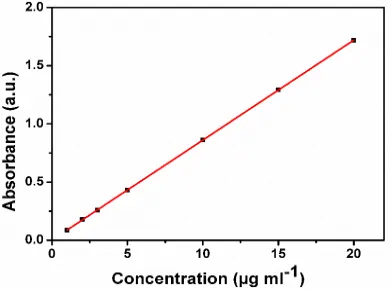
The calibration curves (Fig. 1) was obtained by plotting the concentration of the ascorbic acid standards vs their corresponding absorbance.
The method was linear up to 20 μg ml-1 of
ascorbic acid with r of 0.9998. The molar absorptivity of ascorbic acid at 267 nm was
calculated to be 1.52 × 10⁴ l mol-1 cm-1.
Fig. 1. Calibration curve for ascorbic acid
The ascorbic acid content of baobab fruit pulp was determined by the background correction method, the results obtained are shown in Table 4, the mean value was found to be 237 mg/100 g, and the 95% confidence interval for the ascorbic acid content = 237 ± 18 mg/100 g.
In order to decide whether the standard deviations of the two methods are significantly different from each other or not, F test was
performed using equation (3.2)[20],
= (3.2)
The results revealed that the value of
F (= 1.57) is less than F (= 3.18)[22],
therefore, it is obviously indicated that the standard deviations of the two data sets are not
significantly different from each other at 95 % confident level. Suggesting that the two results agree within the experimental error. The comparison between the means of the two methods was carried out using t-test, equation (3.3).
= | ̅ ̅ | (3.3)
The was found to be 1.29, where the
critical value for t (0.05, 18) is 2.10 [22], since
is less than t (= 2.10) then it was
concluded there is no evidence that the two sets of results are significantly different at the chosen confidence level (95%).
Using the average vitamin C content of baobab fruit, the daily recommended dose of vitamin C, 120 mg per day, can be obtained from about 50.7 g of baobab powder. And the daily saturation of vitamin C pool in the body, 140 mg per day, requires about 60 g of baobab powder.
4. CONCLUSIONS
In this study, a direct UV spectrometric method was applied for the determination of the ascorbic acid in baobab fruit. Sudanese baobab fruit pulp from Western Kordofan State proved to be rich source of ascorbic acid (vitamin C), ranged from 195.3 to 288.9 mg/100 g, thus about 51 g of
baobab fruit pulp provided the daily
recommended dose of vitamin C. The proposed method is suitable and valid for the determination of ascorbic acid in baobab fruit pulp. The high concentration of vitamin C in baobab fruit, given the widespread distribution of the tree in western Sudan, offers exciting opportunities for more research.
COMPETING INTERESTS
REFERENCES
1. Angiosperm Phylogeny Group T. An
update of the Angiosperm Phylogeny Group classification for the orders and families of flowering plants: APG II. Botanical Journal of the Linnean Society. 2003;141(4):399-436.
2. Gadanya AM, Atiku MK, Otaigbe BO.
Proximate and elemental analysis of
baobab (Adansonia digitata) seed.
International Journal of Analytical
Biochemistry Research. 2014;1(1):1–4.
3. Sidibe M, Williams JT. Baobab, Adansonia
digitata L. International Centre for
Underutilized Crops for the Future.
Southampton, UK; 2002.
4. Salisu A, Veronica E, David B, Michael A.
Nutraceutical evaluation of baobab
(Adansonia digitata L.) seeds and physico-chemical properties of its oil. Annals of Biological Sciences. 2015;3(2):13-19.
5. Sidibé M, Scheuring JF, Tembely D, Sidibé
MM, Hofman P, Frigg M. Baobab
homegrown vitamin C for Africa.
Agroforestry Today. 1996;8(2):13-15.
6. Abiona DL, Adedapo Z, Suleiman MK.
Proximate analysis, phytochemical
screening and antimicrobial activity of
baobab (Adansonia digitata) leaves.
Journal of Applied Chemistry (IOSR-JAC). 2015;8(5):60-65.
7. Maydell HJ. Trees and shrubs of the
Sahel: Their characteristics and uses. Werkestein, Margrat, Germany; 1990.
8. Kamatou GP, Vermaak I, Viljoen AM. An
updated review of Adansonia digitata: A
commercially important African tree. South African Journal of Botany. 2011;77(4):908-919.
9. Abdalla AA, Mohammed MA, Mudawi HA.
Production and quality assessment of
instant baobab (Adansonia digitata L.).
Advance Journal of Food Science and Technology. 2010;2(2):125-133.
10. Saka JK, Msonthi JD. Nutritional value of
edible fruits of indigenous wild trees in
Malawi. Forest Ecology and Manage-ment. 1994;64(2-3):245-248.
11. Baobab Fruit Company. Nella Tradizione
Africana Baobab; 2002.
12. Ighodalo CE, Catherine OE, Daniel MK.
Evaluation of mineral elements and ascorbic acid contents in fruits of some wild plants. Plant Food Hum. Nutr. 1991;41:151-154.
13. Besco E, Bracioli E, Vertuani S, Ziosi P,
Brazzo F, Bruni R, Sacchetti G, Manfredini S. The use of Photochemiluminescence for
the measurement of the integral
antioxidant capacity of baobab products. Food Chemistry. 2007;102(4):1352-1356.
14. Wickens GE. The baobabs: Pachycauls of
Africa, Madagascar and Australia. Springer Science & Business Media; 2008.
15. AOAC. Official method of analysis. 15th
Edn., Association of Analytical Chemists, Washington, D.C.; 1990.
16. Gokmen V, Acar J. A simple HPLC method
for the determination of total vitamin C in fruit juices and drinks fruit process. 1996;5:198-201.
17. Lau OW, Luk SF, Wong KS. Determination
of ascorbic acid in pharmaceuticals using
direct ultraviolet spectrophotometry.
Analyst. 1987;112(7):1023-5.
18. Lau OW, Luk SF, Wong KS. Background
correction method for the determination of ascorbic acid in soft drink, fruit juices and Cordials using direct ultraviolet spectro-photometry. Analyst. 1986;111:665-670.
19. Onishi I, Hara T. The catalytic effects of
copper complexes on the oxidation of L-ascorbic acid. Bulletin of the Chemical Society of Japan. 1964;37(9):1317-1320.
20. Harris DC. Quantitative chemical analysis.
Eighth Edition, Freeman and Company, New York; 2010.
21. Penney JR, Zilva SS. Interfering
sub-stances in the Roe and Kuether method for
the determination of ascorbic acid.
Biochemical Journal. 1945;39(5):392-397.
22. Harvey D. Modern analytical chemistry.
McGraw-Hill. New York; 2000.
_________________________________________________________________________________
© 2018 Erwa et al.; This is an Open Access article distributed under the terms of the Creative Commons Attribution License (http://creativecommons.org/licenses/by/4.0), which permits unrestricted use, distribution, and reproduction in any medium, provided the original work is properly cited.
Peer-review history: