AN EXPERIMENTAL INVESTIGATION ON
MECHANICAL PROPERTIES OF BACTERIAL
CONCRETE
1
N.Venkateswarlu,
2N.Sarathschandra,
3M.Arun Kumar,
1Assistant Professor,2Assistant Professor,3Assistant Professor 1Department of Civil Engineering,
1NBKR Institute of Science & Technology, Nellore, India
DOI: http://doi.one/10.1729/Journal.19955
Abstract
- There are a lot of bacteria existing on our world and from that same are healthful and important
bacteria are available used for improvement of the mechanical properties of concrete in
the building constructionand Maintenance
material. Now a day, it is establish that bacterial solution by precipitation of calcium carbonate
when it contact with water that resulting healing of cracks in concrete it improves the all properties of concrete.
Bacterial solution based concrete is a most important material, which can effectively healing the cracks in
concrete. This method is extremely attractive since the mineral precipitation induced as a result of microbial
activities is free from pollution and it’s natural. The use of crack healing concept in normal concrete leads to
potential design of latest material called Bio Concrete. Hence, this paper cover the summary of same critical
literature reviews on the previous found that related to self healing concrete and also review the result of these
bacterial solutions on the concrete properties.
Key Words: Bacterial solution, Bio concrete, Improvement, Properties of concrete.
I.INTRODUCTION
Self-healing phenomenon has been observed in cementitious materials for many years. One such example is on an 18th
century bridge in Amsterdam, where micro cracks were self-healed by the recrystallization of calcite. These observations suggest
that under certain circumstances (e.g. when rainwater and carbon dioxide is available) concrete was able to heal its own damage
(e.g. microcracks) with chemical products by itself. For this, by incorporating bacteria into concrete may lead to self –healing of
concrete. In this study “Bacillus subtilis” can be used for self-healing of concrete.
II.LITERATURE REVIEW:
S. Sanjay, S. Neha, and R. Jasvir (2016),This paper was presented the experimental investigation on bacterial concrete to increase the strength of bio concrete and to inform the process involved in the bacterial concrete. To know the calcite crystals formed in bacterial concrete analysis of microstructure has been done that is used for the potential to recovery the cracks in bacterial concrete and also to inform the biological reaction in concrete. As a result, has been got because of good adaptability of nutrient broth medium of bio concrete at 28 days attained better strength when compared to urea medium [1].
A. Thakur, A. Phogat, K. Singh (2016), This paper has presented the overview of several paper in the current years on the use of bio concrete for improving in the mechanical properties, durability and permeation features of normal concrete. They have been studies the analysis on bio concrete by XRD and SEM tests and also several types of bacteria’s, their isolation process, several methods used in the adding of bacterial species in concrete and their belongings on water absorption and compressive strength. Finally, they concluded the bacterial type such as B. cereus and S. pasteurii extreme rise in the compressive strength and the maximum reduce in water absorption for 28 days curing period of specimen respectively. The bacterial like bacillus sphaericus, B. pasteurii, and Bacillus flexus are not harm the human body and also, they have the potential to precipitate calcite but some other bacterial species is dangerous for human health [2].
IJRAR19J2662 International Journal of Research and Analytical Reviews (IJRAR) www.ijrar.org 707
N. Chahal and R.Siddique (2008) this study has been presented that with use of Sporosarcina pasteurii which would make it, self-healing. They observed that newly formed cracks healed by the presence of bacteria. In the concrete mix 10%, 20% and 30% and also 5% and 10% dosage of fly ash and silica fume respectively replacing cement in the bacterial solution of 103, 105 and 107 cells/ml. They did tests on the water absorption and porosity, chloride permeability and compressive strength by using up to age 91 days. They concluded that by the presence of S. pasteruii increase compressive strength, cut downs the permeability and porosity of silica fume and fly ash concrete [4].
V Srinivasa Reddy, M V SeshagiriRaoand S Sushma8, have published a paper on Feasibility Study on Bacterial Concrete as an innovative self crack healing system. This paper describes about the effect of bacterial cell concentration of Bacillus subtilis JC3, on the strength, by determining the compressive strength of standard cement mortar cubes of different grades, incorporated with various bacterial cell concentrations. This shows that the Improvement in compressive strength reaches a maximum at about 105/ml cell concentration. The cost of using microbial concrete compared to conventional concrete which is critical in determining the economic feasibility of the technology, is also studied. The cost analysis showed an increase in cost of 2.3 to 3.9 times between microbial concrete and conventional concrete with decrease of grade. And nutrients such as inexpensive, high protein- containing industrial wastes such as corn steep liquor (CSL) or lactose mother liquor (LML) effluent from starch industry can also be used, so that overall process cost reduces dramatically. Precipitation of these crystals inside the gel matrix also enhances the durability of concrete significantly. Furthermore, this analysis has shown an increase in the cost of production and a significant decrease in carbon footprint compared to conventional concrete[5].
Ramakrishnan et al, (2001) proposed a novel technique in remediating cracks and fissures in concrete by microbiologically inducing calcite precipitation. Microbiologically induced calcite precipitation is a technique that comes under a broader category of science called biomineralization. Bacillus pasteurii, a common soil bacterium can induce theprecipitates of calcite. As a microbial sealant, Calcite exhibited its positive potential in selectively consolidating simulated fractures and surface fissures in granites and in the consolidation of sand. MICP is highly desirable chemical reaction because the calcite precipitation induced is a result of microbial activities. The technique can be used to improve the compressive strength and stiffness of cracked concrete specimens. A durability study on concrete beams treated with bacteria, exposed to alkaline, sulfate and freeze-thaw environments was studied by him. The effect of different concentrations of bacteria on the durability of concrete was also studied by him. It was found that all the beams with bacteria performed better than the control beams (without bacteria). The durability performance increased with increase in the concentration of bacteria. Microbial calcite precipitation was quantified by X-ray diffraction (XRD) analysis and visualized by SEM. The unique imaging and microanalysis capabilities of SEM established the presence of calcite precipitation inside cracks, rod shaped bacterial impressions and a new calcite layer on the surface of concrete. This calcite layer improves the impermeability of the specimen, thus increasing its resistance to alkaline, sulfate and freeze-thaw attack [6].
III.SCOPE AND OBJECTIVES OF WORK:
FROM DETAILED LITERATURE REVIEW THE FOLLOWING POINTS ARE EVIDENCE Develop bacterial concrete by introducing the bacteria’s of bacillus family.
To find optimum dosage of bacteria required for bacterial concrete.
To increase compressive strength of concrete.
To remediate the cracks developed in concrete.
To study the durability of concrete under various weathering conditions. To check the performance of bacillus subtilis by durability test.
To verify the performance of bacillus subtilis with 1mm and 2mm crack width and 15mm, 20mm, 25mm, and 30mm crack depth.
IV. EXPERIMENTALWORK:
The present investigation is divided into two stages. In the first stage cement mortar blocks of mix proportion 1: 3 were casted with different concentrations of soil bacterium named “Bacillus Subtilis” like 0, 104, 105, 106, 107 and 108cells/ml. These
Fig 4.1 Flexural test on prism Fig 4.2 Compression test on cube
Fig 4.3 Split Tensile test on prism Fig 4.4 Flexural strength of prism
V.STUDIES ON MATERIALS:
Cement:
Ordinary Portland Cement of 53 Grade of brand name Ultra Tech Company, available in the local market was used for the investigation. Care has been taken to see that the procurement was made from single batching in air tight containers to prevent it from being effected by atmospheric conditions. The cement thus procured was tested for physical requirements in accordance with IS: 169-1989 and for chemical requirement in accordance IS:4032-1988.
Fine Aggregates:
River sand locally available in the market was used in the investigation. The aggregate was tested for its physical requirements such as gradation, fineness modulus, specific gravity and bulk density in accordance with IS:
2386-1963.The sand was surface dried before use
Coarse Aggregates:
Crushed aggregates of less than 10mm size produced from local crushing plants were used. The aggregate exclusively passing through 10mm sieve size and retained on 6.5mm sieve is selected. The aggregates were tested for their physical requirements such as gradation, fineness modulus, specific gravity and bulk density in
accordance with IS: 2386-1963.
IJRAR19J2662 International Journal of Research and Analytical Reviews (IJRAR) www.ijrar.org 709 Bacterial Solution:
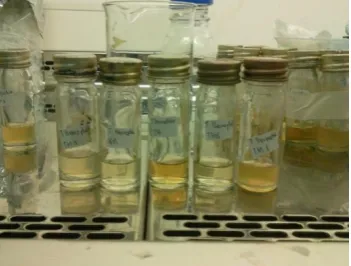
The sample of “Bacillus subtilis”, a soil bacterium was cultured and developed to the tune of requirements of investigations at Microbiology Laboratory, Sri Krishna Devaraya University, Anantapur by giving proper feed to the micro organisms.
Culture of Bacteria:
The pure culture (NCIM-2477) which was obtained from NCIM, PUNE was maintained constantly on nutrient agar slants. It forms irregular dry white colonies on nutrient agar. Whenever required a single colony of the culture is inoculated into nutrient broth of 25ml in 100ml conical flask and the growth conditions are maintained at 370 C temperature
and placed in 125rpm orbital shaker. The medium composition required for growth of culture is Peptone - 5g / lit, Sodium Chloride (NaCl) - 5g / lit and Yeast extract - 3g / lit.
Maintenance of Stock Cultures:
Stock cultures of Bacillus Subtilis were maintained on nutrient agar slants. The culture was streaked on agar slants with an inoculating loop and the slants were incubated at 370C. After 2-3 days of growth, slant cultures were preserved
under refrigeration (40C) until further use. Sub culturing was carried out for every 90 days. Contamination from other
bacteria was checked periodically by streaking on nutrient agar plates.
Mechanism:
Under favourable conditions, soil bacterium can continuously precipitate a new highly impermeable calcite layer over the surface of an already existing concrete layer. This phenomenon is called as microbiologically induced calcite precipitation (M.I.C.P.) The bacteria precipitate calcite (2) in the presence of nutrients. The optimum pH for growth of bacillus subtilis is around 9 and alkaline environment of concrete with pH around 12 is the major hindering factor for growth of bacteria. In natural environments, chemical caco3 precipitation (Ca2+ + CO32- --- CaCO3 i) is accompanied by
biological processes, both of which often occur simultaneously or sequentially.
This microbiologically induced calcium carbonate precipitation (MICCP) comprises of a series of complex biochemical reactions. As part of metabolism, Bacillus Subtilis produces urease, which catalyses urea to produce CO2 and ammonia,
resulting in an increase of pH in the surroundings where ions Ca2+ and CO
32- precipitate as CaCO3. Possible biochemical
reactions in medium to precipitate CaCO3 at the cell surface that provides a nucleation site can be summarized as follows.
Ca2+ + Cell Cell -Ca2+ ---- 1
Cl- + HCO3- + NH3 NH
4Cl + CO32- ---- 2
Cell -Ca2+ + CO32- Cell- Ca CO
3 i ---- 3
Water:
Water plays a vital role in achieving the strength of concrete. For complete hydration it requires about 3/10th of its weight
of water. It is practically proved that minimum water-cement ratio 0.35 is required for conventional concrete. Water participates in chemical reaction with cement and cement paste is formed and binds with coarse aggregate and fine aggregates. If more water is used, segregation and bleeding takes place, so that the concrete becomes weak, but most of the water will absorb by the fibers. Hence it may avoid bleeding. If water content exceeds permissible limits it may cause bleeding. If less water is used, the required workability is not achieved. Potable water fit for drinking is required to be used in the concrete and it should have pH value ranges between 6 to 9.
VI.MIX DESIGN FOR BACTERIA MIXED CONCRETE:
a) Design stipulations:
Characteristic compressive strength required in the field at 28 days: 20Mpa Maximum size of aggregate: 20mm
Degree of quality control: Good Type of exposure: Mild
b) Tested data for materials:
Specific gravity of cement : 3.14
Comp Strength of cement at 7 day : Satisfies the requirement IS:269-1989
Specific gravity of Coarse aggregates : 2.63 Specific gravity of Fine aggregates : 2.75 Water absorption of Coarse aggregates: 1% Free moisture in CA & FA : Nil
c) Target mean strength of concrete:
The target mean strength for specified characteristic cube strength is 20+1.65*4=26.6N/mm2
The free w/c ratio required for the target mean strength of 26.6 N/mm2 is 0.50
The maximum free water-cement ratio for mild exposure is 0.55
The free w/c ratio is taken as the minimum of the above two values, i.e., w/c ratio = 0.50
e) Estimation of air content:
For maximum size of aggregate of 20mm,the air content is take as 2.0%
f) Selection of water and sand content:
From IS method for 10mm max size of aggregate, Sand conforming to grading ZoneII. Water content per cubic meter of concrete = 186kg and sand content % of total aggregate by absolute volume = 35%.
Water =186kg/m3 of concrete.
Table 6.1 Mix design
Change in condition Adjustment required
Water content % Percentage sand in total aggregate
For decrease in water-cement ratio(0.60-0.50) that is 0.10 Therefore, 0.10/0.05×1=2.0
0% -2.0
For increase in compacting factor (0.9-0.8) =0.1 Therefore, 0.1/0.1×3=3.0
+3 0
Total +3 -2.0
Sand = 35% of total aggregate by absolute volume.
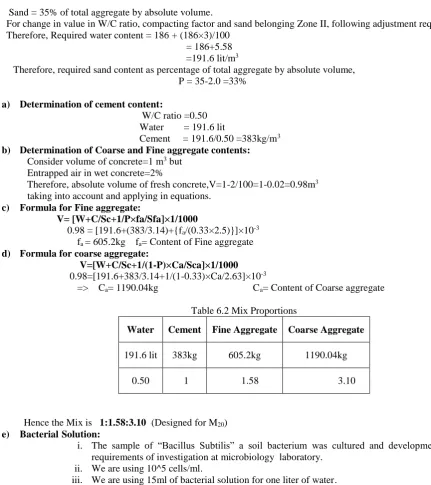
For change in value in W/C ratio, compacting factor and sand belonging Zone II, following adjustment required. Therefore, Required water content = 186 + (186×3)/100
= 186+5.58
=191.6 lit/m3
Therefore, required sand content as percentage of total aggregate by absolute volume, P = 35-2.0 =33%
a) Determination of cement content:
W/C ratio =0.50 Water = 191.6 lit
Cement = 191.6/0.50 =383kg/m3
b) Determination of Coarse and Fine aggregate contents: Consider volume of concrete=1 m3 but
Entrapped air in wet concrete=2%
Therefore, absolute volume of fresh concrete,V=1-2/100=1-0.02=0.98m3
taking into account and applying in equations.
c) Formula for Fine aggregate:
V= [W+C/Sc+1/P×fa/Sfa]×1/1000
0.98 = [191.6+(383/3.14)+{fa/(0.33×2.5)}]×10-3
fa = 605.2kg fa= Content of Fine aggregate
d) Formula for coarse aggregate:
V=[W+C/Sc+1/(1-P)×Ca/Sca]×1/1000 0.98=[191.6+383/3.14+1/(1-0.33)×Ca/2.63]×10-3
=> Ca= 1190.04kg Ca= Content of Coarse aggregate
Table 6.2 Mix Proportions
Water Cement Fine Aggregate Coarse Aggregate
191.6 lit 383kg 605.2kg 1190.04kg
0.50 1 1.58 3.10
Hence the Mix is 1:1.58:3.10 (Designed for M20)
e) BacterialSolution:
i. The sample of “Bacillus Subtilis” a soil bacterium was cultured and development to the tune of requirements of investigation at microbiology laboratory.
ii. We are using 10^5 cells/ml.
iii. We are using 15ml of bacterial solution for one liter of water. iv. We are using 363.5ml of bacterial solution.
IJRAR19J2662 International Journal of Research and Analytical Reviews (IJRAR) www.ijrar.org 711 a) Normal Consistency of Cement:
Table 7.1 Normal Consistency of Cement
Trail No. weight of Cement (gm) % of water added Depth of Penetration (mm)
1 400 28 15
2 400 30 10
3 400 32 7
Hence the Consistency of cement is 32%.
b) Initial setting time of Cement:
Weight of cement sample taken = 400gms
Consistency of cement = 32% as obtained above
Volume of water to be added = 0.85*32/100*400=108.8m Initial setting time obtained = 53 minutes.
c) Final setting time of Cement:
Weight of cement sample taken =400gms Consistency of cement=32% as obtained above
Volume of water to be added =0.85*32/100*400=108.8m Final setting time = 458 minutes.
d) Specific gravity of Cement:
Weight of empty specific gravity bottle W1 = 44.1 gm. Weight of sp.gr. bottle + wt. of cement W2 = 70.00gm. (1/3 rd to 2/3 rd of bottle full)
Weight of specific gravity bottle + cement + kerosene W3 = 106.20 gm Weight of specific gravity bottle+ keroseneW4 = 83.80 gm.
Specific gravity of kerosene= 0.79
Specific gravity of cement = (W2-W1)/{(W4-W1)-(W3-W2)} = 3.14
e) Specific gravity of Coarse aggregates :
Weight of saturated aggregate A = 500gms Weight of dry aggregatesD = 490gms Weight of Pycnometer = 610gms
Weight of Pycnometer + WaterC = 1502.8gms
Weight of Pycnometer + Water+ AggregateB = 1816.8gms Specific Gravity = D/{A-(B-C)} = 2.6
f) Specific gravity of Fine aggregates :
Weight of empty Pycnometer W1 = 610 gm.
Weight of Pycnometer + fine aggregateW2 = 1110 gm. Weight of Pycnometer + fine agg + waterW3 = 1769.2 gm. Weight of Pycnometer + waterW4 = 1450 gm.
1) Dry weight of aggregate =W2-W1
2) Weight of equivalent volume of water = (W2-W1)-(W3-W4) Specific Gravity = (W2-W1)/(W2-W1)-(W3-W4)
= 2.75
g) Water absorption test :
Weight of oven dried aggregate = 500g
VIII.FINAL TEST RESULTS:
Compressive strength:
Concrete cubes of size 15cm×15cm×15cm are tested.
Table-8.1 Compressive strength of cubes at 28 days
Type of bacteria solution added Mix Designation % of Addition No. of cubes Ultimate load(kN) Compressive Strength(Mpa) @ 28 days Average Cube Compressive Strength(Mpa) @ 28
days
Without Bacteria solution
M0 0% 3 565 25.3 25.3
With bacteria
solution M1
15 ml for 1lit of water
1 670 29.5
30.1
2 650 28.8
3 720 32.1
\
Flexural Strength:
Concrete specimens of size 15cm×15cm×70cm are tested.
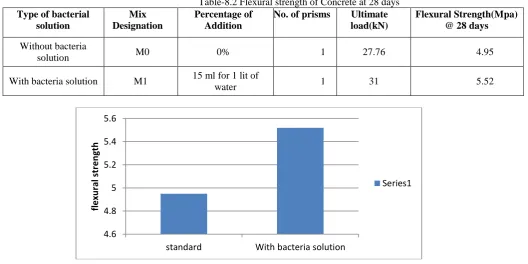
Table-8.2 Flexural strength of Concrete at 28 days
Type of bacterial solution
Mix Designation
Percentage of Addition
No. of prisms Ultimate load(kN)
Flexural Strength(Mpa) @ 28 days
Without bacteria
solution M0 0% 1 27.76 4.95
With bacteria solution M1 15 ml for 1 lit of
water 1 31 5.52
22 23 24 25 26 27 28 29 30 31
standard With bacteria solution
co m p re si e ve st re n gth 4.6 4.8 5 5.2 5.4 5.6
standard With bacteria solution
fl e xu ral str e n gth Series1
Fig 7.2 Graph showing the comparison of results obtained for various proportions of bacteria mixed concrete tested for avg. flexural strength @ 28 days
IJRAR19J2662 International Journal of Research and Analytical Reviews (IJRAR) www.ijrar.org 713 Tensile Strength:
Concrete specimens of diameter 15cm and 30cm long are tested
Table-8.3 Tensile strength of Concrete at 28 days
Type of bacteria solution
Mix Designati
on
% of Addition
No. of Cylinders
Ultimate load(kN)
Tensile Strength
Average Split Tensile Strength(Mpa)
@ 28 days
Without bacteria solution
M0 0% 2 200 2.82 2.82
With bacteria solution
M1 15 ml for
1lit of water
1 260 3.68
3.82
2 260 3.68
3 290 4.1
IX.CONCLUSIONS:
From the investigation, it has been revealed that bacterial concrete has better resistance against strength deterioration for
all curing conditions and curing ages. From the above, it is clear that the presence of a layer of carbonate crystals on the surface
has the potential to improve the resistance of cementitious materials towards degradation processes
.
The compressive strength was found to increase with bacterial addition and this increase is mainly due to deposition of microbial
induced calcium carbonate precipitation on the microorganism cell surfaces and within the pores of the mortar.
The use of bacteria in concrete mix also needs further research efforts. Several issues still need to be addressed in this field: (a) Which calcite producing bacteria are more efficient in highly alkaline environment?
(b) Which is the most eco-efficient encapsulation method?
(c) Will biologically deposited calcite endure the test of time?
(d) Can biomineralization be made cost-efficient?
(e) What are the environmental implications related to the use of corn steep liquor as a nutrient source?
(f) Are there any health implications involved in the use of bacteria?
(g) What is the life cycle analysis of biotech concrete?
0 0.5 1 1.5 2 2.5 3 3.5 4 4.5
standard With bacteria solution
te
n
si
le
st
re
n
gth
Series1
REFERENCES
[1] Etaveni Madhavi andT. Divya Bhavana,” Strength Properties of a Bacterial Concrete with Fly ash and GGBS” International Journal of Engineering Research & Technology (IJERT), 2016,5.
[2] Neha Singla, Sanjay K. Sharma, Jasvir Singh Rattan, “An Experimental Investigation on Properties of High Strength
Bacterial Concrete (Bacillus Subtilis).” International Research Journal of Engineering and Technology (IRJET), 2016, 03.
[3] N. GaneshBabu. An experimental study on strength and fracture properties of self-healing concrete, International Journal of Civil Engineering and Technology (IJCIET), 2016, 7, 398–406.
[4] Mohit Goyal, P. Krishna Chaitanya. Behavior of Bacterial Concrete as Self-Healing Material, International Journal of Emerging Technology and Advanced Engineering, ISSN 2250-2459, 2015, 5, 100-103.
[5] Abhishek ThakurAkshay Phogat, Khushpreet Singh “Bacterial concrete and effect of different bacteria on the strength and
water absorption characteristics of concrete: A Review “International Journal of Civil Engineering and Technology, 2016, 5, 43–56.
[6] Ravindranatha, N. Kannan, Likhit M. L. Self-healing material bacterial concrete, International Journal of Research in Engineering and Technology, 2014, 3, 656659.
[7]
[8] Meera C.M, Dr. Subha V. Strength and Durability Assessment of Bacteria Based Self-Healing Concrete. IOSR Journal of Mechanical and Civil Engineering, 01-07.
[9] Chintalapudi Karthik (, Rama Mohan Rao.P2” Properties of Bacterial-based Self-Healing Concrete- A review “International Journal of Chemtech Research, 2016, 9.