Selamat et al. World Journal of Engineering Research and Technology
METHOD FOR FABRICATION OF C-CU COMPOSITES USING
LOCAL OIL PALM KERNEL SHELL MATERIAL
Mohd Asri Selamat*and Ahmad Aswad Mahaidin
Industrial Centre of Innovation (ICI) Nanotechnology, SIRIM Berhad, Lot 32, Jalan Hi-Tech 2/3, Kulim Hi-Tech Park, 09000, Kulim, Kedah, Malaysia.
Article Received on 07/07/2017 Article Revised on 27/07/2017 Article Accepted on 17/08/2017
ABSTRACT
The carbon-copper (C-Cu) composites are known for their high electrical conductivity and good wear resistance. It’s combine the positive characteristics of thermal and electrical conductivity of Cu, low thermal expansion coefficient and lubricating properties from graphite/carbon. For that particular application, C-Cu composites are widely used as electrical contact devices such as carbon brushes for engine and current-collector for railway power collection system. Due to economic and environment concern, activated-carbon produced from Malaysian Palm Oil Board (MPOB)’s oil palm kernel shell (OPKS) was studied as replacement for conventional graphite. The OPKS was crushed and mixed with copper and resin powder before it was compacted into shape. Then the green body undergoes warm-compaction (1140MPa;100-150C) followed by post-baking (150-250C) process to enhance its properties. The physical and mechanical properties of the C-Cu composite were analysed. The resulting microstructures, electrical and wear properties also are presented and discussed. The prototype of carbon brushes for electrical applications and current-collector for PUTRA LRT were produced from this research work.
KEYWORDS: C-Cu composites, oil palm kernel shell, warm compaction.
World Journal of Engineering Research and Technology
WJERT
www.wjert.org
SJIF Impact Factor: 4.326*Corresponding Author Mohd Asri Selamat
INTRODUCTION
Carbon-copper (C-Cu) composite materials are widely used in various electrical and electronic applications due to their high electrical conductivity and good wear resistance. Most of electrical contact devices and current collector for railway power collection are made of carbon-copper.[1] Nowadays, peoples are more concern about replacing raw materials with renewable energy and hence, using waste to replace conventional materials.
In this research work, activated carbon produced from natural local oil palm kernel-shell is studied as replacement for conventional carbon/graphite used in current market. Palm oil is one of 17 major oils traded in the global edible oils and fat market. Being the world’s largest producer and exporter of palm oil, Malaysia earned about RM 45.2 billion in foreign exchange in 2007.[2,3] Thus, high amount of wastes are produced as a major by-product.
One of oil palm industry’s major by-products is kernel-shell. Large quantities of kernel-shells are produced after extraction of the palm oil and mostly left as waste. It is either burned as low value energy resource or discarded in the field. Both of the methods are unfavourable to the environment. Therefore, studying kernel-shell as replacement for conventional carbon is a great way to solve the problem and creating value added products.
There are several applications that are using palm oil waste as one of its materials. One of the examples is carbon black. It is reported that oil palm empty fruit bunches (EFB) was used to produce carbon black using carbon activation on the precursors of EFB before it undergo carbonization process.[4] With the recent rises in coal and petroleum prices, carbon powder from EFB would be able to be competitive.
The advantages of using kernel-shell as recycle materials are non-renewable materials can be replace with renewable as well as encourage utilization of renewable sources. Although the usage of kernel-shell as local carbon is still new and unproven in electrical and electronic application, they are already being used in automobile disc brake, carbon activation for water purification, concrete ingredient in building industry and fuel for heat generation and thermal insulator.[5]
composites are thermally treated up to 2500C and this is non-economical due to the low solubility of carbon-copper.[5] Thus, liquid Cu could not wet the carbon even by liquid phase sintering and resulting to C-Cu composite with weak interface bonding and poor mechanical properties. Previously, addition of small amount of lead improved densification of C-Cu since lead solder copper particles together. However, it is banned in carbon brushes products due to public awareness issues cause as additive in fabrication of C-Cu composite has been prohibited for the negative and hazardous impact when lead is being used.[6]
The lack of wetting between copper and graphite during composite processing can be overcome by the used of an external binder to facilitate the interactions between particles. In this research work, it has been intended to carry out a complete characterisation of the C-Cu composites with the addition of adhesives obtained through a combination of warm-compaction and post-baking methods. In this way the carbon-copper interfaces are improved, and thereby, the composite properties are enhanced.
The use of an external binder to facilitate the interactions between particles is a strategy frequently used in carbon granular technology.[7] In this regard, binders such as epoxy resin are good binders because of their low cost, good wettability to carbons and their capacity for generating matrices with a different microstructure on carbon-copper composites.
This research work include the results of prospective study on the feasibility of epoxy resin for binding copper with kernel-shell carbon particles in order to produce sound C-Cu composite materials with adequate structural, mechanical and electrical properties for their potential use as carbon brushes and current-collector in light rail transit (LRT) applications.
MATERIALS AND METHODS
The source of carbon powder in this research work is MPOB’s oil palm kernel shell. This is a natural source for carbon and attainable from waste of oil palm industries. There have been
studies that showed palm kernel shell comprises high properties carbon and therefore it is
very much suitable in the present work. Utilizing palm kernel shell as the source of carbon
also impacted several advantages. Not only it ensures abundant natural source of carbon
powder but also helps in reducing the waste material from oil palm industries. Material cost is
The composition of C-Cu composite during consolidation is 65% of carbon (< 93m), 20% of copper (<10 m) and 15% of commercial epoxy resin powder (65C-20Cu-15ER). The micrographs of the powders are analysed using Scanning Electron Microscopy (SEM).
Carbon-copper composites were dry mixing for 1 h at 56 rpm using turbula mixer, followed by uniaxially cold compacted at 625 MPa pressure. Specimens were then warm-compacted at 1040 MPa and holding for 5 minutes. In addition, the melting point temperature of powder resin is compatible with warm-compaction temperature of 150 -250oC when lead is used as additive.
The formed composite is then treated at 200C with post-baked holding steps 120C - 150C - 170C - 200C for 8 hours. Post-baking of the composite sample may be conducted in a microprocessor controlled oven to attain uniform distribution of resin in C-Cu composite samples. The physical, mechanical, electrical and wear properties such as density, transverse rapture strength, hardness and wear properties were analysed as well as the microstructures of the C-Cu composites.
RESULTS AND DISCUSSION
Carbon-copper composites were prepared using kernel-shell carbon and copper as reinforcement while epoxy resin was added as a binder. The natural kernel-shell carbon and a rounded morphology of copper particles from 1 to 93 m (Fig.1) made the mixture can be easily moulded.
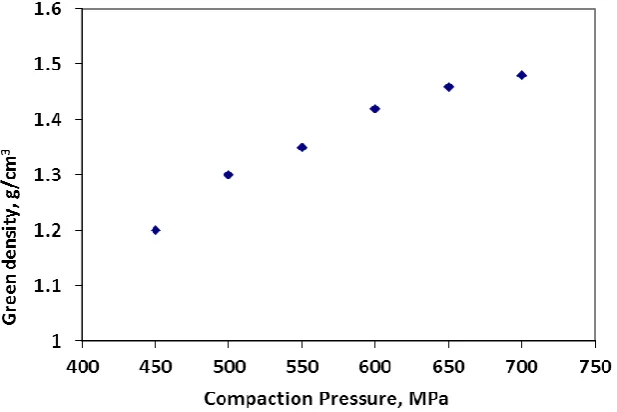
In accordance with previous experiments carried out elsewhere,[4] carbon composites were moulded under 500 and 600 MPa. Under such a pressure, the material density obtained is still very low compared to the theoretical for the material fully compacted, but higher pressure may lead to a carbon/graphite flow creating structure heterogeneity. In this work, the use of 625 MPa seems to exceed the limit of compressibility of the material, producing stresses that cause it to break when an external load is applied, Fig. 2.
At warm-compacted pressure of 1040 MPa, curing temperature range of 150-250ºC with 5 minutes holding time, the optimum properties of this formulation was identified at curing temperature 150ºC, Table 1.
Fig. 1: SEM micrographs of (a) natural kernel-shell carbon, (b) rounded copper powder.
Fig. 2: Green density evolution with compacting pressure.
Table 1: Main properties of C-Cu-resin composites at different warm-compacted temperature.
Sample Sintered Density,
g/cm3
Hardness, HRR
Transverse Rapture Strength (TRS) MPa
C-Cu-resin (150C) 1.52 117.5 37.47 C-Cu-resin (200C) 1.51 113.2 34.86 C-Cu-resin (250C) 1.48 110.8 30.99 C-Cu compacted 1.27 46.5 5.56
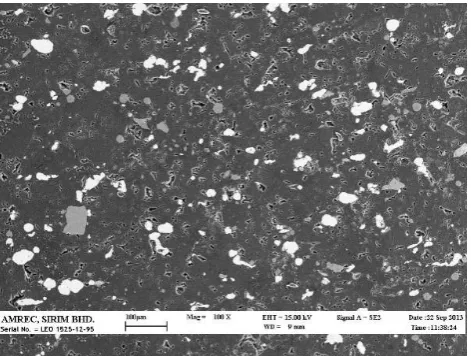
Fig. 3: SEM micrograph of C-Cu-resin sample; warm-compacted at 150C followed with post-baking at 200C (uniformity of C-Cu composite structure).
Table 2: Main properties of optimum C-Cu-resin composites (warm-compacted at 150C) at different post-baking temperature.
Sample Sintered
Density, g/cm3
Hardness, HRR
TRS, MPa
Resistivity,
cm Coefficient of friction, C-Cu-resin (150C) 1.61 120.9 37.99 N/A 0.240 (D) - pass C-Cu-resin (200C) 1.63 124.1 57.75 1488.69 0.262 (E) - pass C-Cu-resin (250C) 1.58 119.9 55.84 N/A 0.232 (D) – pass Commercial carbon
brush 2.15 122.0 47.88 598.77 0.365 (F) – pass Commercial LRT
current-collector 2.16 125.9 58.50 1125.00 0.421 (F) - pass
By further curing the warm-compacted samples in oven at 200ºC for 8 h, the resin after post-baking works as a link among the material particles, which lead to a high hardness, strength and better friction and wear result comparable to the commercial composites, Table 2. This is due to the quick reaction of the resin in contact with the copper that clogged the pores and prevented resin ingress.
In line with the requirement of the Vehicle Equipment Safety Commission Regulation V3,[10]
where no brake lining shall be approved which: a) has a normal friction coefficient below that
of code class E; and b) has a hot coefficient below that of code class D, C-Cu composites of
this research work is comply and suitable for use in friction material applications.
between carbon and copper. This observation is consistent with the works determined by Oku et al.[9] on carbon-copper composites.
CONCLUSION
The use of epoxy resin as binder for C-Cu composites increases hardness and transverse rapture strength (TRS) compared to the C-Cu compacted without resin addition. While, using warm-compaction followed by post-baking process achieved the best physical, mechanical, electrical and wear properties for these C-Cu resin composites comparable to the commercial carbon brushes samples. The used of carbon powder from local MPOB kernel-shell also has the prospect of replacing commercial graphite/carbon powder in C-Cu composites parts such as current collector and carbon brushes for potential electrical and electronic applications.
ACKNOWLEDGMENT
The research work was supported by a science fund grant (03-03-02-SF0233). The authors would like to express their gratitude to the Ministry of Science, Technology and Innovation (MOSTI) and SIRIM Berhad for their support.
REFERENCES
1. C.P. Farago “Metal-graphite brushes”, ASM Handbook, 2000; 7: 634-636.
2. H.P.S. Abdul Khalil, M. Jawaid, A. Hassan, M.T. Paridah and A. Zaidon “Oil palm biomass fibres and recent advancement in oil palm biomass fibres based hybrid composites“, Licensee InTech, 2012; 187-220.
3. Malaysian Palm Oil Council Fact sheets: Malaysia Palm Oil, Selangor, Malaysia, 2007. 4. A.A. Aziz, M. Deraman, R. Mamat, A. Mokhtar, W.H.W. Hasan, R. Ramli and I. Ismail
“Carbon black from empty fruit bunch”, MPOB Information Series, 2006.
5. A. Guillet, E.Y. Nzoma and P. Pareige “A new processing technique for copper–graphite multifilamentary nanocomposite wire: microstructures and electrical properties“, Journal of Materials Processing Technology, 2007; 182(1-3): 50-57.
6. A. Uecker “Lead-free carbon brushes for automotive starters”, 14th International Conference on Wear of Materials, 2003; 255(7-12): 1286-1290.
8. N. Roslani, M.A. Selamat, N. Mohamad Diah and F. Ismail “The effect of metallic additions on mechanical and electrical properties of carbon-copper composites for light rail application“, Brake Pad & Disc Materials, UiTM, 2007; 197-204.
9. T. Oku, A. Kurumada, T. Sogabe, T. Hiraoka and K. Koruda “Effects of titanium impregnation on the thermal conductivity of carbon/copper composite materials”, Journal of Nuclear Materials, 1998; 257(1): 59-66.