Evolution of Properties of Fly Ash-Lime Bricks
with Soil
Varsha Mishra Devansh Jain
M.E Scholar Assiatant Professor Department of Civil Engineering Department of Civil Engineering Rajiv Gandhi Proudyogiki Mahavidyalaya,Bhopal UIT-RGPV, Bhopal
Rajesh Joshi
Assiatant Professor Department of Civil Engineering
Rajiv Gandhi Proudyogiki Mahavidyalaya,Bhopal
Abstract
Fly ash is generated in large measures, especially by thermal power plants. A great batch of inquiry has been channeled out for efficient utilization of fly ash in the structure industry. Use of fly ash in manufacturing brick is one such thing which is being studied by many research scholars and engineers. The aim of the present study is to investigate the durability and water absorption features of fly ash bricks made up with different percentage of lime (L), local soil (S) and fly ash (FA). The experiments were conducted by both Pressure molded fly ash bricks. It was found that none of the L-S-FA bricks satisfy all the demands of standard codes. While some of the bricks satisfy the provisions in respect of intensity level only the L-S-FA (40-0- 60) bricks satisfy the demand of Indian Standard Code in respect of intensity as easily as water absorption features.
Keywords: Lime, Soil, Fly ash, Compressive Strength and Water absorption
________________________________________________________________________________________________________
I.
INTRODUCTION
II.
MATERIAL USED
Fly Ash: A.
Fly ash forms the major component of the raw min for Fly ash bricks. Thus it controls to a large extent the properties of the finished ware. As the ash is non-plastic, a binder must be added either plastic clay or Portland cement. Fly ash content ranges from 60 to 80%. The lime was tested as per the provisions of IS: 6932 -1973. The impurities present in lime were less than 5%. The OMC and MDD were found to be 42.5% and 1080 kg/m3, respectively.
Soil: B.
The soil available in Vidisha was taken and proven as per the provisions incorporated in IS: 2720 -1983. The specific gravity of the soil was 2.65. In all the samples, the fraction finer than 2 µ was maintained at 11%. Its liquid limit (LL), plastic limit (PL), and plasticity index (PI) were 30%, 21%, and 9% respectively. The OMC and MDD were 14.5% and 1780 kg/m³. Its unconfined compressive strength was 0.144 N/mm².
Lime: C.
It is generally desirable to use a high calcium lime of reasonable purity as it is the most important constituent which reacts with silica and alumina etc. Nowadays in the fly ash to make the binder under hydrothermal conditions other burnt lime is not suitable as it does stake readily. The specks of lime should be okay enough to be thoroughly distributed and coat the grains of the mixture. It should also m satisfies IS: 712-1973. Lime content ranges from 20 to 30%.
Water: D.
In the main potable water from a well or a river is required
III.
METHODOLOGY
The modular brick samples of size 190 mm × 90 mm × 90 (IS: 12894-2002) were cast in the laboratory using the linden tree, soil and FA in ratios of: 15: 5: 80 and 10: 10: 80; 25: 5: 70 and 20: 10: 70; 35: 5: 60 and 30: 10: 60 respectively. Similarly mod ular bricks made of L and FA in the proportion of 20: 80, 30: 70 and 40: 60 respectively were cast. The sample was mixed with a sufficient amount of water to obtain working consistency for molding. The white mold was filled with the lime, fly ash and soil mixture without allowing any air bubble. The surplus mix was removed and top surface was pulled down. For the hand molded bricks, no pressure was utilized to the stamp. The pressure moulded bricks were prepared by applying of 50 kN. The molded brick was set aside to dry for two days, protecting from direct sun. The specimens were immersed in water at room temperature for 24 hours and thereafter, the specimens were held out of water. These samples were cured by moist jute bags for 7, 14 and 28 days. The samples were tested after 7,14 and 28 days respectively, for compressive strength as per the provisions of IS: 3495 (Part 1) -1992. The water concentration of the bricks was tested as per the provisions incorporated in IS: 3495 (Part 2) -1992. Before testing, the frogs and voids of the specimen were filled up with cement, sand mortar (1: 1).
IV.
EXPERIMENTAL PROGRAM
Compressive Strength: A.
To find out the compressive strength of the bricks we required Compression testing machine, measuring tape or scale, surface grinder, plywood sheets. After putting up the apparatus we call for a break and Remove unevenness observed in the bed faces to provide two smooth and parallel faces by grinding, then Immerse the sample in water at room temperature for 24 hours, Prepare cement mortar (1:1) and fill the frog and all voids in bed faces with it and then Store the sample prepared under the damp jute bag for 3 days in clean water. Finally Remove and wipe away a trace of moisture. Measure the area of two horizontal faces.
Place the specimen with flat faces horizontal and mortar filled facing upwards between two plywood sheets and sent carefully between plates of the testing machine. Load is applied axially at a uniform rate 14 N/mm2 per minute till failure occurs; Note the maximum load at failure. The compressive strength is calculated by
Compressive Strength (N/mm2 ) =
Water Absorption: B.
afterwards the specimen has been removed from the water (M2). Water absorption, percent by mass, after 24-hour immersion in cold water is broken by the following formula:
*
V.
RESULT AND DISCUSSION
Compressive Strength: A.
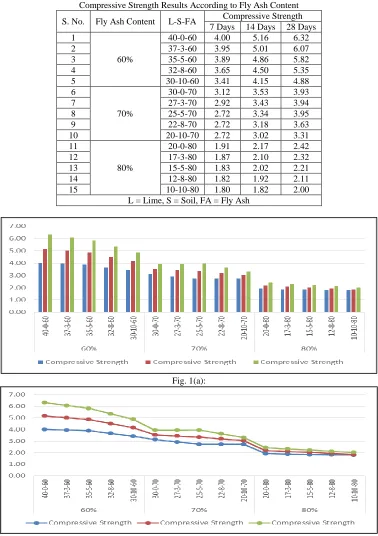
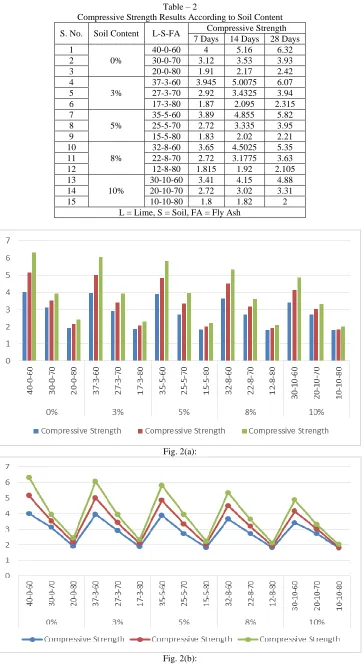
In bricks 60, 70 and 80% fly ash are used with 0,3,5,8 and 10% of soil and remaining percent of lime. It has been observed that lesser the fly ash content and higher compressive strength i.e. as content of fly ash increased in the proportion of brick their compressive strength decrease. Results given in table 1 and 2 and Graph 1,2,3 and 4.
Table – 1
Compressive Strength Results According to Fly Ash Content
S. No. Fly Ash Content L-S-FA Compressive Strength 7 Days 14 Days 28 Days 1
60%
40-0-60 4.00 5.16 6.32
2 37-3-60 3.95 5.01 6.07
3 35-5-60 3.89 4.86 5.82
4 32-8-60 3.65 4.50 5.35
5 30-10-60 3.41 4.15 4.88
6
70%
30-0-70 3.12 3.53 3.93
7 27-3-70 2.92 3.43 3.94
8 25-5-70 2.72 3.34 3.95
9 22-8-70 2.72 3.18 3.63
10 20-10-70 2.72 3.02 3.31
11
80%
20-0-80 1.91 2.17 2.42
12 17-3-80 1.87 2.10 2.32
13 15-5-80 1.83 2.02 2.21
14 12-8-80 1.82 1.92 2.11
15 10-10-80 1.80 1.82 2.00
L = Lime, S = Soil, FA = Fly Ash
Fig. 1(a):
Fig. 1(b):
Table – 2
Compressive Strength Results According to Soil Content
S. No. Soil Content L-S-FA Compressive Strength 7 Days 14 Days 28 Days 1
0%
40-0-60 4 5.16 6.32
2 30-0-70 3.12 3.53 3.93
3 20-0-80 1.91 2.17 2.42
4
3%
37-3-60 3.945 5.0075 6.07
5 27-3-70 2.92 3.4325 3.94
6 17-3-80 1.87 2.095 2.315
7
5%
35-5-60 3.89 4.855 5.82
8 25-5-70 2.72 3.335 3.95
9 15-5-80 1.83 2.02 2.21
10
8%
32-8-60 3.65 4.5025 5.35
11 22-8-70 2.72 3.1775 3.63
12 12-8-80 1.815 1.92 2.105
13
10%
30-10-60 3.41 4.15 4.88
14 20-10-70 2.72 3.02 3.31
15 10-10-80 1.8 1.82 2
L = Lime, S = Soil, FA = Fly Ash
Fig. 2(a):
Fig. 2(b):
Water Absorption: B.
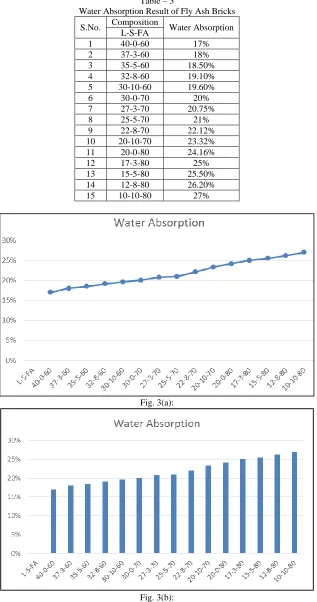
For all the 15 mix water absorption increased as we increase the fly ash content and soil content. Mix 40-0-60 (L-S-FA) least water absorption because it contains least fly ash content and zero soil content. Result given in table 3 and graph 5-6 as per the IS 12894: 1990 water absorption should be less than or equal 20% of the mass so here only 6 brick composition is passed according to codal provision, but as we see 4 composition contain 20% and 23% of the water absorption so these two composition is also allowable.
Table – 3
Water Absorption Result of Fly Ash Bricks
S.No. Composition Water Absorption L-S-FA
1 40-0-60 17%
2 37-3-60 18%
3 35-5-60 18.50%
4 32-8-60 19.10%
5 30-10-60 19.60%
6 30-0-70 20%
7 27-3-70 20.75%
8 25-5-70 21%
9 22-8-70 22.12%
10 20-10-70 23.32%
11 20-0-80 24.16%
12 17-3-80 25%
13 15-5-80 25.50%
14 12-8-80 26.20%
15 10-10-80 27%
Fig. 3(a):
Fig. 3(b):
Combined Result: C.
Table – 4
Combined Result of Fly Ash Bricks
S. No. Fly Ash Content L-S-FA Compresive Strength (28 Days) Water Absorption 1
60%
40-0-60 6.32 17%
2 37-3-60 6.07 18%
3 35-5-60 5.82 18.50%
4 32-8-60 5.35 19.10%
5 30-10-60 4.88 19.60%
6
70%
30-0-70 3.93 20%
7 27-3-70 3.94 20.75%
8 25-5-70 3.95 21%
9 22-8-70 3.63 22.12%
10 20-10-70 3.31 23.32%
11
80%
20-0-80 2.42 24.16%
12 17-3-80 2.32 25%
13 15-5-80 2.21 25.50%
14 12-8-80 2.11 26.20%
15 10-10-80 2.00 27%
L = Lime, S = Soil, FA = Fly Ash
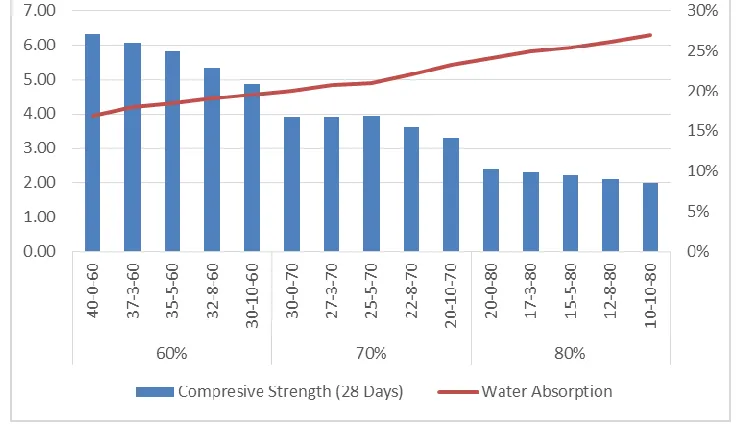
As we see in the above table as increase in the fly ash and soil content is done and with respect to it compressive strength decrease and water absorption is increased. As result shown in table 4, it is clear only only above 6 mix can be used or acceptable and graph 7 shows combined result of lime-fly ash bricks for both compressive strength and water absorption.
Fig. 4: Combined Result of Fly Ash Bricks
VI.
CONCLUSION
The main objective of the project is to determine the Compressive Strength and Water absorption of the Fly ash bricks with different percentage of Lime-Soil-Fly Ash, and the results of their study is given below.
1) Different composition is studied and it has been observed that, compressive strength of bricks increases with lime proportion.
2) As long as the percentage between lime and fly ash is unchanged, the change in soil percentages does not affect compressive strength significantly.
3) Most of the L-S-FA bricks are fail to achieve class 5 Specification.
4) Indian Standard (IS 12894 : 1990) specified The minimum average compressive strength of fly ash-lime bricks shall not be less than the one specified for each class, when tested for Compressive Strength. As the study shows there are only four bricks compositions which gives Compressive Strength higher than 5 kN/mm2 and only one composition which falls near 5 kN/mm2 which is acceptable.
6) There are only three bricks composition which satisfies the criterion in respect of both strength and water absorption are L-S-FA: 40-0-60, L-S-FA: 37-3-60, L-S-FA: 35-5-60, L-S-FA: 32-8-60
REFERENCE
[1] Sardarnagar Building Center (Supported by HUDCO), Mahemdabad 8. NTPC's Guide for users of coal ash. 1999.' Delhi.
[2] Building Materials in India: Last 50 years BMTPC 10. Indian Concrete Journal, July 1992 Subject: i) New trend in bricks and blocks: the role of FaL-G N. Bhanumathidas and N.Kalidas 11. The Indian Concrete Journal 'November 1993 Subject: i) Commercialization of fly ash. --P.C. Gupta and S.C. Ray [3] American Concrete Institute Journal September - Octomber ' 1987
[4] New Building Materials and Construction World October, 2000, B.N.Agrawal, S.M.Kohli
[5] Indian Standard, Guidelines For Utilisation and Disposal of Fly Ash, IS: 10153 - 1982, Indian Standards Institution, New Delhi.
[6] Indian Standard Specification For Fly Ash, IS : 3812 ( Part I) - 1966 For Use As Pozzolana IS : 3812 ( Part II) - 1966 For Use As Admixture For Concrete, Indian Standards Institution, New Delhi.
[7] Gujarat Narmada Fly ash Company Limited, 901, A- Wing, Alkapuri Arcade, R.C.Dutt Road, Vadodara - 390 005 18. Kesarjan Building Centre Pvt. Ltd., Kerala G.I.D.C., Near Bavla District, Ahmadabad. - Promoted by Govt, of India, through “Housing and Urban Development Corporation (HUDCO)". [8] D.L. NarsimhaRao, Editor “Cement and Building Materials Form Industrials Wastes Proceedings of the national conference” July 24-25' 1992 (India). [9] Workshop on Utilization of Fly Ash, May 19-20, 1988 (Roorkee).