in the population sciences published by the Max Planck Institute for Demographic Research Konrad-Zuse Str. 1, D-18057 Rostock · GERMANY www.demographic-research.org
DEMOGRAPHIC RESEARCH
VOLUME 27, ARTICLE 8, PAGES 201-232
PUBLISHED 7 AUGUST 2012
http://www.demographic-research.org/Volumes/Vol27/8/ DOI: 10.4054/DemRes.2012.27.8
Research Article
Family ties and depressive mood in Eastern
and Western Europe
Nienke Moor
Aafke Komter
This publication is part of the proposed Special Collection "Intergenerational family ties in Europe: Multiple linkages between individuals, families and social contexts", edited by Pearl Dykstra.
© 2011 Nienke Moor & Aafke Komter.
This open-access work is published under the terms of the Creative Commons Attribution NonCommercial License 2.0 Germany, which permits use, reproduction & distribution in any medium for non-commercial purposes, provided the original author(s) and source are given credit.
1 Introduction 202
2 Background 203
2.1 Family resources and depressive mood 204
2.1.1 Ties with parents 204
2.1.2 Ties with siblings 204
2.1.3 Ties with a partner 205
2.1.4 Ties with children 206
2.2 Gender differences 206
2.3 Substitution and reinforcement 207
2.4 The importance of family ties for wellbeing in Eastern and Western
Europe 208
3 Data and measurements 209
3.1 Generations and gender surveys 209
3.2 Measurements 209
4 Results 212
5 Conclusion and discussion 220
6 Acknowledgements 223
Family ties and depressive mood in Eastern and Western Europe
Nienke Moor1
Aafke Komter2
Abstract
BACKGROUND
Family ties in Europe are affected by demographic trends associated with parenting and partnering, such as a decline in fertility, an increase in childlessness, postponement of parenthood and of partnership formation, the rise of “new” relationship forms and divorce rates. It is unclear how the contemporary family structure and composition are associated with people’s mental wellbeing.
OBJECTIVE
This article examines how ties with parents, siblings, a partner and children are associated with depressive mood of men and women in seven Eastern and Western European countries.
METHODS
To test our hypotheses we made use of data from the Generations and Gender Surveys. We performed logistic regression analyses to study the associations between people’s family ties and depressive mood.
RESULTS
Our research findings show that family ties can diminish people’s depressive feelings. Although we find some gender differences in these associations, we do not find support for the argument that family ties are more important for the mental wellbeing of women than of men. Moreover, our findings support the hierarchical model of family relations in which new ties with partner and children in adulthood gain precedence over the original primary ties with parents and siblings. Finally, we find that the association between family ties and depressive mood is quite similar in Eastern and Western Europe, but being married or having a partner more strongly reduces depressive feelings in Eastern than in Western Europe.
1 Tilburg University, The Netherlands. E-mail: [email protected].
CONCLUSIONS
Although longitudinal data were not available to us, our research results do provide some indications about how demographic changes, for instance, those affecting family size -- the number of children or siblings -- might be associated with mental wellbeing. Our findings also suggest that the demographic trend of increasing partnership dissolution may have larger consequences for people’s mental wellbeing in Eastern than in Western Europe.
1. Introduction
Family ties in Europe are affected by demographic trends associated with parenting and partnering, such as a decline in fertility (Sobotka 2004), an increase in childlessness (Rowland 2007), postponement of parenthood and of partnership formation, the rise of “new” relationship forms and divorce rates (Billari 2005). In this article, we examine to what extent contemporary family structure and composition are associated with mental wellbeing. Assuming that intimate family ties can provide people with affection and social support, we study how the presence or break-up of ties with parents, siblings, a partner and children diminish or excite depressive mood.
We start our article by presenting an overview of the associations between family ties and depressive mood. Instead of studying the influence of different family ties such as parenthood or having or not having a partner separately as is usual in the existing literature, we consider them together. Doing so is important because of the interconnections in the availability of different types of family ties. For example, people who are married are more likely to have children than people who are not married, and people who experienced a parental divorce are more likely to be divorced themselves (Amato 1996). In our overview we include both family ties that have already been studied extensively, such as ties with children, and family ties that have been less often investigated, such as ties with siblings.
Secondly, we investigate potential gender differences in the relationship between family ties and depressive mood. While it is generally known that women are more likely to develop depressive feelings than men (Almeida and Kessler 1998; Nolen-Hoeksema 2001; Klose and Jacobi 2004), we do not know of any studies that focus on gender differences in the ways family ties affect people’s depressive moods. Is it the case that family ties are more important for the wellbeing of women, given their traditional role as “kin keepers” (Rosenthal 1985)?
kinship relationships (Cantor 1979) by examining whether ties with parents and siblings, “primary” ties during childhood, are more “secondary” in people’s adult life, when greater priority is given to spouses and children.
Finally, we study the relationship between family ties and depressive mood for both Eastern and Western European countries. Despite the fact that demographic trends are similar in Western and Eastern European countries, convergence does not seem to be the predominant pattern (Therborn 2004; Viazzo 2010). Family patterns, such as levels of co-residence and age at marriage and parenthood continue to show regional variation. The regional differences are linked to differences in economic development, religious and cultural climates, and inheritance laws. How family ties are associated with depressive mood in Western and Eastern Europe has not yet been investigated, to our knowledge.
Our overarching research question, then, reads: how are family ties related to the depressive feelings of men and women in Eastern and Western Europe?
2. Background
An explanation for the relationship between family ties and depressive mood is offered by the “conservation of resources theory" (Hobfoll 1989, 2001). People aim to obtain and retain material and non-material resources throughout their lives. With these resources people can fulfill their physical and psychological needs. Therefore, people with more resources will have higher levels of wellbeing. A loss of resources may lead to stress, which may reduce psychological wellbeing (Soons and Liefbroer 2008; Soons, Liefbroer and Kalmijn 2009). In the literature, three main categories of resources are distinguished: material, social and personal (Diener and Fujita 1995). Social resources are expected to be strongly associated with wellbeing, because they provide people with affection, social support and social integration. Intimate social ties are an important “resource” of affection, whereas their absence or loss can lead to loneliness or alienation.
most cases the beneficial aspects of family ties outweigh the negative aspects, we try to answer the above-mentioned questions.
2.1 Family resources and depressive mood
2.1.1 Ties with parents
On the basis of the resources perspective, we expect parental ties to have a positive influence on psychological wellbeing and reduce the likelihood of depressive mood, especially in childhood and young adulthood where parents have a formative and central role. The loss of parental ties is likely to negatively affect psychological wellbeing and excite depressive mood (Birtchnell 1970; Bifulco, Harris and Brown 1992; Morgan et al. 2007; Slavich, Monroe and Gotlib 2011). Existing research focused mainly on the consequences of early parental death for wellbeing in adult life (Maier and Lachman 2000). We argue that parental death later in life may also excite depressive feelings because parental ties remain an important source of support and affection in adult life (Cooney and Uhlenberg 1992). Thus, people who lost a parent or both parents are more likely to feel depressed than people with both parents alive (H1a).
The proportion of people with divorced parents has increased over the past decades. On the basis of the resources perspective, we argue that a parental divorce causes stress for both parents and children and damages people’s social, personal and material resources. This is supported by previous research (Dronkers 1994; Elder and Russell 1996; Ross and Mirowsky 1999; Amato and Booth 2001; Wauterickx, Gouwy and Bracke 2006). Children of divorced parents are more likely to drop out of school, are less inclined to attend higher education and have more difficulties in forming interpersonal relations in adult life. Therefore, people who experienced a parental divorce are more likely to feel depressed than people without this experience (H1b).
2.1.2 Ties with siblings
situations, even though only a minority of them actually receive support (Connidis 1994). Moreover, siblings tend to provide support when other resources are unavailable, for instance, when there are no adult children or a partner who can provide care (Connidis 1994; White and Riedmann 1992). In sum, we expect sibling ties to protect people against depressive mood (H2).
2.1.3 Ties with a partner
2.1.4 Ties with children
According to Ross et al. (1990) children can protect people from depressive mood by offering affection and social support, but can also generate depression by invoking stress. Children - especially young children - increase economic strains on the family and decrease the amount of emotional support that partners receive from each other (Keizer and Schenk 2012). Research on the association between parenthood and depression remains inconclusive. Some studies showed that children decrease the mental wellbeing of parents or do not have a significant influence (Glenn and McLanahan 1981; McLanahan and Adams 1987; Ross, Mirowsky and Huber 1983), whereas other studies found a positive association with the parents’ mental wellbeing (Kandel, Davies and Raveis 1985; Burton 1998; Helbig et al. 2006). Recent evidence suggests that childlessness is associated with enhanced wellbeing, at least for certain social groups in society (Umberson, Pudrovska and Reczek 2010). It has also been suggested that the presence of younger children and resident children increases depressive feelings of the parents (Nomaguchi and Milkie 2003; Kluwer and Johnson 2007), whereas adult children and non-resident children decrease depressive mood (Kandel et al. 1985; Ross et al. 1990). However, the positive impact of having non-resident children is not always found (Rempel 1985, Evenson and Simon 2005; Pudrovska 2008). In line with the findings mentioned previously we expect that people with younger children are more likely to feel depressed, whereas people with older children are less likely to feel depressed, compared with the situation in which no children are present (H4).
2.2 Gender differences
the combination of the family role and the work role is still characteristic for the social position of most women nowadays. From this perspective, we expect the relationship between the presence and break-up of family ties and depressive mood to be stronger for women (H5).
2.3 Substitution and reinforcement
According to Cantor (1979) family relationships can be represented as a set of nested circles, reflecting a hierarchy of kinship relations. During the first stages of life, parental and sibling ties are primary ties, and are thus part of the inner circle of family relationships. However, when people become adults and start having a family of their own, the importance of parental and sibling ties may diminish and be partly replaced by the ties to partner and children.
In the empirical literature, two contrasting views about the impact of marriage on family ties prevail. On the one hand, modern marriage is assumed to have a privatizing, instead of an integrating function: marriage competes with, or even undermines relationships with others, notably parents and adult siblings, because spouses are thrown upon each other. After marriage people have fewer contacts with others (Kalmijn 2003), a phenomenon originally called “dyadic withdrawal” (Johnson and Leslie 1982; Milardo 1982). This view pictures marriage as a “greedy institution”, requiring undivided commitment of the spouses to each other (Coser and Coser 1974). On the other hand, marriage is portrayed as serving an integrating function and as strengthening the ties between adult children and their parents and siblings. Marriage is assumed to serve as a primary building block of community and as a key linchpin for social ties, including one’s own parents and siblings (Sarkisian and Gerstel 2008).
Because empirical results are mixed, we formulate two competing hypotheses. First, the substitution hypothesis (H6a): the association between parental and sibling ties and depressive mood is weaker when they are in a stage of life in which they have a partner and/or children; and second, the reinforcement hypothesis (H6b): the association between parental and sibling ties and depressive mood is stronger when they are in a stage of life in which they have a partner and / or children.
2.4 The importance of family ties for wellbeing in Eastern and Western Europe
In the literature differences between “strong family countries” in Southern Europe and “weak family countries” in the North of Europe have been found to exist (Reher 1998). Eastern European family arrangements bear more resemblance to the patterns that are prevalent in the familialistic Southern European countries than those in the more individualistic Scandinavian and North-Western European countries (Viazzo 2010). Countries in Central and Eastern Europe are characterized by a pattern of early and universal marriage, whereas in Western Europe marriage is more often delayed and rates of never-married people are higher (Kalmijn 2007). In Northern Europe small (nuclear) households are predominant, whereas in Southern and also Eastern Europe the family structure is more often “extended” and the density of the kinship network is higher. In general, the role of kinship - both reflected in norms of family obligation and in actual contact with and support given to family - is believed to be of greater importance in Southern and Eastern European countries compared with Western and Northern Europe. Family ties are supposed to be based on a stronger “kinship culture” in Southern and Eastern Europe than in the rest of Europe (Viazzo, 2010). These differences have been associated with the contrasting systems of welfare provision in North-West Europe on the one hand, and Southern and Eastern Europe on the other hand (cf. also Castles 1993; Esping-Andersen 1990).
norms (Kalmijn and Saraceno 2008). Interestingly, the effect of divorce on wellbeing was also weaker in countries where divorce is more common, such as the Eastern European countries.
We expect the presence of family ties for people’s wellbeing to be especially important in the familiaristic Eastern European countries where people have strong support norms and where people cannot rely on the support of a strong welfare state (H7a). However, we also expect that the break-up of family ties, caused by death or divorce, is less strongly associated with depressive mood among people in Eastern European countries, because they can fall back upon the support and comfort of other family members (H7b).
3. Data and measurements
3.1 Generations and gender surveys
We make use of the Generations and Gender Surveys (GGS), which are part of the Generations and Gender Program (GGP). The primary aim of the GGP is to improve the knowledge-base for policy-making in UNECE countries. The GGS is a panel survey of an 18-79 year-old resident population, which is held in a number of European countries and is designed for a face-to-face interview. It aims to survey nationally representative samples of the population. The GGS have information on the most important societal aspects of demographic choices in contemporary, developed societies, focusing on the processes of childbearing, partnership dynamics, home-leaving and retirement. Currently data are available for thirteen European countries. In this study, we use GGS data for the seven countries for which information is available about people’s depressive mood: the Eastern European countries Bulgaria (2004), Georgia (2006), Romania (2005) and Russia (2004), and the Western European countries Belgium (2008-2010), France (2005) and Norway (2007-2008).
3.2 Measurements
People’s depressive feelings are measured using a subscale of the Epidemiological
Studies Depression Scale or CES-D (Radloff 1977), which measures the prevalence of depressive symptoms in society.
Respondents were asked to tell how frequently they experienced the following feelings during the previous week: “I felt that I could not shake off the blues”; “I felt depressed”; “I thought my life had been a failure”; “I felt fearful”; “I felt lonely”; “I had crying spells”; “I felt sad”. The answer categories were: 0. seldom or never, 1. sometimes, 2. often, 3. most of the time. We computed a scale with a range of 0-21 by adding up the scores of these seven items: higher scores indicate more depressive symptoms. The Cronbach’s alpha for this scale is 0.889 and is above 0.844 in each country. We use a cut-off point of 6 to identify people with depressive symptoms, which matches the widely used cut-off point of 16 on the original CES-D scale with a range of 0-60.
The presence of parental bonds is measured with the number of surviving parents
in the present situation. We distinguish between three categories: 1. both parents are alive, 2. one parent is alive and 3. neither is alive. Respondents who don’t know anything about their biological parent(s) have a missing value on this variable.
The number of siblings refers to the present situation, not to the original number.
We distinguish between people who have 1. no siblings, 2. one or two siblings, and 3. three or more siblings.
Regarding the presence of children (biological, adoptive, foster), we distinguish
between people who have 1. no children, 2. children aged twelve years or younger, and 3. children older than twelve years. Respondents who have both younger children (≤ 12 years) and older children (> 12 years) received score 2.
The variable marital status has five categories: 1. married, 2. partner, not married,
3. widowed, 4. divorced and 5. single, never married.
We also include a variable indicating whether or not a person experienced a
parental divorce (0-1).
Health status, educational level, economic activity, and easiness of making ends meet are included because these variables are strongly intertwined with both family ties and depressive mood. Being healthy, highly educated, employed and having no financial difficulties decreases the likelihood of feeling depressed (Gurland, Wilder and Berkman 1988; Lorant et al. 2003). These characteristics also have an impact on choices regarding parenting and partnering. It was found, for example, that more highly educated people were the last to bear children (Rindfuss et al. 1996), whereas fertility rates are highest among women who were housewives and who did not pursue a career for themselves (Di Giulia et al. 1999). People’s subjective health status is measured
with a four-point scale which ranges from a very bad health to a very good health. Regarding the highest educational level people completed, we coded country-specific
variable economic activity has four categories: 1. fulltime employed, 2. part-time
employed, 3. homemaker, 4. other. Finally, we control for people’s financial situation by taking into account the extent to which people are able to make ends meet. The six-point scale ‘easiness of making ends meet’ ranges from 0. with great difficulty to 5.
very easily.
For the variables ‘parental bonds’, ‘parental divorce’, ‘number of siblings’ and ‘educational level’, we created dummy-categories for the missing values (between 1.1%-2.4% of missing values). For the other variables with less than 1.0 % missing values we applied a listwise deletion. Our dependent variable depressive feelings has
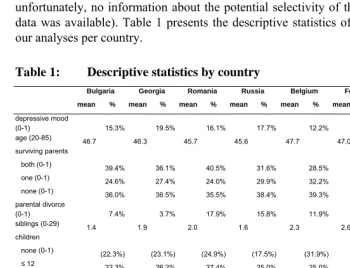
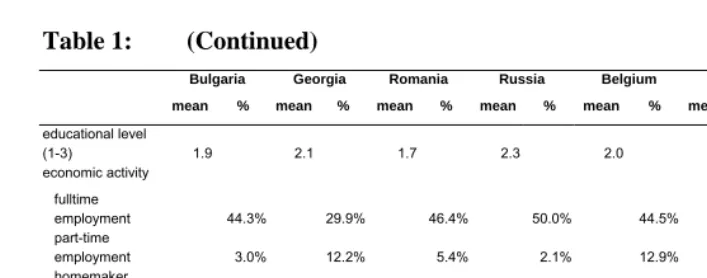
less than 1.0% missing values for all countries, except Norway. In Norway, the depression scale was included in a postal questionnaire, and about 70% of the respondents turned in this questionnaire (which means 30% missing values; unfortunately, no information about the potential selectivity of the Norwegian missing data was available). Table 1 presents the descriptive statistics of the variables used in our analyses per country.
Table 1: Descriptive statistics by country
Bulgaria Georgia Romania Russia Belgium France Norway Sig. mean % mean % mean % mean % mean % mean % mean %
depressive mood
(0-1) 15.3% 19.5% 16.1% 17.7% 12.2% 15.5% 13.1% *** age (20-85) 46.7 46.3 45.7 45.6 47.7 47.0 48.0 ***
surviving parents ***
both (0-1) 39.4% 36.1% 40.5% 31.6% 28.5% 42.6% 43.0% one (0-1) 24.6% 27.4% 24.0% 29.9% 32.2% 26.0% 23.2% none (0-1) 36.0% 36.5% 35.5% 38.4% 39.3% 31.4% 33.8% parental divorce
(0-1) 7.4% 3.7% 17.9% 15.8% 11.9% 15.4% 14.0% *** siblings (0-29) 1.4 1.9 2.0 1.6 2.3 2.6 2.1 ***
children ***
none (0-1) (22.3%) (23.1%) (24.9%) (17.5%) (31.9%) (26.8%) (25.0%) ≤ 12 22.3% 26.2% 27.4% 25.0% 25.0% 28.3% 27.8% > 12 55.4% 50.7% 47.7% 57.5% 43.1% 45.0% 47.1%
marital status ***
married (0-1) 61.7% 56.2% 68.8% 57.8% 56.2% 55.0% 55.3% partner, not
married (0-1) 11.3% 10.8% 8.5% 18.1% 22.4% 22.3% 23.9% widowed (0-1) 6.8% 10.6% 7.2% 8.5% 2.5% 4.4% 3.1% divorced (0-1) 3.0% 1.2% 2.8% 4.7% 3.4% 2.7% 5.5% single, never
married (0-1) 17.2% 21.2% 12.7% 10.9% 15.5% 15.5% 12.3% woman (0-1) 51.8% 56.0% 51.9% 60.8% 50.3% 51.7% 53.1% *** subjective health
(1-4) 2.8 2.3 2.8 2.2 3.1 2.9 3.3
Table 1: (Continued)
Bulgaria Georgia Romania Russia Belgium France Norway Sig. mean % mean % mean % mean % mean % mean % mean %
educational level
(1-3) 1.9 2.1 1.7 2.3 2.0 1.9 2.1 ***
economic activity ***
fulltime
employment 44.3% 29.9% 46.4% 50.0% 44.5% 45.2% 54.5% part-time
employment 3.0% 12.2% 5.4% 2.1% 12.9% 8.2% 12.5% homemaker 1.0% 14.5% 9.4% 5.0% 6.5% 6.5% 1.8% other 51.8% 43.4% 38.8% 42.9% 36.1% 4.1% 31.2% ease of making
ends meet (0-5) 1.1 1.3 2.1 1.4 3.0 2.5 3.5 *** N 11,960 9,698 11,722 10,774 6,938 9,815 10,199
Source: Data from the Generations and Gender program (GGP).
Differences between countries were tested statistical by means of F-test (Anova) and Chi-square; *** = p ≤ .001.
4. Results
We performed logistic regression analyses to study the associations between people’s family ties and depressive mood. The analyses are based on 71,106 respondents from seven European countries. To take into account people’s country of residence, we decided to include dummy-variables for country, with France as the reference category. In our first analysis we examine to what extent the presence or absence of family ties are related to depressive mood. Subsequently, we take into account possible gender differences in the associations between family ties and depressive mood. Thirdly, we test our expectation that the association between parental and sibling ties and depressive mood is weaker when people have a family of their own. Finally, we examine to what extent the associations between family ties and depressive mood differ for Eastern and Western European countries.
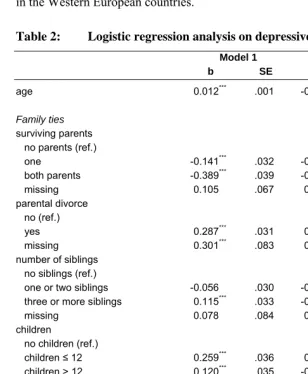
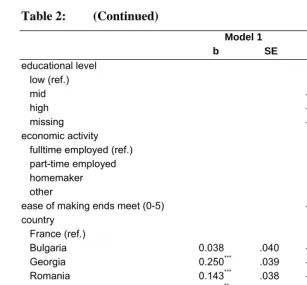
In model 1 of Table 2 we investigate the associations between people’s family ties and depressive mood, controlling for people’s age3. We see that older people are more likely to feel depressed than younger people. In model 2 of Table 2 gender, health, educational level, economic activity, and ease of making ends meet are added as controls. Men, people who are healthy, highly educated, and fulltime employed, and people who have no problems making ends meet are least likely to feel depressed. In both models, we control for people’s country of residence. Model 1 shows that the
3 Although age strongly correlates with number of parents, having (young) children, and health, our results do
likelihood of feeling depressed is highest in Eastern European countries, especially in Georgia, whereas it is lowest in the Western European countries Belgium and Norway. In model 2 we see a completely different pattern. When we take into account country differences in people’s socio-economic status and health status, people in Eastern European countries are less likely, instead of more likely, to feel depressed than people in the Western European countries.
Table 2: Logistic regression analysis on depressive mood by family ties
Model 1 Model 2
b SE b SE
age 0.012*** .001 -0.004** .001
Family ties
surviving parents no parents (ref.)
one -0.141*** .032 -0.027 .034
both parents -0.389*** .039 -0.182*** .041
missing 0.105 .067 0.094 .070
parental divorce no (ref.)
yes 0.287*** .031 0.161*** .033
missing 0.301*** .083 0.207* .087
number of siblings no siblings (ref.)
one or two siblings -0.056 .030 -0.090** .032
three or more siblings 0.115*** .033 -0.056 .036
missing 0.078 .084 0.085 .088
children
no children (ref.)
children ≤ 12 0.259*** .036 0.00 .038
children > 12 0.120*** .035 -0.133*** .037
marital status married (ref.)
partner, not married 0.614*** .033 0.473*** .035
widowed 1.375*** .035 0.975*** .038
divorced 1.253*** .045 0.937*** .049
single, never married 1.153*** .035 0.891*** .036
Control variables
woman (0-1) 0.695*** .025
Table 2: (Continued)
Model 1 Model 2
b SE b SE
educational level
low (ref.)
mid -0.181*** .028
high -0.226*** .035
missing -0.163 .113
economic activity
fulltime employed (ref.)
part-time employed 0.120** .045
homemaker 0.145** .049
other 0.163*** .029
ease of making ends meet (0-5) -0.364*** .010
country
France (ref.)
Bulgaria 0.038 .040 -0.640*** .044
Georgia 0.250*** .039 -0.649*** .045
Romania 0.143*** .038 -0.218*** .041
Russia 0.122** .039 -0.783*** .044
Belgium -0.254*** .046 -0.084 .049
Norway -0.242*** .042 0.378*** .045
N 71,106 71,106
Nagelkerke R2 0.102 0.229
*** = p ≤ .001, ** = p ≤ .01, * = p ≤ .05
Source: Data from the Generations and Gender program (GGP)
Table 2 demonstrates that having one or two siblings lowers the risk of depressive mood: the odds of feeling depressed are almost nine percent lower for people who have one or two siblings than for people without siblings (exp(-0.090)). This effect only becomes significant when we control for people’s socio-economic characteristics in model 2. Having three or more siblings is not significantly associated with the likelihood of depressive mood. Therefore, hypothesis 2, which states that sibling ties protect people against depressive mood is partly supported by our results.
As expected, married people are better off, compared to unmarried people. Unmarried people who have a partner are more likely to feel depressed than married people, but less likely than people without a partner. Hypothesis 3a is supported by this finding. In regard to depressive mood, people who are divorced or widowed do not significantly differ from single people who never married, which does not support hypothesis 3b. When we compare the results from models 1 and 2, we see that the association between marital status and depressive mood decreases strongly after controlling for people’s socio-economic characteristics. This is probably because people who are alone tend to have more financial difficulties than people with a partner. As compared to the associations with other family ties, the association between marital status and depressive mood is substantial. The odds of feeling depressed are about one and a half times as large for people without a partner as for married people.
In model 1 of Table 2, we see that people with children - especially young children - are more likely to feel depressed than people without children. People with (young) children are more likely to feel depressed, because they less often work full-time and have more difficulties making ends meet. When we control for the economic and financial situation of people in model 2, we see that the effect of having young children (≤ 12 years) is no longer significant. The effect of having older children becomes negative: people with older children (> 12 years) are less likely to feel depressed than people without children. The odds for feeling depressed are twelve percent lower for people with older children than for people without children (exp(-0.133)). After controlling for people’s economic and financial situation, the results show a partial confirmation of hypothesis 4.
Table 3: The associations between family ties and depressive mood by gender
Men Women Significance of interaction family tie * gender
b SE b SE
surviving parents
no parents (ref.)
one -0.014 .061 -0.032 .041 n.s.
both parents -0.179* .075 -0.179*** .049 n.s.
missing 0.103 .128 0.089 .085 n.s.
parental divorce
no (ref.)
yes 0.131* .061 0.172*** .040 n.s.
missing 0.204 .141 0.215 .111 n.s.
number of siblings no siblings (ref.)
one or two siblings -0.195*** .056 -0.043 .039 ***
three or more siblings -0.107 .063 -0.036 .043 n.s.
missing 0.110 .150 0.077 .109 n.s.
children
no children (ref.)
children ≤12 0.120 .070 -0.041 .046 n.s.
children > 12 -0.095 .067 -0.144*** .044 *
marital status
married (ref.)
partner, not married 0.529*** .064 0.462*** .043 n.s.
widowed 1.398*** .083 0.900*** .042 ***
divorced 1.379*** .094 0.794*** .057 ***
single, never married 1.189*** .069 0.791*** .043 ***
N 31,881 39,225
Nagelkerke R2 0.212 0.200
*** = p ≤ .001, ** = p ≤ .01, * = p ≤ .05
Controlled for all the variables in Table 2, model 2
Source: Data from the Generations and Gender program (GGP)
Regarding siblings ties, we see that having one or two siblings is associated with a lower likelihood of depressive mood for men, but not for women. This gender difference is significant, as can be seen in the last column of Table 3. Having more than two siblings is not associated with the depressive mood of either men or women. Table 3 also demonstrates that having older children (> 12 years) reduces the likelihood of depressive mood for women, but not for men. This gender difference is significant. Finally, the fourth model demonstrates that the associations between having no partner and depressive mood are stronger for men than for women. People who are widowed, divorced or never married are more likely to feel depressed than married people. These associations are stronger for men than for women.
Summarizing, we can conclude that family ties are associated with depressive mood for both men and women. However, there are some notable gender differences but these are not in line with our hypothesis 5, in which we expected a generally stronger association between the presence and break-up of family ties with women’s depressive mood.
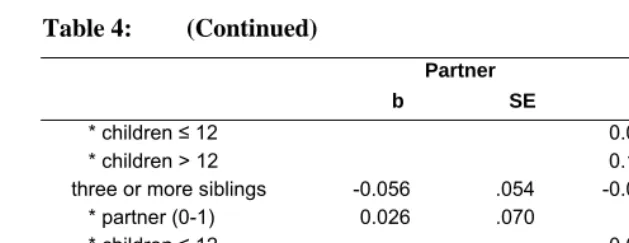
In Table 4 we present the associations between parental ties and sibling ties with depressive mood for people with and without a partner and/or children, controlled for the variables in model 2 of Table 2. For reasons of simplicity and clarity, we decided to only show the main effects of parental ties and sibling ties on depressive mood and the interactions with ties with a partner and children.
Table 4: The associations between parental ties and sibling ties, and
depressive mood for people who do (not) have a partner / children
Partner Children b SE b SE surviving parents
no parents (ref.)
one parent 0.026 .051 -0.255*** .071
* partner (0-1) -0.102 .059
* children ≤ 12 0.100 .111
* children > 12 0.271*** .076
both parents -0.343*** .058 -0.544*** .071
* partner (0-1) 0.218*** .058
* children ≤ 12 0.277** .104
* children > 12 0.540*** .078
number of siblings no siblings (ref.)
one or two siblings -0.062 .047 -0.186** .062
Table 4: (Continued)
Partner Children b SE b SE
* children ≤ 12 0.065 .101
* children > 12 0.148* .074
three or more siblings -0.056 .054 -0.077 .073
* partner (0-1) 0.026 .070
* children ≤ 12 0.049 .112
* children > 12 0.021 .085
N = 71,106
*** = p ≤ .001, ** = p ≤ .01, * = p ≤ .05
Controlled for all the variables in Table 2, model 2
Source: Data from the Generations and Gender program (GGP)
First, Table 4 shows that people with both parents are less likely to feel depressed than people without parents. However, this association is much smaller for people with a partner than for people without a partner. This finding is in accordance with the substitution hypothesis (6a). Regarding the interaction between parental ties and parenthood, we see a similar picture. Only for people without children is the association between having one parent and depressive mood significant. Also, the association between having both parents and depressive mood becomes weaker when people have young children (≤ 12 years) and completely disappears when people have older children (> 12 years). Apparently, the importance of parents for wellbeing decreases when people start a family of their own. Furthermore, Table 4 shows that the effect of having siblings is not different for people with a partner and without a partner. In accordance with the substitution hypothesis, having one or two siblings decreases people’s likelihood of depressive mood, but not when they have older children. There is no association between having three or more siblings and depressive mood, whether people do or do not have children. Concluding, the findings in Table 4 offer more support for the substitution hypothesis (6a) than for the reinforcement hypothesis (6b).
Finally, in Table 5, we examine whether associations between family ties and depressive mood differ between Eastern and Western Europe. We compare separate models for the Eastern and Western European countries in our dataset, controlling for the variables in model 2 of Table 2. In order to know whether the East-West differences in the associations between family ties and depressive mood are significant, we computed interactions between the dichotomous variable Western Europe and the
Table 5: The associations between family ties and depressive mood in Eastern and Western European countries
Eastern Europe Western Europe Significance of
interaction family tie * West
b SE b SE
surviving parents
no parents (ref.)
one -0.001 .043 -0.052 .057 n.s.
both parents -0.172*** .052 -0.142* .067 n.s.
missing 0.064 .095 -0.016 .113 n.s.
parental divorce
no (ref.)
yes 0.249*** .042 0.156** .054 n.s.
missing 0.138 .144 0.199 .113 n.s.
number of siblings no siblings (ref.)
one or two siblings -0.104** .037 -0.006 .063 n.s.
three or more siblings -0.052 .043 0.039 .065 n.s.
missing -0.007 .107 0.272 .158 n.s.
children
no children (ref.)
children ≤ 12 -0.001 .051 -0.023 .057 n.s.
children > 12 -0.187*** .048 -0.071 .059 n.s.
marital status
married (ref.)
partner, not married 0.513*** .046 0.286*** .054 ***
widowed 1.010*** .042 0.745*** .083 ***
divorced 1.036*** .063 0.840*** .078 ***
single, never married 0.974*** .047 0.663*** .058 ***
N 44,154 26,952
Nagelkerke R2 0.244 0.182
*** = p ≤ .001, ** = p ≤ .01, * = p ≤ .05
Controlled for all the variables in Table 2, model 2
Source: Data from the Generations and Gender program (GGP)
likelihood of feeling depressed. Regarding sibling ties, Table 5 shows that the negative association between having one or two siblings and depressive mood is only significant for people living in Eastern Europe. However, the last column of Table 5 demonstrates that this East-West difference is not significant. We see something similar with regard to ties with children: the negative association between having older children and depressive mood is only significant for people in Eastern Europe. However, this East-West difference is not significant. Finally, Table 5 demonstrates that ties with a partner are more strongly associated with people’s depressive mood in the Eastern European countries. Unmarried people with a partner are more likely to be depressed than married people, but this is especially the case in our Eastern European countries. Furthermore, we see that being single (widowed, divorced or never married) is more strongly associated with depressive mood in the Eastern European countries. These effects are approximately 30% smaller in our Western European countries. However, all effects remain significant.
Our results only partly support hypothesis 7a. The associations between parental ties, sibling ties and ties with children and depressive mood do not differ significantly between the Eastern and Western European countries in our study. However, the presence of a partner/spouse appears to be more important for the wellbeing of people in Eastern Europe. Hypothesis 7b is not supported by our results: the break-up of family ties, caused by death or divorce, is more instead of less strongly associated with depressive mood among people in Eastern European countries.
5. Conclusion and discussion
to feel depressed than people without a partner. Having children fosters people’s depressive mood. However, when we take into account the financial situation of people, having younger children (≤ 12 years) is not associated with depressive mood, and having older children (> 12 years) diminishes depressive feelings. When we compare the relative strength of the associations between the different types of family ties and depressive mood, we can conclude that marital status shows the strongest association of all types of family ties.
We also examined under which conditions and for which people family ties are more strongly associated with depressive mood. Regarding gender differences, we assumed that family ties would have a stronger influence on the frame of mind of women than men, because of the feminine gender role of family caretaker. Our research findings did not support this assumption. We found that the presence of older children diminishes women’s but not men’s depressive mood; a possible explanation is that women’s ties with their older children are closer - and thereby potentially a stronger source of support - compared with men’s ties with their adolescent children. Having one or two siblings is associated with a lower likelihood of depressive mood for men but not for women; the buffering effect on mental wellbeing provided by a small number of siblings may be stronger for men than for women because for women the ties with their own children serve as a greater source of support compared with men’s ties with their own children. Moreover, having a partner is more strongly associated with the depressive mood of men than of women, which is in line with the existing literature. Our expectation that family ties would generally be more strongly associated with women’s than with men’s mood, was not confirmed by our data.
Our findings support the hierarchical model of family relations, as proposed by Cantor (1979). Parental ties, and especially sibling ties, are less strongly associated with people’s depressive mood than are ties with a partner and children. Moreover, parental ties are less strongly associated with depressive mood when people have a partner and children. Sibling ties only protect people from depressive mood when they do not have older children. This supports the substitution hypothesis (in people’s adult life the original primary ties with parents and siblings are being substituted by new ties with partner and children) rather than the reinforcement hypothesis (the association between parental and sibling ties and mental wellbeing is stronger when people have children).
Apparently the specific support a partner can provide protects people living in Eastern Europe to a greater extent than people from Western European countries. The more extended welfare state in Western European countries on which single or widowed people can rely as an “alternative source of support” may be at the background of this difference.
A few limitations of our study should be mentioned here. First, we did not dispose of longitudinal data, which would have allowed us to draw conclusions about the effect of changes in the availability of family ties over time. Second, it would have been interesting to also study happiness as another aspect of mental wellbeing, since certain family ties, such as having children, can simultaneously foster depressive mood and happiness (Hansen, Slagsvold and Moum 2009); however, data restrictions prevented us from doing so.
Although we did not dispose of longitudinal data, our research results do provide some indications about how demographic changes, for instance, those affecting family size - the number of children or siblings - might be associated with mental wellbeing. Whereas the association between sibling ties and people’s mood is weak, the presence or absence of older children does show a relationship with people’s depressive mood; childlessness, especially in old age, may foster poor psychological wellbeing. In line with other studies, we found the partner tie to be of great importance for people’s mood. The demographic trend of increasing partnership dissolution may therefore have large consequences for people’s psychological wellbeing.
6. Acknowledgements
References
Almeida, D.M. and Kessler, R.C. (1998). Everyday stressors and gender differences in daily distress. Journal of Personality and Social Psychology 75(3): 670-680.
doi:10.1037/0022-3514.75.3.670.
Amato, P.R. (1996). Explaining the intergenerational transmission of divorce. Journal of Marriage and Family 58(3): 628-650. doi:10.2307/353723.
Amato, P.R. and Booth, A. (2001). The legacy of parents’ marital discord: Consequences for children’s marital quality. Journalof Personality and Social Psychology 81(4): 627-638. doi:10.1037/0022-3514.81.4.627.
Barrera, M.J. and Garrison-Jones, C.-J. (1992). Family and peer social support as specific correlates of adolescent depressive symptoms. Journal of Abnormal Child Psychology 20(1): 1-16. doi:10.1007/BF00927113.
Bianchi, S.M., Milkie, M.A., Sayer, L.C., and Robinson, J.P. (2000). Is anyone doing the housework? Trends in the gender division of household labor. Social Forces
79(1): 191-228. doi:10.1093/sf/79.1.191.
Bielby, D.D. and Bielby, W.T. (1988). She works hard for the money: Household responsibilities and the allocation of work effort. American Journal of Sociology
93(5): 1031-1059. doi:10.1086/228863.
Bifulco, A., Harris, T., and Brown, G.W. (1992). Mourning or early inadequate care? Reexamining the relationship of maternal loss in childhood with adult depression and anxiety. Development and Psychopathology 4(3): 433-449.
doi:10.1017/S0954579400000882.
Billari, F.C. (2005). Partnership, childbearing and parenting: Trends of the 1990s. In: Macura, M., MacDonald, A.L., and Haug, W. (eds.). The new demographic regime: Population challenges and policy responses. New York / Geneva:
United Nations: 63-94.
Birtchnell, J. (1970). The relationship between attempted suicide, depression and parent death. British Journal of Psychiatry 116: 307-313. doi:10.1192/bjp.116.532.307.
Bowling, A. (1987). Mortality after bereavement. A review of the literature on survival periods and factors affecting survival. Social Science and Medicine 24(2):
117-124. doi:10.1016/0277-9536(87)90244-9.
Burton, R. (1998). Global integrative meaning as a mediating factor in the relationship between social roles and psychological distress. Journal of Health and Social Behavior 39(3): 201-215. doi:10.2307/2676313.
Cairney, J., Boyle, M., Offord, D.R., and Racine, Y. (2003). Stress, social support and depression in single and married mothers. Social Psychiatry and PsychiatricEpidemiology 38(8): 442-449. doi:10.1007/s00127-003-0661-0.
Cantor, M.H. (1979). Neighbors and friends: An overlooked resource in the informal support system. Research on Aging 1(4): 434-463. doi:10.1177/01640275791 4002.
Castles, F.G. (1993) (ed.). Families of nations: Patterns of public policy in Western democracies. Aldershot: Dartmouth.
Caya, M.L. and Liem, J.H. (1998). The role of sibling support in high-conflict families.
American Journal of Orthopsychiatry 68(2): 327-333. doi:10.1037/h0080342.
Connidis, I.A. (1994). Sibling support in older age. Journal of Gerontology 49(6):
309-318. doi:10.1093/geronj/49.6.S309.
Cooney, T.M. and Uhlenberg, P. (1992). Support from parents over the life course: The adult child’s perspective. Social Forces 71(1): 63-84. doi:10.2307/2579966.
Cooper, C., Bebbington, P.E., Meltzer, H., Bhugra, D., Brugha, T., Jenkins, R., Farrell, M., and King, M. (2008). Depression and common mental disorders in lone parents: Results of the 2000 national psychiatric morbidity survey.
Psychological Medicine 38(3): 335-342. doi:10.1017/S0033291707001493.
Coser, L. and Coser, R. (1974). Greedy institutions: Patterns of undivided commitment.
New York: Free Press.
De Jong Gierveld, J. (2009). Living arrangements, family bonds and the regional context affecting social integration of older adults in Europe. In: How Generations and Gender Shape Demographic Change: Towards Policies Based on Better Knowledge. New York and Geneva: United Nations: 107-125.
Di Giulia, P., Lesthaeghe, R., Moors, G., and Pinnelli, A. (1999). Fertility tempo and quantum. In: Vallin, J. and Casselli, G. (eds.). Demographie - Analyses et Synthèse, Actes du Séminaire de Roma-Napoli-Pozzuoli. Paris / Roma: Institut
National d’Etudes Démographiques, Dept. Di Science Demografiche, Universita di Roma vol. 2: 31-48.
Diener, E. and Fujita, F. (1995). Resources, personal strivings, and subjective well-being: A nomothetic and idiographic approach. Journal of Personality and Social Psychology 68(5): 926-935. doi:10.1037/0022-3514.68.5.926.
Diener, E., Gohm, C.L., Suh, E., and Oishi, S. (2000). Similarity of the relations between marital status and subjective well-being across cultures. Journal of Cross-Cultural Psychology 31(4): 419-436. doi:10.1177/00220221000310040 01.
Dronkers, J. (1994). The changing effects of lone parent families on the educational attainment of their children in a European welfare state. Sociology 28(1):
171-191. doi:10.1177/0038038594028001011.
Elder, G.H., and Russell, S.T. (1996). Academic performance and future aspirations. In: Simons, R.L., and associates (eds.). Understanding differences between divorced and intact families: Stress, interaction, and child outcome. Thousand Oaks, CA:
Sage: 176-192.
Eriksen, S. and Gerstel, N. (2002). A labor of love or labor itself: Care work among adult brothers and sisters. Journal of Family Issues 23(7): 836-856. doi:10.11
77/019251302236597.
Esping-Andersen, G. (1990). The Three Worlds of Welfare Capitalism. Oxford: Polity
Press.
Evenson, R.J. and Simon, R.W. (2005). Clarifying the relationship between parenthood and depression. Journal of Health and Social Behavior 46(4): 341-358. doi:10.1
177/002214650504600403.
Fokkema, T., de Jong-Gierveld, J., and Dykstra, P.A. (2012). Cross-national differences in older adult loneliness. The Journal of Psychology 146 (1-2): 201-228. doi:10.
1080/00223980.2011.631612.
Fokkema, T. and Liefbroer, A.C. (2008). Trends in living arrangements in Europe: Convergence or divergence? Demographic Research 19(36): 1351-1418. doi:10.
Glenn, N.D. and McLanahan, S. (1981). The effects of offspring on the psychological well-being of older adults. Journal of Marriage and Family 43(2): 409-421. doi:10.2307/351391.
Gurland, B.J., Wilder, D.E., and Berkman, C. (1988). Depression and disability in the elderly: Reciprocal relations and changes with age. International Journal of Geriatric Psychiatry 3(3): 163-179. doi:10.1002/gps.930030304.
Hansen, T., Slagsvold, B., and Moum, T. (2009). Childlessness and psychological well-being in midlife and old age: An examination of parental status effects across a range of outcomes. Social Indicators Research 94(2): 343-362. doi:10.1007/s1
1205-008-9426-1.
Helbig, S., Lampert, T., Klose, M., and Jacobi, F. (2006). Is parenthood associated with mental health? Findings from an epidemiological community survey. Social Psychiatry and Psychiatric Epidemiology 41(11): 889-896. doi:10.1007/s00127-006-0113-8.
Hobfoll, S.E. (1989). Conservation of resources: A new attempt at conceptualizing stress. American Psychologist 44(3): 513-524. doi:10.1037/0003-066X.44.3. 513.
Hobfoll, S.E. (2001). The influence of culture, community, and the nested-self in the stress process: advancing conservation of resources theory. Applied Psychology
50(3): 337-421. doi:10.1111/1464-0597.00062.
Horwitz, A.V., White, H.R., and Howell-White, S. (1996). Becoming married and mental health: A longitudinal study of a cohort of young adults. Journal of Marriage and Family 58(4): 895-907. doi:10.2307/353978.
House, J.S., Landis, K.R., and Umberson, D. (1988). Social relationships and health.
Science 241(4865): 540-545. doi:10.1126/science.3399889.
Hughes, M. and Gove, W. (1981). Living alone, social integration and mental health. American Journal of Sociology 87(1): 48-74. doi:10.1086/227419.
Hughes, M.E. and Waite, L.J. (2009). Marital biography and health at mid-life. Journal of Health and Social Behavior 50(3): 344-358. doi:10.1177/00221465090500 0307.
Huntley, D.K. and Phelps, R.E. (1990). Depression and social contacts of children from one-parent families. Journal of Community Psychology 18(1): 66-72. doi:10.
Johnson, M.P. and Leslie, L. (1982). Couple involvement and network structure: A test of the dyadic withdrawal hypothesis. Social Psychology Quarterly 45(1): 34-43.
doi:10.2307/3033672.
Joseph, S. and Lewis, C.A. (1995). Factor analysis of the Center for epidemiological studies- depression scale. Psychological Reports 76(1): 40-42. doi:10.2466/pr0. 1995.76.1.40.
Kalmijn, M. (2003). Shared friendship networks and the life course: An analysis of survey data on married and cohabiting couples. Social Networks 25(3): 231-249.
doi:10.1016/S0378-8733(03)00010-8.
Kalmijn, M. (2007). Explaining cross-national differences in marriage, cohabitation, and divorce in Europe, 1990-2000. Population Studies 61(3): 243-263.
doi:10.1080/00324720701571806.
Kalmijn, M. (2010). Country differences in the effects of divorce on well-being: The role of norms, support, and selectivity. European Sociological Review 26(4):
475-490. doi:10.1093/esr/jcp035.
Kalmijn, M. and Saraceno, C. (2008). A comparative perspective on intergenerational support: Responsiveness to parental needs in individualistic and familialistic countries. European Societies 10(3): 479-508. doi:10.1080/14616690701744 364.
Kandel, D.B., Davies, M., and Raveis, V.H. (1985). The stressfulness of daily social roles for women. Journal of Health and Social Behavior 26(1): 64-78. doi:10.23 07/2136727.
Keizer, R., and Schenk, N. (2012). Becoming a parent and relationship satisfaction: A longitudinal dyadic perspective. Journal of Marriage and Family 74(4):
759-773.
Klose, M., and Jacobi, F. (2004). Can gender differences in the prevalence of mental disorders be explained by sociodemographic factors? Archives of women’s mental health 7(2): 133-148. doi:10.1007/s00737-004-0047-7.
Kluwer, E.S., and Johnson, M.D. (2007). Conflict frequency and relationship quality across the transition to parenthood. Journal of Marriage and Family 69(5):
1089-1106. doi:10.1111/j.1741-3737.2007.00434.x.
Family solidarity in the Netherlands. Amsterdam: Dutch University Press:
107-123.
Lorant, V., Deliège, D., Eaton, W., Robert, A., Philippot, P., and Ansseau, M. (2003). Socioeconomic inequalities in depression: A meta-analysis. American Journal of Epidemology 157(2): 98-112. doi:10.1093/aje/kwf182.
Loscocco, K. and Spitze, G. (2007). Gender patterns in provider role attitudes and behavior. Journal of Family Issues 28(7): 934-954. doi:10.1177/0192513X073 00787.
Maier, E.H. and Lachman, M.E. (2000). Consequences of early parental loss and separation for health and well-being in midlife. International Journal of Behavioral Development 24(2): 183-189. doi:10.1080/016502500383304.
McLanahan, S. and Adams, J. (1987). Parenthood and psychological wellbeing. Annual Review of Sociology 13: 237-257. doi:10.1146/annurev.so.13.080187.001321.
Menaghan, E.G. and Lieberman, M.A. (1986). Changes in depression following divorce: A panel study. Journal of Marriage and Family 48(2): 319-328. doi:10.2307/352399.
Milardo, R.M. (1982). Friendship networks in developing relationships, converging and diverging social environments. Social Psychology Quarterly 45(3): 162-172.
doi:10.2307/3033649.
Minor, S. and Uhlenberg, P. (1997). Intergenerational proximity and the social role of sibling neighbors after midlife. Family Relations 46(2): 145-153. doi:10.230 7/585038.
Morgan, C., Kirkbride, J., Leff, J., Craig, T., Hutchinson, G., McKenzie, K., Morgan, K., Dazzan, P., Doody, G.A., Jones, P., Murray, R., and Fearon, P. (2007). Parental separation, loss and psychosis in different ethnic groups: A case-control study. Psychological Medicine 37(4): 495-503. doi:10.1017/S003329170600 9330.
Nolen-Hoeksema, S. (2001). Gender differences in depression. Current Directions in Psychological Science 10(5): 173-176. doi:10.1111/1467-8721.00142.
Nomaguchi, K.M. and Milkie, M.A. (2003). Costs and rewards of children: The effects of becoming a parent on adults’ lives. Journal of Marriage and Family 65(2):
Pudrovska, T. (2008). Psychological implications of motherhood and fatherhood in midlife: Evidence from sibling models. Journal of Marriage and Family 70(1):
168-181. doi:10.1111/j.1741-3737.2007.00469.x.
Radloff, L. (1977). The CES-D scale: A self-report depression scale for research in the general population. Applied Psychological Measurement 1(3): 385-401.
doi:10.1177/014662167700100306.
Reher, D.S. (1998). Family ties in Western Europe: Persistent contrasts. Population and Development Review 24(2): 203-234. doi:10.2307/2807972.
Rempel, J. (1985). Childless elderly: What are they missing? Journal of Marriage and Family 47(2): 343-348. doi:10.2307/352134.
Rindfuss, R.R., Morgan, S.P., and Offutt, K. (1996). Education and the changing age pattern of American fertility: 1963-1989. Demography 33(3): 277-290. doi:10.23 07/2061761.
Robins, L., and Regier, D. (1991). Psychiactric disorders in America: The epidemiological catchment area study. New York: Free Press.
Rosenthal, C.J. (1985). Kinkeeping in the familial division of labor. Journal of Marriage and the Family 47(4): 965-974. doi:10.2307/352340.
Ross, C.E. and Mirowsky, J. (1989). Explaining the social patterns of depression: Control and problem solving, or support and talking. Journal of Health and Social Behavior 30(2): 206-219. doi:10.2307/2137014.
Ross, C.E. and Mirowsky, J. (1999). Parental divorce, life-course disruption, and adult depression. Journal of Marriage and Family 61(4): 1034-1045. doi:10.2307/354 022.
Ross, C.E., Mirowsky, J., and Goldsteen, K. (1990). The impact of the family on health: The decade in review. Journal of Marriage and Family 52(4): 1059-1078. doi:10.2307/353319.
Ross, C.E., Mirowsky, J., and Huber, J. (1983). Dividing work, sharing work, and in-between: Marriage patterns and depression. American Sociological Review
48(6): 809-823. doi:10.2307/2095327.
Rossi, A.S., and Rossi, P.H. (1990). Of human bonding: Parent-child relations across the life course. New York: Aldine de Gruyter.
Rowland, D.T. (2007). Historical trends in childlessness. Journal of Family Issues
Sarkisian, N. and Gerstel, N. (2008). Till marriage do us part: Adult children’s relationships with parents. Journal of Marriage and Family 70(2): 360-376.
doi:10.1111/j.1741-3737.2008.00487.x.
Sbarra, D.A. and Emery, R.E. (2005). Coparenting conflict, nonacceptance, and depression among divorced adults. American Journal of Orthopsychiatry 75(1):
63-75. doi:10.1037/0002-9432.75.1.63.
Shapiro, A. and Keyes, C.L.M. (2008). Marital status and social well-being: Are the married always better off? Social Indicators Research 88(2): 329-346. doi:10.10
07/s11205-007-9194-3.
Simon, R.W. (2002). Revisiting the relationship among gender, marital status, and mental health. American Journal of Sociology 107(4): 1065-1096. doi:10.1086/ 339225.
Slavich, G.M., Monroe, S.M., and Gotlib, I.H. (2011). Early parental loss and depression history: Associations with recent life stress in major depressive disorder. Journal of Psychiatric Research 45(9): 1146-1152. doi:10.1016/j.jpsyc hires.2011.03.004.
Sobotka, T. (2004). Postponement of childbearing and low fertility in Europe.
Amsterdam: Dutch University Press.
Soons, J.P.M. and Liefbroer, A.C. (2008). Together is better? Effects of relationship status and resources on young adults’ well-being. Journal of Social and Personal Relationships 25(4): 603-624. doi:10.1177/0265407508093789.
Soons, J.P.M., Liefbroer, A.C., and Kalmijn, M. (2009). The long-term consequences of relationship formation for subjective well-being. Journal of Marriage and Family 71(5): 1254-1270. doi:10.1111/j.1741-3737.2009.00667.x.
Stolzenberg, R.M., and Waite, L.J. (2005). Effects of marriage, divorce and widowhood on health. In: Bianchi, S.M., Casper, L.M., and King, R.B. (eds.). Work, family, health and well-being. NJ: Lawrence Erlbaum Associates, Inc.: 36-77.
Sweeney, M.M. and Horwitz, A.V. (2001). Infidelity, initiation, and the emotional climate of divorce: Are there implications for mental health? Journal of Health and Social Behavior 42(3): 295-309. doi:10.2307/3090216.
Therborn, G. (2004). Between sex and power: Family in the world, 1900-2000. London
Umberson, D., Pudrovska, T., and Reczek, C. (2010). Parenthood, childlessness, and well-being: A life-course perspective. Journal of Marriage and Family 72(3):
612-629. doi:10.1111/j.1741-3737.2010.00721.x.
Viazzo, P.P. (2010). Family, kinship and welfare provision in Europe, past and present: Commonalities and divergences. Continuity and Change 25(1): 137-159.
doi:10.1017/S0268416010000020.
Vink, D. et al. (2009). Onset of anxiety and depression in the aging population: comparison of risk factors in a 9-year prospective study. American Journal of Geriatric Psychiatry 17(8): 642-652. doi:10.1097/JGP.0b013e3181a65228.
Voorpostel, M., van der Lippe, T., Dykstra, P., and Flap, H. (2007). Similar or different? The importance of similarities and differences for support among siblings. Journal of Family Issues 28(8): 1026-1053. doi:10.1177/0192513X07 300713.
Wauterickx, N., Gouwy, A., and Bracke, P. (2006). Parental divorce and depression: Long-term effects on adult children. Journal of Divorce and Remarriage
45(3-4): 43-67. doi:10.1300/J087v45n03_03.
White, L.K. (2001). Sibling relationships over the life course: A panel analysis. Journal of Marriage and Family 63(2): 555-568. doi:10.1111/j.1741-3737.2001.00555.x.
White, L.K., and Riedmann, A. (1992). Ties among adult siblings. Social Forces 71(1):