M E T H O D O L O G Y
Open Access
Motif mining based on network space
compression
Qiang Zhang
*and Yuan Xu
* Correspondence: [email protected]
Key Laboratory of Advanced Design and Intelligent Computing, (Dalian university), Ministry of Education, Dalian 116622, China
Abstract
A network motif is a recurring subnetwork within a network, and it takes on certain functions in practical biological macromolecule applications. Previous algorithms have focused on the computational efficiency of network motif detection, but some problems in storage space and searching time manifested during earlier studies. The considerable computational and spacial complexity also presents a significant challenge. In this paper, we provide a new approach for motif mining based on compressing the searching space. According to the characteristic of the parity nodes, we cut down the searching space and storage space in real graphs and random graphs, thereby reducing the computational cost of verifying the isomorphism of sub-graphs. We obtain a new network with smaller size after removing parity nodes and the“repeated edges”connected with the parity nodes. Random graph structure and sub-graph searching are based on theBack Tracking Method; all sub-graphs can be searched for by adding edges progressively. Experimental results show that this algorithm has higher speed and better stability than its alternatives.
Keywords:Associated matrix, Space compression, Sub-graph mark, Parity nodes
Background
Researchers have discovered that the human genome is a complex network system. With the Human Genome Project (HGP), we step into a post-genome era. The network motif [1,2] is generally represented as the smallest unit in a network. Motif analysis is increasingly recognized as a powerful approach to identify the function structure of a net-work, its organizational principle and species evolution.
The network motif was first defined systematically in Escherichia coli. After this, algorithms regarding network motif mining were developed. Kashtan, Itzkovita, Milo
andAlon[3] proposed the Edge Sampling Algorithm (ESA), which unfortunately leads to sampling deviation and causes error. Wernicke[4] described an algorithm for enu-merating sub-graphs, named Enuenu-merating Subgraph(ESU for short), which allows for a faster detection of network motifs and offers useful additional features. Considerable work has been made concerning subgraph searching, and we select the RAND-ESU method for its performance and unbiased estimation [5,6]. Meanwhile, the generating random network model is a key to identifying motifs. We adopt the standard null model [7,8], in which the degree of every node is not allowed to change, such that sin-gle node properties are fixed. Lauand So. [9] proposed the Markov Chain Algorithm
to generate random networks [10], and we use it to construct the random networks for this paper. In addition, graphs are another key to finding motifs because sub-graph isomorphism is an NP-complete problem [11,12]. In order to solve this prob-lem, a method aimed at reducing the searching size was introduced by Ding and
Huang [13]. An algorithm to reduce the complexity of matching two graphs was pro-posed by Knossow,Sharma, Mateus and Horaud [14]. Another algorithm that opti-mizes the one-to-many matching problem was introduced by Ogras and Marculescu
[15]. Moreover, some more recent algorithms have been developed [16], based on the G-trie method to list all stored subgraphs and the implicit tree method [17] to finding motifs of a size greater than eight. Liao and Chen [18] presented the Depth-First Spelling algorithm for mining sequential patterns of biological sequences with Gap constraints (termed DFSG). Zhang and Lu [19] employed a network stratification strategy to investigate the validity of the current network analysis of conglomerate PPI networks, finding that network stratification may help to resolve many contro-versies in the current research of systems biology. Srinivasan,Vural, King and Guda
[20] presented a new substitution-based scoring function for identifying discri-minative lower denominations that are highly specific to a class. Unfortunately, some of these methods, designed for both directed and undirected graphs, proved to be time-consuming. The aim of this paper is to achieve a method for reducing the sear-ching time storage space required for a motif mining algorithm, while storing all sub-graphs.
We enumerate all sub-graphs that meet the requirements of a given graph by way of reducing the searching space. Then, the associated matrices of these sub-graphs are normalized and the isomorphic sub-graphs are uniquely marked. Through experiment, we verify the accuracy and extensive applicability of our algorithm, and improve the searching speed of sub-graphs enumeration.
In the following, we give some definitions:
Definition 1
The Network motif is generally represented as a topological pattern that occurs more often in a given network than in random networks, and takes on a certain function in practical biological applications. We utilize graph theory to research net-work. A sub-graph is considered as a Network Motif when the following conditions are met [1,2]:
1) The frequencyP< 0.01, from 1000 randomized networks.
2) The number of sub-graph in the input graphNrealis larger than four.
3) SetNrealas the number of sub-graphs in the input graph,Nrandas the mathematical expectation of the random graphs, the following inequality should be satisfied:
Nreal−Nrand> 0.1Nrand.
Definition 2
Definition 3
In a graphG= (V,E), any two nodesViandVjthat meet the following requirement are
calledParity nodes[21].
i) Both in-degree and out-degree ofViandVjare the same, stated as<diin;
diout>¼<djin;djout> :
Definition 4
The frequency partition of a graph (simple graph) is a partition of its vertices grouped by their degree [22].
Definition 5
Two sub-graphs G= (V1, E1) and G/(V2, E2) are Sub-graph isomorphic [12] if there is a one-to-one correspondence between their vertices, stated as f: v1→v2, and also there is an edge correspondence g: e1→e2, directed from one node to another node within one sub-graph. e1 ∈ E1, Ψ1(e) = < u, v> if and only if there is another
edge with the same direction between the corresponding vertices in the other sub-graph Ψ2(g(e)) = < f(u), f(v) > .
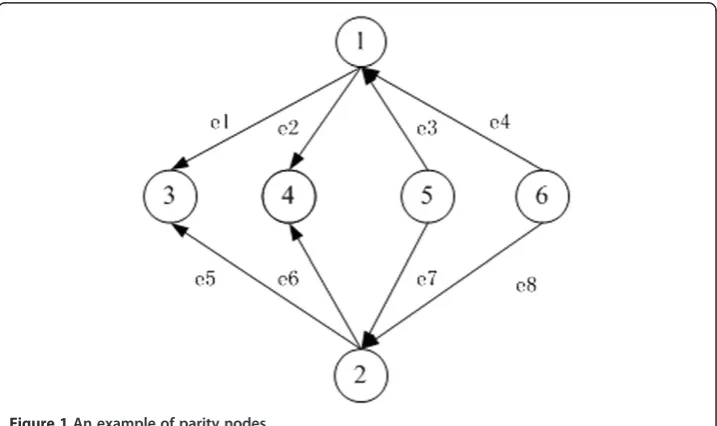
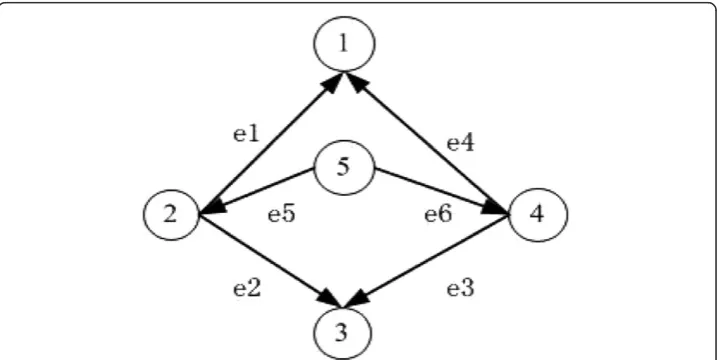
Figure 1 is an example of parity nodes and Figure 2 shows the isomorphism visually.
Methods
In this paper, we provide a new approach for motif mining based on compressing the searching space. Firstly, we use the associated matrices to store directed graphs, and then utilize parity nodes to compress searching space. Secondly, we use Back Tracking to enumerate all sub-graphs of a given size that occur in the input graph which are obtained from real graphs and random graphs. Thirdly, we normalize the associated matrix and mark isomorphism sub-graphs uniquely, by using the Symmetric Ternary to simulate the elements (−1, 0,1) in the associated matrix. And finally, we distinguish motifs among all the sub-graphs found on the basis of statistical parameters to iden-tify it whether or not.
Store graphs
The storage of graphs is the first step in the process of solving the motif-mining prob-lem. The associated matrix is easy to compress and thus it is easy to know the size of a sub-graph, so we use the associated matrix to store real graphs and random graphs.
An associated matrix M(G) shows the connection between the nodes and edges of
G. It is usually not a square matrix, shown as Figure 3
M Gð Þ ¼
e1 e2 e3 e4
v1 1 1 0 1
V2 −1 0 0 0
v3 0 −1 1 1
v4 0 0 −1 −1
In this matrix, a row represents nodes, a column edges, and the algebraic sum of all ele-ments is zero inM(G). In the matrixM(G), the sum of out-degree and in-degree are both
equal to the number of edges, stated asX n
i¼1
Xm
j¼1
mij¼1
¼m¼−X
n
i¼1
Xm
j¼1
mij¼−1
.
Figure 2An illustration of isomorphic graphs.
Sub-graph mark and isomorphism
As is well known, the sub-graph isomorphism is an NP-complete [12] problem among the different types of graph matching algorithms. The required time increases exponen-tially with the size of the input sub-graphs. For an N-vertex sub-graph, the number of the node label permutation is N!. In addition, there is a difficult problem using the associated matrix to store graphs, because an element represents both the connection relationship and orientation directly, such as “-1”. Therefore, we need to adopt the con-cept of symmetrical three hexadecimal to extracting the matrix row by row for get se-quence of symmetric ternary, and the symmetric ternary sese-quence is a Code number that is unique for each isomorphic class. In order to mark each graph uniquely, we need to standardize the associated matrix, which is useful for sub-graph isomorphism as it can reduce the complexity of sub-graph isomorphism and improve the efficiency of the searching. The detailed process of the standardization of the associated matrix can be referred to as [23].
e1 e2 e3 e4 v1 1 0 0 −1 v2 0 −1 1 0 v3 −1 1 0 0 v4 0 0 −1 1
⇔
e1 e2 e3 e4 v1 1 0 0 −1 v3 −1 1 0 0 v2 0 −1 1 0 v4 0 0 −1 1
⇔ð100‐1‐11000‐11000‐11ÞSymmetric Ternary¼13698880
From this example, we know that after two similar matrices get elementarily trans-formed; we can get the same matrix and a unique Code. One Code marks an isomorphic class. We just have to count the same values of the Codes to detect the motif. We confirm the sufficiency and necessity of this unique mark theoretically, this being outlined below:
The sufficiency
If isomorphism exists, their associated matrix is similar matrix. According to the pro-perties of the elementary transformation of matrix, similar matrices will become the same matrix after elementary transformation, and so their Code values are the same, and the mark the isomorphism class is the only.
The necessity
Space compression
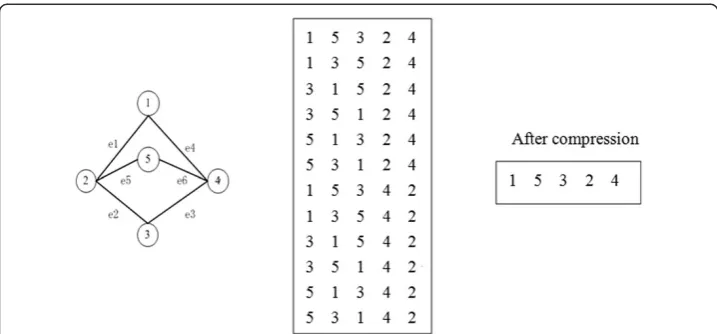
It appears that there is more than one parity node in a graph. The structure and func-tion of these nodes are similar, and the topological network characteristics of these nodes are completely the same. According to the features of the parity nodes, exchan-ging two nodes doesn’t affect the topological structure of the whole network. This means that the corresponding associated matrices are similar after exchanging the par-ity nodes, as can be seen in Figure 4.
e1 e2 e3 e4 e5 e6
1 −1 0 0 −1 0 0
2 1 1 0 0 −1 0
3 0 −1 −1 0 0 0
4 0 0 1 1 0 −1
5 0 0 0 0 1 1
⇒
change
e1 e2 e3 e4 e5 e6
1 −1 0 0 −1 0 0
4 0 0 1 1 0 −1
3 0 −1 −1 0 0 0
2 1 1 0 0 −1 0
5 0 0 0 0 1 1
We perform a pre-treatment of the searching space before enumerating the sub-graphs. In this pre-treatment, we first identify the parity nodes. In a group of parity nodes, we remove all except the node with the minimum mark number such that the network has no pairs of parity nodes, and then search directly into the network. Finally, we determine the network motifs.
In Figure 5,v1,v2represent vertex 1 and 2, respectively, and they are the remaining vertex after compression, e1 is the edge linking v1 and v2. Gr, Gp, Gcv represent the
nodes and edges that remain after compression, the parity nodes that are removed and the vertex and edges connected with the parity nodes, respectively. Upon finishing the compression, we conduct a sub-graph search. At this point, we shall see that the space we need to search is considerably reduced. If we want to search a sub-graph with a specific topological structure, for instance (1,2,5), we need not go through the whole graph to find all graphs with this topology, meaning that searching for sub-graphs like (2,3,5), (1,2,2), (1,4,5), (3,4,5), (1,3,4) is unnecessary. The aforementioned sub-graphs can be stored in Gcv and Gp. What we need to do is replace the parity
nodes correspondingly and make sure there is no repeating. In this way the searching time is reduced.
Enumerating Sub-graphs
Back Tracking [24] is often used to search the optimal solutions of complex problems. It enumerates a set of partial candidates, in which we keep just the initial and the end node of a path. We also reduce the space complexity using the method of saving storage space.
We aim to enumerate all sub-graphs of a given size that occur in the real graph, and then we combine the method for enumerating all sub-graphs (Back Tracking) with that for compressing space. The hybrid algorithm can reduce the complexity of the sub-graphs enumeration and the searching time. The process of enumerating sub-sub-graphs [23] can be read for reference.
Results and discussion
In this section, we will apply our method to some real networks in order to verify the validity. We evaluate our method on the metabolic pathway of the bacteria E. coli, the transcription network of Yeast, the Sea Urchin network, and an electronic network. These can be freely obtained online at http://www.weizmann.ac.il/UriAlon/groupNet worksData.html [25].
Effectiveness of the algorithm
Table 1 shows the numbers and structures of motifs with different sizes observed in some different networks, and in this table, we enumerate the number of the sub-graphs that occurred in the real network and the Code that marks them with different num-bers of edge in these networks.
In Table 1, the different numbers of edges and nodes embody the differences between networks. Most motifs are similar in the different networks, but small parts are differ-ent. If motifs have the same topological structure, their Codesshall be the same. This proves the accuracy of the unique mark of isomorphic sub-graphs, and also that of our
Table 1 [23] A summary of Code values and the topological structures in different networks
Network Nodes Edges Size-N Code Motif
E coli 423 519 3 8528
4 12925664
236808
S208 122 189 3 5668
4 13698880
12925664
S420 252 399 3 5668
4 12925664
13698880
algorithm. In addition, our method achieves the motif mining in different kinds of net-works, and it proves that our method is both valid and extensively applicable.
The results of compression
In order to judge the performance of our method, we carry out a series of experiments on a set of testing data. The performance of the method is evaluated by the consump-tion time. We enumerate all sizes of sub-graphs for testing, and then compare them with method [26]. There are no parity nodes in the electronic circuit network, so the searching time remains unchanged. However, we can compress the searching space in the network based on the properties of parity nodes.
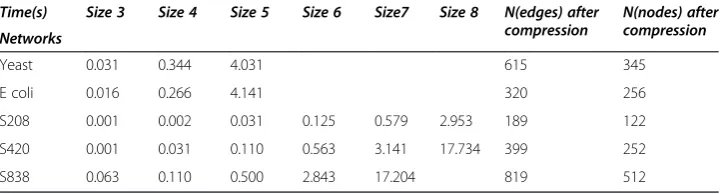
In a network, the searching time is different when the size of the sub-graph is differ-ent. For instance as can be seen in Table 2, the S208 network costs 0.001 seconds when there are three nodes in the sub-graph, and 2.9 seconds when there are eight nodes. With increasing size, the searching time is amplified tenfold. It shows that the search-ing time is directly proportional to the size of the sub-graph. We will now compare the results displayed in Table 3.
After compressing the searching space, we list the searching time in different net-works with different sizes in Table 3. To avoid repeated searching, we only search one of the parity nodes and remove the edges connected with the with parity nodes which were abandoned. In this way we obtain a compressed network; the random network shall be compressed in the same way, which ensures that the random network can be
Table 1 [23] A summary of Code values and the topological structures in different networks(Continued)
4 12925664
13698880
In this table, the fourth column contains the numbers of motifs in the real network.
The fifth column contains the unique Code values that represent the isomorphic class, and the sixth column has the topological structures of these motifs.
Table 2 List of searching times for different networks before compression
Time(s) Size 3 Size 4 Size 5 Size 6 Size7 Size 8 N(edges) before compression
N(nodes) before compression Networks
Yeast 0.013 1.860 31.281 1079 688
E coli 0.031 0.469 8.844 519 423
S208 0.001 0.002 0.031 0.125 0.579 2.953 189 122
S420 0.001 0.031 0.110 0.563 3.141 17.734 399 252
S838 0.063 0.110 0.500 2.843 17.204 819 512
used as a reference. This approach also ensures consistency of a sub-graph regardless of whether it is a network motif.
By comparing Table 3 with Table 2, it can be seen that there are no parity nodes in the electronic circuit networks, such as S208, S420, or S838. Therefore, the time for searching sub-graphs with different nodes is the same before and after compression. The subtle gaps between the results and the original results can be neglected. As for the biological networks with parity nodes, however, the more parity nodes that exist the more obvious the effect of compression is. In the example of the yeast network, the number of the parity nodes is 343, half the number of total nodes. The time for search-ing graphs is greatly reduced after compression. With increassearch-ing numbers of sub-graphs, the efficiency of searching increases up to 10 times for 4-node sub-graphs. Of course, the efficiency of searching depends on the size of the network as well as the size of the sub-graph searched for, and the current hardware environment. In any network, the searching time is different when the size of sub-graph is different.
Through comparison of Tables 2 and 3, we confirm that the method of compressing the searching space based on the property of parity nodes is feasible, and the effi-ciency of searching is greatly improved by saving storage space. The advantage is par-ticularly evident for a network with many parity nodes. This is a new attempt that ensures the identification of network motifs correctly while also improving the effi-ciency of searching.
Comparison of searching times
In the previous sections, we have confirmed the effectiveness, accuracy and extensive applicability of our method. We have also confirmed the smaller search space and stor-age space obtained through the compression of parity nodes. In this section, we will compare the results obtained with our algorithm with those from alternative methods [5,7,17,26]. Due to the limitations of the Feature compression for clustering graphs (FCGI) algorithm [26], we only tested and compared the Yeast network, and due to the limitations of network data just the results obtained for the E. coli network were com-pared to the other algorithms [5,7,17]. The comparison results are displayed in Figure 6 and Table 4.
The comparison between our method and the FCGI method was performed on the same computer environment: Intel (R)Core(TM) i3 CPU, 2.53 GHZ work station, 1.8 G RAM, Windows XP operating system, and Visual C++ 6.0. This ensures that the com-parison is meaningful.
Table 3 List of searching times for different networks after compression
Time(s) Size 3 Size 4 Size 5 Size 6 Size7 Size 8 N(edges) after compression
N(nodes) after compression Networks
Yeast 0.031 0.344 4.031 615 345
E coli 0.016 0.266 4.141 320 256
S208 0.001 0.002 0.031 0.125 0.579 2.953 189 122
S420 0.001 0.031 0.110 0.563 3.141 17.734 399 252
S838 0.063 0.110 0.500 2.843 17.204 819 512
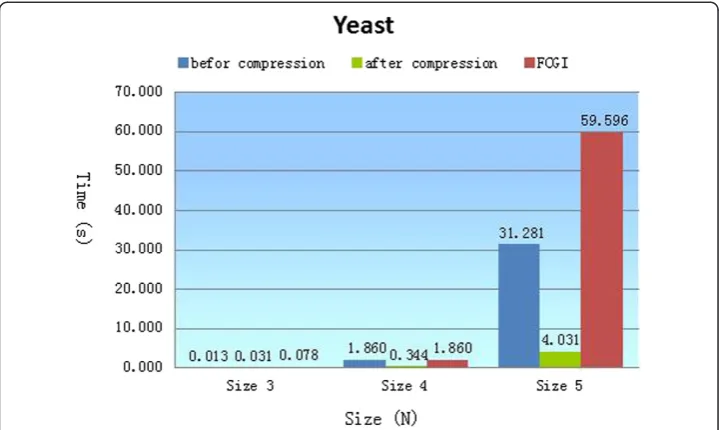
In Figure 6, algorithm performance is evaluated with the consumption time, using the yeast network as a testing data. Searching for sub-graphs in a network is the most important part of the motif mining process. The efficiency of sub-graph enumeration is, therefore, an important standard with which to measure the quality of an algorithm. In reference [26], the sub-graphs are enumerated by the Rand-ESU algorithm. When there are only three and four nodes, there is only a subtle difference between the time spent on enumerating sub-graphs by Back Tracking algorithm compared with
Rand-ESU; this gap is negligible and can be ignored. However, with more than five nodes, the time spent even before compressing the searching space is considerably shorter than that by Rand-ESU, with an improvement of 27 seconds. Most striking is that after compressing the searching space the time needed is a lot shorter than
Rand-ESU, with an improvement of 15 times (our algorithm’s consumption time is about one twelfth of the time in Rand-ESU).
The algorithm of Mfinder can only search a small range of sizes, and its computa-tional cost is the highest. The FANMOD algorithm, able to find sub-graphs and iso-morphic groups of sizes up to eight, results in the identification of the same numbers
Table 4 Computational cost for different algorithms on the E. coli network
Time(s) Size 3 Size 4 Size 5 Size 6 Size 7 Size 8
Algorithms
Before compression 0.031 0.469 8.844
After compression 0.016 0.266 4.141
Kavosh 0.300 1.840 14.910 141.98 1374.01 13173.74
Fanmod 0.810 2.530 15.710 132.24 1205.97 9256.61
Mfinder 31.000 297.000 23671.80
as Kavosh. The searching time of the Kavosh is less than that of FANMOD. With our algorithm, while the size of sub-graphs is limited to a maximum of five, the searching time is shortest.
The references [5,7,17], are performed on superior computer hardware than our algorithm: Intel (R)Core(TM) 2 Quad CPU, 3.2 GHZ work station, 8 G RAM. This means that the increase in speed obtained with our algorithm may be even higher.
Conclusion
In this paper, we presented a method for mining network motifs based on space com-pression. All sub-graphs can be enumerated by adding edges and nodes progressively in aBack Trackingalgorithm, which saves storage space and reduces space complexity as only the initial and end nodes of the path are counted. By taking advantages of the par-ity nodes, a much more efficient solution for enumerating sub-graphs during the motif mining is provided. Particularly for networks with high ratio of parity nodes, the time spent on enumerating the sub-graphs is reduced significantly compared with other common algorithms. From the results obtained, we have proved the accuracy and ef-fectiveness of our method. By comparing the results of our method with others, we can conclude that our approach has considerably shorter searching times and more exten-sive applicability.
Competing interests
The authors declare that they have no competing interests.
Authors’contributions
QZ conceived and designed the experiments and YX carried out the experiments. Both QZ and YX analyzed the data. YX drafted the manuscript and QZ improved some writing. Both authors read and approved the final manuscript.
Acknowledgement
This work is supported by the National Natural Science Foundation of China (No. 31370778), Program for Changjiang Scholars and Innovative Research Team in University (No. IRT1109) and by the Program for Liaoning Key Lab of Intelligent Information Processing and Network Technology in University.
Received: 14 January 2014 Accepted: 25 November 2014
References
1. Milo R, Shen-Orr S, Itzkovita S, Kastan N, Chklovskii D, Alon U:Network motifs: simple building blocks of complex networks.Sci STKE2002,298:824–827.
2. Koyutürk M, Subramaniam S, Grama A:Introduction to Network Biology.Functional Coherence of Molecular Networks in Bioinformatics2012, 1–13.
3. Kashtan N, Itzkovita S, Milo R, Alon U:Efficient sampling algorithm for estimating subgraph concentrations and detecting network motifs.Bioinformatics2004,20:1746–1758.
4. Wernicke S:Efficient detection of network motifs.Comput Biol Bioinform2006,3(4):347–359.
5. Itzhack R, Mogilevski Y, Louzoun Y:An optimal algorithm for counting network motifs.Physics A2007,381:482–490. 6. Itzkovitz S, Milo R, Kastan N, Ziv G, Alon U:Physics Review E2003(2),68:026127.
7. Wernicke S, Rasche FFANMOD:A tool for fast network motif detection.Bionformatics2006,22(9):1152–1153. 8. Baskerville K, Paczuski M:Subgraph Ensembles and motif discovery using a new heuristic for graph
isomorphism.Physics Review E2006,74:051903.
9. Lau JW, So MKP:A Monte Carlo Markov chain algorithm for a class of mixture time series models.Stat Comput 2011,21(1):69–81.
10. Srinivasa S, Haenggi M:Distance distributions in finite uniformly random networks: Theory and applications.
Vehicular Technology2010,59(2):940–949.
11. Tian LJ, Liu CQ, Xie JQ:A Partition Method for Graph Isomorphism.Phys Procedia2012,25:1761–1768. 12. Arvind V, Kurur PP:Graph Isomorphism is in SPP.Inf Comput2006,204(5):835–852.
13. Ding H, Huang Z:Isomorphism identification of graphs: Especially for the graphs of kinematic chains.
Mech Mach Theory2009,44(1):122–139.
14. Knossow D, Sharma A, Mateus D, Horaud R:Inexact matching of large and sparse graphs using laplacian eigenvectors.Graph-Based Representations in Pattern Recognition2009,5534:144–153.
16. Ribeiro P, Sliva F:G-Tries: an efficient data structure for discovering network motifs.Sierre, Switzerland: ACM 25th Symposium On Applied Computing-Bioinformatics Track; 2010:1559–1566.
17. Kashani ZR, Ahrabian H, Elahi E, Nowzari-Dalini A, Ansari ES, Asadi S, Mohammadi S, Schreiber F, Masoudi-Nejad A:
Kavosh: a new algorithm for finding network motifs.BMC Bioinformatics2009,10(318):1–12.
18. Liao V, Chen M:Efficient mining gapped sequential patterns for motifs in biological sequences.BMC Syst Biol 2013,7(4):S7.
19. Zhang M, Lu L:Investigating the validity of current network analysis on static conglomerate networks by protein network stratification.BMC Bioinformatics2010,11:466.
20. Srinivasan S, Vural S, King B, Guda C:Mining for class-specific motifs in protein sequence classification.
BMC Bioinformatics2013,14:96.
21. Bondy JA, Murty USR:Graph Theory.Berlin: Springer Verlag; 2008.
22. Chinn PZ:The frequency partition of a graph. Recent Trends in Graph Theory.Lecture Notes in Mathematics (Berlin: Springer-Verlag)1971,186:69–70.
23. Xu Y, Zhang Q, Zhou C:A New Method for Motif Mining in Biological Network.Evol Bioinforma2014,10:155–163. 24. Xie P:A dynamic model for processive transcription elongation and backtracking long pauses by
multisubunit RNA polymerases.Proteins: Structure, Function, and Bioinformatics2012,80(8):2020–2034. 25. UriAlonLab:Weizmannnetworks.2012. www.weizmann.ac.il/mcb/UriAlon/groupNetworksData.html. 26. Hu JL, Gao L:A novel graph isomorphism algorithm based on feature selection in network motif discovery.
2011. http://www.paper.edu.cn/html/releasepaper/2011/09/56/.
doi:10.1186/s13040-014-0029-x
Cite this article as:Zhang and Xu:Motif mining based on network space compression.BioData Mining20147:29.
Submit your next manuscript to BioMed Central and take full advantage of:
• Convenient online submission
• Thorough peer review
• No space constraints or color figure charges
• Immediate publication on acceptance
• Inclusion in PubMed, CAS, Scopus and Google Scholar
• Research which is freely available for redistribution

![Table 1 [23] A summary of Code values and the topological structures in differentnetworks](https://thumb-us.123doks.com/thumbv2/123dok_us/359845.1528557/8.595.115.479.113.730/table-summary-code-values-topological-structures-differentnetworks.webp)
![Table 1 [23networks] A summary of Code values and the topological structures in different (Continued)](https://thumb-us.123doks.com/thumbv2/123dok_us/359845.1528557/9.595.117.480.620.716/table-networks-summary-values-topological-structures-different-continued.webp)