WIRELESS SENSOR NETWORK ENERGY MANAGEMENT BASED ON COMPRESSION AND
Department of Computer Applications, Mar Thoma Institute of Information Technology, Chadayamangalam PO Ayur, Kerala, India
A R T I C L E I N F O
INTRODUCTION
A common definition of a sensoris “a device that produces measurable response to a change in a physical or chemical condition” More distinctively, a sensor is "a device that responds to a stimulus, such as heat, light, or pressure, and generates a signal that can be measured or interpreted" [1 Typically sensors are thought of as measuring light, sound and temperature and any other physical parameters.
Network is a wireless, ad hoc network, made of hundreds or thousands of nodes, placed in random locations. [4
The OSI model and the layers of communication networks may not apply to sensor networks.[3]
Wireless sensor network have been identified as an important technology for the back born of many industries and servic for the 21st century. A network of sensors is an collection of interconnected nodes with a capability of sensing, computing and communication elements [7-10][11][12] [13 Researchers see WSNs as an emerging area of densely networked systems of power aware wireless nodes with a small amount of processing and memory capacity and large federated networks for high end sensing applications [16][17 19]. WSN provides an infrastructure based services that couple between traditional computing and real time environment. A WSN can contain few to thousands of nodes at a time.
International Journal of Current Advanced Research
ISSN: O: 2319-6475, ISSN: P: 2319-6505,
Available Online at www.journalijcar.org
Volume 7; Issue 1(K); January 2018; Page No.
DOI: http://dx.doi.org/10.24327/ijcar.2018
Article History:
Received 16th October, 2017
Received in revised form 10th November, 2017
Accepted 26th December, 2017 Published online 28th January, 2018
Key words:
Compression, Data encryption, Deployment, Energy Management, Micro sensors, Wireless Sensor Networks, Quality of Service
Copyright©2018 Linoy A Tharakan. This is an open access article distributed under the Creative Commons Attribution License, which permits unrestricted use, distribution, and reproduction in any medium, provided the original work is properly cited.
*Corresponding author: Linoy A Tharakan
Department of Computer Applications, Mar Thoma Institute of Information Technology, Chadayamangalam PO Ayur, Kerala, India
WIRELESS SENSOR NETWORK ENERGY MANAGEMENT BASED ON COMPRESSION AND
COVERAGE – A SURVEY
Linoy A Tharakan*
Department of Computer Applications, Mar Thoma Institute of Information Technology, Chadayamangalam PO Ayur, Kerala, India
A B S T R A C T
Wireless sensor networks are used to monitor changes in t
Coverage, communication and connectivity of the network are the most fundamental challenges in WSNs. Sensors nodes are mostly battery operated and are expected to work for a longer time without replacing the batteries. The measure of the efficiency of a network usually defined with respect to how efficient in sensing the given physical ambience. The constraint most often linked with sensor node is that it operates with restricted energy budgets. Energy conservation becomes the important parameter to prolong the lifetime of sensor nodes. The energy lose may occurs due to collision of data packets, idle listening of sensor node, overhearing of nodes, frequent switching of nodes to various modes. Various energy management practices are in going on
the sensor nodes. This paper describes the survey of energy management in WSN nodes using compression of data packets and node deployment methods.
is “a device that produces measurable response to a change in a physical or chemical condition” More distinctively, a sensor is "a device that responds to a stimulus, such as heat, light, or pressure, and rates a signal that can be measured or interpreted" [1-3]. Typically sensors are thought of as measuring light, sound and any other physical parameters. Sensor Network is a wireless, ad hoc network, made of hundreds or ced in random locations. [4-7]. Usually of communication networks
Wireless sensor network have been identified as an important technology for the back born of many industries and services for the 21st century. A network of sensors is an collection of interconnected nodes with a capability of sensing, computing 10][11][12] [13-15]. Researchers see WSNs as an emerging area of densely
wer aware wireless nodes with a small amount of processing and memory capacity and large federated networks for high end sensing applications [16][17-19]. WSN provides an infrastructure based services that couple
me environment. A nodes at a time.
A wireless sensor network (WS
of tiny sensors spread over an area and integrated to form a communicative network infrastructure . The distributed sensor network stepping forward with the closely associa technologies such as VLSI, le
called micro- electromechanical systems (MEMS).
Wireless sensor nodes are characterized by being tiny intelligent, low in cost,
battery-or in deterministic pattern. Netwbattery-ork nodes are operational w wireless communication transceivers using antennas that may be unidirectional, highly directional (point
capable to steering the dish, or some combination thereof. [11][20]. WSN usually incorporated with actuators which allow them to interact the real world.
can be a valve controlling the flow of hot water, sensor controlled door that opens or shut with the help of a motor, a pump that maintains the amount of fuel injected into an engine. Thus a wireless sensor and actuator network (WSAN) takes instructions from the controller and convert these commands into control commands for the actuator, which then activates physical movement or action.
Characteristic of Sensor network
Each node is equipped with limited built in processor, storage and communication capabilities. These autonomous nodes are low power devices consist with one or more sensors, a processor, storage memory, a battery, a transceiver and an actuator. These tiny devices communicate wirelessly in short distances but having only limited bandwidth [21
International Journal of Current Advanced Research
6505, Impact Factor: SJIF: 5.995
www.journalijcar.org
; Page No. 9511-9517
//dx.doi.org/10.24327/ijcar.2018.9517.1575
This is an open access article distributed under the Creative Commons Attribution License, which permits unrestricted use, distribution, and reproduction in any medium, provided the original work is properly cited.
Linoy A Tharakan
Department of Computer Applications, Mar Thoma Institute of Information Technology, Chadayamangalam
WIRELESS SENSOR NETWORK ENERGY MANAGEMENT BASED ON COMPRESSION AND
Department of Computer Applications, Mar Thoma Institute of Information Technology,
used to monitor changes in the environment of a given field. Coverage, communication and connectivity of the network are the most fundamental challenges in WSNs. Sensors nodes are mostly battery operated and are expected to work replacing the batteries. The measure of the efficiency of a network usually defined with respect to how efficient in sensing the given physical ambience. The constraint most often linked with sensor node is that it operates with Energy conservation becomes the important parameter to prolong the lifetime of sensor nodes. The energy lose may occurs due to collision of data packets, idle listening of sensor node, overhearing of nodes, frequent switching of nodes to various are in going on to increase the life time of the sensor nodes. This paper describes the survey of energy management in WSN nodes using compression of data packets and node deployment methods.
sensor network (WSN) consists of a large density of tiny sensors spread over an area and integrated to form a communicative network infrastructure . The distributed sensor network stepping forward with the closely associated leading to a novel terminology electromechanical systems (MEMS).
Wireless sensor nodes are characterized by being tiny -driven, and deployed randomly or in deterministic pattern. Network nodes are operational with wireless communication transceivers using antennas that may be unidirectional, highly directional (point-to-point), may be capable to steering the dish, or some combination thereof. WSN usually incorporated with actuators which interact the real world. For example, an actuator can be a valve controlling the flow of hot water, sensor controlled door that opens or shut with the help of a motor, a pump that maintains the amount of fuel injected into an sor and actuator network (WSAN) takes instructions from the controller and convert these commands into control commands for the actuator, which then activates physical movement or action.
Characteristic of Sensor network
Each node is equipped with limited built in processor, storage and communication capabilities. These autonomous nodes are low power devices consist with one or more sensors, a processor, storage memory, a battery, a transceiver and an devices communicate wirelessly in short distances but having only limited bandwidth [21-22]. Sensor
Research Article
nodes are may be stationary or mobile, densely deployed and with these limited capabilities. Nodes sense and send their collected data towards a data processing center which is called the “sink node”. [23] A variety of thermal, mechanical, optical, chemical, biological, and magnetic sensors may be attached to the sensor node to measure properties of the atmosphere.[12] The main goals of sensor networks are accuracy, flexibility, reliability, economical and easy deployment. WSN’s have some limitations also, and can be characterized as the following properties: limited processing power, less memory, limited power, low data rate, limited transmission range and the devices within a WSN are mostly battery driven.[24]
Challenges
WSN is autonomous self sustained devices and being in the path of ubiquity. But to attain the ubiquitous computing properties it has to overcome some challenges The main challenges are hardware constraints, Power factors, cost of nodes, Working environments, Transmission channel factors, node distribution, etc.
Table 2 Table shows the sensor constraints details
Constraints Description
Hardware Size is too small 2x5x1 or even small 1x1x1 Power factors Limited power source(battery ) < 500mAh, 1.2 V
AA alkaline batteries or li-AA cells
Cost Individual node cost si critical as the density of nodes is increasingly demanding - 5$ to $10 Environment Deployed usually in unattended remote
geographical locations Transmission
Channels
Radio, Infrared, Optical ranges RF (916 MHz),
Blue tooth compactable (2.4 GHz)
Others (2.4 GHz to 5 GHz 802.11b and 802.11a) Density and
Topology
Density >27 nodes/m3 Usually Dynamic topology
Applications
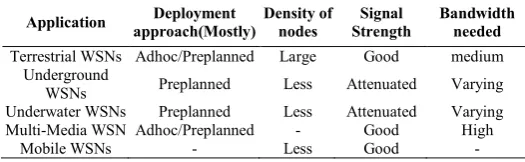
Applications of WSN are of interest to the most assorted scenarios such as environmental monitoring, micro-surgery, agriculture , surveillance, warfare, and child education, Flood and Water Level Monitoring System, Traffic Monitoring and Controlling are only a few examples[21] [28-30] In most of the WSN applications, the network nodes are left unattended for their whole operational lifetime after the node installation. Current WSNs are deployed on land, underground, and underwater. As per the sensor deployment environment, a sensor network deals with different challenges and constraints [31][32][66][67]. The table shows the basic comparison between various applications and its characteristics. The Table 1 describes comparison of various WSN applications.
Table 1 Comparison of Application of WSN
Application Deployment
approach(Mostly)
Density of nodes
Signal Strength
Bandwidth needed
Terrestrial WSNs Adhoc/Preplanned Large Good medium Underground
WSNs Preplanned Less Attenuated Varying Underwater WSNs Preplanned Less Attenuated Varying Multi-Media WSN Adhoc/Preplanned - Good High
Mobile WSNs - Less Good -
Energy Management
A Wireless Sensor Network can be composed of large number of tiny of sensor nodes spread in a wide area and communicating with each other either directly or through routing mechanisms to the other nodes. One or more of the
nodes are the base station with uninterrupted battery source than the other nodes. Since the devices in WSN are often tiny devices with small form factor the computational power of these devices is usually small because there will not support large amount of hardware. Furthermore as the devices are wireless they need to obtain their energy from an inbuilt battery which in the end needs to be recharged or replaced. If the battery of a device is depleted it needs an immediate substitution to function further.
Since these motes are working based on replaceable batteries power conception is the most important design consideration in WSN. Thus an intelligent hardware, software as well as set of protocols for communication is needed to attain the power management goal. Most of their power supply is consumed for their communication between nodes compared to other needs such as internal processing or sensing operation. According to [30], for transmitting a single bit over the network consumes almost as much power as executing 800-1000 instructions. Thus, power consumption of routing and communication is large enough to surpass the power consumed by the other operations. Secondary power supply that harvests power from the ambient such as solar panels may use on appropriateness of the environment.
Energy Consumption Factors
As far as sensor network is concerned energy is a very scarce resource and has to be handled cautiously or wisely in order to improve the network lifetime. Many network characteristics, which are also responsible for depletion of energy, some are also suggested be author of[31-32] are as follows:-
1. Many sensor nodes sense the same data deployed in small area.
2. Sending the repeated sensed data often to the cluster heads also lowers channel utilization.
3. To send a data, keep on listening to the channel. 4. In periodic sensing, keeping the node “on state” while
not in use.
5. Sending control packets in large volume need extra energy if packet is too large.
6. Greater processing facility in sensor node consumes more power.
7. Same event may sense more than one node due to overlapping regions of area of coverage.
8. Collision and retransmission [36][37]
General Energy saving methods
Time Synchronization
In WSN Time Synchronization is important for communication between nodes, but it also helps to gives the ability to detect movement and proximity. The synchronization consists of four components: send time, access time, propagation time, and receive time Fig 1. The time synchronization does not mean that necessarily all clocks are perfectly matched across the network which is difficult to implement. Precise clock synchronization is not always indispensable, so protocols from all variant from soft to strong are available to meet one's needs.
The send time is that of the sender creating time message to transmit over the network. The access time is that of the MAC layer delay in accessing the network. The time for the bits to by transmission on the medium is considered the propagation time. And, the receive time is the processing time of the receiving node to transferring it to the host. The major problem of time synchronization is packet delay along with prediction of the time spent on each mode. Eliminating any of these will greatly increase the performance of the synchronization technique.
Dynamic Power Management
The performance of the WSN is greatly depends on the power efficiency and management capability of the network.. Dynamic Power management is the major research area for the purpose of deployment and designing of the network. In recent times, there have been a good interest to use intelligent tools such as Neural Networks in energy management approaches of Wireless Sensor Networks [35], due to their simple parallel distributed computation and storage, data robustness, auto-classification of sensor nodes and sensor reading.
Real-Time Support
Due to local computation and long range communication the battery gets depleted at faster rate Communication protocols can be designed to make efficient management of energy resources of a sensor node and to obtain real time functionality [36]. All existing routing protocols Medium Access Control layer protocols supports real-time energy management functionality. There exists lots of unsolved challenges that need to be solved in MAC protocols to find out the apt solution for real time support and energy efficiency. Contention free protocols give real time support but not having energy efficiency.
Transmission Power Control
Power consumption for data communication is relatively high in WSN infrastructure. Power adaptation approaches of a transmission mode for a particular transceiver based on several factors is an approach for power optimization. Two main factors affecting the transmission power includes distance and wireless link quality. Physical barriers and climatic conditions are the two depending factors of the link quality. Controlling transmission power according to link quality is an efficient approach. Multi Hop communication is the most prominent research area by activating intermediate nodes for data forwarding.
Encryption Schemes
Here describes how the secure exchange in wireless sensor networks with energy efficiency. It considers link layer security of WSNs, providing both the data ciphers and the encryption, including aspects such as the cipher mode establishment and operation by initialization vectors. Here calculates the computational energy efficiency of different cipher algorithms considering both the characteristics and the effect of channel quality on cipher synchronization [37].
Data Management
Data management in WSN includes both data collection and data processing. Energy efficiency can be achieved by switching on and off the node depends on the data collected by the neighboring nodes. For the purpose of improving the precision of estimation there are estimation models such as Data Estimation using a Physical Model (DEPM), Data Estimation using Statistical Model (DESM) etc. There is another approach called distributed historical data query processing which is an upcoming research area. In this approach, an Index based Historical Data Query Processing scheme which stores historical data locally and processes queries energy-efficiently by using a distributed index tree is used. Area query processing is significant for various applications of WSNs [38]
Compression Techniques
Sensor nodes are capable of performing some processing of information and communicating with other connected nodes in the network [42], [43]. Data compression before transmitting increases energy efficiency. However, employing data compression optimizes the Data Transfer rate (DTR), because reduction in the effective size of the data to be transferred on the network leads to reduction in the effective file transfer time and hence preserves the network energy.
Specific Study
Data Compression
Energy efficiency is necessary in all layers of WSN operations. In the conventional view, energy consumption in WSNs is dominated by radio communications [41-43] The energy consumption of radio communication mainly depends on the number of bits of data to be transmitted within the network [44] In most cases, computational energy cost is less significant with cost of the communication. In particular, the energy cost of transmitting one bit is typically around 500– 1,000 times greater than that of a single 32-bit computation [45]. The data compression can be done locally so that the resulting data to be send to the header noade should be in relatively compressed size. Thus through an efficient data compression algorithm life time of the sensor node may increased by letting the transmission limited to smaller data packets. Therefore, by compression we reduce the number of bits to be transmitted there by significant reduction in communication energy and increase network lifetime. Battery is the main power source in a sensor node.
There are lossy and lossless techniques. Lossless techniques are very important in applications where precision is valued, such as in medical image processing or space research. The most known techniques for lossless compression in popular are ‘Eugene Pamba Capo-Chichi’ and ‘Jean-Michel Friedt’ [47] mentioned about Run Length Algorithm (RLE) as lossless algorithm where as the modified version of RLE called K-RLE is lossy compression algorithm.
‘P. Rachelin Sujae’ and ‘S. Selvaraju’ [48] described about Huffman encoding requires prior knowledge of the probabilities of the source sequence. Otherwise Huffman coding becomes a two pass procedure; the first pass the statistics are collected and the source is encoded in the second pass. But its difficulty in constructing the binary tree is become the limitation of this algorithm, which makes it unsuitable for sensor nodes.
‘S.R. Kodituwakku’ And ‘U.S.Amarasinghe’ concluded that [50]The Lempel Zev Welch Algorithm Dictionary based algorithms are uses a dictionary rather than based on a statistical model. In this method, the previously seen string patterns may used to store and indexed in a dictionary table. In the compression process, instead of repeating string patterns, those index values are used. This algorithm is an adaptive compression algorithm.
The popular LZW data compression algorithm is a dictionary based algorithm. It requires considerably use of RAM is large. Such algorithms cannot be applied to most sensor platform due to limited RAM.[46]
‘Anmol Jyot Maan’ [51] said about arithmetic coding in his paper. There they said Arithmetic Coding is useful for small alphabets with highly twisted probabilities. In this approach, a code word is not used to symbolize a symbol of the text, instead it generates a code for an whole message. In their paper there proved that Arithmetic coding compression ratio is too good compared to Huffman encoding. But the compression speed is slow with respect to Huffman encoding. Lossy techniques are more widely used in the area web development to personal everyday use.[52][62]
Deployment and coverage
Deployment
Setting up sensor network nodes in a real world environment is termed as Deployment. Nodes may be deployed in predetermined locations or place them randomly dropping sensors from a plane would be an example of random placement. The coverage schemes can be quite effortlessly determined in deterministic placement than in random placement. However in many deployments, it is impractical and difficult to deploy sensor nodes in a deterministic way. If the sensor nodes are deployed in an area in high density it is termed as dense deployment while a sparse deployment would have fewer nodes. The model of dense deployment is used in circumstances where it is significant for every event to be detected or when it is important to have multiple sensors cover an area. The sparse deployment is cost effective and it should be properly managed and localized with maximum coverage with minimum nodes. In most of the work studying coverage it is assumed that the sensor nodes are static, they reside in constant place once they are deployed.
There is extensive research in the development of algorithms for deployment of nodes, ad hoc routing and power management in the context of wireless sensor networks. As the algorithms for wireless sensor network are developed, they must be a low-power, highly efficient and adaptable to various hardware platforms. Setting up sensor network nodes in a real world environment is termed as Deployment [53]. Nodes may be deployed in fixed sites (deterministic placement) or place them aimlessly (random placement); dropping sensors from a plane; would be an example of random placement. The coverage schemes can be easily determined in deterministic placement rather in random placement.
Other deployment approaches are dense deployment and sparse deployment. If the sensor nodes are deployed in an area in high density it is termed as dense deployment while a sparse deployment would have less quantity of nodes. The intense deployment model is used in situations where every events may critical to be analyzed so it is important to have several sensors cover a region. The sparse deployment is cost effective and it should be properly managed and localized with maximum coverage with minimum nodes. In most of the work studying coverage, it is assumed that the sensor nodes are immobile; they inhabit in the same place once they are deployed. A more sophisticated deterministic deployment method is given in [54]. The authors suggest a pattern of arranging the sensors in diamond pattern which would correspond with a Voronoi polygon[55]. This pattern accomplishes full coverage with four way connectivity from every nodes by dividing the communication range with the sensing range; which is greater than the square root of two.[58] However the pattern is too difficult to practical deployment. It assumes that the sensing and communication ranges of every node are a perfect circle.
Coverage
Energy efficient Coverage is the one of the most active areas of research in wireless sensor networks. WSN coverage s is defined as a measure of “how successfully and for how long the sensors are able to examine” the physical space. It is Coverage is how well a sensor node(s) will monitor a given environment. It can be thought of as a measure of quality of service (QoS). Connectivity between the nodes and the sink can be maintained only by the effective and standardized coverage. Connectivity can be defined as the ability of the sensor nodes to reach the data sink. Each node has a range where which another node can be located in order to receive data and is defined as the nodes communication range and it is different from the sensing range which defines the area a node can observe. The two ranges may be equal but are often different.
Cardei and Wu [56] survey recent sensor coverage problems proposed in literature and ordered them according to the following design criteria:
1. Problem definition: maximize network lifetime or minimize the number of sensors deployed
2. Deployment approaches: deterministic versus random 3. Relationship between Rs (Sensing range) and Rc
(Communication ranges) (e.g. Rc = Rs; Do all sensors use the same Rc and the same Rs (homogeneous network))
5. Algorithms characteristics: localized versus centralized, distributed
The coverage problems can be classified in the following types [56]
area coverage where the main objective is to cover (monitor) an area, [57-59]
point (or target) coverage [60], where the objective is to cover a set of points (targets)
coverage problems that have an objective to determine the maximal support/breach paths that traverse a sensor field [61][63]
Coverage protocols such as CCP, OGDC, ASCENT, PC are compared with coverage, connectivity, data processing and energy conservation [65] and the Table 2 is given bellow
Table 2 Comparison of coverage algorithms
Protocol Coverage Connectivity Data Processing Energy
conservation
Coverage Configuration Protocol (CCP)
Good God Decentralized Fair
OGDC (Optimal Geographical Density Control).
Good Good Distributed Good
ASCENT (Adaptive Self-Configuring sEnsor Networks Topologies)
Fair Bad Decentralized Bad
Sleep + Power Control (PC)
Protocol
fair Not Considered Decentralized -
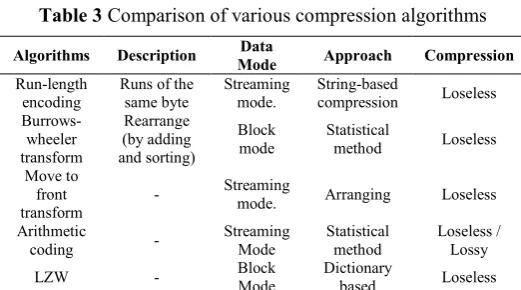
Table 3 Comparison of various compression algorithms
Algorithms Description Data
Mode Approach Compression
Run-length encoding
Runs of the same byte
Streaming mode.
String-based
compression Loseless
Burrows-wheeler transform
Rearrange (by adding and sorting)
Block mode
Statistical
method Loseless Move to
front transform
- Streaming
mode. Arranging Loseless Arithmetic
coding -
Streaming Mode
Statistical method
Loseless / Lossy
LZW - Block
Mode
Dictionary
based Loseless
From the Table 3 the CCP protocol is being suggested as the best coverage protocol followed by OGDB because even ASCENT protocol gives a better coverage it has less energy efficiency compared CCP and OGDB..
CONCLUSION
WSN nodes are operate in a collaborative manner. Fair utilization of networking recourses at node level equally important like accomplishing the overall goal. An energy aware data manipulation and aggression is important in Wireless sensor network applications. The measure of the efficiency of a network is also defined with respect to how efficient in sensing the given physical ambience. Energy efficient coverage and data compression in Wireless sensor network is essential and have lots of scopes in the area for research. This paper generally discuss the characteristics of sensor nodes and WSN and talk about approaches of gaining energy efficiency based on reducing the communication overhead by data compression and node deployment methods.
This paper gives a detailed comparative study of applications, data compressions, coverage and deployment of WSN.
References
1. J. Kabara, Class Notes From Telecom 2721, “Wireless Data Networks”. Lecture Number 5, June 2005.
2. Linoy A Tharakan,, Dr.R Dhanasekaran, Energy Aware Data Compression in Wireless Sensor Network using an advanced RLE method – Matrix RLE (M-RLE)International Journal of Applied Engineering ResearchVolume 10, Number 17 2015
3. María Gabriela Calle Torres “Energy consumption in wireless sensor networks using gsp” Theses University Of Pittsburgh School Of Information Sciences April, 2006
4. Shio Kumar Singh, M P Singh, And D K Singh “routing protocols in wireless sensor networks – a survey”.
International Journal Of Computer Science & Engineering Survey (IJCSES) Vol.1, No.2, November 2010
5. Tarun Sharma Harsukhpreet Singh “A comparative review on routing protocols in wireless sensor networks” International Journal Of Computer Applications (0975 – 8887) Volume 123-No.14, August 2015
6. Amitangshu Pal “Localization algorithms in wireless sensor networks: current approaches and future challenges network protocols and algorithms” ISSN 1943-3581 Vol. 2, No. 1 2010
7. K.Nageswara Rao, Dr. D. Rajya Lakshmi, Prof. T. Venkateswara Rao “Significant storage on sensor storage space, energy consumption and better security based on routing in hybrid sensor networks”
International Journal Of Ad Hoc, Sensor & Ubiquitous Computing (IJASUC) Vol.2, No.4, December 2011 8. Chi-Fu Huang, Yu-Chee Tseng “A survey of solutions
to the coverage problems in wireless sensor networks”
Journal Of Internet Technology Volume 6 No.1 2005 9. Al-Sakib Khan Pathan “Smartening the environment
using wireless sensor networks in a developing country”, 2006
10. Giuseppe Anastasi Marco Conti , Mario Di Francesco , Andrea Passarella “Energy Conservation In Wireless Sensor Networks: A Survey Ad Hoc Networks” 537-568, 2009
11. Mohammad Ilyas And Imad Mahgoub “Handbook Of Sensor Networks: Compact Wireless And Wired Sensing Systems”
12. Vibhav Kumar Sachan Syed Akhtar Imam “Energy-Efficient Communication Methods In Wireless Sensor Networks: A Critical Review International Journal Of Computer Applications” (0975 - 8887) Volume 39– No.17, 2012
13. Chee-Yee Chong, And Srikanta P. Kumar, "Sensor Networks: Evolution, Opportunities, And Challenges” Proceedings Of The IEEE, Vol. 91, No. 8, 1247, 2003 14. Khin Thanda Soe “Increasing Lifetime Of Target
Tracking Wireless Sensor Networks” World Academy Of Science, Engineering And Technology 18, 2008 15. Jennifer Yick, Biswanath Mukherjee, Dipak Ghosal
16. M. Welsh, D. Malan, B. Duncan, T. Fulford-Jones, S. Moulton, ‘‘Wireless Sensor Networks For Emergency Medical Care,’’ Presented At Ge Global Research Conference, Harvard University And Boston University School Of Medicine, Boston, Ma, Mar. 8, 2004.
17. Kazem Sohraby, Daniel Minoli, Taieb Znati “Wireless Sensor Networks: Technology, Protocols, And Applications” (Book)
18. Ibrahiem M. M. El Emary, S. Ramakrishnan Wireless Sensor Networks: From Theory To Applications 19. Asis Kumar Tripathy And Suchismita Chinara
“Comparison Of Residual Energy-Based Clustering Algorithms For Wireless Sensor Network” ISRN Sensor Networks 2012
20. Vijay Raghunathan, Saurabh Ganeriwal, And Mani Srivastava, Ucla Emerging Techniques For Long Lived Wireless Sensor Networks 0163-6804/06, 2006
21. Waltenegus Dargie, Christian Poellabauer Fundamentals Of Wireless Sensor Networks : Theory And Practice (Text Book) Isbn 978-0-470-99765-9 22. M. B. Srivastava, R. R. Muntz, And M. Potkonjak,
“Smart Kindergarten: Sensor-Based Wireless Networks For Smart Developmental Problem-Solving Environments”, In Mobile Computing And Networking, Pp 132-138, 2001
23. Nikos Dimokas, Dimitrios Katsaros Detecting Energy-Efficient Central Nodes For Cooperative Caching In Wireless Sensor Networks IEEE
24. Fengju An Density Adaptive Sleep Scheduling In Wireless Sensor Networks Master Of Science Thesis 2013
25. Sandra Sendra, Jaime Lloret, Miguel García And José F. Toledo “Power Saving And Energy Optimization Techniques For Wireless Sensor Networks” (Invited Paper) Journal Of Communications, Vol. 6, No. 6, 2011 26. V. Raghunathan, C.Schurgers, S. Park And M.B.
Srivastava, "Energy-Aware Wireless Micro Sensor Networks," Journal Of IEEE Signal Processing Magazine, Vol.19, No.2, Pp.40-50, 2002 27. Daniele Puccinelli, Martin Haenggi “Wireless Sensor
Networks: Applications And Challenges Of Ubiquitous Sensing IEEE Circuits And Systems” Magazine - IEEE Circuits Syst Mag , Vol. 5, No. 3, Pp. 19-31, 2005 28. D. Puccinelli And M. Haenggi “WSN: Applications&
Challenges “,Cas Magazine, Sept. 2005
29. Neelam Srivastava “Challenges of next-generation wireless sensor networks and its impact on society”
Journal Of Telecommunications, Volume 1, Issue 1, Feb 2010
30. Hill, J., Szewczyk, R., Woo, A., Hollar, S., Culler, D., Pister, K.: “System Architecture Directions For Networked Sensors” In Asplos-Ix: Proceedings Of The Ninth International Conference On Architectural Support For Programming languages And Operating Systems, Pp. 93–104, Acm, 2000.
31. Zahra Rezaei, Shima Mobininejad “Energy Saving In Wireless Sensor Networks”, International Journal Of Computer Science & Engineering Survey, Feb 2012. 32. C. Liu, K. Wu And J. Pei “A Dynamic Clustering And
Scheduling Approach To Energy Saving In Data Collection From Wireless Sensor Networks” Sensor And Ad Hoc Communications And Networks, , Second
Annual IEEE Communications Society Conference Pp 374-385, 2005
33. Parool Jain, Nitesh Ghodichor, Snehal Golait, Sachin Jain A Survey On Energy Optimization In Wireless Sensor Network International Journal Of Engineering Sciences & Emerging Technologies, Apr. 2013
34. M.A.M. Vieira, C.N. Coelho, D. C. Da Silva, J.M. Da Mata, "Survey On Wireless Sensor Network Devices,", Emerging Technologies And Factory Automation (ETFA '03).Vol.1, No., Pp. 537- 544, 16-19 Sept. 2003
35. Kulakov, A., Davcev, D., Trajkovski, G, “Application of wavelet neural-networks in wireless sensor networks”, Sixth International Conference On Software Engineering, Artificial Intelligence, Networking And Parallel/Distributed Computing And First ACIS International Workshop On Self-assembling wireless networks (Snpd/Sawn'05), Pp.262-2672005
36. Mark Stemm And Randy H. Katz. “Measuring And Reducing Energy Consumption Of Network Interfaces In Hand-Held Devices”. IEICE Transactions On Communications, Special Issue On Mobile Computing. 37. Y. Wang, G. Attebury, And B. Ramamurthy, "A Survey
Of Security Issues In Wireless Sensor Networks," IEEE Communications Surveys & Tutorials, Vol.8, No.2, Pp. 2-23, 2006.
38. J. M. Hellerstein And W. Wang, “Optimization Of In-Network Data Reduction,” In DMSN ’04: Proceeedings Of The 1st International Workshop On Data Management For Sensor Networks. Newyork, Ny,Usa:ACM, ,Pp.40–47, 2004
39. “Energy efficient information collection in wireless sensor networks using adaptive compressive sensing” Ieee Conference, Date Of Conference: 20-23, 2009. 40. M Sartipi - 2011 “Energy-efficient data acquisition in
wireless sensor networks using compressed sensing” IEEE Conference, Date: 29-31 March 2011.
41. Pottie, G.J.; Kaiser, W.J. “Wireless Integrated Network Sensors”. Commun. ACM, 43, 51–58. 2000
42. Barr, K.C.; Asanovi´C, K. “Energy-Aware Lossless Data Compression”. ACM Trans. Comput. Syst. 2006, 24, 250–291.
43. Anastasi, G.; Conti, M.; Di Francesco, M.; Passarella, A. “Energy Conservation In Wireless Sensor Networks: A Survey”. Ad Hoc Networks., 7, 537–568. 2009 44. Mohammad Abdur Razzaque And Simon Dobson
“Energy-efficient sensing in wireless sensor networks using compressed sensing sensors”, 14, 2822-2859 2014 45. Raghunathan, V.; Schurgers, C.; Park, S.; Srivastava, M.; Shaw, B. “Energy-aware wireless microsensor networks”. IEEE Signal Process. Mag., 19, 40–50, 2002 46. Ranjeet S. Pisal “Implementation of data compression algorithm for wireless sensor network using K-RLE”
International Journal Of Advanced Research In Electronics And Communication Engineering
(IJARECE) Volume 3, Issue 11, 2014
47. Eugene Pamba Capo-Chichi, Herve Guyennet, Jean-Michel Friedt" K-RLE : A new Data Compression Algorithm for Wireless Sensor Network" IEEE Explore, July 2009
networks”. Middle-East Journal Of Scientific Research
20 (10): 1286-1291, ISSN 1990-9233 2014
49. Kodituvakku, Anmolu S Amarasanghe Comparison Of Lossless Data Compression Algorithms For Text Data
Indian Journal Of Computer Science And Engineering
Vol 1 No 4 416-425 Issn : 0976-5166
50. S.R. Kodituwakku, U. S.Amarasinghe, Comparison Of Lossless Data Compression Algorithms For Text Data,
Indian Journal Of Computer Science And Engineering
vol 1 No 4 416-425
51. Anmol Jyot Maan. “Analysis and comparison of algorithms for lossless data compression”. International Journal Of Information And Computation Technology. ISSN 0974-2239 Volume 3, Number 3 Pp. 139-146 2013
52. Linoy A Tharakan, Dr.R Dhanasekaran “Web enabled temperature sensing using energy aware wsn node with zigbee for critical sensing environments” ARPN Journal Of Engineering And Applied Sciences Vol. 10, No. 7, 2015
53. Linoy A Tharakan , Dr. R Dhanasekaran “Data Compression In Wireless Sensor Network Associated With A Noble Encryption Method Using Quine-Mc Cluskey Boolean Function Reduction Method”
International Journal Of Applied Engineering Research, ISSN 0973-4562 Vol. 10 No.55 2015
54. Raymond Mulligan, Habib M. Ammari “Coverage in wireless sensor networks: a survey network protocols and algorithms” ISSN 1943-3581, Vol. 2, No. 22010 55. M. Cardei, J. Wu, “Energy-efficient coverage problems
in wireless ad hoc sensor networks”, Accepted To Appear In Computer Communications, Special Issue On Sensor Networks
56. J. Carle And D. Simplot, “Energy efficient area monitoring by sensor networks”, IEEE Computer, Vol 37, No 2 Pp 40-46. 2004
57. D. Tian And N. D. Georganas, “A coverage-preserving node scheduling scheme for large wireless sensor networks”, Proc. Of The 1st ACM Workshop On Wireless Sensor Networks And Applications 2002. 58. S. Slijepcevic, M. Potkonjak, “Power efficient
organization of wireless sensor networks”, IEEE International Conference On Communications, 2001. 59. M. Cardei, D.-Z. Du, “Improving wireless sensor
network lifetime through power aware organization”, Accepted To Appear In Acm Wireless Networks. 60. X.-Y. Li, P.-J. Wan, And O. Frieder, “Coverage in
wireless ad-hoc sensor networks”, IEEE Transactions On Computers, Vol 52 Pp 753-763. 2002
61. D.G.Anand, Dr.H.G.Chandrakanth And Dr.M.N. Giriprasad “Energy efficient coverage problems in wireless ad hoc sensor networks advanced computing”
An International Journal ( ACJI ), Vol.2, No.2, 2011 62. V. Kumar, S. Jain And S. Tiwari, “Energy efficient
clustering algorithms in wireless sensor networks: a survey” IJCSI International Journal Of Computer Science Issues, Vol. 8, Issue 5, No 2, 2011.
63. M. Hempstead, M. J. Lyon, D. Brooks, And G-Y Wei, “Survey of hardware syst ems for wireless sensor networks”, Journal Of Low Power Electronics, Vol.4, Pp.1-10, 2008
How to cite this article:
Linoy A Tharakan (2018) 'Wireless Sensor Network Energy Management Based on Compression And Coverage - A Survey',
International Journal of Current Advanced Research, 07(1), pp. 9511-9517. DOI: http://dx.doi.org/10.24327/ijcar.2018.9517.1575