Open Access
Research
Simulating non-small cell lung cancer with a multiscale agent-based
model
Zhihui Wang, Le Zhang, Jonathan Sagotsky and Thomas S Deisboeck*
Address: Complex Biosystems Modeling Laboratory, Harvard-MIT (HST) Athinoula A. Martinos Center for Biomedical Imaging, Massachusetts General Hospital, Charlestown, MA 02129, USA
Email: Zhihui Wang - [email protected]; Le Zhang - [email protected]; Jonathan Sagotsky - [email protected]; Thomas S Deisboeck* - [email protected] * Corresponding author
Abstract
Background: The epidermal growth factor receptor (EGFR) is frequently overexpressed in many cancers, including non-small cell lung cancer (NSCLC). In silico modeling is considered to be an increasingly promising tool to add useful insights into the dynamics of the EGFR signal transduction pathway. However, most of the previous modeling work focused on the molecular or the cellular level only, neglecting the crucial feedback between these scales as well as the interaction with the heterogeneous biochemical microenvironment.
Results: We developed a multiscale model for investigating expansion dynamics of NSCLC within a two-dimensional in silico microenvironment. At the molecular level, a specific EGFR-ERK intracellular signal transduction pathway was implemented. Dynamical alterations of these molecules were used to trigger phenotypic changes at the cellular level. Examining the relationship between extrinsic ligand concentrations, intrinsic molecular profiles and microscopic patterns, the results confirmed that increasing the amount of available growth factor leads to a spatially more
aggressive cancer system. Moreover, for the cell closest to nutrient abundance, a phase-transition
emerges where a minimal increase in extrinsic ligand abolishes the proliferative phenotype altogether.
Conclusion: Our in silico results indicate that in NSCLC, in the presence of a strong extrinsic chemotactic stimulus (and depending on the cell's location) downstream EGFR-ERK signaling may be processed more efficiently, thereby yielding a migration-dominant cell phenotype and overall, an
accelerated spatio-temporal expansion rate.
Background
Non-small cell lung cancer (NSCLC) remains at the top of the list of cancer-related deaths in the United States [1]. The epidermal growth factor receptor (EGFR) is frequently overexpressed in NSCLC [2,3]. Binding of epidermal growth factor (EGF) or transforming growth factor alpha (TGFD) to the extracellular domain of EGFR produces a
number of downstream effects that affect phenotypic cell behavior including proliferation, invasion, metastasis, and inhibition of apoptosis [4]. In particular, increasing the expression of these growth factors leads to EGFR hyperactivity [5,6], thus increases tumor cell motility and invasiveness, and finally enhances lung metastasis [7,8]. Since approximately 90% of all cancer deaths originate
Published: 21 December 2007
Theoretical Biology and Medical Modelling 2007, 4:50 doi:10.1186/1742-4682-4-50
Received: 12 June 2007 Accepted: 21 December 2007
This article is available from: http://www.tbiomed.com/content/4/1/50
© 2007 Wang et al; licensee BioMed Central Ltd.
from the spread of primary tumor cells into the surround-ing tissue [9], quantitative measurements of the relation-ship between the level of the growth factors and the resulting tumor expansion is crucial – all the more so, since EGFR has emerged as an attractive therapeutic target for patients with advanced NSCLC [10].
A number of EGFR-related intracellular signal transduc-tion pathways have been studied [11-16], including NSCLC [17], and corresponding computational models at the molecular-level have been developed. These quantita-tive works mainly focused on signal-response relation-ships between the binding of EGF to EGFR and the activation of downstream proteins in the signaling cas-cade. With these in silico approaches, experimentally test-able hypotheses can be made on signaling events controlling divergent cellular responses such as cell prolif-eration, differentiation, or apoptosis [18,19]. However, most signaling works did not yet consider the cellular level (see [20,21] for a review), and, conversely, only a few recent EGF/EGFR-mediated cellular-level models have started to incorporate a simple molecular level in studying e.g., cell migration in breast cancer [22], cell proliferation [23], and autocrine receptor-ligand dynamics [24,25]. We argue that a more detailed understanding of a complex cancer system requires integrating both molecular- and cel-lular-level works to properly examine multicellular dynamics. To our knowledge, to date, no multiscale model of NSCLC has been developed or published.
Our group has been developing multiscale models to investigate highly malignant brain tumors as complex dynamic and self-organizing biosystems. Since this NSCLC model builds on these works, we will briefly review some milestones. First, an agent-based model for studying the spatio-temporal expansion of virtual glioma cells in a two-dimensional (2D) environment was built and the relationship between rapid growth and extensive tissue infiltration was investigated [26,27]. This 'micro-macro' framework was then extended 'top-down' by incorporat-ing an EGFR molecular interaction network [28] so that molecular dynamics at the protein level could be related to multi-cellular tumor growth patterns [29]. Most recently, an explicit cell cycle description was imple-mented to study in more detail brain tumor growth dynamics in a three-dimensional (3D) context [30]. These previous works have provided a computational paradigm in which biological processes have been successfully sim-ulated from the molecular scale up to the cellular level and beyond. This progress led us to test the platform's applicability to and flexibility for other cancer types as well.
In this paper, we have therefore extended these previous modeling works to the case of NSCLC. Necessary
modifi-cations include at the molecular level the implementation of a NSCLC-specific EGFR-ERK signal transduction path-way. A novel, data-driven switch that is operated by two key molecules, i.e. phospholipase CJ(PLCJ) and extracel-lular signal-regulated kinase (ERK), processes the pheno-typic decision at the cellular level. The aim of this in silico
work is to provide insights into the externally triggered molecular-level dynamics that govern phenotypic changes and thus impact multicellular patterns in NSCLC. In the following sections, we will first show the detailed design of the model before we present and then discuss the sim-ulation results.
Model
Molecular Signaling Pathway
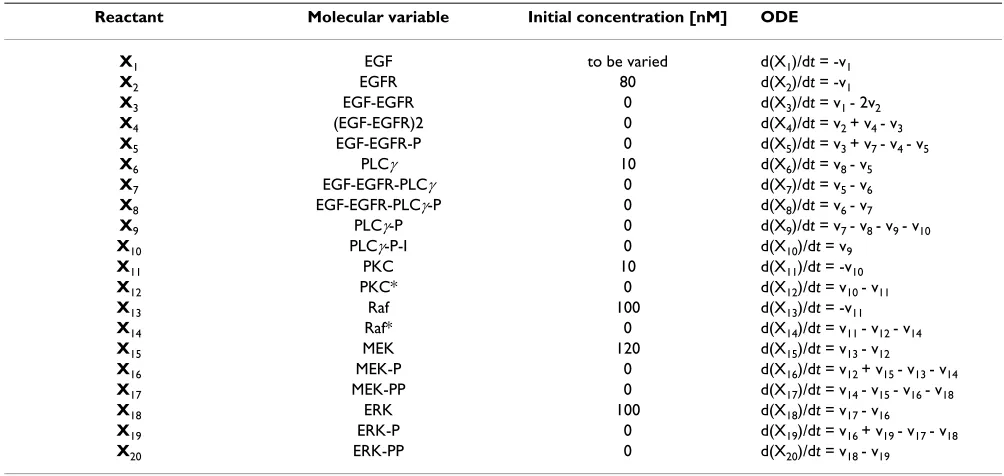
The kinetic model of the implemented NSCLC-specific molecular signaling pathway, which consists of 20 mole-cules, is shown in Fig. 1. These proteins, including both receptor (EGFR) and non-receptor kinases (e.g., PLCJand protein kinase C (PKC) [31,32], Raf, mitogen-activated protein kinase kinase (MEK), and ERK [33-35]), have been experimentally or clinically proven to play an impor-tant role in NSCLC tumorigenesis. Although in reality these molecules fulfil their functions by interacting with a multitude of other molecular species from many distinct pathways [36,37], we choose to start with these proteins not only because of their significance in the case of NSCLC but also since most of their kinetic parameters can be found in the literature. Also, it is reasonable to reduce the number of involved molecules as a starting point for modeling [38]. Amongst these proteins, both PLCJ and ERK are of particular interest for determining the cell's phenotypic changes as we will detail below.
Kinetic equations are written in terms of concentrations and the reaction rates are functions of concentrations. The association and dissociation steps are characterized by first-order and second-order rate constants, respectively. We note that, although in reality chemical reactions of second or higher order are two-step processes, they are usually treated as a one-step process in mathematical modeling [39]. Our model is based on a total of 20 ordi-nary differential equations (ODEs) and uses exactly the same modeling techniques as other pathway analysis studies (see [11,12] for detailed definitions). For simplic-ity, the ODEs for different molecules were calculated by Eq. (1):
where Xi represents one of these 20 molecular pathway components. In Eq. (1), the change in concentration of molecule Xi is the result of the reaction rates producing Xi
d X
dt v v
( i)
production Consumption
Kinetic model of the NSCLC-specific EGFR signaling pathway
Figure 1
Kinetic model of the NSCLC-specific EGFR signaling pathway. The arrows represent the reactions specified in Tables 1 and 2.
Table 1: Kinetic equations and initial concentrations. See Table 2 for references.
Reactant Molecular variable Initial concentration [nM] ODE
X1 EGF to be varied d(X1)/dt = -v1
X2 EGFR 80 d(X2)/dt = -v1
X3 EGF-EGFR 0 d(X3)/dt = v1 - 2v2
X4 (EGF-EGFR)2 0 d(X4)/dt = v2 + v4 - v3
X5 EGF-EGFR-P 0 d(X5)/dt = v3 + v7 - v4 - v5
X6 PLCJ 10 d(X6)/dt = v8 - v5
X7 EGF-EGFR-PLCJ 0 d(X7)/dt = v5 - v6
X8 EGF-EGFR-PLCJ-P 0 d(X8)/dt = v6 - v7
X9 PLCJ-P 0 d(X9)/dt = v7 - v8 - v9 - v10
X10 PLCJ-P-I 0 d(X10)/dt = v9
X11 PKC 10 d(X11)/dt = -v10
X12 PKC* 0 d(X12)/dt = v10 - v11
X13 Raf 100 d(X13)/dt = -v11
X14 Raf* 0 d(X14)/dt = v11 - v12 - v14
X15 MEK 120 d(X15)/dt = v13 - v12
X16 MEK-P 0 d(X16)/dt = v12 + v15 - v13 - v14
X17 MEK-PP 0 d(X17)/dt = v14 - v15 - v16 - v18
X18 ERK 100 d(X18)/dt = v17 - v16
X19 ERK-P 0 d(X19)/dt = v16 + v19 - v17 - v18
minus the reaction rates consuming it. Each biochemical reaction is then characterized by vi (see Fig. 1) with for-ward and reverse rate constants. Tables 1 and 2 summarize the kinetic parameters and the ODEs used for the model.
Micro-Environment
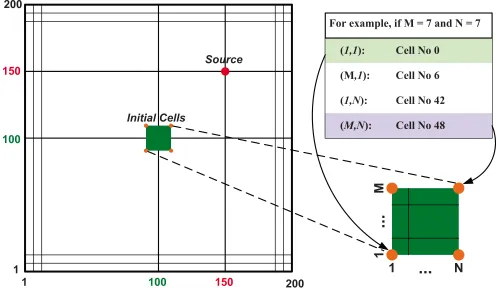
The 2D virtual micro-environment is made up of a dis-crete lattice consisting of a grid with 200 × 200 points (Fig. 2). We use p(i, j) to express each point in the lattice, where
i and j indicate the integer location in Euclidean terms. One single, distant nutrient source (simulating a cross-sectional blood vessel) is located at p(150, 150). To start with, a number of M × N cells (in other words, an M-by-N matrix) are initialized in the center of the lattice (and this number can be set to meet different simulation purposes). Each grid point can be occupied by one cell only or remain empty at a time.
Three external chemical cues are employed in the model: EGF, glucose and oxygen tension. As we have done in pre-vious studies [29,30], the nutrient source carries the high-est value of these three diffusive cues, which implicates that it is the most attractive location for the chemotacti-cally acting tumor cells. Then, by means of normal distri-bution, each grid point of the lattice is assigned a concentration profile of these three cues. The levels of these distributions are weighted by the distance, dij, of a given grid point from the nutrient source. The distribu-tions of these three cues are described by the following equations:
Moreover, the three chemotactic cues continue to diffuse over the lattice throughout the entire process of a simula-tion with a fixed rate, using the following equasimula-tion:
where M represents one of the three external cues, and t
represents a time step. The coefficients in Eqs. (2–5) are listed in Table 3 (see also [30] for more details). It is evi-dent then that the closer a given location is to the nutrient source, the higher the levels of the three cues will be at this grid point. Glucose will be continuously taken up by cells to support their metabolism. Only the nutrient source,
p(150, 150), is replenished at each time step while all other grid points are not. In addition, cells take up both their own EGF and that secreted by adjoining cells in our model, because cancer cells act in both autocrine and paracrine manner in consuming EGF [40,41].
Each cell encompasses a self-maintained molecular inter-action network (shown in Fig. 1) and the simulation sys-tem records the molecular composite profile at every time
step to determine the cell's phenotype for the next step. In
EGFij =Tm⋅exp(−2dij2/σt2)
Glucoseij =Ga+(Gm−Ga) exp(⋅ −2dij2/σg2)
Oxygenij =Oa+(Om−Oa) exp(⋅ −2dij2/σo2)
∂
∂ = ⋅ ∇ =
Mij
t DM M
ij
2
1 2 3 , t , , ,... .
Table 2: Kinetic parameters. Concentrations and the Michaelis-Menten constants (K4, K8, and K11-K19) are given in [nM]. First- and
second-order rate constants are given in [s-1] and [nM-1·s-1], respectively. V
4, V8, and V11-V19 are expressed in [nM·s-1].
Reaction number Equation Kinetic parameter Reference
between time steps, the chemical environment is being updated, including EGF and glucose concentration as well as oxygen tension (according to Eq. (5)). When the first cell reaches the nutrient source the simulation run is ter-minated.
Cellular Phenotype Decision
Four tumor cell phenotypes are considered in the model: proliferation, migration, quiescence and death. Cell death is triggered when the on site glucose concentration drops below 8 mM [42]. A cell turns quiescent when the on site
glucose concentration is between 8 mM and 16 mM, when it does not meet conditions for migration or prolif-eration (see below), or when it cannot find an empty loca-tion to migrate to or proliferate into.
The most important two phenotypic traits for spatio-tem-poral expansion, i.e. migration and proliferation, are decided by evaluating the dynamics of the following criti-cal intracellular molecules. (1) PLCJ is known to be involved in directing cell movement in response to EGF [43-45]; PLCJdynamics are accelerated during migration Two-dimensional virtual micro-environment
Figure 2
Two-dimensional virtual micro-environment. Depicted are the 200 × 200 lattice (left) with the position of the nutrient source, and the seed cells with assignment of the corner cell IDs (0, 6, 42, and 48).
Table 3: Coefficients of distribution and diffusion of EGF, glucose and oxygen tension. Values are taken from the literature [72,73].
Coefficient Value Units Description
Tm 2.56 Nm Maximum concentration of EGF
Ga 17.0 mM Normal concentration of glucose
Gm 57.0 mM Maximum concentration of glucose
Oa 0.0017 DC Normal concentration of oxygen
Om 0.0025 DC Maximum concentration of oxygen
DEGF 6.7 × 10⁻¹¹ m2·s-1 Diffusion coefficient of EGF
DGlucose 5.18 × 10⁻¹¹ m2·s-1 Diffusion coefficient of glucose
in cancer cells [46]. Therefore, in our model, the rate of change of PLCJ (ROCPLC) decides if a cell proceeds to migration or not. That is, if ROCPLC exceeds a certain set threshold, TPLC, the cell has the potential to migrate. (2)
Similarly, the rate of change of ERK (ROCERK) decides if a cell proceeds with proliferation. ERK has been found experimentally to have a strong influence on cell prolifer-ation [33,47,48], and transient activprolifer-ation of ERK with EGF leads to cell replication [49,50]. If a cell decides to migrate or proliferate, it will search for an appropriate location to move to or for its offspring to reside in. Candi-date locations are those grid points surrounding the cell. Implementing a cell surface receptor-mediated chemotac-tic evaluation, the most appropriate location is detected by using a 'search-precision' mechanism [27] according to:
Tij = \·Lij + (1 - \)·Hij
where Tij represents the perceived attractiveness of loca-tion p(i, j), Lij represents the result of an evaluation func-tion for locafunc-tion p(i, j) (see [27] for the definition of Lij), and H~ N(P, V2) is an error term following a normal
distri-bution with mean Pand variance V2. \ [0,1] denotes the
search-precision parameter that for a given run is held constant for all cells. Briefly, for a given cell at a certain location, when \ = 0 the cell performs a pure random walk, whereas when \= 1 the cell always selects the loca-tion with the highest glucose concentraloca-tion. Based on pre-vious results [27], we set \= 0.7 because this value tends to lead to the highest average velocity of the tumor's spa-tial expansion.
It is worth noting that even if ROCPLC or ROCERK exceed their corresponding thresholds, it does not necessarily
have to lead to cell migration or proliferation. Rather, if nowhere else to go, the cell remains quiescent and contin-ues to search for an empty location at the next time step.
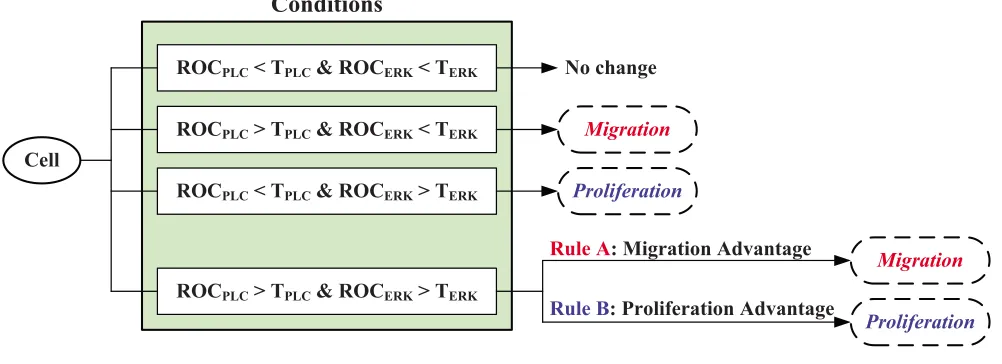
Any cell in the process of changing its phenotype will fall into one of these four categories: (i) ROCPLC < TPLC and ROCERK < TERK; (ii) ROCPLC > TPLC and ROCERK < TERK; (iii)
ROCPLC < TPLC and ROCERK > TERK; and (iv) ROCPLC > TPLC and ROCERK > TERK. Figure 3 lists these conditions and their phenotypic consequences, respectively. Following the first three cell decisions is straightforward; first, if a cell experiences condition (i) no phenotypic change results as both ROCPLC and ROCERK remain below their correspond-ing thresholds; however, if a cell faces condition (ii) the cell migrates because of ROCPLC exceeding its threshold
while in the presence of (iii) the cell proliferates due to ROCERK exceeding its threshold. However, for (iv), and in the absence of any specific experimental data, i.e. for the case that both ROCPLC and ROCERK exceed their corre-sponding thresholds, we explored two hypotheses: 'rule A' yielding migration advantage (i.e., the cell decides to migrate) whereas 'rule B' resulting in a proliferation advantage (i.e., the cell decides to proliferate). For sim-plicity, decision rules for the first three conditions are referred to 'general rules', while rules A and B are referred to 'special rules' hereafter. In the following section, we will describe the corresponding simulation results.
Results
Our algorithm was implemented in C/C++. A total of 49 seed cells were initially set up in the center of the lattice, and these cells were arranged in a 7 × 7 square shape (i.e., M = 7 and N = 7, see Fig. 2 for the configuration of the seed cells). We defined cell IDs from 0 to 48 (left to right, bottom
to top). To investigate cell expansion dynamics, we
moni-Cell phenotypic decision algorithm
Figure 3
Cell phenotypic decision algorithm. See text for more details. !"# !$%&"#%&
!'# !$%&"#%&
!"# !$%&'#%&
!'# !$%&'#%&
()*
+,*-,.-*
+/ -,.-*
tored all cells and recorded their molecular profiles at every time step. We are particularly interested in the fol-lowing four boundary cells: Cell No 0 (bottom-left corner, farthest from the source), Cell No 6 (top-left corner), Cell No 42 (bottom-right corner), and Cell No 48 (top-right cor-ner, closest to the source). Through the distinct micro-environmental conditions they face, these corner cells exemplify the impact of location on single cell behavior, while they however still grasp the nature of the entire sys-tem. As described before, both rules A and B were tested for each different simulation condition.
Multi-Cellular Dynamics
Figure 4 shows two simulation results for rules A and B, respectively. The simulations were conducted with a standard EGF concentration of 2.56 nM. Note that this concentration is derived from the literature [51,52] and has been rescaled to fit our model as a benchmark starting point for further simulations. In the upper panel of Fig. 4(a) for rule A, tumor cells first display on site prolifera-tion prior to exhibiting extensive migratory behavior towards the nutrient source. However, for rule B (lower panel), cells remain stationary proliferative throughout, thereby increasing the tumor radius yet without substan-tial mobility-driven spasubstan-tial expansion. The run time for the latter case (rule B) was considerably longer than for rule A. Based on the criterion chosen for terminating the run, i.e. the first cell reaching the nutrient source, this result is somewhat expected since rule A favors migration whereas rule B promotes proliferation. This is further sup-ported by analysis of the evolution of the various pheno-types and the change of [total] cell numbers (Fig. 4(b)). While both rules generate all three cell phenotypes (pro-liferation (dark blue), migration (red), and quiescence (green)), rule A (left panel) indeed appears to result in a cancer cell population that exhibits a larger migratory frac-tion than the one emerging through rule B (right panel) which, however, yields a larger portion of proliferative cells (light blue). It is thus not surprising that for rule B, the [total] cell population of the tumor system exceeds the one achieved through rule A by a factor of 10.
Influence of Decision Rules on Phenotypic Changes
To better understand the significance of each rule for the tumor system, we have investigated its influence on gen-erating the intended phenotype. Figure 5 shows the weight of rule A on migration (a), and that of rule B on proliferation (b). (The results are taken from the two sim-ulation runs reported in Fig. 4). In Fig. 5(a), migrations derive from two sources: (1) general rule, i.e. [ROCPLC > TPLC and ROCERK < TERK] and (2) rule A; proliferations stem from one source only, i.e. if [ROCPLC < TPLC and ROCERK > TERK]. Rule A plays a more dominant role in trig-gering migrations than the general rule does, yet does not contribute to increasing proliferations. Likewise, rule B
has influence on proliferation only (Fig. 5(b)) and it con-tributes more to inducing proliferations than the corre-sponding general rule does.
However, as documented in the linear least square fit-tings, the rate at which rule A causes an increase in migra-tion exceeds by far the one by which rule B induces an increase in proliferation. This indicates that the influence of rule A on increasing migrations is more substantial than that of rule B on increasing proliferations. Being particu-larly interested in gaining insights into spatially aggressive tumors, we continue in the following with investigating the implications of rule A on microscopic and molecular level dynamics of the cancer system.
Phase-Transition at Molecular Level
To further investigate (for rule A) the relationship between EGF concentration and phenotypic changes we varied the extrinsic EGF concentration from the standard value of 2.65 × 1.0 nM to 2.65 × 50.0 nM by an incremen-tal increase of 0.1 nM in each simulation. As a result of the model's underlying chemotactic search paradigm, expect-edly a simulation under the condition of a higher extrinsic EGF concentration finished faster than that with a lower one. However, cells turn out not to exhibit completely homogeneous behavior.
where p(100,100) is the lower left corner and p(110,110)
is the upper right corner (5 runs, data not shown).
Discussion & Future Works
While using mathematical models to investigate the behavior of signaling networks is hardly new, understand-ing a complex biosystem, such as a tumor, by focusunderstand-ing on the analysis of its molecular or cellular level separately or
exclusively is insufficient, particularly if it excludes the interaction with the surrounding tissue. Recent analyses of signaling pathways in mammalian systems have revealed that highly connected sub-cellular networks generate sig-nals in a context dependent manner [53]. That is, biolog-ical processes take place in heterogeneous and highly structured environments [54] and such extrinsic condi-tions alone can induce the transformation of cells inde-Multicellular tumor expansion dynamics (a)
Figure 4
Multicellular tumor expansion dynamics. (a) Shows the multicellular patterns that emerge through rule A (upper panel) and rule B (lower panel), respectively. (b) Describes the numeric evolution (y-axis) of each cell phenotype as well as of the [total] cell population (light blue) over time (x-axis) for rule A (left panel) and rule B (right panel), respectively. Note: proliferative tumor cells are labeled in dark blue, migratory cells in red, quiescent cells in green and dead cells in grey.
+,
+/
1
! !
"#$%
&'"
()
#
%)*)$*& "+)$*& ,'#& -$. $*$&'"()#
/
! !
"#$%
&'"
()
#
pendent of genetic mutations as has been shown for the case of melanoma [55]. Taken together, modeling of can-cer systems requires the analysis and use of signaling path-ways in a simulated cancer environment (context) across
different spatial-temporal scales.
Our group has been focusing on the development of such multiscale models for studying highly malignant brain tumors [27,29,30,56]. Here, on the basis of these previous works, we presented a 2D multiscale agent-based model to simulate NSCLC. Specifically, we monitored how, dependent on microenvironmental stimuli, molecular
profiles dynamically change, and how they affect a single NSCLC cell's phenotype and, eventually, the resulting multicellular patterns.
Proceeding top-down in our analysis, we first evaluated the multicellular readout of molecular 'decision' rules A and B (versus general rules; Fig. 3). The patterns of a more sta-tionary, concentrically growing cancer system (following rule B) are quite different from the rapid, chemotactically-guided, spatial expansion that can be seen in the tumor regulated by rule A (Fig. 4(a)). Not surprisingly, the latter also operates with many more migratory albeit overall less
Weight of decision rules on changing cell phenotypes
Figure 5
Weight of decision rules on changing cell phenotypes. Influence on changing cell migration (left panel) and proliferation (right panel) when following the corresponding rule (see Fig. 3). The dashed red line indicates rule A-mediated migrations in (a), while the dashed blue line denotes rule B-mediated proliferations in (b). Fitting curves in solid black are calculated using a stand-ard linear least squares method. Slopes of the fitting curves are 1.40 cells/step in (a) and 0.03 cells/step in (b), respectively. Note: The drop of the dashed red line in the left panel of (a) is caused by the termination of the simulation when a cell reached the source (in this case, no further computation on remaining cells will be performed).
!
"#$%
0
'"
()
#
!
"#$%
0'
"
(
)#
/
/
"#$%
0'
"
(
)#
/
/
"#$%
0'
"
(
)#
!---*(+.
+,
2+
!---*(+.
+/
2+
[total] cells (Fig. 4(b)). Furthermore, examining in more detail the influence of the two distinct rules on their respective phenotypic yield, we found that the impact of rule A on increasing cell migration is more substantial than rule B's influence on furthering proliferation (Fig. 5). This finding suggests that the migratory rule A can operate the cancer system through incrementally smaller changes (while the simulation system is more robust for rule B). Such sensitivity to migratory cues corresponds well with experimental data on the response of human breast cancer cells, which showed that a spatially successful expansive system reacts rather quickly to even miniscule changes in chemotactic directionality [57,58].
Continuing therefore with rule A, our effort was then geared to gain insights into tumor expansion dynamics not only with regards to extrinsic stimuli but also to cell geography, i.e. a cell's location relative to the replenished nutrient source. Most interestingly, we found a phase tran-sition in the cancer cell closest to the nutrient source (i.e. Cell No 48, while none of the other three corner cells showed similar behavior). Specifically, for a tumor cell at
this location, i.e., facing nutrient abundance, proliferation is completely abolished once the extrinsic EGF concentra-tion exceeds a certain level. While this at first may seems rather unexpected, this finding however only confirms the experimentally sound notion that EGF stimulates the spa-tial expansion of a cancer system [5-8]. Moreover, with increasing EGF concentrations, the maxima of ROCPLC
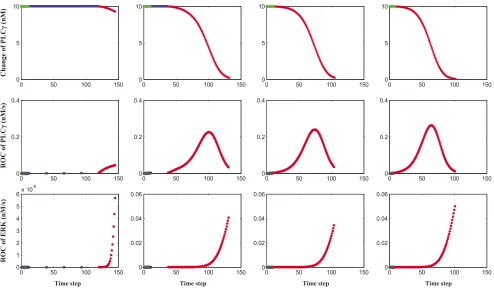
(Fig. 6) gradually occur earlier which seems to indicate that, under these conditions, the downstream signal is processed faster. Interestingly, such a 'no proliferation, just migration' behavior in the presence of chemo-attract-ant has indeed already been reported in several in vitro
studies using a variety of cancer cell lines [59,60] as well as in non-cancerous human cells [61]. (While admittedly, for the reasons stated, rule B did not receive similar atten-tion in our analysis), we nonetheless argue that, on the basis of our results and the experimental reports they seem to correspond with, rule A and thus a migratory deci-sion prompted by a [ROCPLC > TPLC and ROCERK > TERK] condition is a reasonable outcome for the signaling proc-ess taking place in NSCLC also in vitro and in vivo.
Changes at the molecular level for Cell No 48 with an increasing extrinsic EGF concentration (rule A)
Figure 6
Changes at the molecular level for Cell No 48 with an increasing extrinsic EGF concentration (rule A). Four simulation runs are depicted where (from left to right) the EGF concentration increases from 2.65 × 1.0 to 2.65 × 31.1, 2.65 × 31.2, and finally, to 2.65 × 50.0 nM. (From top to bottom) plotted are the absolute change of PLCJ, rate of change of PLCJ, and rate of change of ERK. Note that the number of proliferations is decreasing gradually and finally disappears at a phase transition between the EGF concentrations of 2.65 × 31.1 and 2.65 × 31.2 nM. (For phenotype labeling see Fig. 4).
# 0- # 0- # 0- #
/
1
2 2
%&30
!
Ȗ
30
)* !
Ȗ
2 2 2
2 2
2 2 2
2 2
2 2 2
2 2
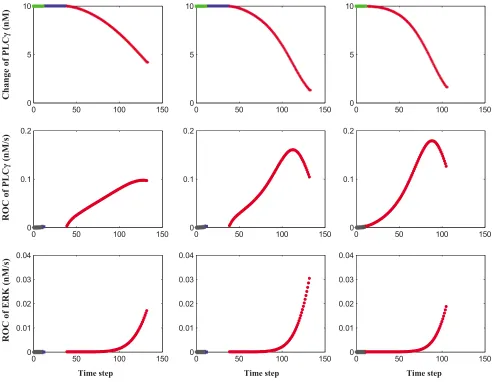
However, moving the model closer to reality will require a multitude of adjustments, one of which is its ability to account for up- or down-regulation in key molecules as a result of tumorigenesis. As a first step, and since experi-mental data on over-expression of EGFR in a variety of cancer types, including NSCLC, are ample [62-65] we have begun to simulate the impact of an increasing number of receptors on the cancer system (Fig. 7; simula-tions conducted with an EGFR concentration of 800 nM (per system)). Comparing this preliminary data with those reported in Fig. 6 (simulations conducted with an
EGFR concentration of 80 nM (per system)), we find that an EGFR-overexpressing NSCLC tumor seems to operate with even more migration and does so earlier on. The result is a spatially even more aggressive cancer system, which seems to correspond well with the aforementioned exper-imental studies. And, intriguingly, while the phase transi-tion itself is preserved, it however occurs already at a smaller EGF concentration, hence indicating that the increase in receptor density leads to an amplification of the downstream signal, which again corresponds well with experimental results in examining signaling activities
gen-Changes at the molecular level for Cell No 48 with an increasing extrinsic EGF concentration (rule A), at an EGFR concentra-tion of 800 nM
Figure 7
Changes at the molecular level for Cell No 48 with an increasing extrinsic EGF concentration (rule A), at an EGFR concentration of 800 nM. Three simulation runs are depicted where (from left to right) the EGF concentration increases from 2.65 × 1.0 to 2.65 × 5.9 and 2.65 × 6.0 nM. (From top to bottom) plotted are the absolute change of PLCJ, rate of change of PLCJ, and rate of change of ERK. Note that a phase transition emerges again between the EGF concentrations of 2.65 × 5.9 and 2.65 × 6.0 nM, hence at a lower concentration compared to the one depicted in Fig. 6 (EGFR concentration of 80 nM). In the two simulations around the phase transition, the maximum rates of change for both PLCJand ERK (i.e., ROCPLC
and ROCERK at 2.65 × 5.9 and at 2.65 × 6.0 nM) are lower compared with those in Fig. 6 (i.e., ROCPLC and ROCERK at 2.65 ×
31.1 and at 2.65 × 31.2 nM). (For phenotype labeling see Fig. 4).
2 2 2/ 2
2 2
2 2 2/ 2
2 2
2 2 2/ 2
2 2
# 0- # 0- #
0-%&30
!
Ȗ
30
)* !
Ȗ
erated by different EGFR family members [66]. Taken together, while preliminary, this finding demonstrates applicability and confirms flexibility of this multiscale platform, hence warrants its further expansion.
There are a number of research tracks that can and should be pursued in future works. First, it will be intriguing to see if, in the presence of a non-replenished nutrient source, the proliferative phenotype eventually can be recovered once extrinsic ligand concentrations fall beyond the phase-transition threshold. More generally, while most of the pathway's parameters, including rate constants and initial component concentrations were obtained from the experimental literature, this data naturally originated from a variety of often stationary experimental settings and different cell types. It therefore represents a less desir-able and relidesir-able input than time series data that come from one experimental setting only. Also, some parame-ters had to be estimated, much like in other well-estab-lished pathway models [11,12]. Taken together, future works will have to include not only proper experimental verification of the estimated parameters and evaluation of the simulation results but also, on the in silico side, tech-niques such as sensitivity analysis to help determine the effects of parameter uncertainties on model outcome [67] and to identify control points for experiment design [68]. While a pathway model cannot be a biological representa-tion in every detail [38] we plan on adding, in incremental steps, other pathways of relevance for NSCLC such as e.g. PI3K/PTEN/AKT [69]. Moreover, simulating a more heter-ogeneous biochemical environment and implementing both cell-cell and cell-matrix interactions [70] are planned steps at the cellular level that should help representing the cancer system of interest in more detail.
Regardless, we believe that the current model already pro-vides useful insights into NSCLC from a systematic view in terms of quantitatively understanding the relationship between extrinsic chemotactic stimuli, the underlying properties of signaling networks, and the cellular biologi-cal responses they trigger. Our results yield several experi-mentally testable hypotheses and thus further support the use of multiscale models in interdisciplinary cancer research. To our knowledge, this presents the first multi-scale computational model of Non-Small Cell Lung Can-cer and is thus potentially a significant first step towards realizing a fully validated in silico model for this devastat-ing disease.
Abbreviations
EGF: Epidermal growth factor;
EGFR: EGF receptor;
ERK: Extracellular signal-regulated kinase;
MAPK: Mitogen-activated protein kinase;
MEK: MAPK kinase;
NSCLC: Non-small cell lung cancer;
PLCJ: Phospholipase CJ;
PKC: Protein kinase C;
TGFD: Transforming growth factor D.
Competing interests
The author(s) declare that they have no competing inter-ests.
Authors' contributions
ZW developed the NSCLC model (algorithm and code), analyzed its simulation results and drafted the manu-script. LZ assisted in developing the algorithm, while JS supported data analysis and preparation of manuscript. TSD developed the model's underlying concept, led its design, development and analysis, and finalized the man-uscript. All authors read and approved the final manu-script.
Acknowledgements
This work has been supported in part by NIH grant CA 113004 (The Center for the Development of a Virtual Tumor, CViT [71]) and by the Harvard-MIT (HST) Athinoula A. Martinos Center for Biomedical Imaging and the Department of Radiology at Massachusetts General Hospital. We would like to acknowledge helpful discussions with Drs. Raju Kucherlapati, Victoria Joshi and David Sarracino from the Harvard-Partners Center for Genetics and Genomics (HPCGG).
References
1. Sharma SV, Bell DW, Settleman J, Haber DA: Epidermal growth factor receptor mutations in lung cancer. Nat Rev Cancer 2007,
7:169-181.
2. Hackel PO, Zwick E, Prenzel N, Ullrich A: Epidermal growth fac-tor recepfac-tors: critical mediafac-tors of multiple recepfac-tor path-ways. Curr Opin Cell Biol 1999, 11:184-189.
3. Hirsch FR, Varella-Garcia M, Bunn PA Jr, Di Maria MV, Veve R, Bremmes RM, Baron AE, Zeng C, Franklin WA: Epidermal growth factor receptor in non-small-cell lung carcinomas: correla-tion between gene copy number and protein expression and impact on prognosis. J Clin Oncol 2003, 21:3798-3807.
4. Ciardiello F, De Vita F, Orditura M, Tortora G: The role of EGFR inhibitors in nonsmall cell lung cancer. Curr Opin Oncol 2004,
16:130-135.
5. Putnam EA, Yen N, Gallick GE, Steck PA, Fang K, Akpakip B, Gazdar AF, Roth JA: Autocrine growth stimulation by transforming growth factor-alpha in human non-small cell lung cancer.
Surg Oncol 1992, 1:49-60.
6. Rusch V, Baselga J, Cordon-Cardo C, Orazem J, Zaman M, Hoda S, McIntosh J, Kurie J, Dmitrovsky E: Differential expression of the epidermal growth factor receptor and its ligands in primary non-small cell lung cancers and adjacent benign lung. Cancer Res 1993, 53:2379-2385.
8. Xue C, Wyckoff J, Liang F, Sidani M, Violini S, Tsai KL, Zhang ZY, Sahai E, Condeelis J, Segall JE: Epidermal growth factor receptor over-expression results in increased tumor cell motility in vivo coordinately with enhanced intravasation and metastasis.
Cancer Res 2006, 66:192-197.
9. Christofori G: New signals from the invasive front. Nature 2006,
441:444-450.
10. Silvestri GA, Rivera MP: Targeted therapy for the treatment of advanced non-small cell lung cancer: a review of the epider-mal growth factor receptor antagonists. Chest 2005,
128:3975-3984.
11. Kholodenko BN, Demin OV, Moehren G, Hoek JB: Quantification of short term signaling by the epidermal growth factor receptor. J Biol Chem 1999, 274:30169-30181.
12. Schoeberl B, Eichler-Jonsson C, Gilles ED, Muller G: Computa-tional modeling of the dynamics of the MAP kinase cascade activated by surface and internalized EGF receptors. Nat Bio-technol 2002, 20:370-375.
13. Brightman FA, Fell DA: Differential feedback regulation of the MAPK cascade underlies the quantitative differences in EGF and NGF signalling in PC12 cells. FEBS Lett 2000, 482:169-174. 14. Hatakeyama M, Kimura S, Naka T, Kawasaki T, Yumoto N, Ichikawa M, Kim JH, Saito K, Saeki M, Shirouzu M, Yokoyama S, Konagaya A: A computational model on the modulation of mitogen-acti-vated protein kinase (MAPK) and Akt pathways in heregulin-induced ErbB signalling. Biochem J 2003, 373:451-463. 15. Resat H, Ewald JA, Dixon DA, Wiley HS: An integrated model of
epidermal growth factor receptor trafficking and signal transduction. Biophys J 2003, 85:730-743.
16. Sasagawa S, Ozaki Y, Fujita K, Kuroda S: Prediction and validation of the distinct dynamics of transient and sustained ERK acti-vation. Nat Cell Biol 2005, 7:365-373.
17. Hendriks BS, Griffiths GJ, Benson R, Kenyon D, Lazzara M, Swinton J, Beck S, Hickinson M, Beusmans JM, Lauffenburger D, de Graaf D:
Decreased internalisation of erbB1 mutants in lung cancer is linked with a mechanism conferring sensitivity to gefitinib.
Syst Biol (Stevenage) 2006, 153:457-466.
18. Khalil IG, Hill C: Systems biology for cancer. Curr Opin Oncol 2005, 17:44-48.
19. Spencer SL, Gerety RA, Pienta KJ, Forrest S: Modeling somatic evolution in tumorigenesis. PLoS Comput Biol 2006, 2:e108. 20. Ma'ayan A, Blitzer RD, Iyengar R: Toward predictive models of
mammalian cells. Annu Rev Biophys Biomol Struct 2005, 34:319-349. 21. Chaplain MA, McDougall SR, Anderson AR: Mathematical mode-ling of tumor-induced angiogenesis. Annu Rev Biomed Eng 2006,
8:233-257.
22. Wang W, Goswami S, Sahai E, Wyckoff JB, Segall JE, Condeelis JS:
Tumor cells caught in the act of invading: their strategy for enhanced cell motility. Trends Cell Biol 2005, 15:138-145. 23. Walker D, Wood S, Southgate J, Holcombe M, Smallwood R: An
integrated agent-mathematical model of the effect of inter-cellular signalling via the epidermal growth factor receptor on cell proliferation. J Theor Biol 2006, 242:774-789.
24. Monine MI, Berezhkovskii AM, Joslin EJ, Wiley HS, Lauffenburger DA, Shvartsman SY: Ligand accumulation in autocrine cell cultures.
Biophys J 2005, 88:2384-2390.
25. Maly IV, Wiley HS, Lauffenburger DA: Self-organization of polar-ized cell signaling via autocrine circuits: computational model analysis. Biophys J 2004, 86:10-22.
26. Mansury Y, Kimura M, Lobo J, Deisboeck TS: Emerging patterns in tumor systems: simulating the dynamics of multicellular clusters with an agent-based spatial agglomeration model. J Theor Biol 2002, 219:343-370.
27. Mansury Y, Deisboeck TS: The impact of "search precision" in an agent-based tumor model. J Theor Biol 2003, 224:325-337. 28. Athale C, Mansury Y, Deisboeck TS: Simulating the impact of a
molecular 'decision-process' on cellular phenotype and mul-ticellular patterns in brain tumors. J Theor Biol 2005,
233:469-481.
29. Athale CA, Deisboeck TS: The effects of EGF-receptor density on multiscale tumor growth patterns. J Theor Biol 2006,
238:771-779.
30. Zhang L, Athale CA, Deisboeck TS: Development of a three-dimensional multiscale agent-based tumor model: simulat-ing gene-protein interaction profiles, cell phenotypes and
multicellular patterns in brain cancer. J Theor Biol 2007,
244:96-107.
31. Mai H, May WS, Gao F, Jin Z, Deng X: A functional role for nico-tine in Bcl2 phosphorylation and suppression of apoptosis. J Biol Chem 2003, 278:1886-1891.
32. Lahn M, Su C, Li S, Chedid M, Hanna KR, Graff JR, Sandusky GE, Ma D, Niyikiza C, Sundell KL, John WJ, Giordano TJ, Beer DG, Paterson BM, Su EW, Bumol TF: Expression levels of protein kinase C-alpha in non-small-cell lung cancer. Clin Lung Cancer 2004,
6:184-189.
33. Brognard J, Dennis PA: Variable apoptotic response of NSCLC cells to inhibition of the MEK/ERK pathway by small mole-cules or dominant negative mutants. Cell Death Differ 2002,
9:893-904.
34. Raben D, Helfrich B, Bunn PA Jr: Targeted therapies for non-small-cell lung cancer: biology, rationale, and preclinical results from a radiation oncology perspective. Int J Radiat Oncol Biol Phys 2004, 59:27-38.
35. Hemstrom TH, Sandstrom M, Zhivotovsky B: Inhibitors of the PI3-kinase/Akt pathway induce mitotic catastrophe in non-small cell lung cancer cells. Int J Cancer 2006, 119:1028-1038. 36. Adjei AA, Hidalgo M: Intracellular signal transduction pathway
proteins as targets for cancer therapy. J Clin Oncol 2005,
23:5386-5403.
37. Zochbauer-Muller S, Gazdar AF, Minna JD: Molecular pathogene-sis of lung cancer. Annu Rev Physiol 2002, 64:681-708.
38. Aldridge BB, Burke JM, Lauffenburger DA, Sorger PK: Physico-chemical modelling of cell signalling pathways. Nat Cell Biol 2006, 8:1195-1203.
39. Bhalla US, Iyengar R: Emergent properties of networks of bio-logical signaling pathways. Science 1999, 283:381-387.
40. Rusch V, Klimstra D, Venkatraman E, Pisters PW, Langenfeld J, Dmitrovsky E: Overexpression of the epidermal growth factor receptor and its ligand transforming growth factor alpha is frequent in resectable non-small cell lung cancer but does not predict tumor progression. Clin Cancer Res 1997, 3:515-522. 41. Shvartsman SY, Wiley HS, Deen WM, Lauffenburger DA: Spatial range of autocrine signaling: modeling and computational analysis. Biophys J 2001, 81:1854-1867.
42. Freyer JP, Sutherland RM: Regulation of growth saturation and development of necrosis in EMT6/Ro multicellular spheroids by the glucose and oxygen supply. Cancer Res 1986,
46:3504-3512.
43. Mouneimne G, Soon L, DesMarais V, Sidani M, Song X, Yip SC, Ghosh M, Eddy R, Backer JM, Condeelis J: Phospholipase C and cofilin are required for carcinoma cell directionality in response to EGF stimulation. J Cell Biol 2004, 166:697-708.
44. Piccolo E, Innominato PF, Mariggio MA, Maffucci T, Iacobelli S, Falasca M: The mechanism involved in the regulation of phospholi-pase Cgamma1 activity in cell migration. Oncogene 2002,
21:6520-6529.
45. Friedl P, Wolf K: Tumour-cell invasion and migration: diversity and escape mechanisms. Nat Rev Cancer 2003, 3:362-374. 46. Dittmar T, Husemann A, Schewe Y, Nofer JR, Niggemann B, Zanker
KS, Brandt BH: Induction of cancer cell migration by epider-mal growth factor is initiated by specific phosphorylation of tyrosine 1248 of c-erbB-2 receptor via EGFR. Faseb J 2002,
16:1823-1825.
47. Li M, Lee TW, Yim AP, Mok TS, Chen GG: Apoptosis induced by troglitazone is both peroxisome proliferator-activated receptor-gamma- and ERK-dependent in human non-small lung cancer cells. J Cell Physiol 2006, 209:428-438.
48. Vicent S, Garayoa M, Lopez-Picazo JM, Lozano MD, Toledo G, Thun-nissen FB, Manzano RG, Montuenga LM: Mitogen-activated pro-tein kinase phosphatase-1 is overexpressed in non-small cell lung cancer and is an independent predictor of outcome in patients. Clin Cancer Res 2004, 10:3639-3649.
49. Marshall CJ: Specificity of receptor tyrosine kinase signaling: transient versus sustained extracellular signal-regulated kinase activation. Cell 1995, 80:179-185.
50. Santos SD, Verveer PJ, Bastiaens PI: Growth factor-induced MAPK network topology shapes Erk response determining PC-12 cell fate. Nat Cell Biol 2007, 9:324-330.
Publish with BioMed Central and every scientist can read your work free of charge "BioMed Central will be the most significant development for disseminating the results of biomedical researc h in our lifetime."
Sir Paul Nurse, Cancer Research UK
Your research papers will be:
available free of charge to the entire biomedical community peer reviewed and published immediately upon acceptance cited in PubMed and archived on PubMed Central yours — you keep the copyright
Submit your manuscript here:
http://www.biomedcentral.com/info/publishing_adv.asp
BioMedcentral metastatic variant of a human non-small-cell lung cancer cell
line. Br J Cancer 1996, 74:1776-1782.
52. Kurachi H, Morishige K, Amemiya K, Adachi H, Hirota K, Miyake A, Tanizawa O: Importance of transforming growth factor alpha/ epidermal growth factor receptor autocrine growth mecha-nism in an ovarian cancer cell line in vivo. Cancer Res 1991,
51:5956-5959.
53. Jordan JD, Landau EM, Iyengar R: Signaling networks: the origins of cellular multitasking. Cell 2000, 103:193-200.
54. Di Ventura B, Lemerle C, Michalodimitrakis K, Serrano L: From in vivo to in silico biology and back. Nature 2006, 443:527-533. 55. Postovit LM, Seftor EA, Seftor RE, Hendrix MJ: Influence of the
microenvironment on melanoma cell fate determination and phenotype. Cancer Res 2006, 66:7833-7836.
56. Deisboeck TS, Berens ME, Kansal AR, Torquato S, Stemmer-Rach-amimov AO, Chiocca EA: Pattern of self-organization in tumour systems: complex growth dynamics in a novel brain tumour spheroid model. Cell Prolif 2001, 34:115-134.
57. Segall JE, Tyerech S, Boselli L, Masseling S, Helft J, Chan A, Jones J, Condeelis J: EGF stimulates lamellipod extension in meta-static mammary adenocarcinoma cells by an actin-depend-ent mechanism. Clin Exp Metastasis 1996, 14:61-72.
58. Wang SJ, Saadi W, Lin F, Minh-Canh Nguyen C, Li Jeon N: Differen-tial effects of EGF gradient profiles on MDA-MB-231 breast cancer cell chemotaxis. Exp Cell Res 2004, 300:180-189. 59. Kim S, Li Q, Dang CV, Lee LA: Induction of ribosomal genes and
hepatocyte hypertrophy by adenovirus-mediated expression of c-Myc in vivo. Proc Natl Acad Sci USA 2000, 97:11198-11202. 60. Wroblewski LE, Noble PJ, Pagliocca A, Pritchard DM, Hart CA,
Campbell F, Dodson AR, Dockray GJ, Varro A: Stimulation of MMP-7 (matrilysin) by Helicobacter pylori in human gastric epithelial cells: role in epithelial cell migration. J Cell Sci 2003,
116:3017-3026.
61. Wang L, Zeng H, Wang P, Soker S, Mukhopadhyay D: Neuropilin-1-mediated vascular permeability factor/vascular endothelial growth factor-dependent endothelial cell migration. J Biol Chem 2003, 278:48848-48860.
62. Creighton CJ, Hilger AM, Murthy S, Rae JM, Chinnaiyan AM, El-Ashry D: Activation of mitogen-activated protein kinase in estro-gen receptor alpha-positive breast cancer cells in vitro induces an in vivo molecular phenotype of estrogen receptor alpha-negative human breast tumors. Cancer Res 2006,
66:3903-3911.
63. El Sheikh SS, Domin J, Abel P, Stamp G, Lalani el N: Phosphoryla-tion of both EGFR and ErbB2 is a reliable predictor of pros-tate cancer cell proliferation in response to EGF. Neoplasia 2004, 6:846-853.
64. Onn A, Choe DH, Herbst RS, Correa AM, Munden RF, Truong MT, Vaporciyan AA, Isobe T, Gilcrease MZ, Marom EM: Tumor cavita-tion in stage I non-small cell lung cancer: epidermal growth factor receptor expression and prediction of poor outcome.
Radiology 2005, 237:342-347.
65. Raspollini MR, Castiglione F, Garbini F, Villanucci A, Amunni G, Baroni G, Boddi V, Taddei GL: Correlation of epidermal growth factor receptor expression with tumor microdensity vessels and with vascular endothelial growth factor expression in ovar-ian carcinoma. Int J Surg Pathol 2005, 13:135-142.
66. Hendriks BS, Orr G, Wells A, Wiley HS, Lauffenburger DA: Parsing ERK activation reveals quantitatively equivalent contribu-tions from epidermal growth factor receptor and HER2 in human mammary epithelial cells. J Biol Chem 2005,
280:6157-6169.
67. El-Samad H, Kurata H, Doyle JC, Gross CA, Khammash M: Surviving heat shock: control strategies for robustness and perform-ance. Proc Natl Acad Sci USA 2005, 102:2736-2741.
68. Bentele M, Lavrik I, Ulrich M, Stosser S, Heermann DW, Kalthoff H, Krammer PH, Eils R: Mathematical modeling reveals threshold mechanism in CD95-induced apoptosis. J Cell Biol 2004,
166:839-851.
69. Vivanco I, Sawyers CL: The phosphatidylinositol 3-Kinase AKT pathway in human cancer. Nat Rev Cancer 2002, 2:489-501. 70. Griffith LG, Swartz MA: Capturing complex 3D tissue
physiol-ogy in vitro. Nat Rev Mol Cell Biol 2006, 7:211-224.
71. The Center for the Development of a Virtual Tumor, CViT
[http://www.cvit.org]
![Table 2: Kinetic parameters. Concentrations and the Michaelis-Menten constants (K4second-order rate constants are given in [s, K8, and K11-K19) are given in [nM]](https://thumb-us.123doks.com/thumbv2/123dok_us/324168.1524888/4.610.53.554.492.719/table-kinetic-parameters-concentrations-michaelis-menten-constants-constants.webp)