Secure Routing in Wireless Sensor Networks: Attacks and Countermeasures
Chris Karlof
David Wagner
University of California, Berkeley
Abstract
We consider routing security in wireless sensor net-works. Many sensor network routing protocols have been proposed, but none of them have been designed with security as a goal. We propose security goals for routing in sensor networks, present general classes of attacks, and analyze the security of nearly all the cur-rently documented sensor network routing protocols and energy conserving topology maintenance algorithms. We find that they are all insecure, and we suggest po-tential countermeasures. This is the first such analysis of secure routing in sensor networks.
1. Introduction
In the near future, we envision large scale deploy-ments of wireless sensor networks for distributed con-trol and monitoring applications. These networks are composed of a new class of compact computing de-vices which integrate tiny sensors and actuators with ex-tremely low-power computation and wireless communi-cation [1]. It is foreseen that these devices will eventu-ally be small and inexpensive enough to easily deploy on a very large scale, possibly even mixed into concrete and paint, woven in fabric, or scattered from airplanes. Po-tential applications include environmental, medical, and habitat monitoring, energy management, inventory con-trol, home and building automation, and military war-fare.
Our focus is on secure routing in wireless sensor networks. Applications using sensor networks are in-herently distributed and usually route messages using multi-hop wireless communication. It is paramount that adversaries should not be able to disrupt or interfere with the routing infrastructure – without it, a sensor network is crippled and useless. But the challenges are great. Wireless communication is inherently insecure and sen-sor nodes have slow processen-sors, limited energy, and very little memory and storage. In addition, many sensor net-works will likely be deployed in open, physically inse-cure, or even hostile environments where node compro-mise is a distinct possibility.
Current proposals for routing protocols in sensor net-works optimize for the limited capabilities of the nodes and the application specific nature of the networks. Al-though they have not been designed with security as a goal, we feel it is important to analyze their security properties. When the defender has the extreme liabil-ities of insecure wireless communication, limited node capabilities, and possible insider threats, and the adver-saries can likely use powerful laptops with high energy and long range communication to attack the network, designing a secure routing protocol is non-trivial. It is our assertion that sensor network routing protocols must be designed with security in mind, and it is unlikely a protocol designed without security in mind can be made secure by adding mechanisms after its design has been completed.
We make four main contributions. First, we propose threat models and security goals for secure routing in wireless sensor networks. Second, we introduce two new classes of previously undocumented attacks against sensor networks1– sinkhole attacks andHELLOfloods.
We also present previously documented attacks such as wormhole attacks [2] and the Sybil attack [3], which have been discussed in the context of ad-hoc wireless networks and peer-to-peer systems. We discuss for the first time their relevance to sensor networks. Third, we present the first detailed security analysis of ten routing protocols and four energy conserving topology mainte-nance algorithms for sensor networks. These represent nearly all the currently documented sensor network rout-ing protocols and energy conservrout-ing topology mainte-nance algorithms. We find that they are all insecure: we describe practical attacks against all of them that would defeat any reasonable security goals. Finally, we sug-gest a set of countermeasures and considerations for the design of secure routing protocols for sensor networks.
2. Background
We use the term sensor network to refer to a heteroge-neous system combining tiny sensors and actuators with general-purpose computing elements. Sensor networks 1These attacks are relevant to some ad-hoc wireless networks as
Protocol Insecure? Relevant attacks
TinyOS beaconing
Bogus routing information, selective forwarding, sinkholes, Sybil, wormholes,HELLOfloods
Directed diffusion and its multipath variant
Bogus routing information, selective forwarding, sinkholes, Sybil, wormholes,HELLOfloods
Geographic routing (GPSR, GEAR)
Bogus routing information, selective forwarding, Sybil Minimum cost
forward-ing
Bogus routing information, selective forwarding, sinkholes, wormholes, HELLOfloods
Clustering based proto-cols (LEACH, TEEN, PEGASIS)
Selective forwarding,HELLOfloods
Rumor routing
Bogus routing information, selective forwarding, sinkholes, Sybil, wormholes
Energy conserving topol-ogy maintenance (SPAN, GAF, CEC, AFECA)
Bogus routing information, Sybil,HELLOfloods
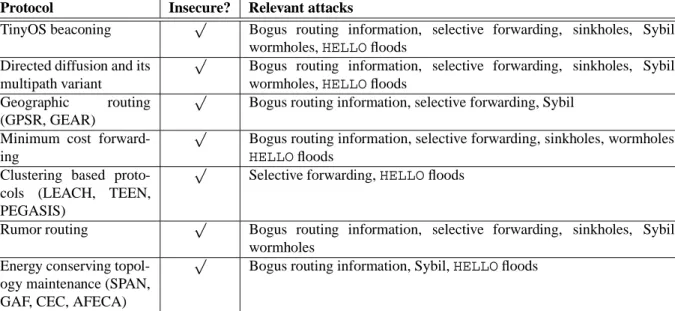
Figure 1. Summary of attacks against proposed sensor networks routing protocols.
may consist of hundreds or thousands of low-power, low-cost nodes, possibly mobile but more likely at fixed locations, deployed en masse to monitor and affect the environment. For the remainder of this paper we assume that all nodes’ locations are fixed for the duration of their lifetime.
For concreteness, we target the Berkeley TinyOS sen-sor platform in our work. Because this environment is so radically different from any we had previously encoun-tered, we feel it is instructive to give some background on the capabilities of the Berkeley TinyOS platform.
A representative example is the Mica mote2, a small
(several cubic inch) sensor/actuator unit with a CPU, power source, radio, and several optional sensing el-ements. The processor is a 4 MHz 8-bit Atmel AT-MEGA103 CPU with 128 KB of instruction memory, 4 KB of RAM for data, and 512 KB of flash memory. The CPU consumes 5.5 mA (at 3 volts) when active, and two orders of magnitude less power when sleeping. The radio is a 916 MHz low-power radio from RFM, delivering up to 40 Kbps bandwidth on a single shared channel and with a range of up to a few dozen meters or so. The RFM radio consumes 4.8 mA (at 3 volts) in re-ceive mode, up to 12 mA in transmit mode, and 5A in
sleep mode. An optional sensor board allows mounting of a temperature sensor, magnetometer, accelerometer, microphone, sounder, and other sensing elements. The whole device is powered by two AA batteries, which provide approximately 2850 mA hours at 3 volts.
Sensor networks often have one or more points of cen-tralized control called base stations. A base station is
2We use the terms mote and sensor node interchangeably.
typically a gateway to another network, a powerful data processing or storage center, or an access point for hu-man interface. They can be used as a nexus to dissemi-nate control information into the network or extract data from it. In environmental sensing applications, base sta-tions can also be used as gateways to issue queries to motes, requesting sensory information such as light or temperature, or posting interests to be notified of the oc-currence of events such as movement or some unusual activity. In some previous work on sensor network rout-ing protocols, base stations have also been referred to as sinks.
Base stations are typically many orders of magni-tude more powerful than sensor nodes. They might have workstation or laptop class processors, memory, and storage, AC power, and high bandwidth links for communication amongst themselves. However, sensors are constrained to use lower-power, lower-bandwidth, shorter-range radios, and so it is envisioned that the sen-sor nodes would form a multi-hop wireless network to allow sensors to communicate to the nearest base sta-tion. See Figure 3 for a picture illustrating a representa-tive architecture for sensor networks.
A base station might request a steady stream of data, such as a sensor reading every second, from nodes able to satisfy a query. We refer to such a stream as a data flow and to the nodes sending the data as sources.
In order to reduce the total messages sent and save en-ergy, sensor readings from multiple nodes may be pro-cessed at one of many possible aggregation points which would forward to a base station a single message repre-senting an aggregate of the received values. Aggregation
Sensor node Base station Adversary
Low−power radio link
Low latency, high bandwidth link
Figure 2. Sensor network legend. All nodes may use low power radio links, but only laptop-class adversaries and base stations can use low latency, high bandwidth links.
points are typically regular sensor nodes, and their selec-tion is not necessarily static. Aggregaselec-tion points could be chosen dynamically for each query or event, for ex-ample. It is also possible that every node in the network functions as an aggregation point, delaying transmission of an outgoing message until a sufficient number of in-coming messages have been received and aggregated.
Power management in sensor networks is critical. At full power, the Berkeley Mica mote can run for only two weeks or so before exhausting its batteries. Conse-quently, if we want sensor networks to last for years, it is crucial that they run at around a 1% duty cycle (or less). Similarly, since the power consumption of the radio is three orders of magnitude higher when transmitting or listening than when in sleep mode, it is crucial to keep the radio in sleep mode the overwhelming majority of the time.
It is clear that we must discard many preconcep-tions about network security: sensor networks differ from other distributed systems in important ways. The resource-starved nature of sensor networks poses great challenges for security. These devices have very lit-tle computational power: public-key cryptography is so expensive as to be unusable, and even fast symmetric-key ciphers must be used sparingly. With only 4 KB of RAM, memory is a resource that must be husbanded carefully, so our security protocols cannot maintain much state. Also, communication bandwidth is ex-tremely dear: each bit transmitted consumes about as much power as executing 800–1000 instructions [4], and as a consequence, any message expansion caused by se-curity mechanisms comes at significant cost. Power is the scarcest resource of all: each milliamp consumed
Figure 3. A representative sensor network ar-chitecture.
is one milliamp closer to death, and as a result, nearly every aspect of sensor networks must be designed with power in mind.
Lest the reader think that these barriers may disap-pear in the future, we point out that it seems unlikely that Moore’s law will help in the foreseeable future. Because one of the most important factors determining the value of a sensor network comes from how many sensors can be deployed, it seems likely there will be strong pressure to develop ever-cheaper sensor nodes. In other words, we expect that users will want to ride the Moore’s law curve down towards ever-cheaper systems at a fixed per-formance point, rather than holding price constant and improving performance over time.
This leaves us with a very demanding environment. How can security possibly be provided under such tight constraints? Yet security is critical. With sensor net-works being envisioned for use in critical applications such as building monitoring, burglar alarms, and emer-gency response, with the attendant lack of physical secu-rity for hundreds of exposed devices, and with the use of wireless links for communications, these networks are at risk.
In the following section, we compare sensor networks to ad-hoc wireless networks. We show why existing se-cure routing mechanisms for ad-hoc wireless networks are inadequate for sensor networks, and we discuss gen-eral design considerations for sensor network routing protocols. We also discuss previous and related work.
3. Sensor networks vs. Ad-hoc wireless
net-works
Wireless sensor networks may appear similar to ad-hoc wireless networks in that the dominant
communi-cation paradigm in both is multi-hop networking, but several important distinctions can be drawn between the two. First, ad-hoc networks typically support routing between any pair of nodes [5, 6, 7, 8], whereas sensor networks have a more specialized communication pat-tern. Most traffic in sensor networks can be classified into one of three categories:
1. Many-to-one: Multiple sensor nodes send sensor readings to a base station or aggregation point in the network.
2. One-to-many: A single node (typically a base sta-tion) multicasts or floods a query or control infor-mation to several sensor nodes.
3. Local communication: Neighboring nodes send lo-calized messages to discover and coordinate with each other. A node may broadcast messages in-tended to be received by all neighboring nodes or unicast messages intended for a only single neigh-bor3.
In addition, in most of the foreseen applications of sen-sor networks the nodes are not mobile, possibly embed-ded in walls or dispersed from an airplane in a field, fur-ther simplifying the necessary routing mechanisms.
Second, sensor networks are extremely resource con-strained. Although ad-hoc networks have been tradi-tionally considered to have limited resources in terms of energy, processing power, and storage, the limitations faced by sensor networks are two or three orders of mag-nitude worse. Whereas nodes in an ad-hoc network may have a 32-bit processor, megabytes of RAM, a 2 Mbs ra-dio, and a large battery that can be frequently and easily recharged, typical sensor nodes have an 8-bit processor, kilobytes of RAM, a 40 Kbs radio, and a tiny battery.
Although all of the above resource constraints pose significant challenges to sensor networks, the extremely limited energy resources are the most pressing. After deployment, many sensor networks are designed to be virtually unattended for long periods. Nodes may be embedded in concrete to determine the affect of earth-quakes on buildings or deployed in enemy territory for surveillance. Battery recharging or replacement in such situations may be infeasible.
Power consumption is dominated by communication costs. The power consumed by sending a single bit over the radio is equivalent to executing 800 instruc-tions [4]. In order to ensure long life, this necessitates extremely conservative management of radio traffic in terms of both total messages sent as well as packet over-head. Packet overhead for TinyOS beaconing [4] is only 4 bytes.
3By neighbor we mean a node within normal radio range.
Finally, since an event in the environment may cause several neighboring nodes to send data to the sink at correlated times, there may exist a significant amount of redundancy in network traffic. This motivates in-network processing, aggregation, and duplicate elimina-tion to help reduce message traffic and save energy. The initial prototypes of sensor networks we have seen are often very cooperative and exhibit trust relationships be-yond those that are typically found in ad-hoc networks.
Security issues in ad-hoc networks are similar to those in sensor networks and have been well enumerated in the literature [9, 10], but the defense mechanisms developed for ad-hoc networks are not directly applicable to sensor networks. There are several reasons for why this is so, but they all relate to the differences between sensor and ad-hoc networks enumerated above.
Some ad-hoc network security mechanisms for au-thentication and secure routing protocols are based on public key cryptography [9, 11, 12, 13, 14, 15, 16, 17]. However, public key cryptography is well beyond the capabilities of sensor nodes. Computing a RSA digi-tal signature with a 1024 bit key on a Palm Pilot can take up to 30 seconds, while key generation can take as long as 15 minutes [18]. Palm Pilots typically have 32-bit processors and around 8MB of RAM, and thus are orders of magnitude more powerful than sensor nodes. For this reason, security protocols for sensors networks must rely exclusively on efficient symmetric key cryp-tography.
Hu, Perrig, and Johnson [19, 20], Basagni et al. [21], and Papadimitratos and Haas [22] have proposed schemes for secure routing in ad hoc networks based on symmetric key cryptography. Hu, Perrig, and John-son [19, 20] use TESLA [23], an efficient broadcast au-thentication protocol, and hash chains to develop secure distance vector and source routing protocols. Basagni et al. [21] present a key-management scheme based on clustering and probabilistic selection of the key generat-ing node usgenerat-ing symmetric key cryptography. Papadim-itratos and Haas [22] propose a secure source routing protocol that assumes a pre-existing security association between the two communicating nodes. Distance vector and source routing protocols are generally unsuitable for sensor networks, because they are too expensive. They require local state or packet overhead that exceeds the capabilities of sensor nodes and are designed to find and establish routes between any pair of nodes—a mode of communication not prevalent in sensor networks.
Marti et al. [24] and Buchegger and Boudec [25] con-sider the problem of minimizing the effect of misbehav-ing or selfish nodes on routmisbehav-ing through punishment, re-porting, and holding grudges. The application of these techniques to sensor networks is promising, however the
possibility of malicious nodes blackmailing good nodes and the difficulty in distinguishing between node mis-behavior and poor network conditions must be handled with care.
Perrig et al. present two security protocols opti-mized for use in sensor networks, SNEP andTESLA
[26]. SNEP provides confidentiality, authentication, and freshness between nodes and the sink, and TESLA
provides authenticated broadcast. Both are useful build-ing blocks for securbuild-ing routbuild-ing protocols in sensor net-works.
4. Problem Statement
Before diving into specific routing protocols, it helps to have a clear statement of the routing security problem. In the following sections we outline our assumptions about the underlying network, propose models for dif-ferent classes of adversaries, and consider security goals in this setting.
4.1. Network Assumptions
Because sensor networks use wireless communica-tions, we must assume that radio links are insecure. At the very least, attackers can eavesdrop on our ra-dio transmissions, inject bits in the channel, and replay previously heard packets. We assume that if the de-fender can deploy many sensor nodes, then the adver-sary will likely also be able to deploy a few malicious nodes with similar hardware capabilities as the legiti-mate nodes. The attacker may come upon these mali-cious nodes by purchasing them separately, or by “turn-ing” a few legitimate nodes by capturing them and phys-ically overwriting their memory. We assume that the at-tacker might have control of more than one node, and these malicious nodes might collude to attack the sys-tem. Also, in some cases colluding nodes might have high-quality communications links available for coordi-nating their attack (see, e.g., Section 5.5 for one way in which attackers might put such a capability to use).
We do not assume sensor nodes are tamper resistant. We assume that if an adversary compromises a node, she can extract all key material, data, and code stored on that node. While tamper resistance might be a viable defense for physical node compromise for some networks, we do not see it as a general purpose solution. Extremely effec-tive tamper resistance tends to add significant per-unit cost, and sensor nodes are intended to be very inexpen-sive.
4.2. Trust Requirements
Since base stations interface a sensor network to the outside world, the compromise of a significant number
of them can render the entire network useless. For this reason we assume that base stations are trustworthy, in the sense that they can be trusted if necessary and are assumed to behave correctly. Most, but not all routing protocols depend on nodes to trust messages from base stations.
Aggregation points may be trusted components in cer-tain protocols. Nodes may rely on routing information from aggregation points and trust that messages sent to aggregation points will be accurately combined with other messages and forwarded to a base station. Aggre-gation points are often regular sensor nodes. It is possi-ble that adversaries may try to deploy malicious aggre-gation points or attempt to turn currently compromised nodes into aggregation points. For this reason aggrega-tion points may not necessarily be trustworthy.
4.3. Threat Models
An important distinction can be made between mote-class attackers and laptop-mote-class attackers. In the former case, the attacker has access to a few sensor nodes with similar capabilities to our own, but not much more than this. In contrast, a laptop-class attacker may have access to more powerful devices, like laptops or their equiva-lent. Thus, in the latter case, malicious nodes have an advantage over legitimate nodes: they may have greater battery power, they may have a more capable CPU, they might have a high-power radio transmitter or a sensitive antenna for eavesdropping, and so on.
An attacker with laptop-class devices can do more than an attacker with only ordinary sensor nodes. An ordinary sensor node might only be able to jam the ra-dio link in its immediate vicinity, while a laptop-class attacker might be able to jam the entire sensor net-work using its stronger transmitter. A single laptop-class attacker might be able to eavesdrop on an entire network, while sensor nodes would ordinarily have a limited range. Also, laptop-class attackers might have a high-bandwidth, low-latency communications channel not available to ordinary sensor nodes, allowing such at-tackers to coordinate their efforts.
Obviously, given the limited capabilities of sensor nodes, it is in the best interest of the adversary to launch attacks from laptop-class devices whenever possible, but there may be situations when adversaries are lim-ited to using only mote-class nodes. Consider nodes which have cryptographic key material deeply embed-ded within a tamper resistant processor. It may be be-yond the means of an adversary to extract the key mate-rial from stolen or captured nodes, but relatively easy to physically reprogram and reintroduce such nodes. Sim-ilarly, in a high security environment such as a space shuttle, a military installation, or a bank vault, it may be
difficult to sneak in a laptop-class device, but relatively easy to introduce mote-class nodes.
A second distinction can be made between outsider attacks and insider attacks. We have so far been dis-cussing outsider attacks, where the attacker has no spe-cial access to the sensor network. One may also con-sider incon-sider attacks, where an authorized participant in the sensor network has gone bad. Insider attacks may be mounted from either compromised sensor nodes run-ning malicious code or adversaries who have stolen the key material, code, and data from legitimate nodes, and who then use one or more laptop-class devices to attack the network.
4.4. Security Goals
Secure sensor network routing protocols should have the traditional security goals of integrity, authenticity, and availability. In this section, we discuss in more con-crete terms what these goals mean in sensor networks and consider the consequences of the presence of insid-ers or compromised nodes on a protocol being able to satisfy them.
In Section 3 we discussed the three main communica-tion patterns typically found in sensor networks: many-to-one, one-to-many, and local communication. In the ideal world, a secure routing protocol should guaran-tee the integrity, authenticity, and availability of mes-sage delivery for all three communication patterns in the presence of adversaries of arbitrary power. Every eligi-ble receiver should receive all messages intended for it and be able to verify the integrity of every message as well as the identity of the sender.
In our view, protection against eavesdropping is not an explicit security goal of a secure routing algorithm. Secrecy is usually most relevant to application data, and it is arguably not the responsibility of a routing protocol to provide it. Instead, confidentiality should be provided through end-to-end or link layer encryption. However, we do consider it the responsibility of a routing proto-col to prevent eavesdropping caused by misuse or abuse of the protocol itself. Eavesdropping achieved by the cloning or rerouting of a data flow should be prevented, for example.
Similarly, we believe protection against the replay of data packets should not be a security goal of a secure routing protocol. This functionality is best provided at the application layer because only the application can fully and accurately detect the replay of data packets (as opposed to retransmissions, for example).
In the presence of only outsider adversaries, it is con-ceivable to achieve these idealized goals. However, in the presence of compromised or insider attackers, es-pecially those with laptop-class capabilities, it is most
likely that some if not all of these goals are not fully at-tainable. Rather, instead of complete compromise of the entire network, the best we can hope for in the presence of insider adversaries is graceful degradation. The ef-fectiveness of a routing protocol in achieving the above goals should degrade no faster than a rate approximately proportional to the ratio of compromised nodes to total nodes in the network.
5. Attacks on sensor network routing
Many sensor network routing protocols are quite sim-ple, and for this reason are sometimes even more suscep-tible to attacks against general ad-hoc routing protocols. Most network layer attacks against sensor networks fall into one of the following categories:
1. Spoofed, altered, or replayed routing information 2. Selective forwarding
3. Sinkhole attacks 4. Sybil attacks 5. Wormholes
6. HELLOflood attacks 7. Acknowledgement spoofing
In the descriptions below, note the difference between attacks that try to manipulate user data directly and at-tacks that try to affect the underlying routing topology.
We start with some general discussion of these types of attacks; in Section 6, we show how these attacks may be applied to break various routing protocols that have been proposed in the literature.
5.1. Spoofed, altered, or replayed routing
infor-mation
The most direct attack against a routing protocol is to target the routing information exchanged between nodes. By spoofing, altering, or replaying routing infor-mation, adversaries may be able to create routing loops, attract or repel network traffic, extend or shorten source routes, generate false error messages, partition the net-work, increase end-to-end latency, etc.
5.2. Selective forwarding
Multi-hop networks are often based on the assump-tion that participating nodes will faithfully forward mes-sages received. In a selective forwarding attack, mali-cious nodes may refuse to forward certain messages and simply drop them, ensuring that they are not propagated
any further. A simple form of this attack is when a mali-cious node behaves like a black hole and refuses to for-ward every packet she sees. However, such an attacker runs the risk of neighboring nodes concluding that she has failed and deciding to seek another route. A more subtle form of this attack is when an adversary selec-tively forwards packets. An adversary interested in sup-pressing or modifying packets originating from a select few nodes can reliably forward the remaining traffic and limit suspicion of her wrongdoing.
Selective forwarding attacks are typically most effec-tive when the attacker is explicitly included on the path of a data flow. However, it is conceivable an adversary overhearing a flow passing through neighboring nodes might be able to emulate selective forwarding by jam-ming or causing a collision on each forwarded packet of interest. The mechanics of such an effort are tricky at best, and may border on impossible4. Thus, we be-lieve an adversary launching a selective forwarding at-tack will likely follow the path of least resistance and attempt to include herself on the actual path of the data flow. In the next two sections, we discuss sinkhole at-tacks and the Sybil attack, two mechanisms by which an adversary can efficiently include herself on the path of the targeted data flow.
5.3. Sinkhole attacks
In a sinkhole attack, the adversary’s goal is to lure nearly all the traffic from a particular area through a compromised node, creating a metaphorical sinkhole with the adversary at the center. Because nodes on, or near, the path that packets follow have many opportu-nities to tamper with application data, sinkhole attacks can enable many other attacks (selective forwarding, for example).
Sinkhole attacks typically work by making a com-promised node look especially attractive to surround-ing nodes with respect to the routsurround-ing algorithm. For instance, an adversary could spoof or replay an adver-tisement for an extremely high quality route to a base station. Some protocols might actually try to verify the quality of route with end-to-end acknowledgements containing reliability or latency information. In this case, a laptop-class adversary with a powerful ter can actually provide a high quality route by transmit-ting with enough power to reach the base station in a sin-gle hop, or by using a wormhole attack discussed in Sec-tion 5.5. Due to either the real or imagined high quality route through the compromised node, it is likely each 4It may be extremely difficult for an adversary to launch such an
at-tack in a network where every pair of neighboring nodes uses a unique key to initialize frequency hopping or spread spectrum communica-tion, for example.
neighboring node of the adversary will forward pack-ets destined for a base station through the adversary, and also propagate the attractiveness of the route to its neigh-bors. Effectively, the adversary creates a large “sphere of influence”, attracting all traffic destined for a base sta-tion from nodes several (or more) hops away from the compromised node.
One motivation for mounting a sinkhole attack is that it makes selective forwarding trivial. By ensuring that all traffic in the targeted area flows through a compro-mised node, an adversary can selectively suppress or modify packets originating from any node in the area.
It should be noted that the reason sensor networks are particularly susceptible to sinkhole attacks is due to their specialized communication pattern. Since all packets share the same ultimate destination (in networks with only one base station), to influence a potentially large number of nodes a compromised node needs only to pro-vide a single high quality route to the base station.
5.4. The Sybil attack
In a Sybil attack [3], a single node presents multiple identities to other nodes in the network. Any system whose correct behavior is based on the assumption that most nodes will behave properly may be at risk for Sybil attacks. The Sybil attack is especially threatening to fault-tolerant schemes such as distributed storage [27], dispersity [28] and multipath [29] routing, and topology maintenance [30, 31]. Replicas, storage partitions, or routes believed to be using disjoint nodes could in ac-tuality be using a single adversary presenting multiple identities.
Sybil attacks also pose a significant threat to geo-graphic routing protocols. Location aware routing of-ten requires nodes to exchange coordinate information with their neighbors to efficiently route geographically addressed packets. It is only reasonable to expect a node to accept but a single set of coordinates from each of its neighbors, but by using the Sybil attack an adversary can “be in more than one place at once”.
5.5. Wormholes
In the wormhole attack [2], an adversary tunnels mes-sages received in one part of the network over a low la-tency link and replays them in a different part5. The simplest instance of this attack is a single node situated between two other nodes forwarding messages between the two of them. However, wormhole attacks will more commonly involve two distant malicious nodes collud-5Specifically, packets transmitted through the wormhole should
have lower latency than those packets sent between the same pair of nodes over normal multi-hop routing.
ing to understate their distance from each other by re-laying packets along an out-of-bound channel available only to the attacker.
In some cases, an adversary situated close to a base station may be able to completely disrupt routing by creating a well-placed wormhole. An adversary could convince nodes who would normally be multiple hops from a base station that they are only one or two hops away via the wormhole. This may create a sinkhole: due to the potential attractiveness of the route created by the wormhole, those nodes neighboring the adversary on the other side of the wormhole may choose to forward packets destined for a base station through her and then propagate knowledge of this route to their neighbors and attract more traffic. Figure 6 shows an example of a wormhole being used to create a sinkhole. Wormholes may also be used simply to convince two distant nodes that they are neighbors by relaying packets between the two of them.
Wormhole attacks would likely be used in combina-tion with selective forwarding or eavesdropping. De-tection is potentially difficult when used in conjunction with the Sybil attack.
5.6.
HELLOflood attack
Many protocols require nodes to broadcast HELLO packets to announce themselves to their neighbors, and a node receiving such a packet may assume that it is within (normal) radio range of the sender. This assump-tion may be false: a laptop-class attacker broadcasting routing or other information with large enough transmis-sion power could convince every node in the network that the adversary was its neighbor.
For example, an adversary advertising a very high quality route to the base station to every node in the net-work could cause a large number of nodes to attempt to use this route, but those nodes sufficiently far away from the adversary would sending packets into oblivion. The network is left in a state of confusion. A node realizing the link to the adversary is false could be left with few options: all its neighbors might be attempting to forward packets to the adversary as well. Protocols which de-pend on localized information exchange between neigh-boring nodes for topology maintenance or flow control are also subject to this attack.HELLOfloods can also be thought of as one-way, broadcast wormholes.
Note: “Flooding” is usually used to denote the the epidemic-like propagation of a message to every node in the network over a multi-hop topology. In contrast, despite its name, theHELLOflood attack uses a single hop broadcast to transmit a message to a large number of receivers.
5.7. Acknowledgement spoofing
Several sensor network routing algorithms rely on im-plicit or exim-plicit link layer acknowledgements. Due to the inherent broadcast medium, an adversary can spoof link layer acknowledgments for “overheard” packets ad-dressed to neighboring nodes. Goals include convincing the sender that a weak link is strong or that a dead or dis-abled node is alive. For example, a routing protocol may select the next hop in a path using link reliability. Artifi-cially reinforcing a weak or dead link is a subtle way of manipulating such a scheme. Since packets sent along weak or dead links are lost, an adversary can effectively mount a selective forwarding attack using acknowledge-ment spoofing by encouraging the target node to trans-mit packets on those links.
6. Attacks on specific sensor network
proto-cols
Due to storage and energy constraints, sensor network routing protocols are often much simpler than ad-hoc and wired routing protocols. Due to their simplified nature and the broadcast medium in which they oper-ate, many proposed sensor network routing protocols are highly susceptible to attack. Adversaries can attract or repel traffic flows, increase latency, or disable the entire network with sometimes as little effort as sending a sin-gle packet. In this section, we survey the proposed sen-sor network routing protocols and highlight the relevant attacks.
6.1. TinyOS beaconing
TinyOS [4] is a lightweight, event-driven operat-ing system targeted specifically for sensor networks. TinyOS is under development at UC Berkeley, and the most current version runs on the MICA architecture [32]. Although there is work in progress to develop more robust routing protocols for TinyOS, due to its simplicity, the basic routing mechanism included with current TinyOS distribution has been widely used in re-search and experimental platforms [33, 34, 35, 36].
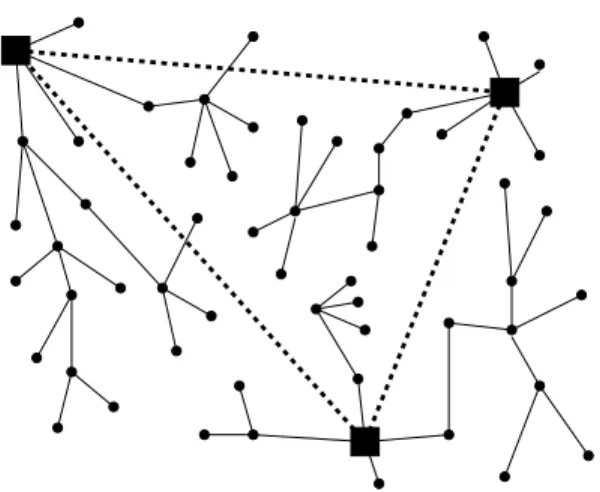
In the basic TinyOS beaconing protocol, the base sta-tion from which the beacon originates is the implicit fi-nal destination of all data packets. Conceptually, the routing mechanism works by constructing a breadth first spanning tree rooted at the base station. Periodically the base station broadcasts a route update. All nodes within receiving range of the update mark the base station as its parent and rebroadcast the update. The algorithm con-tinues recursively with each node marking its parent as the first node from which it hears a routing update dur-ing the current time epoch. All packets received or gen-erated by a node are forwarded to its parent.
Figure 4. A representative topology con-structed using TinyOS beaconing with a sin-gle base station.
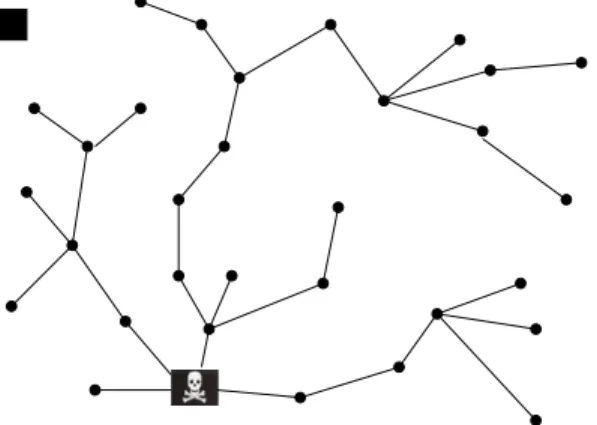
Figure 5. An adversary spoofing a routing up-date from a base station in TinyOS beacon-ing.
The protocol does not specify a specific scheme for query dissemination. Queries can be flooded [33, 34], or there can be no queries, with data events always sent at a constant rate (when they are frequent) or only after they occur (when they are rare).
Attacks: The TinyOS beaconing protocol was not
de-signed with security in mind, and unsurprisingly, it is highly susceptible to attack. Since routing updates are not authenticated, it is possible for any node to claim to be a base station and become the destination of all traffic in the network.
Authenticated routing updates will prevent an adver-sary from claiming to be a base station, but a powerful laptop-class adversary can still easily wreak havoc. An adversary interested in eavesdropping on, modifying, or suppressing packets in a particular area can do so by mounting a combined wormhole/sinkhole attack. The
Figure 6. A laptop-class adversary using a wormhole to create a sinkhole in TinyOS bea-coning.
adversary first creates a wormhole between two collud-ing laptop-class nodes, one near the base station and one near the targeted area. The first node forwards (authenti-cated) routing updates to the second through the worm-hole, who participates normally in the protocol and re-broadcasts the routing update in the targeted area. Since the “wormholed” routing update will likely reach the tar-geted area considerably faster than it normally would have through multi-hop routing, the second node will create a large routing subtree in the targeted area with itself as the root. Most likely all traffic in the targeted area will be channeled through the wormhole, enabling a potent selective forwarding attack.
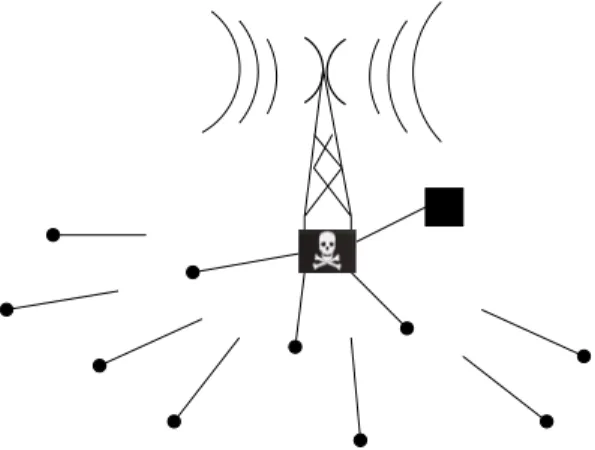
If a laptop-class adversary has a powerful transmitter, it can use aHELLOflood attack to broadcast a routing update loud enough to reach the entire network, causing every node to mark the adversary as its parent. Most nodes will be likely out of normal radio range of both a true base station and the adversary. The network is crippled, with the majority of nodes transmitting packets into oblivion. Due to the simplicity of this protocol, it is unlikely there exists a simple extension to recover from this attack. A node that realizes its parent is not actually in range (say by using link layer acknowledgements) has few options short of flooding every packet. Each of its neighbors will likely have the adversary marked as its parent as well.
Routing loops can easily be created by mote-class ad-versaries spoofing routing updates. Suppose an adver-sary can determine that node A and node B are within ra-dio range of each other. An adversary can send a forged routing update to node B with a spoofed source address indicating it came from node A. Node B will then mark node A as its parent and rebroadcast the routing update. Node A will then hear the routing update from node B
Figure 7. HELLOflood attack against TinyOS beaconing. A laptop-class adversary that can retransmit a routing update with enough power to be received by the entire network leaves many nodes stranded. They are out of normal radio range from the adversary but have chosen her as their parent.
and mark B as it is parent. Messages sent to either A or B will be forever forwarded in a loop between the two of them.
6.2. Directed diffusion
Directed diffusion [37] is a data-centric communica-tion paradigm for drawing informacommunica-tion out of a sen-sor network. Base stations flood interests for named data, setting up gradients within the network designed to draw events (i.e., data matching the interest). Nodes able to satisfy the interest disseminate information along the reverse path of interest propagation. Nodes receiv-ing the same interest from multiple neighborreceiv-ing nodes may propagate events along the corresponding multiple links. Interests initially specify a low rate of data flow, but once a base station starts receiving events it will re-inforce one (or more) neighbor in order to request higher data rate events. This process proceeds recursively until it reaches the nodes generating the events, causing them to generate events at a higher data rate. Alternatively, paths may be negatively reinforced as well.
There is a multipath variant of directed diffusion [38] as well. After the primary dataflow is established using positive reinforcements, alternate routes are recursively established with maximal disjointedness by attempting to reinforce neighbors not on the primary path.
Attacks: Due to the robust nature of flooding, it may
be difficult for an adversary to prevent interests from reaching targets able to satisfy them. However, once sources begin to generate data events, an adversary
attacking a data flow might have one of four goals: Suppression: Flow suppression is an instance of denial-of-service. The easiest way to suppress a flow is to spoof negative reinforcements.
Cloning: Cloning a flow enables eavesdropping. After an adversary receives an interest flooded from a legiti-mate base station, it can simply replay that interest with herself listed as a base station. All events satisfying the interest will now be sent to both the adversary and the legitimate base station.
Path influence: An adversary can influence the path taken by a data flow by spoofing positive and negative reinforcements and bogus data events. For example, after receiving and rebroadcasting an interest, an adversary interested in directing the resulting flow of events through herself would strongly reinforce the nodes to which the interest was sent while spoofing high rate, low latency events to the nodes from which the interest was received. Three actions result: (1) data events generated upstream by legitimate sources will be drawn through the adversary because of her artificially strong positive reinforcements, (2) alternate event flows will be negatively reinforced by downstream nodes because the adversary provides (or spoofs) events with the lowest latency or highest frequency, and (3) the adversary’s node will be positively reinforced due the high quality spoofed and real data events she is able to provide. With this attack, an adversary is able to ensure any flow of events propagates through herself on the way to the base station that originally advertised the associated interest.
Selective forwarding and data tampering: By using the above attack to insert herself onto the path taken by a flow of events, an adversary can gain full control of the flow. She can modify and selectively forward packets of her choosing.
A laptop-class adversary can exert greater influence on the topology by creating a wormhole between node A located next a base station and node B located close to where events are likely to be generated. Interests ad-vertised by the base station are sent through the worm-hole and rebroadcast by node B. Node B then attracts data flows by spoofing strong positive reinforcements to all neighboring nodes while node A broadcasts spoofed negative reinforcements to its surrounding nodes. The combination of the positive and negative reinforcements pushes data flows away from the base station and to-wards the resulting sinkhole centered at node B.
The multipath version may appear more robust against these attacks, but it is just as vulnerable. A single
adver-B:(2,2) A at (3,2) A3 at (1,2) A2 at (2,1) A1 at (2,3) A:(3,2) A3:(1,2) A1:(2,3) A2:(2,1) C:(0,2)
Figure 8.The Sybil attack against geographic routing. Adversary A at actual location (3,2) forges location advertisements for non-existent nodes A1, A2, and A3 as well as advertising her own location. After hearing these advertisements, if B wants to send a message to destination (0,2), it will attempt to do so through A3. This transmission can be overheard and handled by the adversary A.
sary can use the Sybil attack against her neighbors. A neighbor will be convinced it is maximizing diversity by reinforcing its next most preferred neighbor not on the primary flow when in fact this neighbor is an alternate identity of the adversary.
6.3. Geographic routing
Geographic and Energy Aware Routing (GEAR) [39] and Greedy Perimeter Stateless Routing (GPSR) [40] leverage nodes’ positions and explicit geographic packet destinations to efficiently disseminate queries and route replies. GPSR uses greedy forwarding at each hop, routing each packet to the neighbor closest to the des-tination. When holes are encountered where greedy forwarding is impossible, GPSR recovers by routing around the perimeter of the void. One drawback of GPSR is that packets along a single flow will always use the same nodes for the routing of each packet, lead-ing to uneven energy consumption. GEAR attempts to remedy this problem by weighting the choice of the next hop by both remaining energy and distance from the tar-get. In this way, the responsibility for routing a flow is more evenly distributed among a “beam” of nodes be-tween the source and base station. Both protocols re-quire location (and energy for GEAR) information to be exchanged between neighbors, although for some fixed, well-structured topologies (a grid for example) this may not be necessary. B:(0,1) C:(1,1) B at (2,1) A:(1,2) B:(2,1) D:(3,1) 2 3 1
Figure 9.Creating routing loops in GPSR.By forging a location advertisement claiming
is at (2,1), an adversary can create a routing loop as described in Section 6.3.
Attacks: Location information can be misrepresented.
Regardless of an adversary’s actual location, she may advertise her location in a way to place herself on the path of a known flow. GEAR tries to distribute the re-sponsibility of routing based on remaining energy, so an appropriate attack would be to always advertise maxi-mum energy as well.
Without too much additional effort, an adversary can dramatically increase her chances of success by mount-ing a Sybil attack. As depicted in Figure 8, an ad-versary can advertise multiple bogus nodes surrounding each target in a circle (or sphere), each claiming to have maximum energy. By intercepting transmissions sent to each of the bogus nodes, the adversary maximizes her chances for placing herself on the path of any nearby data flow. Once on that path, the adversary can mount a selective forwarding attack.
In GPSR an adversary can forge location advertise-ments to create routing loops in data flows without hav-ing to actively participate in packet forwardhav-ing. Con-sider the hypothetical topology in Figure 9 and flow of packets fromto location (3,1). Assume the maximum
radio range is one unit. If an adversary forges a location advertisement claimingis at (2,1) and sends it to,
then after forwards a packet destined for (3,1) to, will send it back tobecause it believesis close to
the ultimate destination. andwill forever forward
the packet in a loop between each other.
6.4. Additional routing protocols
Refer to the appendix for security analysis of mini-mum cost forwarding [41], clustering protocols such as LEACH [42], rumor routing [43], and energy conserv-ing topology maintenance algorithms such as SPAN [31] and GAF [30].
7. Countermeasures
7.1. Outsider attacks and link layer security
The majority of outsider attacks against sensor net-work routing protocols can be prevented by simple link layer encryption and authentication mechanisms using a globally shared key. The presence of a valid message authentication code in a packet validates that the packet originated from a friendly node knowing the global key, and thus prevents adversaries from spoofing or altering routing and data packets. Replay can easily be detected by maintaining a monotonically increasing counter for each link and including the next value of the counter with each packet. Each node simply remembers the most recently received counter value from each of its neighbors and discards packets containing older values. These mechanisms are enough to counter most of the discussed attacks when mounted by outsiders. The Sybil attack is no longer relevant because nodes are unwilling to accept even a single identity of the adversary. The majority of selective forwarding and sinkhole attacks are not possible because the adversary is prevented from joining the topology. Link layer acknowledgements can now be authenticated.
Major classes of attacks not countered by link layer encryption and authentication mechanisms are worm-hole attacks andHELLOflood attacks. Although an ad-versary is prevented from joining the network, nothing prevents her from using a wormhole to tunnel packets sent by legitimate nodes in one part of the network to legitimate nodes in another part to convince them they are neighbors or by amplifying an overheard broadcast packet with sufficient power to be received by every node in the network.
The attacks against TinyOS beaconing described in Section 6.1 illustrate these techniques, and link layer se-curity mechanisms can do nothing to prevent them. If a wormhole has been established, encryption may make some selective forwarding attacks against packets using the wormhole more difficult, but clearly can do nothing to prevent “black hole” selective forwarding.
Link layer security mechanisms using a globally shared key are completely ineffective in presence of in-sider attacks or compromised nodes. Inin-siders can at-tack the network by spoofing or injecting bogus routing information, creating sinkholes, using the Sybil attack, and broadcastingHELLOfloods. More sophisticated de-fense mechanisms are needed to provide reasonable pro-tection against wormholes and insider attacks. We focus on countermeasures against these attacks in the remain-ing sections.
7.2. The Sybil attack
An insider cannot be prevented from participating in the network, but she should only be able to do so using the identities of the nodes she has compromised. Us-ing a globally shared key allows an insider to masquer-ade as any (possibly even non-existent) node. Identities must be verified. In the traditional setting, this might be done using public key cryptography, but generating and verifying digital signatures is beyond the capabilities of sensor nodes.
One solution is to have every node share a unique symmetric key with a trusted base station. Two nodes can then use a Needham-Schroeder like protocol to ver-ify other’s identity and establish a shared key. A pair of neighboring nodes can use the resulting key to im-plement an authenticated, encrypted link between them. In order to prevent an insider from wandering around a stationary network and establishing shared keys with ev-ery node in the network, the base station can reasonably limit the number of neighbors a node is allowed to have and send an error message when a node exceeds it.
Thus, when a node is compromised, it is restricted to (meaningfully) communicating only with its verified neighbors. This is not to say that nodes are forbidden from sending messages to base stations or aggregation points multiple hops away, but they are restricted from using any node except their verified neighbors to do so. In addition, an adversary can still use a wormhole to cre-ate an artificial link between two nodes to convince them they are neighbors, but the adversary will not be able to eavesdrop on or modify any future communications be-tween them.
7.3.
HELLOflood attacks
The simplest defense against HELLO flood attacks is to verify the bidirectionality of a link before taking meaningful action based on a message received over that link. The identity verification protocol described in Section 7.2 is sufficient to preventHELLOflood at-tacks. Not only does it verify the bidirectionality of the link between two nodes, but even if a well-funded adversary had a highly sensitive receiver or had worm-holes to a multiple locations in the network, a trusted base station that limits the number of verified neighbors for each node will still preventHELLOflood attacks on large segments of the network when a small number of nodes have been compromised.
7.4. Wormhole and sinkhole attacks
Wormhole and sinkhole attacks are very difficult to defend against, especially when the two are used in com-bination. Wormholes are hard to detect because they
use a private, out-of-band channel invisible to the un-derlying sensor network. Sinkholes are difficult to de-fend against in protocols that use advertised information such as remaining energy or an estimate of end-to-end reliability to construct a routing topology because this information is hard to verify. Routes that minimize the hop-count to a base station are easier to verify, however hop-count can be completely misrepresented through a wormhole. When routes are established simply based on the reception of a packet as in TinyOS beaconing or directed diffusion, sinkholes are easy to create because there is no information to verify.
A technique for detecting wormhole attacks is pre-sented in [2], but it requires extremely tight time syn-chronization and is thus infeasible for most sensor net-works. Because it is extremely difficult to retrofit ex-isting protocols with defenses against these attacks, the best solution is to carefully design routing protocols in which wormholes and sinkholes are meaningless.
One class of protocols resistant to these attacks are geographic routing protocols. Protocols that construct a topology initiated by a base station are most suscepti-ble to wormhole and sinkhole attacks. Geographic pro-tocols construct a topology on demand using only lo-calized interactions and information and without initia-tion from the base stainitia-tion. Because traffic is naturally routed towards the physical location of a base station, it is difficult to attract it elsewhere to create a sinkhole. A wormhole is most effective when used to create sink-holes or artificial links that attract traffic. Artificial links are easily detected in geographic routing protocols be-cause the “neighboring” nodes will notice the distance between them is well beyond normal radio range.
7.5. Leveraging global knowledge
A significant challenge in securing large sensor net-works is their inherent self-organizing, decentralized na-ture. When the network size is limited or the topology is well-structured or controlled, global knowledge can be leveraged in security mechanisms.
Consider a relatively small network of around 100 nodes or less. If it can be assumed that no nodes are compromised during deployment, then after the initial topology is formed, each node could send information such as neighboring nodes and its geographic location (if known) back to a base station. Using this informa-tion, the base station(s) can map the topology of the en-tire network. To account for topology changes due to radio interference or node failure, nodes would period-ically update a base station with the appropriate infor-mation. Drastic or suspicious changes to the topology might indicate a node compromise, and the appropriate action can be taken.
We have discussed why geographic routing can be rel-atively secure against wormhole, sinkhole, and Sybil at-tacks, but the main remaining problem is that location information advertised from neighboring nodes must be trusted. A compromised node advertising its location on a line between the targeted node and a base station will guarantee it is the destination for all forwarded pack-ets from that node. Probabilistic selection of a next hop from several acceptable destinations or multipath rout-ing to multiple base stations can help with this problem, but it is not perfect. When a node must route around a “hole”, an adversary can “help” by appearing to be the only reasonable node to forward packets to.
Sufficiently restricting the structure of the topology can eliminate the requirement for nodes to advertise their locations if all nodes’ locations are well known. For example, nodes can be arranged in a grid with square, triangular, or hex shaped cells. Every node can easily derive its neighbors’ locations from its own, and nodes can be addressed by location rather than by an identifier.
7.6. Additional countermeasures
Refer to Appendix B for discussion about authenti-cated broadcast and flooding mechanisms, countermea-sures against selective forwarding, implementation is-sues with the proposed Sybil attack countermeasures, and the ultimate limitations of secure multi-hop routing.
8. Conclusion
Secure routing is vital to the acceptance and use of sensor networks for many applications, but we have demonstrated that currently proposed routing protocols for these networks are insecure. We leave it as an open problem to design a sensor network routing protocol that satisfies our proposed security goals. Link layer en-cryption and authentication mechanisms may be a rea-sonable first approximation for defense against mote-class outsiders, but cryptography is not enough to de-fend against laptop-class adversaries and insiders: care-ful protocol design is needed as well.
References
[1] G. Pottie and W. Kaiser, “Wireless integrated net-work sensors,” Communications of the ACM, vol. 43, no. 5, pp. 51–58, May 2000.
[2] Yih-Chun Hu, Adrian Perrig, and David B. John-son, “Wormhole detection in wireless ad hoc net-works,” Tech. Rep. TR01-384, Department of Computer Science, Rice University, June 2002.
[3] John R. Douceur, “The Sybil Attack,” in 1st International Workshop on Peer-to-Peer Systems (IPTPS ’02), March 2002.
[4] Jason Hill, Robert Szewczyk, Alec Woo, Seth Hol-lar, David Culler, and Kristofer Pister, “System architecture directions for networked sensors,” in Proceedings of ACM ASPLOS IX, November 2000. [5] Vincent D. Park and M. Scott Corson, “A highly adaptive distributed routing algorithm for mobile wireless networks,” in IEEE INFOCOM ’97, 1997, pp. 1405–1413.
[6] C. Perkins and E. Royer, “Ad-hoc on-demand dis-tance vector routing,” in MILCOM ’97 panel on Ad Hoc Networks, 1997.
[7] David B Johnson and David A Maltz, “Dynamic source routing in ad hoc wireless networks,” in Mobile Computing, Imielinski and Korth, Eds., vol. 353. Kluwer Academic Publishers, 1996. [8] Charles Perkins and Pravin Bhagwat, “Highly
dynamic destination-sequenced distance-vector routing (DSDV) for mobile computers,” in ACM/SIGCOMM’94 Conference on Communica-tions Architectures, Protocols and ApplicaCommunica-tions, 1994, pp. 234–244.
[9] L. Zhou and Z. Haas, “Securing ad hoc networks,” IEEE Network Magazine, vol. 13, no. 6, Novem-ber/December 1999.
[10] Frank Stajano and Ross J. Anderson, “The resur-recting duckling: Security issues for ad-hoc wire-less networks,” in Seventh International Security Protocols Workshop, 1999, pp. 172–194.
[11] J. Hubaux, L. Buttyan, and S. Capkun, “The quest for security in mobile ad hoc networks,” in Proceedings of the ACM Symposium on Mobile Ad Hoc Networking and Computing (MobiHOC 2001), 2001.
[12] J. Kong, P. Zerfos, H. Luo, S. Lu, and L. Zhang, “Providing robust and ubiquitous security support for mobile ad-hoc networks,” in ICNP, 2001, pp. 251–260.
[13] Manel Guerrero Zapata, “Secure ad-hoc on-demand distance vector (SAODV) routing,” IETF MANET Mailing List, Message-ID: [email protected], Available at ftp://manet.itd.nrl.navy.mil/pub/manet/2001-10.mail, October 8, 2001.
[14] Haiyun Luo, Petros Zefros, Jiejun Kong, Songwu Lu, and Lixia Zhang, “Self-securing ad hoc wireless networks,” in Seventh IEEE Symposium on Computers and Communications (ISCC ’02), 2002.
[15] Jim Binkley and William Trost, “Authenticated ad hoc routing at the link layer for mobile sys-tems,” Wireless Networks, vol. 7, no. 2, pp. 139– 145, 2001.
[16] Bridget Dahill, Brian Neil Levine, Elizabeth Royer, and Clay Shields, “A secure routing pro-tocol for ad-hoc networks,” Tech. Rep. UM-CS-2001-037, Electrical Engineering and Computer Science, University of Michigan, August 2001. [17] Jiejun Kong, Haiyun Luo, Kaixin Xu, Daniel Lihui
Gu, Mario Gerla, and Songwu Lu, “Adaptive secu-rity for multi-layer ad-hoc networks,” Special Is-sue of Wireless Communications and Mobile Com-puting, Wiley Interscience Press, 2002.
[18] N. Modadugu, D. Boneh, and M. Kim, “Gener-ating RSA keys on a handheld using an untrusted server,” in RSA 2000, 2000.
[19] Yih-Chun Hu, David B. Johnson, and Adrian Per-rig, “SEAD: Secure efficient distance vector rout-ing for mobile wireless ad hoc networks,” in Proceedings of the 4th IEEE Workshop on Mo-bile Computing Systems and Applications (WM-CSA 2002), June 2002, pp. 3–13.
[20] Yih-Chun Hu, Adrian Perrig, and David B. John-son, “Ariadne: A secure on-demand routing pro-tocol for ad hoc networks,” Tech. Rep. TR01-383, Department of Computer Science, Rice University, December 2001.
[21] Stefano Basagni, Kris Herrin, Emilia Rosti, and Danilo Bruschi, “Secure pebblenets,” in ACM International Symposium on Mobile Ad Hoc Net-working and Computing (MobiHoc 2001), October 2001, pp. 156–163.
[22] P. Papadimitratos and Z.J. Haas, “Secure routing for mobile ad hoc networks,” in SCS Communica-tion Networks and Distributed Systems Modeling and Simulation Conference (CNDS 2002), January 2002.
[23] Adrian Perrig, Ran Canetti, Dawn Song, and J.D. Tygar, “Efficient and secure source authentication for multicast,” in Network and Distributed System Security Symposium (NSSS ’01), February 2001.
[24] Sergio Marti, T. J. Giuli, Kevin Lai, and Mary Baker, “Mitigating routing misbehavior in mo-bile ad hoc networks,” in Sixth annual ACM/IEEE Internation Conference on Mobile Computing and Networking, 2000, pp. 255–265.
[25] Sonja Buchegger and Jean-Yves Le Boudec, “Nodes bearing grudges: Towards routing secu-rity, fairness, and robustness in mobile ad hoc net-works,” in Proceedings of the Tenth Euromicro Workshop on Parallel, Distributed and Network-based Processing, Canary Islands, Spain, January 2002, pp. 403–410, IEEE Computer Society. [26] Adrian Perrig, Robert Szewczyk, Victor Wen,
David Culler, and J.D. Tygar, “SPINS: Security protocols for sensor networks,” in Proceedings of Mobile Networking and Computing 2001, 2001. [27] Castro and Liskov, “Practical byzantine fault
toler-ance,” in OSDI: Symposium on Operating Systems Design and Implementation. 1999, USENIX As-sociation, Co-sponsored by IEEE TCOS and ACM SIGOPS.
[28] Anindo Banerjea, “A taxonomy of dispersity rout-ing schemes for fault tolerant real-time channels,” in Proceedings of ECMAST, May 1996, vol. 26, pp. 129–148.
[29] K. Ishida, Y. Kakuda, and T. Kikuno, “A rout-ing protocol for findrout-ing two node-disjoint paths in computer networks,” in Internation Conference on Network Protocols, November 1992, pp. 340–347. [30] Y. Xu, J. Heidemann, and D. Estrin, “Geography-informed energy conservation for ad hoc routing,” in Proceedings of the Seventh Annual ACM/IEEE International Conference on Mobile Computing and Networking, 2001.
[31] B. Chen, K. Jamieson, H. Balakrishnan, and R. Morris, “Span: An energy-efficient coordina-tion algorithm for topology maintenance in ad hoc wireless networks,” ACM Wireless Networks Jour-nal, vol. 8, no. 5, September 2002.
[32] “Hardware designs for TinyOS,” http://webs.cs.berkeley.edu/tos/hardware.html. [33] Samuel R. Madden, Michael J. Franklin,
Joseph M. Hellerstein, and Wei Hong, “TAG: a tiny aggregation service for ad-hoc sensor networks,” Submitted for publication, May 2002. [34] Samuel R. Madden, Robert Szewczyk, Michael J.
Franklin, and David Culler, “Supporting aggregate
queries over ad-hoc wireless sensor networks,” in Workshop on Mobile Computing and Systems Ap-plications, 2002.
[35] Alan Mainwaring, Joseph Polastre, Robert Szewczyk, and David Culler, “Wireless sensor networks for habitat monitoring,” in First ACM International Workshop on Wireless Sensor Networks and Applications, 2002.
[36] “Smart buildings admit their faults,” Lab Notes: Research from the Col-lege of Engineering, UC Berkeley,
http://www.coe.berkeley.edu/labnotes/1101smartbuildings.html, November 2001.
[37] Chalermek Intanagonwiwat, Ramesh Govindan, and Deborah Estrin, “Directed diffusion: A scal-able and robust communication paradigm for sen-sor networks,” in Proceedings of the Sixth An-nual International Conference on Mobile Comput-ing and Networks (MobiCOM ’00), August 2000. [38] Deepak Ganesan, Ramesh Govindan, Scott
Shenker, and Deborah Estrin, “Highly-resilient, energy-efficient multipath routing in wireless sensor networks,” Mobile Computing and Communications Review, vol. 4, no. 5, October 2001.
[39] Y. Yu, R. Govindan, and D. Estrin, “Geographical and energy aware routing: A recursive data dis-semination protocol for wireless sensor networks,” Tech. Rep. UCLA/CSD-TR-01-0023, University of California at Los Angeles Computer Science Department, May 2001.
[40] Brad Karp and H. T. Kung, “GPSR: greedy perimeter stateless routing for wireless networks,” in Mobile Computing and Networking, 2000, pp. 243–254.
[41] F. Ye, A. Chen, S. Lu, and L. Zhang, “A scalable solution to mininum cost forwarding in large sen-sor networks,” in Tenth Internation Conference on Computer Communications and Networks, 2001, pp. 304–309.
[42] Wendi Rabiner Heinzelman, Anantha Chan-drakasan, and Hari Balakrishnan, “Energy-efficient communication protocol for wireless mi-crosensor networks,” in 33rd Annual Hawaii In-ternational Conference on System Sciences, 2000, pp. 3005–3014.
[43] David Braginsky and Deborah Estrin, “Rumour routing algorithm for sensor networks,” in First
ACM International Workshop on Wireless Sensor Networks and Applications, 2002.
[44] F. Ye, S. Lu, and L. Zhang, “GRAdient broad-cast: A robust, long-live large sensor network,” Tech. Rep., University of California at Los Ange-les Computer Science Department, 2001.
[45] D. Estrin, R. Govindan, J. Heidemann, and S. Ku-mar, “Next century challenges: Scalable coordina-tion in sensor networks,” in 5th annual ACM/IEEE International Conference on Mobile Computing and Networking, 1999, pp. 263–270.
[46] A. Manjeshwar and D.P. Agrawal, “TEEN: A rout-ing protocol for enhanced effeciency in wireless sensor networks,” in 1st International Workshop on Parallel and Distributed Computing Issues in Wireless Networks and Mobile Computing, 2001. [47] S. Lindsey and C.S. Raghavendra, “PEGASIS:
Power-efficient gathering in sensor information systems,” in IEEE Aerospace Conference, March 2002.
[48] L. Li, J. Halpern, and Z. Haas, “Gossip-based ad hoc routing,” in IEEE Infocom 2002, 2002. [49] Meng-Jang Lin, Keith Marzullo, and Stefano
Masini, “Gossip versus deterministic flooding: Low message overhead and high reliability for broadcasting on small networks,” Tech. Rep. CS1999-0637, 18, 1999.
[50] Ya Xu, John Heidemann, and Deborah Estrin, “En-ergy conservation by adaptive clustering for ad-hoc networks,” in Poster Session of MobiHoc 2002, 2002.
[51] Ya Xu, John Heidemann, and Deborah Estrin, “Adaptive energy-conserving routing for multihop ad hoc networks,” Research Report TR-2000-527, USC/Information Sciences Institute, October 2000.
[52] Deepak Ganesan, Bhaskar Krishnamachari, Alec Woo, David Culler, Deborah Estrin, and Stephen Wicker, “An empirical study of epidemic algo-rithms in large scale multihop wireless networks,” Tech. Rep. IRB-TR-02-003, Intel Research, March 2002.
[53] Joanna Kulik, Wendi Rabiner Heinzelman, and Hari Balakrishnan, “Negotiation-based protocols for disseminating information in wireless sensor networks,” Wireless Networks, vol. 8, no. 2-3, pp. 169–185, 2002.
Appendix
A. Security analysis of additional routing
protocols
A.1. Minimum cost forwarding
Minimum cost forwarding [41] is a paradigm for effi-ciently forwarding packets from sensor nodes to a base station with the useful property that it does not re-quire nodes to maintain explicit path information or even unique node identifiers. It works by constructing a cost field starting at the base station. The base station has cost zero. Every other node maintains the minimum cost required to reach the base station. Cost can represent any application dependent metric: hop count, energy, latency, loss, etc.
Every node except the base station starts with cost.
Cost values are established by flooding a beacon start-ing from the base station. The beacon advertises the base station’s cost (zero) and is propagated throughout the network. Upon hearing an advertisement from node
containing’s cost, node now knows of a path
of cost
. Node
compares its current cost to , where is ’s cost carried in
the advertisement and
is the cost of the link
be-tween and. If the new cost is smaller, then it sets
and rebroadcasts an advertisement
containing its new cost. In essence, this is a distributed shortest-paths algorithm.
As a node’s cost converges to its minimum cost, the node will immediately send out a new advertisement every time its cost is updated. The authors present an optimization to the above algorithm which reduces the number of messages sent to establish the minimum cost field. After a node updates its cost, it delays rebroad-casting the advertisement containing its new cost for a time proportional to the link cost in the advertisement it received.
A message initiated by a source contains a cost bud-get initialized to the calculated minimum cost from the source to the base station. At each hop, the link cost of the hop is subtracted from the budget. The mes-sage is broadcast without specifying a specific next hop. A neighboring node hearing the message will forward the message only if the packet’s remaining cost bud-get is equal to that node’s own minimum cost. The authors also present a multipath version called credit-based mesh forwarding [44] which works by giving a message an extra amount of “credit” beyond the mini-mum cost of the source, enabling possibly multiple re-ceivers to forward the message.
Attacks: Minimum cost forwarding is extremely