
ELECTRICITY CONSUMPTION PATTERN DISAGGREGATION BASED ON USER UTILIZATION FACTOR
NUR FARAHIN BINTI ASA @ ESA
A thesis submitted in fulfilment of the requirement for the award of the degree of
Master of Engineering (Electrical)
Faculty of Electrical Engineering Universiti Teknologi Malaysia
To my mother, my family, my supervisors, & my fellow friends,
iv
ACKNOWLEDGEMENT
Alhamdulillah. Thanks to the Almighty Allah S.W.T, for His blessings and guidance for giving me inspiration and strengths to complete this project.
Firstly, I would like to express my sincere gratitude to my main supervisor Dr. Md Pauzi Abdullah for the continuous support of my Master study and related research, for his patience, motivation, and immense knowledge. His guidance helped me in all the time of research and writing of this thesis. I could not have imagined having a better advisors and mentors for my Master study.
I would like to thank the director of Centre of Electrical Energy Systems department, Professor Dr. Mohammad Yusri Hassan for his encouragement and convenient facilities he offers along the research period.
A bunch of appreciations to my fellow lab mates and friends, Shahida, Dayang and Asyikin for the stimulating discussions, for the sleepless nights we were working together before deadlines, and for all the fun we have had in the last three years. My sincere obligation also goes to administrative staffs at Faculty of Electrical Engineering, Research Management Centre (RMC), UTM, and others who have provided assistance at various occasions. Their assessments and tips are useful indeed. Unfortunately, it is not possible to list all of them.
Last but not the least, I would like to thank my family: my lovely mother, Labiah Ariffin, whom always by my side, my brothers and sisters for supporting me spiritually throughout writing this thesis and my life in general. I thank them their confidence and believing in me in times when I could not even believe in myself.
ABSTRACT
Non-Intrusive Appliance Load Monitoring (NIALM) technique has been studied intensively by many researchers to estimate the electricity consumption of each appliance in a monitored building. However, the method requires a detailed, second-by-second power consumption data which is commonly not available without the use of high specification energy meter. The common energy meter used in buildings can only capture low frequency data such as kWh for every thirty minutes. This thesis proposes a bottom-up approach for disaggregating kWh consumption of a building. The relationship between the load profile of a building and electricity usage pattern of the occupants were studied and analysed. From the findings, a method based on utilization factor that relates user usage pattern and kWh electricity consumption was proposed to perform load disaggregation. The method was applied on the practical kWh profile data of electricity consumption of Block P19a, Fakulti Kejuruteraan Elektrik, Universiti Teknologi Malaysia. The disaggregated kWh consumption results for air-conditioning and lighting system were validated with the actual kWh consumption recorded at the respective branch circuits of the building. Results from the analysis showed that the proposed method can be used to disaggregate energy consumption of a commercial building into air-conditioning and lighting systems. The proposed method could be extended to disaggregate the energy consumption for different areas of the building.
vi
ABSTRAK
Teknik Pemantauan Perkakas Beban Tidak Bergantung (PPBTB) telah dikaji secara intensif oleh ramai penyelidik untuk menganggarkan penggunaan elektrik setiap perkakas di dalam sesebuah bangunan yang dipantau. Walau bagaimanapun, kaedah ini memerlukan secara terperinci, data penggunaan kuasa setiap saat yang biasanya tidak boleh didapati tanpa menggunakan meter tenaga berspesifikasi tinggi. Meter tenaga yang kebiasaannya digunakan di dalam bangunan hanya boleh merekod data frekuensi rendah contohnya kWh bagi setiap tiga puluh minit. Tesis ini mencadangkan teknik bawah-ke-atas untuk mengasingkan data penggunaan kWh bagi sesebuah bangunan. Hubungan antara profil beban bangunan dan corak penggunaan elektrik oleh penghuni telah dikaji dan dianalisis. Dari hasil kajian, kaedah berdasarkan faktor penggunaan yang menghubungkan corak penggunaan pengguna dan penggunaan elektrik kWh telah dicadangkan untuk melaksanakan pengasingan beban. Kaedah ini diaplikasikan secara praktikal dengan menggunakan profil data kWh di Blok P19a, Fakulti Kejuruteraan Elektrik, Universiti Teknologi Malaysia. Keputusan pengasingan bagi penggunaan kWh untuk sistem penghawa dingin dan pencahayaan telah disahkan dengan penggunaan kWh sebenar yang dicatatkan daripada litar cawangan bangunan masing-masing. Keputusan daripada analisis menunjukkan bahawa kaedah yang dicadangkan boleh digunakan untuk mengasingkan penggunaan tenaga bangunan komersial kepada sistem penghawa dingin dan lampu. Kaedah yang dicadangkan juga boleh digunakan lebih meluas untuk mengasingkan penggunaan tenaga berdasarkan setiap ruang bangunan yang berbeza.
TABLE OF CONTENTS
CHAPTER TITLE PAGE
DECLARATION ii
DEDICATION iii
ACKNOWLEDGEMENT iv
ABSTRACT v
ABSTRAK vi
TABLE OF CONTENTS vii
LIST OF TABLES x
LIST OF FIGURES xii
LIST OF ABBREVIATIONS xv
LIST OF SYMBOLS xvii
LIST OF APPENDICES xviii
1 INTRODUCTION 1
1.1 Research Background 1
1.2 Problem Statement 3
1.3 Objectives of the Research 4
1.4 Scope of the Research 4
1.5 Significance of the research 5
1.6 Thesis outline 6
2 LITERATURE REVIEW 7
viii
2.2 Energy Management 8
2.3 Non-Intrusive Appliance Load Monitoring 2.3.1 Low-Frequency Hardware Installation 2.3.1.1 Real power and reactive power changes
2.3.1.2 Real power and reactive power with additional “macroscopic” signatures changes
2.3.1.3 Changes of real power only 2.3.2 Higher Frequency Sampling Hardware 2.3.3 Comparison of different Non-Intrusive Appliance Load Monitoring Method
12 13 13 16 20 26 32 2.4 Bottom up approach
2.4.1 Statistical random model 2.4.2 Probabilistic empirical models 2.4.3 Time of use based models
36 38 40 41 2.5 Chapter Summary 44 3 METHODOLOGY 45 3.1 Introduction 45 3.2 Implementation Plan 45 3.3 Data Collection
3.3.1 Load Profile Data 3.3.2 Walk-through audit 3.3.3 Building specification 47 47 50 52 3.4 Proposed Load Disaggregation method 53
3.5 Summary of Chapter 61
4 RESULTS AND DISCUSSIONS 62
4.1 Introduction 62
4.2 Collected load profile data for analysis 63
4.3.1 Utilization factor 66 4.4 Estimation of Lighting and Air-Conditioning
Energy Consumption
4.4.1 Validation of Load Disaggregation results
69
73 4.5 Electricity consumption profile of individual
area 81
4.6 Summary of Chapter 85
5 CONCLUSIONS AND FUTURE
RECOMMENDATIONS 86
5.1 Conclusion 86
5.2 Recommendations for future work 87
REFERENCES 89
x
LIST OF TABLES
TABLE NO. TITLE PAGE
1.1 Regional and sectoral electricity consumption in
Malaysia, 2014 1
2.1 Fragment of a life style matrix 37
2.2 Classification of occupancy pattern for a
three-person household 38
3.1 Power input of lighting system according to specified
area 52
3.2 Power input of air-conditioning system according to
specified area 53
3.3 Electricity usage ratings 56
3.4 Example of utilization factor representation 57
3.5 Utilization factor limits 58
3.6 Example of estimated energy consume by lighting system of overall laboratory in P19a building 59 4.1 Usage ratings defined by occupants of P19a for
lighting system 66
4.2 Usage ratings defined by occupants of P19a for air
4.3 Utilization factor result for lighting system 68 4.4 Utilization factor result for air-conditioning system 68 4.5 Result of load disaggregation on 18 February 2015 69 4.6 Comparison of actual and proposed data on 18
February 2015 73
4.7 Table of percentage error for the proposed method on
18 February 2015 77
4.8 Table of error for remaining days 80
4.9 Energy consumption of individual area of lighting
system on 18 February 2015 (kWh) 82
4.10 Energy consumption of individual area of air-conditioning system on 18 February 2015 (kWh) 84
xi
LIST OF FIGURES
FIGURE NO. TITLE PAGE
1.1 Non-Intrusive Appliance Load Monitoring
Division 3
2.1 Types of behavior‐based energy efficiency
strategies and approaches 8
2.2 Efficiency programs with different types of
feedback systems 9
2.3 Intrusive Load Monitoring process using smart meter by measuring each appliance power
consumption 11
2.4 Non-intrusive Appliance Load Monitoring disaggregate data to individual appliance power consumption given aggregate data consumption 12 2.5 Power versus time shows step changes for total
load due to individual appliance events 15 2.6 Signature Space and appliance cluster (Reactive
versus Real Power) 15
2.7 Application of the method used in Hidden Markov Model
(a) LCD State Transition diagram
(b) Hidden Markov Model (HMM) graphical representation
(c) Appliance HMMs are organized in a particular structure to form a Factorial HMM and define a combined load model.
2.8 Noise FFT as a features
(i) Power line shows background noise detected. (ii) After a new device is turned on, new signal that create EMI is present.
(iii) After background subtraction the new signal features are extracted. The features are amplitude (A), mean (μ) and variance (σ) of the Gaussian fit
32
3.1 Implementation plan flow chart 46
3.2 Data collection process
(a) Kyoritsu Kew Power Quality Analyzer used to record power and energy consumption
(b) Connection between power analyzer at main power input of air-conditioning system
48
3.3 Overview of connection
(a) single line diagram of installed meter
(b) diagram of 3-phase 4-wire connection between power analyzer and load
49 3.4 Hourly energy consumption of P19 building 49
3.5 Illustration of the proposed method 54
3.6 Flowchart of proposed load disaggregation method 55 4.1 Building’s load profile on Wednesday (18/2/15) 63 4.2 Building’s load profile on Monday (23/2/15) 64 4.3 Building’s load profile on Tuesday (24/2/15) 64 4.4 Building’s load profile on Wednesday (25/2/15) 64 4.5 Building’s load profile on Thursday (26/2/15) 65 4.6 Building’s load profile on Sunday (1/3/15) 65 4.7 Building’s load profile on Monday (2/3/15) 65 4.8 Load profile of disaggregated data on 18 February
xiv 4.9 Load profile of disaggregated data for
corresponding days (a) 23 February 2015 (b) 24 February 2015 (c) 25 February 2015 (d) 26 February 2015 (e) 1 March 2015 (f) 2 March 2015 72
4.10 Comparison of actual data and proposed data load profile
(a) lighting system
(b) air-conditioning system
75
4.11 Comparison of disaggregated data between actual
and proposed data 76
4.12 Comparison of disaggregated data between actual and proposed data for corresponding days
(a) 23 February 2015 (b) 24 February 2015 (c) 25 February 2015 (d) 26 February 2015 (e) 1 March 2015 (f) 2 March 2015 79
4.13 Load profile of lighting system for individual area 83 4.14 Load profile of air-conditioning system for
LIST OF ABBREVIATIONS
AC - Air-conditioning system
ANNOT - Automated Electricity Data Annotation APEC - Asia-Pacific Economic Cooperation
CU - Concordia University
CHP - Combine Heat Power
CPU - Central Processor Unit
DHW - Domestic hot-water
DSM - Demand Side Management
DSP - Data Signal Processor
EE - Energy Efficiency
EMI - Electromagnetic Interference
FFT - Fast Fourier Transform
FL - Lighting system
FKE - Fakulti Kejuruteraan Elektrik FHMM - Factorial Hidden Markov Model FSM - Finite State Machines
H - High
HELP - Heuristic End-Use Load Profiler
HMM - Hidden Markov Model
HVAC - Heating, ventilation and air-conditioner IALM - Intrusive Appliance Load Monitoring
kHz - Kilohertz
kW - Kilowatt
xvi
MOHE - Ministry of Higher Education’s
NIALM - Non-Intrusive Appliance Load Monitoring
N-N - Neural-network
PE - Pencawang Elektrik
PF - Power factor
RBF - Radial Basis Function
RECAP - Recognition of electrical Appliances and Profiling SMLP - Simple Method of formulating Load Profile SMPS - Switch Mode Power Supplies
SVM - Support Vector Machines
TOU - Time of Use
T5 - Fluorescent Tube Lamp Type T5
T8 - Fluorescent Tube Lamp Type T8
UEC - Unit Energy Consumption
UK - United Kingdom
UNEP - United Nations Environment Program UTM - Universiti Teknologi Malaysia
US - United States
VH - Very high
VL - Very low
VRV - Variable Refrigerant Volume
W - Watt
LIST OF SYMBOLS
A - Utilization factor
i - Area
j - Time/hour
µj - mean electricity consumption at hour j
σ - Variance
Pi - Power input
Ej - kWh electricity consumption
Ns - Total number of areas
PF - Power factor
xviii
LIST OF APPENDICES
APPENDIX TITLE PAGE
A List of Author’s Publication 95
B Schedule of Split-Unit Air-Conditioning
System 96
CHAPTER 1
INTRODUCTION
1.1 Research Background
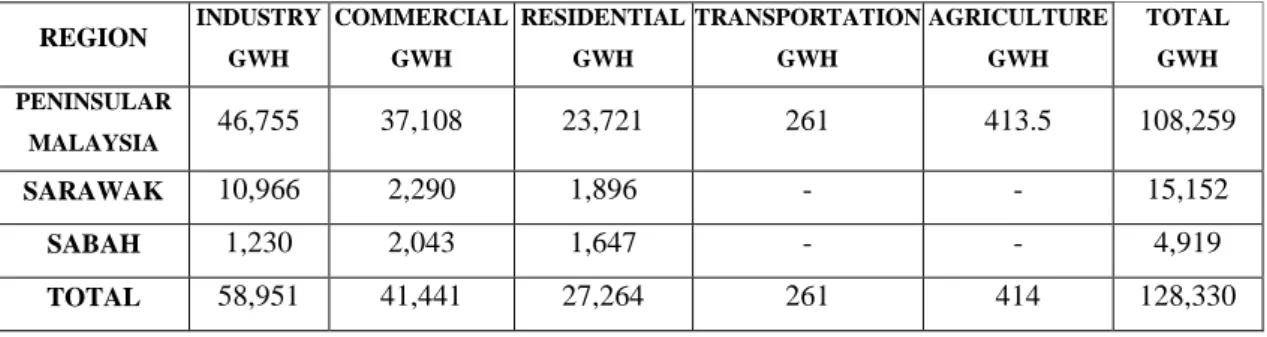
Asia-Pacific Economic Cooperation (APEC) Energy Demand and Supply Outlook estimate that electricity demand in Malaysia will significantly rise to 206 TW/h in 2035 from 96.3 TW/h in 2009 [1]. It is said that approximately 30% from the total demand nationwide is contributed by commercial buildings alone [2-4]. Table 1.1 presents regional and sectoral electricity consumption in Malaysia for year 2014. Thus, Malaysia must explore available initiatives to encourage efficient usage of the electricity demand for a better energy management control [5]. University buildings are also one of the high energy consumers and thus, education centres are advised by Ministry of Higher Education’s (MOHE) to apply a better energy practice [6-8].
Table 1.1: Regional and sectoral electricity consumption in Malaysia, 2014
REGION INDUSTRY GWH COMMERCIAL GWH RESIDENTIAL GWH TRANSPORTATION GWH AGRICULTURE GWH TOTAL GWH PENINSULAR MALAYSIA 46,755 37,108 23,721 261 413.5 108,259 SARAWAK 10,966 2,290 1,896 - - 15,152 SABAH 1,230 2,043 1,647 - - 4,919 TOTAL 58,951 41,441 27,264 261 414 128,330
2 There are many strategies to reduce electricity consumption such as demand side management (DSM) and energy efficiency (EE) program. DSM focuses on consumer demand adjustment in energy usage to control energy consumption at end-user through education or financial incentives. EE program is a system to manage and restraining the increase in energy demand. A building that provides same services for less energy input or more services for the same energy input is said to be energy efficient [2, 9]. There are several options to reduce energy consumption waste by providing consumer with their energy level consumption such as smart meter installation known as intrusive appliance load monitoring and analysis of current and voltage waveform through non-intrusive appliance load monitoring method.
Intrusive Appliance Load Monitoring (IALM) is known as one of the most accurate and reliable systems to recognize load consumption of an individual appliance. A few smart meter will be installed to recognized consumers’ energy consumption in a building where each meter directly interacts with each involve appliances and finally decomposes the total energy consumption. Apparently, this method is not the common preferred option due to the high cost of installation that requires smart meter to be set up on each appliance.
Meanwhile, the study on Non-Intrusive Appliance Load Monitoring (NIALM) is widely evolving which focuses on load signature behaviour to perform load disaggregation. This method delivers reliable results which conforms with one of the objectives of feedback system that is to achieve appliance disaggregation. A NIALM is designed to monitor an electrical circuit that contains a number of appliances. NIALM estimates the number and nature of the individual loads, their individual energy consumption, and other relevant statistics such as time-of-day variations by a sophisticated analysis of the current and voltage waveforms of the total load. This method is often used to disaggregate overall consumption into individual energy usage of experimented appliances. Besides, the analysis requires less cost than the IALM technique because access to individual components is unnecessary for installing sensors or making measurements.
The study of NIALM is divided into two categories which are low sampling and high sampling installation. Figure 1.1 shows the NIALM method separated into
several divisions, depending on the frequency of input data [10]. Low sampling installation normally analyses the behaviour of power changes and applies macroscopic features due to fundamental period that is 1/60 s or 1/50 s while higher frequency sampling hardware focuses on the study of harmonic and waveforms.
Various studies on NIALM could offer historical usage information to consumers which provide more detail in energy use comparisons and their energy usage per appliance data. Therefore, consumers who are well informed of their current energy usage will be more motivated to change their behaviours toward energy consumption to reduce electricity bill.
Figure 1.1 Non-Intrusive Appliance Load Monitoring Division [10]
1.2 Problem Statement
Most NIALM method requires high frequency sampling data for load signature tracing before load disaggregation can be made. It also requires a recorder with extensive memory space to store such detail and huge data, which can only be done by
Non-Intrusive Appliance Load
Monitoring
Low Frequency Hardware Installation
Change of real power & reactive power
Change of real & reactive power + 'additional' macroscopic feature
Change of real power only
Higher Frequency Sampling Hardware
Harmonic & Fourier Transform
Beyond Fast Fourier Transform
4 specialized high specification energy meter. In practice, most commercial buildings are only equipped with a standard energy meter, which is only capable in capturing hourly kWh data. Applying NIALM method for such data to disaggregate load is impossible. A load disaggregation method for limited data i.e. low frequency sampling kWh data is needed. The method must able to estimate the usage pattern of major electrical equipment in the building that reflects the electricity usage behaviour of the occupants.
1.3 Objective of the research
The objectives of this research are:
i. To study the relationship between recorded energy consumption (kWh) pattern of a building and the occupant’s energy usage behaviour
ii. To propose a load disaggregation method that reflects occupant’s energy usage behaviour through bottom-up based utilization factor
iii. To validate the proposed method against actual data
1.4 Scope of the research
This thesis proposes Non-Intrusive Appliance Load Monitoring to disaggregate overall load profile into specific appliance energy usage. Due to the requirement of high specification device and extensive amount of data storage, this study makes use of bottom-up concept to evaluate the relationship between load profile pattern and occupant utilization behaviour. For this purpose, block P19a, Faculty of Electrical Engineering, University Teknologi Malaysia (UTM) is used as a test system for this research. The test system is an academic building which consists of
administration offices, lecturer rooms, class rooms and laboratories. The developed method is tested against practical data of the test system to validate the results. The experimental analysis focuses on estimating the energy usage pattern of two main equipment that influence the high energy consumption of P19a building, which is lighting and air-conditioning system. Other electrical equipment are neglected due to their very low power rating and their presence in total energy consumption is too small compared to lighting and air-conditioning system.
1.5 Significance of the research
Standard energy meter commonly does not provide individual energy data of the equipment installed in a building. Thus, the prospect of estimating energy consumption of various appliance is definitely appealing. Load disaggregation explored in NIALM requires high frequency data and high specification devices. Therefore, a simplified way of load disaggregation method is introduced in this study by correlating the relationship between load profile pattern and occupant utilization behaviour. The proposed method only requires historical data per hour which is accessible through a standard energy meter and simple calculations are involved so that it can be practically applied by the general consumers. The relevance of this study is to offer historical usage information to consumers with more detail energy use comparisons, their energy usage pattern as well as historical data of regular energy consumption. The disaggregated load information provided by the proposed method can inform consumer of their individual appliance energy usage and identifying which appliances are consuming and contribute the most power from their total electricity bills as well as providing guidance for energy-saving behaviours.
6 1.6 Thesis outline
This thesis is separated into five chapters. Chapter 1 describes the project overview. This chapter consist of background of the research, problem statement, objectives, scope of research and the significance of the research. Chapter 2 presents the literature review that discusses the concept of non-intrusive appliance load monitoring where the idea to disaggregate electrical appliance data consumption is developed. Chapter 2 also reviews the method that was implemented in previous researches that are related to this study. Later in this chapter, the basic idea of bottom-up concept is briefly reviewed. Chapter 3 present the proposed method to be applied in this analysis. It explains the steps taken throughout the proposed method in this study to meet the research objectives. Chapter 4 presents the results and analyses obtain through the proposed method. The result is presented in simple tables, figures and charts as well as detailed clarification of the findings. In this chapter, the extended application of the proposed method is also presented. Chapter 5 is the concluding section of this thesis. The recommendations for future work are also presented in this chapter.
factor and power input of that building needs to be calculated and observed to fit the user behaviour and characteristic of the building.
89
REFERENCES
1. APEC Energy Demand and Supply Outlook, 5th Edition. 2013. p. 424.
2. Saidur, R., Energy consumption, energy savings, and emission analysis in Malaysian office buildings. Energy Policy, 2009. 37(10): p. 4104-4113. 3. Bakar, N.N.A., et al., Sustainable Energy Management Practices and Its Effect
on EEI: A Study on University Buildings.
4. Moghimi, S., et al. Building energy index (BEI) in large scale hospital: case study of Malaysia. in In Proceeding GEMESED’11, Proceedings of the 4th
WSEAS international conference on “Recent Researches in Geography Geology, Energy, Environment and Biomedicine”, Corfu Island, Greece. 2011. 5. Syafrudin, M. and H. Amir Rabani Abd. Demand control & monitoring system as the potential of energy saving. in Research and Development (SCOReD), 2014 IEEE Student Conference on. 2014.
6. Ahmad, A.S., et al. Energy efficiency measurements in a Malaysian public university. in Power and Energy (PECon), 2012 IEEE International Conference on. 2012. IEEE.
7. Shakur, A., et al., Energy conservation opportunities in Malaysian universities.
Malaysian Journal of Real Estate, 2010. 5(1): p. 26-35.
8. Wai, C.W., A.H. Mohammed, and L.S. Ting, Energy management key practices: A proposed list for Malaysian universities. Journal homepage: www. IJEE. IEEFoundation. org, 2011. 2(4): p. 749-760.
9. Patterson, M.G., What is energy efficiency?: Concepts, indicators and methodological issues. Energy Policy, 1996. 24(5): p. 377-390.
10. Nur Farahin Asa @ Esa, M.P.A., Mohammad Yusri Hassan, Faridah Hussin,
Electricity Consumption Pattern Disaggregation Using Non-Intrusive Appliance Load Monitoring Method, in Advanced Research in Electrical and Electronic Engineering Technology (ARiEET). 2015, Jurnal Teknologi Bandung, Indonesia.
11. Amber Mahone, B.H., Overview of Residential Energy Feedback and Behavior‐based Energy Efficiency. 2011, Energy Environmental Economics. 12. Derijcke, E. and J. Uitzinger, Residential behavior in sustainable houses, in
User Behavior and Technology Development: Shaping Sustainable Relations Between Consumers and Technol, P.-P. Verbeek and A. Slob, Editors. 2006, Springer Netherlands: Dordrecht. p. 119-126.
13. Workgroup, E.G.B., Buildings and their impact on the environment: a statistical summary. 2009.
14. Frontczak, M., R.V. Andersen, and P. Wargocki, Questionnaire survey on factors influencing comfort with indoor environmental quality in Danish housing. Building and Environment, 2012. 50: p. 56-64
15. Frontczak, M. and P. Wargocki, Literature survey on how different factors influence human comfort in indoor environments. Building and Environment, 2011. 46(4): p. 922-937.
16. Lindelöf, D. and N. Morel, A field investigation of the intermediate light switching by users. Energy and Buildings, 2006. 38(7): p. 790-801.
17. Masoso, O.T. and L.J. Grobler, The dark side of occupants’ behaviour on building energy use. Energy and Buildings, 2010. 42(2): p. 173-177.
18. Andersen, R.V., et al., Survey of occupant behaviour and control of indoor environment in Danish dwellings. Energy and Buildings, 2009. 41(1): p. 11-16.
19. Heinonen, J. and S. Junnila, Residential energy consumption patterns and the overall housing energy requirements of urban and rural households in Finland. Energy and Buildings, 2014. 76: p. 295-303.
20. Gul, M.S. and S. Patidar, Understanding the energy consumption and occupancy of a multi-purpose academic building. Energy and Buildings, 2015. 87: p. 155-165.
21. D. Parker, D.H., A. Meier, and R. Brown, How much energy are we using? potential of residential energy demand feedback devices, in Proceedings of the 2006 Summer Study on Energy Efficiency in Buildings, American Council for an Energy Efficiency Economy. 2006: Asilomar, CA. p. 13.
22. Darby, S., The effectiveness of feedback on energy consumption: a review for DEFRA of the literature on metering, billing and direct displays. 2006.
91 23. Fischer, C., Feedback on household electricity consumption: a tool for saving
energy? Energy Efficiency, 2008. 1(1): p. 79-104.
24. Residential Electricity Use Feedback: A Research Synthesis and Economic Framework. 2009, Power Delivery & Utilization - Distribution & Utilization. p. 126.
25. Advancing Energy Efficiency in Calgary: Energy Savings Through Consumer Feedback Programs. 2014, Alberta Energy Efficiency Alliance: www.aeea.ca. 26. Faruqui, A., S. Sergici, and A. Sharif, The impact of informational feedback on energy consumption—A survey of the experimental evidence. Energy, 2010. 35(4): p. 1598-1608.
27. RIBEIRO SERRENHO Tiago, Z.P., BERTOLDI Paolo, Energy Feedback Systems: Evaluation of Meta-studies on energy savings through feedback. 2015.
28. Xiaofan, J., et al. Design and implementation of a high-fidelity AC metering network. in Information Processing in Sensor Networks, 2009. IPSN 2009. International Conference on. 2009.
29. Suzuki, K., et al. Nonintrusive appliance load monitoring based on integer programming. in SICE Annual Conference, 2008. 2008.
30. Ridi, A., C. Gisler, and J. Hennebert. A Survey on Intrusive Load Monitoring for Appliance Recognition. in Pattern Recognition (ICPR), 2014 22nd International Conference on. 2014.
31. Hart, G.W., Nonintrusive appliance load monitoring. Proceedings of the IEEE, 1992. 80(12): p. 1870-1891.
32. Tsai, M.S. and Y.H. Lin. Development of a non-intrusive monitoring technique for appliance' identification in electricity energy management. in Advanced Power System Automation and Protection (APAP), 2011 International Conference on. 2011.
33. Adabi, A., et al. Status and challenges of residential and industrial non-intrusive load monitoring. in Technologies for Sustainability (SusTech), 2015 IEEE Conference on. 2015.
34. Yung Fei, W., et al. Recent approaches to non-intrusive load monitoring techniques in residential settings. in Computational Intelligence Applications In Smart Grid (CIASG), 2013 IEEE Symposium on. 2013.
35. Zeifman, M. and K. Roth, Nonintrusive appliance load monitoring: Review and outlook. Consumer Electronics, IEEE Transactions on, 2011. 57(1): p. 76-84.
36. Stickels, T.D., Residential Load Control and Metering Equipment: Costs and Capabilities ; Final Report. 1987: Electric Power Research Inst.
37. Zeifman, M., Disaggregation of home energy display data using probabilistic approach. Consumer Electronics, IEEE Transactions on, 2012. 58(1): p. 23-31.
38. Sultanem, F., Using appliance signatures for monitoring residential loads at meter panel level. Power Delivery, IEEE Transactions on, 1991. 6(4): p. 1380-1385.
39. Belley, C., et al., An efficient and inexpensive method for activity recognition within a smart home based on load signatures of appliances. Pervasive and Mobile Computing, 2014. 12: p. 58-78.
40. Norford, L.K. and S.B. Leeb, Non-intrusive electrical load monitoring in commercial buildings based on steady-state and transient load-detection algorithms. Energy and Buildings, 1996. 24(1): p. 51-64.
41. Figueiredo, M., A. de Almeida, and B. Ribeiro, Home electrical signal disaggregation for non-intrusive load monitoring (NILM) systems.
Neurocomputing, 2012. 96: p. 66-73.
42. Cole, A.I. and A. Albicki. Data extraction for effective non-intrusive identification of residential power loads. in Instrumentation and Measurement Technology Conference, 1998. IMTC/98. Conference Proceedings. IEEE. 1998.
43. Zoha, A., et al. Low-power appliance monitoring using Factorial Hidden Markov Models. in Intelligent Sensors, Sensor Networks and Information Processing, 2013 IEEE Eighth International Conference on. 2013.
44. Powers, J., B. Margossian, and B.A. Smith, Using a rule-based algorithm to disaggregate end-use load profiles from premise-level data. Computer Applications in Power, IEEE, 1991. 4(2): p. 42-47.
45. Farinaccio, L. and R. Zmeureanu, Using a pattern recognition approach to disaggregate the total electricity consumption in a house into the major end-uses. Energy and Buildings, 1999. 30(3): p. 245-259.
93 46. Baranski, M. and J. Voss. Nonintrusive appliance load monitoring based on an optical sensor. in Power Tech Conference Proceedings, 2003 IEEE Bologna. 2003.
47. Baranski, M. and J. Voss. Detecting patterns of appliances from total load data using a dynamic programming approach. in Data Mining, 2004. ICDM '04. Fourth IEEE International Conference on. 2004.
48. Bouloutas, A., G.W. Hart, and M. Schwartz, Two extensions of the Viterbi algorithm. Information Theory, IEEE Transactions on, 1991. 37(2): p. 430-436.
49. Hart, G.W. and A.T. Bouloutas, Correcting dependent errors in sequences generated by finite-state processes. Information Theory, IEEE Transactions on, 1993. 39(4): p. 1249-1260.
50. Jian, L., et al. Load signature study <inf>¡</inf>V part I: Basic concept, structure and methodology. in Power and Energy Society General Meeting, 2010 IEEE. 2010.
51. Laughman, C., et al., Power signature analysis. Power and Energy Magazine, IEEE, 2003. 1(2): p. 56-63.
52. Lee, K.D., et al., Estimation of Variable-Speed-Drive Power Consumption From Harmonic Content. Energy Conversion, IEEE Transactions on, 2005. 20(3): p. 566-574.
53. Wichakool, W., et al., Modeling and Estimating Current Harmonics of Variable Electronic Loads. Power Electronics, IEEE Transactions on, 2009. 24(12): p. 2803-2811.
54. Srinivasan, D., W.S. Ng, and A.C. Liew, Neural-network-based signature recognition for harmonic source identification. Power Delivery, IEEE Transactions on, 2006. 21(1): p. 398-405.
55. Meehan, P., C. McArdle, and S. Daniels, An Efficient, Scalable Time-Frequency Method for Tracking Energy Usage of Domestic Appliances Using a Two-Step Classification Algorithm. Energies, 2014. 7(11): p. 7041-7066. 56. Aladesanmi, E.J. and K.A. Folly, Overview of non-intrusive load monitoring
and identification techniques. IFAC-PapersOnLine, 2015. 48(30): p. 415-420. 57. Akbar, M. and D.Z.A. Khan. Modified Nonintrusive Appliance Load Monitoring For Nonlinear Devices. in Multitopic Conference, 2007. INMIC 2007. IEEE International. 2007.
58. Tarter, R.E., Solid-state power conversion handbook. 1993: Wiley,.
59. Umeh, K. and A. Mohamed. Intelligent system for identification of harmonics originating from single phase nonlinear loads. in SoutheastCon, 2005. Proceedings. IEEE. 2005.
60. Chahine, K., et al., Electric Load Disaggregation in Smart Metering Using a Novel Feature Extraction Method and Supervised Classification. Energy Procedia, 2011. 6: p. 627-632.
61. Bouhouras, A.S., A.N. Milioudis, and D.P. Labridis, Development of distinct load signatures for higher efficiency of NILM algorithms. Electric Power Systems Research, 2014. 117: p. 163-171.
62. Froehlich, J., et al., Disaggregated End-Use Energy Sensing for the Smart Grid. Pervasive Computing, IEEE, 2011. 10(1): p. 28-39.
63. Patel, S.N., et al., At the flick of a switch: detecting and classifying unique electrical events on the residential power line, in Proceedings of the 9th international conference on Ubiquitous computing. 2007, Springer-Verlag: Innsbruck, Austria. p. 271-288.
64. Gupta, S., M.S. Reynolds, and S.N. Patel, ElectriSense: single-point sensing using EMI for electrical event detection and classification in the home, in
Proceedings of the 12th ACM international conference on Ubiquitous computing. 2010, ACM: Copenhagen, Denmark. p. 139-148.
65. Trung, K.N., et al. Using FPGA for real time power monitoring in a NIALM system. in Industrial Electronics (ISIE), 2013 IEEE International Symposium on. 2013.
66. Zoha, A., et al., Non-Intrusive Load Monitoring Approaches for Disaggregated Energy Sensing: A Survey. Sensors, 2012. 12(12): p. 16838-16866.
67. Marchiori, A., et al., Circuit-Level Load Monitoring for Household Energy Management. Pervasive Computing, IEEE, 2011. 10(1): p. 40-48.
68. Marceau, M.L. and R. Zmeureanu, Nonintrusive load disaggregation computer program to estimate the energy consumption of major end uses in residential buildings. Energy Conversion and Management, 2000. 41(13): p. 1389-1403. 69. Najmeddine, H., et al. State of art on load monitoring methods. in Power and
Energy Conference, 2008. PECon 2008. IEEE 2nd International. 2008. 70. Kato, T., et al., Appliance Recognition from Electric Current Signals for
95
Assistive Health and Wellness Management in the Heart of the City, M. Mokhtari, et al., Editors. 2009, Springer Berlin Heidelberg. p. 150-157. 71. Cole, A. and A. Albicki. Nonintrusive identification of electrical loads in a
three-phase environment based on harmonic content. in Instrumentation and Measurement Technology Conference, 2000. IMTC 2000. Proceedings of the 17th IEEE. 2000.
72. Ruzzelli, A.G., et al. Real-Time Recognition and Profiling of Appliances through a Single Electricity Sensor. in Sensor Mesh and Ad Hoc Communications and Networks (SECON), 2010 7th Annual IEEE Communications Society Conference on. 2010.
73. Jiaming, L., S. West, and G. Platt. Power decomposition based on SVM regression. in Modelling, Identification & Control (ICMIC), 2012 Proceedings of International Conference on. 2012.
74. Lee, W.K., et al., Exploration on load signatures, in International Conference on Electrical Engineering (ICEE). 2004.
75. Lam, H.Y., G.S.K. Fung, and W.K. Lee, A Novel Method to Construct Taxonomy Electrical Appliances Based on Load Signaturesof. Consumer Electronics, IEEE Transactions on, 2007. 53(2): p. 653-660.
76. Chang, H.-H., H.-T. Yang, and C.-L. Lin, Load Identification in Neural Networks for a Non-intrusive Monitoring of Industrial Electrical Loads, in
Computer Supported Cooperative Work in Design IV, W. Shen, et al., Editors. 2008, Springer Berlin Heidelberg. p. 664-674.
77. Chang, H.-H., Non-Intrusive Demand Monitoring and Load Identification for Energy Management Systems Based on Transient Feature Analyses. Energies, 2012. 5(11): p. 4569-4589.
78. Shaw, S.R., et al., Nonintrusive Load Monitoring and Diagnostics in Power Systems. Instrumentation and Measurement, IEEE Transactions on, 2008. 57(7): p. 1445-1454.
79. Cole, A.I. and A. Albicki. Algorithm for nonintrusive identification of residential appliances. in Circuits and Systems, 1998. ISCAS '98. Proceedings of the 1998 IEEE International Symposium on. 1998.
80. Hazas, M., A. Friday, and J. Scott, Look Back before Leaping Forward: Four Decades of Domestic Energy Inquiry. Pervasive Computing, IEEE, 2011. 10(1): p. 13-19.
81. Schoofs, A., et al. ANNOT: Automated Electricity Data Annotation Using Wireless Sensor Networks. in Sensor Mesh and Ad Hoc Communications and Networks (SECON), 2010 7th Annual IEEE Communications Society Conference on. 2010.
82. Capasso, A., et al., A bottom-up approach to residential load modeling. IEEE Transactions on Power Systems, 1994. 9(2): p. 957-964.
83. Kiichiro Tsuji, F.S., Tsuyoshi Ueno, Osamu Saeki, Takehiko Matsuoka.
Bottom-Up Simulation Model for Estimating End-Use Energy Demand Profiles in Residential Houses. in 2004 ACEEE Summer Study on Energy Efficiency in Buildings. 2004.
84. Michalik, G., et al., Structural modelling of energy demand in the residential sector: 1. Development of structural models. Energy, 1997. 22(10): p. 937-947. 85. Michalik, G., et al., Structural modelling of energy demand in the residential sector: 2. The use of linguistic variables to include uncertainty of customers' behaviour. Energy, 1997. 22(10): p. 949-958.
86. Yao, R. and K. Steemers, A method of formulating energy load profile for domestic buildings in the UK. Energy and Buildings, 2005. 37(6): p. 663-671. 87. Grandjean, A., J. Adnot, and G. Binet, A review and an analysis of the residential electric load curve models. Renewable and Sustainable Energy Reviews, 2012. 16(9): p. 6539-6565.
88. Rice, A., S. Hay, and D. Ryder-Cook. A limited-data model of building energy consumption. in BuildSys'10 - Proceedings of the 2nd ACM Workshop on Embedded Sensing Systems for Energy-Efficiency in Buildings. 2010.
89. Stokes, M., Removing barriers to embedded generation : a fine-grained load model to support low voltage network performance analysis. 2005, De Montfort University.
90. Swan, L.G. and V.I. Ugursal, Modeling of end-use energy consumption in the residential sector: A review of modeling techniques. Renewable and Sustainable Energy Reviews, 2009. 13(8): p. 1819-1835.
91. Paatero, J.V. and P.D. Lund, A model for generating household electricity load profiles. International Journal of Energy Research, 2006. 30(5): p. 273-290. 92. Pratt, R.G., P.N. Laboratory, and U.S.B.P. Administration, Description of
97
End-use Load and Consumer Assessment Program (ELCAP). 1989: Bonneville Power Administration.
93. Walker, C.F. and J.L. Pokoski, Residential Load Shape Modelling Based on Customer Behavior. IEEE Transactions on Power Apparatus and Systems, 1985. PAS-104(7): p. 1703-1711.
94. Armstrong, M.M., et al., Synthetically derived profiles for representing occupant-driven electric loads in Canadian housing. Journal of Building Performance Simulation, 2009. 2(1): p. 15-30.
95. Widén, J., et al., Constructing load profiles for household electricity and hot water from time-use data—Modelling approach and validation. Energy and Buildings, 2009. 41(7): p. 753-768.
96. Richardson, I., et al., Domestic electricity use: A high-resolution energy demand model. Energy and Buildings, 2010. 42(10): p. 1878-1887.
![Figure 1.1 Non-Intrusive Appliance Load Monitoring Division [10]](https://thumb-us.123doks.com/thumbv2/123dok_us/652450.2578676/20.892.224.734.491.781/figure-non-intrusive-appliance-load-monitoring-division.webp)
