Edith Cowan University
Research Online
ECU Publications Pre. 2011
2002
Promoting student learning through peer tutoring
-a c-ase study
Barnard Clarkson
Edith Cowan University, [email protected]
Joseph Luca
Edith Cowan University
This article was originally published as: Clarkson, B. & Luca, J. (2002). Promoting Student Learning through Peer Tutoring – A Case Study. In P. Barker & S. Rebelsky (Eds.), Proceedings of World Conference on Educational Multimedia, Hypermedia and Telecommunications 2002 (pp. 1176-1181). Chesapeake, VA: AACE. Copyright by AACE. Reprinted from the Proceedings of World Conference on Educational Multimedia, Hypermedia and Telecommunications 2002 with permission of AACE (http://www.aace.org) Original article availablehere
This Conference Proceeding is posted at Research Online. http://ro.ecu.edu.au/ecuworks/3914
Promoting Student Learning through Peer Tutoring – A Case Study
Joe Luca, Edith Cowan University, Multimedia Department, Australia [email protected] Barney Clarkson, Edith Cowan University, Multimedia Department, Australia [email protected]
Abstract: The literature abounds with information about peer tutoring and the benefits that it can bring to student learning. This case study sought to explore ways of using peer tutoring to enhance the learning experience of a group of higher education students in a multimedia course, who had access to learning resources in an on-line environment. It illustrates how easily and effectively the basic principles of peer tutoring can be adapted and implemented following explicit guidelines from the literature.
Introduction
It is ironic that schools and tertiary institutions are often chided for not providing a real world experience for students, yet they can provide a perfectly realistic learning environment for students to tutor others. This permits authentic practice of a number of useful generic skills like working collaboratively with peers, which can enhance teamwork and interpersonal skills. This study presents support for using peer tutoring and peer assessment for students in higher education. After all, evidence suggests that peer tutoring can greatly enhance the learning experience of both the student tutor and learner(Goodlad, 1999; Topping, 1996).
At a time when there is a push for higher education institutions “to do more with less” and promote the development of students’ generic skills (Australian National Training Authority, 1998; Bennett, Dunne, & Carre, 1999; Candy, Crebert, & O'Leary, 1994; Dearing, 1997; Mayer, 1992), peer tutoring can provide an effective system which not only assists student tutors and tutees to learn better, but also helps promote the development of generic skills, as well as freeing up time for tutors (Topping, 1996). This provides an alternative teaching and learning approach in which students take a pro-active role in thinking, questioning and sharing knowledge.
In this paper, we examine design issues needed when implementing a teaching program using peer learning, and also present the results of our evaluation. We begin by considering some theoretical underpinnings and design aspects of implementing peer tutoring and learning.
Peer Tutoring – theory and design aspects
The concept of learning through peer tutoring is based on a social constructivist view of learning that emphasises the role of the students to generate learning where students coach peers through social interaction within their zones of proximal development (Vygotsky, 1978). Rather than applying a stimulus/response process, users are actively engaged in making meaning through cognitive accommodation and/or assimilation (Piaget, 1969). Vygotsky argued that learning comes about through social negotiation within a cultural context, with language as the primary enabling tool. This social constructivist philosophy has been expanded on recently, introducing the notion of cognitive apprenticeship (Brown, Collins, & Duguid, 1989) through which students learn in a manner similar to traditional apprenticeships. The students access expertise through mentors, whose role is to facilitate rather than teach, and the aim of learning is to solve realistic and practical problems in an authentic setting. For a peer tutor, this setting is a very realistic human setting. Just as in traditional apprenticeships, learners engage in activities ‘on-the-job’ rather than through the didactic teaching of abstract concepts. The argument is that students are better equipped to approach non-familiar problems and produce solutions that are appropriate to a given culture. Peer tutoring is aligned with these aspects of social constructivist theory by enhancing social negotiation with the student tutor and tutee, where knowledge construction is promoted through communication and dialogue, which is helpful for the tutees.
Peer tutoring is also valuable for the tutor, ie “learning is enhanced through teaching”. In an evaluation study conducted by Hartman (1990), a reported outcome of peer tutoring was an increase in student motivation toward learning. These results are supported by Whitman (1982), Annis (1983) and Benware & Deci (1984) who argue that peer tutoring can be the most intellectually rewarding experience of a student’s career, and that they perform better on higher order conceptual understanding scales than students who read the material simply for study purposes. The benefits of peer tutoring are summarised by Goodlad (1999) as follows:
• Student tutees found lessons more interesting, easier to follow, more enjoyable and seemed to learn more;
• Student tutors practiced communication skills, felt that they were doing something useful with their knowledge, got to know people from different social backgrounds, gained insights into how other students saw subjects, increased self-confidence and reinforced subject knowledge;
• Teachers found lessons easier to handle, teaching was more enjoyable and reported that pupils seemed to learn more.
Implementing a peer-tutoring program is not a trivial process, as there are many salient issues. Topping (1996) describes nine different peer tutoring formats suiting different circumstances ie cross-year small-group tutoring, a personalised system of instruction, supplemental instruction, same year dyadic fixed-role tutoring, same year dyadic reciprocal peer tutoring, dyadic cross year fixed-role tutoring, same year group tutoring, peer assisted writing and peer assisted distance learning. In our case study, the personalised system of instruction was akin to type seven, ie implemented at the same year group level, where tutors assisted tutees who were working at their own pace on set exercises.
Even though different formats meet different needs, there is a commonality of purpose as well. Goodlad (1999) lists seven “golden rules” as criteria for designing and implementing peer-tutoring schemes. His criteria are:
1 Clearly define the aims of the tutoring scheme by writing a statement of intent which shows “who is teaching what to whom and for what purpose”;
2 Define roles and responsibilities in the scheme being implemented, which may include rules for matching or pairing students by sex, friendship or ethnicity;
3 Train the tutors in task/content requirements and also in tutoring techniques such as “pause, prompt and praise”;
4 Structure the content so that there are clearly defined, meaningful tasks for the tutees which involve maximum participation and reinforcement;
5 Support the tutors with regular feedback through de-briefing sessions and well structured materials;
6 Keep logistics as simple as possible ie make the scheduled time and space for meetings convenient to all parties; 7 Evaluate the scheme.
Context of Study
“IMM 1122 - Publishing on Web”, was designed as an introductory unit to teach media students at Edith Cowan University how to publish information on the web. Students were required to create web pages that incorporated graphics, sound and animation, design suitable media for web delivery and use a variety of web development tools to build well-designed sites. An outline of the weekly topics included: Introduction to HTML, Designing a Web Page, Tables, Frames, Creating Forms, Programming with Javascript, WWW Images, Bandwidth and Compression, Flash and using Word, PowerPoint and Acrobat for on-line publishing. All notes, exercises and the syllabus were made available to the students through the use of a web site.
There were 110 students from a wide variety of backgrounds in the course, which comprised of a one-hour lecture and a two-hour tutorial. This required four academic tutors to run five classes, with about twenty-three students in each class. The unit is an elective in the “Communications and Multimedia” course, and can be taken by first, second or third year students. Also, students taking this unit are from disparate backgrounds ie some students in the program have the intention of majoring in Media Studies, Film & Television or Photomedia, while others would be majoring in Multimedia, Computer Science or Information Systems. So, in the same class it is possible to have a third year student majoring in Multimedia and Computer Science alongside a first year student majoring in Media Studies and Photomedia. This large discrepancy in student expertise and background created a great diversity of abilities, which suggested implementing a peer-tutoring program.
The students were required to complete three assessment tasks. Two assessments were based on developing web-based portfolios, showing their “digital achievements” which could serve as potential CV’s for employment opportunities. The peer tutors were involved in the third assessment block of weekly tasks which required students to complete ten tasks (worth 3 marks each), based on the previous week’s work. Academic tutors would then assess each student’s work during the tutorial session, which was a time intensive task and took up most the academic tutors’ time during the two-hour tutorial. Tutors would discuss the task with students and give them a mark and justification. Students could ask questions, but generally the amount of time spent on each student was only five or ten minutes. While this was in progress, it was difficult for students having problems to ask their normal academic tutor any questions.
So, given that there was a great discrepancy in student abilities, and also that academic tutors were busy assessing weekly tasks, it seemed appropriate to implement a peer-tutoring scheme in this context.
Implementation
Within the syllabus, clear guidelines were given to students about peer tutor responsibilities and assessment of these. Four peer tutors were required in each class, which had 20-25 students. The scheme commenced in week three of the semester, which allowed time for nominations, and was based on a short competency test given by the academic tutors.
What was the incentive for peer tutors wanting to take on this responsibility? Simple - they were “bribed”! Successful peer tutors would be exempt from doing weekly workshop activities (worth 3 marks each). However, to remain as peer tutors they were expected to obtain positive feedback from their peers. This was acquired through an online database at the end of each tutorial session. If they obtained two consecutive weeks of poor feedback they were warned that they could be taken off the role. This commitment was established through a “Student Contract” which had these criteria and was signed by both peer tutor and lecturer.
Goodlad’s (1999) “seven golden rules”, were generally adhered to except for training tutors in tutoring techniques and supporting tutors with regular feedback. Over the semester, it was found that all the tutors across all the classes were keen to maintain their role and worked hard at maintaining a high standard of delivery. However, as time was always limited in the tutorial sessions, not much feedback was given to the peer tutors. This was largely due to weekly student feedback being so positive in the early weeks, and then gradually tapering off.
Student Feedback – Tutees
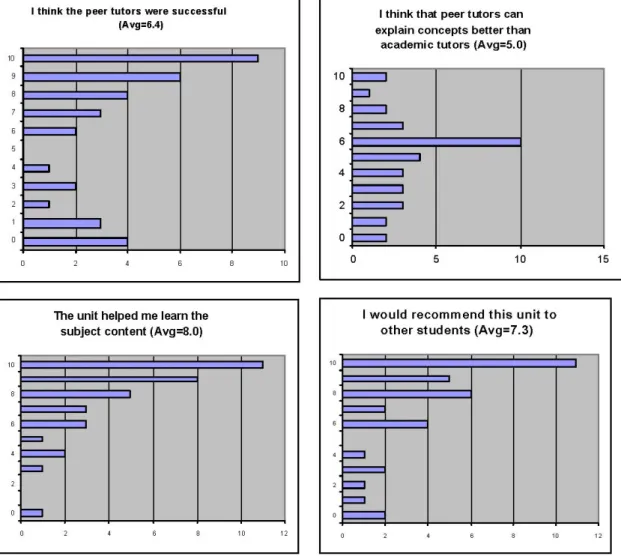
Student tutees were asked to complete a post-course questionnaire, of which thirty-five were collected. Students were asked to rate a range of questions using a Likert scale (0_2_4_6_8_10) from 0 (low) to 10 (high). Key results are shown in Figure 1 and summarised as follows:
• “I think the peer tutors were successful” had an average of 6.4, and is clearly bi-modal. Students were largely strongly positive or strongly negative about the peer-tutoring program. By closely examining the responses, it appeared that students who were capable and didn’t need help felt that peer tutoring was a waste of time. Also, a small number of weaker students also criticised the peer tutors, who felt that peer tutors should have done more for them. However, the majority of weaker students rated the peer tutoring system highly, and felt that it supported their learning
• Students who needed help rated the peer tutoring system highly (10 or close to 10), whereas the more able students who didn’t need as much help rated the peer tutoring system low (0 or close to 0), and considered it irrelevant or of little use
• “I think that peer tutors can explain concepts better than academic tutors” had a wide range but an average score of 5.0, which implied that there were probably multiple diverse feelings about this issue
• “This unit helped me learn the subject content” and also “I would recommend this unit to other students” both gained high scores of 8.0 and 7.3 respectively, which implied that overall the unit was perceived as being useful. We attributed a good part of that success to the support provided by the peer tutoring system.
Figure 1: Results of four questions from the post-questionnaire survey
Students were also asked to give written opinions about what they thought about the peer assessment program. Positive comments included:
• Peer tutoring was a good idea. Less wait for help and they did the same work as us so they knew the material
• Peer tutors were an effective concept. Offers a less formal way of problem solving on a more personal and intimate level. Also, it doesn’t hinder the tutors marking of weekly tasks
• they did a good job. I think in helping others, they also learn new stuff, too. Very co-operative in helping to solve problems..
• the peer tutoring system worked well for the students who were struggling. Our peer tutors very patient and spent time explaining things to students
• peer tutors are an effective concept. They offer a less formal way of problem solving on a more personal and intimate level, also it doesn’t hinder the tutor’s marking of the weekly tasks
• I think using the peer tutors was excellent, as the tutor cannot be in two places at once
• :> good, cool thing!
• peer tutors are good for a go-between student and tutor. Sometimes if the peer tutor doesn’t know the answer we work on it together to solve it.
• it would have helped if the peer tutor ever came. First few weeks were good but then it dropped off
• no-one knew who they were; the system died without a sound. While they did a good job, there wasn’t any real definition of they were supposed to be doing, and a lot of them were just plain bored!
• They need to do more – offer more help to people
• They need to be more prominent. Also, maybe we should be able to email them!
• I found I did not need much basic help. I tended to work problems out myself
• I didn’t use a peer tutor, the books were easy to follow
• Good idea, but maybe need to make it clearer who they are and what they are there for
Considering some of the negative comments given by the students, it appears that Goodlad’s (1999) “seven golden rules” were not applied as well as we had wanted. Clearly some students were unsure about who the peer tutors were and what their specific roles were. A closer analysis of the data, showed that these comments were class dependent, ie how the academic tutor in each class introduced and promoted the peer tutoring system probably affected its implementation.
Student Feedback – Peer Tutors
Peer tutors were also asked to complete a post-course questionnaire. Ten responses were collected which represented about two thirds of the peer tutors. These students were asked to rate questions using a Likert scale from 0 (low) to 10 (high). The results are shown in Table 2.
Table 1: Average scores of post-course questionnaire
Participants were also asked to give written opinions about improving the system. Comments included: • Not a bad idea in theory, although many people possibly didn’t use us enough and it got boring
• More feedback on our performance would have been useful
• I didn’t know if students were filling out feedback on our efforts, so I wasn’t sure if my help was satisfactory?
• Would have liked more information about how the system worked before we started
• Have the peer tutor tied with the same students all semester. This way it would be easier to help them, as you know where they are at, their history and motivation. This also would help in developing some trust between the peer tutor and the student which would help smooth things out at assignment time when both are stressed
• The tutors need more tasks to perform. The students were not using us enough.
Clearly, all the peer tutors felt peer tutoring had been a useful exercise and the experience had helped them learn the content and develop better communication and interpersonal skills. Also, they felt that peer tutoring should be implementation across other units. However, they were not so content with the level of feedback received, as they were unsure if they were “doing a good job”. Clearly, it is critical to keep tutors well informed of their progress to maintain their motivation and level of success. This is stipulated by Goodlad (1999) in point five “Support the tutors with regular feedback through de-briefing sessions…”.
Conclusions
Both peer tutors and tutees, as other studies predicted, tended to enjoy the peer tutoring process and were largely supportive. It is difficult to determine if tutor support was based on the “rewards” attached to being a peer tutor (ie not having to do the weekly tasks), or a case of being intellectually and interpersonally stimulated by the exercise. To avoid problems it seems evident that Goodlad's (1999) principles are worth following when implementing peer-tutoring strategies. Also, in larger implementations such as this, where there were over 100 students and multiple academic tutors required, clear instructions, regular follow-up and even training sessions are needed to ensure an on-going peer-tutoring implementation. This should reduce inconsistencies across classes, as noticed in the student feedback where some students were unaware of the role peer tutors. In the next implementation, we would be more specific and procedural about giving peer tutors training and support with clear feedback about their progress.
Question Asked Average Score /10
Being a peer tutor helped me learn the subject content ie HTML, Flash etc.. 10 Being a peer tutor helped me practice and develop communication & interpersonal skills 10
Using peer tutors would be useful in other units 10
In summary incorporating peer tutoring into this tertiary course was not taxing when we used the “seven golden rules” outlined by Goodlad (1999). Further, the rules appeared to be robust criteria. The results in this case study showed strong positive feedback for and support from the peer tutors, high student satisfaction with the course, and, obviously, satisfaction for the academic staff. It demonstrates how easily peer tutoring can be integrated with reasonable success into an existing unit of work with tertiary students.
References
Annis, L. F. (1983). The processes and effects of peer tutoring. Human Learning, 10(1), 39-47.
Australian National Training Authority. (1998). Australia's National Strategy for Vocational Education and Training 1998-2003. Canberra: Commonwealth of Australia.
Bennett, N., Dunne, E., & Carre, C. (1999). Patterns of core and generic skill provision in higher education. Higher Education, 37(1), 71-93. Benware, C. A., & Deci, E. L. (1984). Quality of learning with an active versus passive motivational set. AmericanEducational Research
Journal, 21(4), 755-765.
Biggs, J. (1999). Teaching for Quality Learning at University. Buckingham: Open University Press.
Brown, J. S., Collins, A., & Duguid, P. (1989). Situated cognition and the culture of learning. Educational Researcher,18(1), 32-42. Candy, P., Crebert, G., & O'Leary, J. (1994). Developing Lifelong Learners through Undergraduate Education. Canberra: Australian
Government Publishing Service.
Dearing. (1997). Higher education in the Learning Society. London: HMSO.
Gibbs, G. (1992). Improving the Quality of Student Learning. Plymouth: Technical and Educational Services Ltd.
Goodlad, S. (1999). Never Knowingly Oversold: a watchword for tutoring and mentoring schemes? Paper presented at the 2nd BP Regional Conference on Tutoring and Mentoring, Perth, Western Australia.
Hartman, G. (1990). Peer learning and support via audio-teleconferencing in continuing education for nurses. Distance Education, 11(2), 308-319. Mayer, E. (1992). Employment-related key competencies: a proposal for consultation. Melbourne: Australian Government Publishing Service. Moses, I., & Trigwell, K. (1993). Teaching Quality and Quality of Learning in Professional Courses. Canberra: Australian Government
Publishing Service.
Piaget, J. (1969). Science of education and the psychology of the child. New York: Viking. Ramsden, P. (1992). Learning to Teach in Higher education. London & New York: Routledge.
Topping, K. J. (1996). The effectiveness of peer tutoring in further and higher education: A typology and review of the literature. Higher Education, 32, 321-345.
Vygotsky, L. S. (1978). Mind in Society. Cambridge, MA: Harvard University Press.