Mobile Fog: A Programming Model for Large–Scale
Applications on the Internet of Things
Kirak Hong, David Lillethun, Umakishore
Ramachandran
College of Computing Georgia Institute of Technology
Atlanta, Georgia, USA
{khong9, davel, rama }@cc.gatech.edu
Beate Ottenwälder, Boris Koldehofe
Institute of Parallel and Distributed Systems University of Stuttgart
Stuttgart, Germany
{ottenwaelder,koldehofe}@ipvs.uni-stuttgart.de
ABSTRACT
The ubiquitous deployment of mobile and sensor devices is creating a new environment, namely theInternet of Things
(IoT), that enables a wide range of future Internet appli-cations. In this work, we present Mobile Fog, a high level programming model for future Internet applications that are geospatially distributed, large–scale, and latency–sensitive. We analyze use cases for the programming model with cam-era network and connected vehicle applications to show the efficacy of Mobile Fog. We also evaluate application perfor-mance through simulation.
Keywords
fog computing; cloud computing; programming model; In-ternet of Things; future InIn-ternet applications; situation aware-ness applications
Categories and Subject Descriptors
C.2.1 [Network Architecture and Design]: Distributed networks; C.2.4 [Distributed Systems]: Distributed ap-plications
1.
INTRODUCTION
The growing ubiquity of mobile and sensor devices, such as smart phones and surveillance cameras, is enabling a wide range of novel, large–scale, latency–sensitive applications that are often classified asFuture Internet Applications. For example, traffic applications can analyze recent location in-formation shared by vehicles to detect traffic patterns, such as accidents or traffic jams, and use these patterns to en-rich navigation systems in vehicles [5]. Smart surveillance applications can support police officers by displaying video streams on their smart phones showing suspicious people who were nearby within the last few minutes [3].
Platform as a Service (PaaS) clouds are attractive for developing large–scale applications due to their scalability
Permission to make digital or hard copies of all or part of this work for personal or classroom use is granted without fee provided that copies are not made or distributed for profit or commercial advantage and that copies bear this notice and the full cita-tion on the first page. Copyrights for components of this work owned by others than ACM must be honored. Abstracting with credit is permitted. To copy otherwise, or re-publish, to post on servers or to redistribute to lists, requires prior specific permission and/or a fee. Request permissions from [email protected].
MCC’13,August 12, 2013, Hong Kong, China. Copyright 2013 ACM 978-1-4503-2180-8/13/08 ...$15.00.
and high–level programming models that simplify develop-ing large–scale web services. However, existdevelop-ing PaaS pro-gramming models are designed for traditional web appli-cations, rather than future Internet applications running on various mobile and sensor devices. Furthermore, pub-lic clouds, as they exist in practice today, are far from the idealized utility computing model. Applications are devel-oped for a particular provider’s platform and run in data centers that exist at singular points in space. This makes their network distance too far from many users to support highly latency–sensitive applications.
Cisco recently proposed a new computing paradigm called
fog computing [2] that runs generic application logic on re-sources throughout the network, including routers and ded-icated computing nodes. In contrast to the cloud, putting intelligence in the network allows fog computing resources to perform low–latency processing near the edge while latency– tolerant, large–scope aggregation can still be efficiently per-formed on powerful resources in the core of the network. Data center resources may still be used with fog computing, but they do not constitute the entire picture.
However, developing applications using fog computing re-sources is tricky because it involves orchestrating highly dy-namic, heterogeneous resources at different levels of net-work hierarchy to support low latency and scalability re-quirements of applications. To ease such complexity, this paper presents a PaaS programming model, called Mobile Fog, that provides a simplified programming abstraction and supports applications dynamically scaling at runtime. Our contributions include the design of our programming model and the use case analysis of Mobile Fog. While Mo-bile Fog can support diverse applications, we usesituation awarenessapplications as canonical examples in this work.
This paper is structured as follows: Section 2 discusses related work. Section 3 explains the details of the Mobile Fog programming model. Section 4 shows specific use cases for our programming model. Finally, Section 6 concludes with future work.
2.
RELATED WORK
Cloud and data center systems provide highly scalable solutions for web-scale applications, but edge devices must communicate across the Internet to reach the cloud data centers. Satyanarayanan, et al. [7], show that WAN laten-cies can be high and that these latenlaten-cies interfere with in-teractive applications. We argue that situation awareness applications are vulnerable to the same issue due to the
sense-process-actuate loop, as would be any other applica-tions with feedback loops. In short, the could is too far from many mobile users for latency–sensitive applications.
Two systems that can provide resources for computing near the edge of the network are the MediaBroker [6] for live sensor stream analysis, and Cloudlets [7] for interactive applications. However, neither currently supports widely distributed geospatial applications.
Recent advances in software–defined networking (SDN) [4] allow programming in-the-middle network resources. How-ever, these approaches only allow injecting routing logic into network elements, not generic application logic. Further-more, SDN offers neither an elastic resource model nor a programming model for general–purpose applications.
Bonomi et al. [2] define the characteristics of fog comput-ing and show that the fog is the appropriate platform for various applications, including connected vehicles and smart cities. This work complements our work since it presents the potential benefits of fog computing in terms of efficiency and latency while our work focuses on the right programming model for developing applications on the fog.
3.
PROGRAMMING MODEL
As a programming model for large–scale situation aware-ness applications, Mobile Fog has two design goals: The first is to provide a high–level programming model that simpli-fies development on a large number of heterogeneous devices distributed over a wide area. The second goal is to allow applications to dynamically scale based on their workload using on–demand resources in the fog and in the cloud.
3.1
System Assumptions
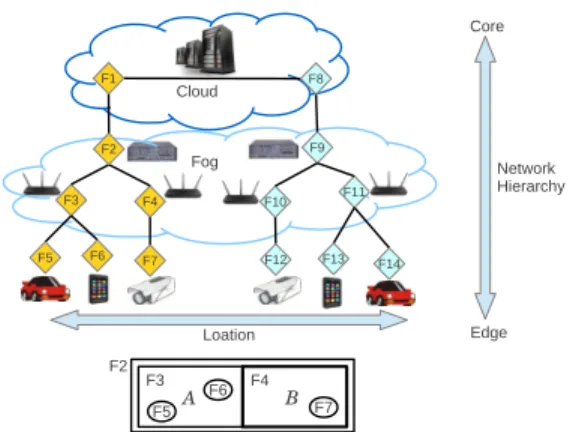
In this work, we assume various devices are available to Mobile Fog for running large–scale applications. These het-erogeneous devices include edge devices such as smartphones and connected vehicles, on–demand computing instances in a fog computing infrastructure, and a compute cloud with an Infrastructure as a Service (IaaS) interface (see Figure 1). The physical devices are placed at different levels of the network hierarchy from the edge to the core network. We assume each device is associated with a certain geophysical location through a localization technique such as GPS.
For the fog computing infrastructure, we assume physical devices called fog computing nodes are placed in the net-work infrastructure. For example, specialized routers can accommodate generic application computing in addition to packet forwarding, while dedicated computing devices can also be placed within the network for the sole purpose of fog computing. We further assume that the fog provides a pro-gramming interface that allows managing on–demand com-puting instances, similar to an IaaS cloud, including creating and terminating computing resources for a specific geospa-tial region and at a certain level of network hierarchy. Each computing instance has certain system resource capacities such as CPU speed, number of cores, memory size, and stor-age capacity, as specified by Mobile Fog. Once computing instances are created in the fog, Mobile Fog can use the instances to execute application code.
3.2
Application Model
Many large–scale future Internet applications require location– and hierarchy–aware processing to handle the data streams from widely distributed edge devices. In Mobile Fog, an
ap-Fog Cloud F3 F4 F9 F10 F11 F2 Core Edge F5 F6 F7 F1 F12 F13 F14 Loation Network Hierarchy F5 F3 F6 F7 F4 F2 F8 A B
Figure 1: A logical structure of an application
plication consists of distributed Mobile Fog processes that are mapped onto distributed computing instances in the fog and cloud, as well as various edge devices. While run-ning, each process performs application–specific tasks such as sensing and aggregation with respect to its location and level in the network hierarchy.
Mobile Fog exposes the physical hierarchy of devices through a logical hierarchy of Mobile Fog processes that is described in Figure 1. As shown in the figure, a process on an edge device becomes a leaf node while a process in the cloud be-comes the root node of a hierarchy, while processes on fog computing nodes become intermediate nodes. A connection between two processes indicates a communication path al-lowed through the Mobile Fog communication API, which is not necessarily a direct physical connection, but rather a logical one. Since communication costs within a data center are relatively inexpensive, root processes are connected to each other in a mesh network (e.g., F1 and F8 in the cloud). Each Mobile Fog process handles the workload from a certain geospatial region. For instance, Figure 1 shows pro-cesses F5 and F6 mapped onto a connected vehicle and a smartphone within region A. These leaf processes are con-nected to process F3 running on a edge fog node that covers the region A. Similarly, processes F3 and F4 are connected to F2 running on a core fog node that covers a region en-compassing A and B.
3.3
API
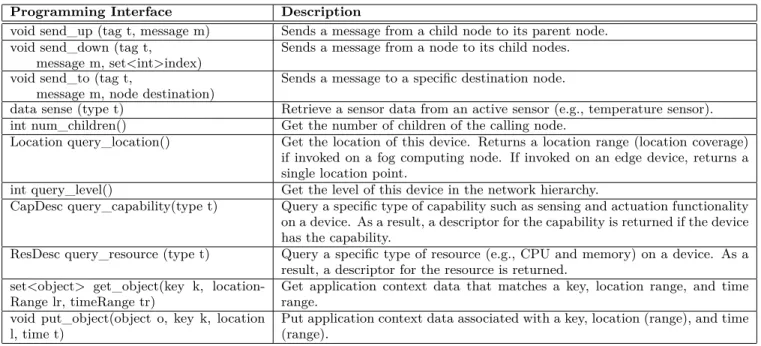
In Mobile Fog, application code consists of a set of event handlers that the application must implement (Table 1) and a set of functions that applications can call (Table 2). The event handlers are invoked by the Mobile Fog runtime sys-tem upon certain events. For example, on_create() is in-voked when an application is started whileon_message()is invoked when a message arrives. Mobile Fog runs the same application code on various devices, including smartphones, smart cameras, connected vehicles, and the computing nodes in the fog and the cloud. This symmetric design simplifies large–scale application development since a developer does not need to write different programs for heterogeneous de-vices with different connectivity.
Mobile Fog also provides detailed information about the underlying physical devices in order to allow application code to perform its task with respect to the geophysical location, available system resources, device capabilities, and network hierarchy level. In particular, application code can
Handler Description
void on_create (node self) Called when a new node is created.
void on_sense(type t, data d) Called upon a new sensor reading from a passive sensor (e.g., a camera). void on_message (tag t, node sender,
message m)
Called when a new message arrived at a node. A tag specifies an application-specific type of the message. A sender specifies the identifier of the source node.
void on_new_child(node child) Called at a parent node when a new child node is connected. void on_new_parent(node parent) Called at a child node when a new parent node is connected. void on_child_leave(node child) Called at a parent node when a child node is leaving. void on_parent_leave(node parent) Called at a child node when a parent node is leaving.
Table 1: Mobile Fog Event Handlers Programming Interface Description
void send_up (tag t, message m) Sends a message from a child node to its parent node. void send_down (tag t,
message m, set<int>index)
Sends a message from a node to its child nodes. void send_to (tag t,
message m, node destination)
Sends a message to a specific destination node.
data sense (type t) Retrieve a sensor data from an active sensor (e.g., temperature sensor). int num_children() Get the number of children of the calling node.
Location query_location() Get the location of this device. Returns a location range (location coverage) if invoked on a fog computing node. If invoked on an edge device, returns a single location point.
int query_level() Get the level of this device in the network hierarchy.
CapDesc query_capability(type t) Query a specific type of capability such as sensing and actuation functionality on a device. As a result, a descriptor for the capability is returned if the device has the capability.
ResDesc query_resource (type t) Query a specific type of resource (e.g., CPU and memory) on a device. As a result, a descriptor for the resource is returned.
set<object> get_object(key k, location-Range lr, timelocation-Range tr)
Get application context data that matches a key, location range, and time range.
void put_object(object o, key k, location l, time t)
Put application context data associated with a key, location (range), and time (range).
Table 2: Mobile Fog Application Programming Interface
retrieve information about available system resources by in-voking query_resource(). An application can also query the device capabilities throughquery_capability(). Depend-ing on the capabilities of the physical device, the applica-tion code can invokesense()to retrieve specific sensor data. However, if the sensor type is passive, the application code is notified of new sensor data through theon_sense()event handler. Mobile Fog also provides information about the lo-cation throughquery_location(). If a process is running on an edge device,query_location()returns the location of the underlying device, whereas it returns the geospatial cover-age of a process running on a computing node in the fog or the cloud. Finally, an application can query its level in the network hierarchy throughquery_level().
Running processes on different devices can communicate with each other using our hierarchical communication API,
send_up() and send_down(), as well as a point-to-point communication API,send_to(). We provide the hierarchical communication API to encourage application developers to perform more efficient in–network processing. On the other hand, we provide the point-to-point API to support commu-nication with mobile nodes while the connection between a mobile node and a computing instance in the fog changes as the mobile node moves.
Once the code is written, an application developer com-piles the code to generate a Mobile Fog process image that can be deployed with an associated unique identifier called anappkey. With the appkey, a developer can manage the application using the management interfaces provided by Mobile Fog. To launch an application, a developer invokes
start_app()with four parameters. The first parameter, app-key, specifies the application code to deploy. Region speci-fies a geospatial region where the application will run. Level
specifies the total number of levels in the hierarchy of Mobile Fog processes. For instance, a video surveillance application may need three levels of hierarchy to perform motion de-tection at smart cameras, face recognition at fog computing instances, and aggregation of identities at a cloud comput-ing instance. The Capacity parameter specifies the class of on–demand computing instances at each level of the network hierarchy. In the previous example, each fog computing in-stance requires high CPU capacity for face recognition while the cloud computing instance requires high storage capac-ity to record the location of each individual over time. We also allow defining a dynamic scaling policy, which will be explained in detail in Section 3.4.
Unlike the computing instances in the fog and the cloud, edge devices join an application by invoking connect_fog()
with the appkey. As a result, the edge device creates a local Mobile Fog process, using its local system resources, that connects to the Mobile Fog process on a fog computing instance covering the location of the edge device.
If an edge device is mobile, the connection from the edge device to a fog computing node changes as the location of the edge device changes. When a mobile device moves from one region to another, a Mobile Fog process covering the new re-gion becomes the new parent of the edge device. To acknowl-edge such a handover to the application, Mobile Fog in-vokes a set of handlers,on_child_join(),on_parent_join(),
on_child_leave(), andon_parent_leave()on the mobile de-vice, the old parent, and the new parent.
3.4
Dynamic Scaling
Many future Internet applications, especially sensor– and event–based applications, deal with dynamic workloads from the real world. To support these applications, Mobile Fog uses on–demand computing instances in the fog and the cloud to provide transparent scalability based on a user–provided scaling policy. The scaling policy includes a set of monitor-ing metrics, such as CPU utilization and bandwidth, and scaling conditions that trigger dynamic scaling (e.g., CPU utilization over 80%).
When a computing instance becomes overloaded due to the dynamic workload, Mobile Fog creates on–demand fog instances at the same network hierarchy level as the over-loaded instance. To distribute the workload over multiple computing instances, Mobile Fog splits the geospatial cov-erage of the overloaded process into multiple smaller cover-ages. Similarly, when multiple nearby processes at the same network hierarchy level become underloaded according to the user–provided scaling policy, Mobile Fog merges their geospatial coverages into a single coverage area and termi-nates all the processes except one for the merged coverage.
To allow transparent scaling, an application has to store its application–specific data in a local object store called the
spatio–temporal object store. An application can store its ob-jects tagged by type, location, and time usingput_object()
andget_object(). For example, a traffic monitoring applica-tion may store detected license plate numbers, tagged by the detection time, camera location, and type LicensePlateNum-ber. Upon dynamic scaling, Mobile Fog automatically parti-tions the objects onto multiple Mobile Fog processes accord-ing to the location of the objects and geospatial coverage of the processes.
4.
APPLICATIONS
4.1
Vehicle Tracking using Cameras
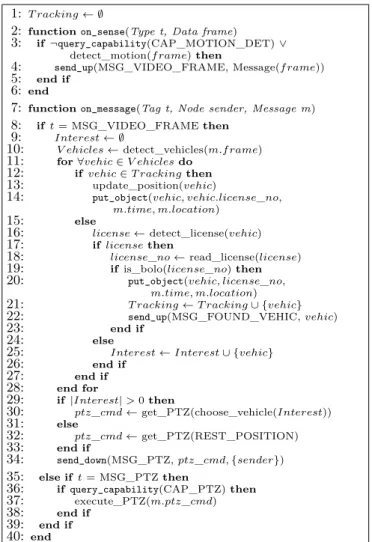
A metro area may have hundreds of cameras monitor-ing the highways. These sensors could enable an applica-tion that uses traffic cameras to help police identify and track vehicles for which they have issued a search, which we refer to as a BOLO. Pseudocode for a simplified ver-sion of this application is given in Figure 2 to illustrate how our API provides the necessary abstractions to keep track of device capabilities and to build applications with sense-process-actuate patterns. For brevity, a few important parts of the application have been intentionally omitted.
There are three types of Mobile Fog processes in this ap-plication. Camera processes are the leaves of the tree and are responsible for sensing the environment and delivering
1: T racking← ∅
2: functionon_sense(Type t, Data frame)
3: if ¬query_capability(CAP_MOTION_DET)∨
detect_motion(f rame)then
4: send_up(MSG_VIDEO_FRAME, Message(f rame))
5: end if
6: end
7: functionon_message(Tag t, Node sender, Message m)
8: if t= MSG_VIDEO_FRAMEthen
9: Interest← ∅
10: V ehicles←detect_vehicles(m.f rame)
11: for∀vehic∈V ehiclesdo
12: if vehic∈T rackingthen
13: update_position(vehic)
14: put_object(vehic, vehic.license_no, m.time, m.location)
15: else
16: license←detect_license(vehic)
17: if licensethen
18: license_no←read_license(license)
19: ifis_bolo(license_no)then
20: put_object(vehic, license_no, m.time, m.location)
21: T racking←T racking∪ {vehic} 22: send_up(MSG_FOUND_VEHIC,vehic)
23: end if
24: else
25: Interest←Interest∪ {vehic}
26: end if 27: end if 28: end for 29: if|Interest|>0then 30: ptz_cmd←get_PTZ(choose_vehicle(Interest)) 31: else 32: ptz_cmd←get_PTZ(REST_POSITION) 33: end if 34: send_down(MSG_PTZ,ptz_cmd,{sender}) 35: else ift= MSG_PTZthen
36: ifquery_capability(CAP_PTZ)then
37: execute_PTZ(m.ptz_cmd)
38: end if
39: end if
40: end
Figure 2: BOLO Vehicle Tracking Algorithm
video frames to their parent processes. Lines 2-6 in Figure 2 show the handler that is executed every time a video frame is produced. Our API can be used to determine whether a “smart camera” has the ability to detect motion in the scene (line 3), and if present, it can be used to avoid sending video to the camera’s parent unless motion is detected.
The lowest tier of fog instances are the immediate parents of the cameras and are responsible for identifying and track-ing vehicles (lines 9-28) as well as controlltrack-ing the cameras (lines 29-38). This allows the most intensive computation to be handled by the most widely distributed and lowest– latency resources. Video frames received by processes with camera children are processed by lines 9-34. First, a com-puter vision algorithm is used to detect_vehicles() in the video. If a vehicle is in the set of vehicles being tracked by this camera (i.e., it was previously detected), then the ve-hicle’s position in space is updated and the location of the vehicle at that time is stored by put_object() on line 14. Otherwise it is a newly detected vehicle, and the algorithm attempts to identify it by its license plate. If the plate can be read clearly on line 16, then we can detect the license number (line 18) and determine if there is a BOLO for that vehicle (line 19). If so, we record the vehicle’s location, add it to the set of vehicles being tracked, and notify this
pro-1: Requires: n//number of levels in hierarchy
2: functionon_new_parent(nodeparent)
3: ifquery_level()=nthen
4: da←create_detection_algorithm(query_location())
5: rq←generate_range_query(query_location())
6: send_up(MSG_DEPLOY,Message(da, rq,mobileId))
7: end if
8: end
9: functionon_message(tagt, nodesender, messagem)
10: ift= MSG_SENSOR_DAT∧query_level()=n−1then
11: put_object(sensor_data(m),"DAT",m.time,m.location)
12: else ift= MSG_DEPLOYthen
13: ifm.rq.range⊂query_location())then
14: put_object(m.da,"DETECTION",N U LL,
m.rq.range)) 15: location_multicast(MSG_RQ, Message(m.rq, nodeId),m.rq.range) 16: else 17: send_up(m) 18: end if 19: else ift= MSG_RQthen 20: ifquery_level()=n−1then
21: B←get_object("DAT",m.rq.time,m.rq.range)
22: send_to(MSG_BUFF, message(B),m.nodeId)
23: else
24: location_multicast(MSG_RQ,m,m.rq.range)
25: end if
26: else ift= MSG_BUFFthen
27: D←get_object("DETECTION",N U LL,N U LL)
28: P←process_events(D, m.Events)
29: send_to(MSG_PATTERN,message(P), mobileId(P))
30: end if
31: end
Figure 3: Traffic Monitoring with MCEP
cess’ parent that a new BOLO vehicle was detected (lines 20-22).
However, if the license is not sufficiently clear to read, we can use pan-tilt-zoom (PTZ) camera capabilities to zoom in for a better view. Line 25 adds the vehicle to a set of “ve-hicles of interest”. Since a camera can only zoom in on one vehicle at a time, lines 29-33 select the vehicle to focus on using a choose_vehicle() algorithm and then sends the PTZ command to the camera (line 34). Lines 35-38 handle the PTZ command when it is received by the camera. The in-corporation of PTZ creates asense-process-actuatefeedback loop that requires the low latency provided by the fog.
4.2
Traffic Monitoring using MCEP
Information from sensors on mobile devices, e.g., vehicles, can help detect traffic situations if the information is shared and aggregated. For example, a sequence of several similar movement and acceleration patterns from different vehicles on the same road can determine if an accident blocks the road. TheMobility–driven distributed Complex Event Pro-cessing (MCEP)system [5] enables deriving such patterns from sensor data. MCEP allows consumers to specify their interest in recent, nearby patterns with a detection algo-rithm (da) and an associated spatio–temporal range query (rq), which is parametrized with a time and range. For example, a range query could select relevant sensor data around a consumer that occurred in the last hour within a one kilometer perimeter around the consumer.
Figure 3 shows how a simplified version of the MCEP system is implemented using the Mobile Fog programming model. Vehicles are on thenth level of the Mobile Fog hi-erarchy and connect to the MCEP system by calling con-nect_fog()(not shown). Sensor data from those vehicles is
buffered by Mobile Fog processes on leveln−1, henceforth referred to as edge processes (Lines 17-18). This buffering allows efficiently answering spatio–temporal range queries after the vehicle has moved away from the edge process.
Each connected vehicle can post a query by sending a MSG_DEPLOY message containing a detection algorithm, range query, and its ID to its parent using send_up()(see Lines 3-8), e.g., the vehicle connected toF5 in Figure 1. The detection algorithm is pushed up the hierarchy to the Mobile Fog process that is associated with a geospatial range that fully contains therangeof the query (Line 19-25), e.g.,F3in
Figure 1. This process is going to perform the detection al-gorithm and pushes the range query down, viasend_down(), to all Mobile Fog processes that overlap with the rangeof the query (Lines 22 & 31), e.g., F5 and F6 in Figure 1.
Edge processes buffer the relevant sensor data for the detec-tion and thus process the range query. Results of the range query are sent via ID to the resource node that hosts the detection algorithm (Lines 27-29) and processed there. De-tected patterns are sent via ID to the mobile device (Lines 34-36). With each location update of a vehicle, or when a vehicle connects to a new resource node, the callback inter-faceson_child_leave()andon_new_parent()deploy a new detection algorithm and range query, and revoke the previ-ous one (see Line 2). To automatically migrate detection algorithms and buffered sensor data when Mobile Fog scales up or down, they are put in the context store.
5.
EVALUATION
To show the benefits of Mobile Fog over a cloud–based approach, in terms of communication cost, we conducted a network simulation using OMNeT++ [8] with realistic traf-fic patterns generated by SUMO [1]. We simulated a thou-sand randomly moving vehicles over fifteen minutes on the road network of an urban area (7.7×3.5 km). The entire area was covered by a Quadtree communication structure: one cloud as root, four core fog computing nodes, and six-teen edge fog nodes that directly communicate with vehicles. Fog nodes at each level cover uniformly divided parts of the entire area. The network latency between each pair of nodes is 20 milliseconds.
Based on the above setup, we simulated two large–scale application scenarios requiring low end-to-end latencies. The first application is vehicle–to–vehicle video streaming, where each vehicle randomly chooses another vehicle within a query range and starts streaming a fixed sized video to the target vehicle. In this application, a cloud–based approach streams all videos through the cloud while the Mobile Fog–based ap-proach streams videos through intermediate fog computing nodes, similar to software defined networking. The second application is Mobile CEP, where a vehicle requests process-ing sensor data from a certain query range. In this appli-cation, the Mobile Fog–based approach stores sensor data in the nearby edge fog computing nodes, while the cloud– based approach stores all sensor data in the cloud. Both ap-plications use thesend_up()andsend_down()API to han-dle user requests in the Mobile Fog–based approach, which means higher level nodes in the Quadtree will be utilized to handle larger query ranges.
Figure 4 (a-b) shows the relative end–to–end latency and core network traffic of the Mobile Fog–based approach com-pared to the cloud–based approach while varying thequery range. The results show that the Mobile Fog–based
0 0.2 0.4 0.6 0.8 1 1.2 1.4 0 3000 6000 9000 12000 0 0.2 0.4 0.6 0.8 1 1.2 1.4 la ten cy co re -tr affi c
query range [meter] Network Traffic
Latency
(a)Vehicle–to–vehicle video streaming
0 0.5 1 1.5 2 2.5 0 200 400 600 800 1000 0 0.5 1 1.5 2 2.5 la ten cy co re tr affi c
query range [meter] Network Traffic
Latency
(b)Traffic monitoring using MCEP
0 100000 200000 300000 400000 500000 600000 0 0.2 0.4 0.6 0.8 1 av g #e ve nts
Cummulative Fraction of Nodes
(c)Workload distribution of MCEP
Figure 4: Relative latency and network traffic of Mobile Fog compared to the cloud–based approach
proach significantly reduces both end–to–end network la-tency and core network traffic when query ranges are small, since Mobile Fog allows users to be served by nearby fog nodes. In the vehicle–to–vehicle video streaming application (Figure 4(a)), the Mobile Fog–based approach always out-performs the cloud–based approach since the video stream goes through the cloud only when a vehicle picks a far– away target vehicle. However, in the MCEP scenario (Fig-ure 4(b)), the cloud–based approach outperforms Mobile Fog when the query range is very large because the Mobile Fog–based approach has to aggregate sensor data stored in edge fog computing nodes before serving a user query. If such a wide–scope aggregation happens frequently, the Mo-bile Fog–based approach could also push sensor data up to the cloud to achieve lower latency and lower network traffic for query processing at the expense of higher network traffic for normal operation.
Figure 4(c) shows the various workloads at different fog nodes. We measured the total number of events stored at each Mobile Fog process running on edge fog nodes in the MCEP scenario. The number of events stored at each pro-cess is directly related to the nepro-cessary storage capacity, as well as the processing needs since more events implies a higher chance of a user request. As shown in the figure, the workload distribution over different Mobile Fog processes is highly skewed, i.e., only a few processes are overloaded be-cause certain regions have higher vehicle traffic. This result motivates dynamic scaling to handle the highly skewed and dynamic workload of applications.
6.
DISCUSSION AND FUTURE WORK
In this paper we discussed the design of Mobile Fog, a programming model for large–scale, latency–sensitive appli-cations in the Internet of Things (IoT). Since this is ongoing research, it creates interesting research problems for future work.
Runtime system implementation: We plan to develop a runtime system that implements the Mobile Fog program-ming model on real fog-enabled devices. The key challenge is to develop a distributed runtime system that can migrate Mobile Fog processes across different devices while provid-ing reliability, security, and performance isolation for shared infrastructure resources.
Process placement algorithm: To achieve better network bandwidth utilization, latency, and load balance across dis-tributed devices, we are currently working on an algorithm
that can adaptively find a near-optimal placement of Mobile Fog processes. The key challenge in this direction is to find a better placement based on dynamic constraints includ-ing available resources, application workload, and migration cost for Mobile Fog processes.
Acknowledgment
This work is supported by contract research “CEP in the Large” of the Baden-Württemberg Stiftung.
7.
REFERENCES
[1] M. Behrisch, L. Bieker, J. Erdmann, and D. Krajzewicz. SUMO - Simulation of Urban MObility: An overview. InAdvances in System Simulation, SIMUL ’11, 2011. [2] F. Bonomi, R. Milito, J. Zhu, and S. Addepalli. Fog
computing and its role in the internet of things. In
Workshop on Mobile cloud Computing, MCC ’12, 2012. [3] K. Hong, S. Smaldone, J. Shin, D. J. Lillethun,
L. Iftode, and U. Ramachandran. Target container: A target-centric parallel programming abstraction for video-based surveillance. InInternational Conference on Distributed Smart Cameras, ICDSC ’11, 2011. [4] B. Koldehofe, F. Dürr, M. A. Tariq, and K. Rothermel.
The power of software-defined networking: line-rate content-based routing using openflow. InWorkshop on Middleware for Next Generation Internet Computing, MW4NG ’12, 2012.
[5] B. Koldehofe, B. Ottenwälder, K. Rothermel, and U. Ramachandran. Moving range queries in distributed complex event processing. InDistributed Event-Based Systems, DEBS ’12, 2012.
[6] D. J. Lillethun, D. Hilley, S. Horrigan, and
U. Ramachandran. MB++: An integrated architecture for pervasive computing and high-performance
computing. InEmbedded and Real-Time Computing Systems and Applications, RTCSA ’07, 2007. [7] M. Satyanarayanan, P. Bahl, R. Caceres, and
N. Davies. The case for VM-based cloudlets in mobile computing.IEEE Pervasive Computing, 8(4), October -December 2009.
[8] A. Varga and R. Hornig. An overview of the OMNeT++ simulation environment. InSimulation tools and techniques for communications, networks and systems & workshops, Simutools ’08, 2008.