Context-Sensitive Content Representation for Mobile
Learning
William C. Chu 1, Hong-Xin Lin 2, Juei-Nan Chen 3
, Xing-Yi Lin 4 1.2.4Department of Computer Science and Information Engineering, TungHai University,
No. 181, Taichung-Kang Road, Sec. 3, Taichung 40744, Taiwan. [email protected]
[email protected] [email protected]
3Department of Engineering Science, National Cheng Kung University,
No. 1, Ta-Hsueh Road, Tainan 701, Taiwan. [email protected]
Abstract. Mobile learning means that the learning contents can be displayed anytime, anywhere, and with any kind of presenting device. Learning Content Management Systems (LCMSs) usually provide convenient authoring tools to help instructors to construct their learning contents, which may include static document such as powerpoint, word, pdf document and dynamic multimedia document such as video and audio files, and then integrate these learning contents to provide learners with proper contents rendering through access devices. However, most of LCMSs are based on desktop computer environments, rather than mobile devices. Context-Sensitivity is an application of software system’s ability to sense and analyze context from various sources. In this paper, we develop a Context-Sensitive Middleware (CSM) for LCMS to transform the same learning contents to different mobile devices, so mobile learning can be supported.
Keywords: Mobile Learning, Learning Content Management System (LCMS), Context-Sensitive
1 Introduction
The purpose of learning is to absorb knowledge efficiently. In tradition, studying habits may be affected by the restriction of time and space to decline the learning quality. Mobile learning means that the learning contents can be gotten anytime, anywhere, and with any kind of devices.
Many Learning Content Management Systems (LCMSs) [1] were developed, which offer convenient authoring tools help instructors to construct their learning contents, which may include static document such as powerpoint, word, pdf document and dynamic multimedia document such as video and audio files, and then integrate these learning contents to provide learners with proper contents rendering through access devices.
However, most of LCMSs are based on desktop computer environments, rather than mobile devices. Context-Sensitivity is an application of software system’s ability to sense and analyze context from various sources. In this paper, we develop a Context-Sensitive Middleware (CSM) for LCMS to transform the same learning contents to different mobile devices, so mobile learning can be supported.
The rest of this article is organized as follows. In section 2, we discuss the related technologies applied in mobile learning. The complete system architecture and approaches are described in section 3. Finally, the conclusion and future works are described in section 4.
2 Related Works
2.1 SCORM
SCORM (Sharable Content Object Reference Model) is a set of standards proposed by ADL (Advanced Distributed Learning). The purpose of its development lies in on-line teaching and web-based learning, and it composes reusable learning object with the techniques of framework [2][3]. SCORM defines a set of related specifications to enable the learning content and system to conform to the high-level requirement model. In addition, the multimedia teaching materials were extensively applied to e-learning applications, so that e-learning objects no longer confine to texts. In the transmission of information, the multimedia teaching materials usually have more expressiveness than texts. Liu et al. have presented methods in automatically producing SCORM-based multimedia learning material [4].
SCORM defines a whole set of system structure. Learners can extend the system functions to exchange information and share the teaching materials with other systems. However, SCORM was not designed to take care of context-sensitivity issues. In order to efficiently and effectively achieve mobile learning, context-sensitivity issues need to be solved. A relevant research called Pocket SCORM which has discussed about context-sensitivity to mobile devices [5]. Our approach focuses more on solving problem on rendering standard SCORM contents in different mobile devices.
3
Context-Sensitive Mobile Learning Environment
The mobile computing environment consists of LCMS, rendering devices, and Context-Sensitive Middleware (CSM), as shown in Fig. 1. The major functionality of CSM is to provide learners with proper content format when they access contents from different mobile devices, so the content rendering is appropriate.
Fig. 1. System Architecture of the Context-Sensitive Mobile Learning
In our approach, we have applied MVC pattern to the design and implementation of our mobile e-learning environment. In order to promote the reusability of mobile contents, we follow SCORM 1.3.1 [3], in which learning content is subdivided into Asset, SCO, SCA and Content Packaging; meanwhile, the linking relationship of these elements is defined by XML description. In this paper, our work has been based on the design and implementation of Context-Sensitive Middleware (CSM).
In the following sections, we will focus on discussing about the detail of XML Profile Generator and View Adaptor. We leave out the other subsystems since their designs are straight forward.
3.1 XML Profile Generator
Due to the limitation of the resources of mobile devices, such as the smaller screen size, the learning content, e.g. slides in powerpoint format which were originally designed for PC environment, can not be properly rendered in mobile devices and need to be analyzed and transformed to the appropriate format. In order to make learners acquire learning contents by their mobile devices, all learning resources are transformed to XML profiles via XML Profile Generator.
XML Profile Generator classifies the learning content into three categories: Slide IMG, Text, and Multimedia. Slide IMG is the image and picture, Text is the text, and Multimedia is the attached multimedia files from slides. These three types of content will be extracted from original slides and transformed into their corresponding profiles in XML format. Based on these profiles, View Adaptor then can adapt them into appropriate format for different devices.
3.1.1 Transformation of Learning Content
The steps of the transformation of learning content into XML profile are the following:
I. Parse and Analyze the slide. When an mobile learning content (MLC) is
acquired from LCMS, we can parse and analyze the slide element according to the Slide Element Table (SET).
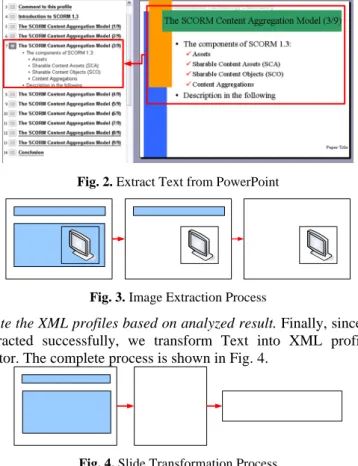
II. Extract the text and image from slide. After parsing and analyzing the slide, one of the slide templates is selected. Then, we must extract the text and image from slide. Since powerpoint supports Text mode (shown in Fig. 2), this problem can be solved. In addition, if there exists some images in the slide, we can extract it directly since powerpoint regards images as independent objects. The process to extract image is by discarding other objects in the slide, as shown in Fig. 3. As mentioned above, the elements of the slide can be extracted effectively and reused in our CSM.
Fig. 2. Extract Text from PowerPoint
Fig. 3. Image Extraction Process
III. Generate the XML profiles based on analyzed result. Finally, since the text can be extracted successfully, we transform Text into XML profiles by Text Generator. The complete process is shown in Fig. 4.
3.1.2 Transformation of Slide IMG and Multimedia
Fig. 5. Transform Slide IMG to XML Profiles
The purpose of generating Slide IMG is to make learners hold the full view of the content when learning in mobile devices. “Slide IMG Profiles” are transformed via Slide IMG Generator, as shown in Fig. 5. Besides, if mobile devices support multimedia playing (detected by Context Detector), learners can switch Slide IMG Mode or Multimedia Mode by this button, “ ” in Fig. 5.
3.2 View Adaptor
In section 3.1, we know how to generate the XML profiles of the three learning resources - Slide IMG Profile, Text Profile, and Multimedia Profile. Next, we describe how to transform the three XML profiles into adaptive ones by Context Detector and View Adaptor, and then integrate these into a customized learning content.
3.2.1 Context-Sensitive Content Rearrangement
Based on the representation of Slide IMG, learners can hold the full view of the content, rather than the detail. This problem can be solved by the connection of Slide IMG and Text. When learners select one Slide IMG, the Text of the image is matched to Text Mode. The technique to attain this is to use a “Double Anchor Hyperlink” between Text and Slide IMG, as shown in Fig. 7.
Fig. 7. Relationship of Slide IMG vs. Text
3.2.2 Context-Sensitive Content Transformation
Some XSL which describe device context are stored in Context Detector. When learners study online, Context Detector selects the proper XSL and then integrates this with XML profiles generated by XML Profile Generator. Finally, we transform the customized mobile learning content according to the browsers that mobile devices support, this is called Context-Sensitive XSL. We put Context-Sensitive XSL into XSL Proxy, so that it is convenient for learners to learn by the same mobile device.
4
Conclusion and Future Works
Most of LCMS can integrate static and dynamic files, but they only pay attention to develop systems based on desktop computer environments, rather than mobile devices. In this paper, the XML profiles of the three learning resources are generated by XML Profile Generator. Then, adaptive XML profiles are transformed via View Adaptor and Context Detector that detect device context of mobile devices. Finally, a customized mobile learning content is packaged to enhance the reusability of learning resources successfully. In the future, we will extend “Context-Sensitive Content Representation” to include “Interactive Learning” and “Offline Learning”.
References
[1] Advanced Distributed Learning (ADL), “SCORM 2004 2nd Edition Overview,”
Available at ADLNet.org, July, 2004.
[2] Advanced Distributed Learning (ADL), “SCORM Content Aggregation Model Version 1.3.1,” Available at ADLNet.org, July, 2004.
[3] J. T. David Yang and C. Y. Tsai, “An Implementation of SCORM-compliant Learning Content Management System – Content Repository Management System,” Proceedings of the 3rd IEEE International Conference on Advanced Learning Technologies (ICALT’ 03), 2003, pp.453.
[4] P. Liu, L. H. Hsu and A. Chakraborty, “Towards Automating the Generation of SCORM-Based Multimedia Product Training Manuals,” Proceedings of 2002 IEEE International Conference Multimedia and Expo (ICME’ 02), 2002, pp. 397-400.
[5] N. H. Lin, T. K. Shih, H. H. Hsu, H. P. Chang, H. B. Chang, W. C. Ko and L. J. Lin “Pocket SCORM,” Proceedings of the 24th International Conference on
Distributed Computing Systems Workshops (ICDCSW’04), March, 2004, pp.