PERSPECTIVES
IMMIGRATION
POLICY
CENTER
A M E R I C A N I M M I G R AT I O N CO U N C I LFEBRUARY 2011
IS MORE GETTING US LESS?
By Eric Olson and David Shirk
I
S
M
ORE
G
ETTING
U
S
L
ESS
?
REAL SOLUTIONS FOR SECURING OUR BORDER
B
YE
RICO
LSON ANDD
AVIDS
HIRKF
EBRUARY2011
ABOUT PERSPECTIVES ON IMMIGRATION
The Immigration Policy Center’s Perspectives are thoughtful narratives written by leading academics and researchers
who bring a wide range of multi‐disciplinary knowledge to the issue of immigration policy.
ABOUT THE AUTHOR
Eric L. Olson is Senior Advisor to the Security Initiative at the Mexico Institute of the Woodrow Wilson International
Center for Scholars in Washington, DC. In this position he oversees the Institute’s work on U.S.‐Mexico security
cooperation and research on organized crime and drug trafficking between the U.S., Mexico, and Central America. Prior
to joining the Wilson Center he was a Senior Specialist in the Department for Promotion of Good Governance at the
Organization of American States from 2006‐2007. He served as the Interim‐Director for Government Relations at
Amnesty International USA, and was Amnesty’s Advocacy Director for the Americas from 2002‐2006. Prior to Amnesty,
he was the Senior Associate for Mexico, and Economic Policy at the Washington Office on Latin America for eight years.
He worked at Augsburg College’s Center for Global Education in Cuernavaca, Mexico from 1989‐1993 where he was the
program director. From 1986‐1988, he worked in Honduras, Central America as a development specialist for several
local non‐governmental organizations.
Dr. David Shirk received his Ph.D. in Political Science at the University of California, San Diego, and joined the Political
Science Department at the University of San Diego in 2003. He serves as the Director of the Trans‐Border Institute and
conducts research and publishes on topics related to Mexican politics, U.S.‐Mexican relations, and law enforcement
and security issues along the U.S.‐Mexican border. Dr. Shirk is the Principal Investigator for TBI's Justice in Mexico
Project, a bi‐national research initiative focused on criminal justice and the rule of law in Mexico that is sponsored by
the William and Flora Hewlett Foundation and the Tinker Foundation. He has been a fellow at the Center for U.S.‐
Mexican Studies (1998‐99; 2002‐04) and at the Woodrow Wilson International Center for Scholars (2009‐10). Recent
publications include Shared Responsibility: U.S.‐Mexico Policy Options for Combatting Organized Crime (2010); Police
and Public Security in Mexico (2009); Contemporary Mexican Politics (2008); Reforming the Administration of Justice in
Mexico (2007); Mexico's New Politics: The PAN and Democratic Change (2005).
ABOUT THE IMMIGRATION POLICY CENTER
The Immigration Policy Center, established in 2003, is the policy arm of the American Immigration Council. IPC's
mission is to shape a rational conversation on immigration and immigrant integration. Through its research and
analysis, IPC provides policymakers, the media, and the general public with accurate information about the role of
immigrants and immigration policy on U.S. society. IPC reports and materials are widely disseminated and relied upon
by press and policymakers. IPC staff regularly serves as experts to leaders on Capitol Hill, opinion‐makers, and the
Ongoing reports about Mexico’s bloody conflict with organized crime have raised again the question of whether the United States should do more to prevent such violence from “spilling over” into the country. While officials have documented few cases of actual “spill over,” fears of exploding violence in Mexico and concerns about illegal migration are driving a policy debate that is centered on “securing the border.” To whit, President Barack Obama announced last May the deployment of 1,200 more National Guard troops to enhance border security, and requested an
additional $500 million from Congress to further modernize southwestern border security. In
August, the U.S. Congress approved a $600 million “Border Security Supplemental Appropriations Act of 2010” in near record time. The question is whether such policy actions are effective.
First, we should place the discussion in its historical context. President Obama’s deployment of National Guard Troops and Congress’s approval of more funds for border security are simply a continuation of a nearly three‐decade effort to beef up the border. The first major push to enhance U.S. border security resulted from the Immigration Reform and Control Act (IRCA) of 1986, when tougher southwest enforcement became a quid pro quo in exchange for amnesty for nearly
2.7 million undocumented immigrants.
The number of Border Patrol agents grew from 2,900 in 1980 to around 4,000 by 1994 when a new free trade agreement with Mexico (NAFTA) raised concerns that drug trafficking might also become easier as legitimate commercial trade was encouraged. Such concerns built public support for
concentrated border‐enforcement efforts such as “Operation Hold‐the‐Line,” intended to gain
operational control of strategic corridors along the border. At that time, President Bill Clinton named then‐U.S. Attorney Alan Bersin as the southwest border “czar,” and dramatically expanded border security budgets. With new funding, the border was fortified with new fencing and high‐ tech surveillance systems. By 2000, the size of the Border Patrol more than doubled to over 9,000 agents.
In the new millennium, the 9/11 attacks placed new urgency on homeland security and led the
Bush administration to continue investments in southwest border enforcement. Additionally,
southwest governors sent hundreds of National Guard troops to the border for extended
deployments throughout the 2000s to shore up federal immigration controls and counter‐drug
efforts.
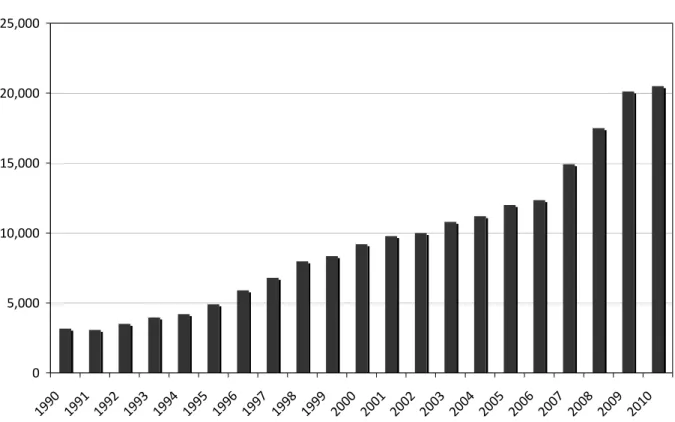
By the end of Obama’s first year in office, the Border Patrol had more than doubled in size to 20,000 agents {Figure 1}, and more than 3,000 Immigration and Customs Enforcement (ICE) agents were sent to the border to bolster efforts to combat arms and cash smuggling by drug traffickers. In short, today the border has a greater security presence than at any point since the 1910 Mexican revolution, when we sent half our military forces to protect against possible incursion by insurgent groups.
Figure 1: U.S. Border Patrol Personnel, 1990‐2010 0 5,000 10,000 15,000 20,000 25,000 1990 1991 1992 1993 1994 1995 1996 1997 1998 1999 2000 2001 2002 2003 2004 2005 2006 2007 2008 2009 2010
Source: Data from 1990‐2007 adapted from José Z. García, "Security Regimes on the Border," Table 12.1 Security Personnel on
the United States' Southwestern Border, p. 306; Leslie Berestein, "Tightened Border in San Diego Shifts Strain to Areas East,"
San Diego Union Tribune special report titled "Operation Gatekeeper: 10 Years Later" and published August 1, 2004; and
Department of Homeland Security, Budget in Brief, 2006‐11.
Border security advocates say that all of this is still not enough. They say that only more boots on the ground, more fencing, and more high‐tech gadgetry will make the border safer. However, further saturating the border is costly and ineffective. Concentrated enforcement at the border has not increased the net effectiveness of counter‐drug or immigration‐control efforts. Indeed, no
matter where you stand on the debate on drugs or unauthorized immigration, nearly everyone
agrees on one thing: no specific policy decision to beef up border security in the last 20 to 30
years has significantly reduced the flow of illicit drugs and people into the United States. The
accumulation of 11 million undocumented immigrants—often at a rate of over 400,000 annually—
has provided a testament to this failure.
But while the overall flow of drugs and people into the U.S. has not declined significantly as border security has been enhanced, it has made passage into the United States more difficult and costly,
which has had numerous unintended and unfortunate consequences. For example, Mexican
migrants used to follow cyclical patterns of migration, working in U.S. fields, hotels, and restaurants but returning home each year to share their bounty with their families. Today, tougher border security has resulted in an increasing number of undocumented immigrants who choose to stay in the United States, rather than risk multiple, ever more arduous trips. Furthermore, tougher border security has been a boon to sophisticated, heavily armed, trans‐national criminal organizations that have specialized in moving drugs, contraband, and people across the heavily fortified border. These
highly profitable organized crime groups are among the most dangerous in the world, and have even successfully penetrated U.S. border security by corrupting Border Patrol agents in the last few years.
Meanwhile, the one thing that has any substantial impact on illicit cross‐border flows is demand. Illicit labor (and drug) flows go up—or down—primarily depending on shifts in U.S. market demand.
During economic booms, employment demand brings large numbers of undocumented immigrants
to the United States. With Mexico’s minimum wage at roughly $5 a day, the number of
undocumented immigrants skyrocketed during the boom times of the late‐1990s and mid‐2000s.
In the current economic downturn, flows of undocumented immigrants have declined to around
200,000 annually, and perhaps a million have returned home.
Regardless of whether the number of undocumented immigrants goes up or down, advocates
always seem to have a justification to call for more funding for concentrated border enforcement.
When the flow of undocumented immigrants rises, border security advocates declare success
because detentions by the Border Patrol correspondingly increase. When the flow of
undocumented immigrants decreases, border security advocates again declare success because
detentions correspondingly decline. To facilitate continued “success,” annual budget requests for border security have grown consistently in recent years. In 2004, the budget for the Department of Homeland Security’s Customs and Border Protection (CBP) agency was $5.9 billion. In 2010, CBP— now headed by Commissioner Bersin—had a budget of more than $11 billion {Figure 2}.
Figure 2: Federal Budgets for Border Security Spending FY 2004‐2010 5.9 6.3 7.1 7.7 9.3 11.3 11.5 3.7 3.1 3.9 4.7 5.1 6.0 5.7 0 2 4 6 8 10 12 14 16 18 2004 2005 2006 2007 2008 2009 2010 Fiscal Year Billions of Dollar s Immigration & Customs Enforcement Customs & Border Protection
Data adapted from U.S. Department of Homeland Security, Budget in Brief publications,
2004‐2010. Note: Total budget authority in billions of dollars, not adjusted for inflation.
Amid this enormous build up in border security, President Obama is under intense pressure from
both sides of the immigration debate. Comprehensive immigration reform advocates despise the
current border‐control strategy not only because of its ineffectiveness and outrageous financial cost, but because it leads many undocumented immigrants to entrust their lives to unscrupulous criminals, resulting in increased cases of robbery, rape, kidnapping, and even death along the
southwest border. Many immigrant advocates therefore find it difficult to understand why
President Obama would continue such an ineffective and dangerous policy.
Yet, Obama has taken a tough stance on the border for an obvious reason: vocal grassroots
movements—like the Minutemen—who support “sealing the border” have mounted an aggressive
political campaign in many areas of the country. For their part, administration officials see securing the border as the first part of a “grand bargain” to negotiate with anti‐immigration forces, which— they hope—will ultimately allow a major overhaul of the U.S. immigration system.
Ultimately, policymakers need to seriously reconsider the merits and effectiveness of current
policies designed to secure the border. While a fraction of undocumented immigrants entering the United States may be involved in drug smuggling or other criminal activities, U.S. authorities last year identified 200 felons out of more than a million people they apprehended at the border.
Rather than focus all our efforts on patrolling the border, security might be enhanced by
redeploying U.S. resources and personnel on intelligence‐based law‐enforcement efforts. For
example, rather than increasing outbound inspections to disrupt the trafficking of bulk cash, the U.S. should focus law‐enforcement efforts on hub cities where traffickers gather and package cash to bring back to Mexico. Likewise, collaborative law‐enforcement efforts that focus on illegal gun sales in high traffic areas near the border have resulted in more cases being referred for
prosecution, and are more effective than costly and disruptive attempts to monitor border
crossings.
Another thing that must be done is to bring immigrants who are otherwise law‐abiding out of the shadows and provide them with legal avenues to enter the country. Widening the gates—with more elastic quotas for work visas (especially for our Mexican and Central American neighbors)— would allow U.S. Border Patrol agents to turn their fullest attention to organized criminal groups and would‐be terrorists without the distraction of hunting down would‐be gardeners and dish‐
washers.
This grand bargain—better security through wider gates—may seem counter‐intuitive, but may be more effective. In order to accomplish such an objective, a radical overhaul of the labyrinthine U.S. immigration system is needed. It would also require more effective tracking of immigrants to the U.S. to ensure compliance with domestic labor regulations and visa expiration dates. In the end, creating a legal path to enter the United States could result in a net economic benefit: higher wages for low‐wage workers in the United States (no longer undercut by black‐market migrant
labor), increased tax revenues from migrant workers (who already pay at least some taxes