Original Research Article
Awareness of family planning services among ASHA workers in a
municipality of northern Kerala
Arya Lokesan Ratnam*, Jayasree Anandabhavan Kumaran
INTRODUCTION
Under the umbrella of National Rural Health Mission (NRHM), government of India is providing comprehensive health care to the people especially in rural areas. Accredited Social Health Activist (ASHA) is one of the key components of NRHM. ASHA worker act as a link between the community and the public health system and would have a central role in achieving goals in national health programs and policies. An ASHA worker should be primarily from the village itself who is either married/widowed/divorced preferably in the age group of 25-45 years. ASHA workers should have a minimum formal education of 8 years.1
ASHA will have to undergo training to acquire adequate knowledge and skills for performing her roles perfectly. ASHAs will receive incentives for her performances like, for accompanying and referring pregnant ladies, for promoting universal immunization, for registering antenatal cases and for the involvement in other health care programs. Other roles of ASHA workers include working with Anganwadi worker, registration of births and deaths, motivating community on sanitation aspects, counselling on family planning, adolescent health and nutrition. Every ASHA is anticipated to be an initiator of community participation in public health programmes in her community. ASHA should be a supporter of hygienic
ABSTRACT
Background: Accredited Social Health Activist (ASHA) is one of the key components of National Rural Health Mission (NRHM).The success of national health programs on family planning depends on how well ASHAs are trained and perform. Therefore it’s essential to assess the knowledge of ASHA workers. This study intends to assess the awareness of family planning services among ASHA workers in a municipality of northern Kerala.
Methods: This is a cross sectional study conducted among ASHA workers working in a municipality in Kannur District, during a study period of two weeks (July 1- July14, 2017). Data was collected using a semi structured questionnaire. Data was analyzed using SPSS version 16.0 software and the results were expressed in terms of means, frequencies and percentage.
Results: Majority (42.1%) of the ASHAs belongs to the age group of 42- 45 years and none of them were below 30 years. The mean population catered by ASHA workers were 1250. All of them were experienced for at least 7 years.
Conclusions: All ASHA workers had satisfactory knowledge about family planning services. Despite this some of the ASHA workers don’t have adequate knowledge about ECPs, Progesterone only pills and non-contraceptive uses of condom. Hence it is essential to ensure that they are getting proper training from qualified personnel at regular intervals.
Keywords: NRHM, ASHA, Family planning
Department of Community Medicine, A.C.M.E., Pariyaram Medical College, Kannur, Kerala,, India
Received: 02 May 2018
Revised: 03 June 2018
Accepted: 04 June 2018
*Correspondence:
Dr. Arya Lokesan Ratnam, E-mail: [email protected]
Copyright: © the author(s), publisher and licensee Medip Academy. This is an open-access article distributed under the terms of the Creative Commons Attribution Non-Commercial License, which permits unrestricted non-commercial use, distribution, and reproduction in any medium, provided the original work is properly cited.
health practices. She should provide a minimum package of curative services and make timely referrals.2
A rapid population growth is a challenge for every country. It can negatively impact the economic growth of the country and can result in poverty. India is the second most populous country in the world.3 One of the key solutions for controlling the outgrowth of population is by adopting family planning methods. Effective family planning measures not only control the population but also ensure better health of mother and child. Thus indirectly benefits the whole nation.
Globally, 41% of all pregnancies are unforeseen, increasing the possibility of unsafe abortion, morbidities and mortalities among mother and child. In spite of various national family planning programs being held in India, one in four pregnancies are unintended. In addition to this, couples do not use any family planning methods until they have desired sex composition of children which remains a norm in India.4
The use of family planning methods depend on the quantity and quality of knowledge. Since ASHAs may be the first person contacted and who could be called upon for any queries about family planning, it is important that ASHAs should be well aware about family planning methods and the services provided by government of India.
As ASHA workers have direct link to their communities, they can play a significant role in implementing National family planning programme in their community. They are vital agents for inspiring the community to follow small family models by accepting various family planning methods. The success of national health programs on family planning depends on how well ASHAs are trained and perform. Therefore it’s essential to assess the knowledge of ASHA workers. The present study was conducted to assess the socio-demographic profile of ASHA workers and their awareness of family planning services.
METHODS
This was a cross sectional study conducted during a study period of 2 weeks (July 1st to July 14th, 2017) in a Municipality of Northern Kerala. Study participants were Asha workers working in the Municipality. First the list of ASHA workers was collected from the municipality and contacted these ASHAs by phone. Of these some had moved to other places, some others were not working at present so they were excluded. A list of 38 ASHAs were made and were included in the study. Informed consent was taken from the ASHA workers. A semi structured questionnaire was used to assess the socio-demographic profile and knowledge about family planning services. The questionnaire was designed in English initially and later translated to Malayalam and back translated to English to check validity of translated questionnaire
contained. The participants were interviewed via phone in detail. The data collected was kept confidential and was used for research purpose only. Each of the knowledge questions were given scores, Maximum score obtainable was 17 and minimum score was10. Score more than 9 were considered satisfactory. Data were entered in Microsoft Excel and analysis was done using SPSS16 Software.
RESULTS
A total of 38 ASHAs were studied. The mean age of study participants was 41.11±4.196 years. Majority (42.1%) of them belonged to the age group of 42-45 years. 94% were Hindus and 3% was Muslim and Christian each. All of them were married. Most of the ASHA workers (94.73%) were experienced for 7–10 years as ASHA. Majority (86.84%) were catering to a population of 1000-1500 and the mean (±SD) population catered was 1250 (±307.34).
Figure 1: Distribution of ASHAs according to age (n=38).
Figure 2: Distribution of ASHAs based on religion (n=38).
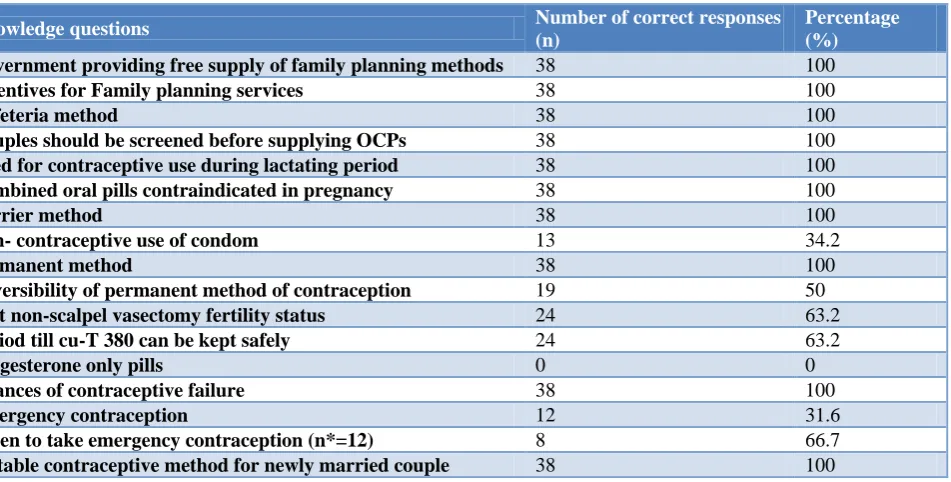
Table 1 reveals the knowledge of ASHAs regarding family planning methods and services. All the ASHAs were aware about entities like cafeteria method and incentives offered to them for carrying out family planning services. All of them were aware about barrier and permanent method of family planning methods. Even though all (100%) of the ASHAs were aware that combined oral contraceptives should not be given for lactating mothers, they were not aware about
9
8
16
5
0 2 4 6 8 10 12 14 16 18
34 - 37 38 - 41 42 - 45 46 - 50
Frequency
Age Group in years
95%
2% 3%
progesterone only pills. Only 13% of them were aware about the non- contraceptive use of condoms.
Figure 3: Distribution of ASHAs based on years of experience (n=38).
Figure 4: Distribution of ASHAs based on population served (n=38).
Table 1: Knowledge of ASHAs on various family planning services.
Knowledge questions Number of correct responses
(n)
Percentage (%)
Government providing free supply of family planning methods 38 100
Incentives for Family planning services 38 100
Cafeteria method 38 100
Couples should be screened before supplying OCPs 38 100
Need for contraceptive use during lactating period 38 100
Combined oral pills contraindicated in pregnancy 38 100
Barrier method 38 100
Non- contraceptive use of condom 13 34.2
Permanent method 38 100
Reversibility of permanent method of contraception 19 50
Post non-scalpel vasectomy fertility status 24 63.2
Period till cu-T 380 can be kept safely 24 63.2
Progesterone only pills 0 0
Chances of contraceptive failure 38 100
Emergency contraception 12 31.6
When to take emergency contraception (n*=12) 8 66.7
Suitable contraceptive method for newly married couple 38 100
*n is the number of ASHAs who knew about emergency contraceptive method.
In the present study, all the ASHAs were aware that couples should be screened before supplying oral contraceptives and combined oral pills are contraindicated in pregnancy. They were also aware that couples should be advised contraceptives during lactating period.
Fifty percentage of ASHA workers were aware that, there is chance for reversibility of sterilization. All ASHAs knew that it takes time for a man to become sterile after Non-scalpel Vasectomy. But among them only 63.2% were aware of the correct window period. The proportion of ASHAs having knowledge about the correct period with which, Cu T 380 can be kept safely in situ was 63.2%. All ASHAs knew about the chances of contraceptive failure. All of them advised a suitable contraceptive method for newly married couple. Only
31.6% were aware about emergency contraceptive pills, among them 66.7% were aware about the window period of i pill correctly.
Figure 5: Awareness regarding government supply of free contraceptives (n=38).
95%
5%
7 - 10 years >10 years
1 1
18
1 14
2 1
0 2 4 6 8 10 12 14 16 18 20
800 900 1000 1200 1500 1800 2000
Frequency
o
f
ASH
ASs
Number of population
38
2
37
0 5 10 15 20 25 30 35 40
Nirodh Mala N I pill
Frequency
Even though all (100%) of ASHA workers were aware that the Government of India supplied contraceptives free of cost, only 23.7% were aware that mala N was supplied free of cost. The newer contraceptives like Chhaya (contraceptive pill) and Antara (injectable contraceptive) launched by the Ministry of Health and Family Welfare, have not reached them yet. These contraceptives have so far been launched in 10 states that includes Maharashtra, Uttar Pradesh, Madhya Pradesh, Rajasthan, Karnataka, Haryana, West Bengal, Odisha, Delhi and Goa.5
DISCUSSION
This study aimed to assess the knowledge of family planning services among ASHA workers. All of the ASHAs belonged to the local community and all were married, satisfying the guidelines for selection of ASHAs. 13.2% of ASHAs were aged above 45 and the adequate representation of all castes was not seen, which is contrary to the guidelines. Similar findings of recruiting ASHA workers against selection criteria have been reported in a study conducted by Kohli in Delhi where, other than recommended age group ASHAs were reported to be selected. The guidelines should be followed strictly for the recruitment of ASHA workers in order to maintain the uniformity.6
Fifty percentage of the ASHA workers served more than the stipulated population (1000) with an average of 1250±307.34 which could possibly be a burden that in turn reduces the overall outcome of ASHA’s work. All of them were experienced for at least 7 years. The mean population served by the ASHA workers in this study was 1250±307.34 which was higher than the mean population (1078) reported in another study conducted by Shashank et al in Bijapur Taluk.7
All (100%) of the ASHA workers were aware about OCPs and the need for screening before starting OCPs. All the ASHAs were also aware about entities like cafeteria method and incentives offered to them for carrying out family planning services.
All (100%) of the ASHAs were aware that combined oral contraceptives should not be given for lactating mothers, which is higher than the report of a previous study in Udupy, Taluk Karnataka, where only 83% of the ASHAs were aware.8 All (100%) of the ASHAs were aware about permanent methods of sterilization.
In this present study the awareness about emergency contraceptive pills (ECPs) is only 31.6% and among the ASHA workers who were aware of emergency contraceptive pills, 33.3% were unaware about the window period of i pill. Similarly, another study reported the awareness about ECP is low among Community Health Workers (CHW) such as ASHAs (15%).9
CONCLUSION
All ASHA workers had satisfactory knowledge about family planning services. Despite this some of the ASHA workers doesn’t have adequate knowledge about ECPs, Progesterone only pills and non-contraceptive uses of condom. Hence it is essential to ensure that they are getting proper training from qualified personnel at regular intervals. Social marketing should be broadened to improve community awareness and acceptance of the new and already available contraceptive services. Monitoring of their work at field is vital to ensure that knowledge is converted into practices as well.
ACKNOWLEDGEMENTS
I express my deepest gratitude to the Head of the department, whole staff and the interns of the Department of Community Medicine, ACME, Pariyaram.
Funding: No funding sources Conflict of interest: None declared
Ethical approval: The study was approved by the Institutional Ethics Committee
REFERENCES
1. National Rural Health Mission (NRHM).Archives. Spotlight: National Portal of India. Available at https://archive.india.gov.in/spotlight/spotlight_archi ve.php?id=14. Accessed on 22 February 2018. 2. About ASHA - Governnment of India: NHM.
Available at http://nhm.gov.in/communitisation/ asha/about-asha.html. Accessed 22 February 2018. 3. Census 2011 India: Population census 2011.
Available at http://www.census2011.co.in/ Accessed on 20 March 2017.
4. Yore J, Dasgupta A, Ghule M, Battala M, Nair S, Silverman J, et al. CHARM, a gender equity and family planning intervention for men and couples in rural India: protocol for the cluster randomized controlled trial evaluation. Reproductive Health. 2016;13(1):14.
5. Health Ministry Launches “Antara” And “Chhaya” Contraceptives, Aims to Bring Down Fertility Rate to 2.1% by 2025 - India.com. Available at http://www.india.com/news/india/health-ministry- launches-antara-and-chhaya-contraceptives-aims-to-bring-down-fertility-rate-to-2-1-by-2025. Accessed on 30 April 2018.
6. Kohli C, Kishore J, Sharma S, Nayak H. Knowledge and practice of Accredited Social Health Activists for maternal healthcare delivery in Delhi. J Family Med Primary Care. 2015;4:359–63.
8. Shet S, Sumit K, Phadnis S. (2017). A study on assessment of ASHA’s work profile in the context of Udupi Taluk, Karnataka, India. Clinical Epidemiology and Global Health. 2017.
9. Khan M, Varma D, Bhatnagar I. Attitudes, beliefs, and practices of providers and key opinion leaders on emergency contraception in India. New Delhi: Population Council. 2012.