School of Computing and Communications
Lancaster University
A Framework for Privacy Aware Design in Future
Mobile Applications
Sarah Mukisa
B.Sc, M.Sc.Submitted for the degree of Doctor of Philosophy
Abstract
Mobile communications and applications play an important role in connecting people ubiq-uitously across different domain spaces due to their portable nature and easy accessibility. Mobile applications have drastically changed the way businesses are run by bringing them closer to their customers. Businesses today are connected to cloud based-tools, which makes it easier to start and run a business. Furthermore, mobile applications have changed the way we communicate with each other in our daily lives. They have increasingly been deployed by companies to help with, among other things, the management of business efficiency, ease in accessing information, simplifying communication and the provision of user-friendly applications. The number of mobile devices is increasing exponentially, it is estimated that 1.5 billion devices are available to the public worldwide. In addition, there is a multitude of operating systems running on these devices, all running on different architectures and configurations. The diversity of the different versions of applications that need to be constantly updated as they become outdated makes mobile applications highly susceptible to security and privacy flaws. Until recently, privacy has not been the main centre of interest within the design of mobile applications. Although, a number of privacy preserving solutions have been developed to improve privacy, existing research solutions adopt static design models which are not suitable for mobile applications. There is a significant gap between having common practices for designing and implementing privacy-preserving methods due to the cross-disciplinary nature of mobile applications. Most importantly, personal data are constantly collected and shared with unknown recip-ients. This is a challenging problem as users are not aware of how their data is used and shared without their consent. Furthermore, existing privacy policies are not stringently
implemented during application development. Application designers do not comply with regulations envisaged by data protection regulation bodies. To investigate the problem domain, this thesis takes a bottom-up approach and contributes by analyzing current mobile applications to determine the integration of privacy mechanisms and privacy policies at the application level. We should however note that, the focus of this work contributes to the knowledge related to designing of holistic privacy preserving mobile applications and not the implementation aspect. Furthermore, this thesis introduces a novel privacy trade-off analysis framework that enables the design of privacy-aware applications. A privacy trade-off analysis generates a design solution that best suits an application's privacy goals and requirements. To demonstrate the privacy-aware framework, TRANK, two prototypes in the eHealth domain and the V2X Telematics domain, that integrate privacy-preserving technologies in modern mobile applications have been implemented and tested. Our implementation takes into consideration the trade-off between privacy, functionality and performance to provide a better privacy-aware application. The resulting system enables users to choose which data are to be collected about them. In this way, users can easily opt in and out of the application without having to give up all their personally identifiable information whenever they choose to, thus, enhance their overall privacy preservation. To the best of our knowledge our framework and the results in this thesis out perform the existing state of-the-art privacy preserv-ing solutions. The privacy-enhancpreserv-ing technologies employed and the privacy-by-design mechanisms introduced at the initial stages of development thus, aid the improvement of privacy in mobile applications.
Dedication
Success is getting what you want. Happiness is wanting what you get. Dale Carnegie.
To my grandparents, who sowed the seed of education in us.
Acknowledgement
I would like to thank all those who have helped me to achieve my goal of completing a PhD. The process has been a long and tedious one.
First of all I would like to thank my supervisors; I would like to thank my supervisor Dr. Angelos Marnerides for his continuous support and constructive guidance. You provided me with the tools that I needed to choose the right direction and successfully complete my dissertation. Thank you for believing in me and enduring my endless emails and conversations regarding this work.
I would like to thank Professor Awais Rashid, whose expertise was invaluable in the formulating of the research topic and methodology. Thank you for constantly assuring me that I would succeed.
I would also like to thank my lecturer Dr. Steffen Zschaler at Kings College London, who initiated the process of my PhD studies.
Thank you very much Hauke Sommerfeld for the support you gave during this thesis. Finally I would like to thank my family for their continuous support.
Table of Contents
Abstract i Table of Contents v 1 Introduction 1 1.1 Overview . . . 1 1.2 Aims . . . 2 1.3 Motivation . . . 3 1.4 Problem statement . . . 11 1.5 Thesis Overview . . . 12 1.6 Summary . . . 132 Background and related work 14 2.1 Privacy-by-design concepts . . . 17
2.1.1 Privacy-by-architecture . . . 18
2.1.2 Privacy-by-policy . . . 24
2.2 Privacy-by-design challenges . . . 30
2.3 Privacy design strategies . . . 33
2.4 Privacy design and legal aspects . . . 36
2.5 Privacy-by-design frameworks . . . 40
2.6 Privacy engineering methodologies . . . 43
2.6.1 LINDDUN privacy threat modeling . . . 43
2.6.2 Privacy enhancing technologies . . . 45
2.7 Privacy metrics . . . 46
2.8 Summary . . . 48
3 Research Methodology 50 3.1 Introduction . . . 50
3.2.1 Mobile application selection and analysis . . . 51
3.3 Research methods used in this study . . . 53
3.3.1 Qualitative research methods - documentary analysis . . . 53
3.3.2 Exploratory research and analysis - of mobile apps . . . 54
3.3.2.1 Privacy requirements analysis in mobile apps . . . 54
3.3.2.2 Data extraction in mobile applications: . . . 55
3.3.2.3 Permissions required in mobile applications . . . 56
3.3.2.4 In-app privacy policies in mobile applications . . . 56
3.3.3 Quantitative approach - Using Privacy scores . . . 57
3.3.4 Qualitative analysis - Conceptual framework design . . . 57
3.4 Summary . . . 58
4 Contributions 60 4.1 Empirical study 1 - Exploratory Empirical study . . . 60
4.2 Privacy in Telematics mobile applications exploratory study . . . 61
4.2.1 Anonymising and data obfuscation . . . 63
4.2.2 Location privacy . . . 63
4.2.3 Data acquisition . . . 64
4.2.4 Search Results . . . 65
4.2.5 Deriving Telematics mobile applications privacy requirements . . . 69
4.2.6 Privacy challenges in Telematics mobile applications . . . 72
4.3 Privacy in eHealth mobile applications exploratory study . . . 75
4.3.1 Anonymising and data obfuscation in eHealth applications . . . 77
4.3.2 Location privacy in eHealth applications . . . 78
4.3.3 Data acquisition in eHealth mobile applications . . . 78
4.3.4 Search Results for eHealth applications . . . 79
4.3.5 Deriving eHealth mobile applications privacy requirements . . . 82
4.3.6 Privacy challenges in eHealth mobile applications . . . 84
4.4 Empirical study 2 - Research Empirical study . . . 86
4.5 TRANK based design for eHealth applications . . . 86
4.5.1 eHealth case study . . . 86
4.5.2 Data collection in eHealth mobile applications . . . 87
4.5.3 Data extraction in eHealth mobile applications . . . 90
4.5.4 Permissions in eHealth applications . . . 91
4.6 TRANK based design for Telematics applications . . . 97
4.6.1 Telematics insurance case study . . . 97
4.6.2 Data collection in telematics mobile applications . . . 97
4.6.3 Data extraction in telematics mobile applications . . . 98
4.7 Privacy metrics used for Data Analysis . . . 106
4.8 Summary . . . 108
5 TRANK: A privacy-aware framework for designing future mobile ap-plications 110 5.1 TRANK framework overview . . . 110
5.1.1 TRANK Framework . . . 116
5.2 TRANK based design for eHealth applications . . . 120
5.2.1 Privacy modelling with TRANK for eHealth applications . . . 120
5.3 TRANK based design for Telematics applications . . . 122
5.3.1 Privacy modelling with TRANK for telematics applications . . . 122
5.4 Privacy goals trade-off analysis . . . 123
5.5 Privacy requirements design for mobile applications . . . 125
5.5.1 Privacy requirements management for mobile applications . . . 128
5.6 TRANK Framework Design Evaluation . . . 128
5.6.1 Ehealth results analysis . . . 128
5.6.2 Telematics results analysis . . . 132
5.6.3 Evaluation of the TRANK framework . . . 134
5.6.4 Impact of TRANK on Data collection . . . 134
5.6.5 Impact of TRANK on Functionality . . . 138
5.7 Summary . . . 138
6 TRANK based application development 140 6.1 Introduction . . . 141
6.2 Gaps in developing privacy preserving mobile applications . . . 143
6.3 TRANK based Mobile application architecture . . . 145
6.4 TRANK Based Mobile application demo . . . 150
6.4.1 TRANK based main component . . . 152
6.4.2 TRANK based Privacy Settings . . . 153
6.4.3 TRANK Based Database . . . 155
6.5 Privacy Evaluation Survey . . . 159
6.5.1 Materials and Methods . . . 159
6.5.2 Data analysis and metrics . . . 161
6.6 Usability Evaluation Survey . . . 162
6.6.1 Questionnaire analysis . . . 165
6.6.2 System Usability Scale scoring . . . 169
6.6.3 Assessment of User Behaviour attitudes . . . 170
6.6.4 Alternative usability analysis methods . . . 172
7 Conclusions 176
7.1 Contributions of this thesis . . . 179
7.2 Data collection in mobile applications . . . 180
7.3 Privacy policies in mobile applications . . . 181
7.4 Privacy regulation in mobile applications . . . 182
7.5 Reflections on the research undertaken . . . 183
7.5.1 The Privacy aware Trade-off analysis framework (TRANK) . . . 183
7.5.2 Empirical evaluation of the TRANK based eHealth and Telematics prototypes. . . 184
7.6 Research implications for emerging privacy-aware mobile applications . . . 184
7.6.1 User sensitization . . . 185
7.7 Future Work . . . 185
7.7.1 TRANK based design for other domains . . . 185
7.7.2 Tool support for the trade-off analysis framework . . . 186
7.7.3 Regulated privacy-by-design templates . . . 186
7.7.4 Data Collection Analysis . . . 187
7.7.5 Regulated privacy enforcement in application development lifecycle . . 187
7.7.6 Reflections and closing remarks . . . 188
Bibliography 189
Appendix 201
App Permissions 202
eHealth Class diagram 204
List of Figures
4.1 Example of information use in black-box insurance . . . 65
4.2 caption . . . 66
4.3 Telematics insurance data flow diagram . . . 70
4.4 Data collected in fitness apps. . . 80
4.5 Data shared in fitness groups. . . 80
4.6 EHealth Heartrate monitor data flow diagram. . . 83
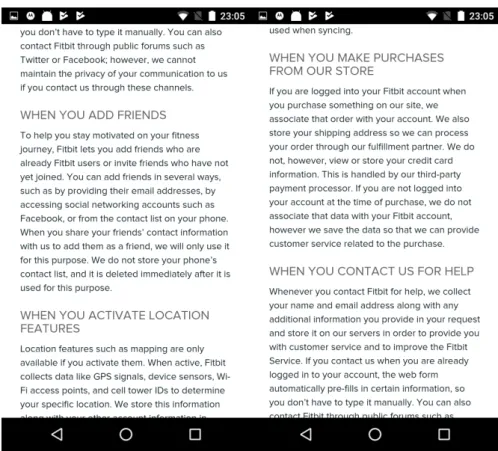
4.7 Fitbit privacy policy - sharing data with third parties. . . 94
4.8 Fitbit privacy policy - of how data is shared with friends and location details. 95 4.9 EmbodyDNA Kit . . . 96
4.10 DNA Report . . . 96
4.11 How Telematics insurance works . . . 97
4.12 Data collection in Drive smart telematics insurance. . . 100
4.13 DriveSmart permissions . . . 101
4.14 User rights. . . 101
4.15 How the app is used. . . 104
4.16 How the app works. . . 104
4.17 In app privacy policy showing how data is used. . . 106
4.18 In app privacy policy data sharing to third-parties . . . 106
5.1 Telematics components . . . 116
5.2 TRANK framework process flow. . . 117
5.3 TRANK framework. . . 118
5.4 Privacy requirements management . . . 120
5.5 Privacy goal trade-off analysis model . . . 124
5.6 EHealth Heart rate monitor data flow diagram. . . 124
5.7 Telematics insurance data flow diagram . . . 125
5.8 Example of a Threat tree . . . 126
5.9 Data collection score in eHealth apps . . . 131
6.1 Mobile Application Architecture. . . 142
6.2 TRANK Mobile Application Architecture Design. . . 143
6.3 TRANK Mobile Application Architecture. . . 144
6.4 TRANK Based Privacy Component. . . 147
6.5 Trank Data Flow. . . 148
6.6 EHealth User integration. . . 149
6.7 Telematics components . . . 149
6.8 Prototype Requirements modelling using TRANK . . . 150
6.9 Integration of TRANK in the Prototype Architecture and Implementation 150 6.10 eHealth Overview. . . 153
6.11 eHealth Timeline. . . 153
6.12 eHealth demo Data Activity. . . 154
6.13 eHealth demo Privacy Settings. . . 154
6.14 TRANK Privacy Data Flow. . . 154
6.15 Response to Question 1 and 2 . . . 166
6.16 Result 1 and 2 . . . 167
6.17 Result 3 and 4 . . . 167
6.18 Result 5 and 6 . . . 168
6.19 Result 7 and 8 . . . 168
6.20 Result 9 and 10 . . . 168
1 eHealth Class diagram . . . 205
2 Participant consent form . . . 208
List of Tables
4.1 Mapping of Data flow diagram to potential threats . . . 71
4.2 Telematic threats modeling . . . 71
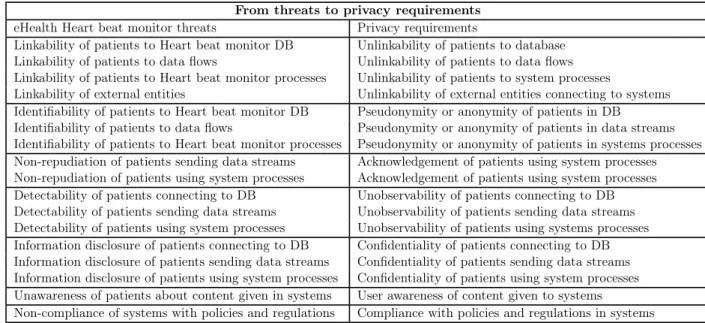
4.3 Deriving privacy requirements from threats . . . 72
4.4 Advantages and drawbacks of LINDDUN privacy-requirements modelling . 73 4.5 Data collected by fitness apps . . . 81
4.6 Sensors used in fitness trackers . . . 81
4.7 Fitbit privacy policy . . . 82
4.8 eHealth heart beat monitor threats modeling . . . 84
4.9 Mapping of Heart beat Data flow diagram to potential threats . . . 84
4.10 Deriving privacy requirements from threats . . . 85
4.11 eHealth apps . . . 88
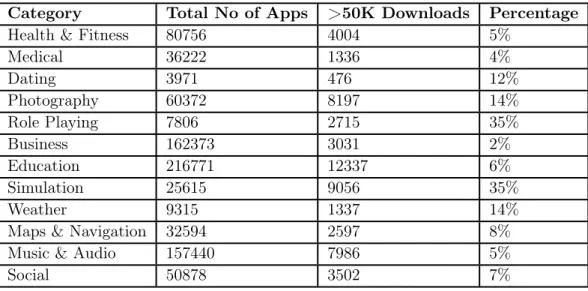
4.12 Number of apps downloaded in a category . . . 88
4.13 Snippet from 7 cups Privacy policy Browser information . . . 91
4.14 Snippet from 7 cups Privacy policy . . . 91
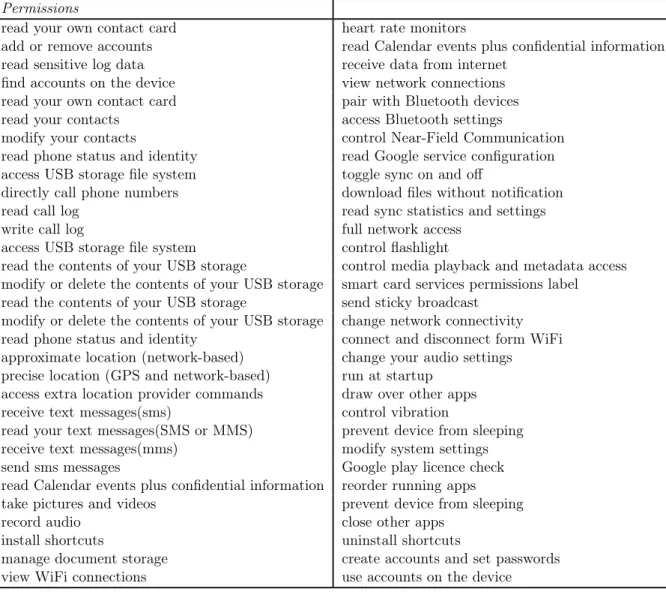
4.15 Example of Permissions extracted . . . 92
4.16 Nike Training Permissions . . . 93
4.17 Depression CBT Permissions . . . 93
4.18 MySugr Permissions . . . 94
4.19 Telematics Insurance apps . . . 98
4.20 Marmalade Telematics insurance Permissions . . . 102
5.1 Modeling privacy goals. . . 123
5.2 Privacy functionality matrix template . . . 126
5.3 An example of a privacy functionality matrix for Telematics application . 127 5.4 Privacy functionality matrix for eHealth Heart beat monitor application . 128 5.5 eHealth app scores before and after using TRANK . . . 135
5.6 Telematics app scores before and after using TRANK . . . 136
5.7 Paired Samples Statistics for eHealth after using The TRANK framework. 137 5.8 Paired differences for eHealth after using the TRANK framework . . . 137
6.1 Privacy Survey . . . 160
6.2 System Usability Scale Statements [1] . . . 164
6.3 Modified SUS questions used in the survey . . . 164
6.4 Sample Results obtained . . . 165
6.5 Points assigned . . . 165
6.6 Calculated points . . . 166
6.7 System Usability Scores . . . 170
1 App permissions . . . 203
Chapter 1
Introduction
1.1
Overview
Mobile applications are used for a range of online services across private and commercial domains. These domains need to be secured and resilient to face challenges of privacy leakages, privacy misconfigurations, cyber security attacks and system failures. Current mobile applications have, however, faced a lot of criticism about unauthorized and unintentional transfer of sensitive data due to misconfigured back ends, data sharing and transfer to third-party service providers. In particular, the range of beneficial opportunities and functional properties offered by mobile applications such as communication through OSNs, easy accessibility, better functionality, business enhancement, introduce a number of privacy and security vulnerabilities. An indirect drawback lies within mobile applications dependency on the Internet where privacy protection has been extensively studied but still faces setbacks.
Data privacy in mobile applications significantly depends on how applications are designed and implemented. Mobile applications generally operate using operating systems that are installed on handheld devices (e.g. phones, tablets, wearables, smart-watches e.t.c) with a plethora of programs running on them. The handheld devices employ various sensors ranging from geo-location sensors (and other sensors e.g., cameras, microphones, accelerometers, motion sensors) to heartbeat sensors as depicted in eHealth
Chapter 1 Aims applications. These applications acquire a lot of personal and sensitive data from their users. This data is often transmitted to large service providers and third parties without users' knowledge leading to a variety of data privacy concerns. Such type of data can easily be intercepted if not securely transmitted and stored leading to massive data breaches. In addition, due to the different applications that run on these devices e.g. geo-location applications, users are easily tracked based on their daily movements. Furthermore, an immense amount of data is transmitted to online data collection companies e.g., OSN companies and users have been subjected to total surveillance [Bat19] Most of the applications are connected to the Internet, with a constant connection to various applications like search engines, geolocation applications and Online Social Networks (OSN) companies like data brokers and third-party service providers use the collected data to provide targeted ads. Consequently, there has been a surge of privacy data breaches in recent years due to the huge volumes of data collected and the high numbers of users connected to such networks. This thesis aims at enhancing privacy preservation in current and future mobile applications by introducing a privacy design framework which employs privacy-by-design through the whole application development lifecycle.
We introduce a trade-off analysis framework that aids application designers in con-sidering the tradeoff between privacy and functionality during system development in an attempt to deliver privacy aware applications that minimize data collection while maintaining application functionality. This way privacy challenges in current mobile applications can be solved to protect user privacy.
1.2
Aims
Future mobile applications must be designed in such a way that privacy enhancing mechanisms are integrated at the go and are pro-active and not only re-active to any data breaches that occur. Users should be aware of the data they provide to data processing companies and should be able to consent to which data they provide. The aim of this thesis therefore is to:
Chapter 1 Motivation • Create a framework that designs privacy-aware applications to reduce the amount
of personal data collected by mobile applications.
• Aid application designers in decision making about privacy preservation in the early stages of system development.
• Aid developers improve the privacy-aware design of mobile applications.
• To expand and contribute towards transferable knowledge in the context of privacy and particularly for data privacy in mobile applications
For the above aims to be achieved, the main technical objective of this thesis is to present a framework that aids application developers in designing privacy-aware applications at the initial stages of system development. In the following, we elaborate on some of the challenges and privacy breaches that have manifested in modern mobile applications.
1.3
Motivation
Mobile communication systems are composed of voice and multimedia data transmitted over wireless communication technologies. In recent years, we have seen a surge of privacy and security attacks in mobile communications leading to both financial and personal information loss. Mobile apps are the main focus of this research because of their evolving nature. Due to their rapid development they require special attention because they run on multiple platforms that are often hard to operate on various devices. This pervasive property of mobile applications therefore, makes the development of privacy and security across the multi platforms very challenging.
Although organizations are constantly improving their systems in terms of privacy preservation, data breaches have continued to occur. This may occur when privacy attacks are caused by a third party or through breaches of privacy trust by data collectors. Privacy attacks caused by third parties are illegal whereas the breach of privacy trust by data collectors is permissible under the terms and conditions of the agreement with the
Chapter 1 Motivation company. This is usually included in privacy policies and often read by users or generally accepted without knowing the consequences.
We consider both aspects of data breaches similarly as they all lead to damage and privacy abuse. The cost of damages caused increases continuously. It is estimated that the average cost of a data breach in 2017 was 3.5 million dollars. This was explicitly depicted by the drop of Yahoos market price by 350 million dollars when Verizon bought it in 2017 after it was reported that, 3bn records had been stolen by hackers [2].
The records included personally identifiable information such as names, telephone numbers, dates of birth, email addresses, hashed passwords and security questions and answers to the questions. The breach was done by using false cookies which gained access to users accounts without using a password. Hackers were able to impersonate themselves as the owners of the email accounts leading to massive data theft. To date, this is regarded as the worst data breach in history [3]. The past years have proved that online data we assume to be in safe hands is not as safe as we thought it to be. We have seen massive record theft from big companies ranging from Online Social Networks to business and medical bodies. In the following we elaborate on major data breaches that have occured in recent years.
Online Social Networks: Online Social Networks(OSN) have increased in the last
decade e.g., Facebook, Myspace, Twitter, Instagram, Snapchat which have a large number of users, however, these have been targeted as they do collect a lot of personal data. The interconnection to friends profiles' allows hackers to extract large amounts of data from the network. One of the major OSN data breaches was hit by Facebook in 2018 when 50 million user accounts were harvested by Cambridge Analytica a data analytics firm and used to manipulate voters during the 2016 US election campaigns and the Brexit vote [4]. This caused a market share price drop of 3\% on the stock market [5].
In another OSN incident, Myspace reported that approximately 427 million records were leaked accessing usernames, passwords, and email addresses in 2016. Although Myspace is considered as a dormant OSN, unfortunately, user data is never deleted and data breaches may occur without users actively using the OSN. Not only do data breaches
Chapter 1 Motivation occur in large data housing companies, in addition to this some companies do not disclose the data breaches to their customers. Google+ exposed 497,000 data records in 2018, which consisted of full names, birth dates, profile photos, places lived, occupation and relationship status. The data breach enabled third-party applications to pull data from users and their friends. As a result, all user functionality was closed down. Nevertheless, Google+ chose to cover up the data breach to avoid any regulatory scrutiny.
Medical data breaches: In the medical sector, it is estimated that securing healthcare
systems will gradually increase and exceed 65B [6] in an effort to avoid being attacked. Medicaid, one of the Centers for Medicare and Medic agencies in the USA has been a major target for attacks. In 2017, Molina a Medicaid insurer, shut down its patient portal after a major data leak exposed patients records. A total of 4.8 million records were compromised which included, diagnosis, medication, dates of birth, names, and addresses. This follows that, whoever, had access to these records is able to identify the patients' addresses and their diagnosis [7].
In a similar incident, 21st Century Oncology a cancer healthcare provider based in Florida was targeted by hackers who stole 2.2 million patient records. The records included names, physician names, treatment plans, social security numbers, and insurance data [8]. In May 2018, UnityPoint Health based in Iowa reported a data breach caused by an email phishing attack which affected 1.4 million records. This is so far the largest medical data breach in 2018. Emails accounts were compromised and were responded to by staff therein giving away a lot of sensitive data to the hackers. MyHeritage genealogy site was hacked in 2017 and 92 million user accounts which included email addresses and hashed passwords. The compromised data was found on a private server under a file name called "MyHeritage". Although MyHeritage acted fast in informing its users, the data set can still be used for illegal purposes. Not only private companies have been a focus of such data breaches, but government bodies have been targeted as was seen in Singapore. This attack led to 1.5 million patients being compromised including those of the prime minister from the Singapore government's health database [9].
Chapter 1 Motivation hard to stop and prosecute. In the UK, a group called Dark Overload comprised celebrity and Royal family data records from a prominent surgery facility called the London Bridge Plastic Surgery Clinic. Intimate health records such as plastic surgery before and after images, genital modification images, breast enhancement information were sent to the media to prove that they had stolen the data [10].
What is worrying about the scale of health data theft is that patients suffer from data breach consequences and the physical pain of the illnesses they are diagnosed with, which are sometimes terminal. In addition, health care data is permanent and cannot be changed like in the case of passwords or credit card numbers. This explains why medical data is sold at a higher price on untraceable black market websites like the Darkweb.
Dating sites: Dating in the 21st century has changed in various ways but the most
significant of all are the mushrooming mobile dating applications online e.g. Bumble, Happn, Hinge, Badoo, Tinder, Grindr, Match, eharmony to mention but a few. These dating sites collect a lot of intimate data used to match users with best-qualifying partners. Data collected includes geo-location data for matching users with partners in the neighborhood, pictures, interests, particulars of partners one is interested in, Facebook IDs, names, email addresses, facebook likes e.t.c. This type of personal data easily attracts hackers and if not properly secured can be leaked to the public as intruders are constantly searching for loopholes to compromise the networks.
In 2014, Tinder a major mobile dating app exposed the geo-locations, Facebook IDS, gender, birthdates, and username of its customers. Tinder connects to Facebook to mine data from users and their friends' profiles. This interconnection makes personal data susceptible to a lot of data breaches that may occur both in Facebook accounts as well as Tinder accounts.
In another incident, the gay dating app Grindr was reported to have exposed the HIV status and geolocation data of its customers to third party companies. Its surprising to know how much private information users are willing to submit on dating apps. For example, Tinder asks for the details of HIV prevention and exact HIV status which in turn is used to match with others. Details of the medication users are on, or if the viral
Chapter 1 Motivation load is low and HIV can't be transmitted are also required. This means that whoever got access to this data could identify the exact location and HIV status and medication used by the individual [11].
Fitness application data breaches: The emergence of eHealth apps or mobile
health apps has created new revenue generating opportunities for medical companies in fields like diabetic management by enabling consumers to monitor their health status continuously. These apps are a big relief to customers and offer very good services towards health care management. However, current medical apps have continuously collected personal and sensitive data without traditional scrutiny from medical bodies. The most used eHealth apps are fitness apps. Several data breaches have been reported in fitness apps. The Under Amour data breach from its fitness nutrition app MyFitnesspal exposed 150 million data records. The app however exposed partial information of the dataset comprising of usernames, passwords, and addresses. Other identifiable information like location information and credit card numbers was not leaked thus reducing the damage caused [12].
Another fitness app that has reported data breaches is Pumpup, which exposed 6 million records of user data like health data, emails, credit cards, location data, facebook accounts, private conversations. The data sets were stored on Amazon cloud infrastructure through an insecure server [13].
In November 2017, Strava a fitness tracking app released a heat map which shows the activity of its users online. This, however, raised a lot of privacy concerns. The app was able to expose the activity of military personnel in military bases of war tone areas like Afghanistan. Thus, endangering personnel in case of a counter-attack from terrorists [14].
Most of the fitness apps are connected to Online Social Networks (OSNs) which are used to register users. A good example of users' unawareness is that of a Reddit user. He asked for advice from Fitbit users about his wife's device which was faulty due to changes in the Fitbit tracking measurements. He was surprised to be informed that his wife might be pregnant which was revealed to be true [15]. This indicates that users are not well informed about the implications of the data they provide to app companies.
Chapter 1 Motivation Privacy concerns also emerge from data collection done in weightloss apps which provide solutions to weight loss using genetic data. EnbodyDNA a product of the weightloss app Lose it!, promises weight loss by determining the gene responsible for losing weight. However, the field of personal genetics is unregulated and users do not understand who owns the DNA information. The gene information is sent by post without any information about who has access to it. It is reported that most genetic testing companies sell user data to third party service providers although users assume its protected [16].
Business domain data breaches: In the business entity, several companies e.g.
E-commerce companies have been hacked into worldwide, for example, banks, online businesses, credit card companies, ticket vending companies, airline companies, telecom-munication companies e.t.c. E-Business and E-commerce applications have exponentially increased in past years. We have seen a rise in Online shops of 80\% for internet users in the UK alone with key major players like Amazon, eBay, Alibaba, Rakuten, Etsy, Craigslist, eBid. These applications require personal private data in order to do Business-to-Business (B2B) and Business-to-Customer (B2C) transactions.
Some of the data collected include credit card numbers, products bought, email addresses, delivery, and payment addresses e.t.c. Companies like Amazon have increased their advertising potential by using initiatives like amazon prime which also has led to the increase in customers and thus buying online. The gradual increase in the number of online customers and online shopping has led to many of the small retail stores on the high-street closing down.
However, apart from this concern, users are getting troubled about the data being collected while shopping online. The information collected is used to tailor users preferences according to details like credit card numbers, postcodes, products bought online e.t.c. The profiling is used to send tailored adverts to users' websites and mailboxes. This is mainly done by third parties. It is not yet clear how large data collection companies on the market deal with user data. These companies sell user data like browsing history, online shop email accounts, credit card history, marital status, postcodes to third-party providers and data brokers for the purpose of advertising. Concerns over the trading of
Chapter 1 Motivation credit card details on the black market and on illegal sites like Dark Web for as cheap as \pounds 11 are increasing [17].
The credit monitoring company Equifax faced one of the major data breaches that exposed a lot of information. Hackers compromised 146.6 million records including social security numbers, credit card numbers, birthdates, drivers license numbers, passports. This is half of the US population. This leaked information may affect customers who need verification from financial creditors to acquire loans once the data gets manipulated [18]. Another major e-business domain worth mentioning is that of online banking. More banks are encouraging customers to sign onto online banking. Customers download online banking apps on their mobile phones regularly and banks encourage customers to sign onto online banking.
Although mobile banking apps are secured, fingerprinting methods can be used to track user behavior online using features like the operating systems, email addresses, gadget type, screen size e.t.c. Certain plugins are able to track user behavior between different browsers, for example, some banking institutions are known for using cookies that could potentially distinguish where a customer has a second bank account based on the browser information and activity.
Most users are not aware of this and are constantly monitored without their permission and knowledge. Therefore, users have to take caution in what type of information they provide in online banking and how they do online transactions keeping in mind the data privacy preferences.
The banking sector has been actively targeted, as was reported in May of 2018 by two large Canadian banks Simpli Financial and Bank of Montreal. The two banks were hacked and its estimated that a total of 90,000 clients lost their data which included personal and account information [19].
Airline companies have also been a target of online hackers. In the summer of 2018, British Airways was hit by a data breach which saw 380,000 transactions made through BA.com while making bookings and changes compromised. Holiday makers were disrupted by the data breach as they were advised by BA to contact their banks or credit card,
Chapter 1 Motivation providers. Data stolen included email addresses, names, credit card numbers, CVV numbers found at the back of the credit cards and expiration dates. Customers were advised to either close their credit card accounts or monitor transactions on their accounts closely.
In general, there is a lack of privacy regulation and controls while designing mobile applications as we have seen in the above-mentioned data breaches. In for example, the eHealth domain, medical apps have been introduced to aid in patients analysis and disease management. The major concern though is that many of these apps do not go through stringent traditional quality controls and scrutiny from medical organizations, although they do collect a lot of private and personal sensitive data.
Similarly, modern apps e.g. vehicular applications are composed of inbuilt sensors which are capable of tracking location, social behavior and monitoring of day to day activities. The collected data is used to infer personal and social movements thereby generating a lot of privacy concerns. In addition to the sensor data, Vehicle-to-Everything (V2X) systems have introduced apps to offer services like telematics insurance to their
customers. However, no limitations are put in using geolocation data.
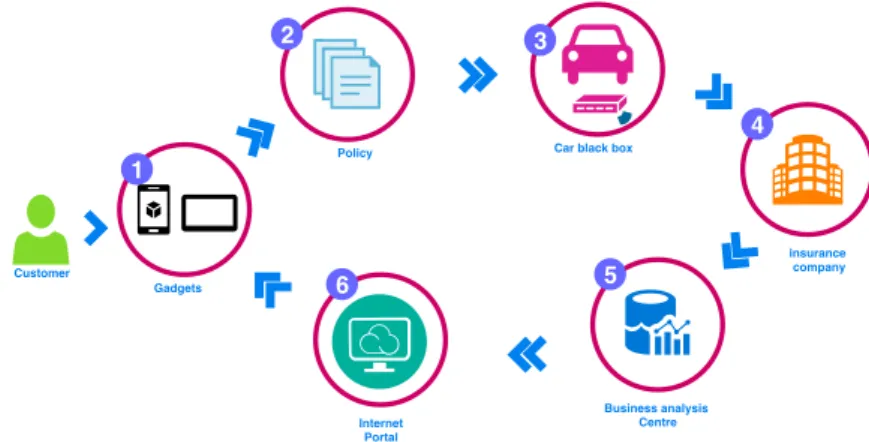
Telematics insurance apps: Another emerging automotive technology is that of
telematics insurance. Telematics insurance applications are on demand as they provide cheaper alternative insurance policies compared to the traditional car insurance policies. Privacy concerns have arisen as users are of the opinion that telematics insurance companies are constantly tracking and monitoring them. Additionally, drivers have concerns about their data being sold to third-party service providers without their consent. In this thesis, we focus on telematics mobile applications and investigate the privacy concerns related to using mobile applications.
In practice, apps have to follow stringent privacy requirements by providing privacy policies and open privacy practices. However, a major privacy concern that arises is whether current apps depict what is in the privacy policies they provide to their users? It is reported that privacy policies of tech giants like Yahoo, Facebook and Google are still not GDPR compliant much as the GDPR was enforced in May 2018.
Chapter 1 Problem statement Due to the data breaches named above, privacy awareness has become a major concern in recent years as companies continue to collect data without users consent. There is continuous monitoring of users through third-party companies which are outsourced to provide services to Online Social Networks (OSN).
User's location and demographic location have been used to profile users as has been seen by the Cambridge Analytica data scandal [20]. In this work, we investigate current privacy breaches in mobile apps and aim in finding solutions to existing privacy challenges faced in designing mobile applications.
1.4
Problem statement
Mobile applications and smart devices have become household items for the majority of the population. It is estimated that more than 60\% of the world's population owns a mobile phone. Consequently, there has been a multitude of mobile applications developed and uploaded on to the Android market known as the Google Play store. However, these mobile applications come with privacy-related challenges. Android applications may reveal private data to both third-party applications or app developers.
Android apps use permissions to implement security and privacy. Much as the permissions are well structured in restricting the apps not to access user's data, some apps leak personal data to third-party service providers [21]. Furthermore, users are not aware of how this data is used by app designers and third party applications.
Users are advised to authorize third-party service providers before their personal data is shared as envisaged by the EU 2016/679 General Data Protection Regulation (GDPR). Such privacy preserving measures have been enacted by the EU legislative bodies. However, data brokers and third-party service providers continue to share and sell customers personal and private data [22]. Users are not explicitly told of the data and the implications of this data being collected.
The key problems of current mobile application development considered in the scope of this research therefore are:
Chapter 1 Thesis Overview • A lack of transparency from the mobile data companies that collect and store the
data and subsequently share it with third parties without users consent.
• Lack of privacy policy implementation and control both at the application level and requirements and goals development level.
• Improper application design which does not integrate privacy enhancing technologies and privacy-by-design methodologies at the initial stages of system development There is a significant gap in the way applications are designed and how users data is transmitted, stored and managed. The above incidences highlight the need for the design of less privacy-invasive applications. In this work, we address these challenges by investigating data collection, privacy policies, and privacy control measures to get an insight into the design and privacy implementations employed in current mobile applications. The main purpose of our study is to provide a framework named TRANK, for designing privacy-aware mobile applications. Through the TRANK framework we will expand and contribute towards practical knowledge on designing and implementing future mobile applications.
In detail, the framework;
• Defines privacy, functional and performance goals and designs privacy requirements using the privacy-by-design notion of the planned application.
• Reviews and redesigns conflicting goals and requirements to meet privacy preserving standards.
• Performs a functionality, privacy and performance trade-off analysis.
1.5
Thesis Overview
This thesis is structured as follows: In chapter 2 we present the background and related work of the research we have done in this thesis. Chapter 3 elaborates on the research methodology and provides the research methods used. Chapter 4 presents the contributions presented in this study which involve two major empirical studies based on two case
Chapter 1 Summary studies; the eHealth case study and a telematics case study used to investigate current mobile applications on the market. Chapter 5 presents a privacy aware trade-off analysis framework (TRANK) which is the core of this thesis. In chapter 6 we provide the technical implementation of TRANK in form of two mobile applications that act as a proof of concept for the framework and further presents an evaluation of the research done in this thesis considering the state-of-art of current mobile applications and the design of privacy aware applications. Finally chapter 7 gives conclusions to this thesis and future prospects that need to be considered while building privacy-by-design mobile applications.
1.6
Summary
This chapter provides an introduction to this thesis which attempts to address privacy and security challenges of current mobile This chapter provides an introduction to this thesis which attempts to address the privacy and security challenges of current mobile applications. The motivation section identifies our focus on the privacy-related data breaches that have occurred in mobile applications. The data breaches have been reported both in the media and by regulatory bodies. We elaborate that all technology-based domains are affected by privacy and security flaws that influence both user privacy and the way businesses are done. In particular, we have discussed the major breaches that have affected user privacy and security which are caused by systems not being properly designed and secured. This section presents an extensive discussion of the data breaches and emphasizes that measures have to be taken to address these issues in an attempt to reduce the data breaches. In the Problem Statement section, we identify the major problems faced through the use of mobile applications followed by the Aims and Objectives of this thesis. Next, we present a Thesis Structure of this work and finally we conclude with a brief summary of this chapter.
Chapter 2
Background and related work
This chapter presents background information on privacy-preserving mechanisms applied in general privacy research, which we think plays a great role in designing mobile applications.
Privacy research: One of the most influential definitions of privacy in previous research
is that of legal scholar Alan Westin. He defines privacy as: ``the claim of individuals, groups or institutions to determine for themselves when, how, and to what extent information about them is communicated to others'' [23]. Considering this definition, we need to understand how privacy is achieved. Privacy has been extensively discussed in previous research because individuals are becoming increasingly concerned about their personal data. Researchers have come up with various approaches to address this, such as the use of Public Key Infrastructures (PKI) used for encryption [24], firewalls [25], intrusion-detection systems [26], privacy-by-design [27]( that is privacy-by-architecture and privacy-by-policy) approaches or privacy-enhancing technologies (PET) [28] to ensure privacy.
Although these approaches have been commonly adopted, experience has shown that IT infrastructure systems cannot be protected by such defences alone. We have seen significant numbers of privacy breach incidents in social media, credit card corporations etc. Social media companies are attacked repeatedly; for example, in 2013, nearly 2 million accounts' user names and passwords were reported stolen from social media giants Facebook, Google, Yahoo and LinkedIn, and other websites. Similarly, almost 40 million
Chapter 2
credit cards' and debit cards' personal identification numbers (PINs) were stolen from the second-largest American retail corporation, Target [29]. Such privacy breaches have led to the adoption of privacy-enhancing technologies. A privacy-enhancing technology (PET) can be defined as: `` a system of Information Communication Technology (ICT) measures protecting informational privacy by eliminating or minimizing personal data thereby preventing unnecessary or unwanted processing of personal data, without the loss of the functionality of the information system'' [28].
PETs include, among others, data-anonymization methods, data-separation methods and authorization concepts that are decided upon by users and access controls. PETs allow individuals to make decisions about how their personal data can be processed and, most importantly, accommodate the principle of data minimization for personal information. Next, we present the background concepts and terminologies related to this thesis.
1. Goal modeling: One of the biggest challenges of privacy modeling is related to
the adequate identification of privacy goals that do not negatively interfere with the functionality of mobile applications. To date, existing approaches have focused on goal oriented frameworks in the security domain, for the analysis and design of system software. These include UML, the Knowledge Acquisition in Automated Framework (KAOS) [30], the i* framework [31], Tropos and NFRF framework as explained in [32]. Our research focuses on privacy goal modeling to analyse privacy goals and concerns in mobile applications.
2. Privacy requirements modeling: Several privacy requirements methodologies
have been employed in the literature, for example, LINDDUN [33] and Pris [34]. However, designing systems to meet privacy requirements is challenging and this is why privacy modeling is inevitable. Initiatives like theThe fair Information Practice Principles (FIPP) privacy guidelines [35] are therefore important to ensure that
privacy measures are met. FIPPs are used as a guideline to protect privacy especially how online companies collect and use personal data. Our approach however uses a privacy and functionality trade-off matrix to improve privacy design in mobile apps.
Chapter 2
• Requirements modelling in Automotive industrial standards: Common prac-tices in requirements engineering focuses on functional requirements, functional safety requirements and security requirements. In the automotive industrial settings, goals are defined using Automotive SPICE which is a status deter-mination and risk assessment tool [36]. In addition to these methodologies, requirements engineering management is performed with the management tool: IBM Dynamic Object Oriented Requirements Management System (DOORS) Next generation. We employed IBM DOORS for requirements management in V2X telematics application design.
• Requirements modelling in eHealth apps: Google Play Store has guidelines on designing privacy policies for all apps that are to be published on the Google play website. We observed a variety of tools used to design requirements in current apps ranging from using mockups tools like mockplus [37] to using wireframes with tools like Balsamiq [38] for designing the requirements speci-fication document. We applied mockplus to model requirements for eHealth applications. However, more research is required to design privacy requirements during the initial stages of eHealth app development.
3. Trade-off analysis methods: A trade off analysis explores situations in which
factors are not attainable at the same time. This must be solved by balancing two opposite situations or qualities to get a best match. Several approaches have been proposed to model and analyse architectural and security requirements trade-offs. These include the Architecture trade-off Analysis (ATAM) [39], and the Security Verification and solution Design Trade-off analysis approach (SVDT) [40]. However, managing privacy trade-offs has not been extensively studied in existing literature. Our approach focuses on the design of a privacy trade-off at the initial stages of mobile applications development with a focus on app functionality, data collection and privacy policies and how these impact privacy preservation in modern applications.
Chapter 2 Privacy-by-design concepts
2.1
Privacy-by-design concepts
This section presents three major privacy design concepts which are based on the paradigm of designing mobile application by implementing by-default. The term privacy-by-default in this thesis, relates to designing mobile applications according to privacy-by-architecture and privacy-by-policy. These privacy design concepts are crucial in
imple-menting privacy and data protection at the initial stages of system development. They are part of the privacy and data protection law and emphasize that privacy should be considered upfront while designing mobile applications. Technical and organizational measures should be implemented in advance in the development life-cycle to ensure user privacy is protected. In particular this means that companies have to integrate privacy protection technologies through the whole system development cycle. Privacy has to be integrated by default in the seven phases of the development life-cycle which are; system planning, requirements analysis, system design, system development, testing, system deployment and system maintenance. Companies and organizations that collect, store, control and process data must be committed to establish a privacy aware culture through out the whole companies processes. This must be done for example, by training staff on privacy protection measures and techniques. The privacy-by default concept, therefore, plays a significant role in designing current mobile applications due to the massive data collection involved. To curb privacy concerns significant efforts have been made in research and development to improve these concepts [27] [41], [42]. This thesis, explores to which extent these concepts have been implemented in current mobile applications. In the following, we will elaborate in detail on these concepts to clearly understand the related background terminologies used. First, we outline some of the organizations and bodies that regulate privacy development.
Privacy regulation bodies and principlesThere exists a number of privacy
regula-tion bodies and privacy principles that have been developed to assist in the implementaregula-tion of privacy in both industry and legal frameworks. The most recent development that has attracted major attention is the introduction of the EU General Data Protection Regulation (GDPR) 2016/697, in May 2018. GDPR is discussed extensively in section
Chapter 2 Privacy-by-design concepts 2.4. Several other principles also exist, these include Fair Information Practice Principles (FIPPs). FIPPs are a set of standards used to monitor the collection of personal data across different countries. They comprise eight major principles which guide companies on how they may use personal information in business transaction processes. Another privacy implementation body's principles worth mentioning are the Organization for Economic Cooperation and Development (OECD) privacy principles, which consist of privacy and data protection laws agreed upon by OECD member countries. Similar principles have been generated by the Asia-Pacific Economic Cooperation (APEC). APEC devised the APEC privacy framework to safeguard information privacy across its 21 member states. The protection of privacy has become a major concern, especially as companies have continued to collect users' data without their consent. The current increase in privacy breaches has, therefore, resulted in governments and legislature bodies, working in part-nership with commercial bodies, intervening in order to protect user data. A set of key principles that have been adopted are the Generally Accepted Privacy Principles (GAPPs) [43]. GAPPs were developed by a privacy task force of the American Institute of Certified Public Accountants and the Canadian Institute of Chartered Accountants to address the challenges companies were facing through privacy breaches. GAPPs comprise 10 major principles which organizations can use to protect user privacy, especially personal identifiable information and protected health information.
These organizations play a major role in regulating privacy preservation on a general basis, we will now give an overview of the privacy-by-design concepts used in this thesis in detail, that is privacy-by-architecture and privacy-by-policy.
2.1.1 Privacy-by-architecture
Privacy-by-architecture approaches aim at protecting data by using techniques like cryp-tography, zero-knowledge proofs and pseudonyms, that prevent attackers from accessing data. A pseudonym is an identifier of a subject, in the setting of the sender or recipient, other than one of the subject's real name. A subject is pseudonymous if a pseudonym is used as an identifier instead of one of its real names. Pseudonyms are a set of short-term
Chapter 2 Privacy-by-design concepts identifiers that ensure privacy of the user by hiding the real identity of the sender. The privacy-by-architecture approach was initially introduced in [27]. Spiekermann and Cranor presented guidelines for building privacy-friendly systems usingprivacy-by-architecture.
The method for addressingprivacy-by-architecture minimizes the collection of personal
data and emphasizes randomization, client-side data storage and processing. This involves using client-centric architectures which embed anonymous transactions that prevent adversaries from performing unauthorized access controls. Privacy-by-architecture em-ploys anonymity based technologies which focus on protecting user identity. In practice, pseudonyms is used to protect Personally Identifiable Information (PII).
Data obfuscation technologies are further used to prevent linking PII to individuals. This may be done by creating ambiguous applications to prevent reverse engineering applications and linking information back to the source. Several research approaches have been proposed to design systems using privacy-by-architecture techniques especially pseudonyms. There are four major categories of pseudonym schemes, namely: (1) based on asymmetric cryptography, (2) based on identity-based cryptography, (3) based on group signatures, (4) based on symmetric cryptography. In the following we elaborate on some of the research where pseudonyms have been used to design applications based on the privacy-by-architecture concept in the vehicular communication domain.
Petit et al. [44] conduct a survey of pseudonym schemes in vehicular networks. The authors categorize pseudonym schemes based on the cryptographic means they employ. The four major categories are schemes based on asymmetric cryptography, schemes based on identity-based cryptography, schemes based on symmetric cryptography and group-signature schemes. They propose an abstract pseudonym life cycle, make a comparison of the various schemes and present their advantages and disadvantages. However, there is no detailed discussion of multi-domain privacy in this work.
Feiri et al. [45] outline problems specific to the real-world deployment of pseudonyms in vehicular networks. The authors find that using pseudonyms does not guarantee privacy, as vehicles are attached to short-term identities to provide accountability and non-repudiation. Although passengers expect privacy in the form of anonymity, pseudonym-change strategies
Chapter 2 Privacy-by-design concepts only offer unlinkability with small immobile adversaries. They stress that it might be necessary to find out whether the cost and complexity of using pseudonyms is worth the limited level of privacy achieved. This paper does not provide any evaluation concerning privacy in cross-domain settings of V2X communication.
Fonseca et al. [46] propose a multi-layer scheme which provides privacy at different layers and packet-forwarding schemes that employ packet-caching. Their scheme employs an extended location service which uses a secure routing protocol to provide message authentication based on digital signatures and asymmetric cryptography. They present four major solutions based on: (1) a cross-layer addressing concept (2) an extended location service (3) pseudonymity-enhanced packet forwarding and (4) link-layer callbacks. Their proof of concept of an OBU communication system observed that a delay in the packet forwarding-process during pseudonym changes can be reduced to enable unicast communications. Although this approach offers an enhanced packet-forwarding scheme based on pseudonym-caching, this may lead to an increase in the communication overhead. In addition, it employs a unicast wireless multi-hop connection between two nodes and geocast broadcasting of data packets, which are susceptible to geo-location tracking, thus endangering users' privacy.
Foerster et al. [47] present three privacy-preserving approaches, namely, the basic pseudonym scheme, the PUCA scheme and a credentials-based approach. The PUCA scheme implements full anonymity and uses anonymous credentials for privacy-friendly authentication with back-end providers when requesting pseudonym certificates. A question left unanswered is how privacy-preserving mechanisms used to protect back-end servers, especially for users data traversing multiple domains, are to be implemented.
Armknecht et al. [48] propose the use of PKI+ as a solution to enhancing cross-layer privacy. They observe that the use of PKI+ has an advantage due to the small data size resulting from the revocation of all its certificates, thus size of the communication overhead. Using PKI+ provides users with anonymity by applying OBUs that are linked to GIDs by an authority. Tracking is avoided by changing pseudonyms frequently, and since vehicles generate there own pseudonyms an adversary cannot link old pseudonyms
Chapter 2 Privacy-by-design concepts to new ones. Though this paper claims good cross-layer privacy results by employing PKI+, the paper does not provide an evaluation of the approach.
In [49], the Peer-to-Peer Anonymous Authentication (PPAA) scheme based on a group-signature scheme is proposed, in which a VANET is considered to be a P2P system. PPAA focuses on privacy and accountability; more notably, both clients and servers are peer users with privacy concerns. The study's major contribution is that peers are pseudonymous to one another but are anonymous and unlinkable to other peers in the network. This results in a high level of anonymity between peers, though a question that remains to be answered is how the revoking of misbehaving vehicles is to be solved.
Sun et al. [50] propose a pseudonymous authentication scheme (PASS), which reduces the revocation-cost and certificate-updating overhead by using hash chains to reduce the certificate revocation list (CRL). Their approach employs a proxy re-signature technique used for updating certificates. The authors disclose that in comparison to other related schemes, their approach has the smallest communication overhead and provides unlinka-bility between RSU and vehicles. However, it is not clear how the certificate authority (CA) is to manage issued certificates without having full control. The problem of having a single point of failure at the CA, which may be used to attack the system, still exists. Weimerskirch [51] distinguishes privacy in two major categories: Privacy against 3rd party entities and privacy against authorities. Privacy against 3rd party entities involves the use of pseudonyms to ensure anonymity and unlinkability. Privacy against authorities involves sharing of power by V2X authorities (e.g. certificate authority and registration authority) to enable the recovery of privacy-sensitive information. The paper neither provides an implementation nor an evaluation of the solutions mentioned, merely outlining concerns over privacy deployment in V2X systems.
Widersheim et al. [52] present an exploratory study of an attacker using a Multiple Hypothesis Tracking (MHT) approach to vehicular networks. The results show that even with changing pseudonyms, an attacker is able to track vehicles and relate pseudonyms to specific drivers, even under noisy data, thereby raising questions about the effectiveness of pseudonymous schemes in V2X networks and the level of achievable privacy protection.
Chapter 2 Privacy-by-design concepts Lu et al. present. [53] a pseudonym-changing strategy (PCS), which aims to achieve a high level of location privacy in areas where a lot of vehicles gather, for example at intersections, in parking areas or at traffic lights termed social spots. They develop anonymity-set analytical models and employ game theory to investigate the privacy levels attained by using a PCS strategy. Though their evaluation of changing pseudonyms at a small social spot (e.g an intersection) and a large large social spot ( e.g a parking area), they attempt to assess the problem of location privacy; however, there is lack of detail to solve the problem of privacy protection in mixed zones for both small and large social spots.
Qu et al. [54] present a review of VANETs and outline methods for providing vehicles with changing pseudonyms, which include preloading pseudonyms in tamper-proof devices (TPDs). The authors point out that these mechanisms are insufficient because vehicles need a large storage capacity to keep anonymous public keys. In addition, revoking malicious nodes uses a large storage space. The paper further notes that having pseudonyms using RSUs is insufficient if the limited wireless channel bandwidth is taken into consideration, because transmitting hundreds of certificates is difficult, especially with peak vehicle densities. The authors observe that using authentication to secure VANETS poses privacy risks to users and that many privacy protocols improve privacy at the cost of safety, as demonstrated by random silent periods. The paper conducts a review and provides no evaluation of the proposed methods for changing pseudonyms.
Feiri et al. [45] outline problems specific to the real-world deployment of pseudonyms in vehicular networks. The authors find that using pseudonyms does not guarantee privacy, as vehicles are attached to short-term identities to provide accountability and non-repudiation. Although passengers expect privacy in the form of anonymity, pseudonym-change strategies only offer unlinkability with small immobile adversaries. They stress that it might be necessary to find out whether the cost and complexity of using pseudonyms is worth the limited level of privacy achieved. This paper does not provide any evaluation concerning privacy in cross-domain settings of V2X communication.
Chapter 2 Privacy-by-design concepts technology for privacy protection in e-services. Their paper examines two types of pseudonym-technology requirements, namely, privacy-related requirements and security-related requirements. Under privacy-security-related requirements fall pseudonymity, unlinkability and property-sharing resistance. Security-related requirements, on the other hand, include authentication, security of users' secret keys and the security of protocols. The paper further lists important pseudonym technologies, such as e-cash, e-ticket and e-voting, and describes privacy applications that have been implemented in these systems to provide anonymity and unlinkability. However, there is no evaluation of the privacy technologies applied.
Karragianis et al. [56] undertake a detailed analysis of vehicular networks, including their characteristics, standardization efforts, projects undertaken (in Europe, Japan and USA) and finally the challenges faced in vehicular communication environments. Among other details, the authors observe that one of the solutions of solving linkability between pseudonyms is to use silent periods and the creation of groups that prevent messages sent in one group being listened to by vehicles in another group. The second solution given is to use mixed zones, which share a secret key. If vehicles leave the mixed zone, keys are exchanged, thus protecting location privacy. This survey, however, does not take into consideration the issue of data privacy in multiple domains of vehicular communication components.
Analogous to the vehicular domain, current mobile applications gather a lot sensitive data and face numerous privacy challenges. There is growing concern about the immense amounts of private data being collected and processed; thus, in an attempt to reduce potential privacy risks, the key challenge is to safeguard personal data during data flows across mobile application processes. This is the major drive behind this thesis. Much as anonymisation techniques have been used in other domains like mobile networks and Intellectual property to protect privacy by privacy-by-architecture, data collection companies continue to collect PII without such measures being put in place. The major drive behind this phenomenon is the use of online target advertising which greatly compromises user privacy. Therefore, we advocate for mobile application designers to
Chapter 2 Privacy-by-design concepts consider privacy protection while designing mobile application that involve sensitive data traversing multiple sources and domains during system development. Subsequently, mobile application development has to be regulated by legal entities that ensure that they are built based on standardized solutions to close the gap of building applications without integrating privacy-by-architecture.
2.1.2 Privacy-by-policy
Privacy-by-policy as described in [27] focuses on the notice and choice principle. Notice is the presentation of terms used in a document which may be presented as a privacy document with terms of the agreement or a privacy policy. Choice on the other hand is the the action of accepting the terms and conditions offered in the privacy document or policy by either signing the privacy document or clicking on an agree button e.g in an privacy policy given to data subjects online. User privacy depends on how the policies governing a system are integrated and managed in an organization. The notice and choice principle involves notifying data subjects of how there data is going to be used. They have a choice to either consent or decline. This highly depends on the way the system is designed and managed by system operators to enable user control, access control to collected data. In practice, companies tend to employ privacy-by-policy ordinarily than privacy-by-architecture as system administrators often lack the knowledge to design privacy preserving technologies. Therefore, there is a gap in educating system managers on how privacy can be enhanced in mobile applications. The other major gap facing current mobile applications is the assumption that the giant data collecting corporations can be trusted to protect the data they collect. Likewise, data subjects assume that the documents they sign while providing PII e.g. privacy policies can be enforced by government legal entities. This is not always the case as we have seen a number of privacy breaches and misuse done by giant corporations that have not been penalized. Therefore, data subjects have to be enlightened on privacy protection methodologies so that they can choose which type of data is subjected to data collecting companies. Next, we will elaborate more on the implementation of the privacy-by-policy concepts that have been
Chapter 2 Privacy-by-design concepts initiated legally as an effort to protect user privacy.
Privacy-by-policy from a legal perspective: Privacy-by-policy is regulated by
legal entities in order for the privacy documents and privacy policies to be effective. This thesis is based on the General Data Protection regulation (GDPR) and focuses mainly on the EU regulations. We have grouped the into two categories : legislature based on
Notice principles and legislature based on Choice principles.
EU data protection regulation from the perspective of Notice principles: The EU
data protection laws stipulate that data controllers have to inform data subjects about the data they collect and this is legally provided under article 14 of the General data protection regulation (GDPR) [57]. Below is an excerpt of article 14 which explains the legal measures to be taken before processing data.
1. Where personal data have not been obtained from the data subject, the controller shall provide the data subject with the following information:
(a) the identity and the contact details of the controller and, where applicable, of the controller's representative;
(b) the contact details of the data protection officer, where applicable;
(c) the purposes of the processing for which the personal data are intended as well as the legal basis for the processing;
(d) the categories of personal data concerned;
(e) the recipients or categories of recipients of the personal data, if any;
(f) where applicable, that the controller intends to transfer personal data to a recipient in a third country or international organization and the existence or absence of an adequacy decision by the Commission, or in the case of transfers referred to in Article 46 or 47, or the second sub paragraph of Article 49(1), reference to the appropriate or suitable safeguards and the means to obtain a copy of them or where they have been made available.
Chapter 2 Privacy-by-design concepts provide the data subject with the following information necessary to ensure fair and transparent processing in respect of the data subject:
(a) the period for which the personal data will be stored, or if that is not possible, the criteria used to determine that period;
(b) where the processing is based on point (f) of Article 6(1), the legitimate interests pursued by the controller or by a third party;
(c) the existence of the right to request from the controller access to and rectifica-tion or erasure of personal data or restricrectifica-tion of processing concerning the data subject and to object to processing as well as the right to data portability; (d) where processing is based on point (a) of Article 6(1) or point (a) of Article
9(2), the existence of the right to withdraw consent at any time, without affecting the lawfulness of processing based on consent before its withdrawal; (e) the right to lodge a complaint with a supervisory authority;
(f) from which source the personal data originate, and if applicable, whether it came from publicly accessible sources;
(g) the existence of automated decision-making, including profiling, referred to in Article 22(1) and (4) and, at least in those cases, meaningful information about the logic involved, as well as the significance and the envisaged consequences of such processing for the data subject.
3. The controller shall provide the information referred to in paragraphs 1 and 2: (a) within a reasonable period after obtaining the personal data, but at the latest
within one month, having regard to the specific circumstances in which the personal data are processed;
(b) if the personal data are to be used for communication with the data subject, at the latest at the time of the first communication to that data subject; or (c) if a disclosure to another recipient is envisaged, at the latest when the personal
Chapter 2 Privacy-by-design concepts 4. Where the controller intends to further process the personal data for a purpose other than that for which the personal data were obtained, the controller shall provide the data subject prior to that further processing with information on that other purpose and with any relevant further information as referred to in paragraph 2. 5. Paragraphs 1 to 4 shall not apply where and insofar as:
(a) the data subject already has the information;
(b) the provision of such information proves impossible or would involve a dis-proportionate effort, in particular for processing for archiving purposes in the public interest, scientific or historical research purposes or statistical purposes, subject to the conditions and safeguards referred to in Article 89(1) or in so far as the obligation referred to in paragraph 1 of this Article is likely to render impossible or seriously impair the achievement of the objectives of that processing. In such cases the controller shall take appropriate measures to protect t