Procedia Environmental Sciences 12 ( 2012 ) 810 – 814
1878-0296 © 2011 Published by Elsevier B.V. Selection and/or peer-review under responsibility of National University of Singapore. doi: 10.1016/j.proenv.2012.01.352
2011 International Conference on Environmental Science and Engineering
(ICESE 2011)
An Outlier Mining Algorithm Based on Dissimilarity*
Ming-jian Zhou
1,a,Xue-jiao Chen
2,b1Department of Computer Science & Technology,Nanchang University,Nanchang, Jiangxi Province, 330031,China 2Library of Gannan Medical University,Gannan Medical University
Ganzhou, Jiangxi Province,341000, China a[email protected],b[email protected]
*
This work is partially supported by the Education Department of Jiangxi Province of China (Grant #GJJ10296 to M.J. Zhou.) Abstract
Outlier mining is a hot topic of data mining. After studying the commonly used outlier mining methods, this paper presents an outlier mining algorithm OMABD(Outlier Mining Algorithm Base on Dissimilarity) based on dissimilarity. The algorithm first constructs dissimilarity matrix based on object dissimilarity of each object of data set, then makes the dissimilarity degree of each object according to the dissimilarity matrix, and finally outlier will be detected by comparing the dissimilarity degree with dissimilarity threshold. The experiment results show that this algorithm can detect outlier efficiently.
© 2011 Published by Elsevier Ltd. Selection and/or peer-review under responsibility of [name organizer] Keywords :Outlier; dissimilarity; data mining; algorithm
1.Introduction
With the development of information technology and the growing popularity of Internet, much more application data are available to people. But there are many noises or incomplete data. Usually, this kind of data which has special behavior or model is called outlier. An outlier, according to Hawkins [1], is “an observation that deviates so much from other observations as to arouse that it was generated by a different mechanism”. Outliers are mainly produced by the following three causes: 1) Data caused by their inherent changes. This change occurs naturally due to data sample, and is uncontrollable. 2) Data result from execute error such as manual operation errors, hacker break and equipment failures. 3) Data that fall into wrong classes. In effective data set, outlier is a small part and recognized as the byproduct of clustering. So, outlier is always cancelled or neglected simply. However, researchers gradually realize that certain outlier probably is the real reflection of normal data. So outlier mining becomes an important aspect of data mining.
The task of outlier mining is to discover exceptional, interesting, sparse and isolated patterns concealed in massive data set. It often makes people find some real, but unexpected knowledge. Therefore, outlier mining in real life has a wide range of applications, such as credit card malicious overdraw, network intrusion detection, loan proof checking and son on[2].
Nowadays, the classical technologies of outlier mining can be divided into four categories: statistic-based methods[3], distance-based methods[4,5], density-based methods[6,7,8] and deviation-based methods[9,10,11]. © 2011 Published by Elsevier B.V. Selection and/or peer-review under responsibility of National University of Singapore.
Open access under CC BY-NC-ND license.
( )
The statistic-based methods use inconsistent test to determine the outliers with a known probability distribution of the data set, such test needs to know the data distribution. But in many instance, data distribution is unknown, and does not fit any desired mathematics distribution.
The distance-based methods do not make assumption for the distribution of the data since they essentially compute distance among points. Outliers in it are those objects which do not have enough neighbors. Bay and Schwabacher[4] propose a distance-based method and claim its complexity is close to linear in practice. But using these methods requires the identification of suitable parameters.
The density-based methods determine whether the given data is an outlier by comparing the neighbors of the density of each data point. They put the object into nearly cluster when the density of point in an area is bigger than certain threshold value, and can detect local exception which can not distinguished by distance-based methods.
The deviation-based methods identify outliers by examining the main characteristic of objects in a group instead of by applying statistical tests or distance-based measurement. Objects that deviate from the given description are considered outliers. Their complexity is linear with the size of data set, and has perfect calculated performance, but the hypothesis of exception is too idealization.
Above classical methods have respective advantages in application, but they all have some limitation in certain aspects. So, based on dissimilarity, this paper proposes an outlier mining algorithm. This algorithm resolves some factual problems in outlier mining and fills up the deficiency of existing algorithm.
2.Formal Definition
In order to comprehend the algorithm proposed in this paper, relative conceptions are introduced as follows. Definition 1: The data set D is defined as D=(U,A), in which U is the object set and the cardinality is m, A is the attribute set and the cardinality is n.
Definition 2: Attribute dissimilarity ad. Given a data set D=(U,A), U={u1,u2,Ă,um}, for attribute fęA,uięU,
ujęU, the attribute dissimilarity of ui and uj on f is:
f f f jf f if f jf f if f ij x x x x x x x x x x ad min max * ) ( (1)
In which,
x
ifis the value of attribute f of ui,x
jf is the value of attribute f of uj,x
fis the average value of attributef,
x
maxf is the maximal value of attribute f,x
minfis the minimal value of attribute f.Obviously, the value of
ad
ijf is affected by xf,xmaxf and xminf. But the value range of attribute is different betweeneach other. In order to avoid the situation that the value of
ad
ijf has too large weight compared to those with small range, the attribute dissimilarity must be normalized.Definition 3: Object dissimilarity od. Given a data set D=(U,A), U= U={u1,u2,Ă,um}, A={a1,a2,Ă,an}, for uięU,
ujęU, the object dissimilarity of ui and uj is:
n ad j i od n k a ij k
¦
1 ) , ( (2)In which, n is the cardinality of A.
Definition 4: Dissimilarity matrix dm. Given a data set D=(U,A), U={u1,u2,Ă,um}, the dissimilarity matrix of D is:
) , ( ) 1 , ( ) 2 , ( ) 1 , ( ) , 1 ( ) 1 . 1 ( ) 2 , 1 ( ) 1 , 1 ( ) , 2 ( ) 1 , 2 ( ) 2 , 2 ( ) 1 , 2 ( ) , 1 ( ) 1 , 1 ( ) 2 , 1 ( ) 1 , 1 ( m m od m m od m od m od m m od m m od m od m od m od m od od od m od m od od od dm " " " " " " " " " (3)
In which, m is the cardinality of U.
Definition 5: Synergic Dissimilarity sd. Given a data set D=(U,A) and the dm of D, U={u1,u2,Ă,um}, for uięU,
the Synergic Dissimilarity of ui is:
¦
m j i odi j sd 1 ) , ( (4)In which, m is the cardinality of U.
Definition 6: maximum dissimilarity dmax. Given a data set D=(U,A) and the dm of D, U={u1,u2,Ă,um}, the maximum dissimilarity is:
i m i sd
dmax
max
1 (5)In which, m is the cardinality of U.
Definition 7: Dissimilarity degree dd. Given a data set D=(U,A) and the dmax of D, U={u1,u2,Ă,um}, for uięU, the
dissimilarity degree is:
max max d sd d dd i i (6)
The dissimilarity degree reflect the degree of deviation of ui, the smaller the ddi is, the greater the possibility of the
object ui being an outlier, and vice verse.
3.Outlier Mining Algorithm Based On Dissimilarity(OMABD)
Generally, outlier keeps away from normal data. Namely, they deviate from the center of data set, and have small quantity. So, the outlier detection focus on finding the data objects which are very dissimilar to the other data objects in some dataset. In out approach, to find out the outliers, the dd of each object of data set must be calculated based on dissimilarity matrix, and then distinguish the outlier by comparing the dd value with pre-set threshold tdd: if dd value of object Ui is smaller than tdd, then the object Ui is outlier. The OMABD algorithm is shown as follow:
OMABD(x[1..m][1..n],tdd)
Input: 1)data set D represented by x[1..m][1..n], in which x[i][j] is the jth attribute value of ith object; 2)dissimilarity threshold tdd
Output: the outliers
//step 1: get xmaxf,xminf and xf of each attribute
For (i=1;i<=n;i++) { xmaxf[i]=x[1][i]; xminf[i]= x[1][i]; xf[i]= x[1][i]; for (j=2;j<=m;j++) { If (x[j][i]>xmaxf[i]) xmaxf[i]=x[j][i]; If (x[j][i]<xminf[i]) xminf[i]=x[j][i]; xf[i]+=x[j][i]; } xf[i]/=m; }
//step 2: compute matrix and dmax dmax=0.0 For (i=1;i<=m;i++) { sd[i]=0.0; for (j=1;j<=m;j++) { od[i,j]=0.0; for (k=1;k<=n;k++) od[i][j]+=abs(abs(x[i][k]-xf[k])-abs(x[j][k]- xf[k])_ *abs(abs(x[i][k]- xf[k])-abs(x[j][k]- xf[k]))_ /( xmaxf[k]- xminf[k]); od[i][j]=od[i][j]/n; sd[i]+= od[i][j] } // for j If (dmax<sd[i]) dmax=sd[i]; } //for i
For (i=1;i<=m;i++) {
dd[i]) =(dmax-sd[i])/dmax; if (dd[i]<tdd) output(i); }
The time complexity of OMABD algorithm is affected by the size of data set (m) and the number of attributes (n). OMABD has three main steps:
1) Getting xmaxf,xminf and xf of each attribute;
2) Making the dissimilarity matrix of data set D by calculating od value of each object, and computing the maximum dissimilarity of dissimilarity matrix by calculating synergic dissimilarity of each object;
3) Calculating dissimilarity degree of each object and detecting outlier.
Time complexity of the three steps respectively is O(m*n),O(m2*n), O(m). Therefore, the total complexity of OMABD algorithm is O(m2*n+m*n+m), which is less than reference [12](O(m2*n+2*m2+m)).
4.Experiment
In order to demonstrate the validity of the algorithm proposed in this paper, we have implemented the algorithm and compare it with the traditional KNN[7], LOF[8] and FINDCBLOF[13] algorithm. We make the experiment on the ginger dataset of SIRC-TCM[14](150 objects and 20 attributes), Lymphography dataset of UCI[15](148 instances and 19 attributes) and Thyroid Disease dataset of UCI(215 instances and 9 attributes). The experimental dataset are got by inserting 5% outliers with large deviation into original dataset. All experiments in this paper are implemented by VC++ 6.0 under the environment of 2.8GHz PentiumČIntel(R) CPU, 1GB memory and Microsoft XP Professional.
4.1.recall ratio
The recall ratio of algorithm is defined as:
outliers ected the of number orithm a by outliers identified the of number ratio recall exp lg _
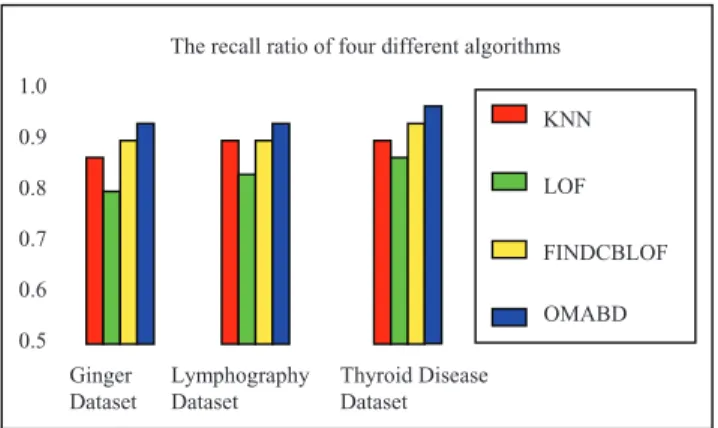
The Fig. 1 shows that recall ratio of OMABD is all above 0.93 with the different objects and attributes. The recall ratio of OMABD is higher than the three comparison algorithms. This is because the other three algorithms need to repeatedly input and test the parameter to achieve satisfactory results.
Fig. 1 The recall ratio with different dataset
4.2.precision ratio
The precision ratio of algorithm is defined as:
orithm a by objects identified the of number orithm a by outliers identified the of number ratio precision lg lg _
The TABLE I describes the precision ratio of KNN, LOF, FINDCBLOF and OMABD algorithm. The recall ratio of four different algorithms
1.0 0.9 0.8 0.7 0.6 0.5 KNN LOF FINDCBLOF OMABD Ginger Dataset Lymphography Dataset Thyroid Disease Dataset
( ) TABLE I THE precision ratio WITH DIFFERENT DATASET
KNN LOF FINDCBLOF OMABD
ginger dataset 0.88 0.81 0.90 0.93
Lymphography dataset 0.89 0.84 0.90 0.94
Thyroid Disease dataset 0.91 0.89 0.92 0.96
As is seen from TABLE I, the OMABD algorithm has higher precision ratio contrast to the three comparison algorithms, but with the number of attributes increased gradually, the precision ratio of OMABD reduced. This is because that the attribute interference between each other is increased with the increase of the number of attributes.
5.Conclusion
The purpose of outlier mining is to find small groups of data that are exceptional within a large amount of data. Mining of such outliers is important for many applications. But outlier data mining technology in process of its development has encountered many difficulties and obstacles. This paper presents an outlier data mining algorithm based on dissimilarity. Experimental results show that this algorithm, compared with the traditional ones, has better recall ratio and precision ratio. So it is more suitable for massive data.
However, this new algorithm for outlier mining based on dissimilarity still has some problems to further study duo to the limited conditions. For example, the computation of non-numerical attribute’s value beyond the studying scope of this paper and is a topic for future study
6.Acknowledgment
This work is partially support by the Education Department of Jiangxi Province of China (Grant No.GJJ10296).
References
[1] Hawkins D. “Identification of Outlier,” London: Chapman and Hall,1980
[2] Wang Hongding, Tong Yunhai. “Research Progress on Outlier Mining,” CAAI Transaction on Intelligent System, vol. 1, no. 1,pp.67-73,2006
[3] Barnet V, Lewis T. “Outliers in Statistical Data,” New York: John Woley& Sons,1994
[4] Bay S, Schwabacher M. “Mining Distance-Based Outliers in Near Linear Time with Randomization and a Simple Pruning Rule,” Proc. of ACM SIGKDD International Conf. on Knowledge Discovery and Data Mining. Washington, 2003, pp.29-38
[5] Knorr E, Ng R. “Finding Intentional Knowledge of Distance-Based Outliers,” Proc. of the VLDB Conf. Edinburgh: Morgan Kaufmann Publishers,1999,pp.211-222
[6] Mao Junguo, Duan lijuan, Wang Shi, Shi Yun. “Data Mining Principle and Algorithm,” Tsinghua University Press, 2007
[7] Romaswany S, Rastogi R, Shim K. “Efficient Algorithms for Mining Outliers from Large Data Set,” Proc. of the ACM SIGMOD International Conf. on Management of Data, Texas: ACM Press,2000,pp.473-478
[8] Breuing M, Kriegel H, Ng R, Sander J. “LOF: Identifying Density-Based Local Outlier,” Dallas, Texas: Proc. of ACM SIGMOD Conf.,2000,pp.94-104
[9] Yu Zhongqing, Fang Yi, Pan Zhenkuan, Shao Fengjing. “OLPA Architecture,” Qingdao-Hong Kong international Computer Conf.,1999,10
[10] Arning A, Agrawal R, Raghavan. “A Linear Method for Deviation Detection in Large Database,” Proc. of the KDD Conf., Portland: AAAI Press,1996,pp.164-169
[11] Tian Zhang, Raghu Ramak, Miron Livny. ”BIRCH: An Efficient Data Clustering Method for Very Large Database,” Technical Report, Computer Science Dept., Univ. of Wisconsin-Madison,1995
[12] Tu Lihong, Tong Haiyan, Yang Liping. “Research of Outlier Mining Based on Dissimilarity,” Computer and Digital Engineering,2008,36(1), pp.16-19
[13] He Zengyou, Xu Xiaofei, Deng Shengchun. “A Fast Greedy Algorithm for Outlier Mining,” Proc. of the 10th Pacific-Asia Conf. on
Advances in Knowledge Discovery and Data Mining, Singapore,2006, pp.567-576 [14] http://www.tcm120.com/