Securing Cloud Storage by
Transparent Biometric Cryptography
by
Leith Hamid Abed
A thesis submitted to the University of Plymouth
in partial fulfilment for the degree of
DOCTOR OF PHILOSOPHY
School of Computing, Electronics and Mathematics
June 2019
COPYRIGHT STATEMENT
This copy of the thesis has been supplied on condition that anyone who consults it is understood to recognise that its copyright rests with its author and that no quotation from the thesis and no information derived from it may be published without the author’s prior consent.
I
Abstract
Securing Cloud Storage by Transparent Biometric Cryptography Leith Hamid Abed
With the capability of storing huge volumes of data over the Internet, cloud storage has become a popular and desirable service for individuals and enterprises. The security issues, nevertheless, have been the intense debate within the cloud community. Significant attacks can be taken place, the most common being guessing the (poor) passwords. Given weaknesses with verification credentials, malicious attacks have happened across a variety of well-known storage services (i.e. Dropbox and Google Drive) – resulting in loss the privacy and confidentiality of files. Whilst today's use of third-party cryptographic applications can independently encrypt data, it arguably places a significant burden upon the user in terms of manually ciphering/deciphering each file and administering numerous keys in addition to the login password.
The field of biometric cryptography applies biometric modalities within cryptography to produce robust bio-crypto keys without having to remember them. There are, nonetheless, still specific flaws associated with the security of the established bio-crypto key and its usability. Users currently should present their biometric modalities intrusively each time a file needs to be encrypted/decrypted – thus leading to cumbersomeness and inconvenience while throughout usage. Transparent biometrics seeks to eliminate the explicit interaction for verification and thereby remove the user inconvenience. However, the application of transparent biometric within bio-cryptography can increase the variability of the biometric sample leading to further challenges on reproducing the bio-crypto key.
An innovative bio-cryptographic approach is developed to non-intrusively encrypt/decrypt data by a bio-crypto key established from transparent biometrics on the fly without storing it somewhere using a backpropagation neural network. This approach seeks to handle the shortcomings of the password login, and concurrently removes the usability issues of the third-party cryptographic applications – thus enabling a more secure and usable user-oriented level of encryption to reinforce the security controls within cloud-based storage. The challenge represents the ability of
II
the innovative bio-cryptographic approach to generate a reproducible bio-crypto key by selective transparent biometric modalities including fingerprint, face and keystrokes which are inherently noisier than their traditional counterparts. Accordingly, sets of experiments using functional and practical datasets reflecting a transparent and unconstrained sample collection are conducted to determine the reliability of creating a non-intrusive and repeatable bio-crypto key of a 256-bit length. With numerous samples being acquired in a non-intrusive fashion, the system would be spontaneously able to capture 6 samples within minute window of time. There is a possibility then to trade-off the false rejection against the false acceptance to tackle the high error, as long as the correct key can be generated via at least one successful sample. As such, the experiments demonstrate that a correct key can be generated to the genuine user once a minute and the average FAR was 0.9%, 0.06%, and 0.06% for fingerprint, face, and keystrokes respectively.
For further reinforcing the effectiveness of the key generation approach, other sets of experiments are also implemented to determine what impact the multibiometric approach would have upon the performance at the feature phase versus the matching phase. Holistically, the multibiometric key generation approach demonstrates the superiority in generating the bio-crypto key of a 256-bit in comparison with the single biometric approach. In particular, the feature-level fusion outperforms the matching-level fusion at producing the valid correct key with limited illegitimacy attempts in compromising it – 0.02% FAR rate overall. Accordingly, the thesis proposes an innovative bio-cryptosystem architecture by which cloud-independent encryption is provided to protect the users' personal data in a more reliable and usable fashion using non-intrusive multimodal biometrics.
III
Table of Contents
Table of Contents ... III List of Figures ... VI List of Tables ... VIII Acknowledgment ... X Author’s Declaration ... XI
Chapter One: Introduction ... 1
1.1 Overview ... 1
1.2 Research Goal and Objectives ... 6
1.3 Thesis Organization ... 7
Chapter Two: Biometric Systems ... 10
2.1 Introduction ... 10
2.2 Biometric Characteristics ... 13
2.3 Components of a Biometric System ... 14
2.4 Performance Measurement of Biometric System ... 17
2.5 Multibiometrics ... 19
2.6 Continuous and Transparent Biometric Authentication ... 22
2.6.1 Transparent Biometric Approaches ... 25
2.6.1.1 Fingerprint Recognition ... 26
2.6.1.2 Face Recognition ... 28
2.6.1.3 Eye Geometry ... 29
2.6.1.4 Ear Geometry ... 31
2.6.1.5 Speaker Recognition ... 32
2.6.1.6 Keystroke Analysis or Dynamics ... 34
2.6.1.7 Behavioural Profiling ... 35
2.7 Biometric Cryptography ... 37
2.7.1 Biometric Key Release ... 40
2.7.2 Biometric Key Generation ... 42
2.7.3 Biometric Key Binding ... 44
2.8 Bio-Cryptosystem Requirements ... 45
2.8.1 Dealing with Intra-Person Variations ... 47
IV
2.9 Conclusion ... 51
Chapter Three: Literature Review of Biometric Cryptography ... 52
3.1 Introduction ... 52
3.2 Literature Review Methodology ... 53
3.3 Biometric Key Release Approaches ... 54
3.4 Biometric Key Generation Approaches ... 58
3.4.1 Fuzzy Commitment Approaches ... 65
3.4.2 Fuzzy Extractor or Generator Approaches ... 71
3.4.3 Fuzzy or Secure Sketch Approaches ... 79
3.5 Biometric Key Binding Approaches... 89
3.5.1 Conventional Approaches ... 90
3.5.2 Fuzzy Commitment Approaches ... 92
3.5.3 Fuzzy Vault Approaches ... 96
3.5.4 Salting or BioHashing Approaches ... 102
3.6 Discussion ... 107
3.7 Conclusion ... 114
Chapter Four: Investigation into Transparent Bio-Cryptography ... 116
4.1 Introduction ... 116
4.2 A Novel Bio-Cryptographic Approach ... 118
4.3 Research Methodology ... 120
4.3.1 Datasets ... 123
4.3.1.1 Fingerprint Dataset ... 125
4.3.1.2 Face Dataset ... 129
4.3.1.3 Keystroke Analysis Dataset ... 133
4.3.2 Investigation into Transparent Bio-Crypto Key Generation ... 134
4.3.3 Investigation into Improving the Key Generation Performance ... 141
4.3.4 Investigation into Generating Different Key Sizes through Features .... 143
4.4 Results and Analysis ... 146
4.4.1 Experiment 1: Transparent Bio-Crypto Key Generation ... 147
4.4.2 Experiment 2: Improving the Key Generation Performance ... 151
4.4.3 Experiment 3: Key Length versus Feature Length ... 160
V
4.6 Conclusion ... 168
Chapter Five: Investigation into Transparent Multibiometric Cryptography ... 170
5.1 Introduction ... 170
5.2 Methodological Approach ... 172
5.2.1 Datasets ... 174
5.2.2 Investigation into Transparent Multibiometric Key Generation by Feature-Level Fusion ... 175
5.2.3 Investigation into Transparent Multibiometric Key Generation by Matching-Level Fusion ... 178
5.3 Results and Analysis ... 181
5.3.1 Experiment 1: Transparent Multibiometric Key Generation by Feature-Level Fusion ... 181
5.3.2 Experiment 2: Transparent Multibiometric Key Generation by Matching-Level Fusion ... 185
5.4 Discussion ... 188
5.5 Conclusion ... 191
Chapter Six: Transparent Bio-Cryptosystem Architecture ... 192
6.1 Introduction ... 192
6.2 System Requirements ... 193
6.3 System Architecture ... 198
6.4 System Architecture Components ... 204
6.5 Operational Considerations ... 217
6.6 Discussion ... 224
6.7 Conclusion ... 228
Chapter Seven: Conclusions and Future Work ... 230
7.1 Introduction ... 230
7.2 Contributions and Achievements ... 230
7.3 Limitations of Research ... 232
7.4 Future Work ... 233
VI
List of Figures
Figure 1. 1 The Growth of Cloud Storage Subscribers ... 2
Figure 2. 1 The Components of the Biometric System ... 16
Figure 2. 2 The Metrics Performance in terms of FRR and FAR ... 18
Figure 2. 3 A Model of Conventional Authentication ... 23
Figure 2. 4 A Model of Continuous Authentication Confidence ... 24
Figure 2. 5 The Idea of Biometric Key Release ... 41
Figure 2. 6 The Idea of Biometric Key Generation by Helper Data ... 44
Figure 2. 7 The Idea of Biometric Key Binding ... 45
Figure 2. 8 Single Error Category ... 48
Figure 2. 9 Burst Error Category ... 49
Figure 3. 1 Block Diagram of Fuzzy Commitment Idea ... 66
Figure 3. 2 Block Diagram of Fuzzy Extractor Approach ... 72
Figure 3. 3 Block Diagram of Registration and Authentication ... 74
Figure 3. 4 Block Diagram of Key Learning Stage ... 78
Figure 3. 5 Block Diagrams of Key Generation Stage ... 78
Figure 3. 6 Block Diagram of Enrolment and Verification ... 96
Figure 3. 7 The Main Processes of the Proposed System ... 104
Figure 4. 1 The Innovative Bio-Crypto Key Generation Scheme ... 119
Figure 4. 2 The Methodological Approach of the Experiments ... 122
Figure 4. 3 Sample Images of Fingerprint Dataset Captured via the AES2501 Scanner ... 126
Figure 4. 4 Fingerprint Minutiae-Based Feature ... 128
Figure 4. 5 The Difference Minutiae amongst a Number of a User’s Samples ... 129
Figure 4. 6 Face Pose Samples ... 130
Figure 4. 7 Facial Expression Variations ... 131
Figure 4. 8 Facial Accessories ... 131
Figure 4. 9 Face Samples of Different Illuminations ... 132
Figure 4. 10 Facial Feature Points ... 133
Figure 4. 11 The Performance of the Transparent Key Creation from Fingerprint 148 Figure 4. 12 The Effectiveness of the Transparent Key Generation Approach via Face ... 149
Figure 4. 13 The Performance of the Transparent Key Generation via Keystrokes ... 150
Figure 4. 14 The Performance of the Fingerprint Key Generation... 152
Figure 4. 15 The Accuracy of Generating a Key from the Face Biometric Modality ... 153
Figure 4. 16 The Performance of Producing the Bio-Crypto Key of 256-Bit Length by the Keystroke ... 154
VII
Figure 4. 17 Fingerprint Key Generation Using the Two Hidden Layers of 80-80 Nodes ... 156 Figure 4. 18 Face Key Generation Using the Two Hidden Layers of 120-120 nodes ... 158 Figure 4. 19 Key Generation Using Double Hidden Layer of 120-120 Nodes via Keystrokes ... 160 Figure 4. 20 Key Generation via Different Ranges of Top-Ranked Fingerprint
Features ... 161 Figure 5. 1 Matching Fusion Process of Selective Biometric Modalities Using
Majority Voting ... 180 Figure 5. 2 Feature Fusion Performance of Three-Biometric Modalities via 50-Sample Unification for All Users ... 184 Figure 5. 3 Matching Fusion Performance of Three-Biometric Modalities via 50-Sample Unification for All Users ... 188 Figure 6. 1 An Innovative Model of Multi-Biometric Cryptography Undertaken at the Cloud Side ... 199 Figure 6. 2 An Innovative Model of Multi-Biometric Cryptography Undertaken at the User Side ... 202 Figure 6. 3 Non-Intrusive Biometric Engine ... 205 Figure 6. 4 Key Generation Engine ... 212
VIII
List of Tables
Table 2. 1 The Security Criteria of Bio-Cryptographic Techniques versus
Password-Based Techniques ... 12
Table 2. 2 Common Ear Recognition Performance ... 32
Table 2. 3 A Brief Comparison of Various Transparent Biometric Approaches ... 37
Table 3. 1 Classification of Literature Review ... 54
Table 3. 2 Short Summary on Biometric Key Release Contributions ... 58
Table 3. 3 Analytical and Assessable Work on Biometric Key Generation Approaches-Based Timeline ... 86
Table 3. 4 Chronological and Comparative Compilation of Biometric Key Binding Schemes ... 105
Table 4. 1 The Characteristics of the Fingerprint Dataset ... 126
Table 4. 2 The Description of Fingerprint Features ... 128
Table 4. 3 The properties of Face Dataset ... 130
Table 4. 4 The Attributes of Keystrokes Dataset ... 133
Table 4. 5 Experimental Settings of the First Investigation ... 137
Table 4. 6 FF-MLBP Classification Parameters ... 138
Table 4. 7 Generated Keys on Enrolment ... 139
Table 4. 8 Experimental Settings of the Second Investigation ... 142
Table 4. 9 Fingerprint Key Generation Using Single Hidden Layer ... 155
Table 4. 10 Fingerprint Key Generation Using Double Hidden Layer ... 155
Table 4. 11 Face Key Generation Using Single Hidden Layer ... 157
Table 4. 12 Face Key Generation Using Double Hidden Layer ... 157
Table 4. 13 Keystroke Dynamics Key Generation Using Single Hidden Layer .... 159
Table 4. 14 Keystroke Dynamics Key Generation Using Double Hidden Layer ... 159
Table 4. 15 The Effective Entropy (Bitlength) versus Different Fingerprint Feature Sets... 161
Table 4. 16 Key Generation via Different Ranges of Top-Ranked Face Features 162 Table 4. 17 The Effective Entropy ((Bitlength) versus Different Face Feature Sets ... 163
Table 4. 18 Key Generation via Different Ranges of Top-Ranked Keystrokes Features ... 163
Table 4. 19 The Capacity of Generating Different Key Lengths ... 164
Table 4. 20 The Effective Entropy (Bitlength) from each Biometric ... 168
Table 5. 1 Empirical Settings of Feature-Level Fusion ... 177
Table 5. 2 Classification Parameters of Feature-Level Fusion ... 177
Table 5. 3 The Final Key Generation by Majority Voting Mechanism ... 179
Table 5. 4 Key Creation Performance via Combining All Biometric Approaches at Feature Level ... 181
IX
Table 5. 5 Key Generation Performance by Incorporating Different Permutations of Biometric Modalities Using Feature Level Fusion ... 182 Table 5. 6 Key Generation Performance by Incorporating All Biometric Approaches at Matching Level ... 185 Table 5. 7 Key Creation Effectiveness through Combining Different Permutations of Biometric Modalities Using Matching Level Fusion ... 186 Table 5. 8 Effective Entropy (Bitlength) of Single, Two, and Three Biometric
X
Acknowledgment
Most of all, I would like to thank Allah Almighty for giving me the health, knowledge, and capability to undertake the PhD study and to persevere in completing it satisfactorily. I do thank Him so much for His uncountable favour and without His help, this work would not have been possible.
I would like to express my grateful thanks to my Director of Studies Professor Nathan Clarke for his agile guidance. Special thanks also have to go to my second supervisor Dr Bogdan Ghita who has been supportive throughout my study.
I owe a debt of gratitude to my beloved parents my father (Hamid) and my mother (Bahiya) for their endless encouragement and support. Any success that might be resulted, optimistically, should help me making them proud and happy. I should not forget to thank my dear siblings who have been supportive without any hesitation, many thanks to them all.
My countless love, and appreciation must go to my wife (Nada), my son (Wisam), and my little daughter (Laian) who have been very patient and understanding throughout this journey, spending days, nights, and sometimes even holidays without me. I hope the potential success of this study will compensate some of what they have missed.
I am also very thankful to my best friends Abdulrahman Alruban, Hussam Mohammed and Yaseen Alheety for their assistance and support during the PhD endeavour.
Finally, I would like to express my sincere thanks to the Republic of Iraq and in particular the Higher Committee for Education Development for granting me a scholarship and sponsoring my PhD study.
XI
Author’s Declaration
At no time during the registration for the degree of Doctor of Philosophy has the author been registered for any other University award without prior agreement of the Doctoral College Quality Sub-Committee.
Work submitted for this research degree at the University of Plymouth has not formed part of any other degree either at the University of Plymouth or at another establishment.
This study was financed with the aid of a scholarship from the Higher Committee for Education Development (HCED) in the Republic of Iraq.
Relevant seminars and conferences were attended at which work was often presented and several papers are published:
Abed L., Clarke N., Ghita B. (2017) Enabling Secure Cloud Storage through Transparent Authentication. Proceedings of the 8th Annual International Conference on ICT: Big Data, Cloud and Security (ICT-BDCS 2017), Singapore, 21st- 22nd August, pp 14-23, ISSN: 2251-2136.
DOI: https://10.5176/2251-2136_ICT-BDCS17.07
Abed L., Clarke N., Ghita B., Alruban A. (2019) Securing Cloud Storage by Transparent Biometric Cryptography. In: Lanet JL., Toma C. (eds) Innovative Security Solutions for Information Technology and Communications. SECITC 2018. Lecture Notes in Computer Science, vol 11359. Springer, Cham. DOI: https://doi.org/10.1007/978-3-030-12942-2_9
Word count of main body of thesis: 64,354 words
Signed …….……… Date ………
1
Chapter One: Introduction
1.1 Overview
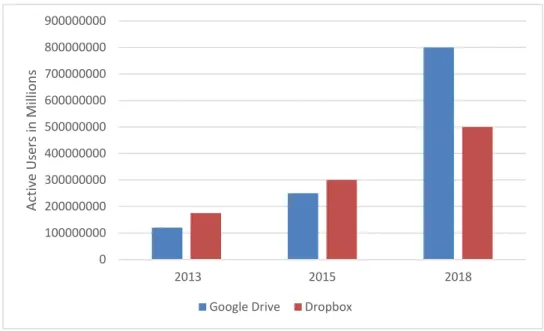
Cloud computing is an evolutionary paradigm in the scope of Internet-based computing providing services ranging from end-users applications, developers software platforms, to computing resources (Behl and Behl, 2012, Parekh and Sridaran, 2013). Amongst cloud computing services, cloud storage affords individuals and enterprises a free level of storage capacity for storing their own data on remote datacenters, aimed at abstracting away the complexity of hardware management and maintenance (Drago et al., 2012). In return for the immediate service provision, cloud storage providers charge the beneficiaries a very reasonable price per significant storage space (Ju et al., 2011). Customers also have ability to directly upload, download, update, remove, and share files via accessing their data from any-where at all times (Columbus, 2016). With the rapid increase in the amount of digital information, cloud storage has been a predominant service for storing data over the Internet (Phillipson, 2016). Therefore, this storage paradigm has become a very important topic in both academic and industrial communities (Behl and Behl, 2012). Microsoft OneDrive, Google Drive, and Dropbox are examples of the most popular and widespread cloud storage providers (Griffith, 2014). The number of Google Drive, and Dropbox subscribers world-wide has increased exponentially as illustrated in Figure 1.1 (Gannes, 2013, Sullivan, 2015, Columbus, 2016, Gildred, 2018).
2
Figure 1. 1 The Growth of Cloud Storage Subscribers (adopted from Gannes, 2013, Sullivan, 2015, Columbus, 2016, Gildred, 2018)
According to the participatory-based study by Cloud Industry Forum (CIF), 88% of organizations in the UK utilized one of the cloud computing services, and the highest used cloud service was cloud storage (CIF, 2019). In the United States, business spent more than $13 billion on different cloud services in 2014 (McCue, 2014), and the majority of cloud consumers are expected to increase spending on storage services (Mellor, 2016). This shows that there is a very good sized market for the cloud computing services (Galibus et al., 2016) – and specifically for cloud storage services (Butler, 2013).
The cloud storage paradigm can be regarded as less secure than local storage, where the latter benefits from logical and physical security countermeasures before being able to access data. The local storage information can be stored on a hard drive in a computer on an office within an entire building. Thus, they are protected by both physical and logical security controls, such as secure door systems and firewalls, aimed at hindering the malicious attempts to hack the stored information.
0 100000000 200000000 300000000 400000000 500000000 600000000 700000000 800000000 900000000 2013 2015 2018 Activ e U se rs in M ill ion s
3
In this case, an adversary either has to attack the entire building, or logically fudge around the firewall to violate stored data. As a result, there will be more challenging threat vectors to breach the stored information. However, within cloud storage-based systems, such as Dropbox and Google Drive, potential attacks can simply take place through the web portals by which users log in to get access to their accounts. Of course, cloud systems have stronger security measures including fingerprint locks, and armed guards for protecting and monitoring the data storage centres preventing attackers from violating them (Dobran, 2019). Nevertheless, the access into the cloud storage data is still granted using password verification and guessing the potential weak password can leak the user account from single portal and this is not the case within the PC login. Millions of user accounts are also accessible via the same portal - providing a single point of attack. As such, the attacks on local storage technologies can be considered more difficult than cloud-based storage.
There is no doubt that cloud storage provides subscribers highly advantageous attributes including scalability, flexibility, accessibility, usability and data backup (NT, 2014). However, security issues have been the intense debate within the scientific communities (Parekh and Sridaran, 2013, Behl and Behl, 2012). Overall, cloud providers employ a number of security countermeasures, aimed at achieving robust security. Data in transit is secured by standard Internet security protocols, such as Transport Layer Security (TLS). Cryptographic techniques also encrypt data at rest to protect them from external attacks (Galibus et al., 2016). Accessing the stored data is granted by successful password verification (Azam and Johnsson, 2011). If an attacker can obtain a verification credential, neither the security controls in transit nor at rest can combat that attack. This results in breaching data confidentiality –
4
since the malicious access is considered to be genuine with successful verification. Even if two-factor authentication is used to mitigate this vulnerability, there are still simple passphrases can be hacked (Toorani and Beheshti, 2008). In addition, this approach is not universally adopted and providing further burden upon the user to have a second login using another piece of credential. Passwords techniques have been the topic of intense debate in academia, and are arguably manifested to be often poor (Uludag et al., 2004, Rathgeb and Uhl, 2011). Subscribers commonly access cloud services by simple passwords. As such, a number of recent attacks have had significant impact. For instance, approximately 7 million Dropbox accounts were leaked illegally (Kovach, 2014), and around 5 million Google Drive accounts were hacked in 2014 (Vonnie, 2014). The selection of poor passwords arises when users are struggling with recalling, managing, and using complex passwords. With a view to tackling the current security issues, many clients have sought to provide additional security through using third-party encryption tools to manually encrypt or decrypt data prior to putting it into the cloud (Bischoff, 2018). Illegitimate access to the cloud service will result in violating encrypted files which still require a secondary key – ideally for each and every file to breach them. However, these tools still bring usability issues in terms of having to manage a key for each file in addition to the login password. Subscribers also need to cipher/decipher each file manually – further exacerbating the usability issue.
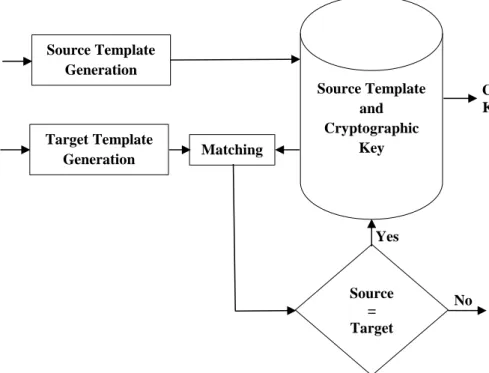
From the above presentation, it is clear that the current security approaches are not providing adequate security without introducing significant usability issues. Biometric cryptography produces reliable and usable bio-crypto keys from biometrics modalities (Kanade et al., 2009b) – where there is no need to remember complex
5
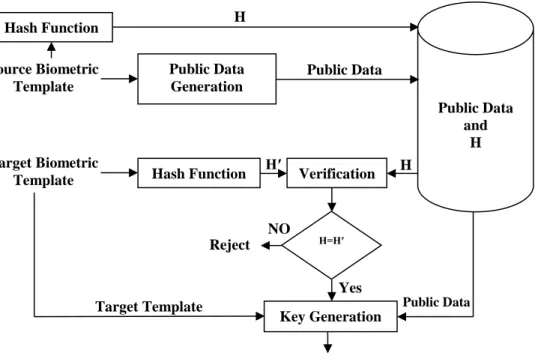
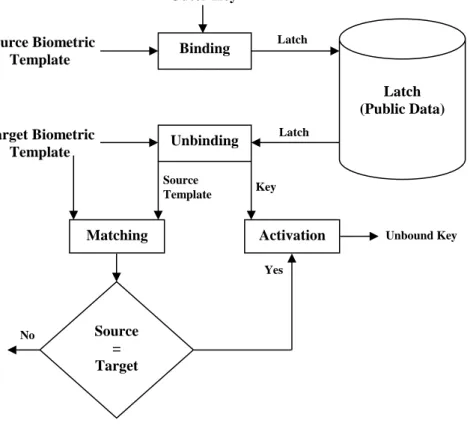
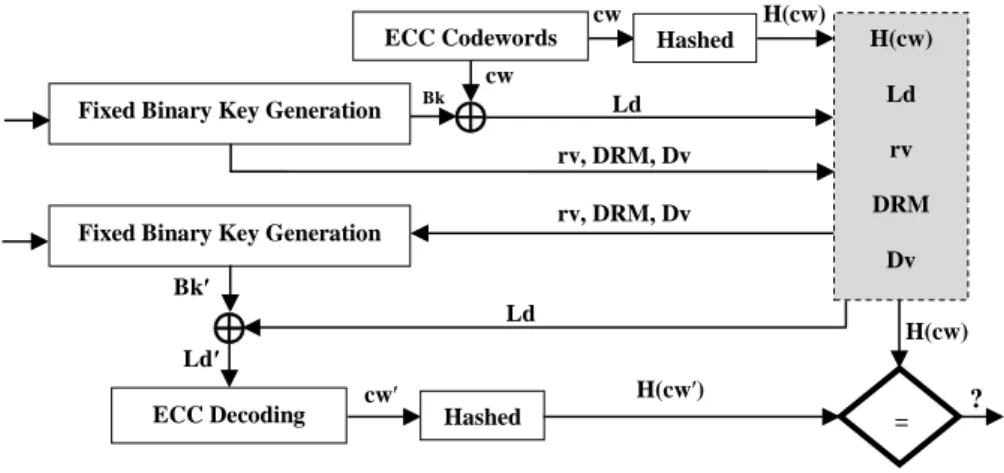
passwords/keys. In essence, the bio-crypto key can be established by constructing and storing public data from biometric on registration, and this data will be used on verification to reproduce the same key for cryptographic goals, such as encryption and authentication (Rathgeb and Uhl, 2011). Bio-cryptography accordingly ensures that sensitive information (i.e. biometric information, secret keys) will not be stored somewhere within bio-cryptosystem. Thus, bio-cryptographic approaches overcome significant security attacks that happen upon the storage component within cryptographic and biometric systems (Uludag et al., 2004). In addition, the traditional password authentication will no longer need to protect the secret keys. Given the characteristic of storing public data only, bio-cryptography can also revoke the security credentials (biometric templates, secret keys and passwords) in case of compromise (Rathgeb and Busch, 2012). As such, the application of bio-crypto keys within cloud storage can offer the capacity to manage the above-mentioned security and privacy issues without incorporating any auxiliary applications. That is, a file will be only decrypted by the bio-crypto key that is established using the biometric features of a genuine user as these features have a high level of uniqueness to a distinct person. The attacker who is attempting to hack the file will have no capacity to produce the same key as the presented biometric features are different. Even if an attacker had the ability of guessing a weak password, he cannot hack this file because it is encrypted by a key established from the biometric features of the cloud user. However, there are still some impairments related to the usability of the bio-crypto key and its security in practice. Users currently need to present their biometric modalities intrusively each time a file needs to be encrypted or decrypted; thus, it still presents a usability issue. On the other hand, achieving a repeatable bio-crypto key
6
in a secure manner with the absence of storing biometric information can be considered very challenging as biometric features are inconsistent over time. Using the research area of transparent and continuous biometric verification, in which biometrical signals are collected in a non-intrusive fashion, offers the opportunity to remove many of the usability issues associated with traditional biometric cryptosystems – potentially enabling more usable and secure cryptography. However, an effective bio-crypto approach that can successfully compass transparent biometric in a secure manner needs to be identified.
1.2 Research Goal and Objectives
The aim of this research is to develop an innovative bio-cryptographic approach using transparent biometrics in order to reinforce the lack of security controls within cloud-based storage. A transparent encryption framework built upon this approach would maximize the level of protection and convenience – the user no longer needs to recall, or present complex credentials, and the encryption is seamlessly undertaken for the authorized identity.
With a view to accomplishing the research goal, subordinate research objectives are established in order to:
Review the current state-of-the-art in the research area of biometric cryptography in terms of existing approaches, strategic schemas, issues and available solutions.
Conduct a number of investigations to explore whether a repeatable bio-crypto key can be established from a single transparent biometric throughout.
7
Perform a set of experiments to investigate the effectiveness of biometric fusion approaches for producing a superior repeatable bio-crypto key from multiple non-intrusive biometric modalities on a timely basis.
Design and develop an innovative transparent and multimodal bio-cryptosystem architecture for cloud storage technology capable of providing a secure, robust and frictionless user experience.
1.3 Thesis Organization
In addition to this chapter, which presents the research problem, the overall aim and objectives, and the structure of the research, the thesis contains a further six chapters outlined as follows:
Chapter 2 is titled “Biometric Systems”. This chapter introduces the theoretical background of the research. This mainly includes the basics of biometric systems, the concepts of continuous and transparent biometric authentication, and the principles of biometric cryptography. The biometric system fundamentals are elaborated in terms of biometric requirements, system components, and performance measurement. A devoted section is also presented to discuss multibiometrics and in particular the levels of fusion in which biometric modalities can be consolidated. Accordingly, a conceptual view of transparent biometric verification is illustrated with a concentration upon contextualizing its approaches toward the core of this work to handle security and usability issues. The principles of biometric cryptography are ultimately considered and explained with the purpose of understanding to what extent such an approach can robustly tackle the security and privacy issues of cloud storage.
8
Chapter 3 presents a critical analysis of the current state-of-the-art comprehension of biometric encryption. The review of biometric cryptographic approaches is broken down into several thematic sections, and the research is presented in a chronological order.
Chapter 4 initially proposes a novel bio-cryptographic approach for enabling a more secure and usable cloud storage through transparent biometric modalities, given the lack of additional protection in place. Accordingly, a set of essential investigations are undertaken and carried out aiming to ultimately discover the potential contribution of the developed approach. The first series of experiments concentrates upon investigating how reliable the innovative bio-cryptographic approach in generating a bio-crypto key from transparent biometric modalities. Another set of experiments explores the potential of enhancing the performance of the bio-crypto key generation. The final experiments seek to investigate the capacity of generating different cryptographic key sizes through biometric features.
Chapter 5 is titled “Investigation into Transparent Multibiometric Cryptography”. This chapter seeks to develop an advanced bio-cryptographic model using the principle of multibiometric fusion, aiming ultimately at investigating to what degree it can improve the performance of the bio-crypto key generation over the single biometric modalities. Accordingly, two fundamental investigations are developed and conducted in order to explore the potential outperformance via multibiometric. The former experiment determines the key generation effectiveness at the feature level, while the latter explores the performance at the matching level.
Chapter 6 presents the architectural framework of the innovative multibiometric cryptosystem. The essential system architecture requirements are primarily
9
identified depending upon the obtained knowledge and the experimental outcomes from the previous chapters. Then, a comprehensive clarification of the system components, and mechanisms is presented - with a concentration upon tackling the security and usability issues in order to ensure a convenient and reliable experience for cloud storage subscribers. A number of operational considerations are also addressed and conceptually explicated with a view to reinforcing the system operation in practice.
Chapter 7 presents the fundamental conclusions arising from the research; the main contributions, achievements and limitations. It also poses a discussion on potential areas for future work.
10
Chapter Two: Biometric Systems
2.1 Introduction
For many years, human traits (biometrics) have been employed to identify people; for example, individuals can be recognized via their fingerprints, irises, and voices (Jain et al., 2007). In seeking a secure solution, biometrics modalities have been applied to achieve sophisticated authentication and identification systems. Biometrics approaches can provide a reliable protection for environments that require high level of security as biometric features are very unique to an individual (Clarke, 2011). Biometric identifiers can also prevent the person from having to remember/recall difficult credentials or carry and protect tokens (Jain et al., 2007). Biometrics approaches, therefore, have been adopted in a variety of applications, including border agencies and military organizations (Soutar et al., 1999). After five decades of research in biometric, its techniques have been widely developed in the last years – where they are built in various everyday technologies, such as mice, keyboards, laptops, smartphones, and ATMs. As a result, the biometrics store is expected to grow over 304% between 2016 and 2023 to exceed $34.60-billion (MarketsandMarkets, 2016).
Traditional biometric authentication approaches verify the user at first of the session only not frequently (i.e. point-of-entry verification) which resulting in particular shortcomings. That is, when the genuine person has gone away from his active device after a successful verification, critical vulnerabilities can arise (Clarke and Furnell, 2005). Biometric techniques , on the other hand, can be exploited farther to authenticate the user frequently via capturing the biometrics traits in a non-intrusive
11
fashion without any inconveniences – thus defeating the initial verification only at the beginning of the session and overcoming the flaws of traditional verification at point-of-entry only (Clarke, 2011). In particular, the transparent approaches, such as face and voice afford users a more usable and secure way in practice, where there is no explicit interaction for the continuous verification against imposters. In addition, as the biometric samples are collected in a spontaneous manner, an adversary will have difficulties in spoofing the collective biometric signals (Clarke, 2011).
From a cryptographic perspective, the existing encryption approaches lack the secure management of the secret keys. Fundamentally, the cryptosystems can be classified into two systems: symmetric key and asymmetric key systems (Soutar et al., 1999). Symmetric key systems use a symmetrical key for encryption and decryption, and it must be securely stored somewhere. Asymmetric key systems, however, use public and private keys. The public one is utilised for ciphering the secret information, and it is distributed amongst the communicative parties for verification aims. On the other hand, the private key is utilized to decipher the information, so it has to be stored in a secure place as well. On the whole, there are two issues with the above cryptographic systems. First, adversaries could attack the private key transmission from one party to another. Second, potential attacks may take place on the stored private key. Consequently, a mechanism is required to cope with these security issues. Whilst Date in transit can be protected via standard Internet security protocols (e.g. Transport Layer Security (TLS)) (Galibus et al., 2016), the access to the stored secret keys is permitted via traditional password authentication approaches (Chang, 2012). Overall, passwords are weakly selected, and often derived from personal information, and this will make the system
12
vulnerable to several attacks, such as password guessing attacks (Kanade et al., 2008). In addition to this, cryptography does not ensure that an individual, who provides the password, is a legitimated user (Soutar et al., 1999). Consequently, Bodo (1994) innovated the idea of establishing robust encryption based on biometrics due to its capability of identifying human beings in a reliable way. Thus, a number of efforts in combining biometrics and cryptography have resulted in developing the field of biometric cryptography. In particular, bio-cryptographic techniques seek to establish secret keys from biometrics in a secure management in which nor keys neither biometrics would be stored somewhere. As such, the biometric keys can be revoked in case of compromise. Contrarily, password-based techniques need always to store the passwords at some location and accordingly, they cannot be cancelled if they have been hacked (Cavoukian and Stoianov, 2007). In addition, whilst bio-cryptography offers strong bio-crypto keys without forcing the users to remember them, weak passwords can be selected when users are struggling with recalling, managing, and using complex passwords. Table 2.1 summaries the security criteria between bio-cryptographic techniques and password-based techniques.
Table 2. 1 The Security Criteria of Bio-Cryptographic Techniques versus Password-Based Techniques (adapted from Cavoukian and Stoianov, 2007)
Bio-cryptographic Techniques Password-Based Techniques
Neither key nor biometric should be stored A password should be always stored A hacked key can be revoked A hacked password cannot be revoked
Key is strong A password can be strong or weak
From the above presentation, it is clear that the use of biometric encryption seems to be more robust than passwords for protecting secret keys and/or sensitive information. Employing transparent biometric could also present the capacity of
13
eradicating particular vulnerabilities and inconveniences relevant with traditional bio-cryptosystems – probably providing more secure and usable bio-cryptographic framework for cloud-based storage. So as to introduce an insight into transparent bio-cryptography, this chapter states the biometric systems in terms of characteristics, performance metrics, advantages and disadvantages. Furthermore, the capacity of applying a number of biometric techniques in a transparent mode is discussed for tackling the usability issues within cloud-based storage. Biometric cryptography is also explained with regard to the overall concept, the approaches of bio-cryptosystems, system requirements and performance measurement.
2.2 Biometric Characteristics
The selection of biometric modalities for security purposes is dependant on a number of characteristics which are very important to be taken into account. Consequently, biometric modalities can be considered suitable for security applications, once they are met all of the requirements of universality, uniqueness, permanence, collectability, circumvention, performance and acceptability. An explanation for each characteristic is listed below (Jain et al., 2007):
Universality means that the exploitable biometric identifier needs to be available over the complete population of users.
Uniqueness refers to the level of distinctiveness of the biometric characteristic. That is, any two persons should be completely different with regard to their biometric traits for successful verification.
Permanence represents the capability to generate a stable biometric template over time. For instance, the iris is one of the most consistent
14
biometrics over very long periods of times, but gait behavioural recognition can be inconsistent since the person could be in hurry or tired.
Collectability indicates the flexibility to collect the chosen modality for a biometric system. Specific biometrics approaches can be regarded very intrusive where they require special devices and/or explicit user interaction, such as a retina scan. On the other hand, some biometric approaches can be captured easily with normal daily devices and interactions, such as gathering voice samples when having a phone call.
Circumvention implies to how difficult it is to attack the biometric system by imposters.
Performance refers to the scalability of the biometric features to meet the specific achievement of accuracy and reliability. The performance of the biometric system is increased whenever the biometric features are constant over time (Atah, 2011).
Acceptability indicates to what extent people that are willing to accept the biometric system.
2.3 Components of a Biometric System
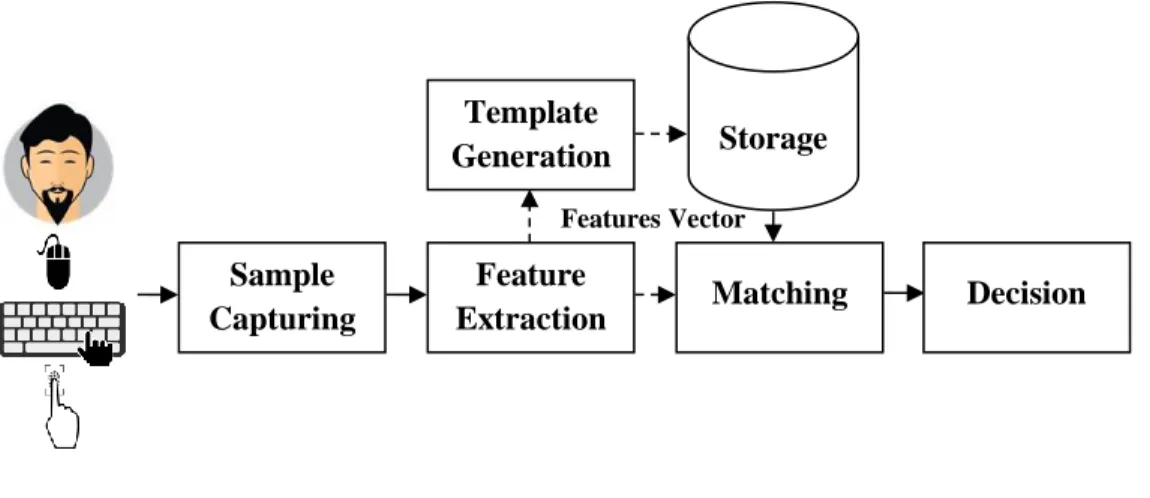
A conventional biometric system mainly comprises of five components which are described as below (Jain et al., 2007, Clarke, 2011):
1. Acquisition
The biometric patterns are captured from an individual by a viable acquisition device. Some biometric technologies can use existing equipment such as
15
face recognition via webcam whilst others need sophisticated scanners (e.g. eye retina recognition).
2. Feature Extraction
Through this component, the biometric features are extracted from the captured samples using particular signal processing algorithms to generate a source biometric template.
3. Storage
The source biometric template is stored on a database or a smartcard in order to be used in the matching process.
4. Matching or Classification
With the purpose of achieving secure access for a genuine user, biometric features are extracted from live biometric samples to compare against the stored template by using a matching algorithm. Consequently, their degree of similarity is represented by a match score.
5. Decision
The degree of required similarity which results in a yes or no response is usually predefined in the system by a threshold. Depending on the response of the system the access will be granted or denied. Figure 2.1 shows the components of the common biometric system:
16
Figure 2. 1 The Components of the Biometric System (modified from Clarke 2011)
On the whole, a biometric authentication is achieved through the enrolment and the verification stages. At the time of enrolment, biometric samples of the legitimate are acquired, and then a biometric template is generated by applying a number of pre-processing and feature extraction algorithms. This biometric template will be stored for subsequent use – where it would be compared against future samples. The quality of biometric samples should be ameliorated to ensure that they are appropriate for successful verification. On authentication, the biometric system verifies the current identity of user with his/her stored identity. The access to the system will be granted to the user if the matching process results in a similarity score that is sufficiently high. The decision component determines what the threshold for acceptance is (Jain et al., 2004).
Biometric approaches fall into two groups: physiological and behavioural biometrics. Physiological approaches rely on the human being body, such as the shape of a face, or eye. Behavioural approaches, however, depend on the behaviour of users when they are doing specific tasks, such as walking or speaking (Ashbourn, 2004). Overall, physiological biometric techniques tend to be the more reliable and mature technology, and they are widespread used due to the tendency of their biometric
Sample Capturing Feature Extraction Template Generation Matching Decision Storage Features Vector
17
features to be invariant over time (Le and Jain, 2009). According to the participatory-based research by Biometrics Institute Industry (BII), the form under which the biometric technologies are classed on the basis of the participant preference starts with fingerprint then face followed by iris (physiological approaches). However, speaker recognition (behavioural approach) comes at the end of the study list (BiometricsInstituteLimited, 2013). Behavioural biometric approaches, however, are typically more convenient than physiological biometrics in terms of collection (Clarke, 2011). That is, the authentic user may not have to react with behavioural biometric system through the sample acquisition phase. The explicit interaction for biometric verification can normally take a while each time – leading to a tedious process. For instance, the voice samples can be captured in a passive manner when the user has a phone call.
2.4 Performance Measurement of Biometric System
As mentioned previously, a biometric system recognises the genuine person from others through the matching or comparison between the target biometric template of the current sample and the stored enrolment biometric template. During this time, several factors can impact the performance of biometric system. For instance, environmental noises can prevent legitimate users to access the system, and conversely allow impostors to get access when they should not.
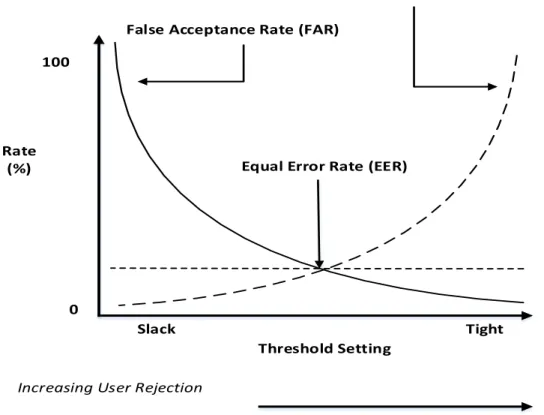
There are two error rates that can evaluate the accuracy of biometric systems. These error rates are the False Rejection Rate (FRR), and the False Acceptance Rate (FAR). FRR measures the rate of biometric system error in rejecting genuine users; however, FAR measures the rate of biometric system error in accepting forgers
18
(Ross et al., 2006, Jain et al., 2007, Clarke, 2011). Figure 2.2 shows the metrics of biometric system performance in terms of FRR and FAR as below:
False Rejection Rate (FRR) False Acceptance Rate (FAR)
Equal Error Rate (EER) 100 Rate (%) 0 Slack Threshold Setting Increasing User Rejection
Tight
Increasing Security
Figure 2. 2 The Metrics Performance in terms of FRR and FAR (Clarke, 2011)
The acceptable values of FRR and FAR are managed by the predefined threshold. Depending on this threshold, the requirements of the system security and usability can be determined. As shown in Figure 2.2, when the threshold is defined tight – requiring a significant level of matching, the access of authentic users to their accounts could be ignored (FRR) (Clarke and Furnell, 2005). In this case, the security level can be underpinned in terms of rejecting illegitimate access (i.e. the FAR will be decreased). However, this would not necessarily improve the overall biometric security. This can also result in user inconveniences due to the repetitive unsuccessful verifications - such systems may not get attracting to be adopted. On the other hand, when the threshold is defined slack – requiring a low level of matching,
19
the possibility of forger’s access to the biometric system will be raised (FAR). Although this would achieve a very convenient verification to valid users by reducing the likelihood of being refused (FRR), it will influence the security aspects negatively. Consequently, the aspects of security and usability should be cautiously balanced. As depicted in Figure 2.2, the accuracy of the biometric system can be also evaluated by another metric called Equal Error Rate (EER) in which the FRR and FAR are intersected. Whenever the EER value decreases, the performance of a biometric system increases and vice versa (Clarke, 2011).
2.5 Multibiometrics
Generally, all biometric approaches can be operated in a single or multimodal biometrics. There is no doubt that the system of multibiometric copes with certain shortcomings of single biometric systems. Single biometric systems have a number of weaknesses, such as low individuality, high forgery attempts, high error rate, and lack of universality. For instance, in face recognition, it is impacted by position, expressions and the amount of present illumination. Also, it has been evident for most contributors that around 2% of the population does not have a legible fingerprint. As a result, they cannot be registered into a fingerprint biometrics system (Congress, 2012). Thus, unimodal biometric can be inadequate for some cases and individuals. The multibiometric system, however, can offer more secure and convenient aspects for particular populations and applications (Ross et al., 2006). For example, national border agencies require applications of high security that can be offered by multi-biometric system. In this context, the AND bitwise fusion of two or more subsequent verifications are applied to be more difficult to tamper with by forgers (Cimato et al.,
20
2009). Another instance is when users are incapable of providing a specific biometric sample either temporarily (e.g. a person with broken hand cannot have hand geometry samples) or permanently (e.g. a wheelchair person cannot have gait samples). In this situation, the OR bitwise fusion can increase the population coverage (Cimato et al., 2009). Consequently, multibiometric systems could offer a higher level of flexibility, convenience, and security over their single biometric counterparts (Ross et al., 2006). Whilst this could improve the system accuracy, robustness and reliability, considerations, such as processing load, cost, and vendor-services should be taken into account prior to deploying such a system. On the whole, multibiometrics systems can be developed by utilising one of the following sources (Ross et al., 2006):
Multimodal in which multiple biometric modalities are used, such as voice and face or iris and gait.
Multi-instance where more than one subtype of the same biometrics is utilised, such as the right and left iris biometrics.
Multi-sensor means that multiple sensors are exploited to acquire a single biometric of a person, such as using both optical and capacitive fingerprint sensors.
Multiple samples under which a single sensor is used to capture more than one sample of the same biometric with taking into account of their potential variations, such as face poses.
Multiple algorithms mean that more than one classification algorithm upon a single biometric is used to combine the resultant features (e.g. minutiae-based and texture-minutiae-based fingerprint classifier algorithms).
21
Hybrid by where a subset of the above-mentioned categories is exploited, aiming at improving the recognition accuracy. For example, three face recognition algorithms can be incorporated with two iris recognition algorithms. The variety of information sources (multimodal, instance, sensor, multi-sample, multi-algorithmic, and hybrid approaches) for a multibiometric system aims to improve the verification decision. Therefore, the way of combining the biometric features, which is termed fusion, should be employed carefully to reinforce the decision process. Overall, the fusion method can be applied during particular levels in the biometric system. These levels that are sensor, feature, matching and/or decision level are illustrated as below (Ross et al., 2006, Sim et al., 2007):
Sensor level fusion integrates the raw data of multiple biometric samples afore the feature extraction stage. The raw data can be captured by a single sensor or by multiple sensors (e.g. consolidating several iris images from one or several sensors).
Feature level fusion consolidates multiple feature vectors that are extracted from the samples of one or more biometric modalities by using several feature extraction algorithms. The fusion of multiple feature vectors will be used in the matching phase (e.g. consolidating the feature vectors of the fingerprint and iris).
Score level fusion in which the results of multiple biometrics matchers are combined to obtain a new stacked match score that will be exploited for the consecutive decision process.
Decision level fusion occurs when each associated biometric system has presented its own decision to provide a final decision.
22
2.6 Continuous and Transparent Biometric Authentication
Most standard authentication approaches, such as biometric authentication establishes initial user verification at the beginning of the session only not frequently (i.e. point-of-entry authentication); accordingly, these approaches have particular shortcomings. That is, when point-of-entry authentication has been successfully achieved, and the genuine person has gone away from his active device for significant periods of time, critical issues can arise (Clarke and Furnell, 2005). Serious vulnerabilities under which an adversary can attack the device will take place after an initial genuine login only – where free and open abuse can be performed. The majority of the authentication approaches verify the valid user at the time of making the access control decision only not throughout as shown in Figure 2.3 (Clarke, 2011):
23
Figure 2. 3 A Model of Conventional Authentication (Clarke 2011)
As such, it is arguably advantageous to maximise the authentication of users beyond simple and standard authentication approaches. A possible direction of coping with the misuse issues is to apply sophisticated authentication techniques that can apply user reverification continuously and periodically without any inconveniences. Most of the applicable authentication techniques are built in an intrusive fashion. To say, there is an explicit interaction between the user and the system. For instance, the user should type the password to gain access to the system (Ceccarelli et al., 2015). Although biometric authentication is intrusively deployed, it can be developed in a more usable and secure manner. That is, biometrics can be collected in a spontaneous or non-intrusive way, aimed at verifying the legitimate users continuously. Therefore, transparent or non-intrusive biometric is an approach in which an active and continuous verification mechanism is provided over time by non-intrusively collecting the biometric samples thus eradicating the inconveniences on having to explicitly interact with the system. This authentication presents the opportunity of immigrating a yes/no response to a more appropriate and reliable
Assumed Authentication Security
Time Actual Authentication Security Desired Email Game Micro Payment Local Telephone Call SMS Aut hentic a tio n Securit y P oint of E ntr y Auth enti ca tion
24
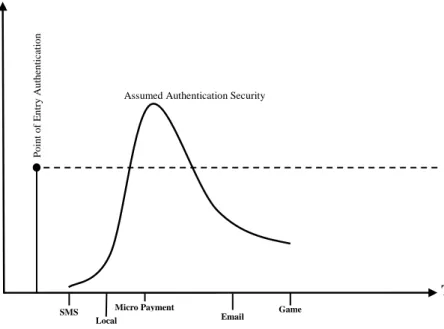
decision where a non-intrusive authentication process is more closely stood up with the access control decision. Moreover, transparent biometric verification takes into account that the entire authentication techniques are unequal, and they have different levels of effectiveness as illustrated in Figure 2.4 (Clarke, 2011):
Figure 2. 4 A Model of Continuous Authentication Confidence (Clarke 2011)
However, the establishment of transparent authentication is still a challenging task. Although transparent authentication presents a continuous and flexible authentication over time, specific issues impede the verification process. These largely concentrate around the case of acquiring a person’s biometric sample in a non-intrusive way. For instance, in the case of capturing the face samples, external and environmental factors, such as the distance of the camera, face orientation and lighting considerably impact the accuracy of facial detection (Clarke, 2011). Furthermore, not all biometric techniques can be adapted to operate in a transparent manner. This chapter will concentrate in the next subsection on discussing biometric
P oint of E ntr y Auth enti ca tion Time
Actual Authentication Security Provided
Actual Authentication Security Desired Email Game Micro Payment Local Telephone Call SMS Aut hentic a tio n Securit y
25
techniques that are considered transparent-enabled approaches and appropriate with the context of this research.
In spite of the abovementioned barriers and challenges of transparent authentication, its conception can offer potential benefit over traditional intrusive biometric in this research. Applying transparent biometrics within bio-cryptography can remove many of the usability issues of the existing cloud-based storage model and simultaneously introduce cloud-independent encryption layer. The cloud subscriber will no longer need to manually encrypt/decrypt each and every file prior to putting it into cloud storage through auxiliary encryption tools. In addition, the encryption key will be biometrically established on the fly without storing it somewhere to overcome potential attacks upon stored security credentials (biometrics, secret keys/passwords).
2.6.1 Transparent Biometric Approaches
A number of biometric modalities can be considered transparent-enabled approaches as they do not necessarily require an explicit interaction for sample collection. Transparent biometric techniques can be also classified into two categories: physiological (e.g. face, ear and fingerprint) and behavioural, such as keystrokes analysis, eye gaze or eye tracking and gait (Clarke, 2011). Of course, the features in both categories are established in non-intrusive manner without inconveniencing the user. A variety of physiological and behavioural approaches that could be transparently employed in the context of this research are debated in the following subsections. These subsections start with physiological biometrics of
26
fingerprint, face, eye geometry and ear, and then turn into behavioural biometrics of voice, keystrokes analysis and behavioural profiling.
2.6.1.1 Fingerprint Recognition
Fingerprint recognition is the oldest and popular biometric technologies that have been widely used in many computing and mobile applications for authentication purposes. The adoption of fingerprint technology become very prevalent around because profound studies have been experimentally proven that fingerprint recognition approach has high level of individuality to each finger (Jain et al., 2007). As a result, the applications of fingerprint biometric are exploited for both physical and logical access control. Overall, fingerprint recognition compares ridges, valleys and patterns of a person fingerprint via one of the three matching classification approaches: minutiae-based, correlation-based and ridge feature-based (Maltoni et al., 2009). It is evident that there are no two individuals (including identical twins) sharing the same fingerprints as the fingerprint patterns are part of an individual’s phenotype, and do not seemingly rely on genetics (Danielyan, 2004, Ross et al., 2006).
Fingerprints have been used to recognise human beings for a long time. During 1926, law enforcement in American cities had started submitting fingerprint cards to the Federal Bureau of Investigation (FBI) in an attempt to build a database of fingerprints from known criminals. In the early 1960s, fingerprint technology became automated with the Automated Fingerprint Identification System (AFIS) (Soutar et al., 1999). Later, the FBI developed the AFIS in 1999 with respect to response time and capacity, and at the same time included the ten fingerprints to become the Integrated
27
Automated Fingerprint Identification System (IAFIS). Despite the evidences of pre-historic use of fingerprint technology for human recognition (Holder et al., 2011), the current applications of fingerprint technique earned wide prominence since the evolution of digital computer, and has continued to remain popular in forensics, commercial, civil and Government applications.
From the unconstrained authentication perspective, fingerprint has the potential to be applied in a transparent fashion. There are some efforts that can reflect promising indications towards achieving mature transparent fingerprint techniques. Owing to the rush in the number of touch based smart devices, there is an increasing necessity for developing a convenient authentication framework via the fingerprint uniqueness of person’s identity. As such, fingerprint samples can be collected by using capacitive sensing techniques in touchable smart devices. In an interesting review, Koundinya et al. (2014) proposed an innovative integrated device using transparent electronics for both multi-touch interaction and fingerprint scan. Non-intrusive touch sensitive device and an input/output circuit which drives the capacitive sensor array for fingerprint sensing at higher resolutions and for touch interactions at low resolutions are discussed in an elaborate manner. The experimental results demonstrated that the proposed scheme can be recognised, and can present a highly efficient means for transparent user authentication. Furthermore, Apple Company has recently introduced the Touch ID fingerprint scanner on the iPhone 6 (Hattersley, 2016). Using this technology, a person should initially register his finger samples to the system. As such, whenever a person places his finger on the home button to unlock the mobile phone device, the hardware passively scans the finger, and the software establishes the genuine verification. Apple’s implementation of the Touch ID can
28
arguably reflect transparent and continuous authentication (Hattersley, 2016). It can be argued that the novel insights of employing the fingerprint modality towards unconstrained sample collection will undoubtedly present mature transparent and continuous fingerprint verification for enhancing the security and usability aspects.
2.6.1.2 Face Recognition
Facial recognition has been widely utilised in the computer security and surveillance applications since it can provide vital discriminative features for recognising human beings. (Jain et al., 2007). The face modality is deemed a passive biometric since it does not necessarily require the reaction of the user to achieve recognition as well as the unobtrusive nature of its technology makes it an attractive choice for many security applications. For example, an automated face recognition system can use a video camera to capture face images from a distance, and detect, track and finally recognize people, such as terrorists or drug traffickers (Solayappan and Latifi, 2006). The features of the face biometric can be the dimensions of the eyes, nose, mouth, ears, cheekbones, and the distance among most or all of them. The location and shape the face attributes (e.g. eyes, nose and lips) can be also used as facial features. These facial features are extracted by particular algorithms, and their effectiveness depend on several factors, such as the consistency of the extracted features over time, image resolution, surrounding lighting, and face distance and position from the camera (Clarke and Furnell, 2005). As a result, certain schemes have been presented in order to manage some of these factors in a transparent mode. Using a three-dimensional image modal could assist in mitigating the impacts of face orientation and illumination conditions. However, the need for 3D acquisition
29
device, such as camera or sensor would hinder its acceptance (Clarke, 2011) due to their tendency to be slower in response and more expensive (Jain et al., 2007). What is more, Clarke et al. (2008) transparently suggested an advanced composite paradigm in which a number of person’s face samples in different sizes, orientations and illumination are jointly stored as a biometric template. Accordingly, when a sample is captured, it will be compared with the stored composite template to accomplish user authentication. For example, if the taken sample is facing down, then it will be matched with the stored template under which that orientation exists and similarly for other instances. On the other hand, the trade-off between security and user friendliness is an issue because the possibility of rejecting a legitimate user decreases while that of accepting a forger increases.
2.6.1.3 Eye Geometry
As one of the distinctive facial features, human eyes specifically play a vital role in face recognition and facial expressions analysis. The eye geometry is mostly more prominent and consistent feature than the other facial features over time (Peng et al., 2005). As such, the landmarks of eye patterns are considered an important discovery for quick, convenient, and reliable pattern recognition since they are quite unique. As a result, the eye recognition technology could be close to the other biometric technologies in terms of performance, such as iris, voice and fingerprint recognition. However, it seems that there have been no independent trials of the eye geometry recognition technology (Panda and Ranjan, 2007). On the whole, eye recognition technique depends on the eye detection approaches (Peng et al., 2005). Various papers, therefore, have been published in the scope of eye detection in order to present the capacity of developing eye recognition.
30
Eye detection approaches in the literature can be divided into two groups: active infrared (IR) approaches and passive approaches. The detection approaches which depend on active remote IR illumination are simple and effective, where they utilise an active IR light source to obtain the bright or dark pupil impacts. That is to say, these methods can be only applied to the IR illuminated eye pictures. Of course, these methods are not widely used as the eye samples of real-time applications are apparently not IR illuminated (Peng et al., 2005). On the other hand, the passive methods can be divided into three types: template based methods (Xie et al., 1994), appearance based methods (Huang and Wechsler, 1999) and feature based methods (Feng and Yuen, 1998). In template based methods, a generic eye model, which is based on the eye shape, is designed first. Accordingly, template matching is used to find the nearest picture for the test samples. Whilst these methods can accurately detect eyes geometry, they are taking considerable period of time to process the eye detection (Peng et al., 2005). The appearance based methods can detect eyes based on their photometric appearance. However, these methods usually need to collect a large amount of training data, representing the eyes of various volunteers, under different facial orientations, and under different illumination conditions. So as to accomplish the eye detection process, these training data are used to learn a classifier, such as a neural network or the support vector machine, and depending on the matching score, the decision is made (Huang and Wechsler, 1999). Feature based methods discover the eye features of edge and the intensity (i.e. the colour distributions of the sclera and the flesh of the eyes) to identify unique biometric features. Even though these methods are usually efficient, they lack accuracy for the pictures that have no high contrast. For instance, these techniques could mistake the eyebrows of eyes (Feng and Yuen, 1998). Therefore, multiple eye
31
detection approaches can be incorporated with the aim of increasing the performance of the eye recognition technique. Generally, the dimensions of the eyes and the distance between them are utmost incorporated with the other facial features to establish face recognition. However, it might be advantageous to treat the eye geometry modality as an individual biometric approach to underpin the performance of multibiometric.
2.6.1.4 Ear Geometry
Ear approach measures the shape of the ear and the structure of the cartilaginous tissue of the pinna. Generally, the ear recognition technology depends on matching the distance of prominent points on the pinna from a landmark location on the ear (Jain et al., 2004). Ear biometric technology is viable as the ear anatomy is unique to each person and features based on measurements of that anatomy are comparable over time. That is, each individual has his own ear anatomy that is significantly different from others. Ear biometrics is passive in nature as in face, where it does not require the active participation of the human being (Yan and Bowyer, 2005). It has been demonstrated that the distinctive features of the ear geometry are quite constant over time (Pflug and Busch, 2012). Furthermore, the ear features can be recognised from a distance, and they are not influenced by specific factors, such as lighting and aging (Abaza et al., 2013). Despite the appropriateness of the ear for achieving robust authentication, there are apparently no commercial launches regarding ear geometry technologies. For non-invasive applications, the specifications of the front camera on smart phones may be exploited to achieve transparent ear authentication where the samples can be collected in an unobtrusive manner during a phone call interaction (Clarke, 2011).
32
On the whole, recognition performance of traditional ear biometric techniques is high, and could reflect encouraging indications towards the initiatives of transparent ear authentication. The common ear recognition performance for specific approaches according to Yan and Bowyer (2005) are tabulated in Table 2.2 as follows: