Formula One - The Engineering Race
Evolution in virtual & physical testing over the last 15 years
Torbjörn Larsson
How F1 has influenced CAE development by pushing boundaries
working at the “bleeding edge”
But now lost the edge?
Torbjörn Larsson
Starting Grid
P1
Altair & Creo Dynamics
P3
Aerodynamics
P5
Supercomputing
The haydays and the future
P2
Introduction to Formula One
P4
Evolution of CFD in F1
P6
Beating the rules
• Built upon philosophy, technology and lessons learned in F1
• Leverage via networking and technical collaboration with academia and industry
5
6
Evolution of F1 cars since 1950
• Formula One is a highly regulated sport and the car basic dimensions are dictated by the FIA technical regulations.
• Car shaping is primarily driven by aerodynamic efficiency.
7
2009 Rule Change of FIA Technical Regulation
8
Car Shape Evolution
2009 2008
The Performance of the Package
Driver
Grip - Tyres, Suspension, etc.
Vehicle Mass and Centre of Gravity
Engine and Transmission of Power
Aerodynamics
% CHANGE IN LAP TIME
• +5% of Tyre Grip Average = -1.62
• -5% of Weight Average = -0.96
• +5% of Power Average = -0.74
• +5% Aerodynamic Efficiency = -0.52
Aerodynamics
11
Aerodynamics
12
Flow Physics
– Strong vorticies and wake flow – Separated flows
– High lifting wings – Ground effect – Flow interactions
Shape Complexity – Geometrical details – Large range of scales
– Small clearances (ground, tire seals) – Deformations and aero-elastic effects
Aerodynamics
Aerodynamics Performance Propels the Development in Formula One
‐ Extremely high development pace
‐ Continuous and incremental design evolution
‐ Combined use of physical and virtual testing (Track, WT, CFD) ‐ State-of-the-art technology
Ultra-competitive industry which has become a competition in engineering excellence. F1 has acted as catalyst in developing state-of-the-art CFD techniques over the last decade. Having the upper hand in simulation driven design is key to success in F1.
CFD
Requirements
• High development pace
Short turn-around time required for CFD to have an influence
• Incremental design approach
Sufficient accuracy and fidelity in the CFD results required to pick-up the correct trends from sequences of small design changes
14
CFD
Formula One - an Early Adopter of New Technology
• Large scale unstructured meshing
• Parallel efficiency of meshing, solving and post-processing tools
• Moving mesh and mesh morphing algorithms
• Efficient solvers and solving schemes
• Tuning and tailoring of turbulence models (high-lifting wings, transition, wake flows)
• Adjoint solvers
• FSI
• Automation and scripting
Simulation Tools
Simulation Tools
Wind Tunnel & CFD
• Extremely high development pace
Teams operating with ~100 people to support the aerodynamics development in the wind tunnel
• Wind tunnels run 24/7
(not true anymore)
• Very short project lead times
Evolution of CFD Usage in F1
The past …
18
Supercomputing in F1
The race begins ..
In 2005 the Sauber F1 team introduced Albert …
19
Supercomputing in F1
The race begins ..
2006 Albert2 1024 cores 12 TFlops (#60 on Top 500 list)
2008 Albert3 4224 cores 58 TFlops (#45 on Top 500 list)
Supercomputing in F1
The race begins ..
Formula 1 Supercomputer Championship 2008 (by TFLOPS)
• BMW Sauber F1 Team: Albert3, 4224 cores (Intel Xeon)
• Renault F1 Team: Appro Xtreme-X2, 1024 sockets, 4096 cores (AMD QC Opteron)
• Ferrari : Acer/IBM/Racksaver, 1000+ processor sockets (upgrading to QC Opteron)
• McLaren: Silicon Graphics Altix, 512 Sockets, 1024 cores (Intel Itanium 2)
• Red Bull: IBM, 512 sockets, 1024 core (upgrading to AMD QC Opteron)
• Toyota F1 Team: Fujitsu, 320 Sockets, 640 cores (Intel Itanium 2)
• WilliamsF1: Lenovo Unnamed, 332 Sockets, 664 cores (Intel Xeon 5100)
• Honda F1 Racing: SGI Altix ICE, unknown number of socket/cores, water-cooled Quad-Core Intel Xeon
• Toro Rosso: N/A (uses Red Bull infrastructure)
• Super Aguri: N/A (uses Honda F1 infrastructure)
• Force India: Rental system (unknown specifications)
FIA & FOTA rules
22
FOTA
Bigger computers, new wind tunnels – the costs of F1 are escalating …
• Budget Cap?• Limit Testing?
2009
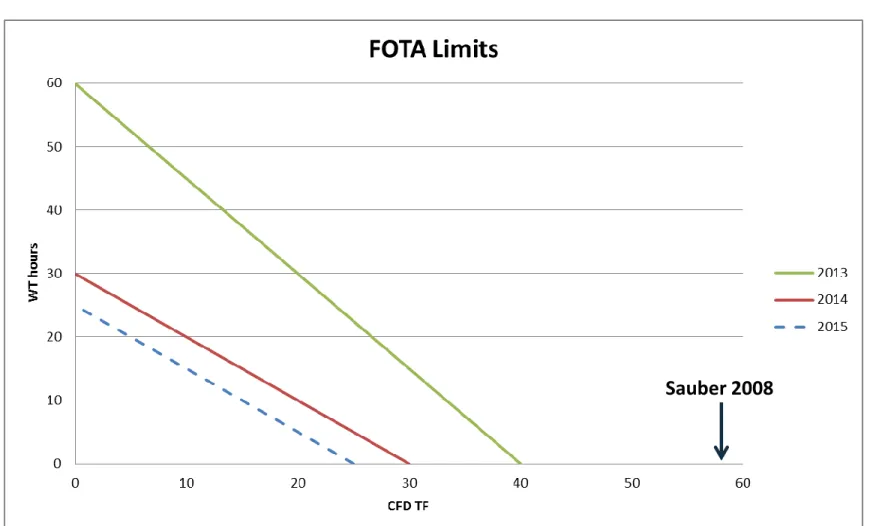
FOTA imposed limitations on aerodynamic testing and CFD.
FIA New Technical Regulations
2009
Driving forces behind the new regulations
• Cost reduction (FOTA)
• Improve the on-track spectacle – promote overtaking
“
Decrease reliance on aerodynamic downforce and increase mechanical grip
with the aim of making wheel-to-wheel racing easier”
FOTA Rules
Wind tunnel & CFD limits
24
FOTA Rules
Implications on hardware
25
What is TFLOPS?
1012 Floating Point Operations per Second
FLOPS = Clock X Operations/Cycle X Cores (Theoretical Peak Performance)
CPU Clock (GHz) operations/clock no of cores/socket TFLOPS
Intel E5 2699 2,3 16 18 0,6624
FOTA Rules
Implications on hardware
26
Already in 2008, teams were operating 4000+ cores clusters. Today - are they running much smaller clusters?
Not necessarily, Formula One is all about “beating the regulations”.
FLOPS = Clock X Operations/cycle X Cores (Theoretical Peak Performance)
What counts is the simulation through-put. So, the question becomes;
How can one design and optimize a HW/SW combo that maximizes through-put at minimum FLOPS?
Have F1 lost the edge?
Exponential growth of supercomputing power - Top 500 List
“The rest of the world is advancing CFD and HPC, tackling ever larger and more complex problems, taking full benefit of latest technology and Moore’s Law”.
Contact Details [email protected] Creo Dynamics AB Linköping Westmansgatan 37A SE-582 16 Linköping Sweden www.creodynamics.com