Social Media Classification Scheme in Online Teaching and Learning Activities: A
Consideration for Educators
Dan V. Dao, Ph.D.
Curriculum and Instruction
Texas Tech University
U.S.A
Abstract
Blackboard, one of the most powerful learning management systems emerged in 1997(Sylvester, 2011). It has been effectively employed in education. Unfortunately, many universities in developing countries cannot afford such a learning management system for some reason. In an effort to provide these countries with the benefits offered by technological instruction, this paper will review literature from different studies on how social media sites can provide instructors and students with many of the features of proprietary course management systems. The paper will briefly report the history and the types of social media sites. It will study in details the reasons why social media sites are classified into six types and the characteristics of social media sites which facilitate interaction between the instructor and students, among the students themselves, and between the students and materials. Finally, the paper also provides a classification scheme of common social media sites for educators.
Key words: Social media sites, features, characteristics, online teaching
Introduction
No one can deny that technology has many prominent features. It is increasingly exploited in education. Online education is becoming more and more common in many schools and universities nowadays because of the advantages of the Internet. One of the most popular learning management systems getting advantages of the Internet is Blackboard. Blackboard was founded in 1997 by two educational advisors, Matthew Pittinsky and Michael Chasen. Blackboard is used by more than 70% of universities and colleges in the U.S (Bradford, Porciello, Balkon, & Backus, 2007).
Although the Blackboard learning system has many prominent features for teaching and learning activities, many universities cannot afford the system because of the high cost and complicated technical skill requirements (Bradford, Porciello, Balkon, & Backus, 2007). Since Blackboard and other learning management systems cannot be used in many universities, especially in developing countries for some reason, in this paper, I will research how social media sites can provide the instructor and students with many of the features of proprietary course management systems.
Definition of Social Media Sites
What is social media? Kaplan & Haenlein (2010) defined social media as "a group of Internet-based applications that build on the ideological and technological foundations of Web 2.0, which allows the creation and exchange of user-generated content” (p. 61). According to Bradley (2010), “At its foundation, social media is a set of technologies and channels targeted at forming and enabling a potentially massive community of participants to productively collaborate” (p. 2). Similarly, Curtis (2011) stated, “Social media are Internet sites where people interact freely, sharing and discussing information about each other and their lives, using a multimedia mix of personal words, pictures, videos and audio” (p. 1). Although researchers have different definitions of social media sites, the definitions all reveal the same meaningful function: social media sites are web-based sites for social communication where Internet users can create online communities to share information with one another. Social media sites are two-way communication, so interaction between the instructor and students, among the students, and between the students and materials becomes effective for online course.
History of Social Media Sites
Social media has had a wonderful history. According to Borges (2012), social media started in 1969 when the first online service was in use by CompuServe. In 1971, the first email was sent between computers. In 1989, the World Wide Web was introduced. In 1994, the first blog was created by a student. The first modern social network was launched in 1997, and it allowed Internet users to create their own profiles and to become friends with other users. In 1999, blog platforms were launched, and people were allowed to post their messages, pictures, and videos to their blogs. People were invited to join their friend‟s personal blogs. Social Networking and Bookmarking sites were launched in 2003. In 2004, Facebook was launched, and more and more people have used Facebook for their everyday communication. Youtube was launched in 2005, and this was the first video hosting and sharing site. The users can upload about 10 minute long videos to Youtube, share them with other users through Youtube, or embed the link to other blogs or personal websites. The online presentation site Slideshare was launched in 2006, as well as Twitter. More and more people have benefited from their daily use of these social media sites. In 2011, social media became social business.
Types of Social Media Sites
Many researchers have different ideas about types of social media sites. However, this paper is developing around the framework of Kaplan and Haenlein (2010) who pointed out six different types of social media: (a) Collaborative projects, (b) blogs and micro blogs, (c) content communities, (d) social networking sites, (e) virtual game worlds, and (f) virtual communities. These six specific types of social media sites are more clearly explained as the followings:
The first type of social media is collaborative blogs or collaborative projects. A Wiki is perhaps the most typical collaborative project site (e.g., Wikipedia). Wiki‟s allow many participants to work together on the same project (e.g., a research analysis, writing a dictionary, or group work project). The project participants can all edit the content of the project at anytime and anywhere to make it complete. Wikis record all the actions of participants in the site. In addition, all participants in one course can share and contribute ideas to the course discussion forum. The second type of social media is Blogs, Microblogs, and Internet Forums. This second type is considered the earliest form of social media sites. Blogs, Microblogs, and Forums are considered personal web pages where individuals can communicate with one another through texts and other multimedia like videos, audios, and pictures. The blog or forum owner can post messages to the blog or can upload information to the blogs or forums while the blog or forum followers can view, download, and give comment to the messages. The most commons blogs and forums are Wordpress.com,Blogger.com, and Yahoo!Groups.com.
Content Communities is the third type of social media. The main function of Content Communities is sharing media contents (e.g., videos, pictures, audio clips, and PowerPoint presentations) between users. Internet users can create an account for each of the Content Communities, upload media content to the sites, and share the media content with one another. The simplest way to share media content is to send a link to others or to post a link to the personal blog. Internet users can access media content by clicking on the link that leads to the content page. Common types of the Content Communities are Youtube (for videos), Flickr (for photos), and Slideshare (for PowerPoint Presentations).
The fourth type of social media is Social Networking.Facebook, Ning, LinkedIn, and MySpace are considered the most common social networking sites. They are called Social Networking Sites because they are sites for social communication. The site applications allow the Internet users to create personal profiles, invite others to join the site, access the profiles of other users, share information (text, pictures, videos, and other links from the other sites), and send emails as well as instant messages to each other. The site owner controls access to the site and the online group discussions. Specifically, Facebook can be used as a forum for classroom discussion.
Virtual Game Worlds is a fifth type of social media. They are online platforms where users can virtually participate in games via personalized avatars in virtual worlds. World of Warcraft is the famous virtual game world.
For teaching, the teacher can choose and design a place or a virtual class and ask the class participants to meet at the place for the class discussion. The only difference is that the users can do whatever they like in their virtual lives that they cannot do in their real lives. Second Life is the most famous site, and this site has a number of teaching and learning applications.
Two Key Elements of Social Media Sites
Kaplan & Haenlein (2010) classified social media sites into these six types based on social presence / media richness and self-presentation / self-disclosure, the two key elements of social media.
1. Social media sites are classified based on social presence and media richness.
Social presence is used to describe and understand how people socially interact with each other in online learning environments. Short, Williams & Christie (1976) defined social presence as the "degree of salience of the other person in the interaction and the consequent salience of their interpersonal relationships" (p. 65). Degree of salience refers to the quality and the state of being there between two communication partners using a communication medium.
Social presence is related to intimacy and immediacy. Argyle & Dean (1965) and Short et al., (1976) indicate that intimacy is used to refer to the interpretation of interpersonal interactions (e.g., face-to-face discussions or conversations) versus mediated interactions (e.g., telephone conversations). The level of intimacy is expressed by verbal and non-verbal behaviors (or gestures). In terms of immediacy, Short et al., (1976) and Weiner & Mehrabian (1968) point out that immediacy is a measure of psychological distance like asynchronous (not happening or not going at the same rate, same time, or exactly together with something like emails and offline messages) or synchronous (occurring or existing at the same time through live chat on Skype or Yahoo!Messanger) of the medium that the communicators take part in the conversation. “The higher the social presence, the larger the social influence that the communication partners have on each other‟s behavior” (Kaplan & Haenlein, 2010, p. 61).
Regarding media richness, Kaplan & Haenlein (2010) say that the concept of media richness is closely related to the ideas of social presence. Daft & Lengel (1986) developed the theory of media richness to see the information processing behaviors in organizations and industries. They discovered that the goal of communication is to reduce uncertainty and to reduce equivocality or ambiguity. Uncertainty represents the “absence of information” (Daft & Lengel,1986, p. 556). Equivocality or ambiguity refers to the prevalence of a number of different and conflicting ideas about the same organizational situation (Daft & Macintosh, 1981). Daft and Lengel (1986) defined media richness as:
The ability of information to change understanding within a time interval. Communication transactions that can overcome different frames of reference or clarify ambiguous issues to change understanding in a timely manner are considered rich. Communications that require a long time to enable understanding or that cannot overcome different perspectives are lower in richness. In a sense, richness pertains to the learning capacity of a communication. (p. 560)
Daft &Lengel (1986) point out that communication media can determine the richness of information. As a matter of fact, different communication media differ in the degree of richness they possess. Daft &Lengel (1986) also clarify that face-to-face communication has the highest richness whereas text or numeric communication has the lowest richness. Similarly, Connell, Mendelsohn, Robins & Canny (2001) add that face-to-face media are the richest, followed by video-conferencing, telephone, computer-mediated communication, addressed written communication, unaddressed written communication, and formal alpha-numeric text which has the lowest media richness. Social Presence and Media Richness are illustrated in Table 1.
Table 1: Social Presence and Media Richness
Social Presence and Media Richness
Low Medium High
Blogs
(e.g., Blogger, WordPress)
(2)
Social networking sites (e.g., Facebook)
(4)
Virtual social worlds (e.g., Second Life)
(6)
Collaborative Projects (e.g., Wikipedia)
(1)
Content communities (e.g., YouTube)
(3)
Virtual game world (e.g., World of Warcraft)
(5)
(Source: Adapted from Kaplan & Haenlein (2010)) || In the table from 1 to 6, the bigger the number is, the more powerful the social media sites are.
In terms of social presence and media richness of Social Media Sites in educational settings
The lowest levels among the 6 types of social media sites are Collaborative Projects (1) (e.g., Wikipedia) and Blogs (2) (e.g., Blogger, WordPress). They have a discussion forum where the teacher and the students can share almost everything from text messages to pictures, audio clips, and video clips. For example, Blogs and Collaborative Projects have a Setting tool that allows the teacher to set up Discussion settings. Whenever the teacher and the students post something onto the discussion platform, Blogs and Collaborative Projects will send him/her a message via the personal email to notify the information. However, the capacity of communication is low and simple because the interactions among the teacher and the students or among the students are based on text only. There is no face-to-face communication as well as audio or video chats.
The higher levels among the applications are Content Communities (3) (e.g., YouTube) and Social networking sites (4) (e.g., Facebook). These applications score higher than Collaborative Projects (1) and Blogs (2)because they enable the ability of sharing of photos, audio clips, video clips, and other forms of media besides text-based communication. The learning capacity of communication is richer. They both have synchronous and asynchronous interaction functions, so the teacher and the students or the students themselves can chat or video-conference synchronously. They can also leave offline messages if they do not meet each other online. The media richness is high. As a result, they can get and update information fast and directly. The teacher and the students can use applications like Skype, Yahoo!Messenger, YouTube, and Facebook for both synchronous and asynchronous communications; Prezi and SlideShare for sharing online PowerPoint Presentations; and Flickr and Picasa for sharing photos. The teacher and the students at this level can text, chat, and share media with one another in their teaching and learning activities.
The highest level among the applications for interactions are Virtual game worlds (e.g., World of Warcraft) (5) and Virtual social worlds (e.g., Second Life) (6). These applications “replicate all dimensions of face-to-face interactions in a virtual environment” (Kaplan & Haenlein, 2010, p. 62). They are considered the most advanced means of communication because the teacher and the students or among the students themselves can chat or talk face-to-face as in their real life. Everyone has his own avatar (a representative of oneself in the virtual world), so the interactive environment is similar to the one in real life. The communication in Second Life, for example, is conducted through the computer chat screen. The teacher and the students can orally communicate by using the microphone and speaker that are connected to the computer or by texting synchronously. These applications are very good for teaching and learning activities.
2. Social media sites are classified based on self-presentation and self-disclosure.
Regarding self-presentation, Goffman (1959) says when an individual enters the presence of others who commonly seek to acquire information about him or to bring into play information they already possess about him, the individual tries to control or guide the impressions like his appearance and manner that others may make of him. This is called self-presentation. The central point in Goffman's theory is the notion of impression management. He indicates that in every social interaction with one another, people usually present themselves as
In addition, Leary (1993) says that self-presentation is a kind of impression management. People present their self-presentation consciously or unconsciously, and they think that self-presentation is very good for smooth social interactions. Sharing ideas about presenting people themselves, Schau & Gilly (2003) point out that many people create their personal websites and present themselves online. They really want to reveal self-referential behaviors and true self. According to Kaplan & Haenlein (2010), all of such above-mentioned self-presentation is “done through self-disclosure” (p. 62).
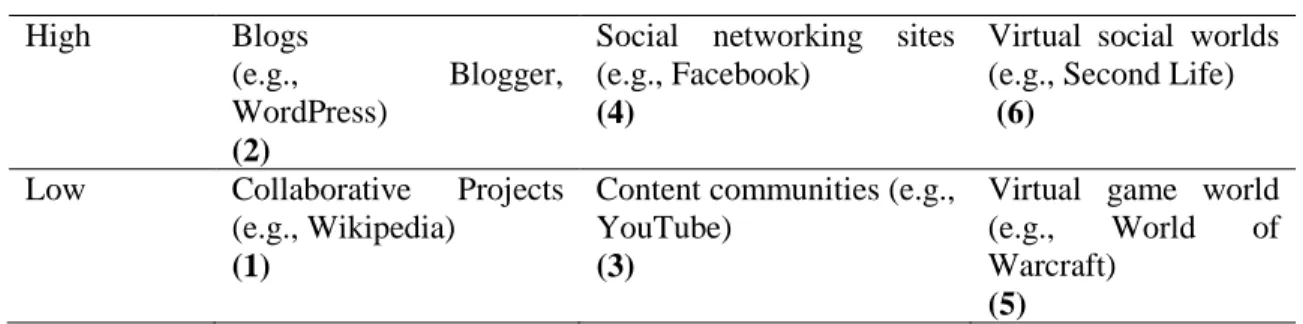
Derlega & Grzelak (1979) refer self-disclosure to any personal information that someone shares with the others. Self-disclosure consists of personal states, dispositions, events happening in the past, and plans for the future. Kaplan & Haenlein indicate that self-disclosure is “the conscious or unconscious revelation of personal information (e.g., thoughts, feelings, likes, dislikes) that is consistent with the image one would like to give” (p. 62). Self-disclosure fosters friendships among members. Draper, Pittard, & Sterling (2008) point out, “the friendship is influenced by the self-disclosure, regardless of the content, because it signifies trust” (p. 3). Self-Presentation and Self-Disclosure are shown in Table 2.
Table 2: Self-Presentation and Self-Disclosure
Self- Presentation and Self-Disclosure
High Blogs
(e.g., Blogger, WordPress)
(2)
Social networking sites (e.g., Facebook)
(4)
Virtual social worlds (e.g., Second Life)
(6)
Low Collaborative Projects (e.g., Wikipedia)
(1)
Content communities (e.g., YouTube)
(3)
Virtual game world (e.g., World of Warcraft)
(5)
(Source: Adapted from Kaplan & Haenlein (2010)) || In the table from 1 to 6, the bigger the number is, the more powerful the social media sites are.
In terms of self-presentation and self-disclosure of Social Media Sites in educational settings
As compared to Blogs (2) (e.g., Blogger, WordPress) and Collaborative Projects (1) (e.g., Wikipedia), Blogs usually have higher scores than Collaborative Projects. Blogs allow the teacher and the students to have more room to disclose their personal information, such as full name, place of work, about you, contact information, adding a photo through avatar, links, and personal websites in their profile than Collaborative Projects that allow the teacher and the students to show their name and profile picture only. In addition, Blogs (e.g., WordPress)have Ratings and Polls, so the teacher and the students or followers can rate the posts to show the reputation; the rate levels are: very poor, poor, average, good, and excellent while Collaborative Projects do not have this rating function. According to Kaplan & Haenlein (2010), the self-presentation of the user‟s identity is shown up through conscious or unconscious self-disclosure of subjective evaluation through expressing their thoughts, feelings, likes, and dislikes.
In the similar dimension, Social networking sites (4) (e.g., Facebook) score higher than Content Communities (3) (e.g., YouTube). Although these applications allow the teacher and the students to show their identity publicly through sharing their personal information, their photos, and their video clips and they both allow the teacher and the students to rate their personal information and picture disclosure by choosing Like (thumbs-up) or Dislike (thumbs-down), Social networking sites are more preferred to self-present than Content Communities. In fact, Social networking sites allow the teacher and the students to publicly manage and disclose their personal information more than Content Communities do. For example, Facebook requires the teacher and the students to provide rich personal information like full name, date of birth, sex, gender, religion, marital status, history of work and education, family, and contact information in their profile while YouTube has a Channel Setting that allows the teacher and the students to display some personal information such as avatar, background information, and personal links or websites.
Finally, Virtual social worlds (6) (e.g., Second Life) require a higher level of self-disclosure than Virtual game worlds (5) (e.g., World of Warcraft). According to Kaplan & Haenlein (2010), these applications are all virtual worlds, and they attempt to replicate a real life in the three dimensional environment. The teacher and the students can choose their own character and their avatar in order to interact with one another in the virtual world as they are doing in real life. However, Virtual social worlds allow the teacher and the students to have more freedom to choose their behavior and to live in their virtual worlds. The teacher and the students have more opportunities to show off their personalities, living styles, and their self-presentation. In the meantime, Virtual game worlds have some strict rules (e.g., creating a suitable name that fits within the World of Warcraft universe, choosing characters, staying in the same character in any channel for role-playing, or maintaining a positive atmosphere for role-playing) for the site users to follow (Wikia, 2012). The strict rules cause the limitation of the teacher‟s and the students‟ self-presentation and self-disclosure.
Generally, self-presentation and self-disclosure let the teacher and the students self-present themselves professionally in the educational context. This disclosure makes the interactions between the teacher and the students and among the students more effective.
To sum up, social media sites are classified into 6 types based on the social presence / media richness and self-presentation / self-disclosure. The degrees of these two key elements determine the levels of social media classifications. Selecting the appropriate elements for teaching and learning activities is very beneficial for the teacher and the students. The specific characteristics of social media sites that are prescribed as the following can be properly used in teaching and learning activities. These following characteristics give educators opportunities to choose appropriate social media for their classroom teaching activities.
Characteristics of Social Media Sites
According to the definition of social media site by Kaplan & Haenlein (2010), it is clear that social media sites allow the site users to generate their content going along with texts, photos, audio clips, video clips, and other multimedia communication elements and then to share the content with one another through various applications. Also, social media use new technology to facilitate integration, collaboration, and interaction among users. Since social media sites are all in the same group of Internet-based applications, they share all the same five characteristics that were pointed out by Mayfield (2008) and Casmer (2012). These characteristics are very helpful for instructional contexts, and they are characterized as the followings.
The first characteristic of social media sites is that they encourage active students Participation. Sharing about getting benefits of social media sites in teaching and learning activities, Duffy & McDonald (2011) say that most social media sites have a discussion platform or „wall‟ with comments, email, chat, an inclusion of comment threads, links (leading to other posts, pages, or websites), categories of posts (e.g., text, photos, audio clips, video clips), and rating. Therefore, they allow for the facilitation of interactions among the teacher and students and among the students. Some popular applications that are strongly suggested for participations in the educational setting are WordPress (for blogging), PBworks (for collaborative projects), Social networking sites (e.g., Facebook for sharing photos, audio clips, and video clips), YouTube (for sharing video clips), Skype (for video-conferencing), World of Warcraft, and Second Life (for face-to-face interactions). They are further prescribed as the followings.
The second characteristic of social media sites is the potential for Openness in terms of shared information. Most social media sites are open to participation, comments, rating, downloading information, and sharing information for users. Kietzmann, Hermkens & McCarthy (2011) indicate that reputation of the site should be set up and maintained to the extent that users can identify the trustworthiness of others and themselves, also. The reputation refers to both the people and their content of the site. Some prevalent applications that are suggested for teaching and learning activities are WordPress (for blogging), PBworks (for collaborative projects), YouTube (for sharing video clips), and Social networking sites (e.g., Facebook, for sharing photos, audio clips, and video clips). These applications allow both the teacher and the students, especially the students to get benefits of the openness of social media sites and to openly take part in conversations and discussions without fear and shyness.
The next characteristic of social media sites is the availability of Conversations. Users like having conversations that can be set up on blogs, wikis, and forums (Casmer, 2012). Since social media sites are better seen as a
two-Most social media sites simultaneously send the comments or responses to the user‟s personal email account or via their mobile phone. This function makes the conversations updated and easily controlled. Skype, Yahoo!Messenger, Facebbok, or Second Life, besides the offline chat function like other social media sites, allow the teacher and the students or among the students can communicate synchronously. They can have online and face-to-face conversations with each other, and this function of social media site makes the teaching and learning activities more student-centered and communicative. Some prevalent applications that are suggested for the teacher and the students in the educational context are WordPress (for blogging), PBworks (for collaborative projects), Social networking sites (e.g., Facebook, for sharing photos, audio clips, and video clips), Skype (for video conferencing), World of Warcraft and Second Life (for face-to-face interactions).
The fourth characteristic that social media sites have to offer is the development of learning Communities. Social media sites allow users to form communities and subcommunities. Kietzmann, Hermkens & McCarthy (2011) say that the more social a social network becomes, the bigger the community of friends, followers, and contacts is. The social group or community like other communities in real world is founded on the fact that the members in the group or community have common beliefs, interests, or hobbies, and the members follow the same principles of the network. The site owner can categorize members into different groups like buddies, followers, classes, or majors. The owner manages the groups or the community and sends the invitation to the members in the same group to let them join the community. Since the people with the same interests and hobbies are grouped together, they have more ideas to contribute to the group discussions and the group environment is very friendly and sympathetic. Duffy & McDonald (2011) mention that Facebook offers the teacher and the students a good opportunity to create groups and to increase relationships with online friends. The teacher can use this characteristic of social media sites in teaching and learning activities. The sites that can be used to create groups in teaching and learning activities are WordPress, PBworks,Facebook,World of Warcraft, and Second Life.
The final characteristic of social media sites is Connectedness in terms of accessing other sites. All social media sites allow their site users to imbed links or personal website links in the sites. This utility makes other users feel comfortable to access other pages on the same window at their ease. In addition, most sites have a ‘Connect with us’ feed (e.g., Twitter, Facebook, or YouTube), so users can connect to different sites easily. Therefore, this characteristic makes the teacher more convenient when the teacher wants to show his students different things from different sites on the same window without going back and forth to type the URL on the Internet browser. Also, it is convenient for the students to follow the links without getting lost or frustrated with the sources.
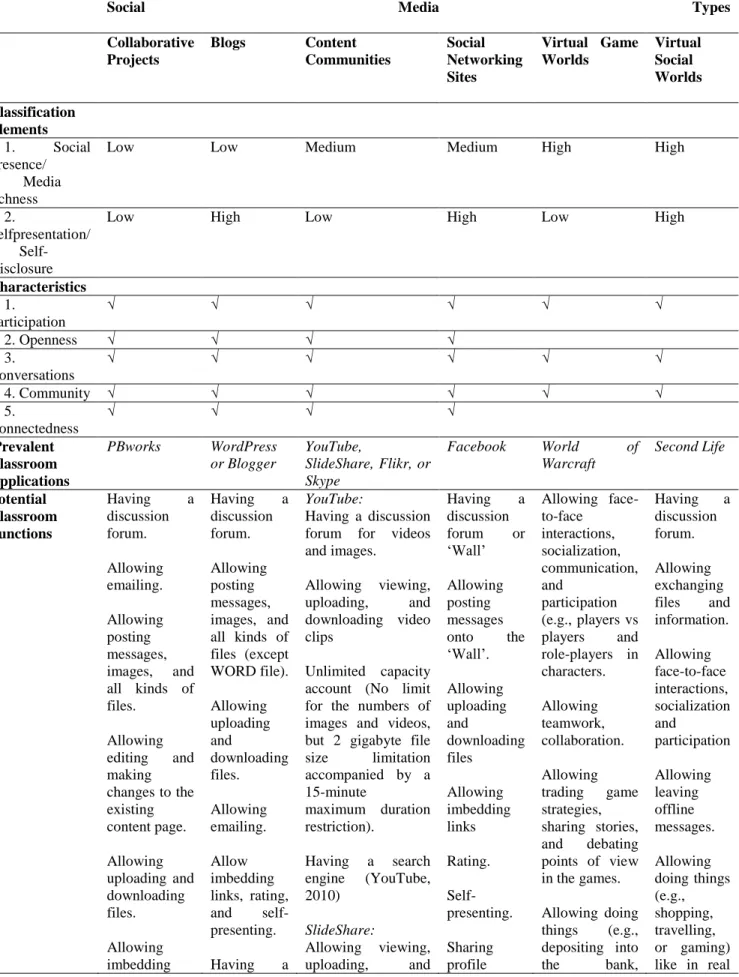
In general, these five prominent characteristics of social media sites can be suitably applied to the online educational environment. The educators have many choices for their classroom activities. The characteristics of social media sites are visualized in Table 3 below.
Table 3: The Social Media Classification Scheme for Educators
Social Media Types
Collaborative Projects Blogs Content Communities Social Networking Sites Virtual Game Worlds Virtual Social Worlds Classification Elements 1. Social Presence/ Media richness
Low Low Medium Medium High High
2.
Selfpresentation/ Self-Disclosure
Low High Low High Low High
Characteristics 1. Participation √ √ √ √ √ √ 2. Openness √ √ √ √ 3. Conversations √ √ √ √ √ √ 4. Community √ √ √ √ √ √ 5. Connectedness √ √ √ √ Prevalent Classroom Applications PBworks WordPress or Blogger YouTube, SlideShare, Flikr, or Skype Facebook World of Warcraft Second Life Potential Classroom Functions Having a discussion forum. Allowing emailing. Allowing posting messages, images, and all kinds of files. Allowing editing and making changes to the existing content page. Allowing uploading and downloading Having a discussion forum. Allowing posting messages, images, and all kinds of files (except WORD file). Allowing uploading and downloading files. Allowing emailing. Allow imbedding links, rating, YouTube: Having a discussion forum for videos and images. Allowing viewing, uploading, and downloading video clips Unlimited capacity account (No limit for the numbers of images and videos, but 2 gigabyte file
size limitation accompanied by a 15-minute maximum duration restriction). Having a search engine (YouTube, 2010) Having a discussion forum or „Wall‟ Allowing posting messages onto the „Wall‟. Allowing uploading and downloading files Allowing imbedding links Rating. Self-Allowing face-to-face interactions, socialization, communication, and participation (e.g., players vs players and role-players in characters. Allowing teamwork, collaboration. Allowing trading game strategies, sharing stories, and debating points of view in the games. Having a discussion forum. Allowing exchanging files and information. Allowing face-to-face interactions, socialization and participation Allowing leaving offline messages. Allowing doing things (e.g.,
links, rating,
and
self-presenting. Good for class (group) discussion and group work projects (Duffy & McDonald, 2011) . search engine on Google. Good for class discussion (Duffy & McDonald, 2011) downloading PowerPoint Presentations, slideshows, or videos. Unlimited capacity account. No limit for uploading presentations and documents as well as the space limit for one account (for free users, the file upload is limited up to 100MG one time only) Having a search engine (SlideShare Inc., 2012). Flikr: Allowing viewing, uploading, and downloading photos or videos. Emailing Unlimited capacity account (there's no limit to the number of photos for users. When people have a free account, they can upload 2 videos about 90 seconds max and 150MB per video and 300MB worth of photos each calendar month) (Flickr, 2012). Skype: Allowing video-conferencing Chatting online and offline
Exchanging files
and ideas via the
chat window
(whiteboard) Emailing (Duffy & McDonald, 2011) information. Emailing. Creating different groups for teaching and learning activities (Duffy & McDonald, 2011). shopping, travelling, or gaming) like in real life. Motivating players‟ intrinsic abilities Keeping players‟ record, so this is very good for the teacher to see how the students perform and collaborate in their work (Bjerede, 2011 and Hsu, 2008). life. Allowing sharing profile information. High self-presentation (Duffy & McDonald, 2011)
Conclusion
Since Blackboard and other learning management systems cannot be used in many universities, especially in developing countries for some reason, social media sites can be a good consideration for educators in online teaching and learning activities. Social media sites are classified into six types according to social presence and media richness on self-presentation and self-disclosure. As a result, educators can have many choices to consider the right type for their online teaching activities. Social media sites are all in the same group of Internet-based applications, so they all share the same five characteristics: Participation, Openness, Conversations Communities, and Connectedness; these characteristics are very useful in online instructional environment. I believe the social media classification scheme is good for the instructor and students in online teaching and learning activities.
References
Argyle, M., & Dean, J. (1965). Eye-contact, distance and affiliation, Sociometry, 28, 289-304. Borges, B. (2012). Social media has been with us four decades. Retrieved from
http://www.findandconvert.com/2012/02/40-year-history-of-social-media/
Bradford, P., Porciello, M., Balkon, N., & Backus , D. (2007). The blackboard learning system. Retrieved from http://uupinfo.org/research/working/bradford.pdf
Bradley, A. (2010). A new definition of social media. Retrieved from
http://blogs.gartner.com/anthony_bradley/2010/01/07/a-new-definition-of-social-media/
Casmer, J. (2012). four characteristics of social media optimization vs seo. Retrieved from http://www.yourmediamoment.com/4-characteristics-of-social-media-optimization-vs-seo/
Connell, J.B., Mendelsohn, G.A., Robins, R.W., & Canny, J. (2001). Effects of communication medium on interpersonal perceptions: Don’t hang up on the telephone yet! USA: San Diego, University of California.
Curtis, A. (2011). The brief history of social media. Retrieved from
http://www.uncp.edu/home/acurtis/NewMedia/SocialMedia/SocialMediaHistory.html
Daft, R. & Lengel, R. (1986).Organizational information requirements, media richness and structural design. Management Science, 32 (5), 554-571.
Daft, R.L., & Macintosh, N.B. (1981). A tentative exploration into the amount and equivocality of information processing in organizational work units. Administrative ScienceQuarterly, 26, 207 – 224.
Derlega, V., & Grzelak, J. (1979). Appropriateness of self-disclosure. In Self-disclosure origins, patterns, and implications of openness in interpersonal relationships. San Fransisco: Jossey-Bass Pub.
Draper, M., Pittard, R., & Sterling, M. (2008). Self disclosure and friendship closeness. Hanover, IN: Hanover College.
Duffy, J., & McDonald, J. (2011). Teaching and learning with technology. Boston: Pearson Education, Inc. Goffman, E. (1959). Presentation of self in everyday life. Retrieved from
http://clockwatching.net/~jimmy/eng101/articles/goffman_intro.pdf.
Kaplan, A., & Haenlein, M. (2010). Users of the world, unite: The challenges and opportunities of social media. Business Horizons, 53 (1), 59-68.
Kietzmann, J., Hermkens, K., & McCarthy, L. (2011). Social media? Get serious! Understanding the functional building blocks of social media. Business Horizons, 54 (3), 241-251.
Leary, M. (1993). The interplay of private self-processes and interpersonal factors in self-presentation. In J. Suls (Ed), Psychological Perspectives on the Self (pp. 127-156). Hillsdale, NJ: Lawrence Erlbaum.
Mayfield, A. (2008). What is social media? Retrieved from
http://www.icrossing.co.uk/fileadmin/uploads/eBooks/What_is_Social_Media_iCrossing_ebook.pdf Schau, J., & Gilly, C. (2003). We are what we post? Self-presentation in personal web space. Journal of
Consumer Research,30(3), 385-404.
Short, J., Williams, E., & Christie, B. (1976). The social psychology of telecommunications. London: John Wiley & Sons.
Sylvester, T. (2011). Hoover's company profiles: Blackboard Inc. Retrieved from http://www.answers.com/topic/blackboard-inc