The
Wage
Gap
in
the
Transition
from
School
to
Work
This draft: May 20, 2012 By: Giovanni Peri (UC Davis), Massimo Anelli (UC Davis), Sara de la Rica (University of the Basque Country), Ainara de San Roman (University of the Basque Country), Luca Flabbi (Georgetown University) and Mauricio Tejada (Georgetown University)
Summary of the Report:
In this report we analyze three fundamental aspects of the gender gap in labor market
performance of highly educated individuals. First, is there discrimination between gender
among employers and does this create a wage gap? Second, how relevant is the different role
of men and women in raising children in affecting their labor market outcomes? Third, how
relevant is the choice of college major in determining their occupation and wage and how
different is it between genders?
In chapter 2 we use a structural model to separate the part of the wage difference between
men and women in the US labor market that is due to productivity and the part due to
prejudice/discrimination. We use very detailed data on US employers and employees to
estimate the model. Interestingly we find that for all education groups prejudice explains a
substantial part of the gender gap, although such share is decreasing from 1995 to 2005. As of
2005 largest part of gender differential in wages is explained by differences in productivity,
except for the group of Masters and PhDs in which, surprisingly, prejudice plays a larger role in 2005 than earlier.
In Chapter 3 we analyze how the presence of children affects women labor market outcomes,
relative to men, in particular their hours worked, hourly wage and their use of part‐time. Using data on Spain we find that the very large use of part‐time by women as of 2008 is explained in
large part by the presence of children. Another interesting pattern we identify is that the
gender gap in average wages in the nineties was mainly a result of family issues (having children
penalized the woman), whereas by 2008, the average wage gap, has increased and it is not
explained by family issues, but by other potential explanations (discrimination, segregation into different jobs, differences in the acquired skills).
This leads us to chapter 4 and 5 in which, using a novel database on high school career, college career and labor market outcomes for a panel of young Italians we analyze the role of choice of college major as determinant of gender gap in income. We find that the very large difference of
choice of college major, in favor of humanities and away from math‐engineering‐business,
explains one third of the gender gap in income and is very persistent. Moreover this choice
does not seem driven by academic skill differentials that exist and are usually in favor or
women. Non‐academic skill differentials and psychological attitudes towards competition and
towards the others may explain part of the choice. The impact of high school peers is found to be more relevant for women while the choice of a better partner (from the economic point of view) does not seem to drive the choice of college‐major as people seem to marry within major rather than across.
Chapter
1:
Gender
Gap
among
college
‐
educated:
Three
important
factors
Giovanni Peri (UC Davis) Massimo Anelli (UC Davis) 1.1 Introduction
Human resources and human talent is, by far, the most valuable economic factor available to
each country. Even from a strictly economic point of view, giving women the same access to
education, economic and political opportunities as men increases the possibility of a country to
grow and to become wealthy. It doubles its human potential. Hence, gender inequality in
economic and social opportunities and achievements is a topic of great relevance for many
countries in the world and a reason of concern for some.
Economists and policy makers in poor countries have recently emphasized the “gender aspect”
of development: empowering women has become a key aspect of several development
policies. For instance, the World Development Report of 2012 is devoted to analyzing and
dissecting gender disparity, in the world, with a special focus on developing countries, and
proposing several policies to address it. The World Bank has developed a whole research
agenda on “Gender and Development1”. Developed countries are also monitoring their
measures of gender gap very carefully and the goal of gender equality is explicitly stated in
several Process and Strategy statements of companies and countries. Since 2006, for instance,
the World Economic Forum has produced a yearly Global Gender Gap report, to monitor the
progress that each country (rich and poor) is making in achieving gender equality in four key
areas: health and survival, education, economic participation and opportunity, and political
empowerment. Hence both scholars and policy makers are devoting increasing attention to this issue and to the causes of gender gaps in different domains and on the consequences of closing this gap. 1
See the website at
We focus in this report on the gender gap in economic opportunity and we single out three
countries, Italy, Spain and the United States. We choose these countries because we have a
particularly good knowledge of the economies of these countries as we have studied them in
the past, often in relation to issues related to the gender gap. They are all rich countries but
they exhibit very different degrees of gender inequality in terms of economic access and
income. In the Global Gender Gap report of 2011, the US was ranked 6th (from the top) in terms
of gender inequality in earnings. Together with Northern European countries, the US is the one exhibiting the smallest gender gap in earnings. Still there is a very significant gender disparity in
the US in access to highly paid and powerful positions both in the corporate world and in
government (senior officers, CEO’s, Board of Directors). While issues of gender inequality are
also relevant among the disadvantaged (e.g. the poverty rate in the US is higher for women
than for men) our study will mainly focus on gender inequality among highly educated. Hence in the US we will focus on discrimination and differences in productivity among highly educated women and men. Spain, on the other hand, has been a country with rapid economic growth in the last two decades, and similarly fast progress on gender inequality. The country was ranking 74th in the world relative to overall economic gender inequality (hence at the very middle of the distribution of 135 countries analyzed by the Global Gender Gap report). As we will document
in Chapter 3 gender inequality in economic access and achievement is still significant in Spain,
even when we focus only on the more educated. The different role of men and women in the
family has affected heavily in the past the possibility of Spanish women to access the labor
market. Only in the recent decades women in general and highly educated women in particular, have made progress in filling the economic gender gap.
Italy, finally, was ranked 90th in terms of gender differences in economic achievement by the
Global Gender Gap report. This is the country with the largest gender income differences
among OECD countries, except for Japan and Greece. While regional disparities in the gender
Gap are still significant in Italy, and while the structure of the family is rapidly changing (the
fertility rate in Italy is among the lowest in the world), there is concern that even highly
educated Italian women do not have access to the same occupations and opportunities that
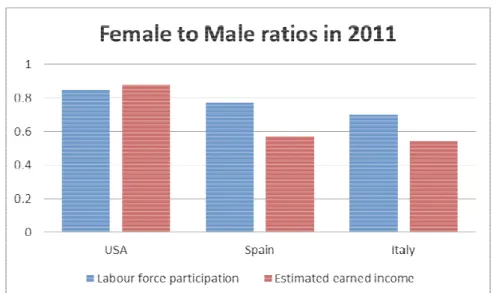
The differences in two key measures of the gender gap across these three countries can be seen in Figure 1. Italy exhibits a very substantial earning gap showing that women earn fully 46% less than man (a number that we will confirm in our analysis of Chapter 4 and 5) while in the US the income gap is only 12%. Similarly in the US Women have a participation rate equal to 88% of the rate of men while for Italy that figure is 70%. These countries, therefore, span a large part of the OECD
range for many of the economic indicators of gender inequality. For instance the female to
male ratio in participation rate was 96% in Sweden, the OECD country closest to equality and
Italy was the OECD country with lowest female to male ratio of participation rate. Also, in
terms of earned income the US is the second country in the female to male ratio after Norway (for which the ratio is equal to 1) and Italy is the second to the last (before Japan whose ratio is 0.51).
Considering the recent trends of gender gap in labor force participation, income and economic
outcomes, points to a decrease in most countries. However, several rich countries, after some
decades of progress in reducing those gaps find themselves with an amount of gender
inequality that is stubbornly persistent and very hard to eliminate. On one hand most OECD
countries have eliminated completely disparity in education between men and women.
According to the Global Gender Gap report of 2011, the top 60 countries have a gender ratio in
schooling achievement between women and men larger than or equal to 0.99. In the top 20
countries women outperform men in measures of schooling achievement. Figure 2 shows that for the three considered countries women have abundantly overtaken men in terms of tertiary
school enrollment2.
On the other hand access to top paid jobs, to high wages and to equal opportunities at the top
of the income distribution are still much harder for women. Women are under‐represented
among senior officials, legislators and managers and also among science, technology and
management professions. Hence most countries still exhibit a significant wage and income
gender gap and because men in those “high‐power” position have very high wages, the gender gap is substantial even among highly educated.
In this report we analyze in some detail some of the possible explanations and determinants for
the gender gap in economic performance and we focus specifically on highly educated
individuals. While the country‐focus of the report is due to our expertise and to the availability to us of interesting and novel data, the focus on highly educated is a choice. It is driven by the
fact that we believe this is a crucial segment of the population in developed countries; it is
growing in size and relevance for economic productivity and in large part it has been “on the
winning side” of the large technological and economic transformation of the last decades.
Highly and in particular college‐educated individuals have become richer and healthier, their
life expectancy is longer and their number has increased relative to the rest of the population.
While gender gap in wage and career in less skilled manual workers can be considered as a
remain of a mode of production and of institutions of the past, and hence as increasingly less
relevant in the modern economies, gender gap among college‐educated, among professionals, senior officials and managers reveals a tendency that may persist.
There are several studies that address the issue of gender gap at the top of the earning
distribution and they focus on different aspects and determinants of it3. In this study we
systematically address three possible determinants of gender gap in earnings and labor market performance for college‐educated and we measure those using data. We use a combination of
descriptive analysis, more structural and model‐based simulations and empirical evidence to
approach this issue. After a brief introduction, in each chapter, on the gender inequality relative to considered country, we focus on specific components and determinants of the gender gap in employment and wages.
In order to understand the gender gap among college educated and their labor market
performance we need to go beyond the well‐known fact (shown in Figure 2) that, in terms of
3
college enrollment and schooling achievements, women have caught up and are leading men in
most of the developed countries. In fact, behind this convergence, there are some very
persistent differences in field of study that, as we will see below, may be at the root of a
significant part of the gap. Moreover the segment of highly educated women seems to differ
significantly from that of men in terms of choices during their early career and the time devoted
to the family and to children is still a relevant factor in determining the gap. Women with
higher education are possibly using a large part of that human capital to raise and educate their children rather than to produce in the market. This is a very valuable use of their skills that we
may not be still fully measuring in our models. Finally there may still be a degree of
discrimination, protected by friction and hysteresis, in maintaining male privileges in some
senior officer, director and manager positions. Among the small network of highly educated
and powerful corporate and political leaders discrimination can still be an important part of the gender gap.
The three aspects we will be considering, therefore, are the role of prejudice and
discrimination, the role of family and early career choice and the role of the choice of college
major in determining the gender gap in labor market performances. Each of the three
components will be studied specifically using one of our countries, and relative individual and
aggregate data that are best suited to address that issue. Chapter 2 addresses the role of
prejudice and discrimination looking at US data and developing a model with search frictions in
the labor market, differences in productivity between men and women and “prejudiced”
employers. The model is estimated on US data and it allows to separately identifying the effects
of productivity and prejudice on wages and employment. Moreover we consider college
educated women separate from non‐college educated, and we can characterize the specific
degree of prejudice towards them and if education increases or decreases such prejudice. In
Chapter 3 we consider the role of family variables (marriage and children) and the early career of women and their effect on the gender gap in wage and employment. In this chapter we use
Labor Force Survey data from Spain for the period 1994‐2008 and we analyze how having
gap can be explained by children. We also focus on college educated and we analyze the time
evolution of such effect. Finally in Chapter 4 and 5 we present and use a novel database on
Italian high school graduates, their choice of college major, their academic quality and their
outcomes in terms of occupation, employment and income, between one and fifteen years
after they have joined the labor force. The focus of those chapters will be the importance of the choice of Major, in determining the gender gap, and we analyze the determinants of choice of
college majors considering academic ability, non‐academic skills, family considerations and
effects of peers and of teachers in high school.
1.2 The role of prejudice, differential productivity and labor market frictions on the gender gap
A first component of the gender gap in the labor market that we will try to quantify is the
impact of prejudice and discrimination. We will be careful in distinguishing the two components
and we will focus on only one possible source of prejudice: the distaste experienced by
prejudiced employers when hiring women.
While explicit prejudice has been a part of economic theory for a long time4, it is still very
difficult to directly observe and measure it. One possible way to estimate its presence and
impact is to infer explicit prejudice from the observed behavior of labor market agents,
conditioning on a specific model of the labor market. A good candidate for such a model, which
we will use in this chapter in an application to the US labor market, is a search‐matching‐
bargaining model.
A search‐matching‐bargaining model is a good candidate for two main reasons. From a
theoretical point of view, the presence of search frictions justifies the survival of prejudiced
employers in equilibrium, as suggested by Heckman (1998) and Altonji and Blank (1999).
Namely if prejudice is inefficient for the employers, because they hire an inefficiently low
number of women, or they hire men instead, then in a perfectly competitive market with free
entry it cannot survive in the long‐run. Market frictions are needed for prejudice to survive in
4
A theory of explicit prejudice (“taste discrimination”) was first proposed by Becker in 1957 (see Becker (1971)) and has been very influential on the discrimination literature ever since (see Altonji and Blank (1999)).
equilibrium. Moreover, search models with matching and bargaining have been used in several
empirical applications and have proved to be a good fit for data in empirical applications
(Eckstein and van den Berg (2007)). Most importantly, in light of the applications performed in
this chapter, Flabbi (2010a) shows that when Becker’s taste discrimination is added to the
framework, the model is able to separately identify the impact of explicit prejudice, differential productivity and gender‐specific search frictions on labor market outcomes.
The separate identification of these three possible sources of gender differentials for different
education groups is the first main contribution of the chapter. The literature attempting a
similar exercise is very limited. Our work is most related to Flabbi (2010a) since we will use the same identification strategy. Flabbi (2010a) estimates a search‐matching‐bargaining model on a
sample of white, college graduated extracted from the 1995 Current Population Survey. His
results suggest that both prejudiced and unprejudiced employers wage discriminate and that
half of the employers are prejudiced. As a consequence, two‐third of the gender earning
differential may be explained by prejudice while the rest is imputed to the lower female
productivity. The first paper attempting a similar exercise was Bowlus and Eckstein (2002).
Differently from Flabbi (2010a), they develop an equilibrium search model and use it to
estimate race discrimination. Even if their identification strategy allows for it, their estimation
strategy has some difficulty in separating the contribution of productivity, prejudice and search
frictions on the observed race gap. Their results focus on showing the importance of explicit
discrimination relative to productivity differences. In particular, about 56% of employers are
estimated to be prejudiced and the disutility from hiring a black worker is estimated at about
31% of the productivity of a white worker. A recent contribution in the same line of research is
Bartolucci (2011). The paper develops an equilibrium search model with rent splitting, on‐the‐
job search and two‐sided heterogeneity in productivity. Estimates obtained using German
matched employer‐employee data indicate that female workers are less productive and more
mobile than male workers and have lower bargaining power. Estimates indicates that 65
percent of the gender gap is due to productivity differences, 17 percent to segregation, and 9
The second main contribution of the chapter is using the estimated model to build an
innovative welfare measure to evaluate returns to schooling and to perform two policy
experiments. Since the overall welfare of labor market participants depends on their current
labor market state but also on the labor market dynamics related to the transitions between
labor market states and job offers, we need a summary measure able to take into account all
these components if we want to assess market returns and the impact of policy experiments.
We use the welfare measure proposed by Flinn (2002) which assigns to each labor market state occupied by the workers in steady state the corresponding utility value weighted accordingly to
the equilibrium steady state distribution. Flinn (2002) contains an extended discussion of the
welfare measure, provides a foundation for it and compares various alternative.
1.3 The role of family choice and early career in the gender gap
A second widely studied and very important component of the gender gap in the labor market performances is the different role of men and women in the family, with a specific importance
of raising/educating the children, and the consequences of this role during their early working
careers. In Chapter 3 we focus on this issue and we use data from Spain, to analyze how family
characteristics, in particular the presence of children, have affected the labor supply decisions
and the labor market performance of highly educated females in Spain during the last 20 years.
Several important contributions in the literature have analyzed the evolution of the role of
college‐educated women in the labor markets and their role within the family, especially
focusing on the U.S. Goldin (2004a, 2004b), for instance, traces the demographic and labor
force experiences of five cohorts of college graduates – from those born in 1900 to the last
born in 1980, focusing on why career and family outcomes changed over time. She describes
the path to the fast track that college graduate women have taken starting with the first cohort, born in 1900, and forced to choose between “family” and “career”, to the latest group, born in 1980 which has achieved success in combining career and family. Each generation built on the successes and frustrations of the previous ones. Each stepped into a society and a labor market with loosened constraints and shifting barriers. The road was not only long, but it has also been
winding. Some cohorts of college graduate women chose “family” whereas other chose “career”. Only recently has a substantial group been able to grasp both at the same time. In describing the trends that characterized some of the changes in women performance in the
US during the 20th century, Goldin (2004b) emphasizes the speed at which the various
transformations took place such as the one from jobs to careers and the one from early to later
marriages. Moreover, most of these changes took place at the same time. The more likely
factors to explain these rapid changes are, in Goldin’s analysis: (1) government mandates, such
as antidiscrimination policy in hiring and promotions, (2) change spurred by the resurgence of
feminism that came on the heels of the Civil Rights movement in the 1960s and (3) the
contraceptive innovation, known as the Pill, which gave young women freedom to plan their
family and the ability to delay marriage and child‐bearing and plan for a career.
These transformations have produced a significant degree of women advancement in the US,
and equality seems within reach. Still family choices seem to penalize the labor market
performance even of those among the most educated and highly skilled women. Goldin and
Katz (2010) analyze the work and family choices among students graduating from one of the
most elite institutions of higher U.S. education (Harvard). They explore the trade‐offs between
family and career, particularly for college graduate women. They find that male earnings are
strongly and positively related to the number of children in the family, whereas female earnings
are negatively related, especially for those having three or more. But the negative impact of
children on women’s earnings is entirely accounted for by hours worked. In fact, a positive
relationship between children and earnings exists for women working full‐time full‐year. This
suggests higher reservation wages for those with more children and positive selection into the labor force based on the number of children.
Similarly Bertrand et al (2010) study the careers of MBAs from a top US business school to
understand how career dynamics differ by gender from 1990 to 2006. Three proximate factors
account for the large and rising gender gap in earnings: differences in training prior to
graduation, differences in career interruptions, and differences in weekly hours. The greater
career discontinuity and shorter work hours for females are largely associated with
experience, greater career discontinuity, and shorter work hours for female MBAs. Those
mothers seem to actively choose jobs that are family friendly, and avoid jobs with long hours
and greater career advancement possibilities.
In general most of the existing literature, relative to industrialized countries, has found that the
presence of children is particularly important to explain the gap in hours worked. Women in
families with children work significantly less than women in families without (see for instance
Waldfogel, 1998; and Harkness and Waldfogel, 1999). Focusing specifically on Spain, the
country considered in the analysis of Chapter 3 of our study, Molina and Montuenga (2009) use the Household Panel for 1994‐2001 and find results confirming that there is clear evidence of a
wage penalty for Spanish working‐women with children. Specifically, the fact that there was a
birth in the family during the current year implies a wage loss of 9% of women’s wage. They use
fixed effect estimation to control for the individual quality of women and effectively show the
existence of the motherhood wage penalty in Spain. Specifically, the penalty is close to 9% if
there is a birth in the family during the current year; 6% if there is one child living in the
household, almost 14% if there are two, and more than 15% if there are three or more.
One interesting fact about the role of family on women career is that, possibly because of
changing social norms, or because families have become much smaller, there seems to be a
clear tendency to a reduction in this negative impact of children on the working hours of
women. Considering Spain, and focusing on the college educated individuals (that will be the
sample of our analysis) Figures 3 and 4, show the profile of participation to the labor market
along the early years of a person’s career. While we notice a negative female‐male differential for all cohorts and ages, it is clear that the largest difference is for the age groups between 30
and 40, when the burden of raising children is highest. However, we also notice a drastic
decrease in the gender gap moving from the older generations (born in 1960) to younger ones
(born in 1975).
The role of family and children, therefore, while certainly changing in the recent decades, has
countries it seem to have had a stronger role on labor supply, rather than on wages. In chapter
3 we will analyze more systematically its role in affecting employment, hours worked and
wages focusing on the interesting case of Spain, where the participation of educated women to the labor market seems increased substantially in the recent cohorts.
1.4 Gender gap in the choice of college majors and occupations
A third significant difference between men and women, certainly contributing to the gender
gap in earnings and career, is the difference in their field of study while in college. This issue is what we tackle in Chapter 4 and 5. As we have already mentioned the educational gap between
men and women in terms of years of schooling and level of tertiary education and enrollment
has been fully eliminated, and in many OECD countries there is actually a positive gap in the
achievement of women measured as years of schooling or graduation rates from college.
However, another gap persists and it has been the subject of studies by economists in several
countries: the gender‐gap in the choice of college major and in the subsequent occupational
choice. Women in many countries seem to shy away from the so called “STEM” majors
(Science, Technology, Engineering and Management) and from the related occupations. In this
section we draw on Flabbi (2010) in order to describe some of the general tendencies in the
gender gap relative to the choice of major across OECD countries. We also provide some
indication of the importance that the choice of major has in determining the choice of
occupation.
We should emphasize that there is a substantial literature on the so called “Math‐Science
Gender gap”5. Economists, Sociologists and Scholars of high education have noticed, across
countries, that women tend to avoid math and science intensive majors in college. Most of the
studies are on the US and on the UK. There is also agreement that the “Science Gap” is an
important component of the gender gap in earnings and it explains a substantial share of that, sometimes up to half of it (see for instance Paglin and Rufolo, 1990, and Brown and Corcoran,
1997). In chapter 4 and 5 we contribute new data, from Italy and new analysis to this debate.
The data are rather unique as they contain very detailed information on the high school and
college career of Italian students, who graduated from high school between 1985 and 2005, as
well as measures of their labor market performance between one and fifteen years after they
joined the labor force. We will explore how significant are the gender differences in the choice
of college major and whether psychological, skill‐based or preference based explanations are
more consistent with the data. Here we review some of the cross‐country evidence of the
gender gap in the choice of major, to emphasize how Italy (whose data will be introduced in
Chapter 4) is a rather average and representative case among OECD countries.
While there are several databases on the educational attainment of women and men across
countries, there is much less cross‐country comprehensive information on the choice of college
majors. To produce some stylized facts we rely on the Flexible Professional in the Knowledge
Society (REFLEX) data set. The REFLEX data set collects the result of a survey on graduates from tertiary education (equivalent to a College B.A. or a Master in most countries) who have about 5 years of experience since leaving higher education and obtained their degree in the academic
year 1999/2000. The project covered 14 countries, all of them developed and most of them in
Europe: Austria, Belgium (only Flanders), Finland, France, Germany, Italy, the Netherlands,
Norway, Spain, UK, Czech Republic, Portugal, Japan and Estonia6. The focus on the REFLEX
project was to study the “Flexible Professional in the Knowledge Society"; hence the data set is rich in variables describing the type of education and skills acquired by the individuals and their
mapping into occupation choices and skills. The database is representative of the sampled
cohort across countries. We will present, here, only statistics relative to the aggregate of all
countries.
The first fact emerging from the data is that the proportion of graduates with a tertiary degree
in 1999/2000 who are women was larger than 50% in all countries, except for Germany and
Japan where the proportion was almost exactly 50%. Hence this database confirms that
equality in tertiary graduation rates has been achieved in most developed countries and that
education, as measured by years of schooling, cannot be a contributor to the gender gap.
Figure 4 and 5 show, instead, prima facie evidence of the differences in choice of college
6
majors, pooling all countries in the sample. The aggregate categories used to classify the
college‐majors are constructed in order to keep the classification consistent across countries.
Figure 4 shows how men and women were distributed across college majors for people who
graduated in year 2000.
Figure 5 shows the percentage of graduates of each of those college majors who are women.
Figure 4 clearly show that Engineering is the Major that attracts the largest share of men (more
than 35%) while it attracts a very low share of women (barely above 10%). Conversely health
and humanities are among the most popular majors among women while they attract a much
lower percentage of men. Correspondingly Figure 5 shows that while 75‐80% of the graduates
in majors such as Education, Humanities and Health are women, only 25% of graduates in
Engineering and 45% of graduates in Mathematics and Sciences are women. These tendencies
are confirmed within each country. In particular there seem to be no exception, across the
countries considered in the REFLEX study, to the fact that Science and Engineering major attract many more men, and Humanities many more women. Whatever the reason for this gender gap,
it seems to be very pervasive and not linked to specific school policies but depending on
generalized differences in abilities or in preferences across genders.
One possible reason for the gender gap in the choice of major is differential academic ability. If
majors such as engineering and math‐sciences are more demanding and men have a better
academic performance than women, then a “vertical” differentiation of majors, according to
the average quality of the admitted student may generate this pattern. The fact that Science
majors are more demanding than the others is (mildly) supported by Figure 6. This figure shows
the percentage of students graduating from secondary school with a grade within the top
quartile of the national grade distribution, attending college in each of four categories of majors
and separated between men and women.
The figure seems to support the idea that science majors are somewhat more selective and
men and women. Hence to explain the much lower percentage of women in Sciences it should be the case that the quality of women, as revealed by the grade in high school, is much lower
than that of men. The two panels in Figure 7 below rule out that explanation. They show the
percentage of men and women in each quartile of the (aggregate) distribution of high school
exit‐grades. In order to make the exit grades comparable across countries we consider only
their relative distribution and we distinguish only between four quartiles within each country.
The differences in distribution across grades are very small with women being somewhat more
concentrated in the third quartile relative to men and less in the first and fourth. We notice,
overall, that the high school grade distribution is quite similar between men and women and it
does not show differences that would justify the large gap in enrollment in math‐intensive
majors observed in Figure 4.
Hence, in general among the considered countries, women of high academic quality choose in
much larger proportions Humanities and Education, relative to Engineering and Science. As we
will see in the in‐depth analysis of Chapter 4, our micro‐data from Italy fully confirm this
tendency.
The important role of major choice in the labor market performance of individuals is due to the fact that different majors determine access to different occupations by providing students with
different skills. If occupational differences are associated with different earning abilities and
different career opportunities then this is a channel through which the choice of major will
affect income significantly. All the considered individuals are highly educated and hence will
have mainly access to occupations classified as “professionals and technicians” (according to
the ISCO code). In fact more than 80% of college educated (men and women) are within this
occupational group. Of the remaining college educated, around 5% are classified as “clerks” and
another 5% as “senior officers”. Within the category of “professionals and technicians”,
however, we see that, men and women have a very different distribution, certainly as a
consequence of the choice of major. Figure 8 shows that more than 40% of men in the group
women do. On the other hand almost 30% of women work in occupations classified as “teaching” while only 10% of men work in that group.
Summing up the stylized facts shown in this section, the link between college major and
occupational choice seems very strong in all countries. This could be a crucial element to
understand the gender gap. In particular three regularities seem pervasive. First highly
educated men and women, in spite of their equal educational attainment (in terms of years of
schooling) and comparable academic performance (in terms of grades) have a large and not
decreasing gap in their choice of field of study (college major) and in the choice of occupation.
Second, women exhibit systematically a negative gap in the probability of choosing math‐
intensive majors as Engineering and Mathematical sciences, while they show a systematic
positive gap in the choice of Majors in the Humanities. Third, the college major seems to be
strongly correlated with the choice of occupation. In particular “teaching” types of jobs are
dominated by women, while “engineering” types of jobs are dominated by men. This
difference contributes significantly to explain gender gap in career, wage and earnings. In
chapter 4 and 5 of this report we will focus on micro‐evidence on individual data from Italy to
understand better the mechanisms and decompose this gender gap in the choice of college
major.
1.5 The structure of this report
The remaining chapters of this report follow the structure anticipated in this introduction. We
tackle, in turn, the analysis of different determinants of the gender gap beginning, in Chapter 2,
with the role of prejudice and market frictions on the wage and employment gap, measured
using US data. Then, in Chapter 3, we analyze the role of family and children in causing a gender
gap in employment and wages, and we use data from Spain to estimate those effects. In
Chapters 4 and 5 we focus on the role of choice of College Major in determining the gender gap
and we analyze what are the causes of such different choices. We do this using a newly
collected database on Italian high school graduates over the period 1985‐2005 for which we
outcomes after up to 15 years from graduation. In order to describe the data and their
characteristics in detail, and to perform also a more thorough statistical analysis we devote to
this case Chapter 4 and 5. We devote Chapter 6 to summarize what we learned, to describe
how likely it is that our results can be generalized and to distill some policy implications, with a special focus on the countries that we have considered.
Each chapter of the Report tries also to be self‐contained, so that it can be read as an article.
For this reason we have left to each chapter an initial description of the important features of
the pre‐labor market and of the labor‐market gender gap, as measured in the country
considered in that chapter. This way, the reader interested only in that particular case may find
it easier to put the results into context. While this report focuses on specific countries we
believe that the channels that we identify are very important, general and, in fact, crucial, in the understanding of gender gap in all developed countries. In particular countries such as Italy and
Spain, where the disparities are still so large, require a full understanding of those channels
and, possibly, new incentives and policies to reduce the gap. As stated at the beginning of the report, allowing women the same access and the same economic opportunity as men can be a
very effective measure to reinvigorate the economies, bringing new human capital, new ideas
and new skills. The effect of those policies can be the largest where those disparities are the
biggest. This report aims at providing some new ideas and new evidence in support of those
References for Chapter 1
Altonji, Joseph G., Blank, Rebecca M. (1999), “Race and gender in the labor market”, In: Ashenfelter, Orley C., Card, David (Eds.), Handbook of Labor Economics, vol. 3. Elsevier.
Bertrand, Marianne (2010), “New Perspectives on Gender”, In: Handbook of Labor Economics, Volume 4b, Elsevier.
Bertrand, Marianne, Goldin, Claudia, Katz, Lawrence F. (2010), “Dynamics of the Gender Gap for Young Professionals in the Financial and Corporate Sectors”, American Economic Journal: Applied Economics, 228–255.
Blau, Francine D., Kahn, Lawrence M. (2008), « Women’s work and wages”, In: Durlauf, Steven N., Blume, Lawrence E. (Eds.), The New Palgrave Dictionary of Economics, second ed., Palgrave Macmillan.
Brown, Charles, Corcoran, Mary (1997), "Sex Based Differences in School Content and the Male‐Female Wage Gap", Quarterly Journal of Economics, 99: 31‐44.
Goldin, Claudia (2004a), “From the Valley to the Summit: The Quiet Revolution that Transformed Women’s Work”, NBER Working Paper, No. 10335.
Goldin, Claudia (2004b), “The Long Road to the Fast Track: Career and Family”, Annals of the American
Academy of Political and Social Science, Vol. 596
Goldin, Claudia, Katz, Lawrence F. (2010), “Transitions: Career and Family Life Cycles of the Educational Elite”, American Economic Review: Papers & Proceedings 2008, 98:2, 363–369.
Harkness, Susan, Waldfogel, Jane (1999), “The Family Gap in Pay: Evidence from Seven Industrialized Countries”, APPAM, Washington, D.C.
Molina, Jose Alberto, Montuenga, Victor (2009), “The Motherhood Wage Penalty in Spain”, J Family
Economic Issues, 30:237–251.
Paglin, Morton, Rufolo, Anthony M. (1990), "Heterogeneous Human Capital, Occupational Choice, and Male‐Female Earnings Differences", Journal of Labor Economics, 8: 123‐144.
Xie, Yu, Shauman, Kimberlee A. (2003), "Women in Science: Career Processes and Outcomes", Cambridge, MA: Harvard University Press.
Waldfogel, Jane (1998), “Understanding the ‘Family Gap’ in Pay for Women with Children”, Journal of
Economic Perspectives, v. 12: 137‐156.
Harkness, Susan and Jane Waldfogel. (1999) “The Family Gap in Pay: Evidence from Seven Industrialized Countries” APPAM, Washington, D.C.
Figure 1
Note: Source is the Global Gender Gap Report 2011
Figure 2
Figure 3:
Life Cycle of Labor force participation rates, Males and Females.
70 75 80 85 90 95 25-27 28-30 31-33 34-36 37-39 40-42 43-45 F em al e La bo r F or ce P ar tic ip at io n R at e ( % ) Age
Born in 1960 Born in 1965 Born in 1970 Born in 1975
60 65 70 75 80 85 90 95 100 25-27 28-30 31-33 34-36 37-39 40-42 43-45 M a le L a b o r F o rc e P a r ti c ip a ti o n R a te ( % ) Age
Figure 4 Figure 5 0 .1 .2 .3 male female Education Humanities
Social Science, Business, Law Sciences, Mathematics Engineering, Architecture Agriculture, Veterinary
Health Social Service
Graphs by female
(Proportion of Graduates in Each Field)
Field of Study Choice by Gender
0 .2 .4 .6 .8 1
Proportion of Women in Field of Study
Education Humanities
Social Science, Business, Law Sciences, Mathematics Engineering, Architecture Agriculture, Veterinary
Figure 6 Figure 7 0 .1 .2 .3 .4 male female
Humanities Social Sciences
Sciences Health
Notes: Top Grades means top grade available or in the top 25% of country-specific distribution.
(Graduates with Top Grades in Secondary School by Tertiary School Field)
Top Grades Secondary by Field of Study and Gender
0 .1 .2 .3 .4 male female
Quartile 1 - Bottom Quartile 2
Quartile 3 Quartile 4 - Top
Notes: Grade distribution computed by country on the joint sample of males and females. (Proportion of Graduates in Quartiles of Grade Distribution) Secondary School Grades Distribution by Gender
Figure 8 0 .1 .2 .3 .4 .5 .6 .7 .8 .9 1
Notes: First job after graduation.
(Professionals and Technician) Proportion of Women in Occupation
physics, mathematics and engineering life science and health
Chapter
2:
Gender
Gap
in
Labor
Market
Outcomes
in
the
US:
The
Impact
of
Employers’
Prejudice
Luca Flabbi (IDB, Georgetown University, and IZA) Mauricio Tejada (Georgetown University) 2.1 Introduction
The chapter proposes three contributions. First, it provides descriptive evidence on gender
differentials by education in the US labor market over the last twenty years. Second, it uses the structural estimation of a search model of the labor market to identify and quantify the impact
of employers’ prejudice on labor market gender differentials. Third, it connects both the
descriptive and analytical findings to recent policy interventions in the US labor market and
performs some policy experiments.
For all the analysis in the chapter, we use the Annual Social and Economic Supplement (ASES or
March supplement) of the Current Population Survey (CPS)7.
2.1.1 Descriptive evidence
We organize the descriptive evidence following the decision process of an individual deciding to
supply labor in the market. First, we look at the outcomes of education decisions. Education
decisions constitute the most important component of pre‐labor market human capital and
they influence not only future performance in the labor market but also the decision to
participate in the labor market itself. It is also a choice and process where gender asymmetries
are present but evolving quickly. We provide evidence on the overall quantity of education
acquired and on one aspect of the "quality" of education acquired: the field of study. All the
evidence on labor market outcomes will be correlated to these previous education decisions.
The main result on pre‐labor market characteristics is that women acquire more college
education than men, reinforcing a trend started with the generation born in 1959. A lot of
asymmetry by gender persists in the choice of field of study.
Second, we look at the decision to supply labor in the market both with respect to the extensive
margin (the participation decision) and to the intensive margin (the hours supply decision). We
correlate this evidence with education and age and we look at the evolution over‐time based
both on survey year and on cohort of birth. Together with the labor supply evidence, we also
present some evidence on unemployment, focusing on unemployment dynamics. The main
result from this section is that women supply less labor than men both on the extensive and on
the intensive margins. The gender gap is not alleviated by education: the gender gap in the
hours worked per week is actually exacerbated by education since it is larger on the College
graduates sample than on the overall sample.
Third, we look at gender earnings differentials in the labor market. We compute both the
raw differential and the differential conditional on standard human capital characteristics. We
also provide evidence on the gender gap at different percentile of the earnings distribution and
on very high‐skilled occupations (CEOs and General Managers) to assess the magnitude of the
so‐called glass‐ceiling effect. Results show that women earn about 20% less on average than
men. The gap has been fairly stable in the last 10/15 years, after a period of significant
reduction in the 1970s and 1980s. One reason for the persistent gender gap in recent years, in particular among skilled workers, is the large differential at the top of the earnings distribution, a possible indication of glass‐ceiling effects.
2.1.2 The Impact of Employers’ Prejudice
In the second part of the chapter, we want to investigate the source of the observed gender
differentials. We give priority to gender differentials in the labor market – both in terms of
wage differentials and of labor market dynamic ‐ but we will attempt to draw some inference
also on gender differentials in pre‐labor market characteristics. We will be able to make
distributional considerations and evaluate some determinants of the glass‐ceiling but we will
abstain from an analysis of labor supply determinants.
We will focus our analysis on three main determinants of gender differentials: productivity
quite exhaustive list of the possible explanations proposed in the literature to account for the
observed gender gap8. The difficulty, from a quantitative point of view, is to separately identify
the contribution of these three components on the observed differential. The methodology we
have chosen to use exploits the structure of a specific model – a search‐matching‐bargaining
model with employers taste discrimination – to separately identify and then estimate these
three components.
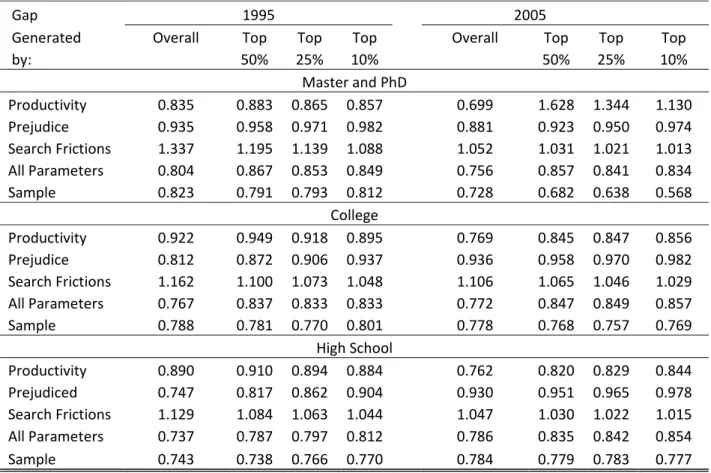
We estimate the model over two time periods (1995 and 2005) and three education levels
(Master and PhD; College; and High School). Results suggest that the gender gap in wage offers is smaller than the gender gap in accepted wages on the high education samples but larger on the low education samples. The gender gap in productivity is estimated to be relatively small on
the College and High School sample but it is increasing over time. The productivity gap for
Master and PhD holders is quite large and increasing over time. The gender gap between
workers employed at prejudiced employers and workers employed at unprejudiced employers
is larger the higher the education level. The gender gaps in unemployment rates are relatively
small in all years and education groups.
We use the separate identification and estimation of the three main determinants of gender
differentials to decompose their impact on the gender wage gap. We find that prejudice has a
significant impact in explaining the wage gap but the impact is decreasing over time and it
becomes smaller than the impact of productivity on all education groups in 2005. Master and
PhD graduates are the exception to the trend: they experience a stronger impact of prejudice in 2005 than in 1995. Thanks to a decomposition of the gender wage gap at different points of the
distribution, we also estimate that the Master and PhD sample shows some evidence of glass‐
ceiling effects.
2.1.3 Policy Experiments and Policy Implications
8Two main determinants are left out: gender asymmetries in household production and differential preferences with respect to job amenities. The first issue is the subject of Chapter 3 of this book, with an application to Spain. For a review, see Waldfogel (1998). The second issue is partially addressed by Chapters 4 and 5 of this book, with an application to Italy and a focus on the relationship between education choices and occupation choices. For an
The descriptive section of the paper shows that gender differentials are by no means limited to
average wage differentials, the variable often used in the literature to summarize the “gender
gap” in the labor market. Gender differences concern the shape of the entire wage distribution,
the labor market dynamics across labor market states and the schooling choice preceding the
entrance in the labor market. To really judge the overall welfare of labor market participants
and to compare welfare across schooling groups and time periods, it is necessary to build an
indicator able to take into account all these different elements. Thanks to the estimates of the structural model, we are able to propose and compute such indicator.
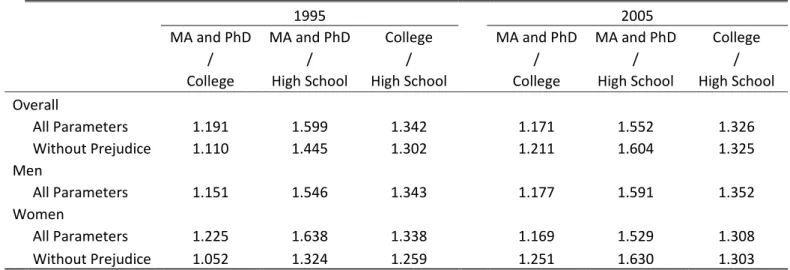
First, we use the indicator to compute a “welfare return” to schooling, i.e. the welfare
differentials enjoyed by labor market participants at different level of schooling. We find that in
1995 female returns were higher than male returns, providing a possible explanation for the
higher level of education acquired by women. However, the returns are estimated to be lower in 2005, a result mainly due to the presence of prejudiced employers in the labor market.
Second, we perform policy experiments that mimic the major policy interventions implemented
in the US labor market: Equal Pay policies and Affirmative Action policies. In the equal pay
policy, we impose that wage schedules cannot be set conditioning on gender. In the affirmative
action policy, we implement an employer subsidy to hire women. The Equal Pay policy is
effective in redistributing welfare from men to women but it is never enough to completely
close the gender gap. It is more effective for lower education levels than for higher ones and it has larger impacts in 1995 than in 2005. The affirmative action policy has a modest but positive impact on closing the gender gap in welfare. Despite the modest impact, the policy is promising
because it is frequently able to close the gap without reducing overall welfare and it targets
better the group that is not showing a positive evolution in closing the gap over time: the
Master and PhD graduates sample.
2.2 Descriptive Evidence
2.2.1 Gender Differentials in Pre‐Labor Market Characteristics
Figure 1 shows the gender gap (women ‐ men) in the percentage of college graduates by
gender. To look at the evolution over‐time, we report the cross‐sectional evidence based on
survey year in Figure 1a and the cohort evidence obtained by pooling the survey years data
together in Figure 1b.
The most important result is that the gender gap has been shrinking over the last twenty years
and it has actually become positive starting with the generation born in 1959. A positive gap
means that women acquire more college education than men. This is a well‐established
empirical fact, which is becoming increasingly common among OECD countries (OECD (2008);
Flabbi (2011)). It is also evidence that has prompted an increasing literature trying to explain
why the gap in education is positive while the gender gap in earnings remains negative9.
In Figures 2 and 3 we focus on the top education levels: Masters and PhDs. We report only the
cohort‐based evidence on the pooled sample but the cross‐sectional evidence generates a
similar picture. At the master level there is no evidence of a systematic gap between men and
women: there is some men's advantage at the beginning of the period but in the last 10 years
the two levels have been very similar. The overall proportion of Master degree graduates is also
fairly stable over the last 10 years, while the decrease by cohort is probably due to
demographics: in the US educational system it is pretty common to go back to school to acquire a Master degree after a few years of work experience therefore generations born after the mid‐
seventies may have not yet completed their graduate school decisions. The PhD evidence,
instead, shows an interesting pattern: the gender gap is decreasing on recent generations but it is not attaining the stable positive gap shown on college graduates.
In Figure 4 we look at one dimension of the quality of education: field of study. One possible
explanation for the puzzle of a positive education gap together with a negative gender wage
gap is that women may choose fields of study correlated with lower wages. While evidence on
9
The most complete explanations proposed so far focus on the return to education on the marriage market (Chiappori, Iyigun, and Weiss (2009) and GE (2011)). For a different explanation based on job amenities, see Flabbi
this correlation may have different sources, Figure 4 shows that the asymmetries on fields of
study choices are substantial. If the favorite field for both men and women is "Business and
Law", almost 20% of men choose "Engineering" while less than 5% of women do. At the same
time, almost 15% of women choose "Humanities" compared with less than 8% of men. As a
result, many fields see an imbalance in terms of gender distribution: looking at Figure 4, we see that the proportion of women in the "Education" and "Medical" fields is much higher than the
proportion of women in the population (the red horizontal line). The opposite is true for
"Science" and "Engineering". The red horizontal line reports the overall proportion of women in
the population giving an immediate pictures of which field of study see an over‐ or an under‐
representation of women.
We borrow the terminology of Flabbi and Moro (2012) to propose just one possible correlation
between field of study choice, occupational choice and job characteristics10. Figure 5 reports
the correlation between the occupational choice of women and the degree of "flexibility" in the job by field of study choice. (In this Table flexibility simply means the possibility of working less
than 30 hours a week.) What we find is that the field of study least favored by women
("Engineering") is characterized by the lowest degree of flexibility while the two relative most
favored fields ("Education" and "Medical" professions) are characterized by the highest degree of flexibility.
To summarize, the evidence on pre‐labor market characteristics shows that women acquire
more college education than men, reinforcing a trend started with the generation born in 1959. Women acquire less graduate education than men but the differential is shrinking. Where a lot of asymmetry by gender persists is in the choice of field of study, choice that may be correlated to desirable future job characteristics. 2.2.2 Gender Differentials in Labor Supply 10
For some recent country‐specific evidence on this correlation in European Countries, see Beffy, Fougère and Maurel (2009) and Chevalier (2011).
We look at the labor supply evidence by presenting separate results for the overall sample and for the sample of College graduates. In this way, we attempt to isolate specific trends on highly educated individuals.
Figures 6 report evidence on the first labor supply decision: supply labor in the market or not.
This extensive margin reports a negative gender gap: men systematically participate in the
labor market more than women both on the overall sample and on the college sample (Figure
6a) but the differential has been shrinking over time. Education makes a difference: the
differential is smaller on the college sample and it has uniformly been smaller over the entire
twenty years period under consideration.
Age is also a relevant determinant of participation rates since it is strongly correlated with
fertility. We have divided the sample in three age groups roughly describing a period before
children (younger than 30); with young children (30‐45 years old) and with older children (older
than 45). What we find is that participation decisions are very sensitive to age but the
education differential remains significant. Evidence by cohort (Figure 6a) confirms this view
because it seems to reflect more life‐cycle patterns than major breaks across different
generations.
Employment rates are reported in Figure 7 following the same structure used in Figure 6.
Figures 7a reports no gender gap in employment rates among college graduates while a small
positive gap exists on the overall sample. Notice the big drop in employment rates during the
"Great Recession" of the last three years. Employment rates are systematically lower for
younger workers and for individuals without a college degree. Interestingly, the lack of a gender
gap in employment for the college graduates is a quite old phenomenon, involving cohorts
going as far back as 1940 (Figure 7b).
To look at some measure of labor force dynamics, we concentrate on the probability of leaving
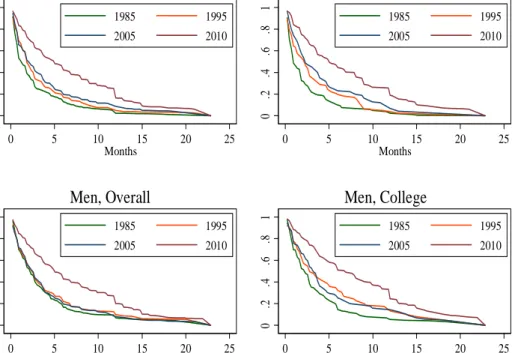
the unemployment state. Figure 8 reports Kaplan‐Meier estimates of the hazard rate out of
unemployment. A first striking result is how much more difficult it is to find a job during the
interesting result is that the impact of the recession is pretty homogenous on all four education/gender groups, in particular a college degree does not seem to cushion the severity of the crisis. Differences among the other years are smaller and the fact that college graduates
systematically take more time to find a job suggests that a lower hazard rates also reflect
"pickier" workers, i.e. workers waiting in unemployment for better job opportunities to come
along. Differences between men and women are larger on the college sample than on the
overall sample but they do not exhibit a strong trend over time.